Visura 9

Issue 9 of Visura magazine is, as its predecessors, full of delights, and doubtless you will find your own and different highlights from mine. Cheryl Karaliks‘s five deaf boys raising their hands in the air in Bobo Dioulasso, Burkina Faso in 1991 certainly lifted my heart and there are many other fine images in her ‘Notes from Africa.’ Alex and Rebecca Webb’s ‘Violet Isle‘ includes many amazing colour images by both, and it was a joy to view the work again.

The work in this issue is extremely varied, and living up to the magazine’s policy which is to feature “personal projects chosen by the contributing artists themselves” with “texts that accompany projects … edited through a collaborative process with the artists” with the goal “to be true to their voice“. Although it is an ‘invitation only’ publication, photographers are invited to include a link to a series of their personal work on the ‘Your View’ page.

I still have some problems with the web design – or perhaps with my connection to the site. I don’t know if I saw all the pictures in some of the essays, as on the final image I reached there was still a button for the next image – but clicking it failed to load more. The initial image for each feature also came equipped with a ‘previous’ button that did nothing on my browser. For some features – including my two favourites mentioned above – I could find no accompanying text other than the image captions, and where the text was on the other features there was a large area of empty space.  I was left wondering whether the photographers had wanted their images shown without text, or whether the text had for some reason failed to load.  It remains the kind of site where I sometimes am left wondering whether I’d using the right browser or have the right plugins loaded.

For some time I’ve been convinced that the future of photography magazines is on the web, and Visura I think is in most ways a good example of how that future will be. Visura has great content and it looks good on my screen (and after all photographers need to have good screens, accurately calibrated to process their own work – so what could be better to view the work of others?)

Previous issues are still available in the archive section of the site and there are many fine features there to discover if you haven’t been a regular reader.

Photojournalist Arrested At Protest

On dvaphoto you can read the full story of the arrest of photographer Ethan Welty in Colorado following his coverage of an environmental protest at the Valmont Power Plant near Boulder on Tuesday April 27th. He was photographing from outside the plant where 4 environmental activists were arrested for 2nd Degree Criminal trespass.

Police named him as one of the arrested activists, and the press, including AP ran the story without checking the facts, and much of the media are still ignoring Welty’s attempt to point out to them that he was acting as a journalist and did not take part in the protest, staying outside the plant.

You can see Welty’s pictures from the event on Photoshelter, and his web site is also worth a look for his other work.  As Matt Lutton says in his post, “This is an issue not just of press freedom for an independent photographer covering an event but of Ethan Welty’s ability to fight false accusations and bad reporting which have brought his name into media reports of the event.

And Who Are You Working For?

Sometimes when police or security people talk to you its just a matter of being friendly, but too often it isn’t. Sometimes it’s easy to think that they are fishing for information, and I’ve often been surprised by questions from police that reveal they know more about me than I might expect – and that some have been reading this blog or my web site or know about my movements.

Although I’ve never seen a police “spotter card” for journalists like the ones that have been found and published for demonstrators, I’m fairly sure that they exist somewhere, perhaps on police station walls and that at least at one time if not now I was featured.

I don’t believe in being rude or uncooperative, but I do think there are some questions we should not answer and some distinctions the police try to make that we should as a profession refuse to admit. So many statements I’ve heard have clearly been the police trying to distinguish between “good” and “bad” journalists – the good being those who work directly for the large circulation and mainly right wing press and the bad being those who contribute to the kind of ‘leftie rags’ in which my work has been known to surface.

So for some time, my response when the police ask “Who are you working for?” has simply been to say “These days we’re pretty well all freelances” even on those too rare occasions when I am actually on commission.  It’s slightly more polite than what I’m thinking, which is that it is none of your business and letting the police decide who is a ‘goodie’ or a ‘baddie’ is going far too far towards a police state. If we have the credentials to show we are a journalist – such as an NUJ card – we should be treated as such – end of story.

So I was interested to hear the story of a well-respected and widely published photojournalist where the police seem to have acted as they should when he was harassed by security while attempting to work:

About 9.30 earlier today (29.01.10), I passed through the police line, showing my NUJ press card, without hindrance. A few minutes later, in front of the main entrance to the Queen Elizabeth II Conference Centre, a man came over to me and asked who I was and who I worked for. He was wearing a plain white identity tag around his neck with ‘press officer’ printed on it. He aggressively and repeatably asked me who I worked for. I replied that I had identified myself as a working journalist to the police and I told him to stop harassing me and who was he ‘press officer’ for. I also asked for his name.He told me that I was on private property and that it was ok for me to be a freelance but that I had to be working for someone even as a freelance, and he demanded that I leave. He took me by the arm and I told him to let go or I would ask for his arrest for assault with intent. He let go of me and demanded again that I leave. I again asked him who he worked for and his name. He told me that he was the Conference Centre press officer and that his name was Bob Honey. He again told me to leave and I told him that I was working and to stop hindering me and that who I work for is my business.He then called over a private security guard who told me to follow him. I refused and replied that he, too, should leave me alone and stop harassing me and that I identified myself to the police. The security guard then walked away.

A couple of minutes later five uniformed police came over to me, one of them a high ranking officer with braid on his hat, asked me who I was and I identified myself again by showing my NUJ press card. The only question he asked me was to verify my name. I did and this satisfied him and I continued working.

It’s good to be able to report that the police behaved correctly both when allowing the photographer to access the press area and when brought in by security to deal with the incident.  If they had any doubts about the photographer they could have checked up on the security hot line, but the card does carry a photograph.

The letter, sent to the union, continues with a request that the NUJ  make a formal complaint to the management at the QEII centre pointing out that freelancers have equal rights as staff journalists and asking them to ensure that they are treated equally. I understand this is in hand.

This is perhaps another story which makes clear why photographers need to join the union. If you are a professional working in London, then the London Photographers Branch will welcome you.

We Stole Your Pics & We Are Suing You For It

When I saw this on PDN Pulse I just could not believe it.  You need to read the comments to get the full story and there is a rather better piece on it by Olivier Laurent on the BJP blog in which he makes clear just what a slap in the face this is to all photographers – as he writes “in my opinion, this case highlights one major problem affecting the journalism world in particular: a blatant lack of respect for a photographer’s work and copyright.”

Frankly it is unbelievable that what we thought was a respectable and trustworthy organisation should behave in this way. I hope it gets to court and AFP really get taken to the cleaners, since the legal issues appear to be clear cut. But I guess AFP will be paying lawyers huge sums to muddy the waters while apparently happily stealing work from photographers

But it isn’t the only current news about photographers getting a raw deal. Guardian News & Media wrote to freelance photographer contributors on Monday telling them it was reducing rates by 10%, unilaterally breaking a long-standing agreement with the NUJ.  You can read more about the cuts in the BJP. On Tuesday the NUJ London Photographers Branch unanimously passed a motion to adopt a model letter for photographers to send to GNM. More on the story on the Journalism web site.

So far the Guardian‘s response to this letter have been to say that they are sorry that the photographers concerned are unwilling to accept the new rates, and agreeing to delete any of their images that may be held in the paper’s archives.

I’ve never contributed work directly to GNM, although in the past I probably occasionally sent work there, I can’t remember it being used.  I very seldom send work to newspapers now, except by request. Most get thousands of unsolicited submissions every day. Most of these never even get glanced at, with most organisations using text search robots to try to identify images that might be of interest. Many stories in all our press now get illustrated with largely generic stock imagery supplied under bulk contracts from the large agencies. You can send a better picture but the chances of it getting seen by a human are very low and of being used almost zero.

Another current story is over Bauer Media, publishers of some of the leading musical magazines among a wide range of titles, which is trying to grab “all rights” from it’s freelance contributors for Kerrang!, Mojo and Q. Once they’ve paid to publish a picture or article in a single issue they want to be able to do anything they like with it for free, and those who have failed to sign up to this agreement have been told they will no longer be commissioned. If they succeed in imposing the agreement on these publications, Bauer plan to extend it to their other titles.

What can photographers do? Join the union and try to fight the cuts – and stand up generally for the rights of photographers and other journalists. Certainly refuse to supply work to GNM at their new rates. But also to try and support new media and alternative media, even if at the moment they don’t generate income directly. As well as trying to sell images as stock through libraries and occasionally to papers and magazines I also publish regularly on Demotix, and Indymedia as well as here and on my own web sites such as My London Diary. There I can tell the stories the way I want to and get work to an audience and just occasionally it does pay off with work.

Digital Myths?

I’m not quite sure why the panel discussion at last Saturday’s ‘The Invisible City‘ got on to a discussion about the relative merits of digital and film. But for whatever reason, it did seem to me that various people were talking nonsense about the subject, and it would appear that rather a lot of students are being indoctrinated with it on their courses.

I think there are still quite a few photographers – particularly in academic circles – who have failed to come to terms with digital as a part of a more general antagonism and lack of knowledge about computing. I worked for some years as an IT co-ordinator and network manager in a college and learnt a great deal about the kind of resistance some have to computers and IT in general.

There are still some particular niches of photography where I would prefer to use film, although it often isn’t practicable to do so.  These are mainly areas which require the use of specialist equipment which simply isn’t available – or not at any reasonable cost – as digital.  Quite where that cost barrier lies will depend on how wealthy you are, and some may consider the Leica M9 a viable alternative to a M-series film camera, while I can’t bring myself to spend the cash.

However it is very hard to find a good reason to use a film SLR in preference to a digital version – with excellent cameras available for relatively small sums – the cost of a few months film for a serious student.

Though I’m not sure how many are serious students – in the old days  to be serious you shot a 100 foot can of bulk Tri-X a month, which I think worked out at 19 x 36 exposure films (and if you were really keen you learnt to load them from a daylight bulk loader but in the dark so as to avoid any fogging on the end of the film. A little under 700 exposures – less than I  now take on digital on a busy day.

Which perhaps leads us to

Myth No 1:

Digital makes you work in a different way, being less critical when you are working because  you are limited in how many exposures you can make.

It isn’t true, and I know photographers who shoot just they way they used to on film. I think they are missing out on things, because digital does open up new possibilities. It gives you the choice of working in a different way, but you don’t have to if you really don’t want to.

Looking through my contact sheets and comparing them with my digital exposures, I don’t think I’m less critical. I am rather more prepared to take risks, but overall I think digital has rather improved the quality of my work, both technically and in terms of being able to achieve various things that just were not possible on film. It provides a much more reliable system than film ever did, in almost every respect.

Digital actually provides a much greater opportunity to be critical while you are actually working, although I’m not a great “chimper“, as I find it disrupts my attention to the subject.  But being able to review your work immediately afterwards is a great advance, and with some kinds of subject it is possible to evaluate and retake pictures on the spot.

There are even some particular subjects where I take less images using digital, especially portraits. On film you could never be sure whether you had actually captured that fleeting gesture or if your subject had managed to blink in the critical fraction of a second. If I could, I kept shooting until I was fairly sure I had got the picture; with digital you can check and stop shooting when you know you have what you want.

Working with digital I simply end up with more good pictures. For a typical event where film might have given me half a dozen decent frames from which to select, with digital I may end up with 50 from which to choose.   Probably these would include the pictures I would have got on film, but they no longer stand out in quite the same way as the dross gets deleted.

Myth No 2:

Film gives you better quality than digital

I almost choked when I heard this. I often need to scan older work and have one of the best systems available for scanning 35mm film to give 80Mb scans, which  can really squeeze the last ounce out of film.  Quality is a rather subjective concept, but given an image from the D700 taken at a similar ISO, I would expect greater resolution, greater sharpness and less noise from the digital image.

So far as colour quality goes, there is just no comparison – digital colour is so much cleaner and more accurate than film ever managed (so long as you don’t allow camera or computer to mess it up.)  You may of course prefer the rather more limited and less real palette of film – and can if you wish use software to emulate it on your digital images. If your idea of quality is a retro look, then you might prefer film.

Black and white film normally does have a greater dynamic range than current digital sensors, although the difference is less pronounced once you have learnt to make use of raw images. And since digital is then able to cope with most subjects (and makes the use of fill flash even easier than on film with modern cameras) this is seldom a vital matter.

The only films that approach the quality of digital sensors of the same format are those extremely slow black and white films that were largely not designed for pictorial use – such as the no longer available Kodak Technical Pan, which I did use quite extensively. It wasn’t an easy film to use and required exposure at rather silly ISOs – from ISO8 to ISO64 depending on developer for pictorial negatives.

Kodachrome with its own peculiar colours was also available as an ISO 25 film, and could possibly compete with results from digital at 3 or 4 stops faster speeds were it still available, although – like Technical Pan – it could not match their dynamic range.

Of course film is available in different formats, and the kind of quality that I currently get at moderate ISOs from the D700 certainly seems to me to compare well with that I got from the Mamiya 6×7 I used to use.  With the great advantage that I can continue to get similar quality at much higher ISOs than with film.

Myth No 3

Film is better for storage than digital

Both film and digital present some problems for storage. But unless you happen to own a deep mine digital is probably the better bet. Digital storage can theoretically keep your images perfect forever – but only if you set up systems with suitable redundancy and regeneration of files. Film storage is more clearly time-limited, but low-tech to give decent short and medium term safety.

My perspective on this problem is perhaps slightly coloured by the rows of slowly deteriorating negative files behind me as I type.  But perhaps the most interesting and authoritative comment on this was made by Mike Seaborne from his position as a museum curator who obviously surprised some of the audience when he said that the best long-term storage is as pigment inkjet prints on well-made paper, fortunately something we can do for both film and digital images.

Myth No 4:

You need to shoot film if you want to work in black and white

Much of the best black and white work I’ve seen published in recent years has been shot on digital.  Although personally I decided to shoot entirely in colour with digital in 2002 when I bought my first DSLR, I know plenty of other photographers who have gone digital with the intention of shooting black and white.

Apart from all the usual advantages of digital, one important one for working in black and white is the ability to actually see your images on the back of the camera in black and white, although the conversion in camera is relatively crude.

Over the years I used quite a few different black and white films, including of course FP4 and Tri-X, but also many less popular films, most no longer available. In later years I worked mainly with chromogenic films – XP1 and 2 and TCN400 largely because it was easier to process them with my colour film. Each of these films had its own particular ‘look’, largely a matter of different sensitivity to different light wavelengths.  But with software such as Lightroom, not only do you have the possibility of emulating these different responses, but also you can vary the sensitivity in a much wider and complex way should you wish.  As in most respects, digital offers greater flexibility.

What might at some point attract me is however the ability to get decent quality results in light levels where film would have needed excessive “pushing” with the accompanying grain and loss of subtlety.  Even a relatively crude digital camera like the Leica M8  can produce pretty good black and white at ISO 1250, while the D700 is rather better at ISO6400.

Myth No 5

Inkjet prints can’t match the quality of darkroom prints

I haven’t made a print in my darkroom for several years.  But there is a certain undercurrent of truth in ‘Myth No 5’, and there are many bad inkjet prints made. But there are also many bad darkroom prints.

But you cannot buy a darkroom paper that is not capable of producing a halfway decent print, when only too many people are happy to print pictures on inkjet with materials that were not produced and are certainly not fit for that purpose.

Good inkjet prints need good paper and good inks. I first started making them using Cone Piezography black and white inks on Hahnemühle papers ten years ago – and the latest Piezography K7 inks (which I haven’t used)  are the best available solution for matte prints.  The prints I made were so good I abandoned for good any ideas of going back to make platinum prints.

Replacing ‘glossy’ prints took longer, but the Epson ABW system using Epson Ultrachrome K3 pigment inks on papers such as Ilford Gold Fibre Silk or PermaJet Classic Fine Art gives results that for 9 prints out of 10 are better than my old darkroom prints.  The only ones that are really hard to beat were made on a paper that is no longer available, the old cadmium-rich Record Rapid, which had a greater depth than modern papers. Some of these new fibre base glossy papers have a very similar ‘baryta’ coating to silver halide papers. 

Printing digitally actually needs the same basic skill as darkroom printing – deciding how a picture should look. But on the computer it is rather easier to achieve, and ‘dodging’ and ‘burning’ can be carried out with more control and precision.  Most images too need a certain amount of corrective retouching to correct defects such as dust and scratches on negatives or dust on the sensor. Increasingly my film images also need retouching to repair the ravages of time, and digital printing becomes the only option.

Of course inkjet printers and materials will be improved, but already they can hold their own against the darkroom, both for colour (which is where most of the printer manufacturers’ efforts are directed) and also – especially with the aid of third-party inks and papers – for black and white.

Further Thoughts

Were I still teaching photography, I would be concentrating on the use of digital photography. Not only because I think it in almost every respect improves on film and is the future of our medium, but because I think it is a very much better teaching tool, because of the more or less immediate feedback it can give.

Years ago, when still teaching darkroom printing, I found it worth teaching students the basics of working with digital images with Photoshop before getting them to make prints in the darkroom.  Before you can print well, you have to learn what good prints look like, and get some idea of what can be done with the various controls that we have – exposure, contrast, burning, dodging – and it is easier, faster and considerably cheaper to get learners to appreciate these in the darkroom once they have experienced them on a computer.  Now of course there is no need for the darkroom, although they can still learn on screen before wasting ink and paper on the print.

Alternative Processes

Silver based photography is fast becoming another alternative process – like making collodion negatives (in some ways the apex of photography) and cyanotypes or gum bichromate prints. Of course there will be students who want to learn and practice these things (and I’ve tried most of them), but they are neither necessary or generally useful for photographers, although they do help in the appreciation of the history and traditions of photography.
Shoot 36

For those of us who want to remember the old times, or for those who never experienced them, professional photographers are invited to take part in Shoot 36, which invites them to shoot a 36 exposure film using a single body and one fixed focal length lens, pick the best 6 images, scan them full frame and upload them to the site.

You can see the full rules on the site if you want to take part in what I think is an interesting bit of fun. So far the one set of six images that stands out for me is from Sang Tan – some nice pictures even if not entirely sticking to the rules!

As it says on the site:

  • It’s a challenge.
  • It’s a bit of fun for the professional photographer.
  • It’s about enjoying past techniques.
  • It’s about hand processing film.
  • It’s about the anticipation of discovery.
  • It’s a test of our skills as photographers.
  • It’s about the smell of the chemicals.
  • It’s about loading a spool.
  • It’s about a fridge full of film!.
  • It’s about taking pictures not because we are paid to but because we want to.

One day I might even try it myself – I’ve got plenty of outdated film to use!

Met Reissues Advice To Police

Amatuer Photographer points out that the Met has recently revised its advice to police officers on photography in public places. The new document is rather more positive, starting from the position:

We encourage officers and the public to be vigilant against terrorism but recognise the importance not only of protecting the public from terrorism but also promoting the freedom of the public and the media to take and publish photographs.

and under that the first section is:

Freedom to photograph/film

Members of the public and the media do not need a permit to film or photograph in public places and police have no power to stop them filming or photographing incidents or police personnel.

The advice, which supposedly has “been made clear to officers and PCSOs through briefings and internal communications” generally clarifies the law – Section 43, 44 and 58A of the Terrorism Act 2000 and makes it clear that officers do not have the power to delete digital images or destroy film. In particular, “where it is clear that the person being searched is a journalist, officers should exercise caution before viewing images as images acquired or created for the purposes of journalism may constitute journalistic material and should not be viewed without a Court Order.”

The guidance also gives clear advice on who is a “genuine journalist” in the statement:

“Genuine members of the media carry identification, for instance the UK Press Card, which they will present on request.”

This seems a considerable advance from last May, when at the NUJ photographers conference Commander Broadhurst apparently seriously asked the question “can anybody apply for an NUJ card who has a camera?”

I hope that this advice to officers will help to reduce the friction there has certainly been between police and the press (and public) over photography. It might not be a bad idea to print off a few copies to hand out to police that we meet!

May Day may well prove a good test of whether good intentions (and perhaps a desire to avoid the prosecution of police for unlawful actions) at the higher levels of the force have permeated down into good sense on the ground.

There has been some attempt again this year in the Tory press to spread rumours of insurrection and mayhem about the street theatre planned for next Saturday – a May Day Carnival, again with the ‘Four Horses of the Apocalypse‘ , but this time their four marches converging on Parliament Square dragging the corpses of Gordon Brown, David Cameron, Nick Clegg and Nick Griffin to a People’s Assembly.

Last April 1 at Bank we saw what happened when the officer in charge inspired a spirit of panic through radio and TV appearances (and doubtless in police briefings)  and encouraged psyched up police hooligans to attack both press and demonstrators, using their agent provocateurs in plain clothes to incite riot.  It isn’t clear what the police hoped to gain from these tactics, clearly exposed in the press and public’s photographs and videos, but it is fairly obvious that they backfired in this instance. Perhaps it was the death of Ian Tomlinson – so clearly an innocent bystander – that really turned the tide against them.

I hope the police have learnt the lesson from April 1st, and that on May Day their response will be proportionate and calm. Let the protesters protest and the press report on that and not on another day of police atrocities.  I hope.

VII – The Magazine

If you’ve not yet seen VII – The Magazine, launched a couple of weeks ago, it’s well worth a look. As you might expect from one of the world’s leading photo agencies, there are some fine photo stories from some of its 29 photographers posted already, and obviously many more to follow.

But perhaps the most interesting piece so far is an interview with Ashley Gilbertson who worked largely on assignment for The New York Times in Iraq from 2002 until 2008 and was in 2004 awarded the  Robert Capa Gold Medal for his work in Falluja by  the Overseas Press Club.

If you click on the image of his mobile, a popup window will open  with a warning that the story contains graphic imagery and language. It does. He talks candidly about the death of Billy Miller, the marine assigned to protect him was killed while he was photographing in Falluja and the affect it had on him. Since then he has looked at the emotional impact war has on the soldiers and their families and the problems faced by those who do come back.

I had some problems with the player software on my system using Firefox but it worked fine when I made the player full-screen. I found the series of black and white panoramic images of the rooms at home of soldiers who had been killed particularly moving, along with a couple of the portraits of those who had returned and were obviously very much affected by what they had seen and done.

RED Chalk

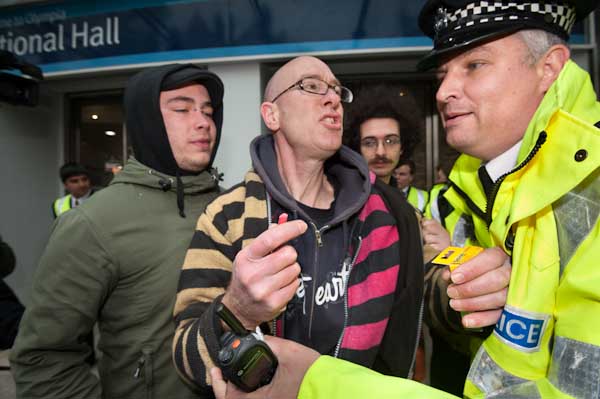
On Wednesday I saw a man arrested by police for chalking on a pavement – the charge was ‘criminal damage.’  I spent years chalking on blackboards in a teaching career without ever being charged with anything more than terminal boredom. Chalk doesn’t damage boards or stone and wipes away without trace.

© 2010, Peter Marshall

I have a small confession to make that might get me banned from some competitions. That stick of chalk he is holding didn’t actually look very red in my photograph. The way that my flash caught it made it a very pale pink, and it took a little bit of Lightroom magic to get it looking red in the picture.

The flash too was a little too bright on the officer’s jacket and especially its reflective strips, and that too took a little taming.

Almost all of my photographs get a certain amount of corrective work, but its aim is always to make the picture seem natural and to reflect how I saw the scene when I took the picture.  I don’t want people to look at one of my pictures and think that I’ve vignetted it or altered it in some way, really I don’t want them to think at all about the techniques, just to see and respond to the image.

Of course with digital images there is a certain amount of technical information embedded in them (unless you deliberately remove it.) So the EXIF data on this frame tells me I was working at ISO 640 (it was quite a dull day) that the exposure was  1/320 f6.3, the focal length 16mm and the subject distance 400mm – about 16 inches if like me you grew up in pre-decimal days. It also tells me that the flash did fire, that I was using an exposure bias of 1/3 stop and a few other things like the exact time according to my camera.

It doesn’t – so far as I can see – tell me I was shooting with the flash set at -1 stop and was probably using it in through the lens balanced flash mode. I think the camera ignores the flash exposure and sets the aperture and shutter speed on the ambient light only, but I don’t think the manual makes this clear.

Several things strike me about this, other than the evident absurdity of the alleged offence. First is that until fairly recently the fastest synchronisation speed on any of the cameras I worked with was around 1/100th second and that using fill-flash would have involved some tricky calculations that would have made it virtually impossible for pictures like this.

The second thing is that distance of 16 inches, I think from me to the hand holding the chalk. I was certainly working fairly close, but still making sure I wasn’t impeding the officer in his duty. I’m surprised it was quite that close, but things do look a little different when you are viewing the world through a 16mm lens. But had I moved back at that point, I would soon have been trying to photograph through the back of another photographer. A few seconds later, there was a ring of police and PCSO’s surrounding the man and I had to work from further back.

You can read more about the event and see the pictures in Olympia Counter Terror Expo Exposed on My London Diary.

Big Gay Flashmob

Last Sunday I was outside the Tory Election HQ on Millbank with a rather large group of people who had a bone to pick with Mr Cameron over the lack of gay-friendly policies in his election manifesto. As was pointed out, it was the Conservative party that put ‘Section 28’ into law, making teachers and others very uncertain about what they could legally say about homosexuality without being accused of “promoting” it.

Proposed by my local MP, it was a peculiarly ineffectual piece of law, working more by creating confusion than in any other way.  And I was rather pleased to see that Mr Wilshire, having been caught out in the expenses scandal, had to give up the seat, although it remains to be seen whether his successor will be any better. Unless we get a pretty large swing to the Liberal Democrats, he will be some kind of banker (at least I think that’s what a ‘financial analyst’ in the City is) with an Eton education, so I have no great hopes.

© 2010, Peter Marshall

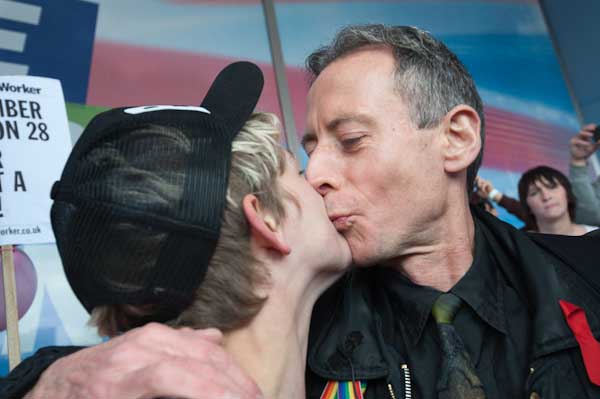
I’ve photographed both Tamsin Omond and Peter Tatchell many times before, but not kissing so in that respect it was a first.

Everybody seemed to be enjoying themselves and it was fun to photograph, although obviously rather a scrum so far as the media were concerned. Several times when I thought I had found a new angle on things I started taking pictures to find photographers to the left, right, above and below me –  and just occasionally in front of me.

At these things there are always a few photographers who spend some time moaning at the others to “go longer” so everyone can get their pictures, but usually it just doesn’t work – and if people are persuaded to go back then nobody gets a decent picture.  At least if everyone just piles in some of us will, and at this event there were plenty of opportunities.

Of course sometimes you want to move back to get a picture, but I think every time I did at this event, someone walked into the gap I’d made.  So the answer is usually to work wide. Most of the time the 16-35mm was very useful, though it was good to have a longer zoom on the D300  – where the 18-200 is equivalent to a 27-300mm.

© 2010, Peter Marshall

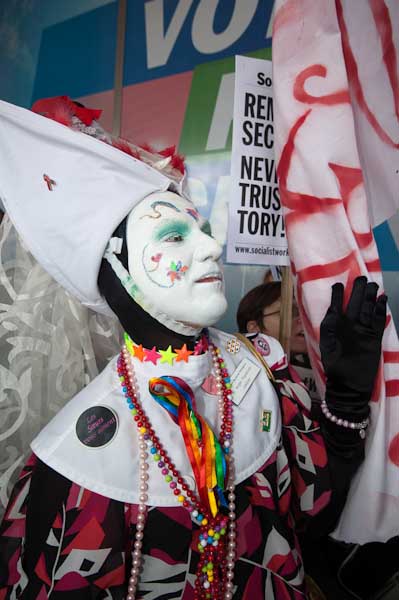
Some people have complained that it was an event that pandered to the stereotypes about LGBT issues, and that the media and photographers in particular choose to photograph people who reinforce these stereotypes.

© 2010, Peter Marshall

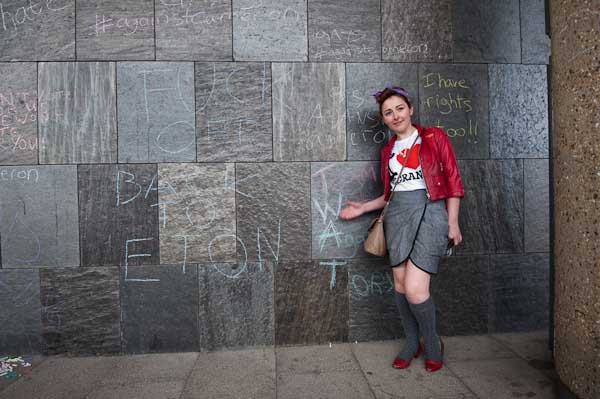
I suppose that in general at demonstrations I am likely to photograph people who stand out in some way, perhaps by holding a banner or placard or wearing a mask or costume or by some behaviour – there has to be something to work with to make a picture. Taking ordinary or boring pictures is seldom of much use to anyone (although rather too many of them get published.)

More about the flashmob and many more pictures on My London Diary.