Dhaka’s Chobi Mela Festival

Shahidul Alam talks with Daniel Boetker-Smith about how his 107 days in prison has impacted the tenth Chobi Mela photography festival which opens on February 28th 2019. Because many of the partner companies in Dhaka now see it as a dangerous organisation to work with and many public spaces and government buildings are no longer available for the festival, it has been forced to return to its roots and “become much more raw and community-oriented festival” and organised more tightly around the new premises for Drik Picture Library Ltd and the Pathshala South Asian Media Institute and a few other centres.

You can read more about what is happening in There’s Power in Photography: The Undying Resilience of Dhaka’s Chobi Mela Festival, and it does sound rather exciting, and indeed encouraging to those of us who live in rather more blasé societies where cultural manipulation is very much more nuanced.

Shahidul states “We see this year’s Chobi Mela as an act of defiance. We are still working out what we are allowed and not allowed to do, and this extends to obtaining visas for our visitors and guests” and it remains to see if some of those invited to take part, including Indian writer and political activist Arundhati Roy will be allowed into the country.

One of the more interesting exhibitions will be of the work of the great Bangladeshi photojournalist Rashid Talukder, born in 1939, who gave all his work to Drik before his death in 2011.   But there are over 27 exhibitions with works from 35 artists spanning 20 countries , as well as site-specific artwork by a group of young Bangladeshi artists around the festival theme of ‘Place’.

You can find more information about the festival on the Chobi Mela web site, Facebook, Instagram and Twitter.

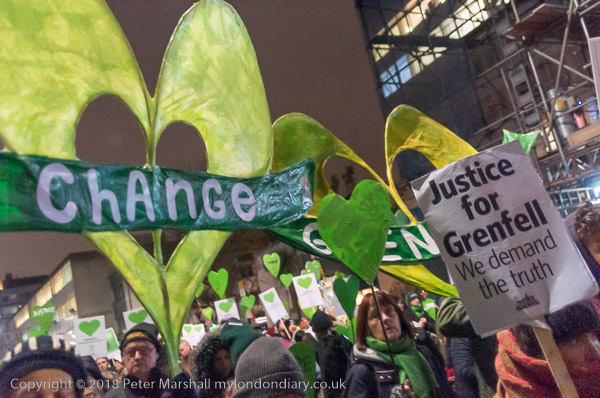
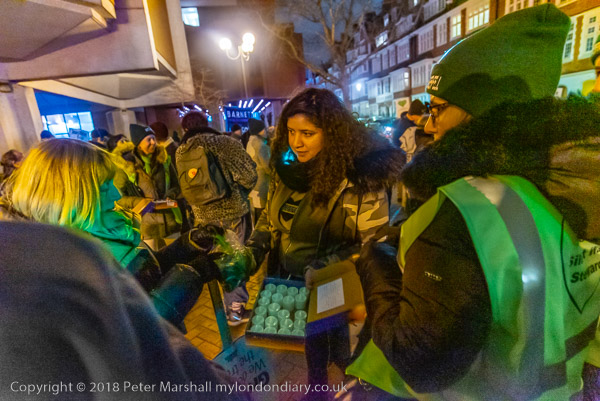
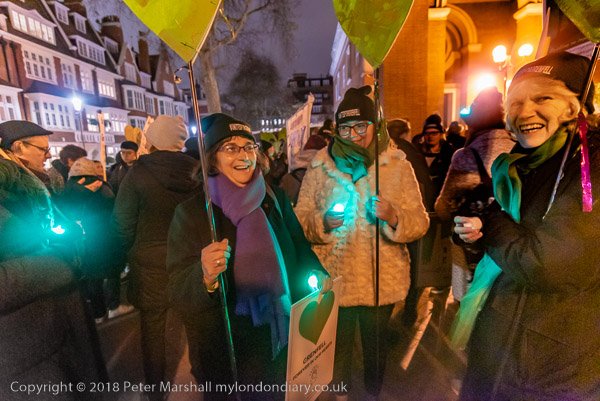
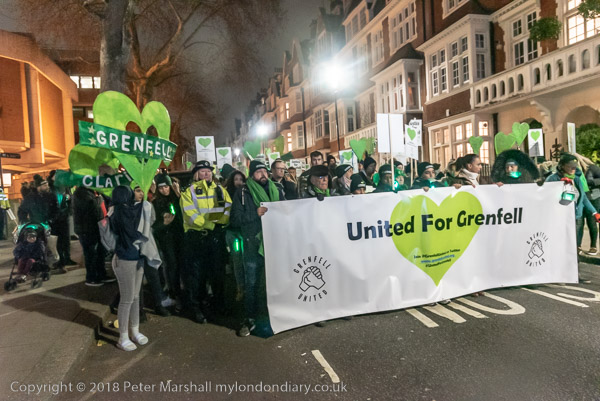
Grenfell – 18 months

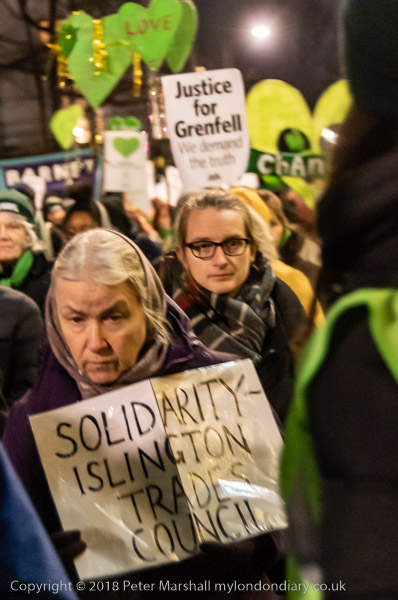
Eighteen months after the terrible fire so little seems to have been done. No real changes to the systems that made it possible. No prosecutions of those responsible for making the tower into a fire-trap and for ignoring or taking steps to silence residents who pointed out the problems. A council that still seems to be failing its duty of care towards the local community, particularly those still in temporary accomodation. None of the government promises kept. No one held to account.

The inquiry has revealed some horrific details, but also seems to have been used to try to push blame onto the firefighters, who made heroic efforts at the scene of the crime, and is widely seen as trying to push any real action longer and longer into the future, hoping that people will forget. Which is why these monthly marches really matter, with thousands marching through the streets carrying green candles, green Grenfell hearts and wearing green scarves to keep the memory alight

But while of course many still suffer the trauma and will continue to do so for the rest of their lives, perhaps the response is now too passive and it’s time to make a lot more noise than this monthly silent walk.  Some feel their real purpose is to divert people from more active resistance.

It isn’t an easy event to photograph. This walk started at Kensington Town Hall, where the yard is at best gloomy. A few people have a very negative attitude to the media and one man followed me for some time telling me I shouldn’t be taking pictures. It remains a rather emotional event, and I try hard not to aggravate anyone’s distress, but it’s hard not to be affected. None of my friends died in Grenfell, but I meet a number of people I know who were friends of some of the victims, and sometimes find my eyes full of tears as I try to frame an image.

It gets a little easier once the walk starts, not least because there is more light on the streets. Most of these pictures were taken with the lenses wide open at around f4, with shutter speeds varying from around 1/8 to 1/50th at ISO 6400. Some in the council yard are still several stops underexposed and require considerable help from Lightroom.

On the walk I still try to be as unobtrusive as possible. There is the added complication of movement, but progess is deliberately slow with many halts. The lighting changes as people go along the street, from lamp post to lamp post, coming into the light then moving back into shadow. The major routes are of course considerably brighter than the side streets, and I made more pictures on them, particularly at Notting Hill Gate, where the walk took a long rest and more walkers joined. In places there was enough light to make using longer focal lengths possible, with shutter speeds up to around 1/100th.

As the march turned off to go towards Grenfell, I made my way to the Underground for the journey home. I’d been on my feet long enough and was cold – and the streets get darker as you go north.

Grenfell silent walk – 18 months on

There are no adverts on this site and it receives no sponsorship, and I like to keep it that way. But it does take a considerable amount of my time and thought, and if you enjoy reading it, a small donation – perhaps the cost of a beer – would be appreciated.

My London Diary : London Photos : Hull : River Lea/Lee Valley : London’s Industrial Heritage

All photographs on this and my other sites, unless otherwise stated, are taken by and copyright of Peter Marshall, and are available for reproduction or can be bought as prints.

To order prints or reproduce images

________________________________________________________

SODEM Night

December 12th wasn’t really a day for taking photograph for me, more a day off to go out for a few drinks and a meal with some photographer friends. But as I sually do on such occasions I took a camera with me, just in case I wanted to take some pictures. Not one of the Nikons I usually use for work, but a Fuji X-E3, with the 18-135 lens fitted, and as something of an afterthought I also put the smallish 18mm f2 in my bag too.

The day out started a little late, as when we agreed to meet at the Tate. For some unknown reason (senility?) I had in mind Tate Modern but everyone else got it right and went to Tate Britain, where at my request we were aiming to start at a show by photographer Markéta Luskačová of her Spitalfields pictures. A couple of phone calls later I was on the Jubilee line to Westminster and then hurrying down past the Houses of Parliament, where I saw a bus coming and rushed to just miss it.

Finally arriving at Tate Britain I had to find the show, which wasn’t easy – the gallery does really need to look at its signage. Finally I asked one of the gallery staff who didn’t really know but gave me a map and pointed in roughly the right direction. The show does continue until May 12th 2019, so if you start now there is some chance of finding it by then.

Finally we were all met, and after I’d run around the show (worth seeing though I was familiar with all the work already) we left for the pub, a journey where I at least part redeemed myself by actually knowint the way as it was the same one I’d gone to meet Class War before their visit to the Rees-Moggs a few months earlier. We’d hoped by around 2pm it would be getting a little less busy, but approaching Christmas it was rather full, with several parties about to take place, and after a drink or two we left for the next venue, a theatre bar I’d often walked past but never visited,  which was quieter and cosier.

An hour or so later we’d had enough of expensive beer and got on a bus towards a Wetherspoons where we were also to eat. Not a gourmet location, but almost always edible and good value, with fast service. Spoons do differ despite all being a part of the same empire, and this was the preferred choice of our late colleague-in-arms Townly Cooke, who at one time was a part of their quality control, being paid to eat and drink unannouced at their pubs across London.

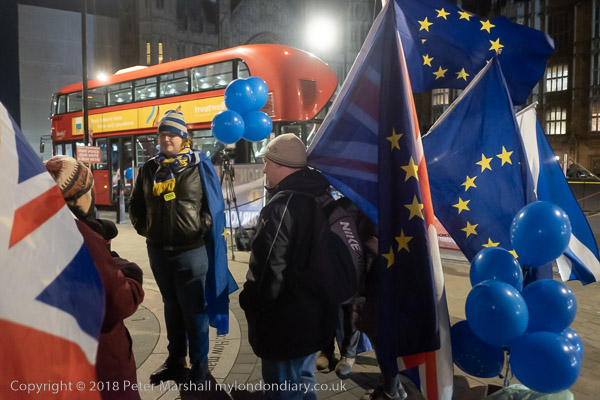
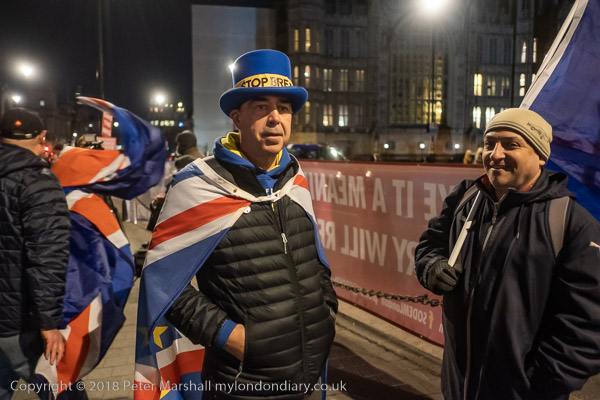
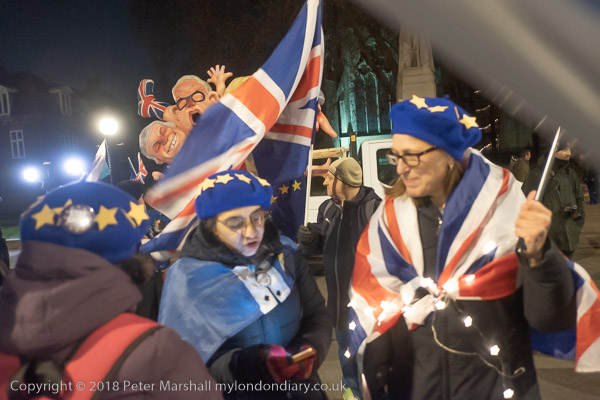
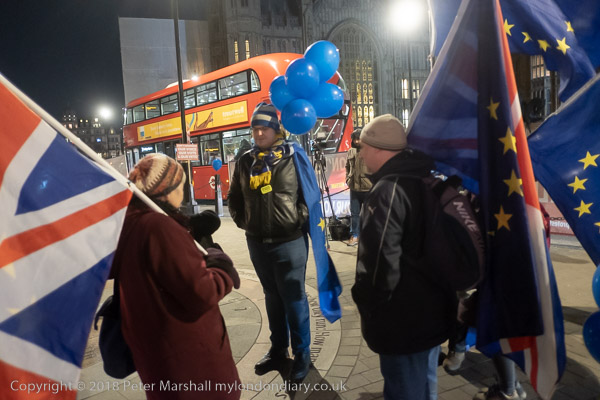
We finished early as one of our number had to get back to Oxfordshire for an early start to work the following day and I found myself going across Waterloo Bridge at around 6.30pm and realising I couldn’t use my Super Off-Peak rail ticket until half an hour later.  I remembered there had been quite a lot of Brexit-related activity outside Parliament when I’d run past earlier in the day and decided to return to see if anything was still happening.

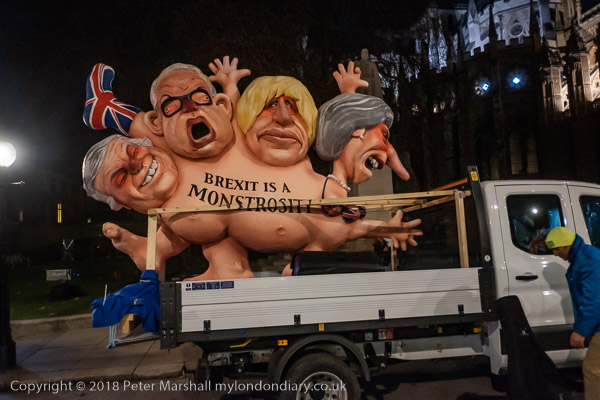
I changed the f3.5 maximum aperture zoom for the 18mm f2 fixed lens and set to work photograph SODEM who were still keeping up their vigil, along with a rather impressive Brexit monstrosity on the back of a lorry. The extreme-right who had been noisy and disruptive were long gone, and things were pretty quiet.

I was interested to see how the Fuji would cope under the failry dim conditions, working at f2 and ISO 3200.  Shutter speeds varied, but were generally usable, around 1/50s and the camera usually focussed fairly easily on something, though not always exactly where I had intended, though I suspect this was my fault. As always under such conditions, depth of filed is always a problem, but the smaller sensor compared to full frame does improve this. Working in low light like this not everything works, and I always have to overshoot, but there weren’t that many absoluted failures. I’ve put most of the frames that didn’t have obvious problems on the web site rather than edit more tightly to perhaps half a dozen frames as I might usually have done.

Although I’ve decided the Fuji cameras I’ve tried can’t really replace the Nikons for my work, I’ve been wondering for some time about trying a micro four thirds system. I think my first step will be to evaluated using one with a telephoto zoom alongside the Fuji X-E3  with the wide-angle zoom.

As I walked back into Parliament Square I saw a bus to Waterloo just entering the square and ran towards to stop to catch it. This time I got there in time.

You can see the pictures I took at SODEM vigil against Brexit

There are no adverts on this site and it receives no sponsorship, and I like to keep it that way. But it does take a considerable amount of my time and thought, and if you enjoy reading it, a small donation – perhaps the cost of a beer – would be appreciated.

My London Diary : London Photos : Hull : River Lea/Lee Valley : London’s Industrial Heritage

All photographs on this and my other sites, unless otherwise stated, are taken by and copyright of Peter Marshall, and are available for reproduction or can be bought as prints.

To order prints or reproduce images

________________________________________________________

A Divided Countryside

I don’t get out into the country much. Most of the posts I make on My London Diary are, not surprisingly about London and things happening in London, but there are parts of my life that don’t feature in that on-line diary, or for that matter on Facebook. Things that I want to keep private don’t feature on either, where I assume, whatever the privacy settings, anything may become public.

Although my first web site back in 1995 was called ‘Family Pictures‘ (and is still on-line with minor code updates and on a different host) I’ve put very few family pictures onto the web, instead sharing some with named individuals via Dropbox or e-mail. That first site too was written with help from two of the main people featured. And although I have published elsewhere a few pictures of my family, particularly when young, I never got them to pose for the kind of stock photos that many photographers produce. Not that there is anything wrong in that, but I’ve always used my photography to follow my own ideas and projects and only worked for others where this overlapped with these interests.

Even photographing protests. Though I’ve occasionally accepted commissions and almost always made some attempt to sell my work, that has never been the reason for me taking pictures. When I began it was because so many went either unrecorded or were poorly recorded and I felt that like other events I was busy recording they were an important part of our society and I wanted to say something about them and provide some historical record.

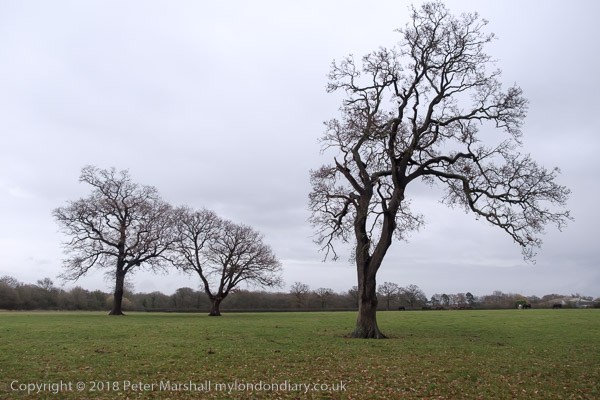
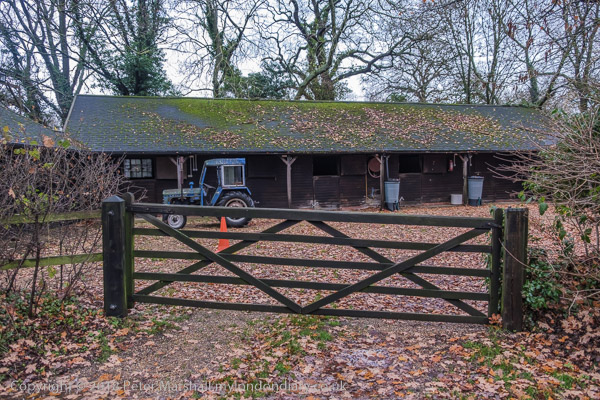
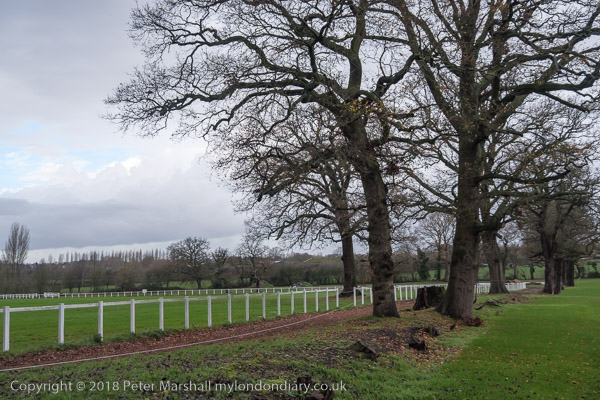
I don’t always post pictures of my family walks, and when I do so you seldom see pictures of those members of the family I’m walking with. Most of these walks are around the western edge of London, as was this one, not far from where I once worked in Bracknell.

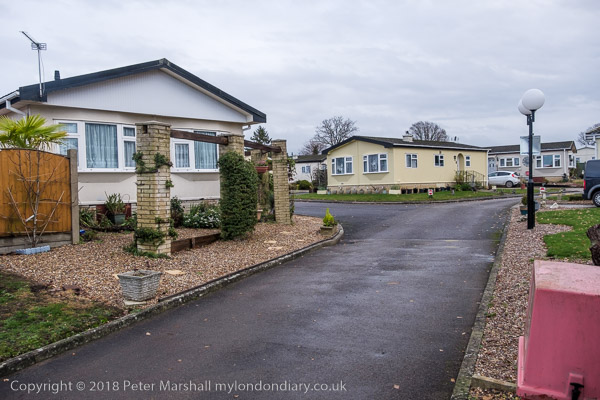
Again and again on this walk I was reminded of the differences between rich and poor and between town and country. Of course there is plenty of rural poverty, even in the Home Counties, but it is largely well hidden.

This region was not long ago important farming land, but much of it now produces little we can eat, though some hugely expensive livestock that occasionally races around nearby Ascot. For around five years I drove past the racecourse in a Ford Cortina driven by a colleague and we would share our plan, come the revolution, to turn it into allotments. Occasionally we’d take a longer route home, along roads including those on the walk route.

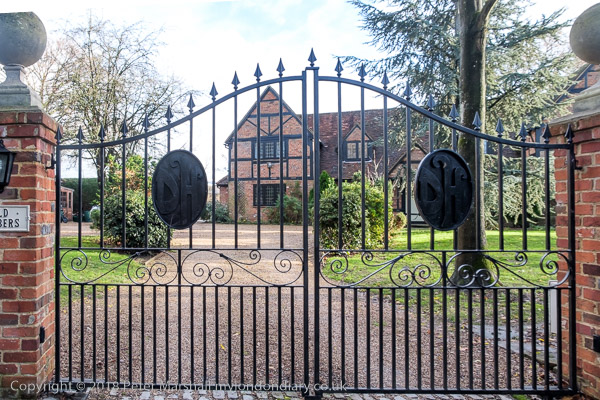
This is now prime commuting counry, not just for the wealthy from the CIty, but internationally, just a short drive from Heathrow. Large estates owned by millionaires and billionaires, often foreign and largely resident abroad. I stepped onto the verge for Rolls-Rooyces and Range Rovers as well as more humble vehicles.

Of course it’s not all like this, and the pictures show it. Unusually we went into two pubs, both nice places with decent beer, but in the first the fish and chips we finally ate had a much fancier description on the menu (‘Punter battered haddock with hand cut chips, tartare sauce and peas’) and cost about twice as much, though I doubt they would have tasted better.

More pictures: Winkfield Walk

______________________________________________________

There are no adverts on this site and it receives no sponsorship, and I like to keep it that way. But it does take a considerable amount of my time and thought, and if you enjoy reading it, a small donation – perhaps the cost of a beer – would be appreciated.

My London Diary : London Photos : Hull : River Lea/Lee Valley : London’s Industrial Heritage

All photographs on this and my other sites, unless otherwise stated, are taken by and copyright of Peter Marshall, and are available for reproduction or can be bought as prints.

To order prints or reproduce images

________________________________________________________

Alternative Housing Awards

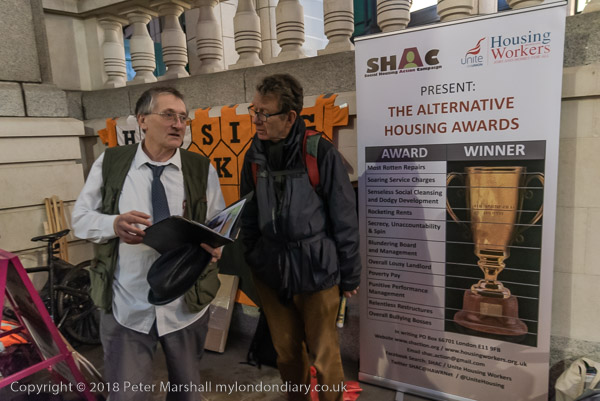
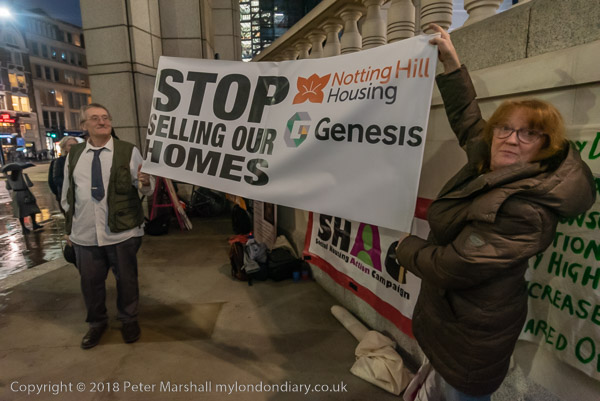
I wasn’t sure, as I made my way to SHAC’s Alternative Housing Awards 2018, due to take place outside the annual National Housing Awards on the edge of the Broadgate development whether it would be possible for the Social Housing Action Campaign to stage the protest there, or if I would be able to photograph it.

Broadgate is one of the increasing number of areas in London which, although open to the public, are privately owned, and where photography and many other activities are strictly controlled. Over the years I’ve been stopped from photographing a number of times, sometimes politely, other times less so. It’s often affected me less than many other photographers, partly because I almost never use a tripod and partly because I generally work fairly rapidly – and have often made the picture I want before security notice.

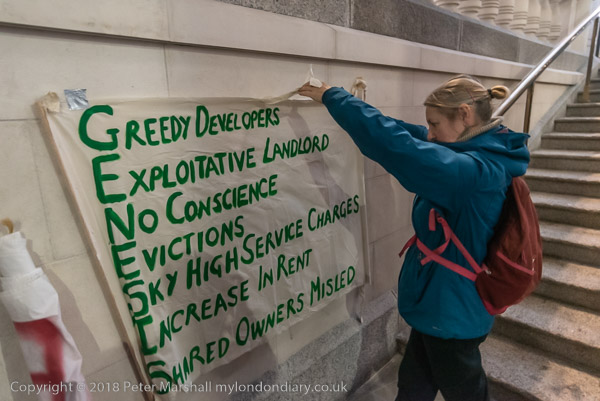
But although the security had insisted the protesters move down a little away from where they had wanted to stage their protest, they did allow it to happen, only insisting that the protesters remove banners they had taped to the walls, fearing they might cause damage. There was considerable argument over this, but eventually as security told them they would call the police unless they took the banners down, they were removed and held instead.

I’m pleased to say security completely ignored me, though the head of security did request a videographer not to film him talking with the protesters, and I was able to cover the event unhindered. I was very pleased the protest had not been forced onto the pavement outside, both because it was considerably darker, but also because it was raining rather steadily and we would have got very cold and wet.

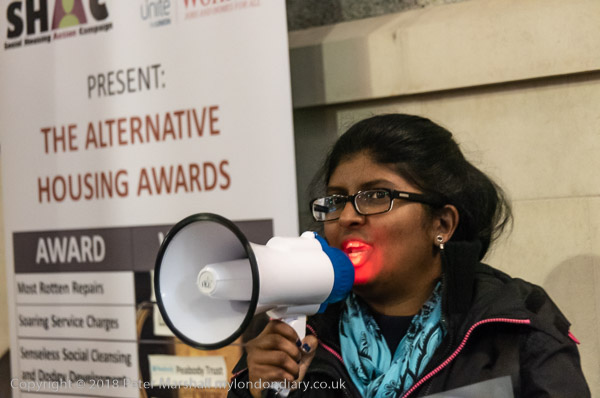
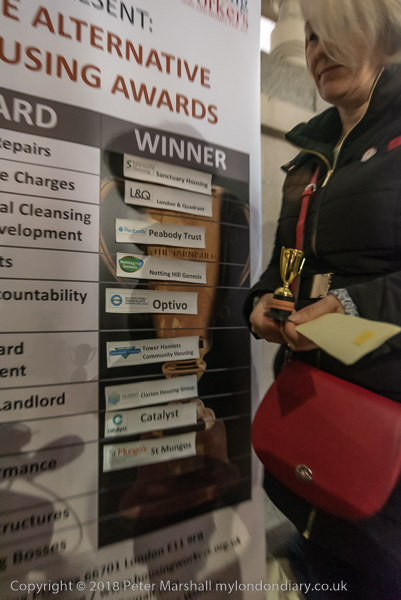
The Alternative Awards Ceremony wasn’t the most interesting event for a still photographer, though I think it will have made a better video. After an introduction for each award to a housing association made by someone from Unite Housing Branch who had organised the event together with SHAC, there was an invitation for them to come up and accept a small cup, but not surprisingly none of them had turned up to collect their awards. Instead residents or former residents or workers came to take them and spoke about their own experiences.

Although we still think of housing associations as being organisations set up to provide low cost social housing, having taken over much of the role of local councils, along with many of their council estates as a part of Thatcher’s policy of marginalising local government, they have changed over the years to become in many cases virtually indistinguishable from private developers and landlords, producing new developments often largely for sale or rent at market prices, usually with fewer properties at high cost affordable rents or shared ownership schemes, and virtually none at true social rents.

The awards were made as follows:

As Landlords

Sanctuary Housing for Most Rotten Repairs,
London & Quadrant for Soaring Service Charges,
Peabody Trust for Senseless Social Cleansing and Dodgy Development, with a special mention for The Old Tidemill Garden in Deptford,
Notting Hill Genesis for Rocketing Rents,
Optivo for Secrecy, Unaccountability & Spin,
Tower Hamlets Community Housing for Blundering Board and Management.

Clarion Housing Group was awarded as Overall Lousy Landlord.

As Employers

Catalyst for Poverty Pay,
St Mungo’s for Punitive Performance Management,
Peabody Trust for its Relentless Restructures.

Catalyst was awarded as Overall Bullying Bosses.

More at SHAC Alternative Housing Awards 2018.

______________________________________________________

There are no adverts on this site and it receives no sponsorship, and I like to keep it that way. But it does take a considerable amount of my time and thought, and if you enjoy reading it, a small donation – perhaps the cost of a beer – would be appreciated.

My London Diary : London Photos : Hull : River Lea/Lee Valley : London’s Industrial Heritage

All photographs on this and my other sites, unless otherwise stated, are taken by and copyright of Peter Marshall, and are available for reproduction or can be bought as prints.

To order prints or reproduce images

________________________________________________________

Digital wins hand tied behind back

I’ve just been looking at the post by Owen Humphreys on Peta Pixel, Film vs Digital in Music Photography: I Shot the Same Show With Both, an overlengthy title where the pictures really are worth a thousand words.

What Humphreys doesn’t make clear, either in the title or the words is that he compared film stretched close to its limits in a modern IS0400 film with digital with one hand tied behind its back for such a gig, also rating it at ISO400, when any sensible photographer would be thinking several stops faster.

Of course it does state clearly that he used ISO400, and did everything else to try to make the comparision ‘fair’, using two copies of the same lens, one of which had to be given a new mount to fit his Canon 6D. But by striving to be fair he handicaps digital, making it give away some of its advantage.

The lens in question was a Canon 55mm f/1.2 SSC Aspherical from 1973, used on both cameras wide-open at f1.2, and the lens choice was again was perhaps giving film something of an easy ride.  Humphreys needed the ultrafast lens to give film a chance in the tricky light conditions, but it is a lens designed to work with the film camera and the split-image focus system of the Canon A-1 rather than the 6D, a camera made for auto-focus.  I’m not a Canon user, but I suspect a current ultra-fast standard lens would give better results, and would certainly be much easier to use on a modern camera. I don’t cover music gigs, but I do often work in very poor light with moving subjects, and seldom get out of focus results using Nikon auto-focus. Working with digital you could also afford to stop it down a little – perhaps to f2 or even 2.8 – unless you really needed close to zero depth of field.

Despite those reservations, it remains an interesting comparison, and I congratulate Humphreys on getting such similar images with both cameras. Of course some of the differences in actual colour could be easily altered in Lightroom, but what stands out – at least for me – is that in nearly every pair of pictures digital is so clearly better.

There are I think three exceptions, all I think due to differences in lighting when the picture was taken, one where the digital image shows strong flare and two where the photographer has simply caught a much better moment with film – and threse should certainly have been eliminated from the comparision.

Your opinion on looking at the results might differ, but to my eye there is a clear advantage in colur purity, in dynamic range and apparent sharpness – in everything that technically makes a good photograph.

Thank goodness for digital – and for modern lenses and cameras – though we often swear at them – that enable us to get so much better quality images. Of course we can still mess things up, but if we fail to make great images it isn’t the fault of our equipment, but of the mind behind the camera.

Boring Street Photography

Forrest Walker’s 7 Habits of Boring Street Photography on PetaPixel (from his own web site, Shooter Files) is perhaps too kind. But there is no arguing that he is right when he says “The Internet is filled with boring street photography“.

Also 100% on the ball is his “The biggest problem is people thinking any photo taken on the street is now street photography.” Though I rather blame the instigators of all this, Colin Westerbeck and Joel Meyerowitz who wrote ‘Bystander: A History of Street Photography‘ for casting their net ridiculously wide.

Perhaps what I find most lacking in that huge pile of boring street photography is intention. Other than that of making an attractive image (though most fail on that too.) You have to feel something and to want to convey it to others. And I think Walker’s bad habits are largely about not making attractive images. But good advice all the same.

Here are his 7 habits – but go and read about them:

1. Nothing of Interest in the Photo
2. Too Far Away
3. Street Performers and Homeless
4. Too Much Bokeh
5. People Doing Nothing Special
6. No Composition
7. Over Edited

And he adds (and I add a heartfelt ‘Amen!’)

Bonus: Using Black & White For Interest

As he says:

Black and white does not fix a boring photo. A boring photo is a boring photo.”

Open Bridges

One of the more interesting projects as a part of Hull’s year as City of Culture in 2017 was ‘Open Bridges‘ , an event unlike some truly based on Hull, a city which has long been split in two by its river. Rivalry between East and West Hull is at its highest in terms of sport, with Hull Football Club on the west formed in 1865 and Hull Kingston Rovers in the east from 1881. The sport is of course Rugby League, though other codes of football are available.

Back when I first began visiting Hull in the 1960s people were always complaining about being late for things because North Bridge or Drypool or one of the other bridges “were up“, disrupting bus or car journeys.  Then the bridges opened frequently with a great deal of traffic moving up and down the tidal river  to various wharves, though now bridge openings are fairly rare (except for Scott St bridge, a listed structure permanently open since some time in the 1990s.)

For Open Bridges, for the first time ever, all the bridges were opened simultaneously at 20:17 hours on the autumn equinox, 22nd September 2017, splitting the city completely in two, although only for a few minutes. Open Bridges also included a film and specially commissioned musical work for the event.

A River Full Of Stories is the follow-up to Open Bridges, and with the support of the Heritage Lottery Fund is producing a film, exhibition, website and a book which will be given to each library and museum in Hull and the East Riding.

I’m very pleased that some of my own work is now included on the web site as one of the Open Bridge Stories,  The River Hull 1977-85 by Peter Marshall, with links to my ‘The River Hull’ and ‘Still Occupied’ books and my Hull web site.

My web site was also produced, but as an entirely unofficial contribution, for Hull’s year as City of Culture and rather to my own surprise I managed to post a new picture on-line every day during 2017 on it, as well as on Facebook, where I also put some short comments.  But I have to admit that I’ve rather neglected it since then, posting only a very few new pictures, and making little progress with adding the text about the images which I’ve written on to the web site.

Recently I’ve begun to scan some more of the colour images I made, at first on colour transparency, and from some time in 1985 using colour negative film. Technical problems in getting the results I wanted from slide film in pictures from Hull were a major motivation in my moving to negative film, and problems in getting the results I wanted from commercial printers led to me setting up my own colour print processing line – and doubtless breathing in lots of harmful fumes. Things are easier in many ways now, though scanning colour negatives still remains rather a dark art.

______________________________________________________

There are no adverts on this site and it receives no sponsorship, and I like to keep it that way. But it does take a considerable amount of my time and thought, and if you enjoy reading it, a small donation – perhaps the cost of a beer – would be appreciated.

My London Diary : London Photos : Hull : River Lea/Lee Valley : London’s Industrial Heritage

All photographs on this and my other sites, unless otherwise stated, are taken by and copyright of Peter Marshall, and are available for reproduction or can be bought as prints.

To order prints or reproduce images

________________________________________________________

Extinction Rebellion Buckingham Palace

Perhaps the most surprising part of the Extinction Rebellion Day came outside Buckingham Palace, where protesters marched up to the impressive front gates behind teh ‘OUR FUTURE’ coffin, at first raising it up, and then lowering it to the ground in front of them.

I think people didn’t know what to do next, though there was some noisy shouting of slogans and then many of us started to wander away and see what was happening behind us.

There was a crowd behind the ‘REBEL FOR LIFE’ banner, with an empty space in front so that people could take pictures. This was one of many occasions where the 18-35mm was not quite wide enough, and I really needed the extra 2mm of the 16-35mm, unfortunately broken beyound economic repair.  I do have another, even wider full-frame lens, a Sigma 12-24mm, but the image quality falls short of the Nikon lenses so it gets left at home.

Normally I’d use the 16mm fisheye to get a wider view, but I know this isn’t really satisfactory when looking at rectangular objects – such as the banner and the palace – head on. The banner would be considerably taller in the centre  than at the edges, as the camera to subject distance is further for peripheral objects; while this makes sense in terms of optics, it just doesn’t look right.

I seldom like to photograph banners (or buildings) head  on, but for this image it makes sense, and I was just able to get back far enough to squeeze it all in. I did also move to one side to use a more oblique view – as you can see on My London Diary.

There was some uneasy grumbling in the crowd as Gail Bradbrook of Extinction Rebellion read a very humble address calling on the Queen to get her government to take the urgent action needed to save her country – and the world. Certainly as I noted, some in the crowd would have been happier to bring a guillotine. There was rather more unity behind yet another joint reading of the ‘Declaration of Rebellion’.

There was then a period of silence in memory of those who have already died because of glabal warming, after which people were invited to bring their wreaths flowers, placards and other objects to lay on top of the coffin, which was soon under a large pile.

The protest ended with dancing, while at least one person superglued herself to the railings by the main gates. Pictures of this and much more are on My London Diary at Extinction Rebellion Buckingham Palace.

______________________________________________________

There are no adverts on this site and it receives no sponsorship, and I like to keep it that way. But it does take a considerable amount of my time and thought, and if you enjoy reading it, a small donation – perhaps the cost of a beer – would be appreciated.

My London Diary : London Photos : Hull : River Lea/Lee Valley : London’s Industrial Heritage

All photographs on this and my other sites, unless otherwise stated, are taken by and copyright of Peter Marshall, and are available for reproduction or can be bought as prints.

To order prints or reproduce images

________________________________________________________

Extinction Rebellion Funeral March

The coffin was carried off of the grass in Parliament Square and to the roadway in front of Parliament, where slowly the protesters formed up behind it. A short flight of steps at the back of Parliament Square enabled me to photograph it looking down and to show the large crowd in the square behind. Using the 16mm fisheye gave me a usefully wide angle of view (about 147 degrees horizontal) which meant including at left the lens of a photographer standing next to me at the top of the steps.

One man had brought a coffin of his own, complete with an animal skull, and another protester had a similar skull on her head, and there were plenty of other creative placards and artifacts. Others carried flowers. It was raining slightly as the march went up Parliament Street into Whitehall and many put up umbrellas, though I found none to photograph with slogans on them.

When the front of the funeral march reached Downing Street, there was a sit in for around 10 minutes, followed by some loud shouting of slogans as they got up and moved on.

I let the front of the march go on and waited for others to pass, wondering if there might be other actions taking place in Whitehall. As I stood next to the memorial for the Women of World War II, a man got out a paint spray and began painting a slogan across it. He gets as far as ‘MOTHE’ and tries to write an ‘R’ as a police officer grabs him, and he is led away and arrested.

I turned back to the crowd still outside Downing St, and see they are standing around in a large circle round a circle of people lying on the ground. Inside them are other bodies making out the double triangle ‘hourglass’ symbol, completing the XR symbol, which has also been chalked or painted on the roadway in several places.  I held the 16mm fisheye as high as I could above my head and took a number of pictures. By using this on the D750 (rather than the D810 which has a fixed rear screen) and working in Live View I was able to swivel the rear screen and have a good idea of the framing. For once the curved horizon adds to the image. Unfortunately I forget to switch from ‘movie’ to ‘still’ mode in Live View, and so get a 16:9 frame rather than the normal ’35mm’ 1.5:1, an annoying feature of the camera.

Others are writing on the walls in Whitehall – and getting arrested for it. Many of those taking part in Extinction Rebellion are deliberately seeking to be arrested, working on the hope that large numbers of arrest give the protests a higher public profile and may prod the authorities into doing something about the problems.

The front of the protest halted at the top of Whitehall, for me and the other protesters to catch up with them, before setting off under Admiralty Arch (now owned by a hotel company) and along the Mall towards Buckingham Palace. A few police try to stop them, but are ordered back to allow the protest to go through – and on to the next stage in the protest.

Many more pictures at Extinction Rebellion Funeral Procession.

______________________________________________________

There are no adverts on this site and it receives no sponsorship, and I like to keep it that way. But it does take a considerable amount of my time and thought, and if you enjoy reading it, a small donation – perhaps the cost of a beer – would be appreciated.

My London Diary : London Photos : Hull : River Lea/Lee Valley : London’s Industrial Heritage

All photographs on this and my other sites, unless otherwise stated, are taken by and copyright of Peter Marshall, and are available for reproduction or can be bought as prints.

To order prints or reproduce images

________________________________________________________