Bilal Hussein and Press Freedom

If you are a photographer and work in Iraq, you run the risk of being imprisoned by the US military. The Committee to Protect Journalists claim that “dozens of journalists – mostly Iraqis – have been detained by US troops over the last three years.”

They get arrested for photographing or filming things that the US army would prefer not to be recorded. Those we know about were mainly working for major foreign agencies such as Reuters and Agence France-Presse, although I wonder if in fact we only know about these people because they were employed by the agencies. Are there many more we don’t know of?

Most get released without charge after a few days or weeks, but the site lists eight cases of more prolonged detention of up to a year. The details of each case ends with the statement: “Charges Substantiated: None

Of course the best known case is that of Associated Press photographer Bilal Hussein, who has been held for almost 20 months. I’ve previously written about him here (and elsewhere,) and linked to the campaign to free him, urging others to join in the petition to free him.

His case at last came to the Central Criminal Court of Iraq yesterday, 9 Dec 2007, but the magistrate issued an order that everything should be kept secret, so the AP report can only report the bare facts. Although Hussein and his lawyer were allowed to see some of the material presented to the court, they were not allowed to take copies to use to prepare his defence, and no actual charges were made.

Hussein and his lawyer have also not been allowed to talk privately in order to plan a defence; their meetings have been held with a US soldier and military interpreter present.

It is now up to the Iraqi magistrate to decide whether there is any case to answer – and if so, it will be dealt with by a panel of three judges. It isn’t clear how long this will take, and certainly at the moment there are grave doubts about whether if the case does come to trial Hussein and his lawyers will be given the opportunity to prepare a proper defence so that he can get a fair trial.

Here in the UK of course we do things differently, although perhaps not so differently if you read the time-line of the SOCPA antics by police and courts as published on Indymedia. It is news and I think important news that has hardly been covered by the mainstream press.

One thing that gives photographers (and videographers) covering events such as these on our streets a little – if limited – protection is the UK Press Card. It isn’t perfect, but it does at least sometimes mean that photographers will get treated as reporters rather than as protesters. This Saturday, photographing a picket at Tesco Metro in Lower Regent Street, I would quite likely have been arrested for refusing to go into a pen when told to do so by a police officer if I hadn’t been able to show my card.
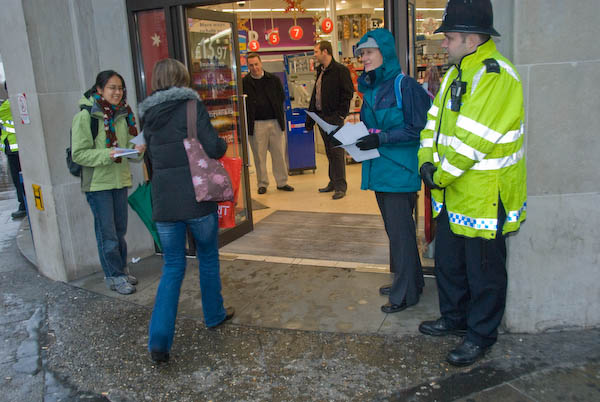

Picket against Tesco support for bio-fuels, London, Dec 8, 2007

Strangely enough, most of the times when I’ve really needed a press card have been at small events – like that picket – where the mainstream press aren’t interested and none of the photographers working for them cover.

I photograph them – as do others – because we think it important in terms of freedom of the individual, freedom of expression and a genuinely free press that such things should be recorded and published – even if only non-commercial media – such as Indymedia – are prepared to do so. Most of us also make some money out of such pictures through their use in small publications and as stock. Not a great deal, but with luck enough to make ends meet, at least along with the occasional more lucrative jobs.

Some news photographers are scheming to severely limit the issue of press cards, basically to guys like them working more or less full-time for the big newspapers. It is a change the police would welcome as making their job considerably easier, but which would severely curtail the wider freedom of the press.

Peter Marshall 

Cruel Fur

Like many people, I thought fur was a thing of the past, remembering those old ladies who came to admire me in pram and pushchair, moth-bitten foxes around their necks, pungent with lavender and mothballs and worse. Later came the campaigns against fashion furs that meant that only the most thick-skinned of dumb animals would be seen alive in another’s coat because of the extreme cruelty across the whole industry.

It was this well-documented cruelty that led to the closure and banning of fur farms in the UK, but in other countries they remain alive and even more sick. I’m not a veggie but I am opposed to cruelty against animals (and wish that all farm production reached the standards of the best.)

So it disgusts me to hear that the big names in fashion and fashion shops are promoting the use of real fur trimming on their garments, and that these are on sale in shops in this country – and that it is perfectly legal to sell these cruelly-produced products. It’s a particularly stupid and callous trade, particularly stupid because in almost all ways the artificial alternatives look and perform better than animal skins. Anyone buying them is paying to wear a badge of cruelty.

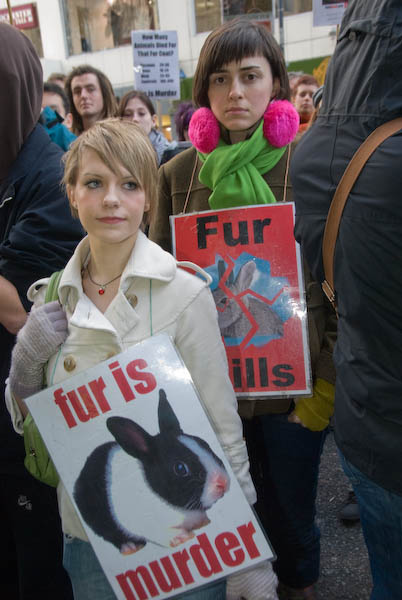
Around 250 people joined a march on Saturday past some of the shops selling these tainted goods in Knightsbridge. The march paused briefly outside several shops before halting outside Harrods, apparently the only department store in the UK that still deals in furs, and where there is a regular picket every Saturday. After a brief address and many shouts of “Shame on Harrods”, there was a minute of silence before the march moved on, and I left them.


Outside Harrods in Brompton Road, Knightsbridge.

Surely it’s time the Government made time to ban this trade. It is one piece of legislation which would gain approval from the great majority of the British public and the kind of measure which would provide a sadly needed increase in their support.

Peter Marshall

Christmas comes early…

Christmas comes early in Surrey and doubtless everywhere else. So far I’ve photographed three Christmas events on the south-west fringes of London (and am wondering whether I can fit another in this evening.)

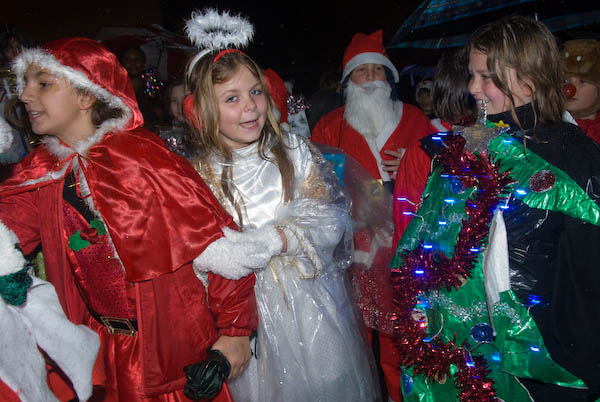
They switched the Christmas lights on in New Malden on 23 Nov, and it was Winter Wonderland in Wimbledon last Thursday. Friday night it was pouring with rain, but the Hampton Hill Christmas Parade went ahead as usual – if rather wetter.

I don’t much like working in the dark or in the rain, and struggling with an umbrella and a recalcitrant camera and flash made me wish I’d stayed in the pub. But all the performers in the parade were out there, mostly getting soaked, so I felt I ought to stick at it too.

Here’s one that I rather liked, and may get on my Christmas card.

Peter Marshall

Photo Histories

Some months ago, Graham Harrison contacted me about a new on-line photography site he was setting up, looking at photography in an intelligent way, and invited me to have a look at the preview site. I was impressed, and offered to write something, though as yet I’ve not got around to it. Perhaps later…

Photo Histories is now up for all to read, and the content so far is impressive, with a great interview with Philip Jones Griffiths, who talks about “why the ideals of the thinking photojournalist forged in the 20th century should not be sacrificed for the dumbed down culture of the 21st.” His ‘Vietnam Inc’ (1971) was one of the most important books of the era, and one that moved me and others powerfully when it came out – and is still a fine example of why photojournalism is important. I also have a great deal of sympathy for his views on the current state of Magnum which you can read in the interview. While others – including myself – have written about his work and its significance, this interview does add some insights into the work and the man who produced it – and has a nice picture of him by Harrison.

Another photographer I’ve also written about previously is Homer Sykes, whose self-published books Hunting with Hounds and On the Road Again I reviewed at some length. (You can download a pdf file of the Autumn 2002 issue of the LIP Journal where my review of On the Road Again appeared in print – and both – along with features on photographers Berenice Abbot and Brassai mentioned below – are probably available on the ‘Wayback Machine‘ or its mirror from About Photography.)

In Photo Histories there is another detailed interview with Sykes, as well as a interesting set of pictures ‘Unknown Homer Sykes : The English 1968 – 78‘.

I met Homer again earlier this year, when he was back photographing Swan Upping on the Thames for the first time for many years. You can see some of my pictures from the event at My London Diary, but surprisingly I don’t seem to have mentioned him. The two of us were the only photographers who ran along the river bank to record the Dyers and Vintners men raising their oars to salute the Royal uppers at the end of the day. I hope he got the exposure better than I did in the wickedly contrasting light. I left the D200 to sort it out and it didn’t.

Other features on Photo Histories include some on key books from the history of photography, including Berenice Abbott‘s ‘Changing New York‘ and ‘Paris de Nuit‘ with pictures by Brassai. Perhaps these were a little disappointing in not really dealing with the images, more with biography and background matters, but still useful introductions. Perhaps it might be a useful addition to have features about key images or sets of images from them as well.

Graham Harrison has of course worked for some of the big names in British publishing, and at the centre of Photo Histories is a section called by that same title, which includes an article (originally published on EPUK) about the first Press Photographer’s Year Expo held this summer. At the end is a footnote:

After the success of the Press Photographer’s Year Expo it was sobering to see Stoddart’s stills used with effect throughout the C4 TV documentary The Rise and Fall of Tony Blair credited to Getty Images only.

Moral rights – including that of attribution – are something that photographers still have to fight for. The Photo Histories section also has a very nice insider story by Brian Harris about working with the late Don McPhee during the 1988 US Presidential campaign.

As well as his main site, you can also see more of Graham Harrison’s work in ‘The Oxford Year,’ though in the two years this has been going he seems so far to have missed those swan uppers!

Streets of London & Paris

Two rather different photographers whose work I’ve enjoyed on the web in the last few days.

Paul Muse was born in England but has lived in Paris for quite a while. On his site you can see a daily image along with a short text (in both English and French,) and the text for 20 Nov:

Paris rediscovers the fun of getting around on foot.”

certainly got a response from me as I was still recovering from walking around Paris courtesy of the striking transport workers.

Don’t miss some interesting work on the gallery pages, including ‘London Falling‘, street pictures taken during a short visit to the city in August 2006, and much more. If you are in Paris his work is on show at the Galerie du Lucernaire’ until 2 Dec – details on his site.

I met Paul when I was in Paris recently, but unfortunately didn’t get to see the pictures then. Next November I’ll book a longer stay, because there really is so much to see – and of course even more next year, when November will also be the ‘Mois de la Photo‘ along with its incredible ‘Off’ fringe.

Brian David Stevens is a photographer I’ve known for a while, and we sometimes find ourselves standing together at events in London, although the pictures we make are usually very different. He continues to work with black and white film in a Leica (he tells me the latest stuff is ‘digital Tri-X’ using a Ricoh GR-D) while I’ve moved to using digital colour (sometimes with an M8, but more often with a Nikon) but there are even more significant differences.

He describes his profession in his ‘Lightstalkers’ profile as “miserable sod” (I think it comes from the Welsh blood.) And although its a mode I can do pretty well myself (look, my middle name is Gwyn), I like to have fun when making pictures.

But his work is dark and powerful, with lots of empty blacks, and it works well, both with the images using reflections and the very direct images of people on the street, often viewed looking up from hip level. One of his images of two women in particular really jumps off from the screen with forceful menace.

It’s interesting to compare the pictures on Flickr where he now posts work, with those on his older personal web site. There are some of the same images, and clearly the same vision, but presented very differently.

Peter Marshall

Paris Strike – Manif, Walks, Party

My diary of pictures from Paris is now on line, on ‘My London Diary‘ and includes pictures from several walks around Paris – thanks to the transport strike there I walked everywhere.

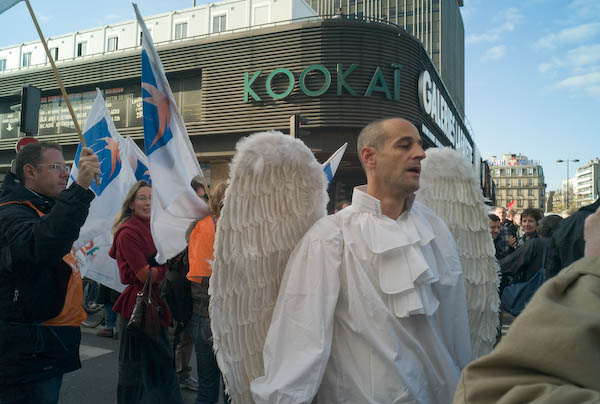
I also got to photograph a ‘manif‘ by the transport workers – where I met a and photographed an angel, as well as some of the union leaders and others there.


© L’Ange Blanc – see http://angeledenia.canalblog.com/
Image used with permission.

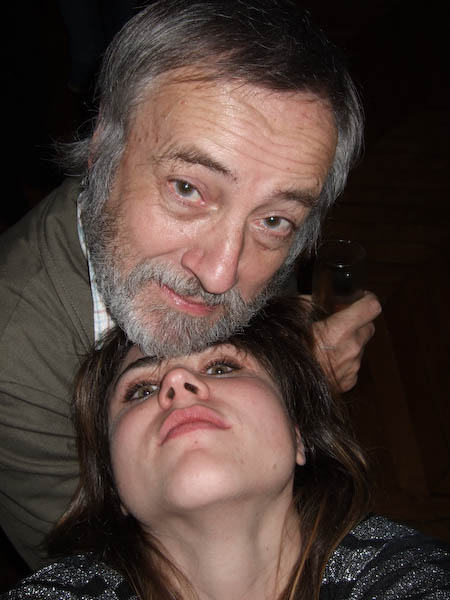
There are also some pictures taken at an excellent party; the party was good, so I’ve no idea who took some of the pictures, though I do appear in them. I think we all had a good time.

To protect the guilty I deliberately haven’t included any names in the captions, though you might recognise some of us. The same is true of the photographers I’ve shown at Paris Photo.

Most of the pictures from Paris were taken on the Leica M8, a camera about which I still have mixed feelings. Working with it is almost like using a film Leica, but the shutter noise can be obtrusive. And there are still problems if you haven’t got the latest Leica lenses with 6 bit coding.

This would matter less if Leica actually made suitable lenses for use with this 1.3x camera, preferably by bringing out some relatively cheap 24mm, 21mm and wider optics (They have produced a 28mm f2.8, but I’d like wider.)

Voigtlander have the lenses (and I own several) but they don’t have the Leica coding. You can add this manually, but this doesn’t work with my 21mm as it has the incorrect lens adapter. The coding allows the camera to compensate for the lens vignetting – which when using the IR cut filter needed for decent colour gives your pictures cyan corners.

Mostly I worked with a Leica 35mm f1.4 (which Leica says won’t work with the camera) fitted with an IR cut filter and some appropriate black marks for 6 bit coding made with a genuine ‘Sharpie’ pen. This is fine, but basically a standard lens (1.3 x 35 = 45.5)

With the Voigtlander 21mm f4, every picture has to be run through software to remove the colour vignetting. It’s an extra chore and using PTCorrect as a Photoshop plugin doesn’t always do the job quite perfectly. I’m hoping I can do it better with CornerFix once I get to grips with it.

Leica could add a menu item as a firmware upgrade that allowed users to get suitable built-in support for non-coded lenses. It would make many users a lot happier with the camera.

Copycat Images?

Copying of images has been making the headlines again in recent weeks. The estate of Bob Carlos Clarke perhaps appears to be claiming rights on any close-up of lips and a tongue, and preparing to take Pepsi to court – you can judge for yourself the validity of their claim on the Amateur Photography web site.

For me, such originality as exists in Carlos Clarke’s image is in the biting down of the teeth on the lips, the particular upthrust of the curled tongue, the slight dynamic tilt and the grainy black and white tonalites, all absent from the Pepsi offering, which – as one might expect from the US giant – is bland, pink and ugly.

It is after all, subject matter we all have to hand (or at least mouth) and probably many of us are wondering if in turn we can sue the estate if Mr Carlos Clarke given that we’ve been photographing people with mouths since the 1960s (or whenever.)

Another case over a similar issue has been decided in the Paris courts, and you can read about it on EPUK (Editorial Photographers UK.) The court ruled that a picture used by the “French National Tourist Office Federation (FNOTSI) was a deliberate copy of a Getty Images stock photograph” by Ian Sanderson.

Here there seems to me little doubt about the visual similarity of the two images – and you can compare them in the EPUK feature, which lists the similarities. As Getty argued in court, you cannot copyright the idea of a couple kissing on a roundabout, but this was an obvious attempt to recreate the image, including the appearance of the models, clothing, pose, background and viewpoint.

Sanderson’s image is widely known, and the only surprising thing about the case appears to me that the agency concerned didn’t just put up their hands, say its a fair cop guv, apologise and then negotiate over the fee. I suspect they may well have tried to do so, but found that Getty were intransigent. The court settlement, including costs, is said to be well below the five times the normal fee that Getty demanded, and given that it took 4 years to reach a settlement one suspects the real costs involved, including all the time of the people concerned, may actually leave Getty out of pocket, though the photographer should be in the money.

FNOTSI have of course lost out – and deserve to on various counts. They had to scrap the campaign and replace it – at an estimated cost of 60,000 euros, as well as paying the fine and damages. And apart from the deliberate breach of copyright involved, they only paid the photographer concerned a miserly 1750 euros for the work, expenses and licencing – when getting the original legally from Getty would have cost around five times as much.

This pair of images is just one of those featured earlier in an earlier feature on Visual Plagiarism on EPUK, now updated, which I’ve written about previously elsewhere.

One vital point to make is that it isn’t sufficient for two images to be visually very similar to cry plagiarism. Your original has to really be original in the first place; there can be plagiarism in copying a cliché. And by my reckoning there are several images featured in the EPUK feature that would be disqualified by that test.

Another problem is that of coincidence. I wouldn’t for a single moment accuse Fay Godwin of either plagiarism or producing clichés, but when I opened one of her books some years ago, I recognised one of my pictures, taken at Chatsworth. One that had actually been hanging on my wall for several years at the time. I made my image in 1984, while hers, in the book ‘Landmarks‘ is dated 1988. (The two pictures are not quite identical, and hers is taken or cropped to a square format.) And although I knew Fay and on various occasions we enjoyed going around exhibitions together and sharing our often similar prejudices, I’m sure neither of us had seen the other’s image when we made our own.

There is a big difference between this case and that of the couple on the roundabout. Neither Fay nor myself arranged anything for the photograph, it was simply a matter of being in the same place within a few inches and using a lens with a similar angle of view (mine was I think a 35mm on an OM body) pointing in more or less the same direction in similar lighting.


I think this was my second picture of the sleepy lion and it was made in May 1984. I’ve put the two pieces of sculpture a little closer together, but the resemblance is fairly striking. (C) Peter Marshall, 1984

Strangely enough, looking through my contact sheets later, I found that I had actually made a very similar photograph on two occasions myself, although I’m fairly sure I didn’t remember the first when I was making the second image. Although I’ve generally got a pretty good memory for images, it is something that has happened to me on a number of occasions.

David Plowden – Vanishing Point?

I’ve written before – elsewhere – about David Plowden. His ‘Small Town America‘, published in 1994 by Harry Abrams in NY (ISBN 0810938421) remains one of my favourite records of America – just one among around 20 of his books, and he was among the list of around 250 ‘Notable Photographers‘ I first put on-line around 2000.

He is also one of the photographers whose work is included on David Sapir’s Fixing Shadows, one of the earliest web sites to feature fine collections of ‘straight photography‘ (and on which I was proud to be included as the first UK photographer on the site.)

So it was a little surprising to read on The Online Photographer a review of his retrospective publication ‘Vanishing Point‘ starting “David Plowden may be the best photographer you never heard of.” Surely there can be few with a serious interest in photography who didn’t visit the old ‘About Photography‘ or ‘Fixing Shadows‘ – I ask tongue in cheek, although back in 2000, there really were not too many other serious games on the block.

But of course there are people with a serious interest in photography – even some photographers – who were hardly out of nappies in those primitive days of the web, and now we are overwhelmed with material. Then I had problems finding sites worth writing about because there was so little available; now I have problems finding sites worth writing about because there is so much.

Back to David Plowden, a fine and unassuming gentleman who I met a few years back, and a great photographer. Reviewer Geoffrey Wittig puts it well: “Walker Evans without the condescension.” His work is clear, precise statements, beautifully seen and presented. As the review also says, it is perhaps low on irony, but it is full of a kind of love and reverence for the subject.

Plowden’s lack of visibility in some circles largely resulted from a difference of opinion between him and curator John Szarkowski, and he never made it to the Czar’s pantheon. There seems to me to be a certain irony here, in that some of Szarkowski’s own photography has a very similar character; perhaps their failure to connect was some kind of turf war on the curator’s part.

Plowden of course kept on at the photography for some 50 years, and at 75 has a show – as Arthur Gross points out in a comment to the review (do read it) – at the Catherine Edelmann Gallery in Chicago (until Dec 29, 2007.) You can also find his work at the Lawrence Miller Gallery, but the definitive site is his own David Plowden website.

Vanishing Point (ISBN-10: 0393062546) is an expensively produced book and one that needs a strong table to rest it on, with some 350 pages. Fortunately it is heavily discounted from suppliers such as Amazon and would be a very acceptable Christmas present for many photographers, including myself!

Larry Clark at the MEP

The Maison Europeenne de la Photographie (MEP) is perhaps my favourite space to go to look at photography, and I only wish we had something like it in London, though of course a part of its charm is that it is just a few yards from the busy pavements of the Rue St Antoine where you can eat and buy real French food along with the ordinary Parisians. I’ve spent many happy hours and days wandering the Marais, and if it has lost a little of its charm over the years under the relentless spread of boutiques it remains one of the great urban experiences.

Marais, 1973
The Marais in 1973, from Paris, 1973 (C) Peter Marshall

Larry Clark‘s “Tulsa, 1963-1971” is one of three major shows currently there (until 6 Jan, 2008) and is an extensive showing of his work, most of which appeared in the books ‘Tulsa‘ and ‘Teenage Lust‘.

An important part of the show was an edited version of a film in which Clark talks about his life and work. This was in English, but with French subtitles. These provided an interesting comment on the differences between English and French ways of thinking, as in many places they diverged. While Clark’s responses were American laconic, the translation was French philosophical.

Clark’s story is probably too well known to need a detailed exposition, and as I managed to lose my notes (it was a very good party on Thursday night) there may be a few misplaced details in this outline, but I don’t think it really matters.

Clark was born in 1943 in Tulsa, Oklahoma, which, from memory, Oscar Gaylord Herron – also from Tulsa – described in his ‘Vagabond‘ (1975) as the jewel in the bellybutton of America, bang in the middle and as number 10 on the list of Soviet missile targets. His father was a door-to-door book salesman, but when business got really bad, left the job and worked with the family business that Clark’s mother had established. This was in baby photography, going to homes and photographing newly-born infants.

When Clark was 14, his father came home one day, took a look at him sitting around downstairs and told him he looked like a piece of shit before going upstairs and hardly ever coming down again or talking to Clark. Family life took on a very curious quality, with his father staying upstairs, eating food which his wife took up to him, although Clark also writes that his father gave him three dollars every Friday to go out.

At his school in one of the poorest areas of the city, Clark mixed and befriended many other kids who also had trouble at home. Kids who arrived at school beaten and bruised; girls who were screwed by their brothers and probably their fathers and more. Hanging out with these kids he learnt how to extract amphetamines from inhalers – his three dollars bought three of them – and get high.

Also at 14, he began to help his mother taking baby pictures, and in a year or two he was a photographer, taking these on his own. Clark realised that he needed to get away from his family, and at 18 left home to go to study photography at Layton School of Art in Milwaukee (Wisconsin). It was there he saw the work of W Eugene (Gene) Smith in Life magazine, and realised that there was rather more to photography than taking baby pictures.

When he returned home, he began to take photographs of his friends and their wayward lifestyle, very much as one of them. Then the army claimed him for a couple of years and after that he moved to New York, trying unsuccessfully to make a living as a photographer. There he met and photographed Gene Smith and also the friends he made – again on the fringes of society.

He left New York and went back to Tulsa with the idea of making a film, telling the truth about the things that were happening in America, with the kind of people that he knew. He bought a camera and sound equipment, but then found it impossible to work on his own. Looking at his photographs he decided instead that they could be a book, although there were gaps in his record that he need to fill, and he went back to photographing his friends to do this.

There is a very strong sense is which the books are like films, showing a story in a very similar way. Clark felt that photographers before him had stopped short, there were things about America that they were not prepared to show. Drugs weren’t supposed to exist in America, nor for that matter was sex (and certainly not incest) and he was determined to show the truth about the kind of life he had been a part of.

Although he exaggerates – there were photographers who had photographed virtually all aspects of the American underbelly as well as those who concentrated on Mom and apple pie – he did so in a much more personal and considerably more intense manner, pulling few if any punches. When Ralph Gibson‘s Lustrum Press brought out Tulsa in 1971, it certainly created a stir.

But in reality, little it showed was news. It may not have featured widely in pictures, but Kerouac’s ‘On The Road‘ was published in 1957 (I picked up my paperback copy on a second-hand bookstall in Hounslow in 1963) and there were plenty of other books. Kerouac’s cast of friends were of course rather more literary, but there was still plenty of sex, drugs and aimlessness, if rather less anger than in Clark’s work.

Clark was able to work the way that he did because he was living – certainly at times – the life that his friends he photographed were living. As he says in Tulsa, “once the needle goes in it never comes out.” He worked with a Leica to avoid the clunk of the mirror with an SLR, the quieter, lower tone of the slow cloth shutter getting in time, as he says, almost musical.

As well as anger, there is also a lyricism about some of his work. In one of my favourite images, a woman sits back in a chair, seen from the side, injecting herself in the right arm. Above the waist she wears only a white bra, and she is lit strongly from the window at top left of the image. The bright light on the white fabric, and also to a lesser extent on her skin are diffused, perhaps by a little greasy fingermark on the lens or filter, creating an incredible glow.

Clark’s work influenced many young photographers, but was also important as a source of inspiration for films such as Taxi Driver and Drugstore Cowboy, and both Martin Scorsese and Gus Van Sant are great fans. When Clark saw Drugstore Cowboy he thought that this guy was treading on his turf, and when they met at an opening, he told Van Sant that he wanted to make a film. This led to ‘Kids‘ (1995) and other films followed.

Large Image Collections on line

MOCA search gives 182 results
Addison Gallery search finds 134 images from Teenage Lust and Tulsa
LACMA search shows 132 images

Other sites

Larry Clark on Myspace
Official Website – under construction in Nov 2007 – but try later.
Luhring Augustine
Artnet

Pavement
Salon
Larry Clark

Peckham or Paris?

If I wasn’t going to be in Paris on Wednesday, I would be heading instead for Peckham, where the Peckham Literary Festival 2007 kicks off with two events I’m sorry to miss (though I could hardly have attended both.) The festival programme continues until Sunday and so far as I can tell contains no photography, although earlier in the year I wrote about the show ‘Peckham Rising’ at one of the festival venues, which included photographs by Thabo Jaiyesimi and Daniele Tamagni.

Things have been happening in Peckham this year – and I was also there for the Human Rights Juke Box and the I Love Peckham festival. If you can’t get to any of the events you can listen to a little of the music which will be performed at the festival from the new album “Psychogeography” described as “ a collection of dark but warm songs about losing vital limbs, nursing small birds, conversations with insects etc.

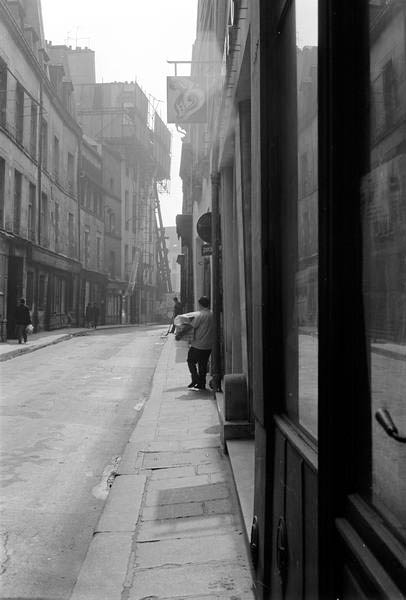
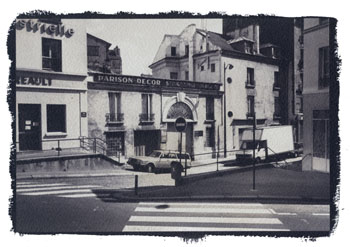
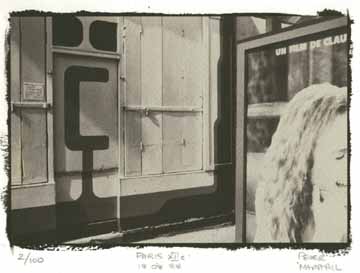
It’s hard for me to see Paris clearly – it has so many memories. Some of them are in the pictures I took there in 1973, on my second visit to the city (now all this site should be working – apologies to anyone who found some missing images earlier.) These are are couple of salted paper prints I made in the 1980s.

And no, I never made the edition which is referred to on the print above, which was a kind of joke. I think I probably made 3 or 4 prints – and they were all different.

Last year, going to Paris and trying to fit in Paris Photo, the Mois de la Photo and the incredible fringe festival, the Off, in five days there I had little time to take pictures during the day (not much at night either) but I did manage to put together a set of work, Paris November, which does include a few pictures inside the photo fair. I won’t need to tell you guys that you can go on to the next image by clicking on the main picture – or choose any other image by clicking on its thumbnail.