Candid on Candids?

Bus, Peckham 1991 (C) Peter Marshall
Bus in Peckham, 1991 (C) Peter Marshall

A day or two ago someone asked on an on-line photography forum if anyone knew of a book on the subject of candid photography they could recommend, mentioning one publication they had already been given as a present. (I haven’t read it, but what looks to me a rather posed portrait on the cover didn’t inspire confidence.

My immediate response was to wonder what there was to write a book about, which perhaps wasn’t the most helpful of comments, although perhaps appropriate. On further thought what I would recommend is Ralph Hattersley’s ‘Beginner’s Guide to Photographing People‘, published in 1975, though it came out in the UK, published by Robert Hale Ltd, in 1979. (ISBN 0709174039)

It’s a work that I admire for starting with a discussion of the ethical basis of portraiture, and with a listing of some of the wrong and the right reasons for taking pictures of people, in a chapter on taking candid portraits. Later in the book there are chapters on how to make staged candid pictures and how to photograph strangers in the street – and that also starts with an examination of your motives.

Hattersley also does a pretty thorough job of the technical stuff, including lighting. Of course its a book written for photographers using film, but really digital hasn’t changed things that much, although some cameras at least provide new opportunities for shooting with the camera away from your eye.

The very term ‘candid photography’ has a dated feel to it. I immediately think of the 1930s ‘Mass Observation’ project and the splendid images of Humphrey Spender on the streets and in the pubs of ‘Worktown.’ If you have any doubts about the validity of working in this way, take a look at the way the Bolton Museums now give the work a proud place on their web site. As they write, “He used what was at the time cutting-edge technology in the form of an unobtrusive 35mm Leica camera.” In some respects the early screw Leica that he used was a better instrument than the later M cameras for this kind of work – where you don’t change lenses. It was smaller and less obtrusive, and I think the shutter was perhaps even quieter. Certainly much quieter than that on the latest digital Leica M8, and even the promised (and expensive) replacement will still be rather more noticeable.

Bolton’s weather also helped Spender, since he spent most of his time there wearing a mackintosh, keeping the camera hidden under this except when he was actually taking a picture. As they note, “He recalled that the occasional Boltonian would react angrily if they discovered him taking a photograph.” There was a feeling of being spied on – rather more rational then than under the Panopticon of security cameras that now track us through much of our lives. Spender himself they suggest “disliked the intrusiveness of his work” and the stress of documentary was one reason why he turned away from photography to painting and stage design.

I think photographers always have a responsibility to their subject, and especially so when you photograph people without their permission. I often take pictures I would not use, perhaps because I’ve caught a moment when they look distinctly peculiar (something some other photographers sometimes seem to strive for.) Or when photographing a flamenco dancer recently, the picture that caught the fleeting fraction of a second where her rapidly swirling skirt revealed rather more than intended. I perhaps see it as my job to try and see the picture as the people in in might see it years later in a book or museum rather than an immediate reaction.

One of the great projects of candid photography was made by Walker Evans, travelling on the New York City subway trains, often accompanied by his assistant Helen Levitt. Starting in 1938 he photographed using a Leica hidden under his coat, its lens poking out, making around 600 photographs. He had conceived the project with the help of his collaborator, writer James Agee – they were working together on the even more famous ‘Let Us Now Praise Famous Men‘, published in 1941 – and Agee in 1940 wrote a preface to the subway work. Although the pictures were finished in 1941, it was not until twenty-five years later in 1966 that ‘Many Are Called’ was published to accompany a show of the images from it at the Museum of Modern Art in New York.

While at the time the pictures might have been seen as an intrusion into privacy, the passing of time gives us – and any of the subjects – a different perspective. The work was published again in 2004 by the Yale University Press and the Metropolitan Museum of Art mark the 100th anniversary of the subway system, with new texts and also greatly improved reproduction of the images, thanks to new digital scans.

I was reminded only briefly of this work on Saturday, as I crammed into an underground carriage full of Kiwis out with a few thousand others for their Waitangi Day Circle Line Pub Crawl. This image, taken with a 12mm lens on a Nikon D200 may in some respects qualify as candid, but was certainly not made without the knowledge and willing consent of those shown.
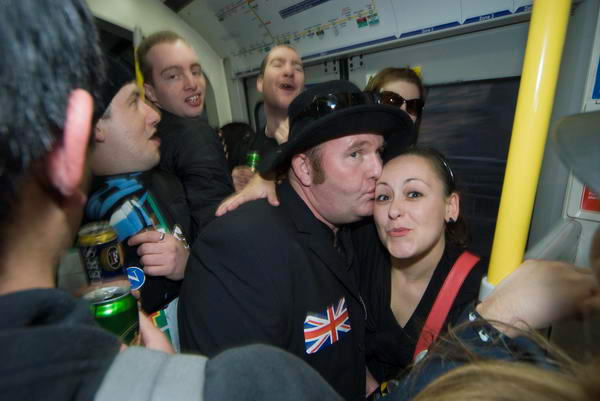
New Zealanders celebrate Waitangi Day on the Circle Line Pub Crawl
(C) Peter Marshall, 2008

More pictures as usual on My London Diary. More about candid photography in other posts shortly – including Stream of Consciousness.

Learning Lessons in Africa

I was very pleased to see that the Guardian Unlimited online feature ‘Learning Lessons in Africa’ has won the Journalism.co.uk multimedia storytelling competition. Using photographs by Ami Vitale and video by Danny Chung taken in Mali, the report was produced by Elliot Smith and designer Paddy Allen.

It is a well deserved award. The report superbly integrates the colour images by Vitale with black and white video by Chung. The commentary by Vitale (and a second story by Jeevan Vasagar) is lucid, intelligent, moving and very much makes it point, as to do her powerful images.

I’m also pleased because the report shows work that it funded by Oxfam, a charity I’ve been a supporter of since I started work.

Finally I’m pleased because Ami Vitale is a fine photographer whose work – you can see more on her http://www.amivitale.com/main.html web site – I’ve written about on several occasions in the past.


Me in Alcatraz. Photo (C) 2005, Ami Vitale

It was a great pleasure to meet her in Poland in 2005 – and to find that she was a a fan of the web site I was then running. As you can see from my diary (and the pictures) we got on very well together. You can also see her taking my picture on the street, although she took a better one in Alcatraz later.

A Busy Friday

Demonstrations are sometimes rather like buses, with none for ages and then three come along together. On the afternoon of Friday 25 Jan it was four rather than three, and I think there were a couple more I didn’t manage to get to.


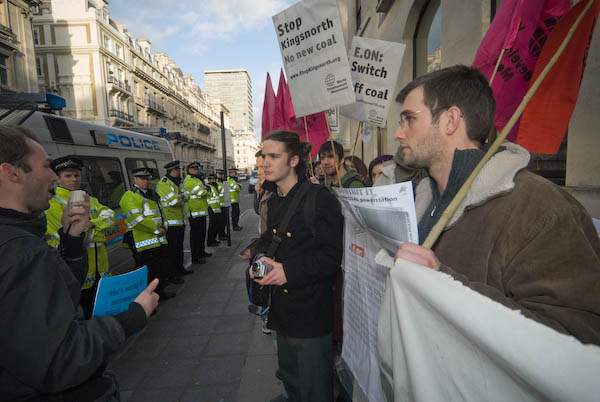
Stop Kingsnorth – No new coal fired power stations

The first I photographed was outside the Pall Mall offices of energy company E.ON who have recently got planning permission from Medway Council to build a coal-fired power station at Kingsnorth on the Thames Estuary. It’s now up to the government to decide whether to give it the go-ahead – another test of whether they take environmental issues seriously.

Of course it’s time we were moving away from large power stations and the high energy losses that come with transferring electricity long distances on the grid, moving to a decentralised low energy use society.

I like the picture above because of the way it lines up demonstrators and police facing each other and shows the whole situation with a speaker addressing the demonstration at the left of picture.

In fact I largely had to work from the side as the officer in charge told me I was obstructing the pavement when I stopped in front of the demonstrators to take photographs. We had a small argument and I reminded him that the police had reached an agreement with the press that recognised we had a job to do and should be allowed to do it, but it didn’t help. I pointed out that if I stood in the large gaps between the officers on the kerb I would not be either obstructing the pavement or impeding the police in any way, but was simply refused permission to do so, without any attempt to justify the decision – but with the clear suggestion I would be arrested if I disobeyed the instruction. So much for police cooperation. As you can see from the other pictures I took, I didn’t entirely do as I was told, but it did make my work difficult.

From Pall Mall I walked along to Trafalgar Square, stopping briefly outside the Uganda High Commission where a group of Kenyans was beginning to gather to demonstrate against the Ugandan president who has given support to the fraudulent Kenyan President. I didn’t stop long as I wanted to go to a larger gathering in Whitehall.

President Musharraf was visiting England, and expected to arrive in Horseguards Avenue by car. A group of around 50 Pakistanis was waiting their to protest against him. I took some pictures of them (and as with the other demonstrations you can see them on ‘My London Diary’.)

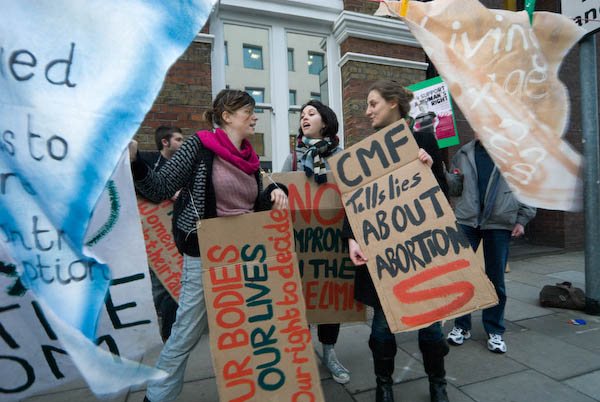
Finally I went to Borough in Southwark, where ‘Feminist Fightback‘ were demonstrating outside the offices of the Christian Medical Fellowship.

The CMF gave misleading evidence to the Parliamentary Committee which was considering possible reforms of the abortion act last year, and a number of its members with little direct scientific knowledge also gave evidence as if they were expert witnesses. They also support (and hosts) the minority report, which is in part based on their unreliable evidence.

Here there were no police and I was able to work without hindrance. Several people came out of the CMF office to talk to the demonstrators and they also had a table with soft drinks and biscuits although I don’t think anyone took any.

Although it was only a small demo, it was more interesting than many to photograph, and presented a few interesting problems, particularly because of a stiff breeze that kept blowing the items of ‘washing’ on the line that the demonstrators strung between a couple of roadside posts, making it hard or impossible to read the slogans on them. But I also liked the contrast between the CMF people and the demonstrators (with whom I felt considerably more at home despite a religious background.) Abortion is a subject that arouses strong and not always rational feelings, often with a failure to understand or appreciate what others are saying.

More about all these events – and of course more pictures – on My London Diary:
Stop Kingsnorth – No New Coal
Kenyans protest against Ugandan President
Protest against Musharraf
Feminist Fightback

Reality Crossings

I’ve just today got my copy of the Winter 2007/8 issue of ‘European Photography‘ magazine (no. 82 – the web site is out of date and still shows 81, another worthwhile issue, but on ‘Photography in Berlin’ as the current issue), which is devoted to the project ‘Reality Crossings’ shown at the 2nd Fotofestival Mannheim_Ludwigshaven_Heidelberg (FMLH for short) in Sept-Oct 2007. Unfortunately I wasn’t invited to be there, but from this magazine issue I think that ‘Reality Crossings‘ may well turn out to have been one of those significant defining moments in photography – like such shows as Szarkowski’s “New Documents” in 1967 or William Jenkins’ “New Topographics: Photographs of a Man-Altered Landscape” at George Eastman House in 1975. And although I didn’t see either of those shows, they changed photography and they changed my photography.

Reality Crossings was a much more diverse show than either of those I’ve mentioned, and the issue contains a photograph (or in some cases, several) and a short statement (mainly by the curator) about the work of around 66 photographers as well as introducing almost 20 videographers. You can see some of the work on the festival web site, (the link is to the English version). I’d recommend anyone with an interest in contemporary photography to both buy the magazine and to look at the work on the web.

Of course many of the photographers in the show will be familiar. They include several I’ve written about elsewhere, including Michelle Sank, Michael Ackerman, Christian Schad and Michel Tichy (as you can see, not all the work is contemporary) as well as a number already on my ‘to-watch’ list.

Of course a publication – or even an exhibition – with such a large number of voices has to be unsatisfactory in that it can only give the merest glimpse of what activates the various authors. It’s even rather an introduction than a manifesto, but, as the introduction by curator Christoph Tannert states, it is “based on realism as an outlook on life” and demonstrates “that courage is indispensable in the pursuit of truth.

He goes on to say “The documentary must be confronted with the psychedelic extravagance of the photographic eye, which also involves conjugating structures, reflecting on form itself.” This is a thought which resonates with me (and I think will do so with all fellow ‘post-street‘ photographers) and which reflects some of the spirit which has inhabited my own work, both in the post-industrial landscapes of ‘London’s Industrial Heritage‘ and in the web-centred profligacy of ‘My London Diary.’

Future-Proof Camera?

Leica M8 owners have recieved an interesting e-mail promising an update package for the camera, the first in what is described as “a perpetual upgrade program” which will result in the Leica M8 being able to “incorporate the latest refinements and developments in handling ease and technology.”

Registered users can buy certificates for the upgrade in March, but the factory will not start the work until August 2008, and we have still to be told the cost, but it sounds as if it will be very useful.

Included are two features which are significant improvements:

  • Scratch-proof sapphire glass cover for the LCD monitor.
  • Noise-optimized shutter with a fastest speed of 1/4000s.

The shutter noise has been one complaint by many users, including myself, who found the M8 sound much more obtrusive than the film Leicas. You can compare the two in the sound files on the Leica M8 Downloads page.

Also welcome is the news that a firmware upgrade, version 1.201 available from tomorrow, Feb 1, (presumably from the download page above) will improve the automatic white balance, one of the annoying minor (for those of us who shoot RAW) defects of the camera.

Leica does seem finally to be getting its act together with the M8, and it’s good to see that it intends to keep the early purchasers of the camera up to date rather than bring out a new model every couple of years. I just hope the cost will not be too great.

Along with Cornerfix – and of course those IR cut filters – we look like ending up with a truly usable camera. Like earlier Leicas it is a great camera to use – within its limitations, and the discipline that this imposes can be extremely productive. I found it very useful in Paris last November when I wanted to travel fairly light, shooting mainly with a 35mm f1.4 lens. Although it isn’t as flexible as a digital SLR, for certain things it is still the best tool. While the SLR is the Swiss Army knife of photography, the Leica is more of a scalpel.

Who Polices the Police?

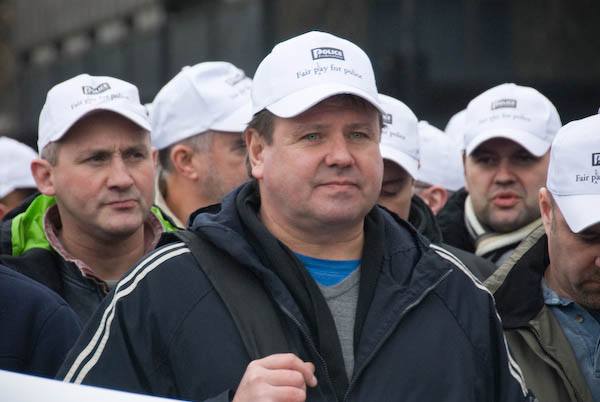
The answer of course is that the police do, and when 20,000 or so off-duty police marched through the centre of London last week, there were a few of their uniformed mates there to make sure things went smoothly. However the guy that usually divides the estimates of numbers on marches by 2 or 3 did seem to be taking a day off!

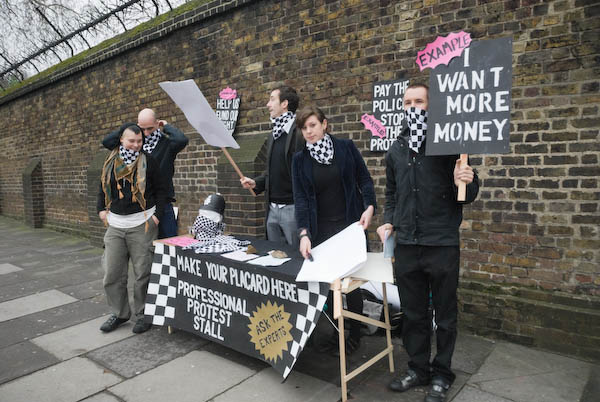
Apart from the numbers, it was a pretty miserable show, and the police clearly needed to take some lessons from the Space Hijackers, who had thoughtfully set up a professional demonstrators stand at Hyde Park Corner to give them advice.

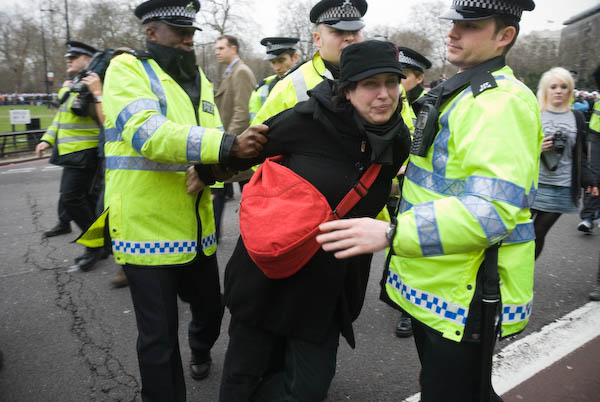
At the start, both ‘Class War‘ and ‘FITWatch‘ had turned up to show them how a mere handful of demonstrators can create rather more interest. With the uniforms being watched by a large media crowd, they were mainly careful to act rather more carefully than is sometimes the case when dealing with – and arresting a couple – of the protesters. The start of  the march was delayed for around half an hour by the protests.

But unfortunately one single man outdid even these, the presence marching with the police of the BNP mayoral candidate for London – largely keeping out of the way of the press – was the evening paper’s headline story.

I’d photographed him at the start of the march, but hadn’t thought anything of it. It’s no secret than there are many BNP sympathisers in the police, and it was no surprise to see him there, It was only when other photographers started to get a little excited about it, later in the march, that I thought I should perhaps get a better picture – but by then he had disappeared. In fact the picture the newspaper used wasn’t any better than mine.

At least one policeman in 20,000 has a sense of humour, and there were even a few who were clearly amused by the ‘professional protesters’, though rather more who shouted abuse (often using language that could have got them arrested!)

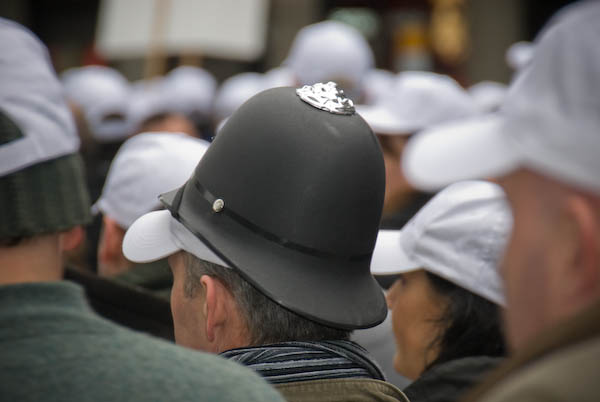
I also came in for a certain amount of abuse and pushing for being a photographer at one point in the march. The police do really have some problems they need to sort out, and their relationship to the media is one – though perhaps less pressing than others.

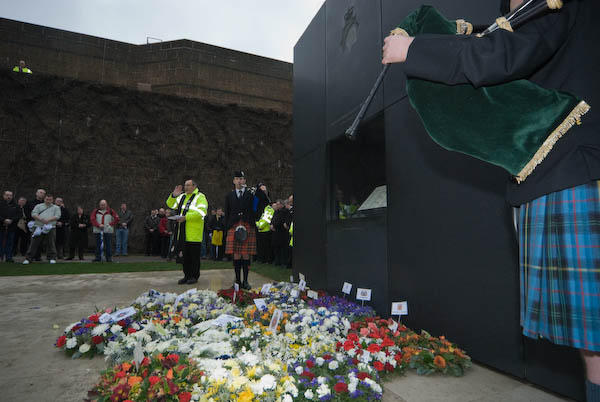
I’m not anti-police. They have a tough job to do, and need more and better training to do it. It is a dangerous job, and this was brought home when wreaths were laid at the National Police Memorial to commemorate those who have died doing it.

More pictures and text on the march on My London Diary.

All pictures are (C) 2008, Peter Marshall. All rights reserved.

Photographers and Politicians

Nowadays it seems to be de riguer for celebs feeling a tad low on publicity oxygen to slap a pap, and the police always seem to have better things to do than investigate cases of assaults on photographers (perhaps because the officers are too busy assaulting those photographers who cover demonstrations – more on the event where this took place on My London Diary.) So it was good to hear (thanks to PDNPulse) that it isn’t open season for politicians to give us a kicking too – or at least not in the USA.

Douglas Bruce, a new qand already controversial Republican in the house from Colorado Springs, interrupted his public prayer at the start of the session in the Capitol, diverting his thoughts from the holy to the lowly photographer crouching rather too close to his feet for the photographers safety. Bible in hand, Bruce booted photographer Javier Manzano one in the knee, upset that he was being photographed during his prayers.

According to the report in The Denver Post, Bruce thinks its ok because he just “tapped him with the bottom of my shoe” and his assault didn’t leave the photographer squirming in agony – there was “no sound, no shriek, no anything” – clearly we need to make sure to squeal well, though that could be tricky should you happen to be knocked unconscious. Manzano actually didn’t seem to be badly hurt – you can see a video of the incident on CBS4Denver although it doesn’t show the actual impact – you see Bruce moving to take a fairly firm swing and hear a thump. And before you get to the action you do have to put up with some more thumping in an ad for medical heart testing.

Bruce is still refusing to apologise, adamant that it is the photographer who should apologise – presumably for doing his job of taking pictures and getting kicked. He continues to refuse despite a 5-1 ruling from a Capitol panel that the Speaker should request a formal apology from him for disrupting the dignity of the chamber. The panel also unanimously recommended that the House should censure him.

The Denver Post already has, with a columinst giving him the tag of ‘Girlyman’, because he “kicks like a little girl” and suggesting that in any other business his conduct would have led to suspension or dismissal.

The Denver Post prints a picture taken just before the kick by their own photographer, and it clearly gives Bruce a dignity that his subsequent action shows is unfounded. Manzano was working for the Rocky Mountain News, where his rather more straightforward picture appears with their feature on the incident.

As this article states “House rules allow the media full access to the floor where the incident occurred. No restrictions are placed on photographers during prayers or any other activities.” Of course, things are rather different in this country and it may perhaps be wise to give Gordon Brown a little more room.

Thinking of politics and the press, things are also different in Brazil.
Congress Brasilia
This picture shows is the area immediately next to the lower house in their Congress building, open to the public, where representatives stroll out from the chamber and are interviewed by the press. As for security, I did write my name and country in the visitor book, though I think this was probably optional.

Cornerfix

For most users of the Leica M8, Cornerfix must rank as one of the most useful piece of software available, and certainly the best value since it comes free, thanks to the generosity of its writer, Sandy McGuffog.

The M8 designers found that the way to get sharper results, and to make a 1.3x size sensor usable with their wide-angle lenses was to use a thinner IR barrier filter over the sensor. When they released the camera they appear not to have realised the problems this would cause photographing in particular some black synthetic fibres.

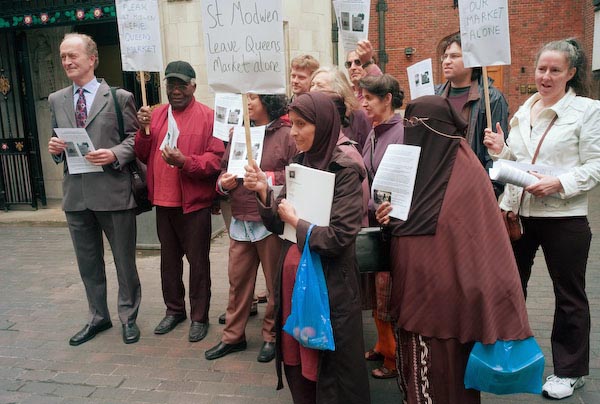
The first job I used my M8 for included photographing a group of people demonstrating against the development of Queen’s Market in Upton Park (pictures and text are some way down the page on the link) outside a shareholders’ meeting in the City of London. Most were wearing black but these clothes were rendered nicely by the M8 in various shades of plum and brown.


More uncorrected Leica images from this event

Careful selection of much of the black clothing in the image, darkening and slightly de-saturating it to produce a more natural result took several hours of work for a small repro fee. I’d done a quite a few test pictures before I took the camera out on this small job, but hadn’t chosen the right subjects or lighting to show how bad the problem could be.

By contrast, here is a picture taken with the Leica under similar lighting at last Saturday’s Ashura procession in London, using the same 21mm Voigtlander lens, taken and processed as described below:

No problems with colour, although rather more shadow noise from the M8 than I would like. The pictures in My London Diary were taken on a Nikon D200, which is more flexible and gives better colour although slightly less resolution.

Leica’s solution was to partly to provide a couple of free IR cut filters for the front of the lens. Apart from these being in rather short supply and slow to arrive, these were an excellent solution for 50mm and longer lenses, but gave an additional problem with wide-angles. Rays from the corner of the image came through the filter obliquely, resulting in a longer path and an over-correction, resulting in cyan vignetting at image corners.

Modern Leica lenses have a set of dots on the rear of the mount which can be in six positions and allow infrared sensors on the camera body to identify the lens. Using this information, camera firmware can correct the vignetting. Overall it’s a very good system giving better image sharpness across the frame than other cameras, but it leaves a problem for those of us who want to use non-coded lenses.

Leica will add lens codes to some older lenses (at considerable cost) but my wide angle wasn’t one of them. In any case I mostly use the considerably cheaper and more compact Cosina Voigtlander lenses. Various people soon found do-it-yourself ways to code these lenses, and for a time my old Leitz 35mm was working well this way. Then the ‘Sharpie’ marks wore off, and after wasting several hours trying to get it working again I gave up.

Cornerfix removes the need for lens coding, correcting the vignetting in software by using a simply created lens profile. It can actually do a better job than firmware as you can create different profiles for different lens apertures, though I think this isn’t really necessary.

To create a profile, you need to photograph a neutral sheet – either grey or white – filling the frame and using even light, avoiding any exposure clipping. Loading this into Cornerfix enables you to create a profile in a few seconds.

As stated, you can create profiles for different apertures, and also for different lighting conditions, however so far I’ve not really found this necessary, perhaps because the light has generally been overcast! Perhaps if we get a summer?

You need to separate out your DNG files by which lens was used, and then these can be batch processed to produce files with _CF suffixed to the name. If you are someone who changes lenses, this could be a problem. File size is also a slight issue for archiving; the _CF files with lossless compression are considerably larger, and Adobe Lightroom seems to lose the compression, producing 40Mb files compared to the original .DNG from camera at around 10Mb.

So I’m having problems in fitting Cornerfix and the processed files into my workflow and archiving. Should I archive the originals or the processed files? How do I fit this in with using Lightroom?

But Cornerfix itself couldn’t be simpler:

Shoot your white or grey card, load the image, use the Lens Profile menu to create a lens profile and save it into your cornerfix directory or elsewhere.

Most of the image settings should be left at the default unless you have good reason to alter them, but you may like to enable lossless compression:

Once you have lens profile(s) for your lens or lenses, you simply need to load the profile, then load either a single image or a batch of images for processing and let the program get on with it.

Left is input file, right is output.

Total process time on my computer is around 8 seconds.

During batch processing it writes the output to the same directory, so you should normally have copied the files onto your hard disk first. The output files are also DNG files and can be processed in any raw processor as normal.

Ashura Procession in London

Saturday wasn’t much of a day for taking pictures, the odd spot of rain in the air and pretty well zero light. But one of the things about photographing events is that you just have to get on and do it, whatever the weather. And Saturday was the 10th day of Muharram, Ashura Day when Shia Muslims remember the martyrdom of Husain and his small group of followers at Kerbala, Iraq in 61AH.

I was surprised to one London blog mentioning this event as a part of “Hidden London” last week. It isn’t too easy to hide several thousand people walking along one of the major roads in the capital, especially as some of them are banging drums and blowing trumpets, while others chant through loudspeakers to lead the mainly black-clad walkers in their mourning.

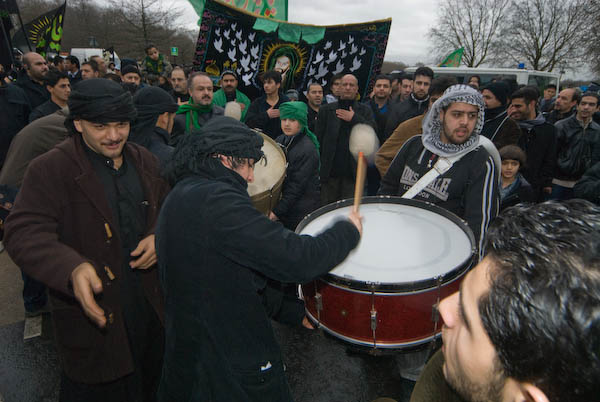
I’ve photographed it several years, I think for the first time in 2000. Despite the weather I was pleased with several of the images I got, particularly this one:


Ashura Procession, London. (C) Peter Marshall, 2008

It’s an image that for me captures some of the fervour and chaos of the event, and the participation of the men involved (I also got another picture I like of some of the women.)

This is an uncropped digital ‘straight print‘ developed from the RAW file using Adobe Lightroom, and it would benefit from a little ‘burning‘ and ‘dodging‘ before making the final output, but I seldom find time for this before putting work on the web. You can see this and some of the other pictures I made at the event on My London Diary as usual.

Peter Marshall

A House that was Home: Oyvind Hjelmen

Many of us have had the rather gloomy experience of clearing out a house when an elderly relative dies or goes into a home, and over the years I’ve seen quite a few photo essays around this theme, with photographers often photographing the house they grew up in as it is cleared ready to be sold.

I’ve done similar things myself, though more often regretted the fact that I never managed to get round to recording such places as my father’s old workshops at the back of his family house, sold when I was away from home at about the time I took up photography seriously. His premises were a health and safety officer’s nightmare, with a more extensive collection of tools from the cart-building trade than I’ve seen in any craft museum. But around 1970, nobody was interested in such things.


My Aunt’s house (C) Peter Marshall

Years ago, when one of my aunts moved out the home in which she had lived for around 50 years into sheltered housing, I did go round and photograph her, and her house in a small series of pictures, just before she moved.


My Aunt’s house (C) Peter Marshall

But most of the pictures I took, and almost all of those sets of work that I’ve seen by others in the past, have perhaps been too personal, too linked to the photographer’s own memories, to be of much interest to others. But there are exceptions, and one of them inspired this posting.

What made me think about this are a set of 12 pictures by Norwegian photographer Oyvind Hjelmen, ‘A House that was Home‘, on the ‘Lens Culture‘ web site. This series of a dozen small square images (the original prints are 12x12cm, exactly the size that I see them on my monitor) demonstrate Hjelman’s sensitivity to light and the subject. As Jim Casper writes, they “reverberate with a visual language of archetypes, memories and dreams.”


House that was Home VI

(C)
Oyvind Hjelmen

Jim has written rather more that you can read on the site, and I’ll leave it to him rather than write more myself – so do take a look. The above image from this series is also available as a signed limited edition print from Lensculture editions.

You can find out more about the photographer on his own web site which has four portfolios, including ‘House that was Home‘, which has one picture not shown on Lensculture.

Despite using Flash, it is a very clean and nicely designed site that is reasonably fast to load. The text is in English, although Google thinks otherwise and tells me “Yvonnee Charlotte Erdal bor i Bergen og er en anerkjent fotograf både innenfor kunstnerisk og kommersielt foto,” suggesting I might like to restrict my search to English sites. Fortunately I’m not so chauvinistic and though seriously linguistically challenged I don’t let it worry me. After all it is the pictures that matter, and they are worth looking at.