Along the Greenway

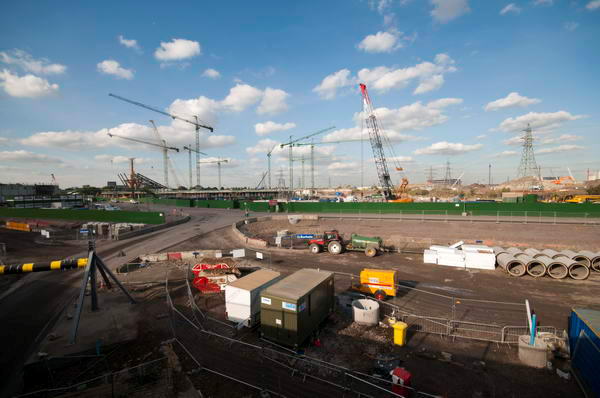
As it was a nice day on Thursday I took the chance of a walk along the Northern Outfall Sewer from Stratford to Old Ford, and then on to Hackney Wick. The ‘Greenway‘ of course runs through the centre of the London Olympic site, and last month a part of it was closed to allow for demolition work.


December 2007


Feb 2007

As you can see, things have changed slightly!

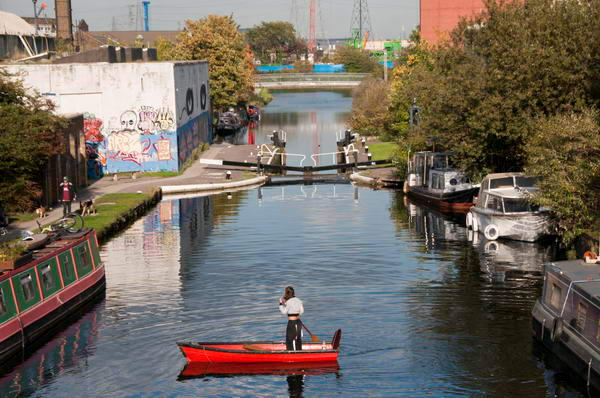
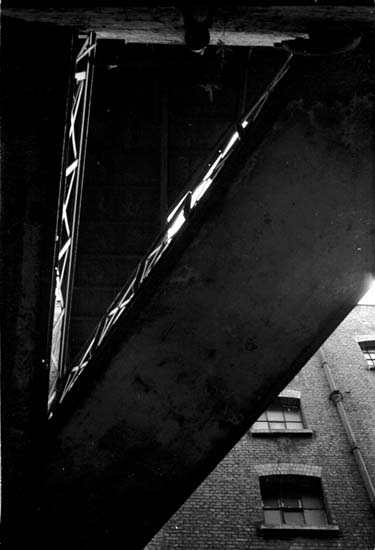
Further on, I went under the Northern Outfall where it goes over the Lea Navigation, and there was some splendid light and reflection:

From there I made for one of my favourite footbridges:

and had a job to tear myself away to get to Hackney Wick and catch the train to start my journey home.

More pictures on My London Diary.
East London Line

The East London Line is a vital transport link for many in East London, taking them across the Thames from Whitechapel to New Cross and New Cross Gate. The northern section to Shoreditch closed down a while back, and just before Christmas, the whole line is to shut for a lengthy period, opening as an extended service from Dalston Junction to Crystal Palace and West Croydon in 2010 (and adding Highbury & Islington in 2011.)

Although the extension is good news (and involves a fairly huge amount of public spending, although almost all of it is along existing routes), there is also bad news, that when it re-opens it will have been privatised, with 8 different contracts. The RMT union isn’t pleased, as the extended line will pay staff less and give them worsened conditions; it also thinks that there are safety implications of the sharing of signalling between London Underground and Network Rail.

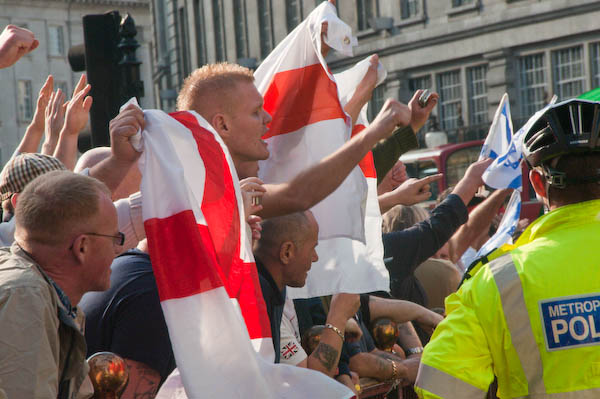
Last Thursday they demonstrated against the privatisation outside City Hall, on the riverside next to Tower Bridge, with a coffin representing publicly owned railways, undertakers and a jazz band as well as various banners. It wasn’t a huge event – most of their members will have been at work, and there were perhaps a hundred there, but a lively parade circled City Hall several times before a short rally.

Transport for London have provided some replacement services, but nothing for the most important part of the line, going across the river between Wapping and Rotherhithe. The feeble excuse is that the can’t get the right kind of buses to go through the Rotherhithe tunnel.

Until closure the journey will take you one minute. Afterwards the alternative routes suggested by the TfL web site usually take around an hour. If you were going to and from work that could mean an extra couple of hours a day. However can they think that is satisfactory?

More pictures of course on My London Diary.

Climate Change Demo

The news from Bali this morning is grim, though there were a couple of glimmers of light, including Kevin Rudd announcing Australia’s acceptance of the Kyoto Protocol. Perhaps there is some hope for those Tasmanian Wedge-Tailed Eagles now, but progress over tackling the bigger issues remains blocked by the USA, Canada and Japan.


The Statue of Taking Liberties

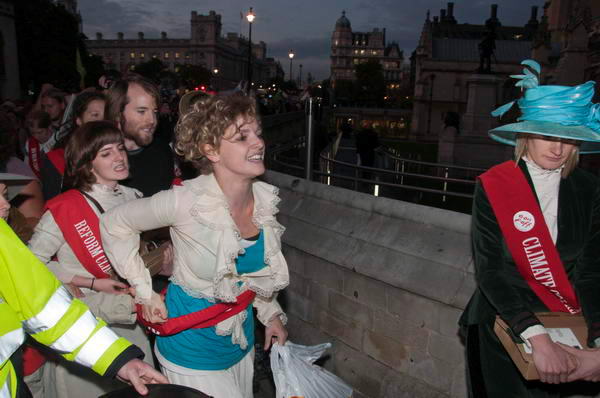
I’m still wringing out my camera after the London event in the Global Climate Change March on Saturday, which also saw Critical Mass out in force, as well as over 6000 marchers. The guys from Surfers against Sewage, in wet suits and carrying their boards were probably the most appropriately dressed for the occasion, or perhaps Lucy as a mermaid with her warning about rising sea levels.

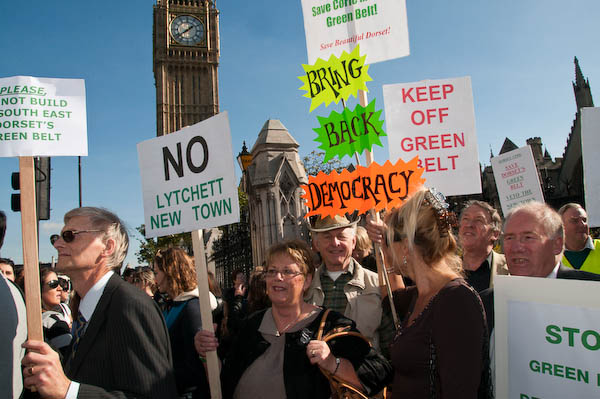
But, as was emphasized by the number of placards opposing the expansion of Heathrow, our government – like most others around the world – is still sitting  foot firmly down to the floor of the juggernaut, driving hard for extinction even as they start to make noises about the impending doom.

You can see many more pictures of the march, and of critical mass on ‘My London Diary.’  I, and my equipment, got too cold and wet to really do justice to the rally that followed the march in Grosvenor Square.  And of course you can read more about climate change at the Campaign against Climate Change web site.

Demonstrations such as this have a vital role – as I hope to be saying next week in Brasilia, where I will be showing similar images – in bringing environmental problems to public awareness and making it possible for politicians to think what was previously impossible.

And unless they do, it’s increasingly difficult to remain optimistic about the future.

Bilal Hussein and Press Freedom

If you are a photographer and work in Iraq, you run the risk of being imprisoned by the US military. The Committee to Protect Journalists claim that “dozens of journalists – mostly Iraqis – have been detained by US troops over the last three years.”

They get arrested for photographing or filming things that the US army would prefer not to be recorded. Those we know about were mainly working for major foreign agencies such as Reuters and Agence France-Presse, although I wonder if in fact we only know about these people because they were employed by the agencies. Are there many more we don’t know of?

Most get released without charge after a few days or weeks, but the site lists eight cases of more prolonged detention of up to a year. The details of each case ends with the statement: “Charges Substantiated: None

Of course the best known case is that of Associated Press photographer Bilal Hussein, who has been held for almost 20 months. I’ve previously written about him here (and elsewhere,) and linked to the campaign to free him, urging others to join in the petition to free him.

His case at last came to the Central Criminal Court of Iraq yesterday, 9 Dec 2007, but the magistrate issued an order that everything should be kept secret, so the AP report can only report the bare facts. Although Hussein and his lawyer were allowed to see some of the material presented to the court, they were not allowed to take copies to use to prepare his defence, and no actual charges were made.

Hussein and his lawyer have also not been allowed to talk privately in order to plan a defence; their meetings have been held with a US soldier and military interpreter present.

It is now up to the Iraqi magistrate to decide whether there is any case to answer – and if so, it will be dealt with by a panel of three judges. It isn’t clear how long this will take, and certainly at the moment there are grave doubts about whether if the case does come to trial Hussein and his lawyers will be given the opportunity to prepare a proper defence so that he can get a fair trial.

Here in the UK of course we do things differently, although perhaps not so differently if you read the time-line of the SOCPA antics by police and courts as published on Indymedia. It is news and I think important news that has hardly been covered by the mainstream press.

One thing that gives photographers (and videographers) covering events such as these on our streets a little – if limited – protection is the UK Press Card. It isn’t perfect, but it does at least sometimes mean that photographers will get treated as reporters rather than as protesters. This Saturday, photographing a picket at Tesco Metro in Lower Regent Street, I would quite likely have been arrested for refusing to go into a pen when told to do so by a police officer if I hadn’t been able to show my card.


Picket against Tesco support for bio-fuels, London, Dec 8, 2007

Strangely enough, most of the times when I’ve really needed a press card have been at small events – like that picket – where the mainstream press aren’t interested and none of the photographers working for them cover.

I photograph them – as do others – because we think it important in terms of freedom of the individual, freedom of expression and a genuinely free press that such things should be recorded and published – even if only non-commercial media – such as Indymedia – are prepared to do so. Most of us also make some money out of such pictures through their use in small publications and as stock. Not a great deal, but with luck enough to make ends meet, at least along with the occasional more lucrative jobs.

Some news photographers are scheming to severely limit the issue of press cards, basically to guys like them working more or less full-time for the big newspapers. It is a change the police would welcome as making their job considerably easier, but which would severely curtail the wider freedom of the press.

Peter Marshall 

Cruel Fur

Like many people, I thought fur was a thing of the past, remembering those old ladies who came to admire me in pram and pushchair, moth-bitten foxes around their necks, pungent with lavender and mothballs and worse. Later came the campaigns against fashion furs that meant that only the most thick-skinned of dumb animals would be seen alive in another’s coat because of the extreme cruelty across the whole industry.

It was this well-documented cruelty that led to the closure and banning of fur farms in the UK, but in other countries they remain alive and even more sick. I’m not a veggie but I am opposed to cruelty against animals (and wish that all farm production reached the standards of the best.)

So it disgusts me to hear that the big names in fashion and fashion shops are promoting the use of real fur trimming on their garments, and that these are on sale in shops in this country – and that it is perfectly legal to sell these cruelly-produced products. It’s a particularly stupid and callous trade, particularly stupid because in almost all ways the artificial alternatives look and perform better than animal skins. Anyone buying them is paying to wear a badge of cruelty.

Around 250 people joined a march on Saturday past some of the shops selling these tainted goods in Knightsbridge. The march paused briefly outside several shops before halting outside Harrods, apparently the only department store in the UK that still deals in furs, and where there is a regular picket every Saturday. After a brief address and many shouts of “Shame on Harrods”, there was a minute of silence before the march moved on, and I left them.


Outside Harrods in Brompton Road, Knightsbridge.

Surely it’s time the Government made time to ban this trade. It is one piece of legislation which would gain approval from the great majority of the British public and the kind of measure which would provide a sadly needed increase in their support.

Peter Marshall

Christmas comes early…

Christmas comes early in Surrey and doubtless everywhere else. So far I’ve photographed three Christmas events on the south-west fringes of London (and am wondering whether I can fit another in this evening.)

They switched the Christmas lights on in New Malden on 23 Nov, and it was Winter Wonderland in Wimbledon last Thursday. Friday night it was pouring with rain, but the Hampton Hill Christmas Parade went ahead as usual – if rather wetter.

I don’t much like working in the dark or in the rain, and struggling with an umbrella and a recalcitrant camera and flash made me wish I’d stayed in the pub. But all the performers in the parade were out there, mostly getting soaked, so I felt I ought to stick at it too.

Here’s one that I rather liked, and may get on my Christmas card.

Peter Marshall

Photo Histories

Some months ago, Graham Harrison contacted me about a new on-line photography site he was setting up, looking at photography in an intelligent way, and invited me to have a look at the preview site. I was impressed, and offered to write something, though as yet I’ve not got around to it. Perhaps later…

Photo Histories is now up for all to read, and the content so far is impressive, with a great interview with Philip Jones Griffiths, who talks about “why the ideals of the thinking photojournalist forged in the 20th century should not be sacrificed for the dumbed down culture of the 21st.” His ‘Vietnam Inc’ (1971) was one of the most important books of the era, and one that moved me and others powerfully when it came out – and is still a fine example of why photojournalism is important. I also have a great deal of sympathy for his views on the current state of Magnum which you can read in the interview. While others – including myself – have written about his work and its significance, this interview does add some insights into the work and the man who produced it – and has a nice picture of him by Harrison.

Another photographer I’ve also written about previously is Homer Sykes, whose self-published books Hunting with Hounds and On the Road Again I reviewed at some length. (You can download a pdf file of the Autumn 2002 issue of the LIP Journal where my review of On the Road Again appeared in print – and both – along with features on photographers Berenice Abbot and Brassai mentioned below – are probably available on the ‘Wayback Machine‘ or its mirror from About Photography.)

In Photo Histories there is another detailed interview with Sykes, as well as a interesting set of pictures ‘Unknown Homer Sykes : The English 1968 – 78‘.

I met Homer again earlier this year, when he was back photographing Swan Upping on the Thames for the first time for many years. You can see some of my pictures from the event at My London Diary, but surprisingly I don’t seem to have mentioned him. The two of us were the only photographers who ran along the river bank to record the Dyers and Vintners men raising their oars to salute the Royal uppers at the end of the day. I hope he got the exposure better than I did in the wickedly contrasting light. I left the D200 to sort it out and it didn’t.

Other features on Photo Histories include some on key books from the history of photography, including Berenice Abbott‘s ‘Changing New York‘ and ‘Paris de Nuit‘ with pictures by Brassai. Perhaps these were a little disappointing in not really dealing with the images, more with biography and background matters, but still useful introductions. Perhaps it might be a useful addition to have features about key images or sets of images from them as well.

Graham Harrison has of course worked for some of the big names in British publishing, and at the centre of Photo Histories is a section called by that same title, which includes an article (originally published on EPUK) about the first Press Photographer’s Year Expo held this summer. At the end is a footnote:

After the success of the Press Photographer’s Year Expo it was sobering to see Stoddart’s stills used with effect throughout the C4 TV documentary The Rise and Fall of Tony Blair credited to Getty Images only.

Moral rights – including that of attribution – are something that photographers still have to fight for. The Photo Histories section also has a very nice insider story by Brian Harris about working with the late Don McPhee during the 1988 US Presidential campaign.

As well as his main site, you can also see more of Graham Harrison’s work in ‘The Oxford Year,’ though in the two years this has been going he seems so far to have missed those swan uppers!

Streets of London & Paris

Two rather different photographers whose work I’ve enjoyed on the web in the last few days.

Paul Muse was born in England but has lived in Paris for quite a while. On his site you can see a daily image along with a short text (in both English and French,) and the text for 20 Nov:

Paris rediscovers the fun of getting around on foot.”

certainly got a response from me as I was still recovering from walking around Paris courtesy of the striking transport workers.

Don’t miss some interesting work on the gallery pages, including ‘London Falling‘, street pictures taken during a short visit to the city in August 2006, and much more. If you are in Paris his work is on show at the Galerie du Lucernaire’ until 2 Dec – details on his site.

I met Paul when I was in Paris recently, but unfortunately didn’t get to see the pictures then. Next November I’ll book a longer stay, because there really is so much to see – and of course even more next year, when November will also be the ‘Mois de la Photo‘ along with its incredible ‘Off’ fringe.

Brian David Stevens is a photographer I’ve known for a while, and we sometimes find ourselves standing together at events in London, although the pictures we make are usually very different. He continues to work with black and white film in a Leica (he tells me the latest stuff is ‘digital Tri-X’ using a Ricoh GR-D) while I’ve moved to using digital colour (sometimes with an M8, but more often with a Nikon) but there are even more significant differences.

He describes his profession in his ‘Lightstalkers’ profile as “miserable sod” (I think it comes from the Welsh blood.) And although its a mode I can do pretty well myself (look, my middle name is Gwyn), I like to have fun when making pictures.

But his work is dark and powerful, with lots of empty blacks, and it works well, both with the images using reflections and the very direct images of people on the street, often viewed looking up from hip level. One of his images of two women in particular really jumps off from the screen with forceful menace.

It’s interesting to compare the pictures on Flickr where he now posts work, with those on his older personal web site. There are some of the same images, and clearly the same vision, but presented very differently.

Peter Marshall

Paris Strike – Manif, Walks, Party

My diary of pictures from Paris is now on line, on ‘My London Diary‘ and includes pictures from several walks around Paris – thanks to the transport strike there I walked everywhere.

I also got to photograph a ‘manif‘ by the transport workers – where I met a and photographed an angel, as well as some of the union leaders and others there.


© L’Ange Blanc – see http://angeledenia.canalblog.com/
Image used with permission.

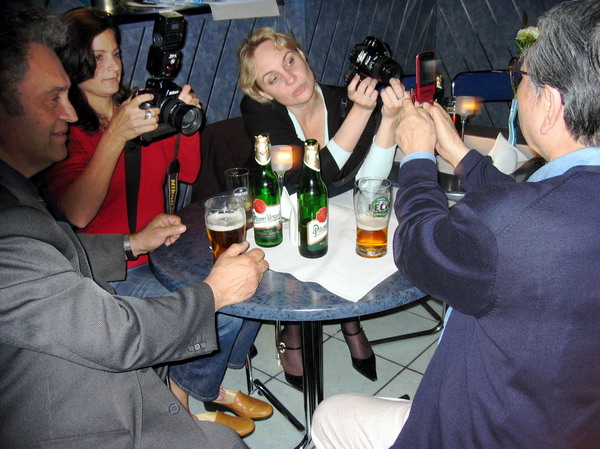
There are also some pictures taken at an excellent party; the party was good, so I’ve no idea who took some of the pictures, though I do appear in them. I think we all had a good time.

To protect the guilty I deliberately haven’t included any names in the captions, though you might recognise some of us. The same is true of the photographers I’ve shown at Paris Photo.

Most of the pictures from Paris were taken on the Leica M8, a camera about which I still have mixed feelings. Working with it is almost like using a film Leica, but the shutter noise can be obtrusive. And there are still problems if you haven’t got the latest Leica lenses with 6 bit coding.

This would matter less if Leica actually made suitable lenses for use with this 1.3x camera, preferably by bringing out some relatively cheap 24mm, 21mm and wider optics (They have produced a 28mm f2.8, but I’d like wider.)

Voigtlander have the lenses (and I own several) but they don’t have the Leica coding. You can add this manually, but this doesn’t work with my 21mm as it has the incorrect lens adapter. The coding allows the camera to compensate for the lens vignetting – which when using the IR cut filter needed for decent colour gives your pictures cyan corners.

Mostly I worked with a Leica 35mm f1.4 (which Leica says won’t work with the camera) fitted with an IR cut filter and some appropriate black marks for 6 bit coding made with a genuine ‘Sharpie’ pen. This is fine, but basically a standard lens (1.3 x 35 = 45.5)

With the Voigtlander 21mm f4, every picture has to be run through software to remove the colour vignetting. It’s an extra chore and using PTCorrect as a Photoshop plugin doesn’t always do the job quite perfectly. I’m hoping I can do it better with CornerFix once I get to grips with it.

Leica could add a menu item as a firmware upgrade that allowed users to get suitable built-in support for non-coded lenses. It would make many users a lot happier with the camera.

Copycat Images?

Copying of images has been making the headlines again in recent weeks. The estate of Bob Carlos Clarke perhaps appears to be claiming rights on any close-up of lips and a tongue, and preparing to take Pepsi to court – you can judge for yourself the validity of their claim on the Amateur Photography web site.

For me, such originality as exists in Carlos Clarke’s image is in the biting down of the teeth on the lips, the particular upthrust of the curled tongue, the slight dynamic tilt and the grainy black and white tonalites, all absent from the Pepsi offering, which – as one might expect from the US giant – is bland, pink and ugly.

It is after all, subject matter we all have to hand (or at least mouth) and probably many of us are wondering if in turn we can sue the estate if Mr Carlos Clarke given that we’ve been photographing people with mouths since the 1960s (or whenever.)

Another case over a similar issue has been decided in the Paris courts, and you can read about it on EPUK (Editorial Photographers UK.) The court ruled that a picture used by the “French National Tourist Office Federation (FNOTSI) was a deliberate copy of a Getty Images stock photograph” by Ian Sanderson.

Here there seems to me little doubt about the visual similarity of the two images – and you can compare them in the EPUK feature, which lists the similarities. As Getty argued in court, you cannot copyright the idea of a couple kissing on a roundabout, but this was an obvious attempt to recreate the image, including the appearance of the models, clothing, pose, background and viewpoint.

Sanderson’s image is widely known, and the only surprising thing about the case appears to me that the agency concerned didn’t just put up their hands, say its a fair cop guv, apologise and then negotiate over the fee. I suspect they may well have tried to do so, but found that Getty were intransigent. The court settlement, including costs, is said to be well below the five times the normal fee that Getty demanded, and given that it took 4 years to reach a settlement one suspects the real costs involved, including all the time of the people concerned, may actually leave Getty out of pocket, though the photographer should be in the money.

FNOTSI have of course lost out – and deserve to on various counts. They had to scrap the campaign and replace it – at an estimated cost of 60,000 euros, as well as paying the fine and damages. And apart from the deliberate breach of copyright involved, they only paid the photographer concerned a miserly 1750 euros for the work, expenses and licencing – when getting the original legally from Getty would have cost around five times as much.

This pair of images is just one of those featured earlier in an earlier feature on Visual Plagiarism on EPUK, now updated, which I’ve written about previously elsewhere.

One vital point to make is that it isn’t sufficient for two images to be visually very similar to cry plagiarism. Your original has to really be original in the first place; there can be plagiarism in copying a cliché. And by my reckoning there are several images featured in the EPUK feature that would be disqualified by that test.

Another problem is that of coincidence. I wouldn’t for a single moment accuse Fay Godwin of either plagiarism or producing clichés, but when I opened one of her books some years ago, I recognised one of my pictures, taken at Chatsworth. One that had actually been hanging on my wall for several years at the time. I made my image in 1984, while hers, in the book ‘Landmarks‘ is dated 1988. (The two pictures are not quite identical, and hers is taken or cropped to a square format.) And although I knew Fay and on various occasions we enjoyed going around exhibitions together and sharing our often similar prejudices, I’m sure neither of us had seen the other’s image when we made our own.

There is a big difference between this case and that of the couple on the roundabout. Neither Fay nor myself arranged anything for the photograph, it was simply a matter of being in the same place within a few inches and using a lens with a similar angle of view (mine was I think a 35mm on an OM body) pointing in more or less the same direction in similar lighting.


I think this was my second picture of the sleepy lion and it was made in May 1984. I’ve put the two pieces of sculpture a little closer together, but the resemblance is fairly striking. (C) Peter Marshall, 1984

Strangely enough, looking through my contact sheets later, I found that I had actually made a very similar photograph on two occasions myself, although I’m fairly sure I didn’t remember the first when I was making the second image. Although I’ve generally got a pretty good memory for images, it is something that has happened to me on a number of occasions.