Plane Stupid – Heathrow Expansion

I was too busy sorting through thousands (literally) of pictures for my talk next week to go up to Parliament Square yesterday morning to photograph the lobby and rally about a referendum over the updating of the European union, so I missed getting a picture of Plane Stupid activists who had climbed onto the roof of the Houses of Parliament and hung two large banners down the front of the building, one reading ‘BAA HQ‘ and the other ‘no third runway www.planestupid.com

It was a protest not just at the expansion of Heathrow, but also at the false nature of the consultation process, where large parts of the consultation document were written by BAA and the government has already decided (barring horrific accidents – such as almost happened recently on the approach over Hounslow when a plane lost power and had to glide in, only just making the airport) on not just a 3rd runway but also a 6th terminal.

Apparently as well as hanging the banners, protesters also made paper planes of the secret documents they had obtained showing government duplicity and fixing of the consultation process and flew them down into the MPs car park.

Photographically I don’t regret the missed opportunity, because I think it only too likely that any pictures I had taken of the event would have been at least as boring as those published in all the papers and Internet accounts I’ve seen. Perhaps one of the 3 men and 2 women who carried out the protest took a camera and made some better pictures?

These are protesters on a rooftop at Heathrow in August, and marchers in London last December:

Of course the protest has been going on ever since the plans were first revealed to a stunned public, and I photographed the local protesters in Sipson and Harmondsworth in 2003.

Of course Gordon Brown doesn’t like the demonstrators, deploring their actions, although in fact this and other similar protests have actually been very useful in pointing out gaps in security. Brown doesn’t like it because it reveals the facts about the skewed consultation process and the alliance between the promoters of unbridled airport expansion and the government (an alliance that started in the 1940s, when the public were first duped about the setting up of a civil airport at Heathrow.) He doesn’t like it because it highlights the absurdity of his claims to an environmental policy.

I grew up under the flight path in Hounslow, in my dreams able to reach up from my back garden and touch the planes as they roared over. I live a short bus ride from the airport (though my post code excludes me from the consultation over flight paths – all those planes that come over me must have lost their way!)

Heathrow was always in the wrong place. Continued expansion over the years has made its position more and more untenable. It makes no more sense than Croydon. We should have begun a new airport to replace it thirty or more years ago. There shouldn’t be any debate at all over its expansion, but simply about how fast it can be run down.

Peter Marshall

The Romance of East London

I’m still not sure where my walk around London’s East End at the Museum of London on Thursday 6 March will take me, but it will I think be a personal journey that reflects on my photographic involvement with the area over the years.

Image- reload if not showing - invite

The event, from 6-9 pm, is a part of the Mayor’s ‘east’ festival, is free and everyone is welcome.

One place I may start.

Image- reload if not showing - St Katherines
St Katherine’s Dock closed in 1968 and these warehouses were
demolished in the early 1970s, shortly after this picture was taken.

Walking across Tower Bridge and seeing the warehouses of St Katherine’s Dock, about to be demolished was where I started to photograph East London.

Image- reload if not showing - Victory Cafe
Victory Cafe, 1986

And it will certainly include the pictures such as the cafe above that were in Cathy Ross’s recent book, The Romance of Bethnal Green (she will be signing copies – and you can see more pictures in an earlier >Re:PHOTO post, Bethnal Green Blues.)

Brick Lane is sure to feature.

Image- reload if not showing - Brick Lane
Brick Lane, 1998

Then perhaps there are some of my pictures from a sometimes surreal docklands after the closure, the colour series of shop fronts and street detail which reflect the changing populations of the area, the black and white records of much of its urban landscape. The River Lea and around, from long before its Olympic disruption to the present, Canning Town (I’ve written a walk) , the DLR, demonstrations, religious festivals and more. I’m not sure how much I can squeeze in to a half-hour or so during the evening, but one event I’m sure I won’t leave out is a real East End street party for the Queen’s Jubilee.

Image- reload if not showing - Jubilee

Peter Marshall

Another View: Jason Parkinson

I first met Jason Parkinson when he was illegally detained by police while covering a demonstration at the Harmondsworth and Colnbrook detention centres in west London in April 2006. Police were refusing to accept that he was a journalist and denied that his press card, issued by the UK Press Card Authority was a real press card. On the back of the card it says “The Association of Chief Police Officers of England, Wales and Northern Ireland and the Association of Chief Police Officers in Scotland recognise the holder of this card as a bona-fide newsgatherer”, but while this may be so, it often doesn’t seem to be good enough for the officers on the street.


Jason shows his press card to no avail at Harmonsdworth

Jason called out to the three of us standing on an earth bank a few yards away taking pictures, asking us to show our press cards and confirm his was genuine. This left me in a little of a quandary, as when getting things ready for the day I’d noticed that mine had expired at the end of the previous month, which had meant I’d had to hold it with a strategically placed thumb when I waved it at police earlier. Fortunately another colleague jumped forward with a valid card and confirmed that Jason’s was genuine, although even then he was not immediately allowed to exit the police bubble.

It’s typical of Jason that he was in there with the demonstrators covering events, as the strapline from his blog has it, “from an uncompromising angle.” Since then I’ve met him covering many events, and also suffered similar treatment from police who’ve refused to accept my press card as genuine – some officers appear to react rather negatively to the fact that it says ‘NUJ’ prominently on it.

Of course we shouldn’t need a press card. Citizens in a democratic countries enjoy various freedoms, including the right to photograph in public places, freedom of assembly and so on. But no longer so in England in areas designated under SOCPA or indeed most places where a political demonstration is taking place, where our police often assume arbitrary powers and misuse provisions intended by Parliament to prevent terrorism.

But having a press card doesn’t solve problems, nor does the existence of agreed guidelines. In his blog post on the police pay demonstration, Jason writes ‘This officer, CO35, then decided to ignore Metropolitan Police guidelines and halted photojournalists from doing their job. Not just once, but twice. When asked if he knew he was restricting freedom of press CO35 answered by saying, “go away”.’ The only thing that surprises me is the mild language of his response – but of course he knew that Jason was recording every word on video, and that the footage would almost certainly be published.

Its always interesting to me to see how other photographers have covered events that I’ve attended, and on Jason’s blog there are several recent examples of events that you will also find on ‘My London Diary’, including my view of the Anonymous protest against Scientology, Police Pay and Freedom of Protest events. But Jason also gets to places and stories that are harder to reach, and February’s entries include a lengthy report on the ‘Beyond Slavery‘ conference and an interesting feature on Football for Change Iraq.

O I L and the second invasion of Iraq

Three letters O I L were always the key to the otherwise inexplicable invasion of Iraq. Oil, state owned, was Saddam’s greatest – almost his only – asset. The giant multinationals wanted rid of him so they could make a killing – and now they are getting their way through the Iraqi government. The first invasion was military, the second is economic. The first has been a disaster for the Iraqi people, and the second will ensure that disaster continues long-term.


Pirates in New Bond St

The tour last Saturday was a fun event – about a very serious problem. People enjoyed dressing up and it certainly helped to gain some attention from the West End crowds.

More on My London Diary

Police Apology for Photographer

The good news came today that photographer Marc Vallée, injured by police while photographing the ‘Sack Parliament’ event in Parliament Square, London on 9 October 2006, has accepted an apology and out-of-court settlement from the Metropolitan Police. You can also read some comments about the case on the NUJ site.


Police medics treat Marc after he was assaulted by police

The incident happened after a stand-off between demonstrators and police on the edge of the square facing the Houses of Parliament. This involved around 20 demonstrators who made an attempt to push through a police line, while perhaps a hundred more watched, together with a large number of media. Marc was assaulted despite very obviously being a photographer rather than a demonstrator, holding a camera, carrying a camera bag and with his NUJ press card clearly visible. Like the rest of the press present he had already been asked to show his press card, and is in any case well known to many of the police – as are the others of us who photograph such events. The attack on him was clearly an attack on a member of the press, and could have happened to any of us.

The policing on the day was entirely an over-reaction to a threat of no consequence posed by a small number of anarchists, mainly students, whose actions are largely symbolic and at most threaten minor damage to property. They might well graffiti a wall or even throw an egg or custard pie a politician, but they are in no way a serious threat.

I was stunned on arriving in Westminster that day to find more police than I’ve ever seen before (or since unless you count their plain-clothes demonstration for more pay.) I don’t know the official number, but my estimate was around a thousand.

As well as forming a line along the front of the Houses of Parliament there were more in Parliament Square and in the other streets around, who apparently stopped many of those intending to come to the demonstration, threatening them with detention under an Act brought in to prevent terrorism.

Of course I’m against terrorism. But I am opposed to the use of law to prevent the normal freedom of movement and of political protest. As too are many individual police I’ve talked to at demonstrations.

It was inevitable that a small group of demonstrators would confront the police. Their aim wasn’t to blow up Parliament but simply to block traffic by sitting down in the road in the front of the buildings.


Police line up to face demonstrators

A ritual scrum attempts to push through the police line

But the line holds

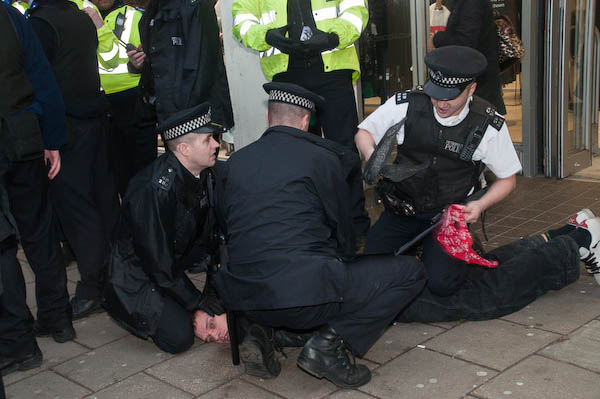
A few minutes later, the police charged the demonstrators and surrounded them, along with a large number of people who had done nothing more than stand in the square and watch. I left more or less straight away, but some other press who stayed inside were apparently not allowed to leave, being treated exactly as the demonstrators. The demonstrators were then held for several hours, with the police making occasional violent raids inside their cordon to grab individuals and take them to the waiting police vans, the others were only allowed to leave after giving police their details.

Various others around the square were also set on by police and taken inside the cordon, or in a few cases put directly into police vans. Most protested they were simply bystanders and had taken no part in the demonstration.


An incident later in the day involving gratuitous violence on a man protesting his innocence but making no attempt to resist his arrest.

Despite my press card, I was also threatened with arrest and issued a warning that I might be committing an offence under SOCPA.


The officer in charge reads the announcement that those present are being detained

Among those bundled into a police van was one man attending the event as a ‘legal observer’ in a high visibility jacket. A woman walking her bicycle across the square against the flow of traffic in the one-way system was also manhandled by police briefly before other officers rescued her.

It was a day the seriously eroded my respect for the police force. They got the intelligence severely wrong, totally misunderstanding the nature of the event. They showed a lack of control, acting with totally uncalled for violence on a number of occasions. They threatened the media – and injured one of them. You can see more of what happened in my account and pictures on My London Diary.

In any other job, those responsible would have been severely reprimanded, but I was later to hear a senior officer defending the actions of the day. It is rare to get an apology from the police, but I think almost all of us who were there deserve one, and I’m very pleased to see that Marc has received not only an apology but also a settlement.

Media Attacks on Muslims

Sometimes it’s hard to make interesting images of important events. Often things just aren’t that interesting. Press photographers, at least in the UK tend to ‘set up’ a picture, but its something I always try to avoid. We don’t seem to have the clear distinction between news and features that is always made in the USA, where the kind of things that many British newspaper photographers do as a matter of course would soon get them fired.

But at least it is rather more difficult for photographers to completely fabricate stories. Or to ask other people to make up stories and phone them in to you. One of the more appalling stories to hit the UK political blogs recently is a leaked email apparently from Diana Appleyard of the Daily Mail offering £100 to anyone who wanted to phone her with “anonymous horror stories of people who have employed Eastern European staff.” I don’t know how many responded to her call, but it seems a golden opportunity for spreading nasty racist slurs – and for the Daily Mail to stoke the prejudices of its readership.

But it was the Daily Express where in 2004 NUJ members objected to the pressure being put on them to write articles denigrating gypsies, who ran the headline: “CHRISTMAS IS BANNED: IT OFFENDS MUSLIMS” (our Muslim relatives send us Christmas Cards – and expect to get them,) and much more designed to stir up and encourage anti-Islamic prejudice. And on Thursday, around 20 people picketed the Express offices on Lower Thames Street with placards asking for an end to media attacks on Muslims.


My framing cropped the placard that said “Stop Media Attacks on Muslims” but otherwise I think it was the best picture I took.

You can read more about it, and see a few of the pictures I took at the event on My London Diary, where I hope you will notice some changes to the site. It took a lot of fiddling to get the new design to work in Internet Explorer 6, which just doesn’t do some things right. It isn’t really possible to get it to work properly, and the site is best viewed in more up-to-date browsers such as Firefox, where the improved navigation really seems to help.

Back to thinking about photographing events that lack the kind of visual interest that photographers would like. I think photographers have got to sometimes admit that a particular event was not that visually interesting, and be prepared to turn in pictures that show it as it was. Setting up pictures is putting a foot on a slippery slope and we owe it to those who see our pictures not to mislead them.

One in Love

One of my photographer friends came up to see what was happening while I was taking pictures of the ‘Reclaim Love‘ party at Piccadilly Circus on Saturday and talked to me briefly before turning around and making for Oxford Street, where he was going to photograph what he called “the real world.

In so far as the world has gone mad, of course he was right. Spending money we don’t have on goods we don’t need is what keeps our economy expanding, generating ever-increasing consumption to fuel global warming. Cheap clothes and consumer goods have proved far more effective than bread and circuses, and the new religion of the masses is a far more potent opiate than Marx’s old foe.

Of course it can’t continue for ever. Exponentially increasing consumption is not in the longer term compatible with a finite planet. As someone who has been talking about such things for 40 years – and in some ways as least living as if it mattered (though I have a fairly comfortable hair shirt) I find it heartening that a few more people now realise this too, although it may be too late to save civilisation – and certainly if it has a future it is not as we know it.

But the good news is that it might be rather better. It could be much more centred around people (though very possibly less of them) and less on profit. Events like ‘Reclaim Love’ are perhaps a small foretaste of one possible future.


(C) 2008, Peter Marshall

Of course as well as things like this, we also need the kind of more obviously political actions – such as those I’ve photographed in London that were the subject of my show for FotoArte in Brasilia. And the kind of practical things that were also included in the example of the Manor Gardens allotments, another place were people mattered.

But there is also bad news. Although those of us in the wealthier countries cause most of the problem, our wealth also insulates us to some extent from the consequences, as too does our geography. Sea level rise and the perturbation of climate through global warming will cause more frequent and harsher catastrophes, in particular the flooding of low lying countries without the protection of expensive sea defences.

On a much more local scale, the Manor Gardens allotment holders are now sadly having great problems with their temporary accommodation on the Leyton Lammas Lands. The soil was taken there from the highly contaminated Olympic site, has been treated – which may have removed contamination, but has also removed the living elements, including worms which are vital to a healthy structure. It also appears to have been put on top of a barrier which prevents proper drainage and is currently waterlogged.

For Collectors

I’ve never been a collector of photographs although I do have a very large collection, mainly of my own work, but with a few fine pictures by other photographers, including one or two vintage prints worth fairly serious sums. But I’ve always felt that the kind of photography that interests me most was largely produced for publication in magazines and books, and that these are the things that anyone with a deep interest in the medium should collect.

Of course there are photographs that are made to be seen as objects and that suffer greatly from reproduction; the gum bichromate that usually hangs in my front room would be one example, although even framing it behind glass as I have really kills the tactile nature of the image. It’s replacement for this year, a finely printed large format 2008 calendar* with pictures from the 2005 FotoArt Festival in Bielsko-Biala can hang without protection (and also has the bonus for me that the August image is my picture taken on the riverside at Greenwich, and it feels good to be in such respected company as Pilar Albajar & Antonio Altarriba, Gunars Binde, Stefan Bremer, Shadi Ghadirian, Eikoh Hosoe, Peter Korniss, Joachim Ladefoged, Sarah Saudek, Antanas Sutkus, Lars Tunbjork and Ami Vitale.)


Greenwich, February 1982. (C) Peter Marshall
A couple of my favourite photographs on display are from gravure portfolios published years ago in an American photographic magazine. I’ve seen the originals of both, one a pigment print, and the other an albumen print, and the gravures are both better prints, though costing several thousands of pounds less. On my bookshelves are thousands of superbly printed images (along with rather more where the printing is indifferent or worse) including many colour images which are keeping considerably better than most of the high-priced vintage prints I see displayed by dealers at the shows.

Some books are of course also extremely valuable collectors items now, and the two volumes by Martin Parr and Gerry Badger on photo books have certainly helped to create a market for some of the more obscure (and sometimes deservedly so) titles around. With notable exceptions it isn’t the most interesting works that become the most collectable, but probably those that were either produced in very short runs or that failed to attract much sales at the time.

I do have a few signed copies of books, but I’d never dream of paying extra for one, although a simple signature by the artist adds significantly to the price. But except for those photographers I’ve known personally I really don’t see any point. Obviously I’m not a collector.

A couple of recent events brought these thoughts to the top of my mind. One was finding a link to an article by Paul Messier on the AIPAD site, ‘Preservation of Photographs: Handling, Storage, Display, Conservation & Retention.’ This is a short piece by one of the authorities on the subject, but probably won’t tell most photographers anything they don’t already know. My own older work is stored in conditions almost guaranteed to cause rapid deterioration – some in my loft, glacial in winter and baking in summer, and all suffering from the occasional high humidity of the damp low-lying Thames valley. Which perhaps explains my own conviction – currently heretical among conservators – that the best chances for survival of my own work are digital.

Recently as a member of the London Photographers’ Gallery I got an invitation to a ‘Collecting Photography Course‘ they are running next month. It looks an interesting programme of half a dozen events including the VIP reception for the Deutsche Borse award with champagne and canapés, as well as talks by some very knowledgeable people and visits to the V&A, Michael Hoppen Gallery and Merill Lynch. At £400 it’s a little above my budget, but if you have excess thousands or millions sitting in your Swiss bank account ready to invest in buying photography, well worth the price.

*Collectors – serious offers are invited for my two spare copies of this highly collectable 58cm x 58cm calendar!

Anonymous Protest

Fair game‘ isn’t fair, or a game, and it isn’t either legal or moral. Wikipedia describes it as “various aggressive policies and practices carried out by the Church of Scientology towards people and groups it perceives as its enemies.” So if you plan to protest against them, it is probably a good idea to hide your identity.

Last month, part of a Scientology video featuring Tom Cruise was posted onto YouTube, and the Church of Scientology (C0oS) successfully demanded its removal, although it and other material about them has since been reposted. The unauthorised biography of Cruise by Andrew Morton has also stirred up controversy, with its allegations – repeated on YouTube – that Cruise is ‘Number 2’ in the organisation. There are also YouTube videos which allege that the CoS had pressurised some Australian booksellers not to stock the book. CoS is also alleged to have forced YouTube to remove some other material that describes its doctrines and practices.

The Internet movement ‘Anonymous‘ emerged  to oppose these CoS activities in mid January,  aiming to remain anonymous to avoid retailiation under the ‘fair game’ policy. In a couple of weeks it managed to set up an international day of action with demonstrations in 50 cities in 14 countries against the CoS, including two in London.

Demonstrators work masks, many choosing the mask used in the film ‘V for Vendetta’, with some also togged up in the matching wig, hat and the rest. The ‘Anonymous’ YouTube videos also had some resemblance to the Warner Bros product, and I’m sure that at one point I heard “People should not be afraid of their governments; governments should be afraid of their people.

Pictures from both London demos

Captioning Dreams

One of the consequences of age (along with diabetes, exacerbated by too many mugs of coffee staring at the computer screen) is that most nights I wake up around 4.30 am (yes, Alex*, AM does mean in the morning.) Fortunately after a short visit to the bathroom I normally fall quickly back to sleep. But this morning, I had a little shock as I woke, struggling as often out of a dream. I realised that my dream had been a kind of dream about a dream, in which I had been captioning each of its images for my pages at Alamy.

As contributors to Alamy will already know, each image submitted needs extensive key-wording, caption and description information, and it is a time-consuming process to add these, made more tedious as the system doesn’t match up well with the more standard IPTC meta-data. Yesterday I spent around 6 hours working on a batch of images submitted last month, so it’s hardly surprising that it was still at the top of my sleeping mind.

I’m not sure that my images will in any case sell from Alamy, as probably they are the wrong kind of subject matter for its customers, and those wanting my work are more likely to look elsewhere – perhaps in specialist libraries such as Photofusion, where I also have work. Or better still; come directly to me having found what they want in the 25,000 or so images on My London Diary. I do get plenty of requests to use images from there, but too few from anyone who can afford to pay.

The simplest approach to keywording would be to make use of a controlled vocabulary, and there are hierarchical lists available for import into applications such as Adobe Lightroom, for example, the Controlled Vocabulary Keyword Catalog or CVKC. I’m not sure that their listing would be particularly appropriate to my rather limited field of work, and until the libraries I work with adopt it, I don’t think it makes much sense for me to pay the modest dollar cost but much more significant time input to make use of it. However the site does have one of the best pages of advice on captioning images I’ve come across, of course starting from the basic “Who, What, Where, When, Why and How?” but with some other very useful tips.

But, as my dream showed, things can take over our lives. I’ve met many people who have said to me that they never take photographs, as they feel it makes them into observers and they would rather take a full part in what they are doing. It’s a view I have some sympathy with, but then there are plenty of events I’d rather observe than take part in.

But there are other occasions where photography is an important part of how I take part in things. It’s also important to me in preserving my own memory and sense of what happened. In the 1960s I threw myself into various things, and was too busy to take photographs. Now I find that it’s true that if you remember what happened you weren’t really there – largely because these were exciting times and too much was happening rather than substance abuse. All I have are occasional glimpses – being in a dressing room with the great master of the tenor sax, Ben Webster, came back to me a few weeks back (my job was to get him on stage able to stand, largely accomplished by drinking my share of the whisky he would otherwise have got through on his own. If he could stand he could play. And did, beautifully. I’ve never really liked whisky since.)

It wasn’t that I didn’t have an interest in photography. But in those years you either had to be extremely rich or devote hours of your time to the darkroom to be a photographer. I was penniless and already trying to fit more than 24 hours into every day. It didn’t help that my camera was still suffering from a rusty shutter after being dropped in the lake at Versailles, making speeds above an eighth of a second problematic and those below default to B. All in all I have little photographic record of those times to jog memory, one of my great regrets.

*Alex ten Napel, a fine Dutch photographer I met in Bielsko-Biala, Poland, left checking his travel arrangements home rather late. In the car when we were going to dinner to celebrate the end of the event, late on the night before we all left, he asked me “does AM mean morning?” And found he was booked to leave in a few hours on the 4.30am train. His portraits of swimmers, taken standing with them in the pool, were one of several highlights for me of the Foto Art Festival there.