Angola & Muslims

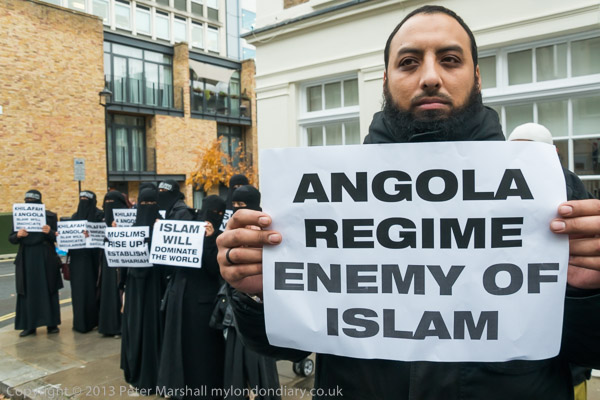
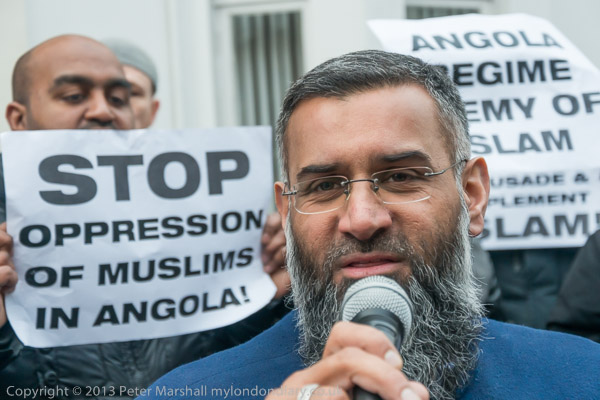
I don’t know how much you know about Muslims in Angola, but when I took the picture above outside the Angolan Embassy just off Baker St in London I knew very little. So of course I Googled it, and came up with several articles, including one in The Guardian and I think on Wikipedia, and wrote a little about why this protest was taking place to go with my pictures, along with rather more about Anjem Choudary who came along to speak at the event.
Thanks to a post by AFP Fact Check, from AFP Kenya, I now know that these pictures have in recent months been shared on social media along with pictures from various countries showing mosques being demolished in posts falsely claming that Islam has been banned in Angola
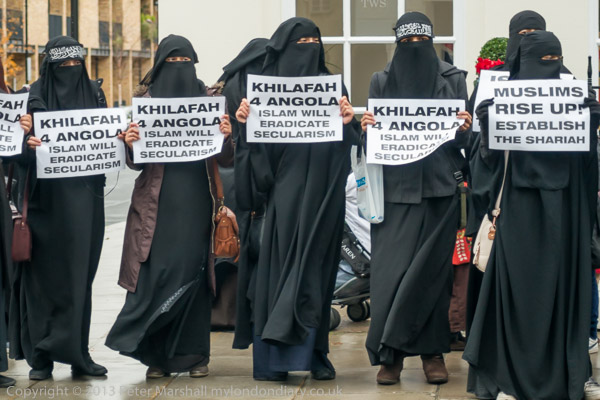
Mary Kulundu, the author of ‘No these pictures are not evidence of Angola banning Islam‘ searched for the pictures online:

Finally, there are two photographs of Muslims protesting against the Angolan government. A reverse image search on Tineye showed that these two images were originally published in 2013 by the British photographer Peter Marshall on his website, My London Diary.
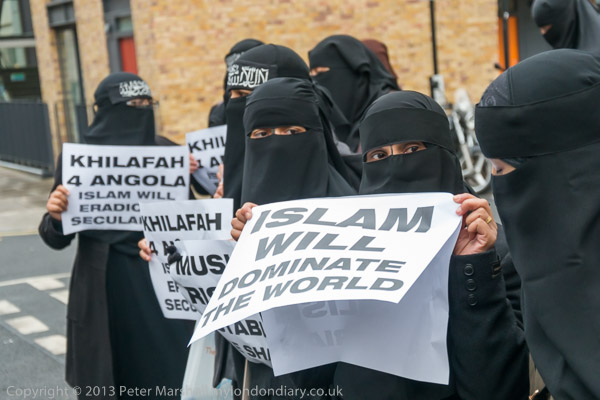
It isn’t of course true that Islam was banned in Angola, but an Islamic organisation had failed to get legal recognition in Angola, along with many other non-Christian organisations, which greatly restricts their activities. Several mosques have been destroyed and others closed and Wikipedia gives some some details, though the article may not be not up to date. But there are said to be 60 mosques still open in the country and Muslims are free to practice their religion.
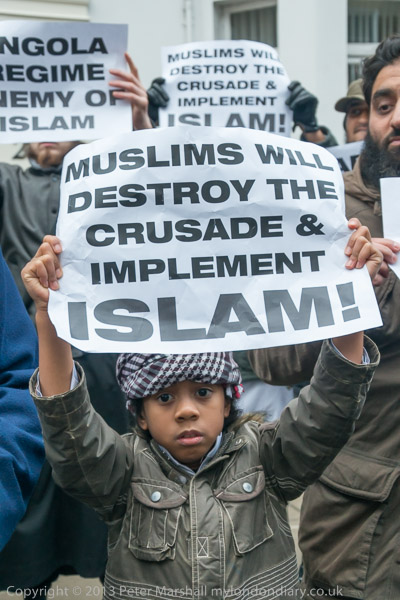
But Muslims in Angola are still trying to get official recognition almost six years later, though apparently there is less opposition now, and the number of signatures required by any religious congregation to acheive recognition has been lowered from 100,000 to 60,000. Estimates of the total number of Muslims in Angola vary wildly from around 80,000 to 800,000, almost all of them Sunni Muslims.

Back in November 2013 I speculated on why Choudary had not yet been arrested, and a couple of years later he was, and sentenced for urging others to support ISIS. Of course when I took these pictures in November 2013, few had heard of ISIS, which was only proscribed in June 2014 . When Choudary talked about Sunni armies being on the move and establishing the Khalifa (caliphate) I thought he was being a fantasist, but all too soon the reality became clear.

See and read more at Islamists Protest Angolas Ban on Muslims


There are no adverts on this site and it receives no sponsorship, and I like to keep it that way. But it does take a considerable amount of my time and thought, and if you enjoy reading it, a small donation – perhaps the cost of a beer – would be appreciated.

My London Diary : London Photos : Hull : River Lea/Lee Valley : London’s Industrial Heritage

All photographs on this and my other sites, unless otherwise stated, are taken by and copyright of Peter Marshall, and are available for reproduction or can be bought as prints.

To order prints or reproduce images


Whose face in the surf?

The detailed and forensic investigation of Capa’s D-Day pictures by A. D Coleman and his co-workers continues to come up with fresh information and insights. Ordinarily I wouldn’t be much interested in the precise events of Tuesday, 6 June 1944, or indeed of any other day of World War Two, but two things make it of great interest.

The first is that whatever the precise circumstances (and we now can be sure what with remarkable accuracy what these were) Robert Capa produced on of photography’s most iconic photographs there, and one that has accreted to itself a remarkable body of largely incorrect legend in writing and film, and secondly that in a couple of weeks time the events of that day will be the subject of major celebrations, which will doubtless parade much of the imaginative inventions around the ten or eleven pictures Capa made duing the landing.

The latest addition to our knowledge comes again from ‘combat veteran and amateur military historian Charles Herrick’ and gives us some insight into about how legends about such events arise, through what Coleman has called “borrowed glamour”.

Apparently quite a few ex-soldiers over the years came to believe that they were the ‘face in the surf’ in Capa’s most famous picture, and in the first of three parts of his latest investigations Herrick examines the claims made by two of the men who actually took part in those D-Day landings .

The best known of the contenders is Huston “Hu” Riley, who landed with Company E, 2nd Battalion, 16th Infantry Regiment in the first wave of infantry, and claimed that a man wearing a war correspondent’s patch on his shoulder helped him up out of the surf. Herrick points out that Capa didn’t wear the patch and wasn’t on the beach at the time the first wave arrived. Whover helped Riley up, it wasn’t Capa.

The second account he discusses is by Charles Hangsterfer, Headquarters Company commander and adjutant of the 1st Battalion, 16th Infantry Regiment, who claimed to have met Capa on the beach, but Herrick shows the details of his story and Capa’s movements on the day make this impossible.

These memories of “borrowed glamour” from the stories recorded by those who took part in the landings usually 50 or 60 or 70 years later are not a case of deliberate deception, but as Herrick writes “When memories fade, it is human nature to reinterpret events in more favorable lights, or place oneself in slightly more important or significant circumstances.” Retelling our stories we always add a little, often confusing our own memories with what others have told us, and with what we have read in books and films (and for D-Day veterans particularly ‘Saving Private Ryan‘) , and bit by bit our memories shift from experience to fabulation.

I don’t expect it will ever be possible to make a positive identification of the face in that surf. Capa’s picture isn’t clear enough to really recognise anyone and too much time has passed. Although we can be sure that whoever it was made it safely onto what was by then a relatively safe beach, he could have been killed minutes, hours or days later during the war; even if he made it safely back to the USA he may well have forgotten the incident and would probably have been unable to recognise himself in the photograph.

But perhaps among those who have put themselves forward as that man, there may be one – or more – who could possibly have been that man. I await parts two and three of Herrick’s post to see if he can cast any more light. But in the end it perhaps doesn’t matter. Like the grave of the unknown soldier, Capa’s picture perhaps gains from his anonymity, the photograph of an unknown man.

Swansong

Another blog ends, along with that of Lens I wrote about yesterday.

I was very sorry to read that David Secombe has written his last post for ‘The London Column‘, a blog I’ve occasionally read over the years and which has featured the work of several people I know, mainly photographers. It’s “Pictorial reports from the life of a city 1951 to now” began in 2011 and they make some interesting reading, featuring “contributions from some of the best writers and photographers from the past sixty years“.

Swansong, published a couple of weeks ago, but which I only came across yesterday, takes a look at the work of Marketa Luskacova, with her pictures from Spitalfields in the late 1970s and early 80s along with her earlier pictures of middle-European pilgrims and the villagers of Sumiac, a remote Czech hill village, both of which featured in her show which closed last Sunday at Tate Britain.

It’s a show I mentioned on >Re:PHOTO in February, though really only in passing, in a piece mainly about the anti-Brexit SODEM protesters. In it I wrote:

‘Finally arriving at Tate Britain I had to find the show, which wasn’t easy – the gallery does really need to look at its signage. Finally I asked one of the gallery staff who didn’t really know but gave me a map and pointed in roughly the right direction. The show does continue until May 12th 2019, so if you start now there is some chance of finding it by then.’

This was echoed at the start of Secombe’ post:

‘Anyone staggering out of the harrowing Don McCullin show currently entering its final week at Tate Britain might easily overlook another photographic retrospective currently on display in the same venue. This other exhibit is so under-advertised that even a Tate steward standing ten metres from its entrance was unaware of it.’

But Secombe goes on to write at some length about Luskacova’s work, around eight well-chosen examples, concluding with the statement “It seems appropriate to close The London Column with Marketa’s magical, timeless images.”

So far as I can recall, I’ve never met Secombe, though we share many interests and his ‘Blogroll’ is largely of web sites which I visit at least occasionally and I’m sure we must have at least occasionally found ourselves at some of the same places at the same time. I do hope that he keeps the site online, as there is much on it that remains of interest.

Keeping up a blog like ‘The London Column’ takes a lot of time and effort – as does this one, and even more so, My London Diary (a blog in spirit though all my own website code, started back when blogs were in their infancy) I’ve often thought about bringing both to an end, but while this still gets a few thousands of readers everyday it seems as useful a way of spending my time.

Lens Ends

Sad news to hear that the New York Times Lens blog is to end at the end of this month, May 2019. You can read more about it on PDN News. The closure, described by the NYT as a “hiatus” for an indefinite period means the end of one of the more thoughtful and innovative blogs about our medium after around ten years, with a number of posts by James Estrin and his co-editors that I’ve mentioned here – though not as many as I might.

Meaghan Looram, NYT director of photography, says it is time to rethink and “give serious thought to how to better position Lens for the future.” I suspect that means a dumbing down and an end to contributions by people with any great love or knowledge of photography, though I sincerely hope I’m wrong.

Lens has been more than just another photography blog. As PDN points out it has promoted many emerging photographers as well as highlighting work from earlier eras that has often been overlooked or under-appreciated. And importantly, as it states “Lens is one of the few photo blogs to pay the photographers whose work it features.”

That’s an important point, not just because many photographers need the money – it’s very tough for many, particularly young photographers to make a living, but because so many others seem to assume that photographers can live on ‘exposure’. But exposure won’t pay the bills. Are the journalists, the printers and others involved in publications and campaigns working for free? When anyone asks me if they can use my pictures without payment I have a simple question to whoever is asking – ‘Are you being paid for your work? ‘

Of course my suspicions about Lens are based on my own experience with the NYT, who bought a company I worked for and ruined it because the bean counters were determined to aim at the lowest common denominator and forced out those of us who wanted to write intelligently. By the time they sold it on it had lost most of its financial value and virtually all of its credibility.

Home Office on Trial

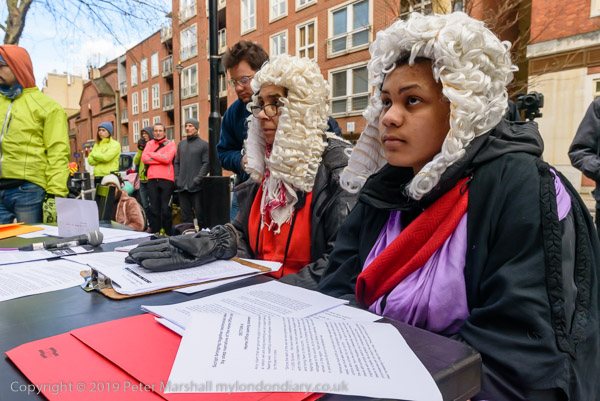
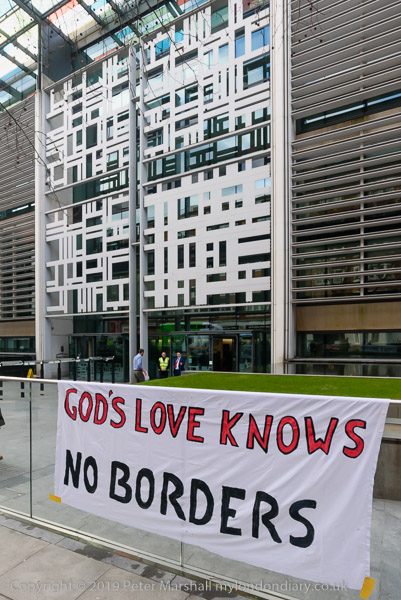
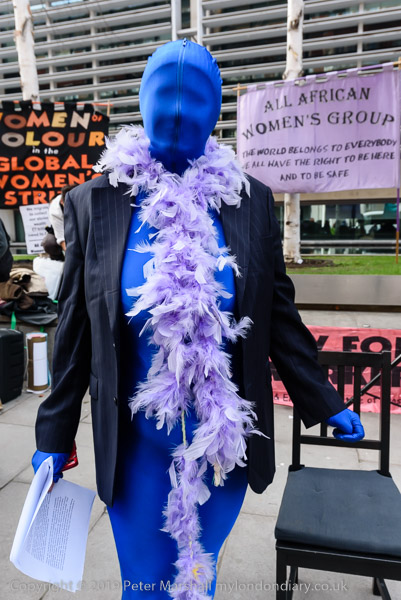
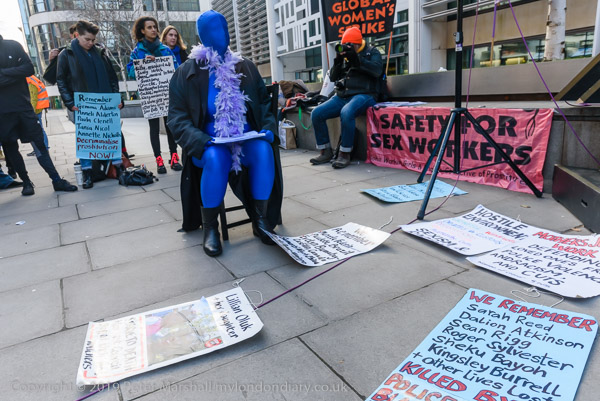
This wasn’t a normal protest on the wide pavement in front of the Home Office, but a theatrical piece in which the Home Office was represented in the dock of a court by a mysterious figure in blue, and I found it a little difficult to photograph with its rather different structure. It was good to have some better than usual props but I think perhaps it was an event more suited to video than still photography.

There is of course no doubt that the Home Office, in particular under recent ministers Theresa May and Amber Rudd, is guilty as charged, and has set up a vicious and racist system of rigged justice, indefinite detention, ill-treatment and arbitrary arrest and deportation under the name of the ‘hostile environment’, though this has longer and deeper roots.

The UK’s modern immigration laws have always been set up in response to racist popular sentiments, beginning with the 1905 Aliens Act, responding to fears about the numbers of poor Russian and Polish Jews arriving in the country. The huge increase in immigration detention began under New Labour, using PFI schemes in 1998 to build Yarl’s Wood, Dungavel, Oakington (which closed in 2010) and greatly expand Harmondsworth.

This huge expansion was needed because New Labour led a great programme of immigration enforcement within the UK, particularly of failed asylum seekers along with others who had overstayed their visas or entered the country illegally. Under Labour the first enforcement teams were set up, the Immigration Service transformed into a law enforcement agency, and new stricter laws on marriages and employing workers without legal right of residence were brought in.

Labour had begun the hostile environment, but it was Theresa May who gave it the name and ramped it up, with Amber Rudd following closely in her footsteps. After she was forced to resign over lying about the Windrush scandal, her successor Sajid Javid made some minor changes (mainly to the language used) and has suggested the UK ignore international laws on asylum.

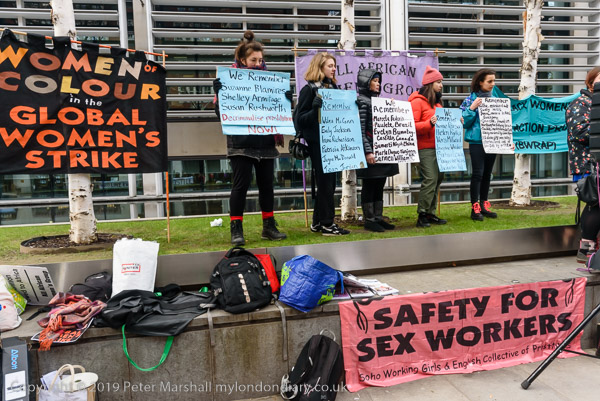
Its racist immigration policies and enforcement was not the only only crime with which the Home Office was charged. There was a strong presentation of its policies on sex work, which have resulted in the deaths of many sex workers.

More pictures from the trial at People’s Trial of the Home Office .


There are no adverts on this site and it receives no sponsorship, and I like to keep it that way. But it does take a considerable amount of my time and thought, and if you enjoy reading it, a small donation – perhaps the cost of a beer – would be appreciated.

My London Diary : London Photos : Hull : River Lea/Lee Valley : London’s Industrial Heritage

All photographs on this and my other sites, unless otherwise stated, are taken by and copyright of Peter Marshall, and are available for reproduction or can be bought as prints.

To order prints or reproduce images

XR Hackney

Extinction Rebellion are of course right in their analysis of the situation, that we face an unprecedented challenge to the future of human life on earth, and that governments around the world are failing to take this seriously enough. The scientific evidence keeps stacking up but politicians either deny or let themselves be diverted from real action by the lobbyists from companies still making huge profits from polluting.

What is less clear is whether the actions they are taking will lead to the drastic changes which are clearly needed. They face huge opposition from extremely wealthy and powerful companies and the many ultra-rich who are doing very nicely thank you from our status quo and have yet to realise that there is little point in laughing all the way to the bank in a dying world.

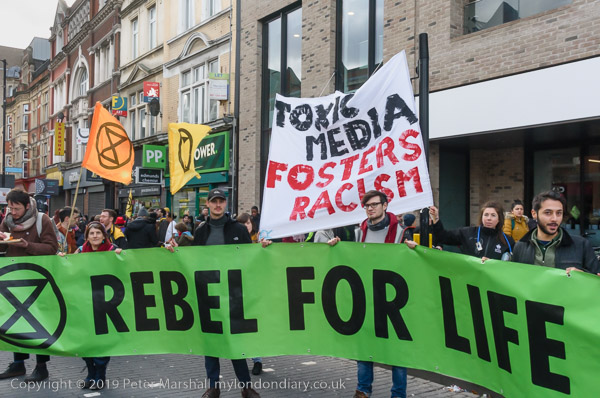
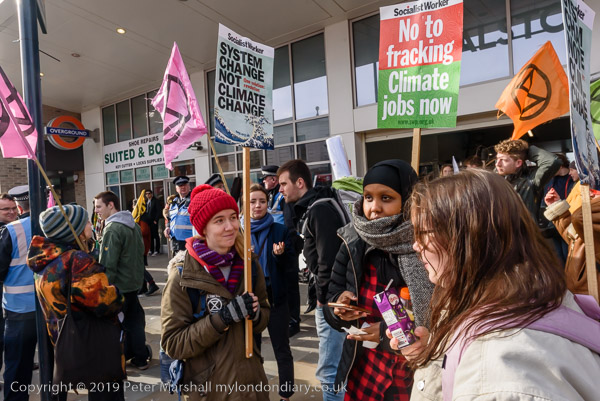
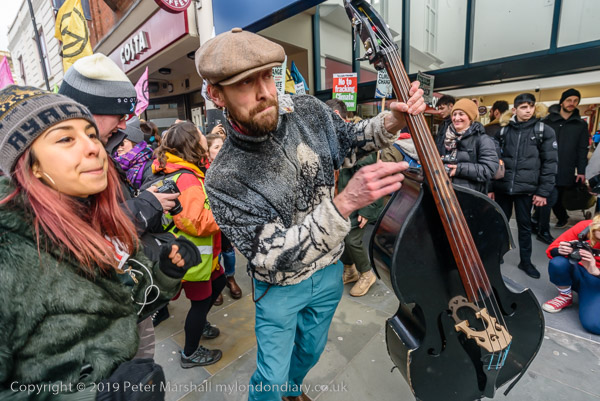
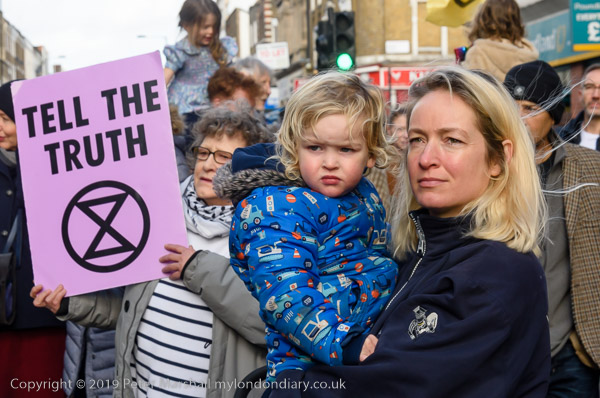
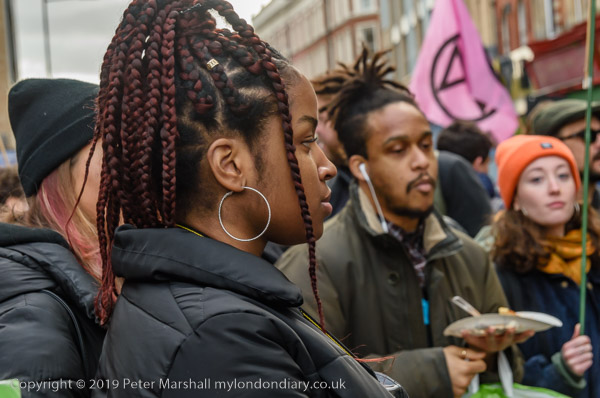
Clearly too, as my pictures I think show, XR’s appeal is still largely to an educated middle class (though my apologies to the minority who will be insulted by this description.) The crowd that gathered on Kingsland High Street for the protest was very different from that thronging the adjoining Ridley Road market.

XR have attracted much flak from parts of the left, particularly for their attitude to the police and arrests, particularly for encouraging people to be arrested and to cooperate with the police, to treat them as friends. For many on the left, ACAB is a matter of faith, and sometimes of bitter experience. Certainly the police seem too ready to act as agents of the state, even where this means perverting justice – and parts of our legal system encourage this.

But at least XR are doing something, and their activities in recent months have begun a shift in the media and perhaps even in our currently Brexit-obsessed politics. While their keyboard critics have nothing to show. The Hackney Street Party may have been just a pleasant event on a nice day causing a little congestion as traffic was diverted by police around it, it was a small step in raising awareness – and part of a much larger campaign, aiming to build a wider movement. Perhaps XR will at some point be overtaken by other more radical actions, with backing from political parties, trade unions and the working class, but at the moment there is little sign of them even putting on their running shoes let alone coming to the starting blocks.

More about the XR Hackney Street Party and of course more pictures.


There are no adverts on this site and it receives no sponsorship, and I like to keep it that way. But it does take a considerable amount of my time and thought, and if you enjoy reading it, a small donation – perhaps the cost of a beer – would be appreciated.

My London Diary : London Photos : Hull : River Lea/Lee Valley : London’s Industrial Heritage

All photographs on this and my other sites, unless otherwise stated, are taken by and copyright of Peter Marshall, and are available for reproduction or can be bought as prints.

To order prints or reproduce images

Livingstone

Bank of England return Venezuela’s Gold

I’ve several times been interviewed by journalists who have asked to name my most important photographic accessory and my answers have varied according to mood and the kind of photographs we are talking about. A good pair of shoes is one of my favourites, but the thing that really made much of my photograph of London possible was the Travelcard, introduced when Ken Livingstone was in charge of the Greater London Council before Mrs Thatcher put London Government back thirty years in a fit of pique by abolishing the GLC and selling off its building.

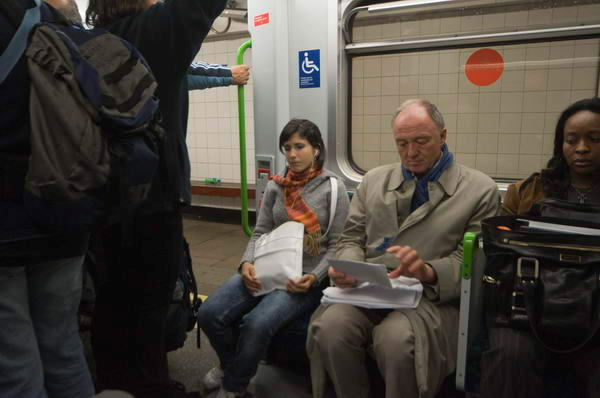
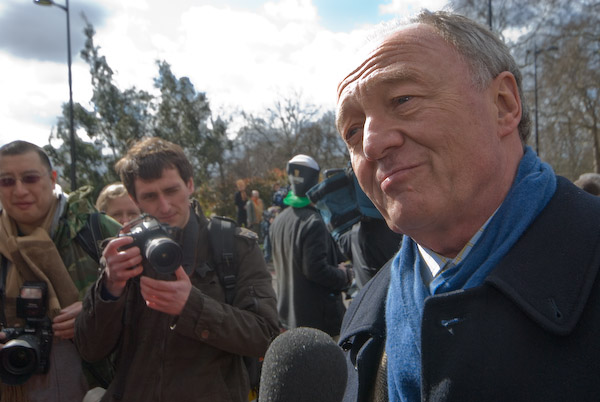
The picture above was taken a few days before the election when he knew from the opinion polls he was almost certain to lose to Boris Johnson. I’d photographed him speaking at an event and we just happened to catch the same train. Just after I took this picture, several people came and asked if they could take ‘selfies’ with him, and he smiled at them and told them of course they could.

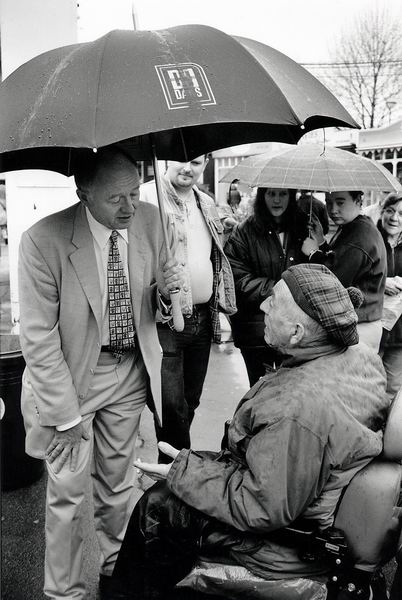
I’ve always been impressed when I’ve watched Ken talking to strangers. Here’s a picture from a few years earlier with him holding an umbrella in an April shower as he shares a moment with a well-wisher at an event at Gabriel’s wharf, Southwark.

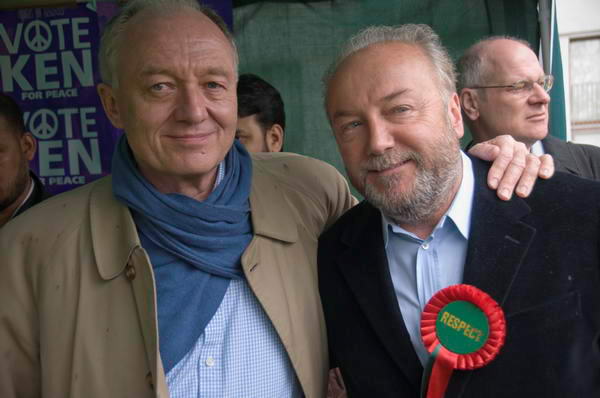
Again a few days before he lost the election, here he is with George Galloway who also spoke at an event in Altab Ali Park in Whitechapel.

As Mayor of London in 2002 he bgan the official celebrations of St Patrick’s Day and I photographed him five years later at the event.

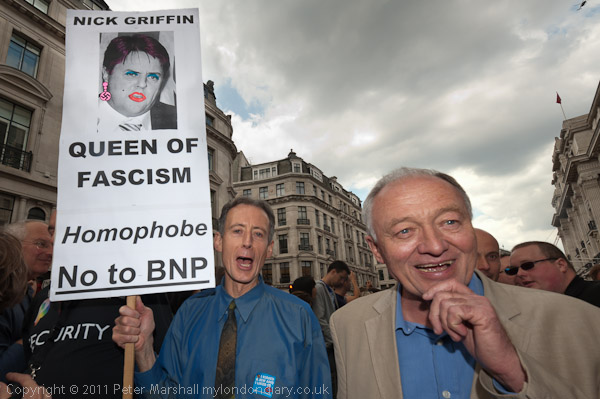
Ken did a great deal fro gay rights and also for all of London’s ethnic minorities. Here he is marching at Pride with Peter Tatchell in 2011 three years after losing the mayoral election; security let photographers approach the marchers for a few seconds and I made this picture.

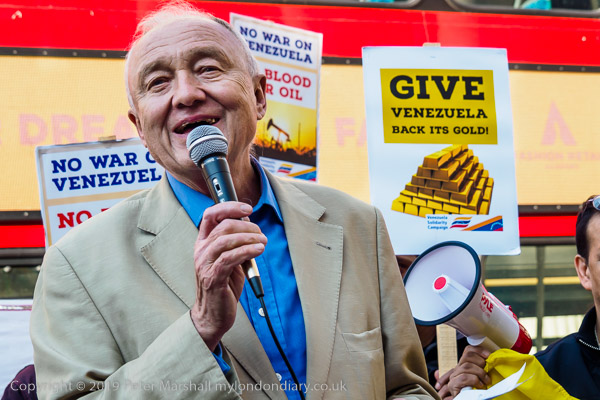
Ken Livingstone was certainly the most interesting of the speakers at the protest outside the Bank of England calling on it to return the 14 tons of Venezuelan gold to the Venezuelan government of President Maduro.  He recalled the visit to London of Hugo Chávez, and how money from Venezuela’s state oil company enabled him to give half price bus fares to lone parents and sick and disabled Londoners in return for teaching planning and traffic management skills to Venezuelan officials.

More at Bank of England return Venezuela’s Goldhttp://mylondondiary.co.uk/2019/02/feb.htm#gold


There are no adverts on this site and it receives no sponsorship, and I like to keep it that way. But it does take a considerable amount of my time and thought, and if you enjoy reading it, a small donation – perhaps the cost of a beer – would be appreciated.

My London Diary : London Photos : Hull : River Lea/Lee Valley : London’s Industrial Heritage

All photographs on this and my other sites, unless otherwise stated, are taken by and copyright of Peter Marshall, and are available for reproduction or can be bought as prints.

To order prints or reproduce images

Pure Colour

I’ve long been something of a fan of Joerg Colberg’s Conscientious Photography Magazine though I often find myself arguing with his opinions and sometimes wondering why on earth he bothered to review some publication. But it’s always good to see some critical thinking about photography, even when I feel he has got it completely wrong.

His review of Pure Country by Bill Sullivan is perhaps a good example of what both interests me and to some extent infuriates me. Colberg begins with a rather interesting discussion of colour in photography, considering 25 reproductions on-line of William Eggleston‘s ‘ The Red Ceiling‘ (aka Greenwood, Mississippi, 1973) a picture that if you have any interest in photography you are doubtless familiar with (click on the link to see a not very convincing version of it on Wikipedia should you need a reminder.)

As Wikipedia reminds us, this is a picture about which Eggleston himself has commented “I’ve never seen it reproduced on the page to my satisfaction” and I suspect he may be even less convinced by most of the reproductions online. As well as viewing it on-screen, I also own various reproductions of it it books and magazines, as well as having viewed the “original”, Eggleston’s approved dye transfer print, at various times in exhibitions.

Colberg reproduces not the picture, but 25 versions of it averaged out into a single colour, with 25 slightly different red tones, and he asks what is the proper colour. Actually in this case the answer is fairly clear, and implied in Eggleston’s answer – it is the colour of the dye transfer print.

And at least dye transfer prints are pretty stable, though they will like anything else look different depending on the illumination they are viewed by. Eggleston went on to talk about the ‘blood-red’ of the original print, so if you want to know what it should look like, you might just prick yourself and compare.

I don’t actually consider Eggleston a good guide to colour. Most of the images in my 1989 copy of ‘The Democratic Forest‘ appear to me to have a colour cast, usually a slight yellow or perhaps pale orange. Many of his actual prints – the C-types rather than the dye-transfers – that I’ve seen in exhibitions seem to have degraded a little over the years even further in that direction, I imagine they were printed on Kodak colour papers which don’t generally age well.

Back in 1985, when I largely moved from colour transparency to colour negative in my work, part of the reason was that Fuji had come out with new and improved colour papers, giving cleaner colour reproduction and promising longer life. They also enabled you to control printing more easily, allowing burning and dodging with no colour shift.

Colour has both a scientific and a subjective, personal and emotional aspect. We can measure accurately in terms of hue, saturation and brightness, look at the spectral distribution of reflected light and use measurements such as these to determine how accurate the reproduction of colour is through particular materials and processes. But accuracy of reproduction isn’t always the goal, and there are always colours which are outside the range of any particular reproduction.

Personally in my own work I like to aim for reasonable colour accuracy and try to avoid any colour casts, though I don’t always succeed. There is always a temptation to make things just a little on the warm side and I normally succumb. I generally don’t like photographs that clearly distort colour, something practicised by some photographers to achieve a personal style.

Colberg goes on to state “Maybe it all comes down to the fact that there really isn’t such a thing as the world in colour. There’s just what you make it look like, plus there are basic facts such as women being able to see more colours than men.

Objectively I think he is wrong, confusing colour as a measurable, physical property describing how objects interact with light, with our subjective experience of colour. What I see in my mind as red or blue may be nothing like what you see as these colours, and we may have very different experiences and emotional reactions to them. We may even use different words to describe them – I often argue with my wife over whether something is blue or green, and while we all still talk about the rainbow having both blue and indigo, it is a distinction that has been lost since someone first coined “Richard Of York Gave Battle In Vain”.

Colberg goes on to discuss Bill Sullivan‘s book Pure Country, which I’ve not seen. From his review and the page images on the publishers web site, I suspect it is not something I would like and certainly not something I’d fork out $80 plus shipping for, although the included “74 page pictorial index called the Pure Country Graphic Index 1659-2018 people, countries, color photography, worlds fairs & expositions, paintings, Suprematism & The Bauhaus. The index functions as a graphic timeline of dates, information, and images that inform the book set along an historical timeline with a major focus on the evolution of color image-making and photography spanning the last five centuries” does sound mildly interesting and at least in the couple of pages shown reproduces its images in more or less correct colour, but it appears to lack any real depth that might make it useful.

Right to Return

This Saturday I’ll be attending the National Demonstration for Palestine taking place in London, one of many demonstrations over Palestine I’ve attended over the years.

Unlike protesters in Palestine, those of us taking part in the London protest will not face live fire by Israeli Defence Force snipers, who as well as protesters, incluidng women and children, have also killed clearly identified journalists and medical staff, though there will probably be the usual small group of Zionists coming to shout messages of hate.

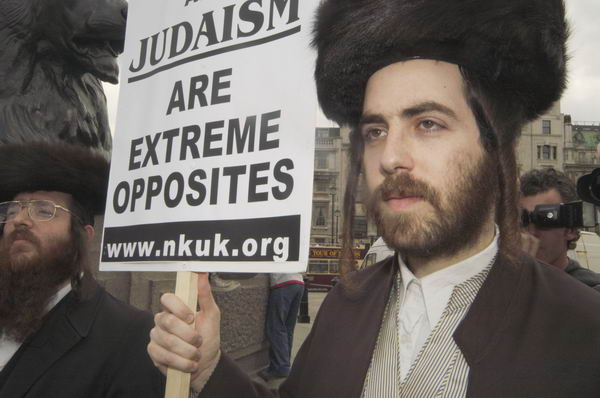
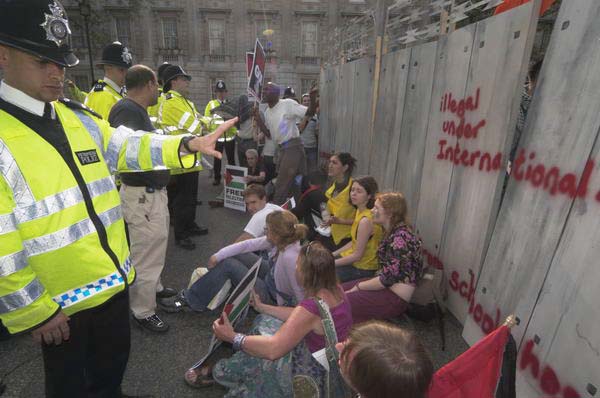
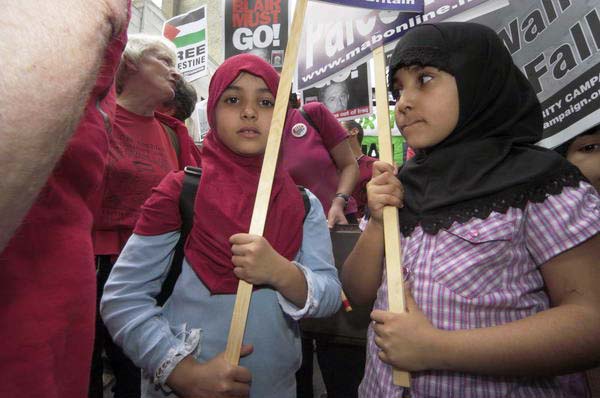
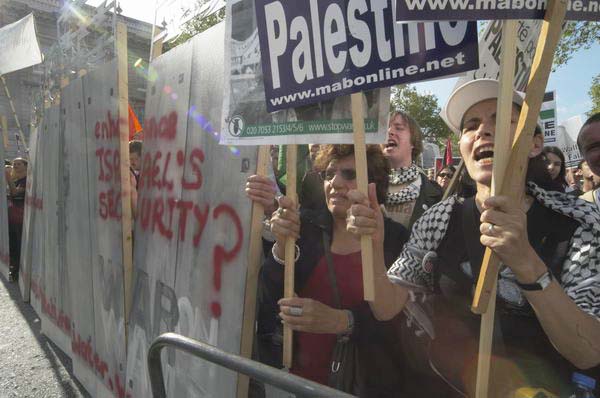
The pictures here come from the first year that I worked at a protest about Palestine using only digital cameras rather than film, in 2004. That year the protest highlighted the wall being built along the border.

Back in Palestine, the situation has got much worse since 2004, with much of Gaza having been destroyed, and a seige in place which prevents vital supplies coming in. Only last weekend hostilities erupted again, with rocket attacks from Gaza and Israeli air raids resulting in the deaths of at least 25 Palestinians and four Israelis. Among those killed in Gaza were a four-month old baby girl, two pregnant women and a 12 year-old boy.

Taking photographs of protests in London is of course a fairly safe occupation, but many photographers risk their lives to cover events such as the protests in Gaza.

Mustafa Hassona is a freelance photographer from the Gaza Strip, working with Anadolu Agency has been covering the weekly ‘Right to Return’ protests which have been taking place since May 30th 2018. You can see his remarkable work on Lensculture.


There are no adverts on this site and it receives no sponsorship, and I like to keep it that way. But it does take a considerable amount of my time and thought, and if you enjoy reading it, a small donation – perhaps the cost of a beer – would be appreciated.

My London Diary : London Photos : Hull : River Lea/Lee Valley : London’s Industrial Heritage

All photographs on this and my other sites, unless otherwise stated, are taken by and copyright of Peter Marshall, and are available for reproduction or can be bought as prints.

To order prints or reproduce images

Cold spell – no heating

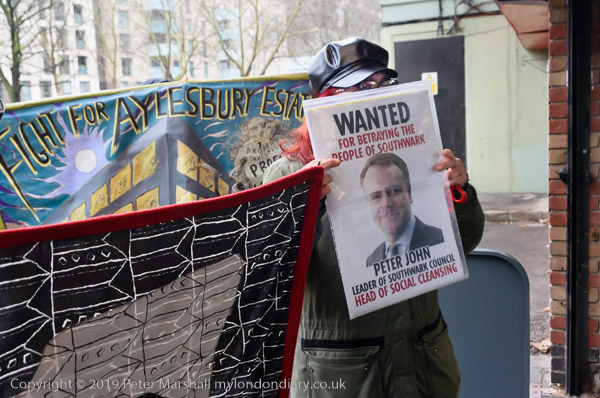
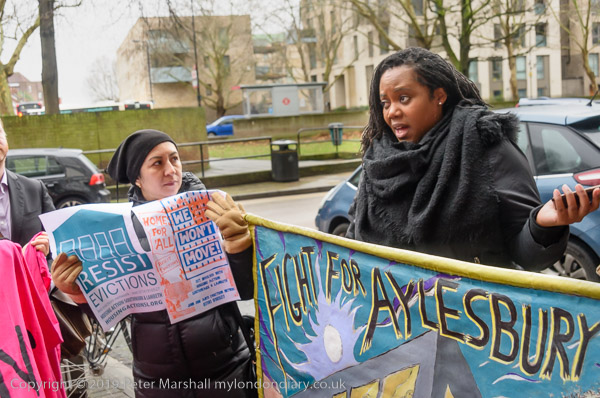
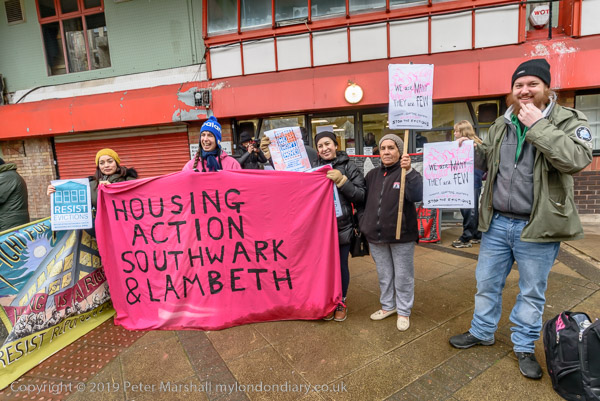
Southwark are perhaps the worst of London’s councils so far as their housing policies are concerned, though they face stiff opposition from others. But their demolition of the Heygate estate next to the Elephant & Castle is hard to beat for its combination of lies, total disregard for residents, loss of social housing, veniality and sheer incompetence and has been well-recorded on local blogs. It is a truly sad story for any local council, and particularly for a council dominated – as most of London’s councils are – by the Labour party, which currently holds 49 or the 63 seats with the only opposition being the 14 Lib Dems.

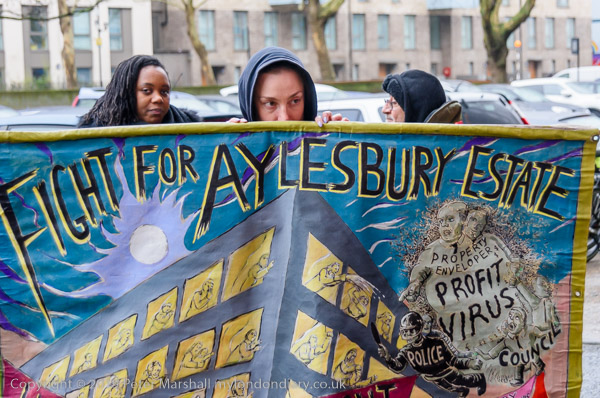
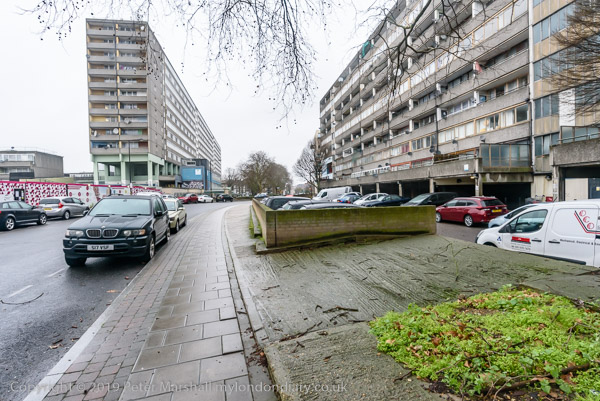
The Aylesbury estate is more or less immediately south of the former Heygate in Walworth, and is said to be the largest public housing estate in Europe, with 2700 homes built between 1963 and 1977. It contains a mixture of huge blocks like those in the picture below and much smaller and lower ones. Residents turned down a plan to pass the estate over to a housing association in 1999 and in a later ballot turned down Southwark’s plans for demolition, calling instead for the much cheaper minor works needed to refurbish each property up to modern standards.

Throughout the 1980s and 1990s Southwark Council had failed to carry out much necessary maintenance, and although the varied properties were generally well designed and built, the estate was allowed to deteriorate. Like the Heygate it was also used to house people with various problems including mental health and drug use and gained a notorious reputation, very much exaggerated by its use for filming a number of TV crime series.

The lack of proper maintenance has continued into this century, and residents feel it has worsened since the council made the decision to demolish the estate, parts of which have already been emptied and destroyed, to be replaced by properties at expensive market rents or the unaffordable ‘affordable’ rents at around 80% of market rates. Few of the Aylesbury residents can afford to take up any of the new properties, and are forced to move to the outer areas of London.

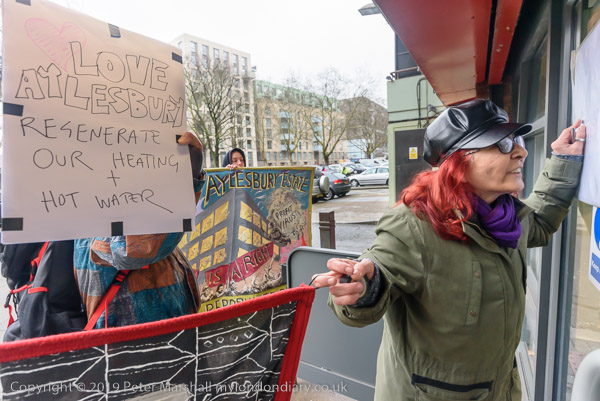
The Aylesbury was built with a central boiler house to run an energy-efficient district heating scheme. Because of the council’s failure to properly maintain this, there are repeated breakdowns in cold periods of winter such as that we had just been suffering. Residents either freeze or rely on expensive electric heating. One of those who spoke told how she had put £20 into her prepayment meter only for it to run out a day later; another told of having reported the heaters in her flat for six months without the council coming to maintain them.

Residents are convinced that Southwark council have been purposefully neglecting their well built homes to justify the demolition of the estate and bully the residents out against a ballot result which called for refurbishment rather than demolition. They protested outside the local housing office for over an hour, calling for someone from the council to come out and speak to them. No one came out and security men prevented the protesters from going inside.

Southwark Council claimed in a statement to a regional TV programme which covered the protest that they were doing their best to keep the heating going, but no-one on the Aylesbury believes them.

More at Aylesbury residents protest lack of heating


There are no adverts on this site and it receives no sponsorship, and I like to keep it that way. But it does take a considerable amount of my time and thought, and if you enjoy reading it, a small donation – perhaps the cost of a beer – would be appreciated.

My London Diary : London Photos : Hull : River Lea/Lee Valley : London’s Industrial Heritage

All photographs on this and my other sites, unless otherwise stated, are taken by and copyright of Peter Marshall, and are available for reproduction or can be bought as prints.

To order prints or reproduce images