Stone Hole

Photofusion, Brixton: 25 Sept – 5 Nov 2009

Stone Hole is a new collaborative exhibition of large digital photographs by Crispin Hughes and a time-lapse film by Susi Arnott, made in tidal sea-caves along the shoreline of North Cornwall. 

© 2009 Peter Marshall
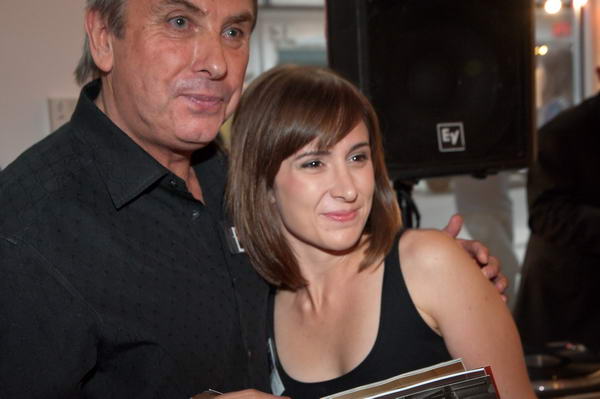
Crispin and Susi at the opening

Crispin and me go back a long way, to a ‘Men’s Group’ he ran back in the Webbs Road days of the Photo-Coop, founded in 1984, and a short walk from Clapham Junction station. I’d forgotten until tonight that photo publisher Chris Boot, also at the opening, was also a member; it was a very long time ago.

© 2009 Peter Marshall

The Photo-Coop moved to more extensive premises in Brixton and became Photofusion, but it was a longer and more complex journey for me, and although I’ve kept in touch – and still contribute pictures to the Picture Library there, run by Liz Somerville – otherwise it perhaps became more peripheral to my own view of photography.

© 2009 Peter Marshall
Hi Liz!

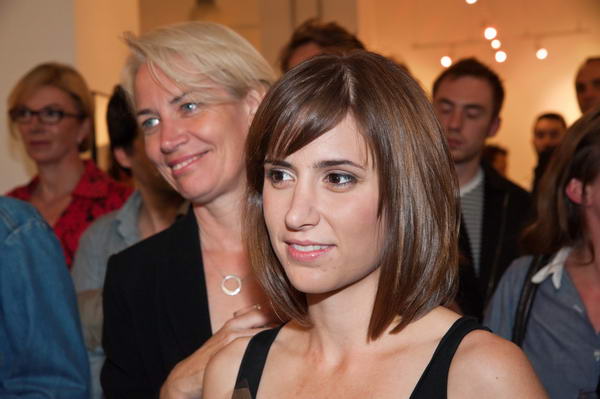
But it was good to go back there yet again tonight and there were certainly a sprinkling of people I knew from the old days as well as some newer friends.

© 2009 Peter Marshall

Crispin’s previous show, ‘Unquiet Thames’ at the Museum of London in Docklands in 2006 was a stunning panoramic exploration of enclosed spaces under bridges, piers and tunnels on the Thames in London, and its large prints and soundtrack created an impressive environment in the gallery space.

Stone Hole develops from this, working in sea caves in North Cornwall with Susi Arnott. The metaphor that underlies this work is that of the eye, with several images that strongly suggest biological structures and diagrams of the eye, and the cave mouth as an aperture admitting light.

© 2009 Peter Marshall

Reading the notes when I arrive home I found that Hughes’s work was carried out at a time of various medical crises, including at one point the loss of sight in one eye.

© 2009 Peter Marshall

Susi Arnott‘s film using time-lapse images explores the dangers of the rising tide in these sea-caves to a degree that made me feel uncomfortable. If you too have had the experience of thinking that you are about to drown and looking up through the greenish blur of water you may share this. But it is an interesting work and complements the still images by Hughes.

© 2009 Peter Marshall

Though I’m seldom a fan of videos in art shows this does add to the the overall effect, though it was hard to appreciate the sound track (which I think is a vital element) above the hubbub  of the opening.

Also in the gallery display is some detailed information about the geology of the area that led to the incredible caves and rock formations, which I soon gave up trying to understand. If you have a particular interest in such matters there is an exhibition talk with geologist Dr Jon King on 10 Oct, while two other events involve a clinical psychologist and an architect.

The splendid large prints were made at Photofusion, are are certainly an excellent advert for the services of Richard their printer.

One rather nice small touch at the opening were the several dishes of small pebbles – just like many of those in the photographs – around the gallery. Except that unlike those in the image, much to my surprise, these turned out to be chocolate.
Capitolio – Christopher Anderson

Anyone who doubts the relevance of black and white in photography now that almost all of us shoot in digital colour should take a look at the selection of pictures on the New York Times ‘Lens’ blog by Magnum photographer Christopher Anderson from his new book on Venezuela,  Capitolio. You can see more of his fine work, both in black and white and colour, on the Magnum site.

The feature on ‘Lens’ by Simon Romero tells you more about the streets of Caracas, surely one of the more difficult places in the world to work, and also about the photographer, so I won’t write more here. Just don’t miss it.

However, as well as great work like this, I do see rather too much black and white photography that I look at and think that it was shot in colour and surely would have been better shown in colour. These days almost all photographers do start with colour – on digital compacts and phones – before taking up photography seriously,  and although may take courses that force them to do at least some work in black and white, few get the kind of experience with working with it that we used to back in the days before digital and when newspapers and many magazines were largely or entirely monochrome.

Taken in London

You are invited  to the opening of this show on Thursday  8 Oct, 6.30-8.30pm

Photographs by Paul Baldesare and Peter Marshall

Shoreditch Gallery

The Juggler, 5 Hoxton Market,  London, N1 6HG
3 Oct- 31 Oct 2009, weekdays 8-6 : Sat10-4 : closed Sun

The show is a part of Photomonth 2009,  the East London photography festival and the This Is Not A Gateway Festival 2009

Website:  http://takeninlondon.co.uk/

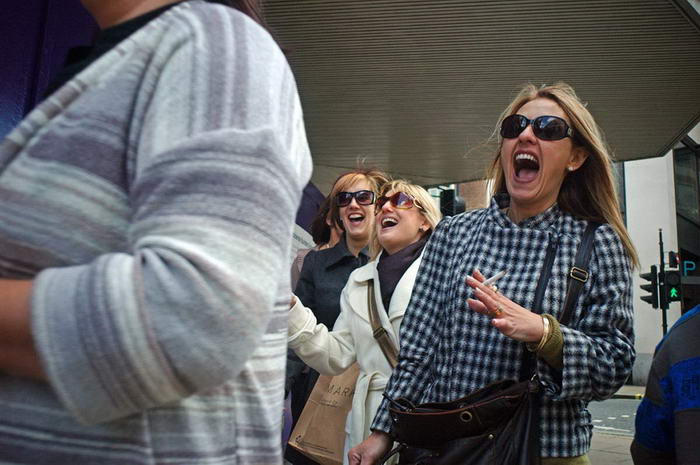
London still has a claim to be the greatest city in the world and it is still the most photographed of all cities. The key area of all cities is the street, where people walk, congregate, shop and meet, and both Marshall and Baldesare come out of the tradition of street photography and concentrate on the life of ordinary people – who are often extraordinary on those streets.

For Baldesare, trade defines the city, and his work concentrates on the shopping streets – particularly Oxford St, the hub of consumerism – and markets. The people on whom he concentrates are very much surrounded by advertising hoardings, window displays and other blandishments of the consumer society. But it is the people themselves who remain important, retain their individuality and autonomy despite their sometimes overpowering surroundings. Their gestures, body language and expressions are the stuff of these images, which often show a surprising intimacy in these very public places.

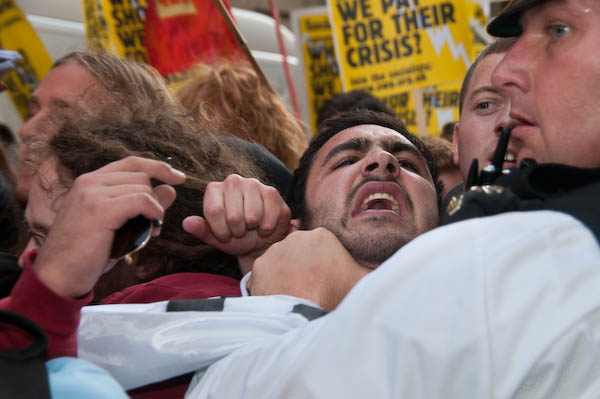
Marshall‘s work looks at the city as an arena for politics, reflecting local, national or international issues on the streets of London. His ‘My London Diary’ from which these images are taken is a unique record, published on the Internet, a highly individual cross-section of political and cultural life across the capital. It is a work that owes its existence to the Internet, and an attempt to exploit some of the properties of the medium particularly in presenting the work back to those that he photographs. By May 2009 there were 40,000 images in this on-line archive.

Paul Baldesare: Woman with cigarette, Debenhams

© 2009, Paul Baldesare

Peter Marshall: March on the City, Oct 2008

© 2008 Peter Marshall

Lens Culture Latest

It’s always worth a visit when a new edition of Lensculture goes on line and the latest is no exception. Not that I find everything on it of interest, one of its attractions is its eclectic nature.

Among the pieces I think particularly worth looking at are Reinaldo Loureiro‘s precise and often almost symmetric square images of “the social and economic landscape of the Spanish greenhouse plains of Almeria” in his ‘Out of Season‘ and Edmund Clark‘s very different but equally precise ‘If the Light Goes Out: Home from Guantanamo‘ which finds something very new to say about this blot on the conscience of that part of America that still has one. Clark’s work is in three parts in a deliberately disjointed edit which jumps between the home of the American community in the naval basem the camps where the detainees have been held and the homes where former detainees are trying to rebuild their lives. You can see more of Clark’s work on his web site and read my post about his earlier book Still Life: Killing Time.

Another pleasant surprise was the work of Ara Güler (born 1928 in Istanbul, of Armenian descent), the leading Turkish photographer of his generation. After his military service he began work for a Turkish magazine in the early 1950s and began working for Time-Life in 1956 and Paris Match and Stern in 1958. During this period he met Henri Cartier-Bresson and became a member of Magnum. A search under “Ara Guler” on the Magnum web site returns over 500 images by him as well as 4 pictures of him by James A Fox (at the bottom of the last page.)

In 2009 he received the award for lifetime achievement in the Lucie Awards.  Although I remember seeing some of his pictures before, I have to admit that I had forgotten all about this photographer and it was good to see the work again.  There is an 8 minute video of his work on YouTube, and some details of his life on Turkish Culture.

Another Magnum photographer in this issue of Lensculture is considerably better-known to me. There are only  half a dozen images from the latest book,  In Whose Name? by Abbas on Lensculture, but you can of course see more of his work at Magnum.

These for me were among the the highlights, and there are some more great things (including Dana Popa who I’ve already written about) as well as just a few things I found lacked interest, but you may well have different tastes. But as always it’s certainly worth looking at Lensculture.

Dana Popa and Vanessa Winship

You still have just a few days to see Not Natasha – Dana Popa at Photofusion – where it closes September 18.  And you can now read an extended interview with her by on Conscientious.

On the same site yesterday he posted A Conversation with Vanessa Winship, another photographer whose work I’ve written about previously on this site – Sweet Nothings – Vanessa Winship – which appeared here when her work was on show at Host Gallery in London in February.  You can see more of her work on her own site.

Both pieces are worth reading, and it’s good to see these two photographers getting wider coverage.

Willy Ronis Dies Aged 99

I was saddened to learn from Jim Casper of Lensculture that Willy Ronis died today, September 12, 2009, aged 99.

I met Willy Ronis in 2003 when he came to talk about his work in London, but didn’t have time to have more than a short conversation with him. But his talk was a fine introduction to his work, which I’d only really seen in isolated images before, and made me feel that his was a much more important and vital view of everyday life in Paris than that of some better-known photographers.  And in a way I got to know him better last year on my trip to Paris in November, when I picked up a copy of his La Traversée de Belleville at the Bar Floréal and followed in his footsteps only to find that his favourite stroll in Paris covered ground that was very familiar to me from a number of earlier visits.

Of course I knew from my extended essay on him in 2003 that his work centred on Belleville and Menilmontant. For contractual reasons I can’t post that essay as I wrote it, but here is a revised version of the first of five sections.

Willy Ronis was one of a small group of photographers whose pictures gave us an image of post-war Paris in the 1950s that still dominates our imagination of that city. With Doisneau, Izis, Cartier-Bresson, Boubat and others his work created a vision of this city that was very much an image of its people. His particular viewpoint was dominated by ordinary working class men and women and life outside the bright lights and the grand boulevards. Ronis photographed ordinary daily life and found in it the extraordinary.

Paris is a hilly city, with many sets of steps joining streets providing short cuts for pedestrians. In 1949 he stood looking down one of these leading to and across Avenue Simon Bolivar. As he stood there considering the view, behind him he heard the sound of a woman talking to a child, and waited for her to fill the empty space below on the steps in his view. As she came to the main road, a heavy cart pulled by a large white horse came across, as on the other side of the road a workman was climbing a ladder. Two women pushed prams carefully spaced on the opposite side of the street, and in front of one of the small shops to the right, a cobbler in a white apron stands talking to a customer. This is any day in working –class Paris at the time, ordinary people, ordinary lives, but also a magical image, arranged perfectly both in the frame of Ronis’s camera and the shapes of the steps and the street.

Ronis called Bruegel his master of composition, and this picture, perhaps more than any other, shows his debt that great painter, one of many Dutch masters of the the 16th and 17th centuries who Ronis admired in the Louvre on his day off – Sunday – when admission to the museums was free.

The scene he captured in the fleeting fraction of a second of this image has a wonderful precision but is also a miraculous creation of chance. Henri Cartier-Bresson, lauded as the master of ‘the decisive moment’, seldom achieved anything with the grace and complexity of this image. Ronis talked about his being always open to failure, photographing on the thread of chance, and this picture shows how he was open to experience and ready at the instant to attempt to snap up the opportunities it offers.

Like  Cartier-Bresson, many of his moments are the result of anticipation, of identifying a possibly fruitful situation and waiting for events to develop – or not.  Sitting waiting in a café, looking out through a window waiting for someone to come into the frame of street in its bottom right, or standing on the street at the crossing of Rue Sèvres and Rue Babylone in Paris in 1959, the sun setting in a misty distance, a shop awning creating a dramatic silhouette pointing to the street crossing beyond. Ronis waited until a sole figure was making her last-minute dash across the road, a woman in a long coat, and caught her motion just where the sinister shape above her in the picture seems to be pointing.

This sense of a moment caught in motion, a dynamic that enlivens them is common to many of Ronis’s pictures. They have a sense of life caught on the hoof that is not found in the more choreographed images of photographers such as Brassai or Brandt. He worked with similar equipment – the 120 format Rolleiflex he bought by instalments in 1937 – and worked largely on the streets with available light, observing and captureing the life he saw. In contrast, Brassai needed to set up his shots – ‘mise en scène‘ or staging of the action – working as a director as well as a photographer so that he could make use of unsynchronised flash.

I hope to publish a revised version of the rest of this essay at a later date.  One site with a nice collection of 14 of his images – including those mentioned above –  is AfterImage.

Harbutt in Visura

Charles Harbutt has long been one of my favourite photographers – his book Travelog (1973) was one of the first real photography books I bought, and it was truly inspiring. His workshops have altered the lives of many, including the late Peter Goldfield – who was led to set up his place for photographic workshops at Duckspool in the west country, and it was to there that I went in the 1990s and got my own taste of the Harbutt workshop experience. By then it was perhaps a little too late to change my own life, but I could certainly see how it had been such an important experience for Peter.

So it was good to get an e-mail telling me that the latest issue of the on-line magazine Visura featured a portfolio of his work – and for anyone not familiar with it, I think it’s a good place to start, although Harbutt also has his own  web site. One thing definitely not to be missed on that is an interview of him by Joe Cuomo, and of course the pictures!

It’s a shame that the link on his site to the short piece I wrote about him on ‘About.com‘ no longer works, although in truth it wasn’t one of my better efforts. I described him as “one of many leading photojournalists to be a distinguished ex-member of Magnum” (he joined in 1963 and was twice its President) and as “leaving to fulfil his more personal interests in photography when he felt it was abandoning its traditions and becoming too commercial in 1981” as well as giving links to his work then available on the web. One article by him I’d recommend is his I Don’t Take Pictures; Pictures Take Me.

Visura Magazine has plenty of other good things too – well worth exploring this issue and the archive – though some links are a little slow to load.

Rotherhithe Photographs

One of the more intriguing features to appear in the British Journal of Photography for a while was on Geoff Howard‘s Rotherhithe Photographs.

You can buy the book and see a preview (including the first 9 photographs taken in Rotherhithe pubs) on Blurb, where it states :

Images from “Rotherhithe Photographs” were first published in the legendary “Creative Camera” magazine in 1975, when the project ran as a cover and major portfolio, described as “a report from someone who is unquestionably one of the major talents among British photographers”.

Unseen for many years, the photographs are a personal documentation of the south London docklands, a cut-off, self-sufficient, largely working-class society; seen between the closure of the docks which had been the area’s raison d’etre, and the consumerist redevelopment of the later Thatcher years.

I don’t remember seeing his work when it was first printed in Creative Camera, though by then I was a subscriber, and the issue will be somewhere hidden under piles of papers in the shelves behind me.

Some of the more interesting images were taken inside working-class pubs in the area using a Leica, but abandoning the available light approach – because there just wasn’t any that film could capture, Howard used a big flash, moved into the right place and took a single image. Rather similar to the way that a few years later, Martin Parr started to do with a bigger camera and colour film. But Howard needed to get to know his subjects so he could get away with working like this.

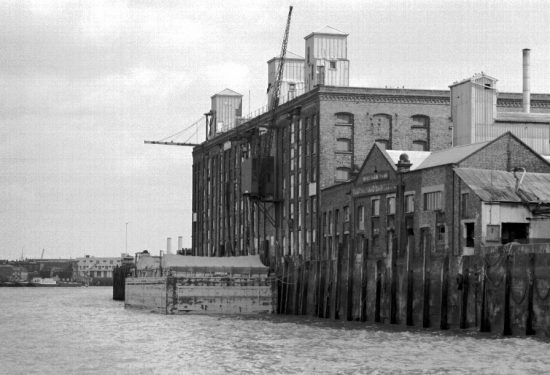
Howard’s work has a particular interest for me because I was also photographing Rotherhithe – along with other areas of London – at around the same time.  You can see some of my pictures on the site ‘London’s Industrial Heritage‘.

© Peter Marshall
Rotherhithe – ©  1982, Peter Marshall

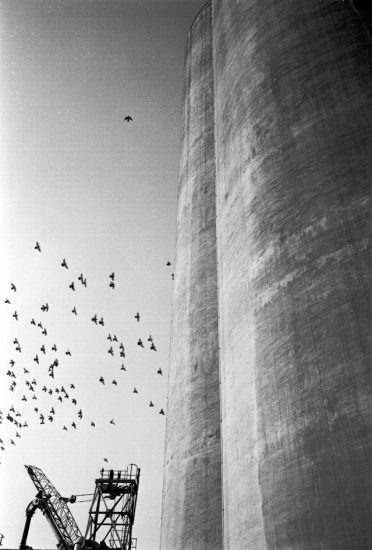
My work in Rotherhithe was more varied than the site suggests, but did mainly concentrate on the urban landscape. The better pictures on my site are probably from other riverside areas of London, such as Wapping, Southwark and Greenwich.

© Peter Marshall
Greenwich, © 1983, Peter Marshall

Milton Rogovin Speaks

You can hear one of my favourite photographers (and I’ve written about him on various occasions) Milton Rogovin talking briefly in the Lens blog on the New York Times about his attitude to photographing people.

It also links to a feature about him in the paper, with photographs of Rogovin, his house (exterior and interior) taken by  Fred R. Conrad for The New York Times, although I don’t really see the point of 5 photographs of Rogovin’s files as he looks through pictures, some showing his hands, but all with his images seen at an angle.  One rather better image of the man showing his hands and the work might have been worthwhile, but really it would have been far better simply to have shown more images of some of his fine work.

You can read some of my own earlier pieces on Rogovin on this site:, in particular two different posts not too cleverly titled identically Milton Rogovin and Milton Rogovin. The second link is to a longer biographical article.

I don’t follow Rogovin’s prescription on photographing people, but like him very much regard it as a mutual or cooperative endeavour. Sometimes I use flash simply to make sure people are aware I’m photographing them, but I don’t think it is the only acceptable way to take pictures. Hard to believe so if you are also a fan of Henri Cartier-Bresson. But even when I photograph people without their knowledge, respect for them is still vital for me.

Maisie’s Night – The Ian Parry Scholarship 2009

© 2009 Peter Marshall.

I’ve written in several previous years about the Ian Parry Scholarship award, particularly when I was writing virtually from New York but actually from Staines for About.com, not least because I wanted to remind our friends in the USA that there is photographic life outside their borders. But this is the first year that I’ve attended the awards ceremony – and the large party that accompanied it in the gallery and on the street outside.

Ian Parry was a 24 year old photojournalist shot while working for the Sunday Times covering the Romanian revolution in 1989, and family and friends set up an annual scholarship in his memory open to those attending a full-time photography course or under the age of 24.

As the exhibition at the Getty Images Gallery in Eastcastle St (near Oxford Circus) in London for the next week (so don’t delay in going to see it) shows, it attracts a high standard of work from around the world – including many from the USA.

Even more important than the prize is the prestige and exposure that the award attracts, with the exhibition and publication of work by the finalists in the Sunday Times magazine (2 Aug 2009 issue), a place on the final list of nominees for the World Press Photo Joop Swart Masterclass and this year, an international assignment for one of the finalists from Save The Children.

The value of the award can be seen in the careers of those who have been awarded it in previous years. Last year’s winner was Vicente Jaime Villafranca and on his web site you can see some of his fine black and white work on the Gangs of BASECO.

© 2009 Peter Marshall.

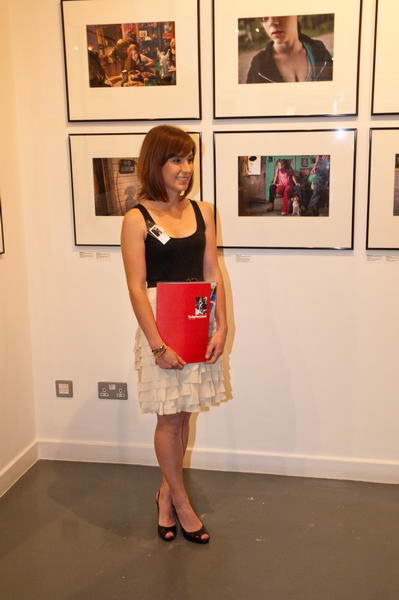
Maisie Crow is currently working as an intern for The Boston Globe and is a graduate student in the School of Visual Communication at Ohio University. Previously she studied Spanish at the Universidad de Veritas  in Costa Rica and Spanish and Art History in Seville before a BJ in Photojournalism at the University of Texas and further studies at the Salt Institute of Documentary Studies, and also worked as a freelance from 2006-8.

Her winning project on Autumn, a 17 year old Ohian girl growing up in a poor and dysfunctional family environment contains some powerful and intimate images – a selection of six were in the BJP feature on the award  (BJP 22/07/2009 p10). One of the captions which sets the scene reads “Autumn sits between a relative’s legs. She alleges he tried to rape her when she was 13 years old but says her parents do not believe her.”

Surprising the 12-page Sunday Times feature uses only one of her pictures, tightly cropped on the front cover. It is a highly charged scene with Autumn being attacked by her boyfriend, pushed down over the kitchen sink (the caption notes that within half an hour they had kissed and made up) printed much more harshly than the original and gaining drama at the expense of sensitivity.

© 2009 Peter Marshall.

Ed Ou’s Highly Commended work on the horrible deformities suffered by people living in the area of Kazakhstan where the Soviet Union carried out over 450 nuclear tests is extremely strong, and hard to view. Too much so for the Sunday Times, who use only a picture of a nurse cradling a small child; the BJP too shies away from publishing the more horrific of these powerful images from ‘Under a nuclear cloud’. Ou doesn’t dwell unduly on these aspects but they are an important part of the story, as you can see in the images on his web site (rather slow to load – but it does eventually appear.)

Some of the other work is better served in publication than on the gallery wall. The two pictures of Dennis, a sufferer from dementia and Ruby his wife, married for 61 years and now forced apart in the Sunday Times are far stronger than the sentimental portrait of the couple on the gallery wall, and made me want to see more of this project by Dan Giannopoulos.

Similarly, the two pictures by Giuseppe Moccia of an American teenager suffering from Down’s syndrome on the wall failed to grab my interest, but the Sunday Times has a far stronger image.  Other photographers whose work seemed more interesting in publication included Alinka Echeverria with images of veterans of the Cuban revolution and Masud Alam Liton’s project Bangladesh: Requiem For Freedom (he has a blog – Liton Photo) and a second set of images from the same country by Mohammad Rashed Kibria.

© 2009 Peter Marshall.

Of course the magazine page (or now the web page) is where this work really belongs, rather than the gallery wall and its perhaps not surprising that some at least works better there. The black and white work in particular seemed better suited to print than frame, perhaps reflecting the difficulties in making good black and white inkjet prints, but occasionally also the hanging. Ruben Joachim‘s Afghan child clinging to her father so intense on the printed page was lost in reflections and weaker contrast on the wall.

It is perhaps more a sign of the times rather than a reflection on the quality of the work that all of the winning and commended work this year was in colour. Personally I would have made some different choices, although the work of Crow and Ou did I think stand out among the rest.

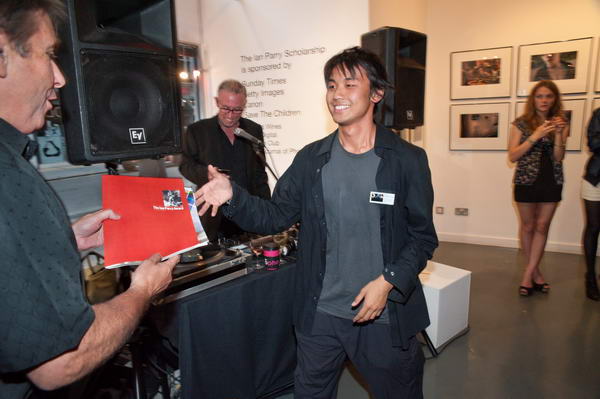
We were sorry to hear that Don McCullin was unable to attend, but Tom Stoddart was there to hand over the awards to the winners. This is one of the more interesting of photographic awards, and deservedly gets sponsorship from the Sunday Times, Getty Images, Canon and Save The Children, as well as Touch Digital, Frontline Club, British Journal of Photography and, last but certainly not least, Eminent Wines.

© 2009 Peter Marshall.

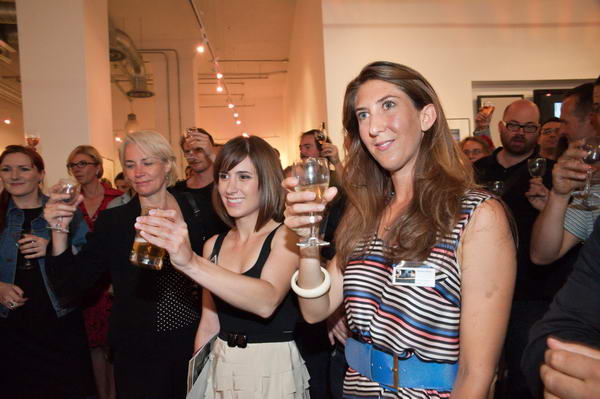
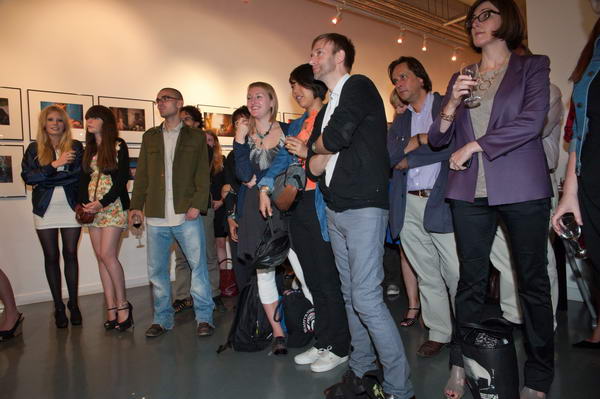
Since I was there, I took some pictures – though using a Nikon D700 with Nikon SB800 flash and a Sigma 24-70 f2.8 HSM lens (sorry Canon!) Given all that excellent wine it is a powerful testimony to Nikon’s intelligent electronics that everything came out.  The gallery was crowded for the opening, and the food and drink was still flowing freely when I left around 10 pm to scurry back to Staines.

© 2009 Peter Marshall.

I’ll put a few more pictures from the opening on My London Diary shortly.