Mendelsohn’s Balsall Heath

An article in The Guardian brought to my attention the work of American photographer Janet Mendelsohn, a Harvard graduate who in 1967 came to study with Stuart Hall and Richard Hoggart at the ground-breaking Birmingham Centre for Contemporary Cultural Studies. Forgotten for years, her work which she made use of photography as “a tool for cultural analysis” in a multi-racial area undergoing a radical transformation through immigration and dire poverty, was rediscovered when Kieran Connell, who was curating a show for the 50th anniversary of the centre, became obsessed by a photograph of hers on the cover of its 1969 annual report.

It took considerable detective work by Connell to find out more about the photographer, but when he finally managed to contact her sent back the request “Please take these photographs off my hands” and sent him a large box with several hundred prints and 3,000 negatives.

Some of these were from a project in the red-light area of Varna Road in Balsall Heath, and it is this series which is the basis of the newspaper article, as well as a forthcoming show at the Ikon Gallery in Birmingham (PDF press release here) and a free symposium at the end of January at Birmingham University with speakers including Magnum photographer Susan Meiselas, artist Mishka Henner, UCL History Professor Catherine Hall and curator and photographic historian Pete James.

One classmate of Mendelsohn’s at Harvard was film-maker Dick Rogers, (1944-2002) who also went to study in Birmingham with Hall and Hoggart for two years, after which he returned to Harvard to study on a Visual Education programme where he met his future wife Susan Meiselas.

Mendelsohn worked with Rogers on his first film, Quarry (1970). His best-known work, Pictures from a Revolution (1991) retraces Meiselas’s work on her photo essay ‘Nicaragua: June 1978-July 1979‘. In an earlier film, 226-1690 (1994) he used recordings left on his phone answering machine from her when there including one with a gunshot in the background.

Some of Mendelsohn’s work was shown last July in ‘The Ghost Streets of Balsall Heath‘ at The Old Print Works, Moseley Road, Balsall Heath as a part of the Flat Pack Festival.


As Drik as Possible

I’ve written on a number of occasions here and elsewhere about Shaidul Alam and Drik, most recently on the agency’s 25th anniversary. The idea of people in the majority world telling their own stories is one which has always seemed important to me, and I have a healthy distrust of some of the efforts of celebrity western journalists and photographers who  sometimes work with little real idea of the society and background to the events they are covering. It’s great to read a truly inspirational success story about Bangladesh, and how they have overcome so many problems. Optimism, a strong belief in what they are doing, the willingness to take serious risks and continuing hard work have been rewarded.

It goes a little deeper than that. Even when I look at how life in my own country and city gets represented though the media I’m often aware of a concentration on the froth and the failure to really understand or show the realities of life for the majority of our citizens. Of course there are some notable exceptions, but we really need a grass-roots photography movement too, as well as publishing on-line and in print that supports it.

The story of Drik, told in Alam’s blog post As Drik as Possible, is an introduction to the 2016 Drik Calendar, and tells a little of the storyand there is a little more about it on Flickr. You can also see a larger album of over 600 of Alam’s pictures of Bangladesh.

Vivian Maier still in hiding?

I’m not a true believer when it comes to Vivian Maier. Not that she was a bad photographer, far from it, but I’ve failed to share the kind of fawning hype that seems to have affected so many. Though I can enjoy looking at her work, to me its rather like the ‘Easy Listening’ section that they used to have in record stores. Obviously she had a great interest in photography and a good eye, and a great appreciation of the tradition, but to say, as curator Anne Morin does in her Lensculture interview with Jim CasperShe has a key place in the history of the medium—right next to Robert Frank and all the other great practitioners” seems just ridiculous nonsense.

As Morin makes clear, Maier was very aware of the history of the medium, and looking through the selection of 120 images on Lensculture it’s impossible not to realise some of the sources that inform her work. As you look at the images, its obvious that this one would not have been made had she not been aware of the work of Lisette Model, others completely predicated on her knowledge of Lee Friedlander or Robert Frank … though perhaps she never quite came to terms with Diane Arbus.

Maier didn’t make history, she depended on it, at least in the images we have seen, and Morin is misguided to think that her exhibition “helps place her work in the history of the field.” Perhaps the main point it and her story makes is that she was outside that history making, a mere – if sometimes enjoyable – footnote.

The fascination is very much in the back story, and it is one that has been carefully cultivated in article and film, with more yet to come to light. Morin mentions the link with the young French woman photographer Jeanne Bertrand with whom Vivian’s mother and the young Vivian were lodging in the Bronx at the 1930 census. Though Vivian was then only four, it seems likely that Bertrand was a friend of the family and they may have kept in touch in later years.

Claus Cyrny in his Artificial blog links to writer Jim Leonhirth who has posted the information he has gathered together about Maier’s family from various sources which often contradicts earlier statements and includes the information above about Bertrand, as well as reproducing a page from the Boston Globe in 1902 with a long article about her becoming well known as a photographer in the region at the age of 21.

Bertrand came from the same commune in rural France as Vivian Maier’s mother, where Vivian and her mother went to live from 1935-8 before returning to the USA, where the 1940 census shows them both living with Vivian’s brother and father (both called Charles) in 1940. Other family members, including an aunt and great-uncle also lived in New York, and it is thought that Vivian’s mother had reverted to her maiden name and died in New York in 1975.

Morin says that so far “somewhere between 120,000-150,000” Maier negatives have been found, including “6,000 rolls of film that Maier didn’t even develop” as well as voice recordings on cassette of her thoughts and ideas. She was only able to make her selection for her exhibition from a selection already made by John Maloof. Perhaps in the larger body of work we have yet to see there will somewhere be the real Vivian Maier?

30 Under 30 Women

I almost gave up with Photo Boite‘s 30 Under 30 Women Photographers, as although the initial page loaded rapidly, when I clicked on the link for 2016 I got just a large blank white page with just the header menu, now showing a larger 2016 and, scrolling down several blank white pages, the page footer.

I waited  and waited and after a minute or two,  went to check my e-mail. But fortunately I’d left the page open in Firefox and five minutes later came back to find the site had loaded.  I don’t know why the page should take so long to load, though around 3Mb of images doesn’t help, but I’m working on a connection where sites download at 35Mbps and pages with a similar amount of images download faster than I can scroll down them. Perhaps it loads all 30 pages at once, though the time seemed excessive even for that, or perhaps it was just very busy when I tried.

I tried the site in another browser, Internet Explorer, rather than the Firefox I normally use, and it did load rather faster, though still slow enough for many to have gone elsewhere.  But don’t be put off; once the site has loaded it works well, and shows a good number of images by each of the 30 women.

As well as the pictures, there are also short biographies of the photographers, many of whom have already enjoyed considerable success, and rightly so from the quality of their work, though there are a few who I felt were perhaps a little over-exposed and where a tighter selection of images might have helped. Or perhaps their work appealed to me less.

Despite the press release which describes the work as:

“A more feminine vision: 30 UNDER 30 exhibits the work of women photographers from around the world offering their visions based on their experience, along with their tact and composure, innocence and sensuality, at times fierce and provocative.

A more innocent vision: Driven by expression, this new generation draws its inspiration
and conveys it through its works with purity, free of disillusionment, through portraiture, photojournalism, landscapes, art and architecture, fashion and even war photography in a milieu traditionally practiced by their counterparts.”

I can’t really see anything about the work that would make me think they were ‘women photographers’ rather than simply thinking of them as photographers; my experience has always been that many of the best photographers I’ve known have been women. When I taught photography, the great majority of my better students were women.

Of course women have been under-represented in the pantheon of photography, but the reasons for this are not photographic but wider social issues.  When I put together a list of notable photographers for a photography web site,  there were only 41 women among the roughly 200 photographers, but these did include some who made really significant contributions to the medium, including Julia Margaret Cameron, Berenice Abbott, Diane Arbus, Nan Goldin, Cindy Sherman, Dorothea Lange, Margaret Bourke-White, Mary Ellen Mark, Imogen Cunningham and more. Many women have over the years played an important role behind the camera as well as in front of it, something I feel the introduction to ‘30 under 30 Women‘ fails to acknowledge.

In Memoriam 2015

This year has seen the loss of a number of fine photographers, including figures who have really contributed to the development of our medium. Many of them are remembered in the Time LightboxIn Memoriam‘ feature, including several who were particularly important to me. One was Charles Harbutt (1935-2015), whose 1974 book 974 book, Travelog made a great impression on me when I was starting in photography, and who I was later fortunate enough to meet and to attend one of his workshops. I’d already picked up much of the lessons that he taught by the time we met, but he really did change the lives of many, including one of my friends, the late Peter Goldfield; attending a Harbutt workshop in 1976 changed his life and he went on to set up his own photography workshop centre at Duckspool, where I met Harbutt in the 1990s. I wrote a longer post on him at the time of his death.

Another loss I felt personally was that of Lars Tunbjörk (1956-2015), a Swedish photograph inspired by the ‘New American Color’ of photographers including Stephen Shore and William Eggleston, who I think added a European irony and incisiveness to their work, and who I think is still comparatively unrecognised. After meeting him in Poland in 2005, I bought three of his books and continue to be amazed every time I take them from the shelves in my living room where I keep my favourite works.

Another photographer whose loss I felt greatly was an old friend of mine, Terry King (1938-2015), who I wrote about at some length in April. Although I’d only seen him infrequently in recent years, back in the late 1970s and early 1980s we often went together on photographic group trips and also worked together on what came to dominate his photography, alternative photographic processes, for which he became one of the leading evangelists and proponents, inspiring and teaching many others, as well as developing his own methods.

I had no personal connection with Mary Ellen Mark (1940-2015) though I admired her work, as well as that of several others listed by Time. Hilla Becher (1931-2015) along with her partner Bernd were enormously influential teachers of photography, and while I admire the ‘typologies’ she and her husband produced I’m not always enamoured of the work of some of their students. Takuma Nakahira (1938-2015) too was a hugely influential figure as the founder and editor of ‘Provoke‘. If others on the ‘Time’ list are less well known to me, this partly reflects my lack of interest in certain areas of photography, though the list is also a reminder of the continuing dangers of photojournalism. The Committee to Protect Journalists lists 97 journalists and media workers killed in 2015, of whom roughly a third were photographers or videographers.

Yunghi Kim

I’m rather surprised – and slightly ashamed – to find that I’ve never mentioned Yunghi Kim in my posts on this site. I’ve been aware of her work as a photographer for a long time, with some powerful images from Rwanda and Kosovo and in particular her remarkable 1996 project on ‘Comfort Women‘, Korean women then grandmothers in their 70s who had been tricked by the Japanese Army and forced to become sex slaves serving Japanese soldiers. Perhaps my only excuse is that these stories – which you can see on her web site – were made before I began seriously writing about photography for a living, but not long enough before to have become a part of photographic history.

Of course Kim has continued to produce great photography, working through Contact Press Images, and winning various awards. Her pictures on her site as ‘Protest in America 2011 & 2012‘ include some of the strongest images of the Occupy movement, and in a very different mood is her highly original and inventive series ‘Coney Island Winter’, also in black and white. It’s great work to see her work and feel how exciting black and white can be, when with so many other photographers now black and white seems more simply just a fashionable ‘look’.

I’ve also come across Kim through being a member of the Facebook group she began and runs, The Photojournalist’s Cooperative,  with its mission “to give freelance photographers a platform where they will exchange ideas and help each other maintain high standards as they navigate the dramatically changing business of photography in the areas of: image licensing, contracts and copyright protection.”  She set up the group after realising the huge extent of unauthorised use of her images on the web, wanting to find out more about how to protect her work and to share what she found with other photographers. Last month she took that sharing to a further stage, giving $10,000 from the fees she has recovered from unauthorized usage to create ten $1,000 grants for members of her Facebook group, who have until next Tuesday (Dec 20, 2015) to make submissions.

Many photographers I know are also members of the group, and it was a post from one of them, Ami Vitale, on my newsfeed today which prompted this short note. It read simply: “Yunghi Kim is a huge inspiration!” and linked to a profile of her on AI-AP (American Illustration-American Photograph) which gives all the information about her that I’ve left out here.  Ami, you are an inspiration too!

The Flaneur

Lensculture has a new set of images, The Flaneur, Hamburg Noir by Giacomo Brunelli, a photographer whose work on animals knocked me out when I first saw it some years ago across a table in 2007 in Birmingham.  You can see that work, and other projects also on Lensculture.

I bought copies of both his books to date, The Animals (2008) and Eternal London (2014) and both are finely produced volumes. I usually like my photography clinical rather than emotional, but when it is done as powerfully as this I find it irresistible. His work has something of the graphic appeal of one of my favourite London-based photographers, Bill Brandt, but with a much smokier, more intimate quality. And like nicotine, it’s highly addictive.

I imagine there will before long be a book of his Hamburg pictures, and I’ll surely buy that. The Animals now sells second-hand for £300 upwards so it could also be a good investment. There may still be the odd copy of Eternal London ISBN-13: 9781907893520 available in bookshops or on-line for £25, and if you see a copy I’d advise you to snap it up now.

Derek Ridgers

It’s good to see one of my old friends – I first met Derek Ridgers almost 40 years ago – getting the exposure he deserves. I knew his work was good when I first saw it back then, and his work was included in a number of group shows we organised together – though none are listed in his Wikipedia entry.

Derek also designed posters for several of them, including a 1984 show at the Orleans House Gallery in 1984 by ‘Group Six‘, led by Terry King, which included the logo he designed for the group:

It was a rather better poster than those I cobbled together for some later of our group shows in which also took part,though the printer I took his artwork to complained bitterly about the large area of black which used too much ink.

Unfortunately we soon had to change the name after some fairly bitter moments that led to us leaving the photographic society we had been a rebellious part of and forming a totally separate group. Among our complaints was the society stealing an exhibition opportunity we had organised with a gallery on the basis of our group’s work to use for an exhibition by the whole society. Among theirs were the acerbic comments that Derek, myself and others made about  club photography.

So we became Framework:

which wasn’t really a logo at all (and apologies for the poor reproduction in a scan from one of the posters which I printed on dot-matrix for a later exhibition – which also included Derek. Among the various shows was

city news urban blues…

in 1988 at the Orleans House Gallery, Twickenham, which you can read more about here in an unfinished web site I began to write about the group some years ago.

Derek’s contribution was:

THE BOX PEOPLE

Photographs of a few of the hundreds of people who are permanently living in cardboard bases now throughout London.

1987 was designated as the International Year of Shelter for the Homeless. All proceeds from the sales of these pictures are to be donated to Shelter.

The New York Times a few days ago published a gallery of 17 pictures from Derek Ridgers’s latest book ‘The Others‘ along with an article Getting Hot and Heavy in the 1980s. You can read an interview with David Owen of IDEA who published it, and a brief review here.

Another book by Ridgers, The Dark Carnival is also published this month and is described as “a darkly fascinating celebration stretching across five decades of London Nightlife’s exuberance and self-expression.”

DB Prize goes political

The shortlist for the 2016 Deutsche Börse photography prize is the subject of an article by Sean O’Hagan in The Guardian, Deutsche Börse photography prize shortlist: drones v the women of Tahrir, in which he writes it “is dominated by artists who engage with contemporary politics and social issues, from drone warfare to refugee activists in Africa.”

A small quibble in that, as he goes on to make clear in the next paragraph, Tobias Zielony actually “photographed the everyday life and struggles of African refugee activists in his native Germany for his exhibition The Citizen.” It’s work that seen on the web has only a limited appeal to me, but as well as the “Layout of 22 colour photographs, various sizes, on 11 large-scale pigmented inkjet prints, mounted on Aludibond, framed, 225 x 160 cm each” which you can view on screen the show also include an installation of newspapers, in 12 hanging displays, 130 x 205 cm each together with a 16 pages tabloid format which include the first-hand written accounts and interviews that O’Hagan mentioned. You get some idea of the look of these from the installation views of the show at the 2015 Venice Biennale also on the page.

Eric Kessels project ‘Unfinished Father‘ is more about an exhibition than about photography, and I’m not sure it will translate well to the Photographers’ Gallery. It certainly isn’t a book I would ever think of buying, and I think the photography in itself is of little interest, although the vintage images of the Fiats on the street towards the end of the short video have a certain charm, and incredibly empty streets.

Trevor Paglen‘s The Octopus is another installation which has little to offer me on the web, and from all I can see or read I doubt will engage me more in the gallery. But perhaps a closer investigation will bring out something of photographic interest.

I’ve mentioned Laura El-Tantawy‘s ‘In the Shadow of the Pyramids‘ several times on this blog, though unfortunately I missed the presentation she gave at one of our union meetings in London. But if you took my advice from In the Shadow of the Pyramids you will already have and have been impressed by her self-published book which is the subject of this short listing. And in response to a review of this work I added a little of my own thoughts in 1000 Words. The book as I predicted is sold out (and available on the web at around four times the original cost – but hang on and it will go up more), but the web site gives a great impression of the work and also includes page spreads and embeds a number of reviews.

I don’t much like these large competitions, which I think have a restrictive effect on photography, putting too much power over the future direction of the medium into the hands of a small and largely self-selected elite. It’s perhaps unhealthy too, that it’s banks which are behind a number of them – should we be relying so heavily on them for the future of the medium? And if these four photographers are all judged to be worthy of having their work exhibited at the Photographers’ Gallery I think there is something inherently unfair that just one of them should walk away with the £30,000 prize.  Usually it’s the wrong one.

LIFE Force

I had forgotten about Life Force*, a ‘a free, monthly, on-line, photo-led magazine which celebrates the art-form of the photo-essay‘ which has been available since the January 2011. The back numbers are still available and over the years it has built up a interesting and varied collection of stories, though perhaps not all of them are truly ‘great photography and pushing the boundaries of the medium to explore conciousness and human perception, by harnessing the unique power that photography holds to capture a moment for analysis.‘ But there is plenty worth looking at, including work by a number of photographers I know as well as some I was surprised to find I didn’t.

The November 2015 issue has seventeen stories, some old, some recent. Rather than talk about them all, I’ll perhaps mention just three of more local interest.

Tonight several of my friends will be out photographing in Lewes where the Firework Societies will be celebrating, including burning a giant effigy of David Cameron with a pig on his lap and another of Seb Blatter. Patrick Ward‘s pictures of the Lewes Bonfire Societies which he was able to cover as an insider give a good impression of the activities, though perhaps they lack a little of the excitement I’ve seen in some other images from these events.

I was more than a little envious at seeing Unseen London by Peter Dazeley who has gained access to photograph the ‘hidden interiors of some of London’s most iconic buildings, from Tower Bridge to Battersea Power Station, Big Ben to the Old Bailey‘ and has done so with great care. Although I’ve actually been inside quite a few of the places in this set, either I’ve not had the opportunity to take pictures or have had to make do with hurried snaps, full of other visitors. The only man in Dazeley’s set is a founder at work in the Whitechapel Bell Foundry, an image which for various reasons I feel does not fit well with the rest of the set.


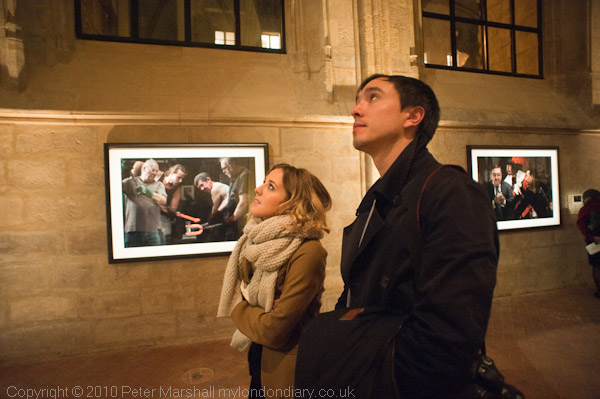
At the Paris opening in 2010 © Peter Marshall

Finally you can see Brian Griffin‘s Black Kingdom, work I have written about before when I attended the opening of his show of in Paris. You can see more pictures from that opening on My London Diary. Good though the work by the others is, his is perhaps the only one of the three I’ve mentioned that I feel is any way ‘pushing the boundaries of the medium to explore conciousness and human perception‘, though there are other essays on the page that could also be considered to have done so.


*I’ve not added links to the individual issue or essays as these are not permalinks and will change presumably when the December 2015 issue is published. To find them after that date you will need to use the ‘Back Issues’ link at the top of the home page and then select the November 2015 issue.
Continue reading LIFE Force