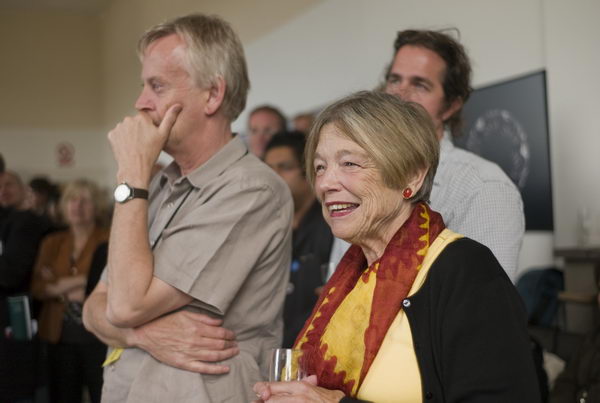
Paris Day One

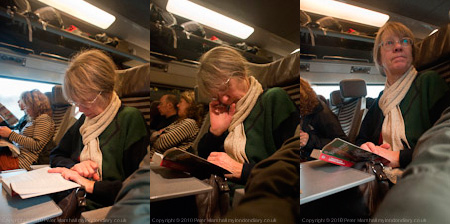
Our Eurostar train got through London from St Pancras at an impressive lick and soon we were at Thurrock before diving down under the Thames to stop at Ebbsfleet. Where almost every passenger probably looked out of the window and said “Where the hell is this?” as we stopped in a deserted station. But soon it was on its way, sweeping across the Medway and on, and we were in the tunnel and arriving in France before I’d had time to finish my sandwiches and the small bottle of red wine I’d taken for the journey.
© 2010, Peter Marshall
England – Tunnel – France

Getting to Paris took a little longer, but we were pulling into the Gare du Nord just around 138 minutes after leaving St Pancras, a couple of minutes early, and hurrying along to the RATP ticket office to get ourselves a Navigo Découverte card which would carry us around Paris on buses and Metro for what seemed a rather small sum for those accustomed to London fares. So my next significant photograph was a rather small  – 25x30mm one of myself, which I slid across the counter and was then attached to a card in a thin plastic sleeve.

© 2010, Peter Marshall
Navigo Découverte

Once you’ve paid 5 euros for the card, you can charge it with a week’s travel across the city of around 18 euros. Unlike London’s Oyster card there are no arcane regulations, although it is less flexible in that the weekly season can only run from Monday to Sunday, and you can only buy it up to Wednesday in any week. But all in all it’s a much better system.

We didn’t need the Navigo to get to our hotel – it was just a short walk – but I wanted to rush off for Paris Photo as soon as we had booked in. This took a little longer than expected as when we arrived we were taken a quarter of a mile to another hotel for our first night as maintenance work meant our room would not be ready until the following day. Fortunately the new hotel was equally close to the metro and soon we were able to rush out to take the train to Paris Photo (PP).
© 2010, Peter Marshall
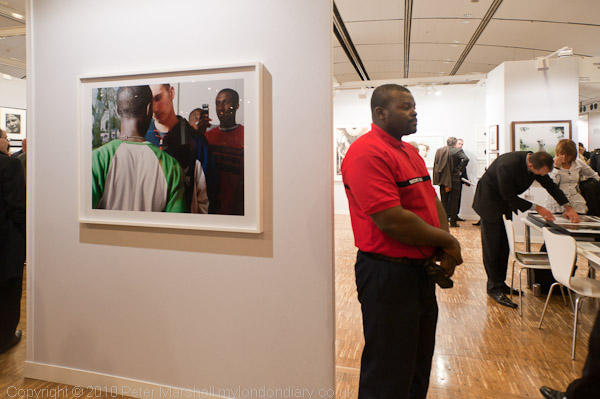
Salle Delorme, Paris Photo

PP takes place in a subterranean shopping and conference centre, Le Carrousel du Louvre,  underneath the Louvre and the Jardin du Carrousel. Two short escalators take you down from street level on the rue du Rivoli or you can exit directly from the line 1 Metro station and walk a couple of hundred yards to the show. From the ticket hall you enter into a central area which includes a number of smaller stalls for publishers, a cloakroom, a bar area, offices and a small exhibition area as well as a stand featuring a BMW or two – BMW are the major sponsors of the show. They provide the money for the BMW-Paris Photo Prize, the short-listed entries for which are up some wide steps on a mezzanine floor above the rear of the central area.

Off three sides of the central area are three exhibition halls with the stand of the various galleries and larger publishers taking part. The stands vary in size, and even more in the number of photographs on show, with some having only a few mural size images and others being crammed with much smaller work – even done to some showing small contact prints.

The only way I can cope with such a huge show – 106 exhibitors from 25 countries – is to approach it in a systematic way, working around the 3 major exhibition halls. I started during the press launch and opening on Wednesday by working around the outer stands of the Salle Le Notre, then moving on to the outside of the Salle Soufflot and finishing with a part of the outside of the Salle Delorme, and coming back in later days to finish the circuit and do the inner blocks of each room. It was the only way I could be sure of seeing everything.

Of course some stands did not detain me long. Many had work that either did not interest me, or that I was already very familiar with. It is sometimes nice to see work you really like “in the flesh” like the Kertesz image Martinique (on the Stephen Daiter Gallery stand and later I found it elsewhere) I’ve written about at some length from its reproduction, though just occasionally the experience can be disappointing, but I’m really more interested in discovering new work that excites me.

Another of the good things about PP is that virtually everyone seems quite happy with people taking pictures of the pictures, unlike many museum and gallery shows – though the only place I went to during the six days I was in Paris where photography was explicitly banned was the Maison Européenne de la Photographie (MEP), though with almost everyone now carrying a camera-phone such bans are virtually impossible to enforce.

One thing that struck me on that first night – and a partial look at PP, was there number of pictures by Bernard Plossu, with a particularly nice set on the stand of Galerie Le Réverbère, Lyon. Plossu is a French photographer whose work has long interested me, and I have a couple of his books including perhaps his best work, ‘New Mexico’. There is a large amount of his work on the ‘documentsdartistes’ web site – click on the images on the thumbnails page to see more.

The work shown by dealers at PP relates to that on show elsewhere in Paris, so Plossu is the major artist in a splendid free show, part of the Mois de la Photo (MdP), ‘Nous avons fait un tres beau voyage‘ at the Hotel de Sauroy (58 rue Charlot, Paris, 3e) until 15 December 2010. It’s a show I very much enjoyed when I saw it later in the week.

There was a lot of Kertesz’s work throughout PP too, to link with his major show at the Jeu de Paume (1 place de la Concorde, Paris 8e) until 6 Feb 2010. Although I’m a great fan of Kertesz, I have seen his pictures so many times. I also have several books of his work and although I enjoyed seeing the many prints of his on display at PP didn’t feel any need to spend time going to see another show of his work as well.

I was particularly struck by a small set of 5 pictures by Lise Sarfati on the Brancolini Grimaldi stand, from her series ‘She‘; the two images of ‘Christine‘ one in a wedding dress and the other apparently in the middle of a desert in California stood out for me.

It’s always good too, to see work by photographers I’ve written about before – and especially if I’ve actually met them. There were some of Vanessa Winship‘s pictures on the ‘Vu Galerie‘ stand (and more of her work from Turkey on ‘The Empty Quarter‘. Vu also had some pictures by John Davies, particularly one from Widnes and another from Blaenau Ffestiniog that I admire. They were also showing the work of Denis Darzacq, although I found these images from his ‘Hyper‘ somewhat less striking than his earlier work in ‘La Chute‘.

But the most striking of all the new work that I saw on that first evening were a large set – around 16 – prints by Lee Friedlander from his ‘America By Car’ series of 192 prints showing at the Whitney Museum in New York until 28 Nov 2010 and at PP on the Janet Borden stand. You can watch the pages of the book of the work being turned on YouTube.

This is inventive and well-printed work that really fits well into the square format and came as something of a shock in the middle of a show rather dominated by very large (and often poorly printed colour images. Much of the black and white work around the show – with notable exceptions – isn’t well printed either, so it was a delight to come upon this set.

Just how many ways can you make use of the structure of a car – its door posts, mirrors, fascia , window – in a photograph. Certainly on the evidence here, rather more than sixteen. Of course the content framed by the car is also both vital and in Friedlander’s case superbly matched, the two integrated into a vibrant whole by the work of the printer.
© 2010, Peter Marshall
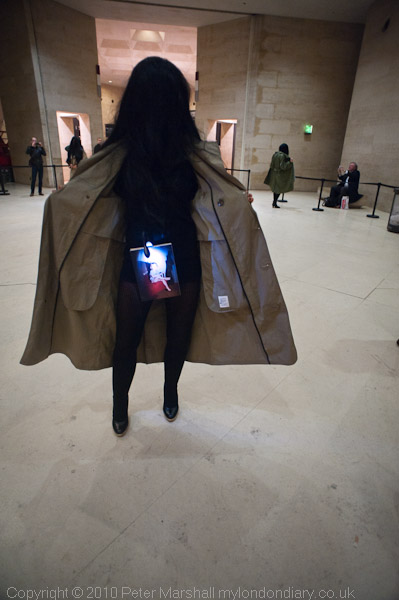
QQQOC counter-event outside Paris Photo

Having seen this, it seemed a good time to leave PP for the day on a high note, and in any case I needed some dinner, and it was time to meet Linda again. On the way out from PP we were greeted by several women in long coats who were rushing up to people and ‘flashing’ open their coats to reveal an illuminated photograph. This was a ‘CONTRE évènement’ against Paris Photo, inspired by its Central European theme and the clandestine circulation of ideas necessitated by state censorship. You can read more about that – in French – and watch videos of the QQQOC artists confronting those leaving and entering PP.
© 2010, Peter Marshall

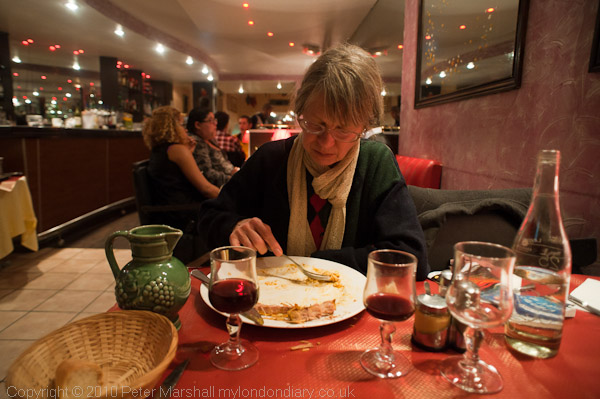
We took a short stroll through the centre of the city to enjoy a leisurely and pleasant cafe meal. Afterwards we strolled again through the Isle St Louis and then looked in vain for a bus back towards our hotel. Fortunately we were still in plenty of time for the Metro.

A few more pictures are now on My London Diary.
Blurb’s London Celebratory Kickoff

 © 2010, Peter Marshall
‘WassinkLundgren’  and their winning portfolio

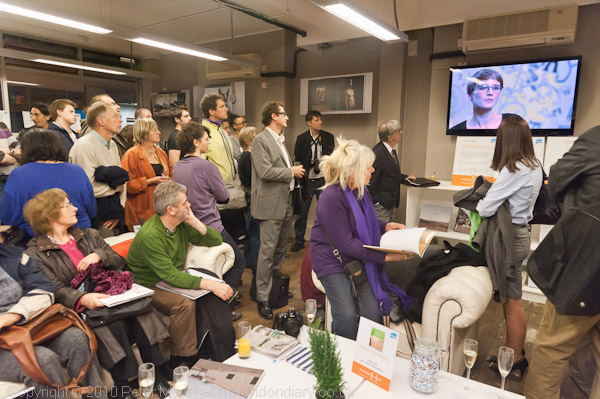
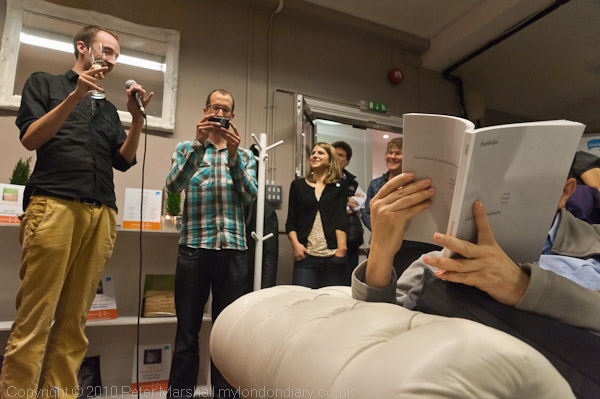
Last night I was at Eastcastle House for the start of Blurb’s London events, celebrating the new pop-up store and the 2010 Photography Book Now winning books.  Several of the winners were present including the Portfolio category winners, Dutch photographers Thijs groot Wassink and Ruben Lundgren, though we had to be content with Judith Stenneken, whose Last Call won the $25,000 Grand Prize, on video.

© 2010, Peter Marshall
Judith Stenneken on video

Some of the judges were there too, and I talked briefly to Martin Parr and a number of old friends at the event, as well as drinking too much fizzy stuff (I’m sure it was the bubbles that made me just a little unsteady as I walked towards the bus stop after the event.)

© 2010, Peter Marshall
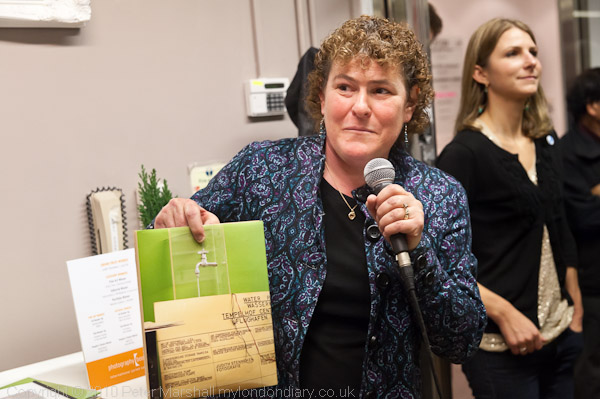
Robin Goldberg, Blurb SVP, International Markets, holds up the winning book

© 2010, Peter Marshall
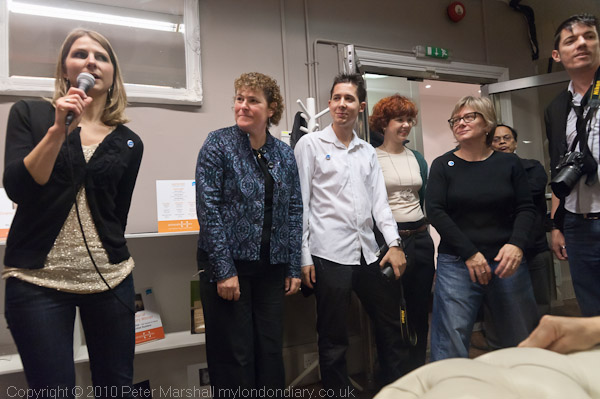
The Blurb Team

After this morning’s session, the events continuing at the London Pop-Up store until Nov 14 are free, and I’ll be there again talking on Sunday about ‘Before the Olympics‘ and my other two Blurb books. Also in Sunday’s programme are some of the Blurb winners, Anton Kusters and ‘WassinkLundgren‘ as well as Jonathan Lewis, and the day ends with a self-publishing debate with guest panellist Bruno Ceschel of Self Publish, Be Happy.

More pictures from last night on My London Diary.

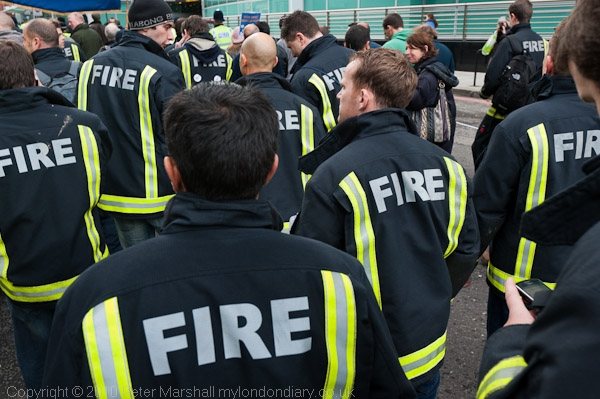
Striking Firefighters March Against Cuts

© 2010, Peter Marshall

I was pleased with this image of the fire-fighters at the front of the thousand or two trade unionists marching to a London rally against the cuts.  Framing was a bit tricky as I was holding the camera up as high as I could above my head and saying my prayers – a ‘Hail Mary‘ shot. I took several frames, looking at the image on the camera back after each and trying to get the distance between me and the closest man right as well as the angle of the camera, and this one seemed to work. The D700 does have a shutter blind which stops light coming in through the viewfinder affecting the exposure, but in practice it’s often easier simply to cover it with my other hand as I did on this occasion.

Either I’d misread the details or it started early, as I was expecting to be at the meeting point for some time before the march actually started, but I met it coming along the road a few hundred yards away.  It’s almost always a good idea to go early when photographing events but I’d had a few things I’d wanted to do first. Some days when I’m photographing a whole series of events it just isn’t possible. But often things are more interesting before the actual start.

© 2010, Peter Marshall

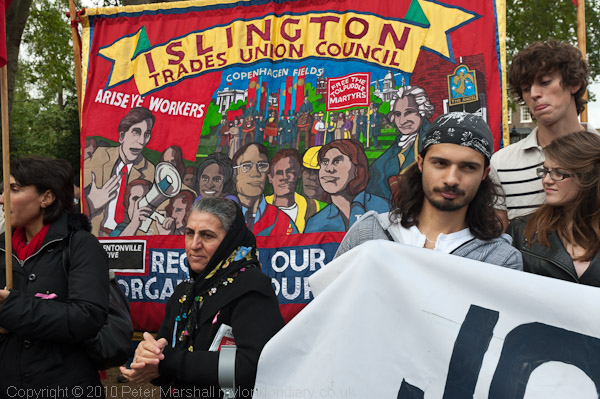
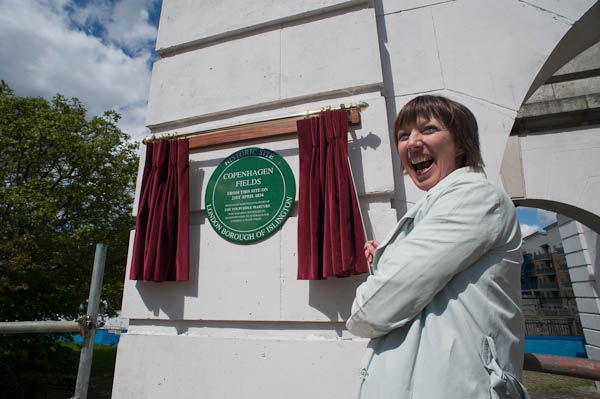
There were plenty of trade union banners and I particularly like this one from Islington Trades Union Council which commemorates the ‘Grand Demonstration‘ by the Metropolitan trades unions to campaign for the release of the Tolpuddle Martyrs in 1834, which gathered at Copenhagen Fields. I was there last year when TUC Deputy General Secretary Frances O’Grady unveiled a plaque to commemorate the event.

© 2009 Peter Marshall

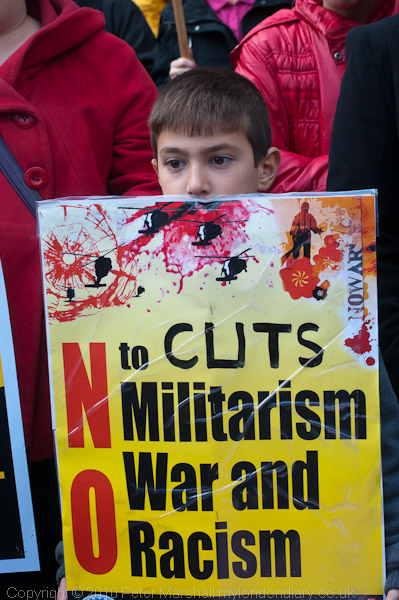
The image on the Islington banner very much reflects the current population of London, and there was a strong group of demonstrators at today’s event from the Refugee Workers Cultural Association Women’s Branch, carrying placards from the  AvEG-Com against Militarism, War and Racism, to which they had added the word CUTS.

© 2010, Peter Marshall

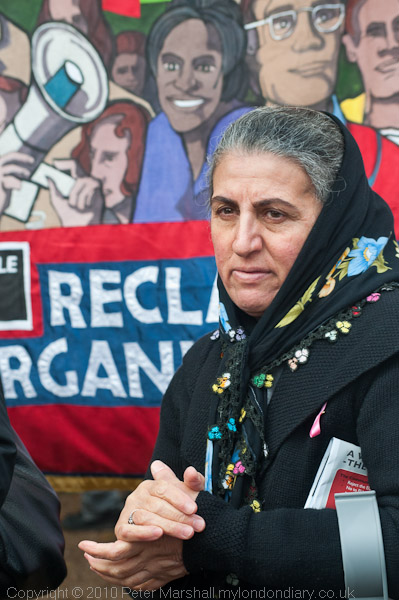
I thought the Islington banner made a fine backdrop against which to mover closer to photograph an elderly woman, I think one of our new Londoners, in a flower-decorated scarf with its crowd as a backdrop.

© 2010, Peter Marshall

Of course there were other pictures, including those of the two main speakers, the RMT’s Bob Crow and  FBU’s Matt Wrack, as well as many more of the crowd, all in Trade Union March Against Cuts on My London Diary.

Clear Blue Skies

Volcanic ash might have caused havoc to the world’s airlines and inconvenience to a many passengers – including several friends of mine and my son, who got an extra week’s stay in America with some more wild swimming.

But for those of us who live near Heathrow it was sheer bliss! We hadn’t realised here how much incessant background noise – day and night – the airport was responsible for, and it was almost like moving out to the country.  Nor how much our skies are normally populated by vapour trails. This morning as I performed my daily workout (not the most strenuous of activities, but good for the heart) I looked up at the sky and realised that every bit of cloud cover was man made, with con trails in virtually every direction speading out to give light and fairly diffuse clouds over perhaps a fifth of the sky.

Of course these trails eventually vaporize in the sun and later in the day we still sometimes get clear blue skies, but those few days when ash grounded the planes were something rather special. Despite being busy with other things I did find time to take advantage of them with a few pictures, in Finsbury Park and Wandsworth.

© 2010, Peter Marshall

The skies seemed a little deeper blue than normal, perhaps because of the ash. We had expected some rather special sunsets too, but I didn’t see any, though I’m not sure I would have photographed them in any case. File with cute cats so far as I’m concerned.

Actually I don’t much like clear blue skies either, better to have some clouds, but the do need to be real clouds. Con trails can be a nuisance, and its often hard to convince viewers that those marks in the sky are not scratches on the print and I have been known to retouch them out of pictures, especially when sending files to Alamy, otherwise their quality control may reject the images.

Alamy are also responsible for the elimination of countless birds from the sky too. Once you’ve had an image rejected for ‘dust’  that you know was seagulls, it’s easier to play safe and simply clone out those little dots.

You can see more blue skies on my pictures from Wandsworth and Finsbury Park on My London Diary, but I’ve taken better pictures of both places previously – with clouds.  Some of my acquaintances threw up their hands in horror when I told them I’d been photographing in Finsbury Park in 2003, expressing surprise that I had survived and not been mugged for the Hassleblad Xpan and other expensive gear I was carrying.

© 2002 Peter Marshall
Finsbury Park, 2002

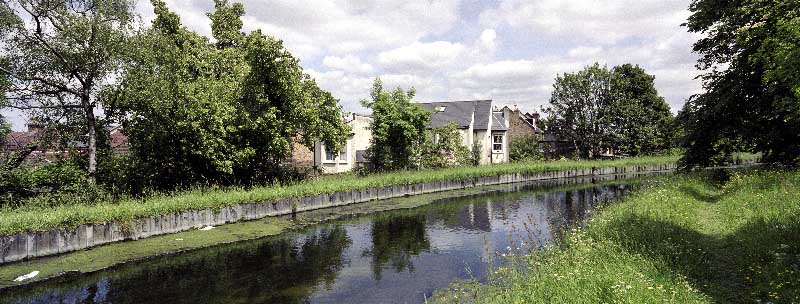
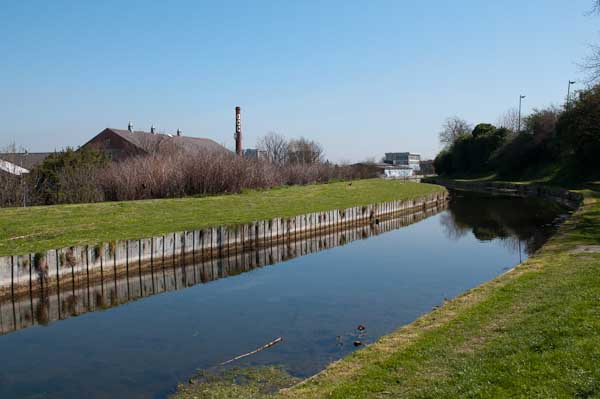
Not a great deal of cloud there, but here are two images taken a few hundred yards and 8 years apart on the New River that really show the difference.

© 2002 Peter Marshall

© 2010, Peter Marshall

Yes, I prefer clouds!

Bite!

Bite! magazine is an interesting project that presents one photographer every day with a  slideshow of their work and a brief text. The photographers are selected by guest curators, including some well-known names. And although Bite! is a stage for emerging talent, with a special focus on photographers from Asia, Africa and South America, the photographer whose work drew my attention to it was an American I first wrote about admiringly some years ago.

I can’t remember now how Ami Vitale first came to my attention, but I do remember our meeting each other at a glittering reception in a Polish castle at the first Bielsko-Bialo FotoArt Festival in 2005 where both of us were showing. She was a fan of my web site and I was very much a fan of her work, and I still am. Perhaps one day I’ll get back to some real writing too, but really photography is more fun.

As curator Hannamari Shakya says about her work, “She gets close with people” and it really shows in her pictures and it is very much how she is. The set of Vitale’s pictures at Bite! is the first of her work I saw, from Guinea-Bissau, and it still has the same powerful impact for me.

There are a lot of other sets of images on the site, and most of those I took a brief glance at looked worth exploring further when I have the time, and I’ve added the site to my RSS feeds to remind me to do so.

Fair Trade Photography

Chris Barton, a photographer based  in Vancouver, Canada, the managing director of a professional photography portal who describes himself as a ‘Fair Trade Photography’ pioneer has put together a rather nice example on the dangers of using cheap stock photography rather than paying a photographer to make a unique image for your use. (thanks to EPUK for this.)

Microstock: why would a reputable company do this to themselves? gives a dozen example web pages using the same picture – and one of the comments points out he did a search using TinEye and found 86. Thanks also to Mr Barton for his “Entire Known World a Royalty-Free in Perpetuity All-You-Can-Eat License to link to this blog article. “

Die-in for Afghanistan

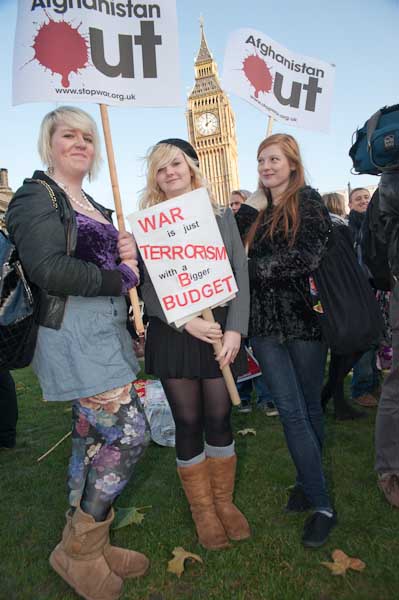
There were a lot of photographers in Parliament Square waiting for the student “Die-In” and I know that some were disappointed that the event was not more theatrical.  One said to me “I was expecting blood and bandages” and there were none of these.

It was in it’s way a nice demonstration, doing what it set out to do and flouting some of our over-restrictive laws that limit the freedom to protest. And although the police at the end did tell those taking part they had been breaking the law in protesting outside Downing St and in using megaphones, so far as I’m aware there were no arrests.

But how do you take interesting pictures of an event such as this? I think all of us look for something a little out of the ordinary, perhaps an interesting placard. But all except one young woman carried the same standard design – so of course she features rather a lot in my pictures, not least because I liked the little bit of humour in ‘Pick fruit not wars.‘  But rather annoyingly all the best pictures I took of her showed the other side that read ‘War is just Terrorism with a Bigger Budget.’

© 2009 Peter Marshall

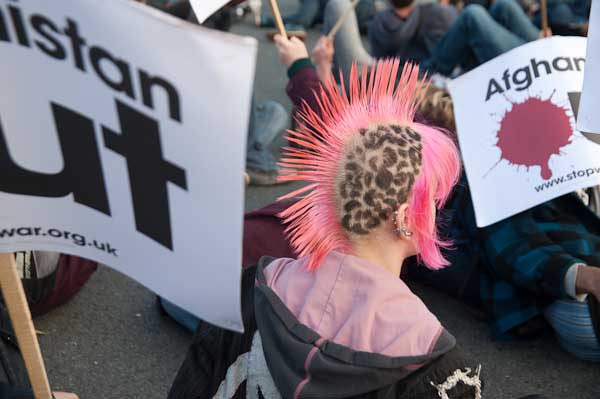
The punk girl with the pink spiky hair obviously felt very much under siege by photographers – and it probably didn’t help that some of her friends tried to shield her with placards. I tried not to be too obtrusive, but she did stand out and make some interest.

© 2009 Peter Marshall.

Often the police actions at demonstrations create a certain tension (and sometimes rather more) but on this occasion they simply stood back and watched most of the time.

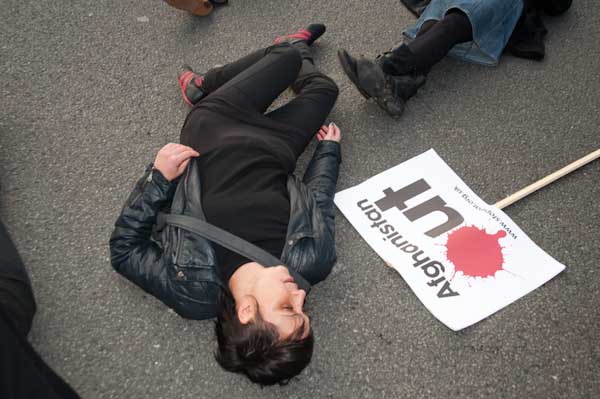
Perhaps a very simple approach was the best:

© 2009 Peter Marshall

but it seemed every time I tired something like this other photographers or TV crews would walk into shot.

There are just some occasions where it’s hard to come up with really interesting pictures, though I think those I took – and you can see and read more on My London Diary – do tell the story of the event.

Half Life

Here’s a set of 30 pictures on Burn that I really enjoyed looking at, not least because as it says “ESSAY CONTAINS EXPLICIT CONTENT”. As always I thought that non-explicit photography would have to be very out of focus, and in fact most of the more sexually explicit images in the sequence deliberately utilise depth of field to soften the relevant areas.

The 30 square black and white images of ‘Half Life‘ were shot on medium format film and individually each  has a certain presence and moodiness, while together they build up a description of a life-style, of relationships, of memories from a recent two year period in the photographer’s life.

You can see more of the work of Edoardo Pasero (b 1978 Milan) on his web site. On permanence is a series of pictures of tattoos on various parts of the male and female anatomy and is perhaps rather more explicit, but Scripta Manent will offend no-one with its images of old books, documents and a library, which also in some images uses limited depth of field to great purpose. His colour portraits, some of which are also semi-nude, are for me less interesting, though there are a couple that I like particularly, a woman with beads that look a little like giant smarties and a man sitting on shopping trolleys, both clothed. You can also see more of his pictures on IrisF64.

Fotofest – Birmingham Mark II?

I was a little surprised to see a picture by Vee Speers at the top of the press release for the Fotofest International Discoveries II show which opens today in Houston and continues until December 19.  Of course I really love her pictures, but I’d hardly call her a ‘discovery’ given the amount of previous exposure of her work, not just the The Birthday Party, first shown in Australia in 2006 which is now on show in Houston, but also previous work including ‘Bordello‘ which first shown in Italy in 2002.

© 2009 Peter Marshall.

I first met her at Birmingham at Rhubarb Rhubarb in 2007, though she first attended in 2005. In 2007 her pictures were on the wall of the room where I was looking at portfolios, one of several fine photographers selected for the show ‘Otherlands‘, though I’d seen her work previously in magazines. Surprisingly Birmingham doesn’t get a mention in the Fotofest release, although it was most probably there she met the senior curator of Fotofest, Wendy Watriss, who was a fellow reviewer.

© 2008 Peter Marshall

Chinese artist Wei Bi’s re-staging of his 80–day experience in a Chinese prison — a sentence received for making a photograph. His large black and white photographs are minimal, showing a surreal relationship between near expressionless guards and disoriented prisoners. One of his images appears at the top of an earlier press release.

Alejandro Cartagena, born in the Dominican Republic lives and works in  Monterrey, Mexico and at Houston he is showing large-format brilliantly coloured images of the dramatic and ever-expanding suburban development of the area. He has shown work widely in Mexico for around 5 years as well as contributing to international group shows. I particularly like some of the ‘NewWork’ on his site.

Minstrel Kuik Ching Chieh was born and raised in a Malaysian fishing village but she studied photography in southern France. You can see her work, including RRose which is being shown at Houston on her blog.

Christine Laptuta produces work about the mystery of land, “its ambiguity, disruption and rhythm.” She chooses to represent ordinarily vast landscapes in multiple printed miniature platinum/palladium contact prints.

The constructed landscapes of cities are focus for Rizwan Mirza‘s photographs. His shadowy nocturnal images reflect the tension between the mysteries of darkness and the lighting.  Born in Liverpool he studied with John Blakemore in the early 1990s and also came to Rhubarb Rhubarb in 2008, although the previous year he showed at various galleries and festivals including PhotoEspana, Madrid, Spain. His work was also on show – not in FotoFest – in Houston in 2008.

Born Tokyo 1948,  Takeshi Shikama has been showing his black and white photographs of trees since 2004, and “The Silent Respiration of Forests” first appeared in a Tokyo gallery in 2006.

Working between Seoul, London and Paris, Korean-born MiMi Youn was one of the three winners of the Lens Culture – Rhubarb Photo Book Awards in 2008 along with Kurt Tong who divides his time between China and the U.K and has photographed a little-known and officially banned element of ancient Chinese funerary practice; Joss Paper or “Spirit Money.”