Rhubarb: Reiner Riedler

On Friday morning I walked with other reviewers from the Burlington Hotel to Curzon Street Station and found my table waiting for me in a light and airy first-floor room showing the ‘Otherlands Exhibition’, certainly the most interesting of the shows in Curzon Street. Several of those included were names I recognised, and one in particular was Austrian photographer Reiner Riedler, with an unforgettable image showing Superman leaping through the air.
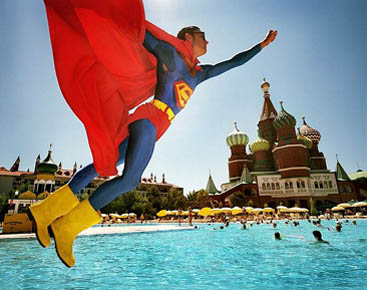

Turkey; Antalya; Lara Beach; World of Wonders, Kremlin Palace;
Animator dressed as Superman © Reiner Riedler / Anzenberger

In April 2006 when I was still writing for ‘About Photography‘ I did a short note on the Anzenberger Gallery in Vienna. The Anzenberger Agency was founded in 1989 and represents photojournalists, documentary photographers and portraitists, selling their work to clients including The New York Times, National Geographic, Geo, Stern, Vogue, New Yorker, Aperture and Le Monde.

In 2002 they decided to open a gallery, and when I looked there was work by around 20 photographers on the site. Among those I mentioned as of particular interest was Reiner Riedler (b 1968, Austria), with work from Russia, the Ukraine, Albania on show. Since then I’ve seen some of his work – including the above image – in magazines.

It came as a welcome surprise – and a rewarding start to the day, when my first visitor (as a late booking not on my schedule) was Riedler with a portfolio of his work on ‘Fake Holidays‘, pictures in theme parks and similar venues around the world. It’s hard for any photographer to resist taking pictures of these places, but very difficult to produce the sustained level of work that Riedler has.

Looking at his images, as well as dealing with the obvious commercial surreality, he has found various ways to invest them with other layers of interest, including the humour of the Titanic Hotel as a shark about to swallow the unsuspecting swimmers in the pool or the slight resemblance in the stance, gesture and features of a man perhaps about to be pounced upon by a dinosaur and that prehistoric creature, or in the menace of a cloud of insecticide spray. Sometimes the focus is on the customers, sometimes on the costumed animators and at other times on the artificiality of the structures themselves. In his images of the indoor “Tropical Islands” pool in Berlin, things could almost be real until you notice the join in the background sky.
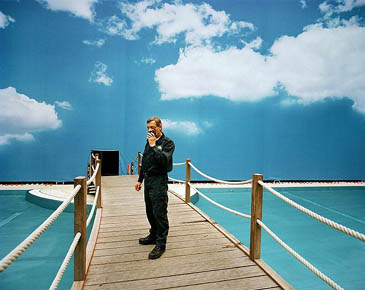

Germany; Indoor Pool “Tropical Islands” in
Berlin Brandenburg; © Reiner Riedler / Anzenberger

Of course photography is itself an illusion, producing simulcra of the world, (the postcards gathered and produced proudly by Michel-Ange and Ulysees in Godard’s ‘Les Carabiniers‘.) In the artificial environments Riedler has photographed, capitalism has taken simulcra into a further dimension and peopled them with real people, but they still lack reality, flawed copies. His photographs add a further layer, usually adding a reality which their subjects lack. His superman image above is atypical, in that it works playfully with the fantasy rather than subverting it, reminding me a little of some of Argentine photographer Marcos López’s kitsch Pop latino work.

You can find out more about Riedler and see his pictures on his own web site, www.photography.at
Stephen Ferry – PicturaPixel

I’ve written before about the work of Stephen Ferry, particularly in an extended review of his fine book ‘I am Rich Potosi’.

Now you can see his pictures and hear him talking on PicturaPixel about two projects from Columbia. One on the Sierra Nevada, taken for National Geographic, which looks at the concern the indigenous Tayrona people, guardians of the mountain have about the melting of the snow, and the warning they want to send to the rest of the world. It isn’t just the scientists that can see the warning signals about global warming.

Ferry first went to Columbia in 1995 to teach a workshop, and the pictures the participants brought made him aware of the civil war that has been going on for 40 years, in part a class struggle. His pictures try to show the complex nature of the struggle and the fear it engenders, with almost every family having members who have been killed or injured. But throughout he is impressed by the rich culture, particularly music and dance of the Columbian people. The pictures are intense and emotional in their use of colour.

Both projects are superb examples of contemporary colour documentary photography – don’t miss them.

Heathrow Climate Camp

I grew up under the flightpath into Heathrow, reaching up from my back garden I could almost touch the planes as they went over a couple of miles from touchdown. I still live around the same distance away. Back in the 1950s we resented the airport for having stolen productive orchards and farmland and being a noisy and smelly bad neighbour. In the 1960s I became a climate activist of sorts at a time when ‘Friends of the Earth’ were only Californian weirdos. We understood then about global warming and that human activities were beginning to have often entirely unpredicted effects on ecosystems.

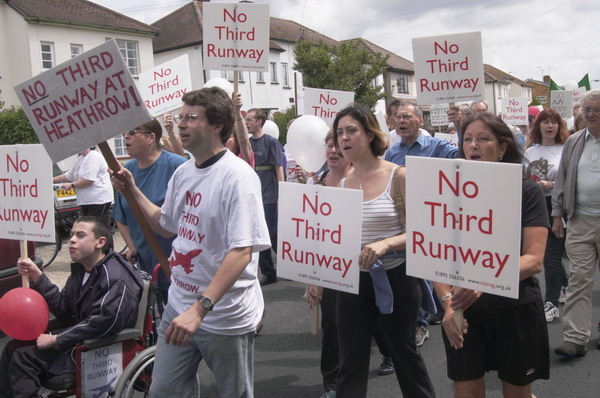
Heathrow from its inception was in the wrong place, too close to built-up areas. Had they been open about the plans it would almost certainly have been turned down as an unsuitable site in the 1940s, but the public – and the authorities – were deceived. Since then, the airport has broken every promise it ever made about expansion, taking over more land, causing more pollution. I supported the efforts to stop T5, marched with the protesters against the third runway in 2003.

No Third Runway (C) 2003, Peter Marshall

Of course it provides a great deal of local employment, but it is still long past the time for a start to be made on running down the activities there, rather than continuing the program of expansion.

So will I be photographing the Heathrow ‘Climate Camp’ set up to the north of the airport yesterday? Regrettably I think not. Despite being entirely in sympathy with the movement’s aims, I can’t stomach the restrictions they have seen fit to impose on photographers and journalists:

Media wanting access to the camp will be invited to come on site between 11 AM and 12 noon. All visits will be over and journalists off site by 1 PM at the latest. Journalists will be given a tour of the site, accompanied at all times by two (or more) members of the media team, who will carry a flag to make the journalists/photographers identifiable. Journalists will be required to stick with the tour and will not be allowed to go into marquees or meetings and workshops unless invited at the agreement of all participants.

These are not conditions I can work under. Such draconian news management isn’t something I want anything to do with. So the camp itself will not get the kind of sympathetic coverage that I might otherwise have provided, and I know many other left photojournalists are equally disappointed. You can read Sion Touhig’s blog and his comments – along with some rather unconvincing attempts to justify the policy. Marc Vallée is there doing his best to cover the event, and I wish him the best of luck. I’ll probably try to cover some of the things happening on the outside later in the week.

The Italian Job

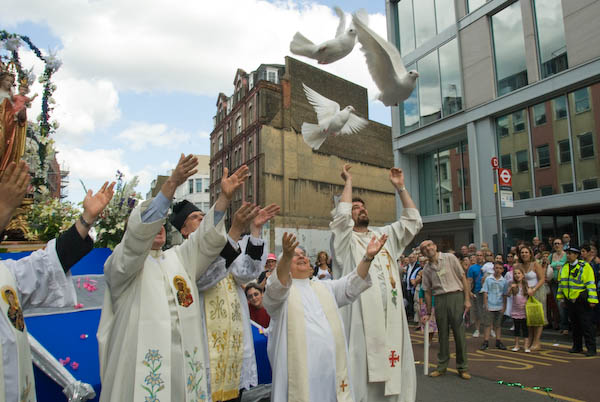
One of the larger community festivals in London takes place every July in Clerkenwell around St Peter’s Italian Church, which holds its Procession in Honour of Our Lady of Mount Carmel, when floats and walkers representing biblical scenes, various associations and banners and the heavy statues from the church are paraded around the neighbourhood, followed by the priests and a large crowd of parishoners.

At the climax of the event, in front of the statue of Our Lady of Mount Carmel, white doves are released and soar up into the air. This year they stopped around long enough to form a rather neat triangle for my image.

(C) 2007, Peter Marshall
Release of the doves, Clerkenwell, July 2007

At extreme left, the statue looks on, while the hands of the priests stretch up into the air, and the crowd behind cranes for a view. I was pleased to get this image, as it’s a tricky and rather unpredictable occasion, with everything happening rather fast.

Saint Veronica is said to be the patron saint of photographers (and laundry workers) as an image of Christ’s face remained on her towel after she wiped him with it as he was on his way to the crucifixion. Her day was a week or so earlier on July 12, but I have to admit I hadn’t prayed to her. But I certainly did a lot of praying on the day, if largely to St Ansel.

Incidentally, despite shooting this on a Nikon D200 which can shoot at 5 fps, I still took this on single shot mode, trusting my reflexes rather than motordrive to catch the precise moment. I’m happier working this way, though I suspect it may be rather less reliable.
It’s actually a great event to photograph, hard not to make some decent portraits, especially of the children. You can see my virtually ball by ball account at My London Diary.

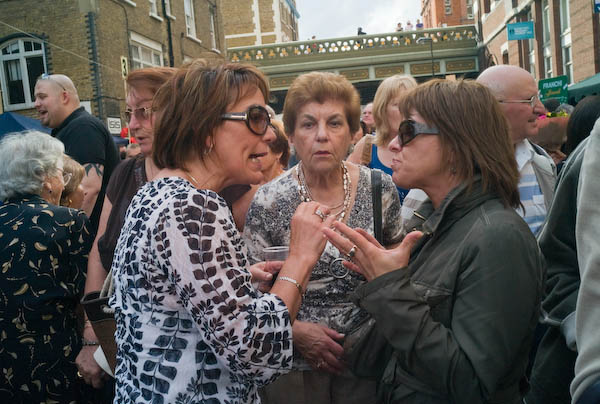
Down in the Sagra or village fair, much Italian wine was being drunk and ice cream and food being eaten and various aspects of Italian culture being celebrated, including the argument. The cheap red wasn’t bad at a pound a cup on what we voted the best stall there.
(C) 2007, Peter Marshall
An animated discussion at the Sagra

Rhubarb Reviewfest

The centre of Rhubarb Rhubarb (R-R for short) for photographers is undoubtedly the reviews, although for reviewers it is perhaps the hotel bar! We kept the bar at the Burlington Hotel busy until late, a comfortable place, although the choice of beers was abysmal and the prices high. (The Burlington is one of if not the best hotels that Birmingham has to offer, rebuilt at the turn of the 20th century and refurbished for the millennium, although with much of its character retained, including the slightly quirky 1902 bathroom fittings in my room.)

(C) Peter Marshall
It was good to meet some friends from other events, including Karol Hordsiej from the Foundation for Visual Arts in Poland and Jim Caspar of Lens Culture, one of my favourite photography web sites (see links at right), along with a number of people I’d corresponded with but never met in the flesh. Mainly the reviewers were curators from galleries and institutions, editors from magazines and book publishers along with a few representatives of agencies. The galleries and publications included some of the major institutions in photography, such as Aperture, the Victoria & Albert Museum, Sothebys, the Photographers’ Gallery, George Eastman House and more. Most of the reviewers came from Britain, Europe, Canada and the USA, but there were a few from elsewhere – including Yuting Duan from China.

(C) 2007, Peter Marshall
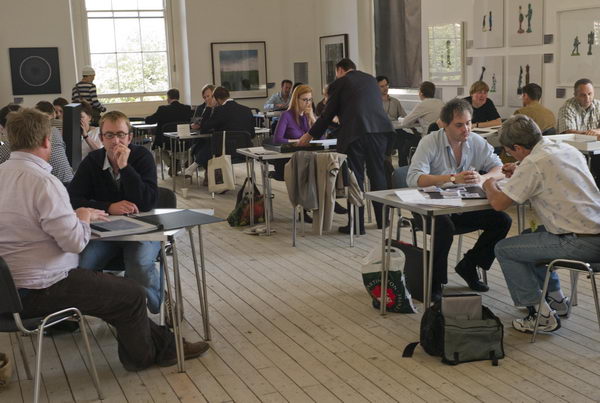
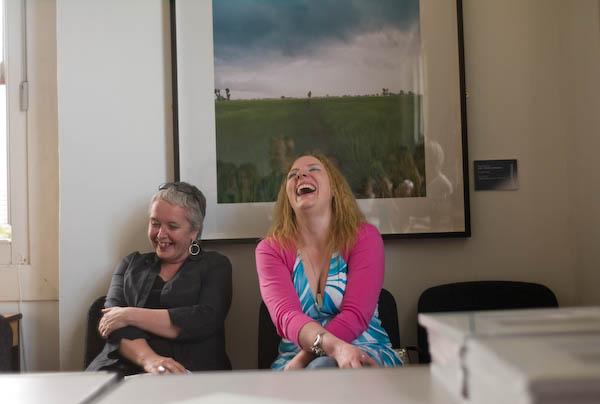
Reviewers and photographers at Rhubarb Rhubarb

When I’d registered as a reviewer I had been working for About.com, Inc as Photography Guide for almost 8 years, creating a large on-line resource on the medium, but by the time I got to Birmingham I had shifted my territory. Luminous Lint is a web site created by Alan Griffiths, and describes itself as “the ultimate online resource for collectors and connoisseurs of fine photography – authoritative reference materials, online exhibitions, expert analysis, commentaries and reviews, press releases, calendars of important events such as auctions, exhibitions and shows, a specialist online bookstore and much more.” By the time I arrived at R-R I’d contributed just two pieces to the site in what I hope will be a long and productive relationship.

Also of course I’m writing for this site, “Re>PHOTO“, which I hope will give a more personal slant on photography than would be appropriate either for ‘About Photography’ or ‘Luminous Lint‘. At About.com, the editorial policy – quite rightly – prevented me from promoting my own photography or that of my friends, although there were several hundred of my pictures scattered around the site, largely as illustrations.

Essentially I think I was at R-R as a photography critic. Someone who likes to look at photographs and write about the experience – or in this case try and talk about it. Of course, the various gallery curators and editors present are also critics. What surprised me a little was that there were no reviewers listed as simply as photographers (though some of those present were also photographers) or as independent critics, and perhaps only one representing an academic institution (although rather more actually taught.)

Most of those I’ve shown my own work to and had useful comments from have been photographers – including (in no particular order) Raymond Moore, Paul Hill, John Blakemore, Ralph Gibson, Martin Parr, Lewis Balz, Paul Trevor, Fay Godwin, Charlie Harbutt, Leonard Freed and many other less well-known names.

Of course some of those reviewing in other capacities are also photographers, but I think fairly small minority. I believe strongly that photographers are the most important sector of the photographic community, and that the medium in a very real way belongs to us. The other guys are parasites, feeding on us for their living, although I don’t intend that term in a pejorative sense. They are necessary and at times useful, and the relationship can be one that benefits photographers as well. But there is something wrong when these people, rather than the practitioners drive the medium.

Peter Marshall 

Rhubarb Rhubarb: Images now on line

As promised, images from Rhubarb Rhubarb are now on ‘My London Diary

(C) 2007, Peter Marshall

As well as pictures of the main event, from the launch above and the portfolio reviews at Curzon Street Station there are also pictures from the party:

(C) 2007, Peter Marshall

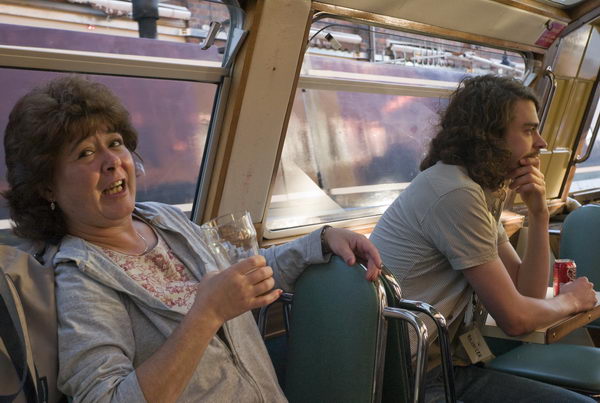
as well as other occasions during the event – such as the mystery trip:

(C) 2007, Peter Marshall

I’ve also included a few images that I took walking around the area.

The pictures were shot on a Leica M8 digital camera, mainly using a 35mm f1.4 lens that Leica say is not compatible with the camera. Equipped with the necessary IR cut filter, and with an appropriate Leica lens code applied to the mount with a black ‘sharpie’ fine point permanent marker, it seems to work perfectly.

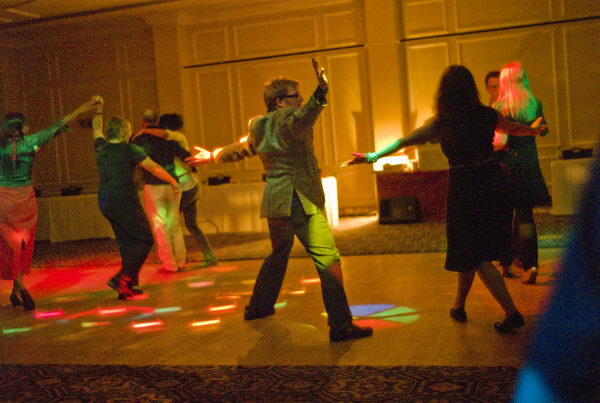
The party shots were made wide open working at ISO 2500. Lighting was generally non-existent, with some flashing coloured effect lights, and it would have been pretty impossible to work with film. People were moving quite a lot and with speeds of around 1/30-1/90 I sometimes managed to avoid blur. Thanks to digital I was saved from either having to dance or to go to bed early.

Peter Marshall

Rhubarb Rhubarb: Ian Wiblin

Rhubarb Rhubarb (this year’s event was 26-29 July) is a festival with various aspects, including the seminar “East Meets Eastside” on the Thursday afternoon which I was unable to attend, although the reports of it were intriguing. Another is the exhibitions held at the main centre of the event, which this year for the first time was Curzon Street Station close to the centre of Birmingham, as well as at associated venues. The New Art Gallery at Walsall was one of these with a show of colour work by Ian Wiblin, “Recovered Territory“, which continues there until Sept 9, 2007.

(C) 2007, Peter Marshall
The New Art Gallery, Walsall

The art gallery is a fine modern building in the centre of Walsall, standing out among some indifferent modern sheds and remaining proud Victorian relics as a symbol of the possibilities for regeneration of the area. I arrived in Birmingham on Thursday afternoon just in time to jump on a coachfor the short trip to Walsall, along with a few of the other reviewers, volunteers, organisers and others at the festival. We were then treated to the full Birmingham experience of a traffic jam on the motorway, along with a short circular tour around Walsall’s town centre when our coach driver missed the gallery first time round.

Inside the gallery a warm welcome awaited us, along with some even more welcome refreshments, before we took the lift the the top floor, where Ian Wiblin’s work was on show. This is a fine exhibition space, with large windows giving a view over the surrounding town (unfortunately a little rain meant we were unable to use the roof terrace), and a 30 foot or so high ceiling which perhaps rather dwarfed the small colour images on show, well spaced out on the tall white walls.

(C) 2007, Peter Marshall
Ian Wiblin and visitors in the gallery reception area

The old Polish city of Wroclaw had a largely Germanic population from the 13th century, and in 1741 officially took on the German name of Breslau, later becoming one of the major cities of Prussia. By the start of the Second World War, the Nazis had cleared out remaining Poles along with most of the Jews, and the city became a Nazi stronghold, the last German city to fall to the allies after a long siege by the Red Army. Almost three quarters of the city was destroyed, and many of the German civilians were killed. The rest were evicted in a post-war settlement, Stalin sliding Poland toward the west, incorporating Breslay under its Polish name of Wroclaw. The city gained a new Polish population displaced from Lwow, (renamed Lviv and added to the Ukraine), along with rather more Poles from Warsaw and Poznan.

In Wroclaw, as in the rest of the “recovered territories” large investments were made to remove traces of its German past, including the removal of many German signs and inscriptions and the restoration of many of the ancient building in order to promote a partly or largely mythical Polish past.

Wiblin first visited Wroclaw shortly before the fall of communism in 1989, producing the series of images “Wroclaw” shown at the Photographers Gallery, London (and elsewhere) in 1990. He returned to the city for a few days in 2006, working in colour to produce “Recovered Territory.” The title refers both to the lands incorporated into Poland following the war and also to his personal impression of the change from a state-controlled communist city into a capitalist one. As with his earlier black and white work, these carefully framed fragments showed an intense and often unusual, sometimes surprising vision, glimpses that reflect past history that are often compelling, sometimes strangely uneasy. Perhaps I found the need for some text on the walls – perhaps equally fragmentary – to anchor these visions to their context.

In Wiblin’s previous black and white work from Wroclaw as well as in the images in “Night Watch“, the book from his year in residence in Cambridge in 1994-5, Ian’s printing added greatly to the impression that the images created, its dark charcoal greys and glowing lights being very much integral to the syntax with which he worked. Here the images were in colour and in a much more neutral key; perhaps an area which he might exploit more fully. But it was a show I found intriguing and powerfully evocative, and I look forward to more work by him in colour.

It was perhaps a shame that there were not more of us on the visit – and that there were not more shows around the area as a part of the festival. And although it was good to see those that were taking place at Curzon Street Station, they could perhaps have been made a more positive feature in the programme. Since much of the work was in the review areas, viewing was really only possible in the breaks during the day. Some of the photographers who only attended for a single day will probably not have seen much of this work.

(C) 1982, Peter Marshall
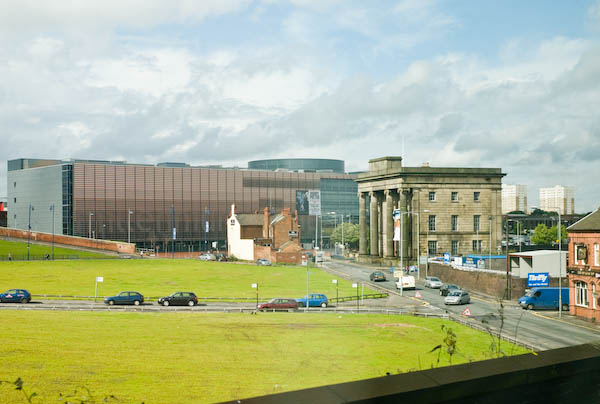
Curzon Street Station, seen from the train.

Curzon Street Station is a fine building, the first station linking Birmingham to London, built in 1838, and built to impress. Although the tracks are long gone, the building still impresses, dominating the largely cleared area around it and providing light, airy spaces within, although in some aspects in need of refurbishment. With some investment it would make a fine centre for photography and digital imaging.

I was fortunate to be reviewing in a room containing perhaps the best of these shows, ‘Otherlands‘ with some exceptional work by a number of photoographers including Vee Speers, and Reiner Reidler (of whom more in later features), and there were aslo some pleasing works in the more public areas such as the stairways and landing, notably a set of John McQueen‘s colour pictures showing the once proposed Birmingham Ship Canal with a toy liner cruising the city. There were also a few images I related less positively to, including a pair so badly off-colour that it made me feel ill to view them, but fortunately such things were rare.

More of my impressions from Rhubarb shortly.

Peter Gwyn Marshall

Rhubarb Rhubarb: Three Canons

Having just returned home from four days or so in Birmingham (the one that calls itself the “Heart of England”,) where I was one of the many portfolio reviewers at Rhubarb Rhubarb, the annual International Festival of The Image, I’m still suffering from picture shock, overwhelmed by images and many hours of meeting with old friends and making many new ones.

It was my first Rhubarb, and now I can’t think why I’ve stayed away so long, having enjoyed much of it immensely. However I am looking forward to my first decent glass of wine since last Wednesday, having refused to contemplate the 500% mark-up which appears to be the norm in some posher Brummie hotels and restaurants. (And although the lunches at Rhubarb itself were excellent (and rhubarb-free), our limited research suggests an inverse relationship between the expensiveness of dining establishments in the city and the quality of food on offer. Do rich Brummies really so lack taste? And can this blog become even more irrelevant? Rumour does suggest the Pope may be Catholic.)

It really seemed to be a fine event, rewarding for photographers and reviewers alike, and in the coming weeks – once I get back from a short holiday – I’ll look at it and some of the more interesting work that I saw in more detail. And perhaps show some of what went on in the photographs I couldn’t stop myself taking – like this one:

Rhurbarb Rhubarb (C) 2007, Peter Marshall

Before I put down my computer and pick up my bucket and spade, I hope to find time to make a couple of posts. This first one is some advice for all those people who bring portfolios to such events, although I hasten to add many of those I fortunate to see were in no need of it, presenting their work in an exemplary manner. But sadly not all.

Three Canons for Reviewees

  1. Be still, let your work speak and your reviewer think. Say only what is necessary.

  2. When making your pictures think for yourself; when preparing to present your work, think of your audience.

  3. Erase the word memory from your memory, your statements, your discourse. Let your work be memory, if so, then no one will need to be reminded.

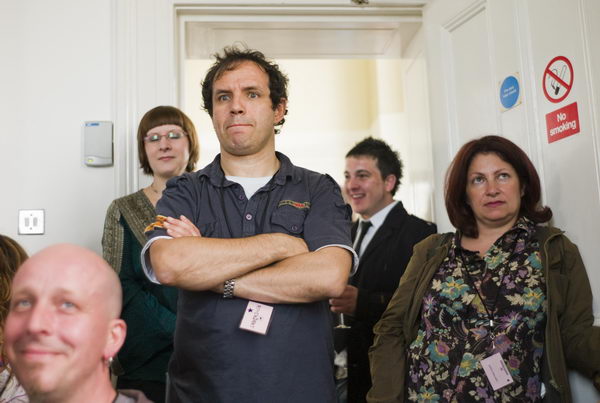
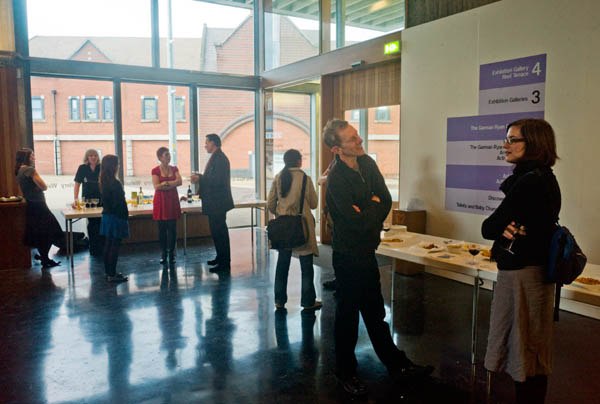
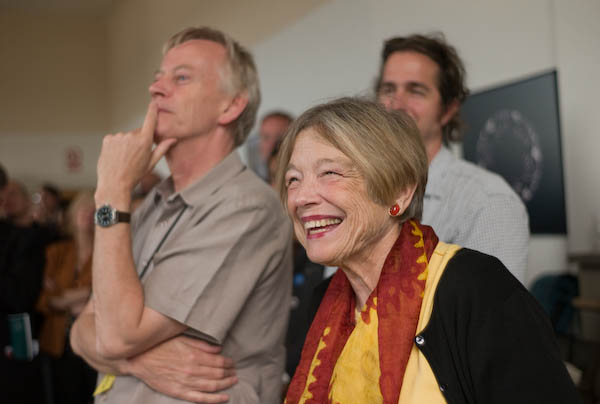
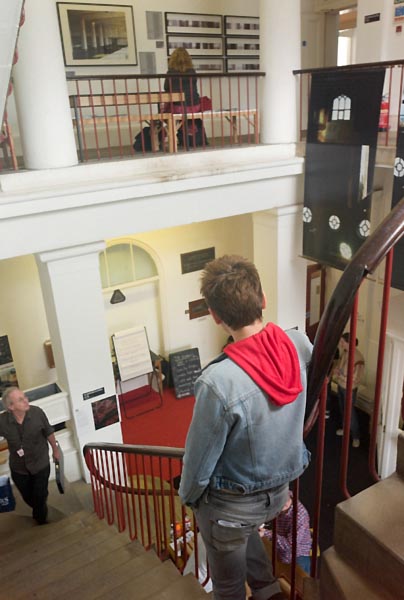
Of course there should be a picture to accompany each of the precepts. For the moment you will have to make do with three from the event, two from the sort of formal opening and book launch at the end of the first full day, and one which gives an idea of the interior of the Curzon Street station. This was the first time that Rhubarb Rhubarb was held there and the picture shows a quiet moment during the day.

Curzon St - Rhubarb (C) 2007, Peter Marshall

More features and more photographs about ‘Rhubarb Rhubarb’ on this blog later – and I’ll also put up some galleries on ‘My London Diary’ in a week or two.

Peter Marshall

England under water

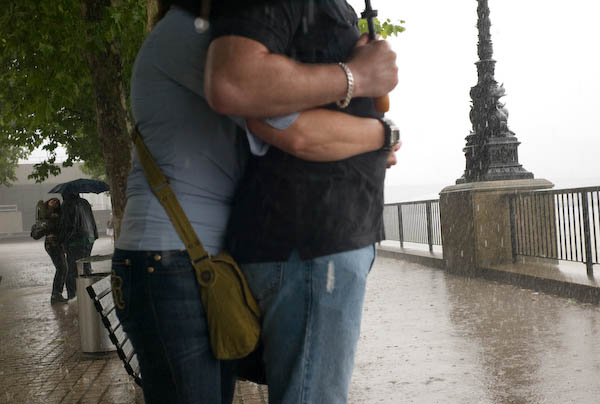
So far I’ve been fortunate to escape the floods that appear to have crippled much of England, though last week I was in Hull and East Yorkshire where around 17,000 homes were damaged in June. In London just over a week ago I sheltered under a tree on the embankment during one of the heaviest rain storms I’ve ever seen; at its worst there was an almost total white-out, with anything further than around 25 metres disappearing from sight.

I’d kept dry under the tree for some time, but when it really came down it offered no protection at all, and the umbrella I put up wasn’t entirely effective either, though it kept the worst off. I was too busy trying to keep dry to take pictures until the worst was over, and even then it was difficult to keep the camera dry.

London (C) 2007, Peter Marshall
I took some pictures when the rain eased off

The floods are moving down river towards where I live at the moment – we have a flood warning in force and its likely we will get flooded. Its 60 years since the house was last flooded, and the levels are said to be a few inches higher than then. So I’m starting moving what I can to the first floor.

Queens and Looking Glasses

My own notions about Queens are largely based on those of Lewis Carroll (an interesting photographer in several ways) in ‘Alice’s Adventures in Wonderland‘ and its sequel. Queens – like the Queen of Hearts in the Dormouse’s tale were apt to come out with “Off with his head!” at the slightest provocation.

So I was shocked to hear on the BBC News one morning this week, that photographer Annie Leibovitz had dared to tell the Queen to off her tiara, and surprised that her maj’s reported response was as mild as saying “I’m orf” (shouldn’t it have been “We are orf” or perhaps “One’s orf”? At the very least Annie would surely have ended up spending a night or two in the Tower of London.

So it came as no surprise to learn that the whole thing appears to have been an ill-advised publicity stunt, using a clever bit of cutting, or that, having carefully allowed the story to play to maximum effect, the big bosses of the Beeb were down on their knees grovelling for the royal pardon.

It’s a sad story. The BBC, and in particular its ‘World Service’, has a proud record that has led to it being a trusted around the world – and listened to in many situations, even at times and places when it was illegal. TV has of course its own needs to present constant noise and controversy, frenetic and demotic, that at times override sense and taste, and always sacrifices subtlety.

For those with a little knowledge of photographic history, there was a certain sense of the similar, remembering the famous image of Winston Churchill, taken by Karsh immediately after he had apparently snatched Winston’s trademark cigar from his mouth, and there was baby without his dummy glaring into the camera, apparently on the edge of bursting into tears.

At least Annie wasn’t said to have snatched the tiara – and once anchored by the Queen’s hairdresser this would probably have taken some doing (and headlines ‘Annie Scalps Queen’). The pictures she made aren’t bad, if perhaps not her best work. But good portraits don’t always arise from making your subject comfortable, and some well-known for the apparent psychological depth of their images have taken quite different approaches. Paul Strand is said to have told his subjects where to stand and then to appear to have ignored them, although obviously he was waiting for the expression or stance that he wanted.

I thought a little about this yesterday, when another photographer butted in (perhaps unintentionally) while I was setting up a photograph and proceeded to give all of the people in it clear and precise directions as to what to do. Well, it isn’t the way I like to work, though of course I do sometimes need to attract people’s attention, and I like to work with people and let them react to me and what I do, but not to direct them.

Peter Marshall