Photographing the World – in London

Last night I dreamed I was presenting a show of my work to my wife and grown-up son in a curiously expanded version of my front room. These were a set of pictures that had been put in the corner and forgotten for a long time, several large prints mounted on polystyrene that was beginning to fall to pieces. But the most curious piece was a large black cloth-bound bible, which, when you opened it, it kind of folded out to give not a book, but a small prospectus of the show, four prints.

The only picture I remember well was a landscape image. From the cathedral tower visible in the distance we worked out that it was taken near Chichester. A metal fence ran across the foreground, but on closer inspection you could see that only part of it was an actual fence, and the rest was a shadow of a fence. The posts (and shadows) divided the space into a number of vertical strips, and if your eye continued up the print, across the fairly flat scrubby landscape, you could see that various features in the distance echoed this division, fitting neatly into the strips across the image. It was a subtle but powerful image, taken in such an ordinary place. Another image was more striking, I don’t remember its details, but it reminded me of Giacomelli or Fontana, some kind of more clearly graphic – and perhaps Italian – landscape. (I showed work in the same festival as Giacomelli in Poland in 2005 – five years after his death; two years later I was back speaking at the same festival and Fontana’s work was showing – but he didn’t come. I’m not a great fan of either man’s landscape work, so why should I dream of having done something like it?)

Several of the pictures had been bent or folded, or otherwise damaged, partly by attempts to push a vacuum cleaner into the (non-existent) corner where they were stored. The overall title of the show, as the ‘bible’ stated was something like ‘Photographs Around the World‘.

I woke up and gradually realised that it was all a dream, and that I hadn’t actually taken these pictures, and I felt distinctly disappointed. I did go to Chichester last year, but the scene didn’t resemble anything I remember as we walked around the area there.

Well, I’ve no idea what this dream meant (if dreams mean anything) but there was perhaps a slight connection with part of the work I’d been doing the previous day, which included preparing some images of rather untidy artists studios for use in the final issue of the magazine ‘Art and Cities‘, due out shortly. But the title of the ‘show’ rather interested me, as I have a well-deserved reputation for seldom photographing anything beyond the reach of a Travelcard.
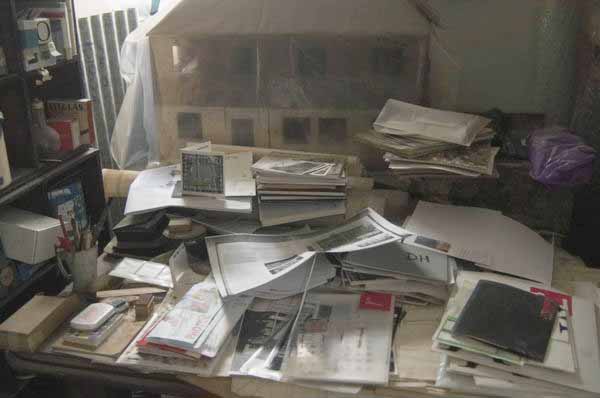

A corner of David Hepher’s studio in Camberwell

I’ve long felt that living in London you don’t have to travel, because the world comes to you. So, as yesterday’s post here showed, on Saturday I started by photographing a demo about Tibet. I left that as it passed Trafalgar Square to catch the Rally for Dignity and Democracy in Zimbabwe organised by ACTSA as a part of their Dignity! Period campaign to provide sanitary pads for the women and girls of Zimbabwe. Mugabe’s madness has destroyed the economy and caused unbelievable levels of inflation, making such essential supplies unobtainable.

For various reasons the rally, held on International Womens Day, was very badly attended, despite high level trade union support – with the TUC General Secretary coming to speak. Probably many who might otherwise have attended were instead at Hyde Park for the start of the Million Women Rise march in London.
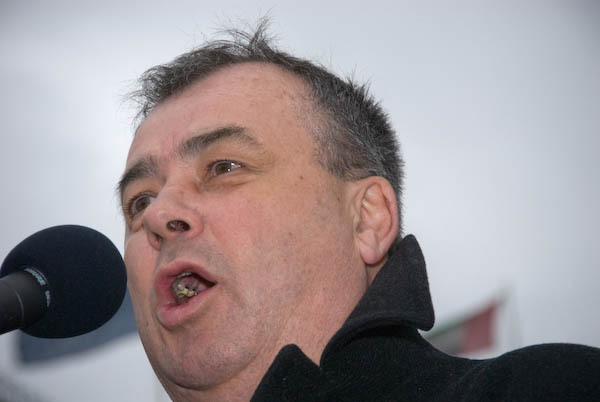

Brendan Barber speaking in Trafalgar Square

Later that afternoon I also called in at the regular weekly Zimbabwe Vigil, started in 2002 and continuing to protest at human rights violations in Zimbabwe. As usual there was drumming and dancing as well as handing out of leaflets.
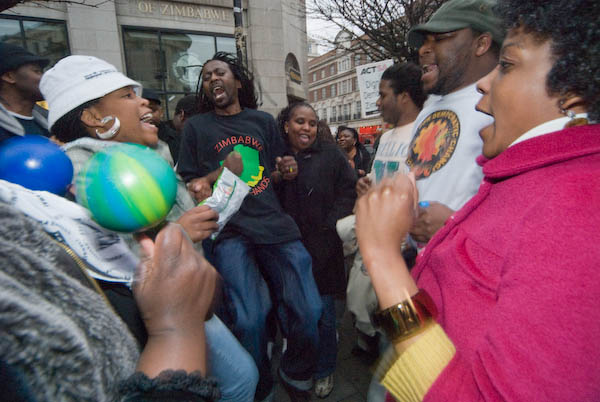
Peter Marshall
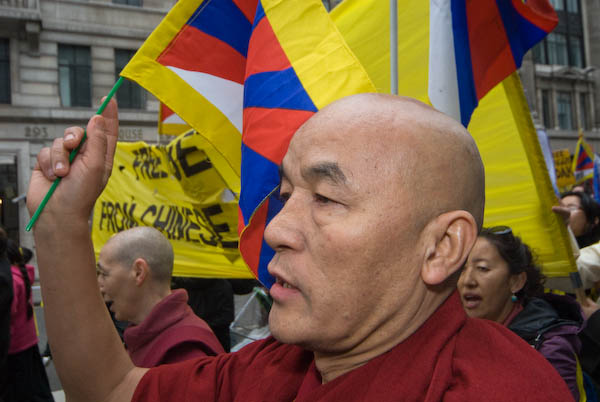
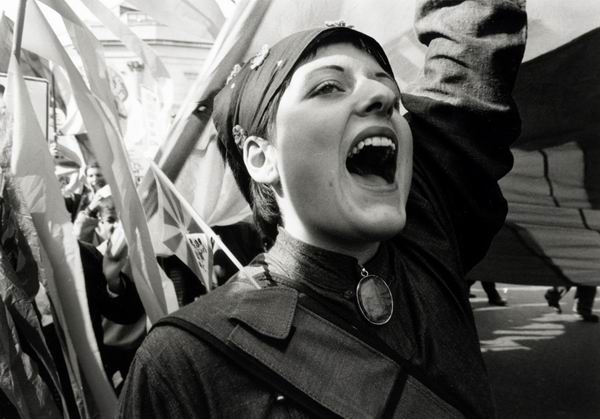
Déjà Vu?

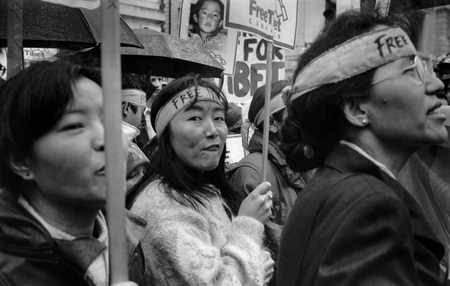
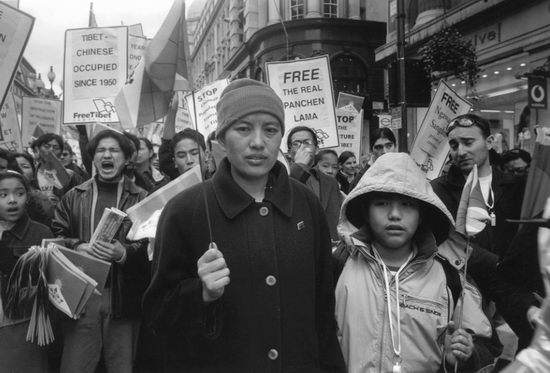
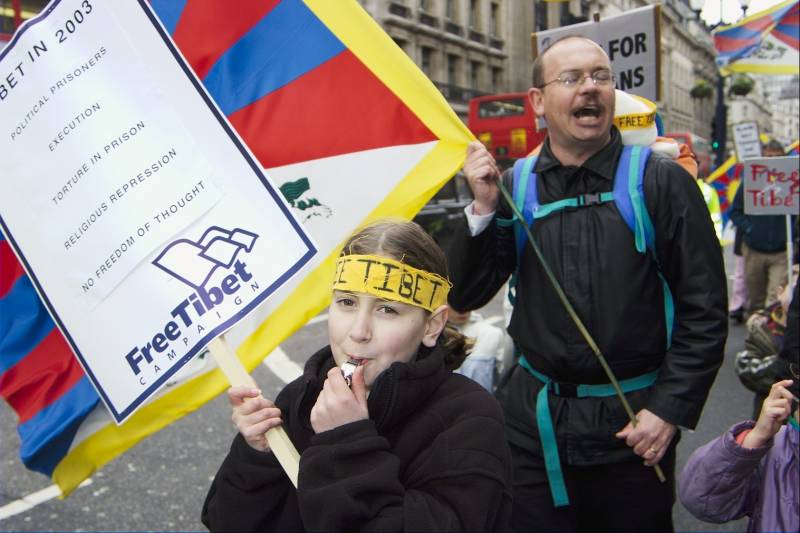
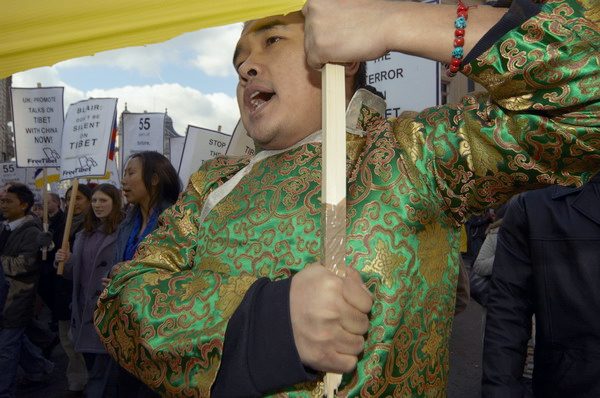
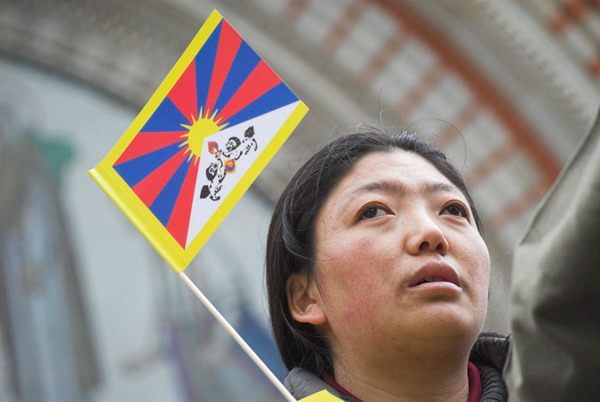
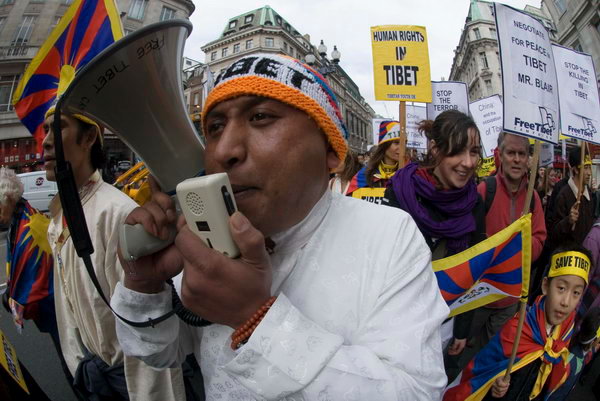
Saturday morning started for me opposite the Chinese Embassy, where supporters of a free Tibet were demonstrating on the 49th anniversary of the Tibetan uprising. I haven’t photographed there all of those 49 years, but it sometimes begins to feel a little like it, and this and the ensuing march through the West End certainly felt like watching a yet another repeat. All over again!


more 2008 pictures

Photographically it brought to mind two people, both in their different ways important teachers, although for me only at second-hand.

Alexey Brodovitch was art director of Harper’s Bazaar from 1938 to 1958, and among the photographers he nurtured there were Irving Penn, Richard Avedon and Hiro, while his classes in New York (and New Haven) drew Diane Arbus and Tony Ray Jones and a whole generation of New York based photographers. One of the many whose work you may not know well, but has a great web site with work from 60 years of photography is George S Zimbel.

Brodivitch used to insist to photographers “Surprise me!” and told them that if they looked into the viewfinder and saw something they had seen before not to take the picture.

The other person who came to mind was Garry Winogrand (and it was Zimbel who turned Winogrand on to photography), whose work has always interested me greatly. Again I never met him, though I’ve used film of him in teaching (and a piece in The Online Photographer last summer included links to a TV video on him from 1982 and the recollections of O C Garza who studied with him at the University of Texas in the mid 70’s – both well worth looking at.)

In the video, one of several comments by Winogrand is “You don’t learn anything from repeating what you know … in effect … so I keep trying to make it uncertain

Saturday with ‘Free Tibet‘, too many things seemed familiar and I had problems with making things uncertain as I struggled with what Winogrand described as “the battle of form versus content.” But too many of my images were merely safe – and as he also said, “Most everything I do doesn’t quite make it. Hopefully you’re risking failing every time you make a frame.” Perhaps as usual I wasn’t risking enough.

You can see more of my pictures from 2008 on My London Diary, as well as some from previous years:

Free Tibet: 2000

Free Tibet 2001


Free Tibet 2002


more 2002 pictures

Free Tibet 2003

more 2003 pictures

Free Tibet 2005

more 2005 pictures

Free Tibet 2006

more 2006 pictures

Free Tibet 2007

more 2007 pictures

Looks like I had a year off in 2004!

Peter Marshall 

Phillip Jones Griffiths Interview

Although I have to say thanks to Jörg Colberg of Conscientious for alerting me to the Aperture interview with Philip Jones Griffiths, I find his comment on the piece pretty trivial and a little unpleasant. Whatever Jones Griffiths may say about photography doesn’t make his pictures one tiny bit less great. He would remain one of the greatest photojournalists of the 2oth century – and as well as the slide show in the Aperture Interview you can see more of his work on Magnum, including Vietnam Inc.

Colberg finds him “narrow-minded and outright disappointing (apart from intellectually lacking)”. Looking at what he writes and what Jones Griffiths says, I think that largely means that they come at photography from different perspectives. If Colberg can’t work out what Jones Griffiths was saying – and his comments suggest he didn’t – its a failure on his part .

For me – as I think with Jones Griffiths (certainly my favourite Welsh photographer) – the power of photography as a distinctive medium comes from its curious relation with reality, something that has been explored at great length but not always much light by many. For me it certainly isn’t something limited to photojournalism – and is even more important in much documentary photography, and also in much photography that comes under the rather vague category of fine art. But there are certainly works which although produced with the help of a camera don’t seem to me to be a part of the photographic tradition and that I don’t feel it appropriate to think of as photographs, although I may still appreciate them as art.

PDN 30 – My Top 5

The PDN’s annual choice of 30 “New and Emerging Photographers to Watch” is always of interest, and earlier years have certainly picked some fine photographers who have become well-known at least among other photographers – as well as quite a few we’ve yet to see more from.

Most of the photographers included – 25 out of the 32 (two of the choices are photographers who work as a pair) are 30 =/- 4 years old, and a majority live New York City and Brooklyn, with half a dozen others residing elsewhere in the US, mainly in California.

You could take that as representing the way that photographic talent is spread around the world, but probably only if you are a New Yorker. More likely it tells you that there is more interest in photography in NY than anywhere else on the globe, and that if you want to get noticed, NY is the place to be. And of course that PDN is based in NY.

Of course you don’t have to be American to live in NY, and one of the 30 (or 32) was born in Chorleywood, a northern fringe London suburb. Andreas Lazlo Konrath‘s father was a Hungarian architect, mother an English ballet dancer, so he became a skateboarder and played in a punk band, turning to photography after his elder brother gave him a Larry Clark book for his 18th. After writing off his knee in the way of skateboarders he turned to punk and punk photography, living in the East End and getting a fine art degree from London Guildhall. Now he’s taking portraits in New York.

Ed Ou stands out partly because he’s only 21 and lives in Israel, although he’s Canadian. At 21 his history is phenomenal. Working for Reuters, AP and Sipa in Africa, the Middle East, Asia. It helps that he speaks Mandarin, Arabic, French and some Hebrew too. Some very impressive images too.

Espen Rasmuissen is Norwegian, based in Oslo, where he is a picture editor for the biggest newspaper as well as a photographer. Represented by Panos, he has done a lot of work with Medecins Sans Frontieres. Perhaps more emerged than emerging, as his powerful images have won both World Press Photo and POYi awards.

Mikhael Subotzky is another photographer perhaps already too well-known to be considered emergin, with images by this South African already in the collections of MoMA as well as SA museums, several awards already in his bag and exhibitions around the world. I wrote quite a long time ago about his amazing stitched 360 degree panoramic images from South African prisons, although these are only a small aspect of his work.

Munem Wasif is from Bangladesh. Born 1983, he studied at the South Asian Institute of Photography and is now a staff photograph at DrikNEWS. Drik, set up in 1989, aimed to show the views of photographers and writers from the developing world, presenting images from that showed the majority world “not as fodder for disaster reporting, but as a vibrant source of human energy and a challenge to an exploitative global economic system.” It has become a very impressive organisation, known around the world, not least for its organisation of the Chobi Mela international photography festivals in Bangladesh. The 2008 festival is on the theme of ‘Freedom‘ and submissions can be made by post or on-line until 31 May 2008.

I’m not sure why my top five from the PDN30 are all of photographers whose background is far from the typical. Only one living in New York, and that an English photographer. Certainly there are others whose work interests me – Donald Weber, Brian Sokol, Dustin Snipes in particular – but on checking I find that none of them live in New York either. It must mean something, if only that I’m not a New Yorker.

Desert Massacre Remembered

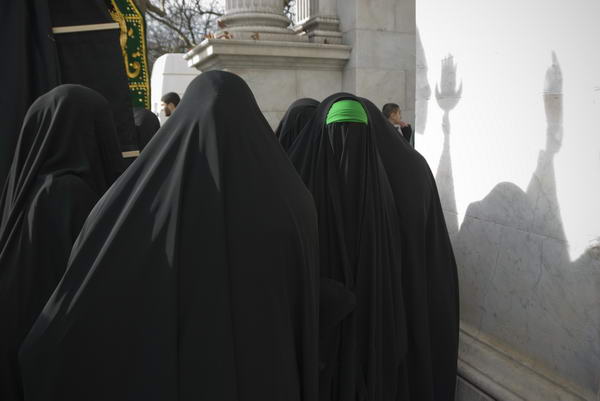
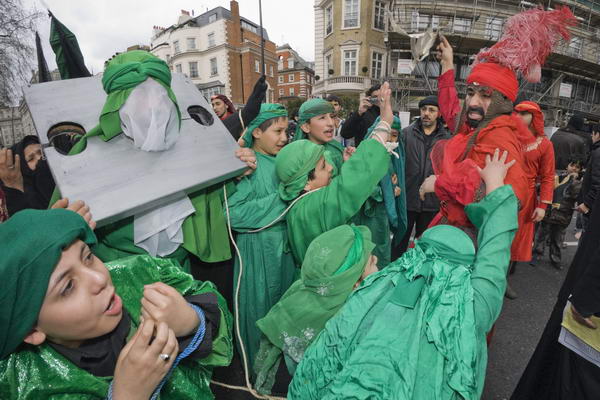
The martyrdom of the Imam Hussain and his 72 companions at Karbala, facing an army of 40,000 and choosing to die with honour rather than to live in humiliation in 61AH (680 AD) is celebrated by Shia Muslims around the world. Their 40 days of remembrance and mourning begin with Ashura and end with the Arbaeen procession which took place at Marble Arch in London last Sunday.

The 72 martyrs of Karbala were all decapitated, and their heads paraded impaled on spears on a long march through towns and villages to the city of Damascus, 750 miles away, as a warning to others not to rebel. The captured women and children were forced to march along with them.

It is impossible not to be impressed by the fervour of those taking part in the events, and their devotion to the Imam and the ideals that he stood for. It is also a colourful event, with costumes and golden shrines as well as a decorated horse, and some intense performances.

More pictures

Deutsche Borse Winner

I was a little shocked but not really surprised to find that the winner of this year’s Deutsche Borse Photography Prize is Esko Männikkö. He certainly didn’t come in my own top two choices of the four on the shortlist. Is he really the photographer of the four “who has made the greatest contribution to photography over the previous year?”

I’ve previously posted my thoughts on the 4 contestants. You can read them at:

John Davies
Jacob Holdt
Esko Männikkö
Fazal Sheikh

Prizes like this are of course a lottery, decided on the whim of a particular jury, and another group of equally eminent jurors would likely have reached a different decision. It isn’t really possible to come to an objective decision over something like this when the four bodies of work are so different.  If like me you have a strong conviction that documentary is the real centre of photography, then Männikkö’s work for this show was unlikely to get your vote.

So congratulations to Männikkö and commiserations to the other three contestants who the pin missed. Although it’s a great honour to have been short-listed, the disparity between the award made to the winner and the others seems, as always, greatly unfair.

This is only one of several important prizes awarded recently, which I’ll look at it a later post.

Trafalgar Square, 20 to 1

The Met obviously thought that the second ‘Freedom to Protest‘ event scheduled for Saturday afternoon posed a great threat to their credibility, although surely even they can’t have felt it was any kind of real threat to public order. But in January they had been caught a little with their pants down – and it wasn’t going to happen again. Police outnumbered the small group of demonstrators who gathered in Trafalgar Square by at least 20 to 1, and there were many more extra on duty in Parliament Square and elsewhere across Westminster.

So we had hundreds if not thousands of extra police on duty around Westminster, costing us many thousands of pounds to save a little face for the police. And in the event, a demonstration that was just a little street theatre and would have best been completely ignored by the farces of law and order – a typo on my part that actually became reality when the FIT phtoographer ran scared, chased by a protester with a shopping trolley offering free cakes, taking refuge by running up the stairs of the National Gallery.

The only other real action by police I’m aware of was to stop and search a young protester walking down Whitehall, making him remove his balaclava. They appear to be using law against terrorism to impose their fashion sense.

He was on his way to join the continuing anti-war protest in Parliament Square, where Brian Haw will have been for 2500 days early next month. Eventually a small group of the protesters did walk there without apparently being noticed, although the police did trail them as they walked out of the square all the way to a pub on the Horseferry Road.

More pictures from the day on My London Dairy.

Plane Stupid – Heathrow Expansion

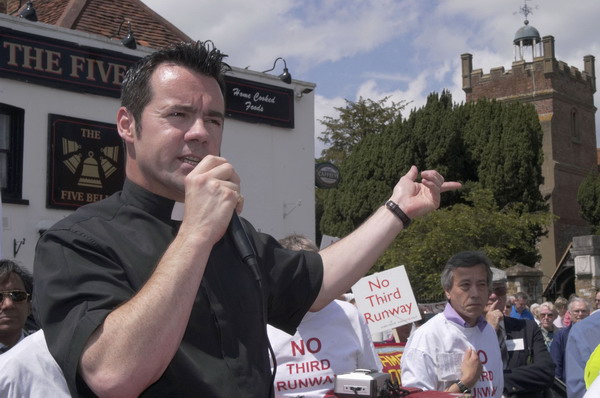
I was too busy sorting through thousands (literally) of pictures for my talk next week to go up to Parliament Square yesterday morning to photograph the lobby and rally about a referendum over the updating of the European union, so I missed getting a picture of Plane Stupid activists who had climbed onto the roof of the Houses of Parliament and hung two large banners down the front of the building, one reading ‘BAA HQ‘ and the other ‘no third runway www.planestupid.com

It was a protest not just at the expansion of Heathrow, but also at the false nature of the consultation process, where large parts of the consultation document were written by BAA and the government has already decided (barring horrific accidents – such as almost happened recently on the approach over Hounslow when a plane lost power and had to glide in, only just making the airport) on not just a 3rd runway but also a 6th terminal.

Apparently as well as hanging the banners, protesters also made paper planes of the secret documents they had obtained showing government duplicity and fixing of the consultation process and flew them down into the MPs car park.

Photographically I don’t regret the missed opportunity, because I think it only too likely that any pictures I had taken of the event would have been at least as boring as those published in all the papers and Internet accounts I’ve seen. Perhaps one of the 3 men and 2 women who carried out the protest took a camera and made some better pictures?

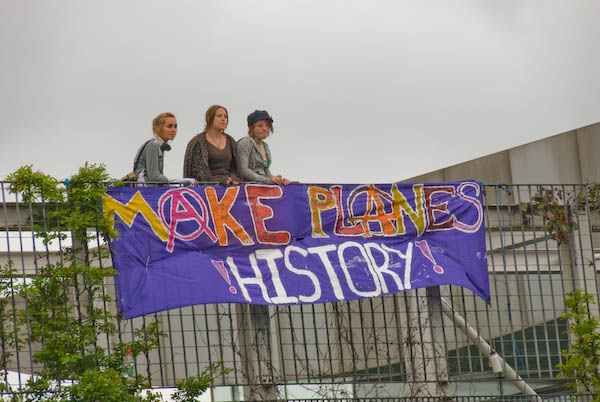
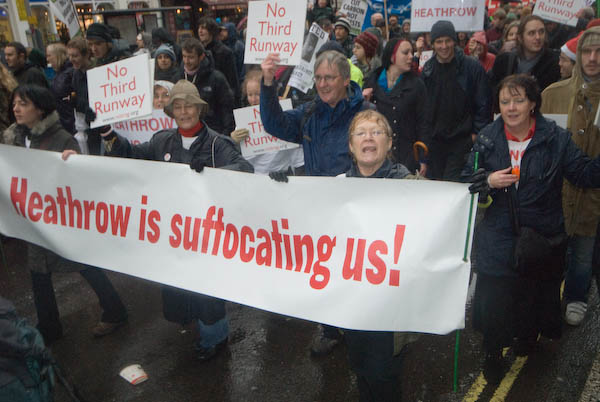
These are protesters on a rooftop at Heathrow in August, and marchers in London last December:

Of course the protest has been going on ever since the plans were first revealed to a stunned public, and I photographed the local protesters in Sipson and Harmondsworth in 2003.

Of course Gordon Brown doesn’t like the demonstrators, deploring their actions, although in fact this and other similar protests have actually been very useful in pointing out gaps in security. Brown doesn’t like it because it reveals the facts about the skewed consultation process and the alliance between the promoters of unbridled airport expansion and the government (an alliance that started in the 1940s, when the public were first duped about the setting up of a civil airport at Heathrow.) He doesn’t like it because it highlights the absurdity of his claims to an environmental policy.

I grew up under the flight path in Hounslow, in my dreams able to reach up from my back garden and touch the planes as they roared over. I live a short bus ride from the airport (though my post code excludes me from the consultation over flight paths – all those planes that come over me must have lost their way!)

Heathrow was always in the wrong place. Continued expansion over the years has made its position more and more untenable. It makes no more sense than Croydon. We should have begun a new airport to replace it thirty or more years ago. There shouldn’t be any debate at all over its expansion, but simply about how fast it can be run down.

Peter Marshall

The Romance of East London

I’m still not sure where my walk around London’s East End at the Museum of London on Thursday 6 March will take me, but it will I think be a personal journey that reflects on my photographic involvement with the area over the years.

Image- reload if not showing - invite

The event, from 6-9 pm, is a part of the Mayor’s ‘east’ festival, is free and everyone is welcome.

One place I may start.

Image- reload if not showing - St Katherines
St Katherine’s Dock closed in 1968 and these warehouses were
demolished in the early 1970s, shortly after this picture was taken.

Walking across Tower Bridge and seeing the warehouses of St Katherine’s Dock, about to be demolished was where I started to photograph East London.

Image- reload if not showing - Victory Cafe
Victory Cafe, 1986

And it will certainly include the pictures such as the cafe above that were in Cathy Ross’s recent book, The Romance of Bethnal Green (she will be signing copies – and you can see more pictures in an earlier >Re:PHOTO post, Bethnal Green Blues.)

Brick Lane is sure to feature.

Image- reload if not showing - Brick Lane
Brick Lane, 1998

Then perhaps there are some of my pictures from a sometimes surreal docklands after the closure, the colour series of shop fronts and street detail which reflect the changing populations of the area, the black and white records of much of its urban landscape. The River Lea and around, from long before its Olympic disruption to the present, Canning Town (I’ve written a walk) , the DLR, demonstrations, religious festivals and more. I’m not sure how much I can squeeze in to a half-hour or so during the evening, but one event I’m sure I won’t leave out is a real East End street party for the Queen’s Jubilee.

Image- reload if not showing - Jubilee

Peter Marshall

Another View: Jason Parkinson

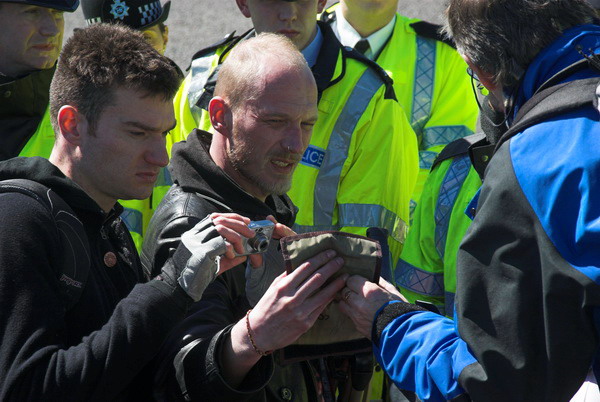
I first met Jason Parkinson when he was illegally detained by police while covering a demonstration at the Harmondsworth and Colnbrook detention centres in west London in April 2006. Police were refusing to accept that he was a journalist and denied that his press card, issued by the UK Press Card Authority was a real press card. On the back of the card it says “The Association of Chief Police Officers of England, Wales and Northern Ireland and the Association of Chief Police Officers in Scotland recognise the holder of this card as a bona-fide newsgatherer”, but while this may be so, it often doesn’t seem to be good enough for the officers on the street.


Jason shows his press card to no avail at Harmonsdworth

Jason called out to the three of us standing on an earth bank a few yards away taking pictures, asking us to show our press cards and confirm his was genuine. This left me in a little of a quandary, as when getting things ready for the day I’d noticed that mine had expired at the end of the previous month, which had meant I’d had to hold it with a strategically placed thumb when I waved it at police earlier. Fortunately another colleague jumped forward with a valid card and confirmed that Jason’s was genuine, although even then he was not immediately allowed to exit the police bubble.

It’s typical of Jason that he was in there with the demonstrators covering events, as the strapline from his blog has it, “from an uncompromising angle.” Since then I’ve met him covering many events, and also suffered similar treatment from police who’ve refused to accept my press card as genuine – some officers appear to react rather negatively to the fact that it says ‘NUJ’ prominently on it.

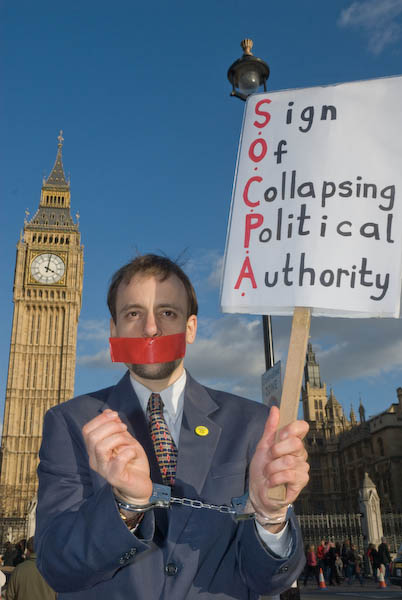
Of course we shouldn’t need a press card. Citizens in a democratic countries enjoy various freedoms, including the right to photograph in public places, freedom of assembly and so on. But no longer so in England in areas designated under SOCPA or indeed most places where a political demonstration is taking place, where our police often assume arbitrary powers and misuse provisions intended by Parliament to prevent terrorism.

But having a press card doesn’t solve problems, nor does the existence of agreed guidelines. In his blog post on the police pay demonstration, Jason writes ‘This officer, CO35, then decided to ignore Metropolitan Police guidelines and halted photojournalists from doing their job. Not just once, but twice. When asked if he knew he was restricting freedom of press CO35 answered by saying, “go away”.’ The only thing that surprises me is the mild language of his response – but of course he knew that Jason was recording every word on video, and that the footage would almost certainly be published.

Its always interesting to me to see how other photographers have covered events that I’ve attended, and on Jason’s blog there are several recent examples of events that you will also find on ‘My London Diary’, including my view of the Anonymous protest against Scientology, Police Pay and Freedom of Protest events. But Jason also gets to places and stories that are harder to reach, and February’s entries include a lengthy report on the ‘Beyond Slavery‘ conference and an interesting feature on Football for Change Iraq.