Stop Trident, Troops out of Iraq – 2007

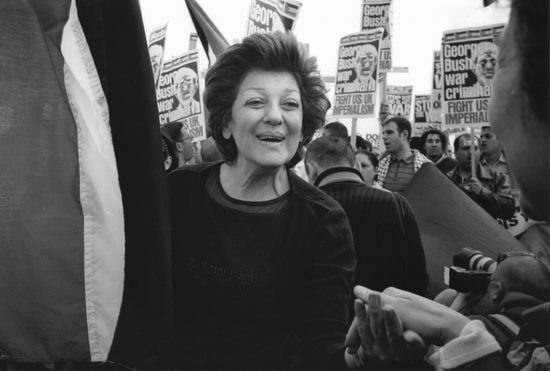
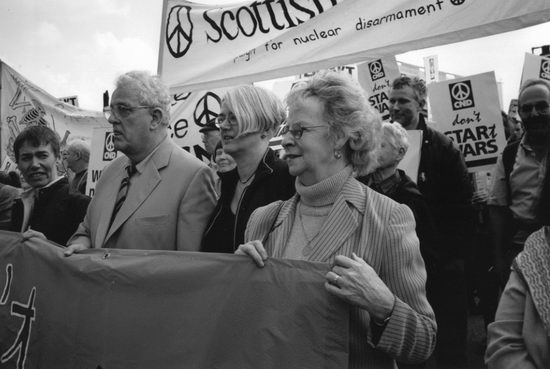
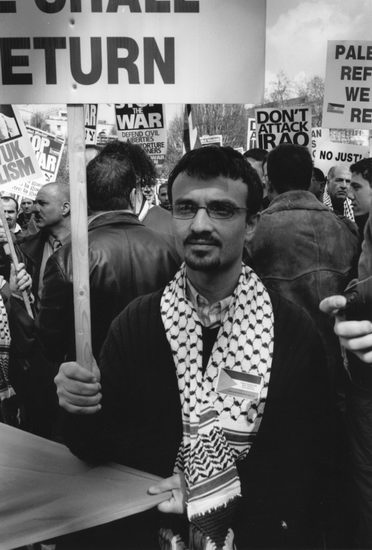
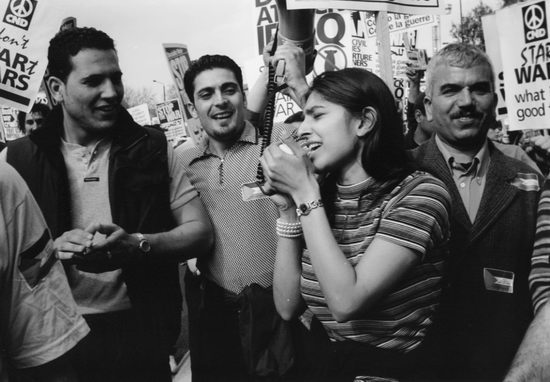
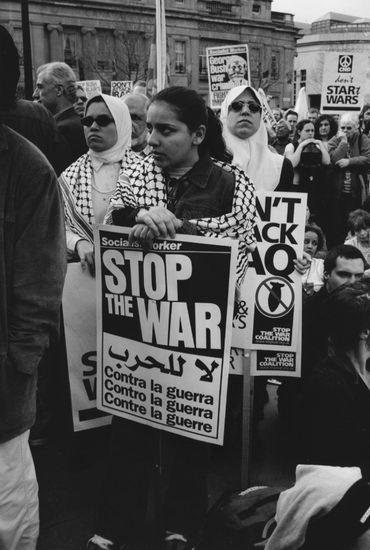
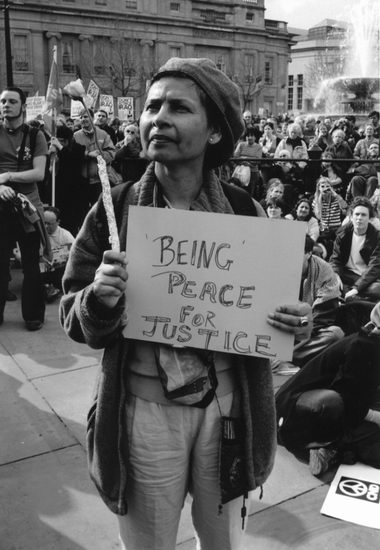
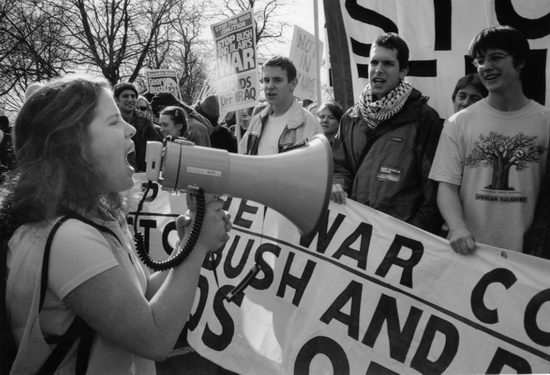
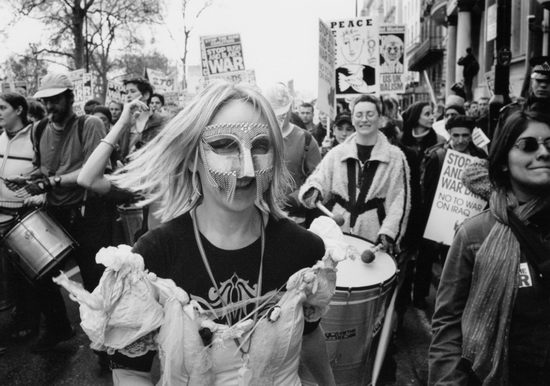
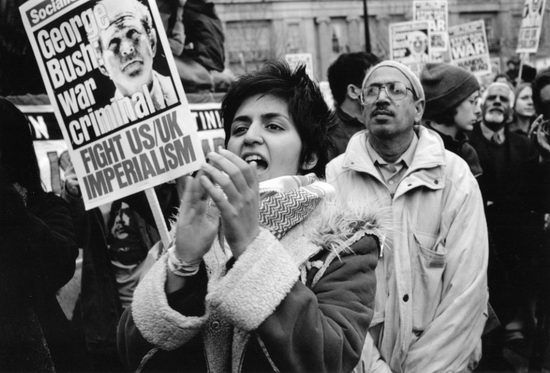
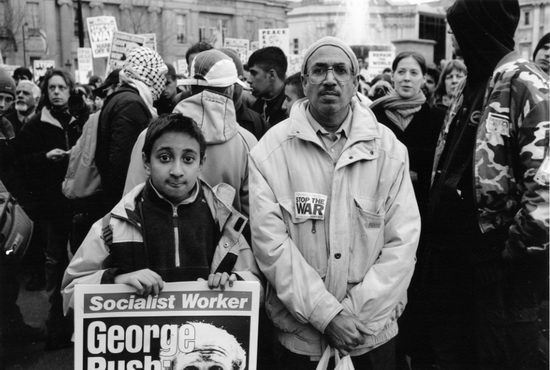
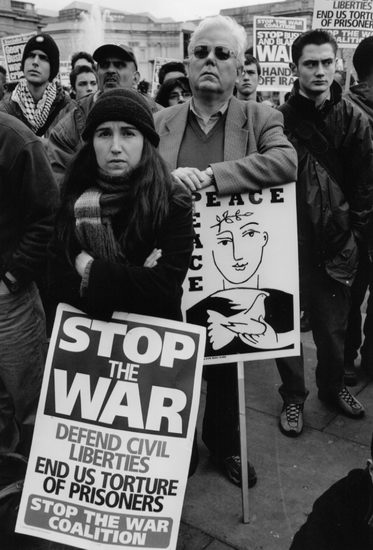
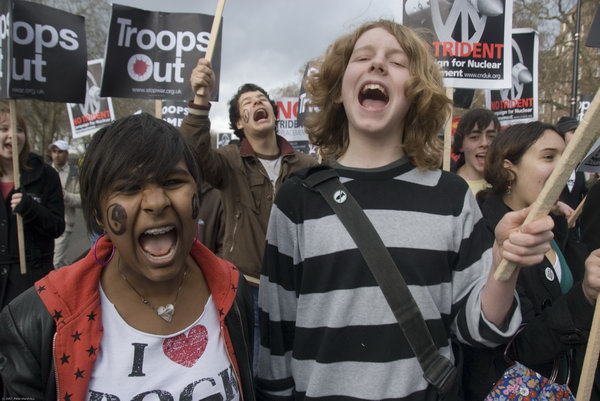
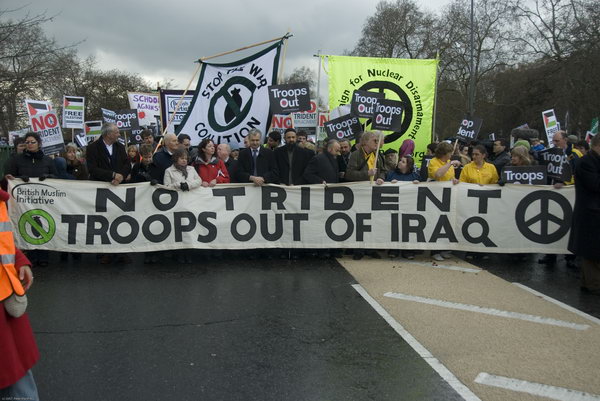
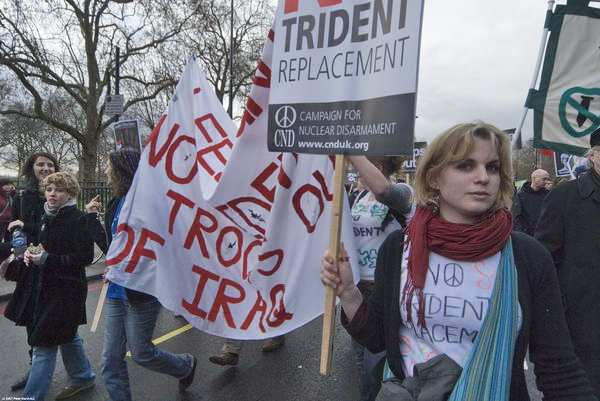
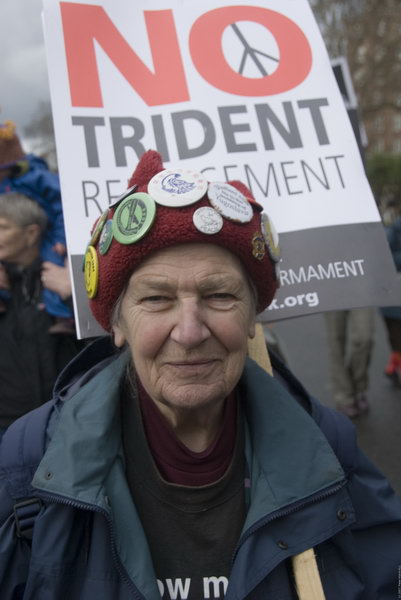
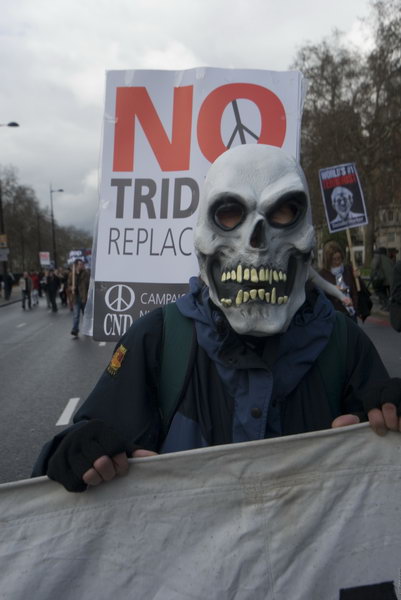
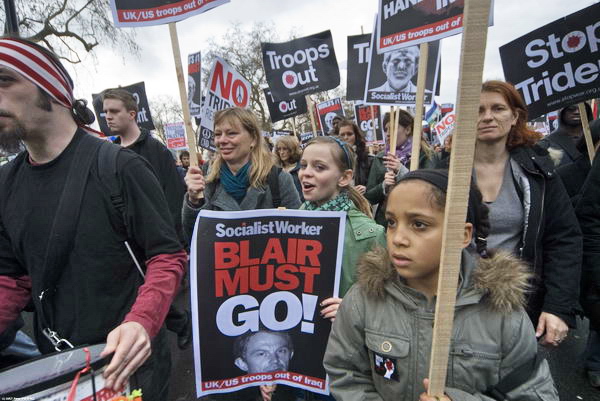
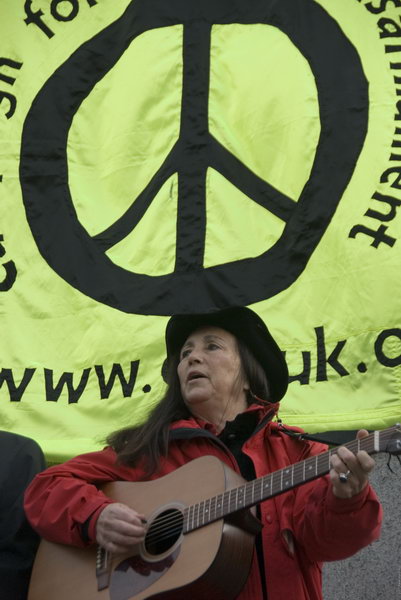
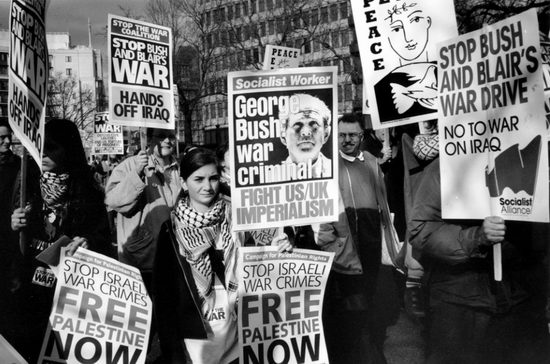
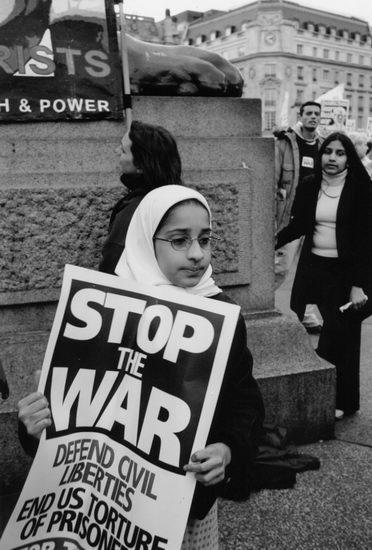
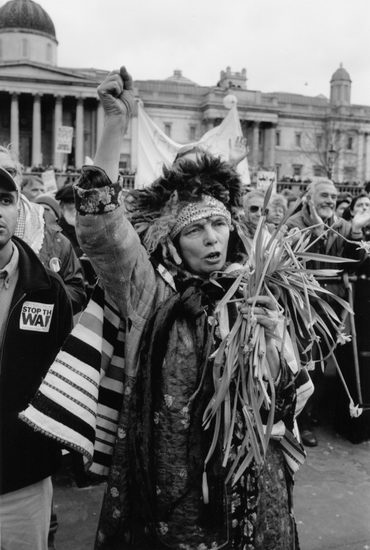
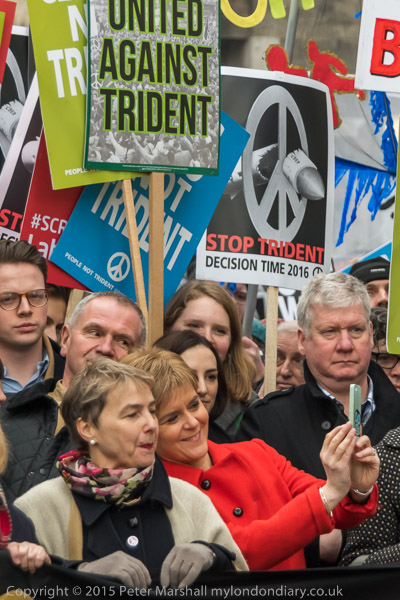
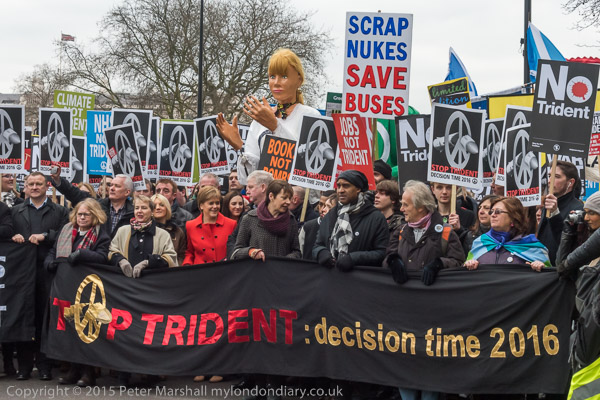
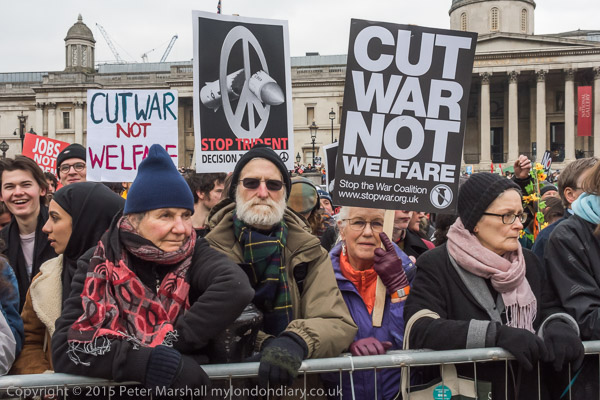
Stop Trident, Troops out of Iraq – 2007. On Saturday 24th February 15 years ago I spent a long afternoon photographing around 50,000 protesters marching through London calling for an end to Britain’s nuclear weapons and for our troops to be withdrawn from Iraq.
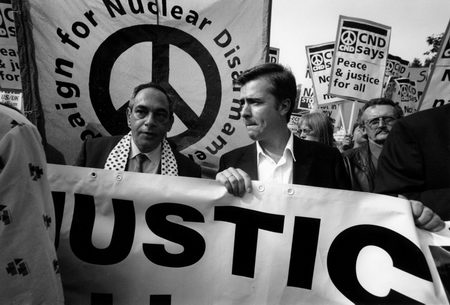
The march was organised by Stop The War, the Campaign For Nuclear Disarmament and the British Muslim Initiative, and on My London Diary – back then still only in lower case – I made clear my support for the marchers:

i’ve for many years been opposed to the so-called independent british nuclear weapons. even at the height of the cold war they were never credible as an independent deterrent. if they have ever had any justification it was that they made the usa feel less guilty, although american guilt at its huge nuclear arsenal and at being the only country ever to have used nuclear weapons has always been an incredibly stunted growth.

i was also firmly against the invasion of iraq. it was always clear to those who didn’t want to be deluded that the so-called ‘intelligence’ on weapons of mass destruction was laughable. blair was either a liar or a fool as he misled a minority of the british people and a majority of their mps. or most probably both. (saddam may also have been deluded and certainly was an evil dictator, but we had long failed those who tried to oppose him.) the invasion was criminal, but the lack of planning for the occupation that inevitably followed even more so.

My London Diary – Feb 2007

My account also points out the ridiculously low estimate of the numbers taking part given by the police of 4,000 – though I think they were eventually forced to increase this somewhat – and gives my own method of assessing numbers on such large demonstrations as this. The marchers took 90 minutes to pass me as I photographed them in Park Lane. My usual rule of thumb was to double the police estimate, but on this occasion they surpassed themselves, being an order of magnitude out.

There certainly is always a policy by our establishment, backed up by the BBC and the press, except on rare occasions to minimise dissent, particularly left-wing dissent, in this country while often exaggerating any protests against left-wing governments abroad. It’s a bias which has been very obvious in the coverage of events in Latin-American countries such as Venezuela.

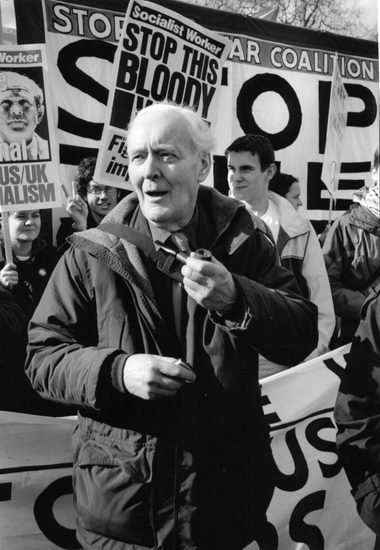
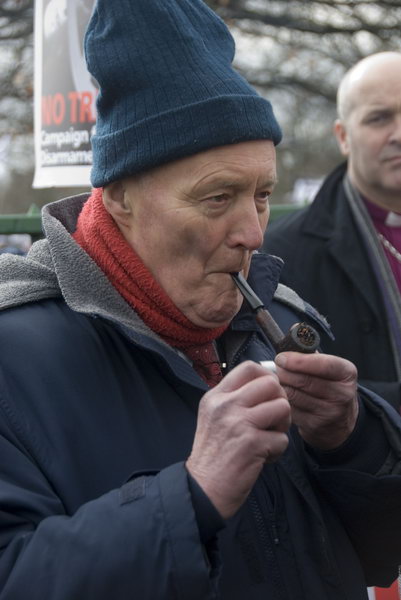
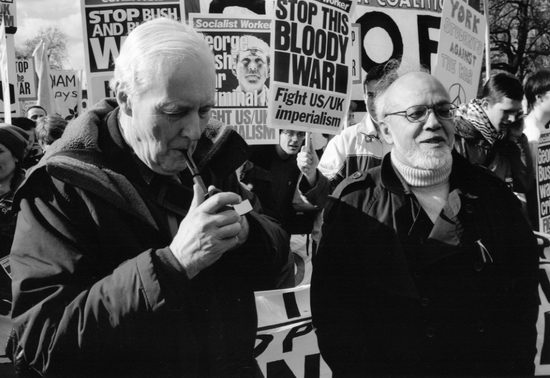
Tony Benn

The BBC and some of our newspapers have some excellent reporters and correspondents, and it is more in the selection of what they are asked to report on and the editing of their reports and the context in which they are placed that the bias occurs. Some things are just not ‘news’, while others, often trivial or flippant, get major attention.

Fortunately there are other sources with different biases, including the almost invisibly small left-wing press in the UK (the two daily papers – the Communist Morning Star and Workers Revolutionary Party’s The News Line together have a circulation probably well under 10,000), but more importantly large news organisations such as the Russian-funded RT International and the Qatari Al Jazeera English – the latter particularly interesting about current events in the Ukraine.

Every journalist has a point of view and while we may strive to be factual I don’t think there is such a thing as objectivity. Our reporting is always subjective, based on what we feel and what we think is of importance. Every photograph I take involves choice – and the rejection of other things I don’t photograph – even at times things I think would make eye-catching images but would misrepresent people or the event. Further choices come in the selection of which images to send to an agency, and also which I choose to put on My London Diary.

On this occasion I chose rather too many to put on-line, with 17 pages of pictures, though this reflects the typical internet speeds of 15 years ago, when pages with more than ten small images were too slow to load even though I compressed the images as lower quality jpegs than I would now. But the number of pictures also reflected my intention to tell the story of the event as fully as possible rather than creating a single image for the event that might appeal to a picture editor.

Julie Felix

Looking at the report now I feel there are rather too many images particularly of some of the well-known faces I photographed at the rally. Perhaps also I made too many of the marchers, some of which might be of far more interest to the people shown in them than the general public. But if people make an effort to make an interesting placard or banner I think it deserves a little recognition.

You can read more of my report of the event and see another 160 or so pictures on My London Diary, beginning on the February 2007 page, though you will need to scroll a long way down the page to reach this march and rally.


A Threatened Hospital, Riverside Walk, Syria & Mali

A Threatened Hospital, Riverside Walk, Syria & Mali – pictures from nine years ago on February 15th 2013.

Fight to Save Lewisham Hospital Continues

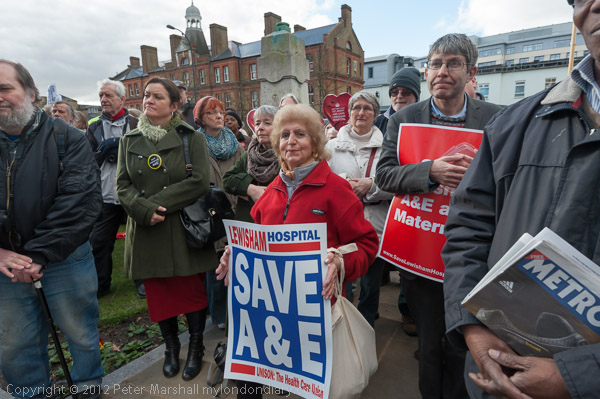
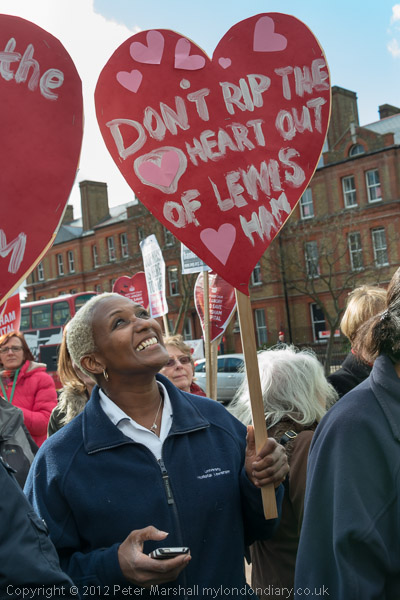
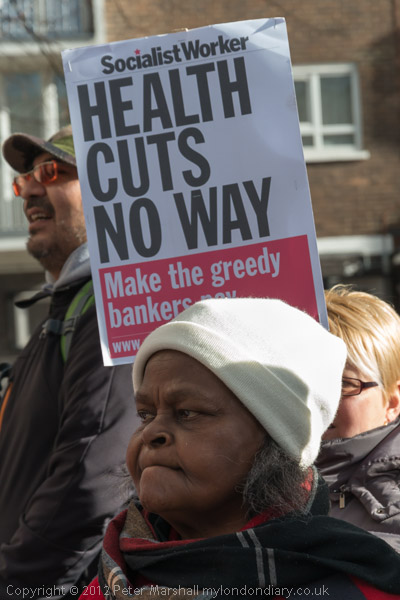
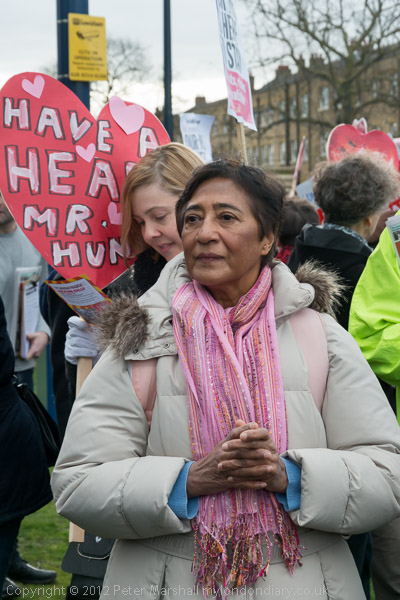
My work began at a lunchtime rally opposite Lewisham Hospital where the whole local community is fighting to save their hospital with both a legal challenge and further mass demonstrations including a ‘Born in Lewisham Hospital’ protest a few weeks later. Parts of the hospital across the main road are in the picture.

People were appalled by then Health Minister Jeremy Hunt’s decision to accept the proposals for closure, and to ignore the mass protests by local residents. Not only are the proposals medically unsound and will lead to patient deaths, but they also represent short-term thinking that will result in a huge waste of public funds.

Lewisham was a sucessful and financially sound hospital and had received sensible public investment to provide up to date services, and the services to be cut will have to be set up again at other hospitals. Closing Lewisham would not only incur high costs, but would waste the previous investment in its facilities.

Closure was only considered because of huge debts inherited when it was merged into a group which had earlier made a disastrous PFI (private finance initiative) agreement to build a new hospital a few miles away. Both the hospital group and Jeremy Hunt had been shown to be telling lies about the scope and cost of the replacement A&E and maternity facilities which would be needed if Lewisham were closed.

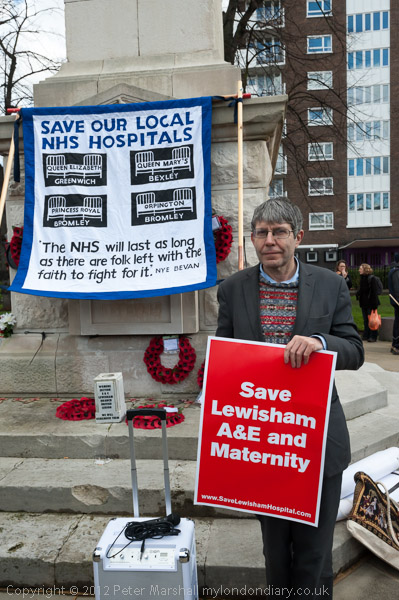
The well-attended protest was organised by the Save the Lewisham Hospital campaign which was raising funds for a legal challenge as well as a new poster and leaflet campaign and the forthcoming mass demonstration. But this was not just a campaign for Lewisham, but one that is vital for the whole of the NHS. Behind the speakers was a banner for the South-East London ‘Save Our Local NHS Hospitals’ campaign quoting Nye Bevan: ‘The NHS will last as long as there are folk left with the faith to fight for it.‘ They certainly had the faith in Lewisham.

Fight to Save Lewisham Hospital Continues


Thames Path Greenwich Partly Open

Here’s what I wrote back in 2013:

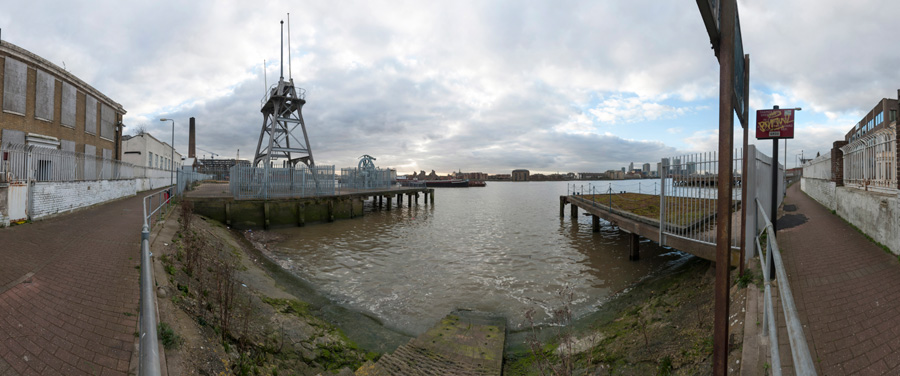
I had some time to spare between protests and it was a nice day, around 10 degrees warmer than we’d been having and sunny, so I decided to take a bus to North Greenwich and walk along the Thames Path, having heard that parts of it had re-opened. The weather changed a little and there were some dramatic skies.

There is still a section of the walk that is closed, a giant building site where Delta Wharf once was up to Drawdock Road, but on each side of this the walk is open. although the council sign on the footpath leading from Tunnel Avenue still indicates it is closed. At the river the path north is blocked, but you can walk south to Greenwich.

A panorama – the same path in opposite directions at both sides

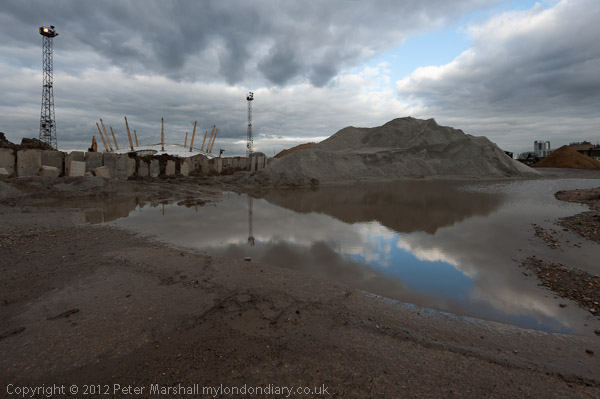
At first the walk goes alongside a giant manmade landscape of sand and gravel, like some alien planet – and behind the conical hills the Dome and the gas holder, with occasional lighting towers and cranes add to the scene. Most of this is behind tall fences, but fortunately these have gaps between the posts allowing you to see and photograph. Years ago the path here went through a working container dock, the Victoria Deep Water Terminal, with yellow lines marking the route, though occasionally it was blocked by crane operations, and we waited rather than have heavy containers overhead. There are a couple of my pictures of this and others from the riverside path in the 1980s on my London’s Industrial Heritage site.

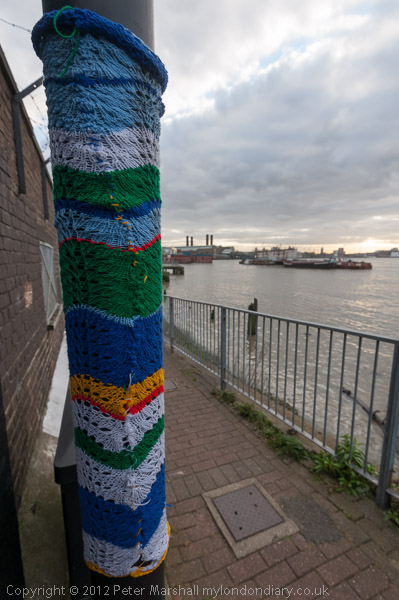
Beyond there the riverside path seems rather empty, with many structures having dissappeared, including the huge concrete silo I photographed. But something new has appeared, ‘guerilla knitting’ on some of the trees and posts along the path.

Many more pictures at Thames Path Greenwich Partly Open on My London Dairy


Stop Western Intervention in Syria & Mali

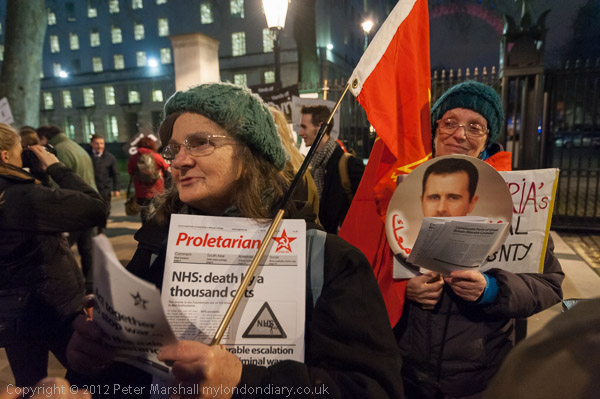
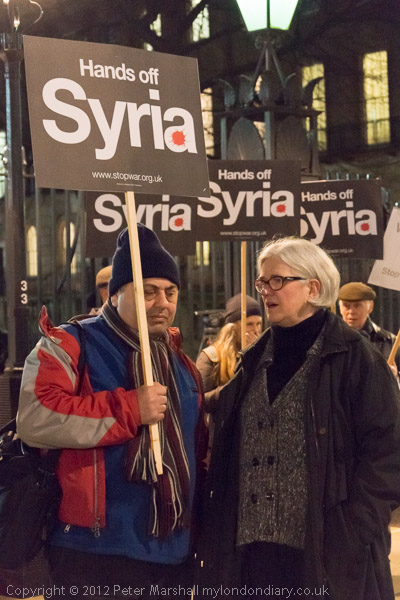
It was the 10th anniversary of the march by 2 million against the Iraq war, Stop the War organised a small protest at Downing St calling for a stop to Western intervention in Mali and Syria and against the possible attack on Iran.

Many on the left feel that the failure of that huge protest to actually prevent the UK taking part in the invasion of Iraq showed a failure in the leadership of Stop The War to make any quick and efffective action to follow it up. Stop The War have also failed to convince the public at large with their more recent campaigns against intervention in Libya and now against the support being given to the Free Syrians and the Mali government. As the upper picture shows there were some supporters of the Assad regime, from a small left group, the Communist Party of Great Britain (Marxist-Leninist), taking part in the protest. Almost certainly the great majority of supporters of Stop The War while against UK military intervention would like to see more support being given in other ways to the Syrian rebels.

Stop Western Intervention in Syria & Mali


October 13th 2001-2015

Thinking about events I had photographed on October 13th I found rather a lot over the years – so here are links to some of them from 2001-2015.

There are just a few black and white pictures from the October 2001 Stop The War March in London. Back in 2001 I was still working on film, and although I had taken pictures in both black and white and colour I only had a black and white scanner.


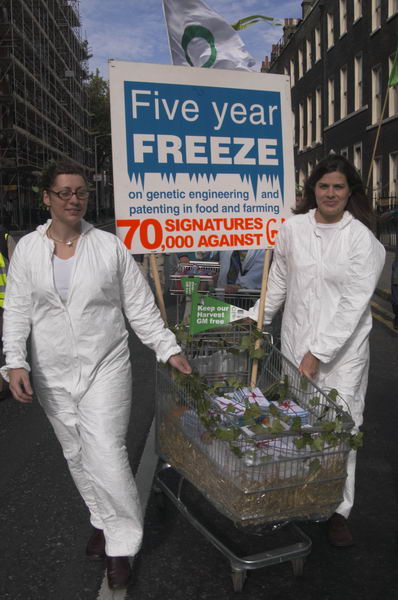
By 2003 I was working with a digital camera, a Nikon D100, and on the 13th October I joined another thousand or so people from around the country to say ‘No to GMO’. Most of the work being done on genetic modification was aimed at increasing the profits of companies and at locking farmers into using patented seeds which had to be purchased from them and which required expensive chemical inputs and would penalise or even lead to prosecutions of those who continued with traditional methods, particularly organic farmers, and severely reduce bio-diversity. The protesters were largely concerned about the possible risks of genetic modifications that were not being subjected to thorough long-term testing. The government seemed simply to be preparing to give way to commercial pressures.

The protesters went first to the National Farmers Union, then to Downing Street (or rather outside the gates to Downing Street) then on past the Houses of Parliament to the Department for Environment, Food and Rural Affairs (DEFRA) in Smith Square. The digital pictures I was making then seem rather dark and muted and processing software then was still rather poor.


It was 2007 before I photographed anything at all relevant on 13 October again, and this time I was on a walk about The Romance of Bethnal Green, a book by Cathy Ross, which had included a number of my pictures from the 1980s.

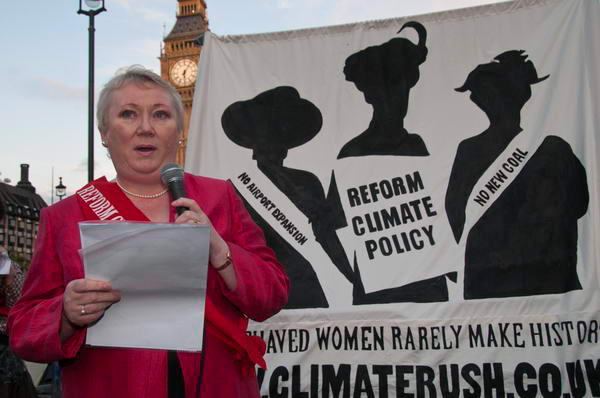
In 2008 came ‘Climate Rush – Deeds Not Words’:


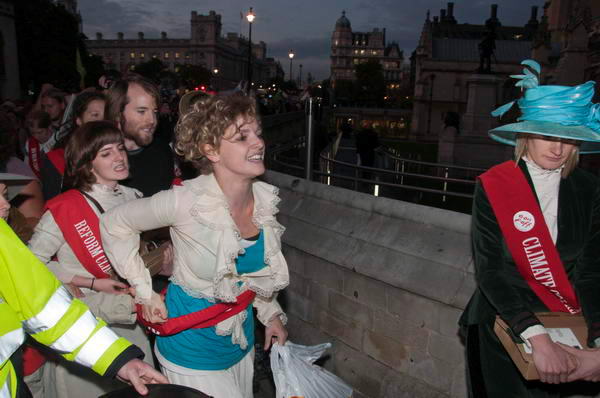
Exactly 100 years ago, more than 40 women were arrested in the ‘Suffragete Rush’ as they attempted to enter The Houses of Parliament. To mark this centenary, women concerned with the lack of political action to tackle climate change organised and led a rally in Parliament Square, calling for “men and women alike” to stand together and support three key demands:

  No airport expansion.
  No new coal-fired power stations.
  The creation of policy in line with the most recent climate science and research.

Those attending were asked to wear white, and many dressed in ways that reflected the styles of a century ago, and wore red sashes with the words ‘Reform Climate Policy’, ‘No New Coal’ ‘Climate Code Red’ and ‘No Airport Expansion’, with campaigners against a second runway at Stansted having their own ‘Suffrajets’ design. We were also offered fairy buns with ‘Deeds Not Words’ and ‘Climate Bill Now’

It was a protest that brought together some fairly diverse groups, including the Women’s Institute and the Green Party as well as Climate Rush, who, led by Tamsin Omond tried to storm their way in to the Houses of Parliament like their Suffragette predecessors, but were stopped by police. She was later arrested, not for this action but for breach of her bail conditions from the ‘Plane Stupid’ roof-top protest at the Houses of Parliament 8 months earlier.


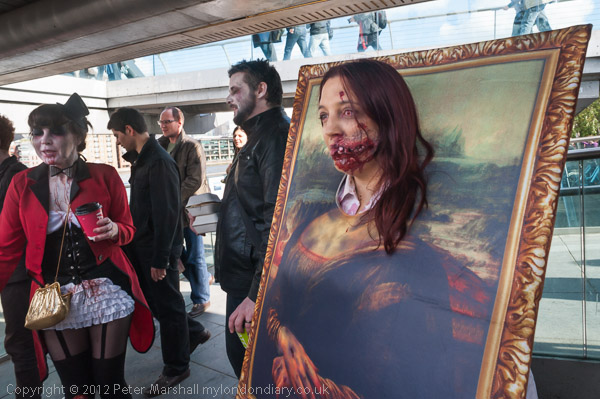
On 13th October 2012, Zombies invaded London in a charity event, to “raise the dead and some dough in aid of St. Mungo’s“, a charity which reaches out to rough sleepers and helps them off the streets.

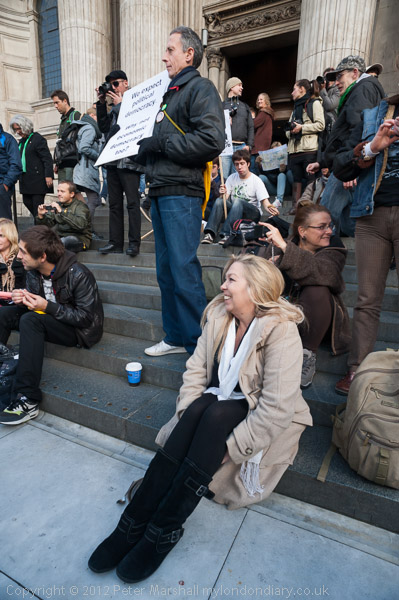
I went on from there to the steps of St Pauls, where on the first anniversary of their attempt to occupy the Stock Exchange, Occupy London joined a worldwide day of protest, #GlobalNoise, by the Occupy movement, to target the “political and financial elites who are held responsible for destroying our communities and the planet, resonating the ongoing wave of anti-austerity protests in Europe and around the world. At the same time #GlobalNoise is a symbol of hope and unity, building on a wide variety of struggles for global justice and solidarity, assuring that together we will create another world.

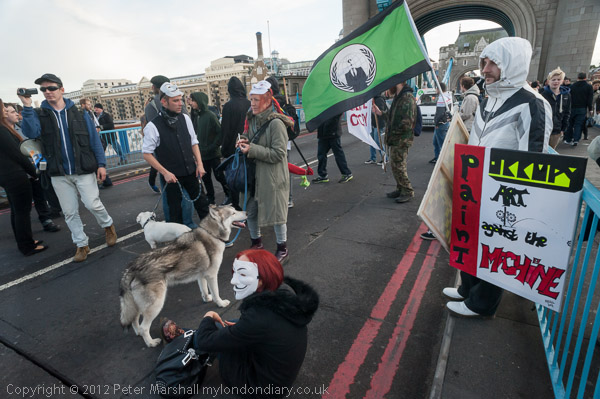
From a rally at St Paul’s they went on to sit down at a few places around the City, before crossing London Bridge heading for an undisclosed location to occupy for the weekend. Some wanted to occupy the ‘Scoop’ next to City Hall, but others felt it wasn’t suitable. A group went on to block Tower Bridge, but then returned to join others at Scoop.

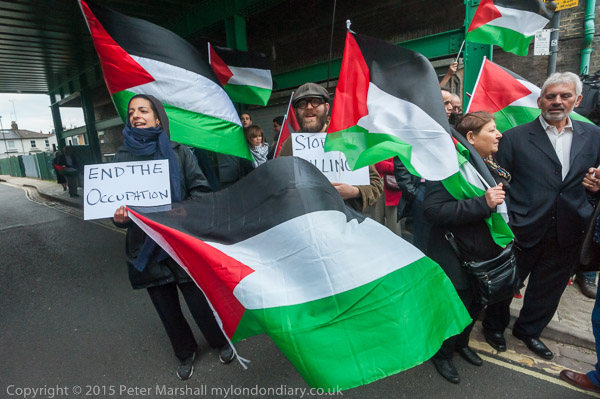
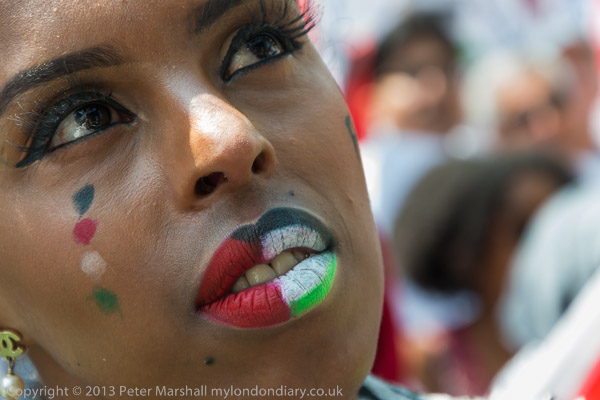
In 2015 the Zionist Federation organised a protest outside the Palestinian Authority UK Mission against the stabbings of Jews in Israel. Jewish and other groups supporting Palestinian resistance to occupation and Israeli terror came along to protest against all violence against both Jews and Palestinians in Israel and for an end to the Israeli occupation of Palestine.


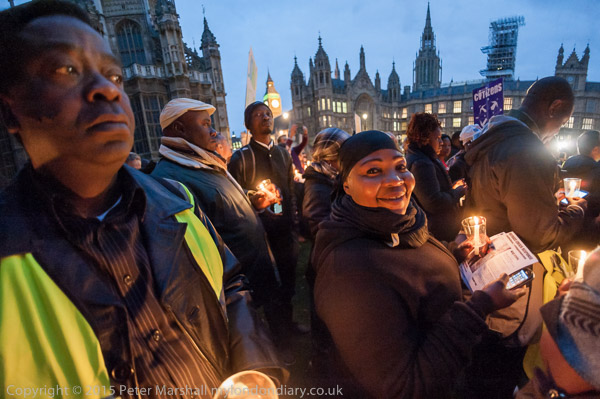
I left while the two protests were continuing to shout at each other to join the candlelit vigil at Parliament by Citizens UK calling for 1000 Syrian refugees to be resettled in the UK before Christmas and 10,000 a year for the next 5 years. Six children froze to death in the camps last year and many in the UK have offered homes and support.

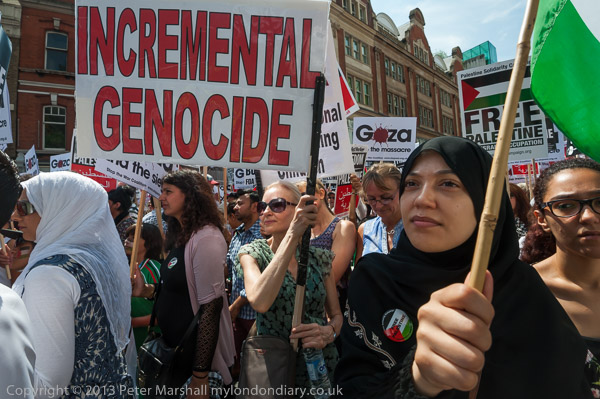
End Gaza Invasion: 2014

Israel ‘disengaged’ from Gaza in 2005, but retained many controls in what international bodies still consider a form of occupation. It has maintained a blockade, controlling access by sea and air to the area which has a closed border with Egypt and strict border controls to Israel. With 1.85m Palestinians on under 140 square miles it is the third most densely populated area in the world. (See Wikipedia for most of the figures in this post.)

The Israeli and US-led economic blockade of Gaza, imposed after Hamas gained a majority in the area in the 2006 elections and too over from Fatah in 2007 has stopped the import and export of many goods, and together with damage caused by Israel air raids and invasions has led to severe shortages of water, medicine and power.

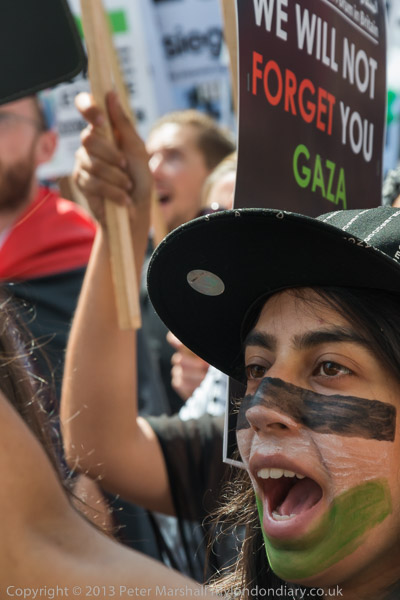
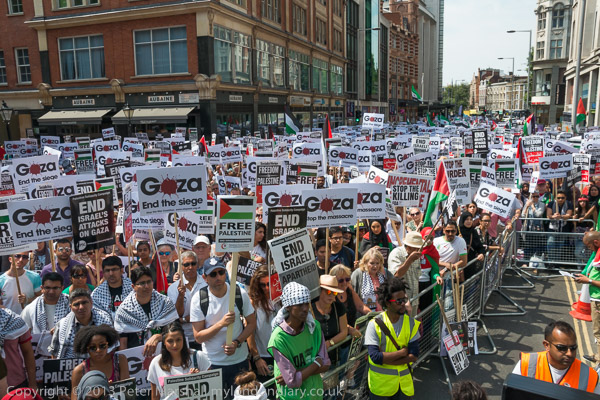
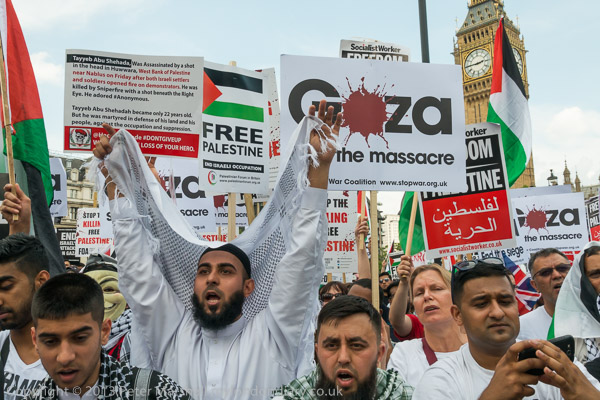
The protest in London on July 26th 2014 came during the Israeli ‘Operation Protective Edge’, which had begun on July 8th with bombing and artillery fire and escalated to a ground invasion on July 17th, with the aim of killing as many Palestinian militants as possible. It was sparked by the murder of three Israeli teenagers by Hamas members but the Israeli response was quite disproportionate.

Estimates of deaths and damage vary slightly, but agree that over two thousand Palestinians were killed, with the UN suggesting that 1,462 of these were civilians. 67 Israeli soldiers were killed and 6 civilians were killed by Palestinian rockets.

The damage to properties was similarly disproportioate. While around 18,000 homes were destroyed or seriously damaged in Gaza, Palestinian rockets only destroyed one in Israel. Gaza also lost over 200 places of worship, and almost three hundred primary schools and 73 medical facilities were badly damaged or destroyed. The attacks are said to have produced around 2.5 million tons of rubble in Gaza.

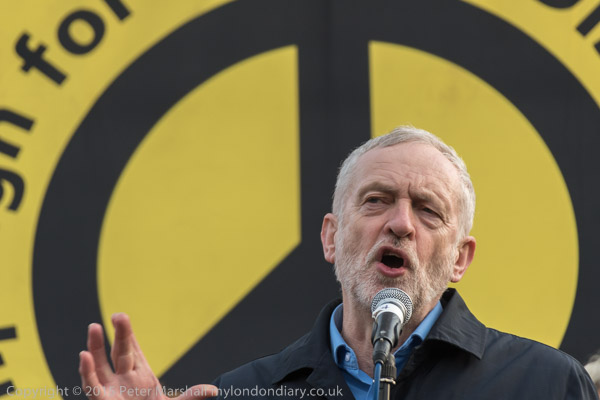
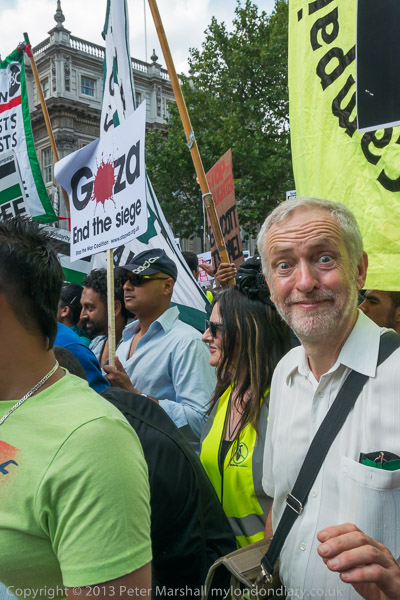
Jeremy Corbyn on the march in Whitehall

This is of course not the only year in which there were attacks by Israel on Gaza. “008-9 saw ‘Operation Cast Lead’ which also produced incredible devastation and over a thousand Palestinian Deaths and 13 of Israelis. In 2018 there were border protests in which over 13,000 Palestinians were seriously wounded by Israeli snipers and many killed. A UN Human Rights Council’s independent commission examined 489 cases of Palestinian deaths or injuries and found that only two were possibly justified as responses to danger and the rest were illegal. And most recently in May 2021 there were ten days of attacks by Israeli forces resulting in more destruction and deaths.

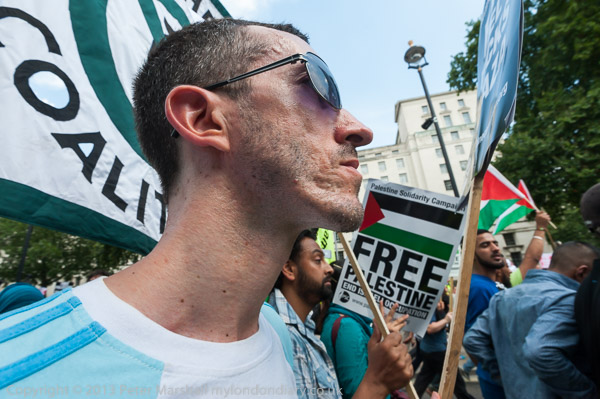
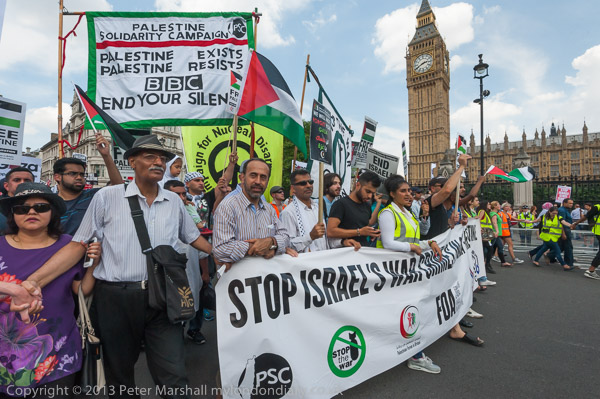
The protest on July 26th began on the main road close to the Israeli Embassy, tucked away in a private street in Kensington. Soon themain road was packed with people many too far away to hear the speeches despite the amplification. Finally it moved off on its way to Parliament Square.

There was a long list of speakers at the rally, including a number of well-known musicians and other public figures, but I began to feel rather tired, having been on my feet too long covering this and another protest, and I left before the end. But you can see pictures of many of the speakers as well as the crowd in My London Diary.

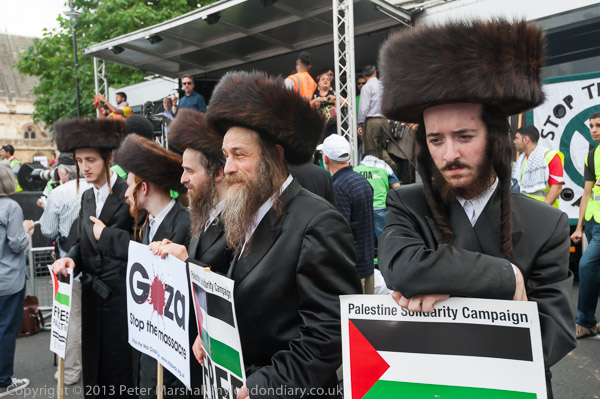
As usual there were many Jewish supporters of Palestine on the march, and a small group of the ultra-orthodox Neturei Karta anti-Zionist Jews who had walked from north London to join the rally.

Stop the Massacre in Gaza Rally
End Gaza Invasion March to Parliament
Israeli Embassy rally – End Gaza Invasion

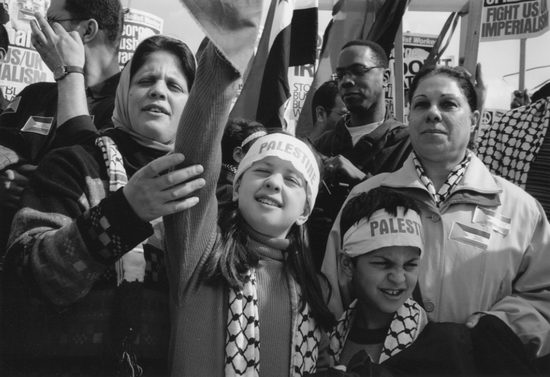
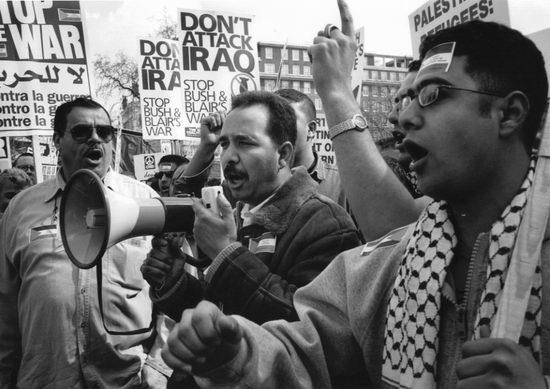
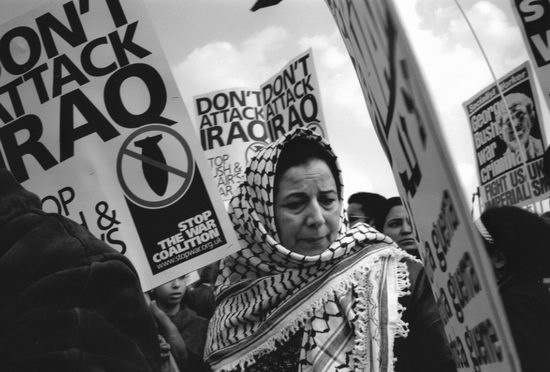
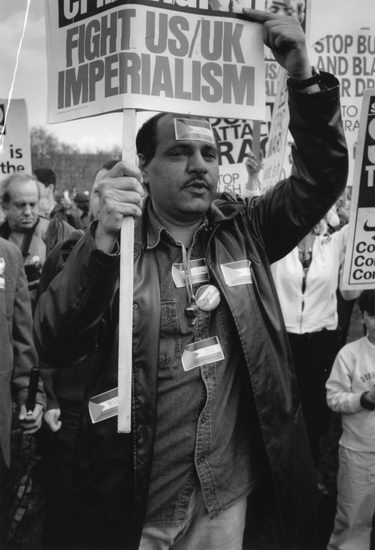
2 March 2002: Stop the War, Hands off Iraq

Back in 2002, protests were still in black and white – or rather I was still using film for my photographs and the library I was putting pictures into was still only taking colour pictures as transparencies – something I had given up taking seventeen years earlier as I found colour negative far better to work with.

For the huge Stop The War protest on March 2nd, 2002 against the war in Afghanistan and the forthcoming invasion of Iraq I was actually working with three cameras, one with black and white film, a second with colour negative and the third a panoramic camera also loaded with colour negative film. Although I contact printed the developed films from all three, it was only selected images from the black and white work that was printed and went to the library.

Some day I hope to get around to printing some selected images from the seven or eight colour films I exposed on that day, but at the time I had no particular incentive to do so. It was difficult for me to use colour even on the web site, as my flatbed scanner at that time was a monochrome only scanner – and all the pictures on My London Diary from this event are black and white scans from the black and white prints I made to send to the library.

There are a few colour pictures from this era on my web sites, mainly those taken on a pocket-sized 2Mp digital camera I had begun to use as a notebook a year or two earlier, but the images were generally unsuitable for publication. Prints from them at much more than postcard size were poor quality.

Around this time I did get my first film scanner, but it was very slow to use and the quality wasn’t great. And at the end of 2002 I began using my first DSLR, the 6Mp Nikon D100, and soon began submitting digital images to agencies that would handle digital work.

Newspaper reports at the time rather followed the police in giving figures of 10-15,000 people at the protest, though I think the true number was at least twice this. As I reported, “people were still leaving hyde park at the start of the march when trafalgar square was full to overflowing two and a half hours later.” It takes more than 15,000 to fill Trafalgar Square and the tailback over the 2 mile route adds considerably to that number.

As I wrote back then:

police estimates of the number were risible as usual – and can only reflect an attempt to marginalise the significant body of opinion opposed to the war or a complete mathematical inability on behalf of the police.

In my comments I also quote Tony Benn telling us photographers at the start of the march that it wasn’t worth us taking his picture, “it won’t get in the papers unless i go and kick a policeman” and he was quite right. They didn’t report his speech either, in which he said that for the first time in his life he though the situation was so desperate that he was advocating non-violent resistance, calling for everyone to stop work for an hour at the moment the bombing begins. “Stop the buses. Stop the trains. Stop the schools. It’s all very well going to Downing Street, I’ve spent half my life at Downing Street, in, outside Downing Street. It has to be more than that, its got to be something we take up in every town and village.” This he said would get the debate going. His speech received a huge reception from the crowd.

It was hardly a very radical suggestion – and after the bombing started it would have been too late. But had ‘Stop The War’ called for similar action before the parliamentary debate – and not just another A to B march planned months in advance – it might have made a difference. The message that this was simply a war for control of oil resources and would be a disaster for the region was getting through – and there were regular protests in towns and villages across the nation, including in the true-blue town where I live, and more radical actions could have prevented the UK joining in the US action.

More at http://mylondondiary.co.uk/2002/03/mar.htm


All photographs on this and my other sites, unless otherwise stated, are taken by and copyright of Peter Marshall, and are available for reproduction or can be bought as prints.


Stop Trident, Save Refugees…

Last Tuesday I watched John Pilger’s 2010 film, The War You Don’t See, a film that takes an honest look at wars and the failure of most journalists to report honestly on them – and how those that do find their work fails to get broadcast or printed. It’s an at times harrowing view of war and lays open the whole huge PR web of lies that is used to persuade the public that they are necessary and to support them, based mainly around the propaganda over Iraq and Afghanistan.

It is now a matter of official record that all of the reasons put forward at the time for the invasion of Iraq, notably in the UK by Prime Minister Tony Blair were lies; but not only that, were known at the time to be false. It was simply a war for the control of Iraqi oil, and to keep the military industry growing. Of course many of us outside the
CIA and other agencies also knew that at the time, including the over a million who went to protest in London.

Pilger managed to get interviews with a wide range of people, including journalists and others who admit that they failed for various reasons to inform the public what was really going on. Those from other news sources, including the BBC, make a wholly unconvincing attempt to justify the approach they took, visibly squirming as Pilger asks his questions, trying to defend their toeing the government line rather than examining the evidence and reporting objectively.

We are in an age of perpetual war, not largely because of real disputes that could not be solved by other means, but manufactured and promoted by a huge web of deceptions to feed what is sometimes called the military-industrial complex, a term coined by Eisenhower for his final public speech in 1961 when he warned of the “economic, political, even spiritual” dangers of “the disastrous rise of misplaced power” it it could – and has – produced.

Pilger’s film deals briefly with the bombing of Hiroshima and Nagasaki, which it is now clear served no military purpose as the war with Japan was rapidly drawing to a close when they were dropped. The film includes an interview he made in the 1980s with Australian journalist Wilfred Graham Burchett who managed to evade the military security that kept almost all journalists simply taking down and passing on the military briefings which denied the existence of radiation sickness and went to Hiroshima and reported on the terrible effects of the bomb.

Despite censorship and other attempts to stop his report reaching the outside world, the first 200 words of his 3,000 word report reached the Daily Express who put it on the front page – and the world learnt of how 30 days after the bombing apparently uninjured people were still “dying, mysteriously and horribly” from what Burchett described as “the atomic plague.”

Journalists who step out from the official line can expect to suffer, and many. particularly those who refuse to be led and “embedded” have been killed reporting on wars. Others, such as Julian Assange find themselves the subject of deliberate campaigns to harass and discredit them – and in his case to imprison him in solitary confinement – possibly to be extradited to life in solitary in the USA – despite an extradition treaty that excludes those accused of political crimes.

Our so-called Independent Nuclear Deterrent is wholly a programme to feed that military-industrial complex, with its chilling threat hanging over us all, something that at least one US president has been prepared to consider using and which only the willingness of one Russian soldier to disobey orders saved us from its accidental unleashing.

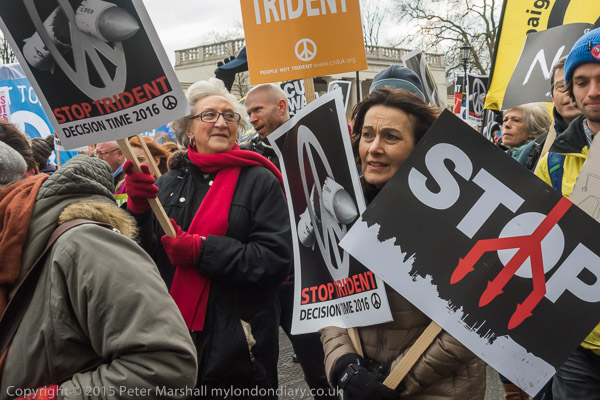
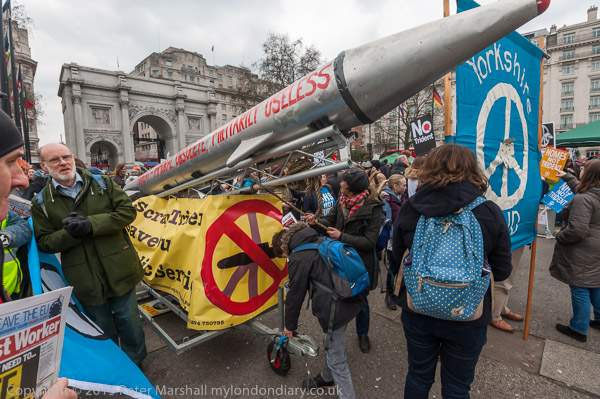
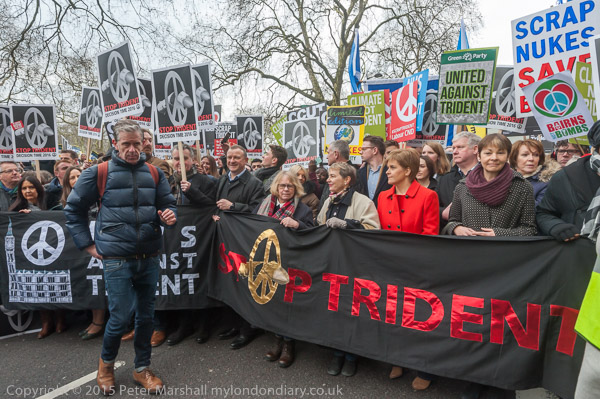
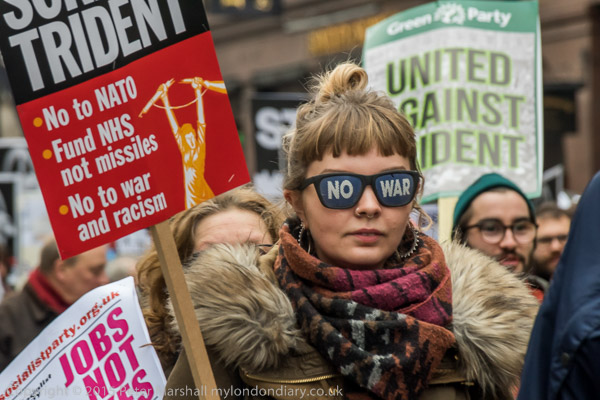
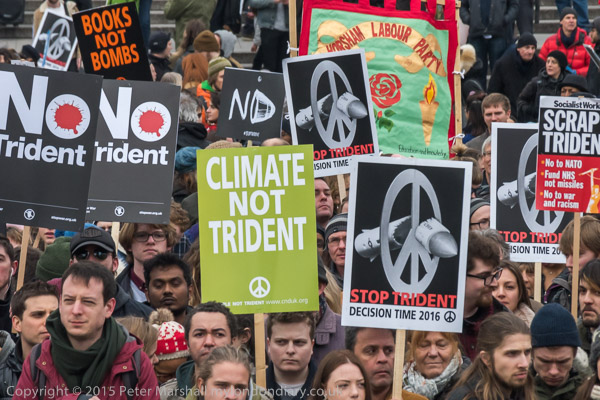
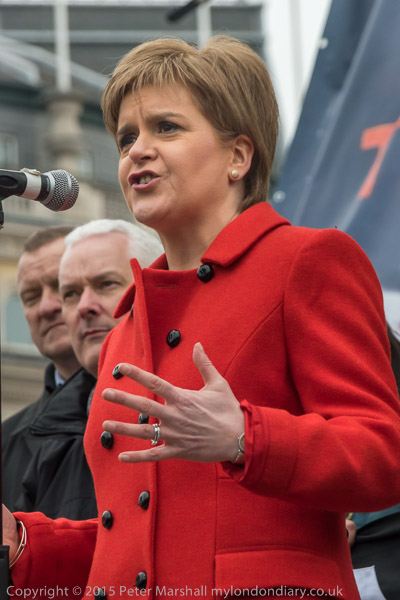
On Saturday 27th February, around 60,000 came to Marble Arch to march from there to a rally in Trafalgar Square against government plans to replace the UK’s Trident nuclear weapons at a cost of £180 billion or more. They said Trident is immoral and using it would cause catastrophic global damage; these weapons of mass destruction don’t keep us safe and divert resources from essential spending on services like the NHS, schools and housing.

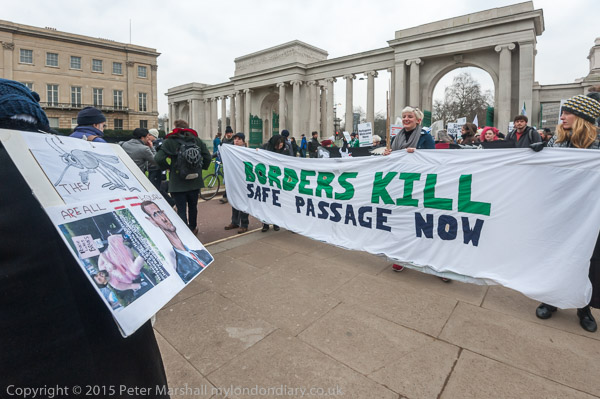
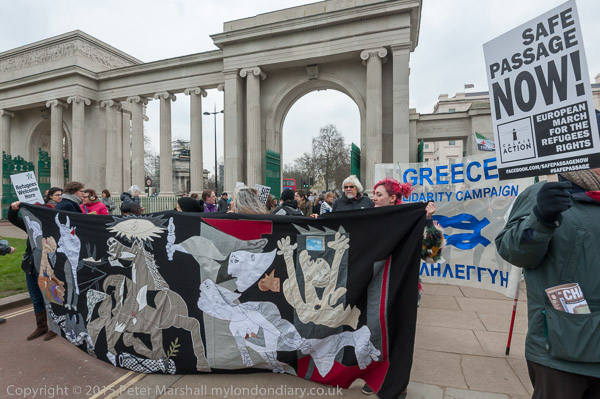
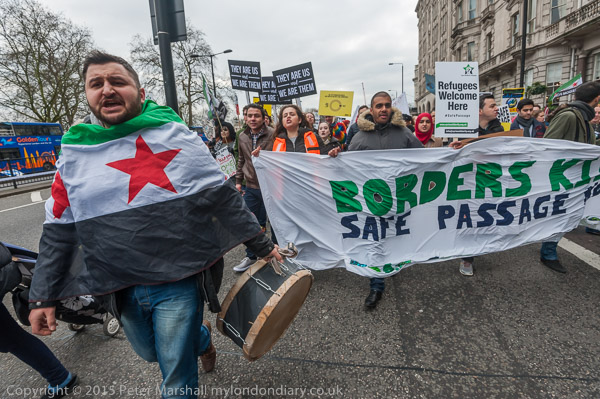
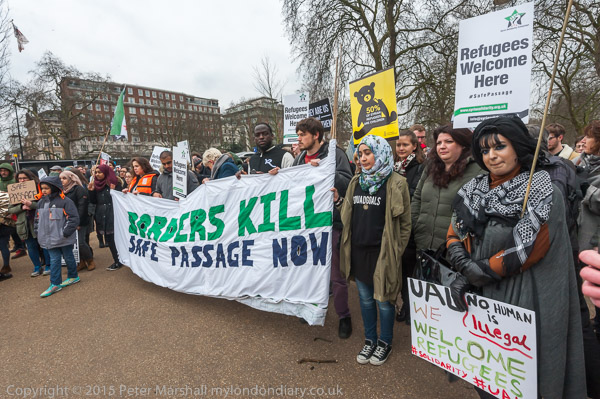
I was a little late to the official photocall because of the dense crowds as I made may way from the European March for Refugee Rights which had finished with a rally a short distance away in Hyde Park. This was taking place in various cities across Europe and demanding that governments take action now to open secure safe passage routes for all refugees and asylum seekers seeking protection in Europe. They called for an end to deaths at borders and for refugees to be allowed to keep their possessions and be reunited with their families.

At the end of this march, many of those taking part went to join the Stop Trident march, some forming up as a group ahead of the official front of the march despite attempts by the Stop the War stewards to move them. Eventually the stewards halted the main march for around ten minutes to create a gap between the two groups.

Stop Trident Rally
Stop Trident March
European March for Refugee Rights


All photographs on this and my other sites, unless otherwise stated, are taken by and copyright of Peter Marshall, and are available for reproduction or can be bought as prints.


Don’t attack Iran!

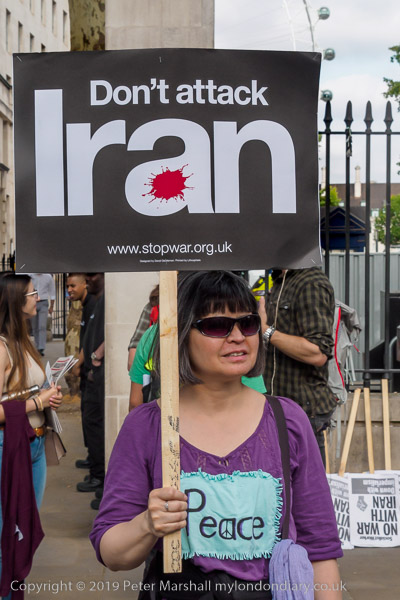
For a few days it really looked as if Trump was about to launch an attack on Iran and he was really being urged to do so by some of his hard-line advisers.

Trump had called off a planned air strike at the last minute which was planned in retaliation for the shooting down of an unmanned US reconaissance drone by Iranian forces. Iran had said it had strayed into Iranian air space while the US claimed it was in international air space.

Despite the US official claim it seems almost certain that the drone was attacked in Iranian air space, when it and an armed Boeing P-8 Poseidon US navy surveillance aircraft with a crew of 35 flying close to the drone had strayed into it over the Gulf or Hormuz.

Iran issued a statement that both aircraft were in their airspace and that they had twice warned the US before deciding to attack the drone, but had decided not to attack the manned aircraft, stating “we could have shot it down, but we did not .”

It was perhaps this statement that caused Trump to call off the US attacks at the last minute, saying he had been told 150 Iranians would be killed, and that this would be disproportionate.

Trump also stated; ” There was a plane with 38 people yesterday, did you see that? I think that’s a big story. They had it in their sights and they didn’t shoot it down. I think they were very wise not to do that. And we appreciate that they didn’t do that. I think that was a very wise decision.

But the US threat remains, with Trump in a later tweet promising “Any attack by Iran on anything American will be met with great and overwhelming force. In some areas, overwhelming will mean obliteration.

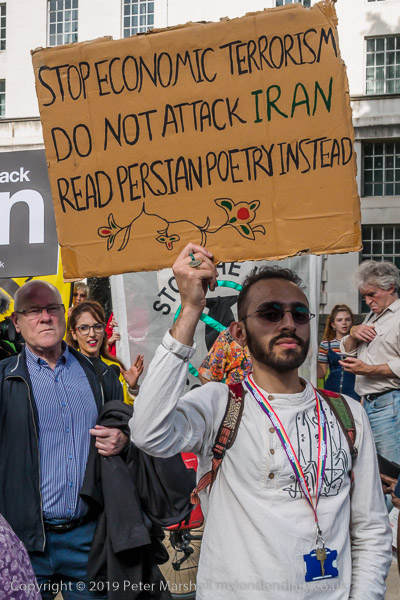
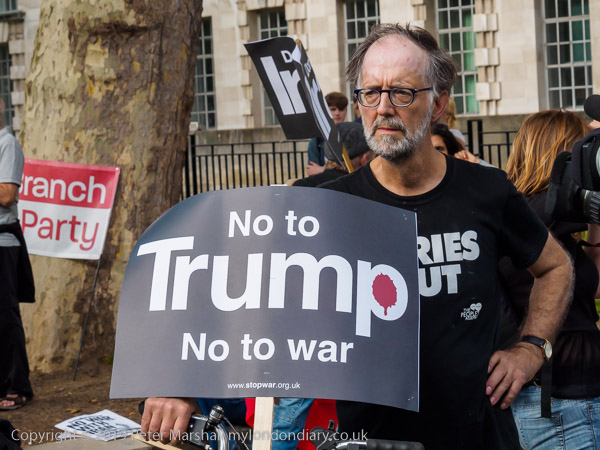
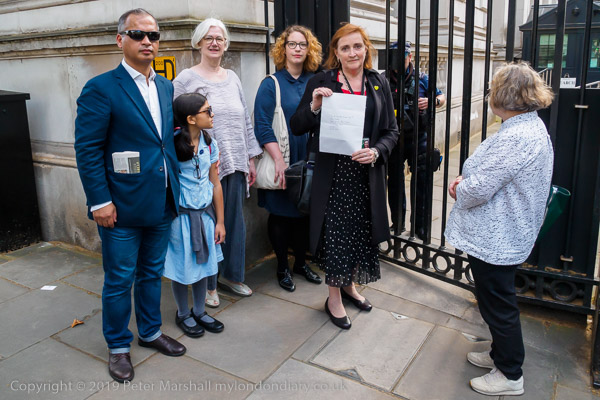
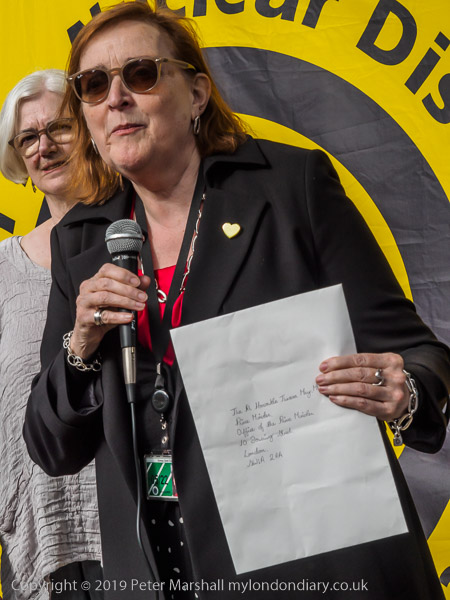
Because of the high and continuing threat level of war against Iran, Stop The War had called an emergency protest to demand our government to make it clear to Trump that it did not want and would not support a war against Iran. They protested opposite Downing St and tried to deliver an urgent letter to the Prime Minister, but were refused admission to Downing St by an apologetic police office on the gate as they had not arranged permission some days beforehand.

I had thought that MPs were allowed entry without prior arrangement, but Emma Dent Coad, MP for Kensington, was refused entry. The protesters were told to put the letter in the post.

More pictures: Don’t Attack Iran


All photographs on this and my other sites, unless otherwise stated, are taken by and copyright of Peter Marshall, and are available for reproduction or can be bought as prints.

There are no adverts on this site and it receives no sponsorship, and I like to keep it that way. But it does take a considerable amount of my time and thought, and if you enjoy reading it, please share on social media.
And small donations via Paypal – perhaps the cost of a beer – would be appreciated.