Jesse Jackson & Christian Aid

When I go to most of the political events that feature on My London Diary I’m going as a photographer rather than to take part in them. If you read what I write it is of course usually fairly clear whether I support them, or what reservations and disagreements I have. But last Wednesday morning it was a little different, as I was actually going to lobby my MP about action over trade justice in an event organised by Christian Aid.

For many years my wife has organised local events for this charity, including the annual house to house collection carried out by members of local churches. It’s a charity that I admire for its work with local groups of all kinds (certainly not all church connected) in the majority world, really tackling problems at the most basic level through working with cooperatives and other small organisations, as well as its relief work in disasters, where its local connections can enable it to be far more effective than some other aid organisations.
© 2010, Peter Marshall

So rather than attending as ‘press’ and going up  into the gallery, I went into the hall along with the crowds and was seated by a steward in the centre of the hall rather towards the back. I hadn’t actually intended to take photographs during the meeting, just to listen to the speeches, and I settled down in my seat, waiting for the event to begin.

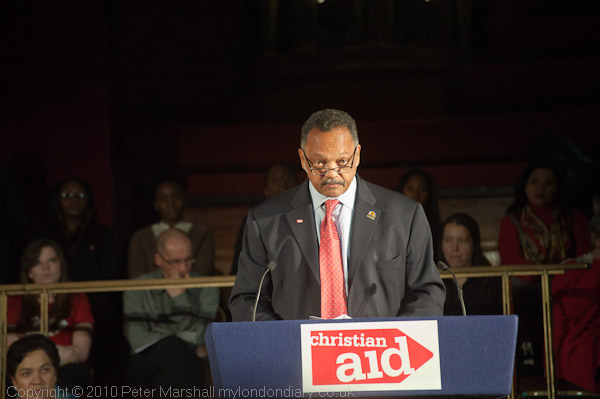
But then I thought I had a decent view of the front of the stage and although the hall was fairly dim there was some spotlighting there, and I took out the D700 and fitted my Sigma 55-200 lens.  It wasn’t ideal – at 200mm the maximum aperture was f5.6 and really I could have done with another couple of stops. Exposures varied from around 1/50th to 1/250th working at ISO2000, and even at the slower speed some were sharp. Unlike most lenses I now use, this one doesn’t have image stabilisation, which might have helped, although some of the wasted frames were caused by the subject moving.

I stayed sitting in my seat to increase stability and also because I didn’t want to cause more annoyance to those seated around me. I also hoped that the tops of heads in some pictures would give a greater feeling of actually being there.

Jesse Jackson, the star of the show, spoke without gestures, just occasionally glancing up from the text he was reading with a penetrating glance over his glasses direct at the audience and in particular me in the middle of it – which I caught on several frames, including the one above. The message was in his words and not in his performance. Others, and Jackson himself when not speaking, as you can see in the pictures on My London Diary, were at times more demonstrative.

But as a set of pictures these are of course limited by the same viewpoint throughout, though there are some changes in framing.

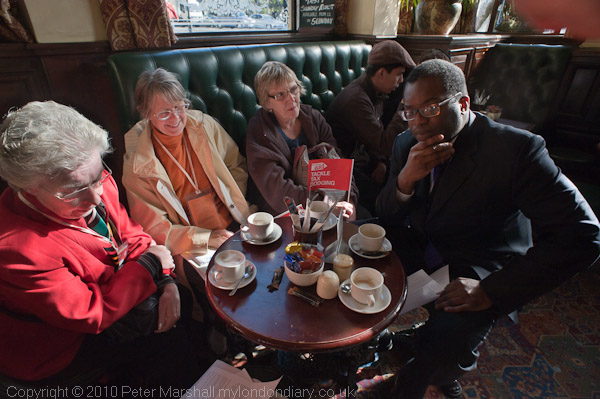
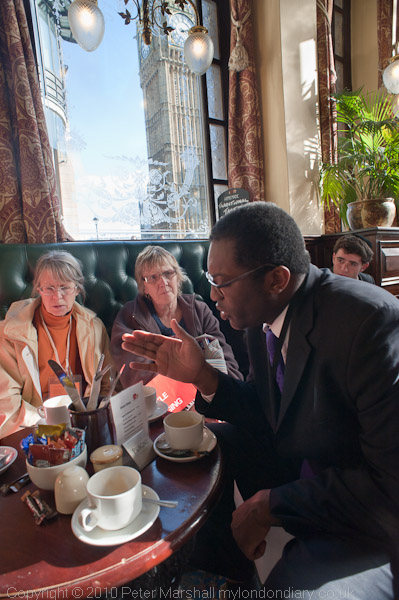
Later, when actually lobbying my MP – we had coffee with him in a pub – I had more freedom, although I was also trying to take part in the discussion and really you can’t do two things at once. These pictures were taken with the 20mm f2.8 and the main problem was excessive contrast, with direct sunlight streaking in on one of those taking part and the dark skin of our MP in deep shade.

It was a situation I would have written off when working with film, even with colour neg – and perhaps used for graphic effect in black and white. But with a lot of work in Lightroom I managed to get usable results. I also had to give extra exposure to the Christian Aid logo and the blue background of the lectern, which was excessively prominent in the pictures, and was I think lit rather more strongly than the speakers.
© 2010, Peter Marshall

though getting Big Ben visible through the window was pretty tricky:
© 2010, Peter Marshall

Of course, using flash fill would have simplified things, but it would also have altered the whole atmosphere of our meeting, which I didn’t want to do. As we left of course I did take a few more boring shots outside to send to the local newspaper, who tend not to like any more interesting pictures.

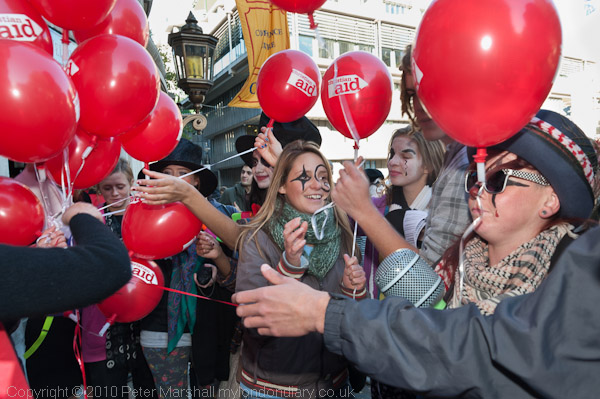
Finally I photographed some of the younger Christian Aid supporters who were parading around the Westminster area.
© 2010, Peter Marshall

More on  My London Diary.

No Science Cuts?

I’m not sure anyone is entirely sure about Britain’s future investment in science after Wednesday’s speech in parliament  on the cuts. I was in Westminster to photograph other things, but caught a glimpse Chancellor George Osborne sitting in a car looking fairly pleased with himself as he left Parliament after giving the speech in a small part of which he confirmed that the government was going to protect the confirmed that the £4.6 billion per year science budget to make sure the country retains its position at the leading edge of technological advances.

I’d stopped to chat briefly with one of the group of photographers standing ready to grab pictures as the cars drove out, but decided not to get in their way as they leaped into action as the car approached. They had their job to do and I was in any case not ready for that kind of grabbed picture had I wanted to try. I don’t personally find such images of great interest, although the papers do often seem to use them.

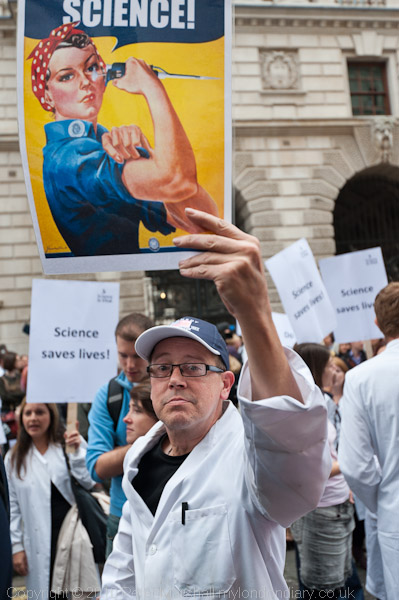
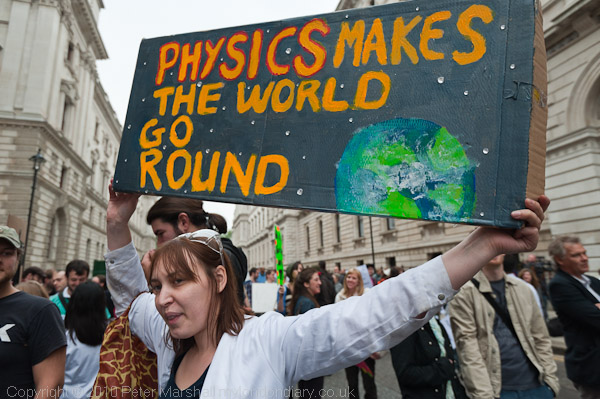
It will have come as good news to the couple of thousand white-coated demonstrators I’d photographed ten days earlier outside the Treasury in London, but many of them will also have been worried by the 40% cut he also announced for teaching budgets in Higher Education, which may well mean fewer jobs in the sector as well as higher fees for students. So things may be getting pretty tough in the next few years in our universities.

© 2010, Peter Marshall

The scientists had done their best to put on a show for the demonstration, with some placards with snappy slogans, some scientific celebrities and even two science comedians, but it was still a more subdued crowd than at most demonstrations, and perhaps lacked the drama that makes for the best photographs.

© 2010, Peter Marshall

Of course one can’t tell if this protest had any effect on the chancellor, but certainly the media coverage it gained will have made it easier for him to make the decision to protect spending in this area. You can see my report which went on Demotix on the day of the demonstration and more pictures in Don’t Cut Science on My London Diary.

TINAG and Amy Whitehouse

Spitalfields has changed dramatically over the years I’ve walked through it and occasionally taken pictures there. One of the places where the change is most apparent is Spitalfields Market. One of my most talented students went there years ago and did a fine essay on the guys who worked there, handling the fruit and veg.

Last night as I walked through, there was a small crowd around a shop and looking in through the window I saw a woman with an impossible wig singing. She didn’t have a bad voice either, which rather surprised me, as this was the opening of an Amy Whitehouse shop and the paps were busily papping. I thought about taking a picture myslef, but decided I couldn’t be bothered, and hurried on down Hanbury St to the Hanbury Hall, where the TINAG festival was opening.

It’s hard to describe what TINAG is. The letters stand for ‘This Is Not A Gateway, and it’s a three day annual festival which aims to provide a platform for artists concerned with urban issues and to encourage “interdisciplinary and cross-cultural exchange.” You can read more detail in the  ‘Background‘ page of their web site.

Last year, Paul Baldesare and I took part in TINAG, giving a presentation on our work then on show half a mile away in the Shoreditch Gallery, ‘Taken in London‘ and taking part in a group discussion on this and some other presentations. I’d thought about taking part again this year, as our  ‘Paris, New York, London‘ was obviously relevant to their programme, but there were too many problems in actually getting that show on the road for me to put it forward to TINAG.

If you are in London today, Saturday or Sunday (22-24 Oct 2010) it’s worth taking a visit to the Hanbury Hall at 22A Hanbury St, Lodnon E1 6QR. You can see the full programme of events and exhibitions on the TINAG web-site. So far as the photography is concerned there are very definitely some highs and some lows. Among those I really found worth looking at is David Boulogne’s ‘Confessions From The City’, with a presentation of black and white images, most of which are also in his Blurb book “MAKE IT A GOOD EXPERIENCE in the City“, although they look considerably better in the on-screen show. I also liked a series of portraits of workers in a South American market,  Jhon Arias‘s Portraits from Corabastos, the largest food marketplace in South America. Showing next to this is a 3-channel video by Juan Delgado who worked in the same market, with help from Arias who grew up working there, helping with his father’s business. I found his blog about making the film in some ways told me more than the actual presentation

More on this later when I have some time – and perhaps a few of the pictures I did take of this event, even though I couldn’t be bothered to photograph that young woman. I think she was the real thing, though I’ve seen more convincing Amy Whitehouse imitators.

The Three Cities of Photography

[Text of my speech at the opening of ‘Paris – New York – London‘ at the Shoreditch Gallery, London on 20.10.2010. The show continues until 29.10.2010.]

Stars of tonight’s show are the most vital cities in the history of photography, Paris, New York and London. As we know the twin birth of our medium was announced within a few days in Paris and London in 1839; New York was to dominate much of the twentieth century.

The most notable British photographer of the last century illustrates their relationship well. Bill Brandt was a German who re-invented himself as a Londoner, learnt photography in Paris, and when he had the first major solo exhibition by a living photographer in any of our leading art institutions, his Hayward Gallery show came from the Museum of Modern Art in New York.

London dominated photography in the 19th century. One of our greatest photographers was Roger Fenton, honoured by a blue plaque on a fine house overlooking Parliament Hill Fields. But after a few years as our leading photographer he abandoned photography and went back to making some money instead – as a lawyer. Despite the strength of photography here, this country has never really accepted photography, never developed a culture, a community that supports it.

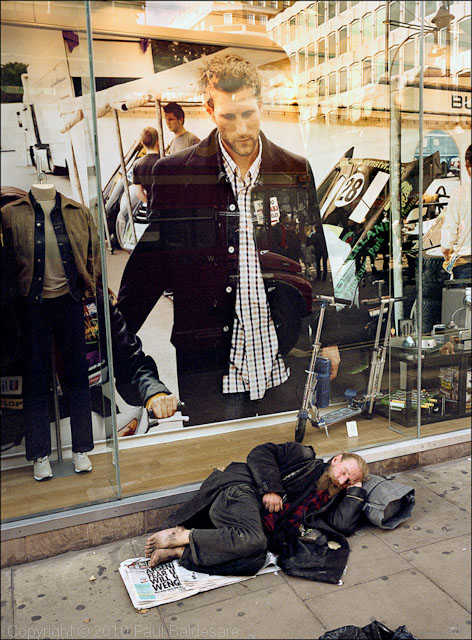
© Paul Baldesare
Sleeping vagrant, Davies St, Mayfair, London. Paul Baldesare

Paris’s great period was between the two World Wars; Atget was still working in the twenties, Henri CartierBresson was young and active in the next decade and others including Capa, Brassai, Kertesz and Man Ray flocked there. But photography was just one of the arts that flourished, and the inspiration for my own work on the wall here came more from Surrealist literature and in particular Aragon‘s ‘Paris Peasant.’

© 1988, Peter Marshall

One man almost single-handedly dragged the US to the forefront of photography around the start of the twentieth century, and Alfred Stieglitz in New York repeated his miracle when he published the work of Paul Strand in the final two editions of Camera Work in 1916-7. Later the city was the home for a hugely vital upsurge of photography in the form of the New York Photo League, closed down by McCarthyism at the start of the 1950s.

Alexey Brodovitch came from Paris to New York in the mid 1930s, becoming art director of Harper’s Bazaar and in the 1950s and 60s established a legendary laboratory for photographers. Two who went through that mill, John Benton-Harris and Tony Ray-Jones came to London in the late 1960s and helped to kick-start a decade of resurgence of photography here which lasted through most of the 1970s, particular through their influence on the magazine ‘Creative Camera‘, based in London, though its publisher, Coo Press was kept afloat by men in braces in the pigeon lofts of our northern cities who bought its other publications.

This was only a short-lived flutter, soon cut down to size and emasculated by a British establishment that refused to take photography seriously (and held its nose and kept it at arm’s length when it had to take it at all), and in particular the Arts Council and their ‘photographic flagship’ in London, the Photographers’ Gallery, or as I christened it a couple of years ago after its move to new premises, the zombies of Ramilees St. The gallery made only half-hearted attempts to encourage and nurture photography in this country, and these were abandoned completely  in the late 1980s.

I was one of the photographers influenced by that outburst of the 1970s, and Paul Baldesare‘s work developed particularly from that of Tony Ray-Jones and John Benton-Harris.

Although a photographic culture is still almost completely lacking here, there have been a few small glimmers of hope arising if sometimes rather dimly and uncertainly from a general pea-soup of indifference. Photofusion in Brixton, Host not too far from here, and, perhaps most notably, the East London Photomonth, now celebrating its tenth year. I’m pleased to have been able to be involved with it through shows here in the last three of these.

Peter Marshall 20.10.2010

[I ended with thanks to various people and also an advert for Photo Paris, which includes the pictures from Paris on show here, as well as mentioning that work from two of us was on sale. Pictures from the opening in a later post.]

Paris Photo 2010

When I wrote about photography for About.com, one of the things I was keen to promote was photography that was taking place outside the charmed circle which was largely defined by US dealers, US galleries and US academics, with a little help from their Western European colleagues.

Of course there were photographers from outside that area who were recognised, but they were largely restricted to a few whose work had somehow been discovered in the USA and rewarded with major exhibitions there, for example the great Czech photographer Josef Sudek.  His work was brought to New York by Sonja Bullaty.  At the age of 22 she had escaped from a death march after four years imprisoned by the Nazis  in the Lodz Ghetto, Auschwitz and Gross-Rosen concentration camps, and hid until liberation when she was able to return to Prague and became ‘apprentice-martyr’ to Sudek. Two years later distant relatives discovered she had survived and sent her the money to go and live with them in New York, where she worked as a photographer (along with her husband, New Yorker Angelo Lomeo) for the rest of her life. It was her work and particularly her book of pictures by Sudek, published in 1978 that brought his work to the attention of the US-based photography world – and to me.

There were many others too – including many from the USA – who brought pictures from photographers around the world to exhibitions and wrote about their work, and of course many photographers from around the world made their way to America and to New York – in many respects the world capital of photography –  in particular. But when I started writing a professional column in 1999 it was still true that photography was very much dominated by US photographers and US opinions. There had even been some little discussion about whether as a non-US citizen who didn’t live in New York I was actually a suitable person to write about the medium (and not being American was one of a number of reasons why I finally lost the job, though it was more important that I insisted on taking photography seriously.)

I tried to do a little to educate the photographic public (and although I had many readers around the world it was mainly an American public) that there had been and was photography outside the states of the union and outside the at times narrow definitions largely set down by the Museum of Modern Art. One area of the site I set up was devoted to ‘World Photography’ and at first I concentrated on Central and South America, treating it country by country, starting with Argentina (by the time I was sacked I had got as far as four features on Mexican photography in a total of 16 from that area, 6 from Africa, 13 from Asia, 2 from Australasia, 38 from Europe as well as 23 from North America.)

Most of those from Europe were from England and France, but I had written about photographers from Hungary, Albania, Lithuania, Russia and Finland, and was preparing to write more about photography in Central and Eastern Europe when my contract was terminated. But while I don’t pretend my work had any great influence,  it did I think represent a current of opinion whose time had come and others obviously shared some at least of my ideas, and photography has been opening its borders and becoming more international in the past decade.

I’m particularly pleased to see that this year’s Paris Photo has a special emphasis on photography from Hungary, Poland, Slovakia, Slovenia and the Czech Republic. Whether or not you are going to Paris this year you can see some of this work on line, and Lens Culture has  a preview of more than 300 images in a high-resolution slide-show.

Not all of the pictures are from Europe; the second image in the slide show is by one of my favourite Japanese photographers, Issei Suda. One of his books was the first book of Japanese photography I ever bought, many years ago.  The slide show, like Paris Photo, is an incredible mixture with work to suit every taste (or lack of it) with quite a few images that seem to me totally pointless, but also much to delight.

See Also

Meet Me in Paris?
November in Paris & Lensculture fotofest

Alex Ten Napel on Verve

I’ve mentioned Verve, a web site set up by photographer and photo editor Geoffrey Hiller to feature new documentary “photographs and interviews by the finest contemporary image makers today” several times before, and it’s a site where I often find interesting work, too often to write about it every time. It’s a site I’d recommend you to bookmark and browse through from time to time, or add to your RSS feeds.

As I do. And yesterday I came across some work from a Dutch photographer I met a few years ago in Poland, Alex Ten Napel. I started to write about his work at the time, impressed by his water portraits, but somehow that piece never got published (I think I may have been waiting for permission to use some of his pictures and then simply forgot about it.) The work on Verve is from his black and white series of portraits of people with Alzheimer’s that he made in the 1990s, and there are more on his web site along with several other projects.

Other people have written about him and published articles in various countries. On his web site you can find a PDF with magazine pages with his pictures and text  in (I think) English, Dutch, French, Italian, Greek, Russian and Polish.

2012 Pics

My camera hasn’t yet travelled into the future, rather the opposite, as the pictures that I’ve just contributed to the 2012 pics blog run by David Boulogne actually date from 1990 and 1992.  So far I’m the third photographer to contribute work to the site, after Boulogne himself and Dominik Gigler.

David describes this site, under the sub-heading memory for future generations as:

Collection of photographs about the east part of London where the core of the 2012 Olympics will take place. The project aims to capture a landscape in transition. Not only of the site but also of its surroundings. Anyone with original concept using film photography is welcome to send submission.

I think the first post on 2012 pics was made in March this year, although the pictures were from December 2009, and the site gives a good idea of what the site looked like around that time and since.

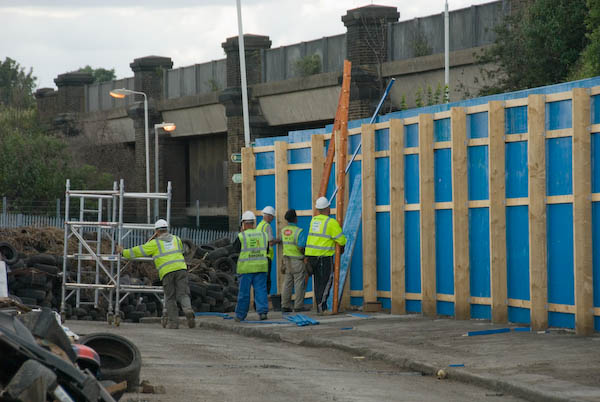
Of course its an area I’ve visited many times over the years and which is covered in my Blurb book, Before the Olympics, as well as on my River Lea – Lea Valley web site. There are also quite a few pictures on My London Diary, including this one of the blue fence being put up:

© 2007 Peter Marshall
From My London Diary, June 2007

Among the five pictures on my first contribution to 2012 pics is one of ‘Pauls Cafe’ also known as ‘Cockney Hideout, which makes clear that there “aint no airs or graces ere“and there weren’t. Another shows the Pudding Mill river which at that time still flowed south under the Eastern Region main line. Now it just gives its name to a station on the Docklands Light Railway – alight there to visit the viewing platform/café on the Northern Outfall Sewer (now called the Greenway.) It’s name lives on too in ‘Pudding Mill River: Purveyors of Sporting Spirits and Foodstuffs‘ which according to their blog have been gathering the wild fruits of the Lower Lea Valley for generations, and which produced some amusing videos, including one of the Pudding Mill River Song which appealed to my warped sense of humour.

Pudding Mill is apparently the name given by the planners to the whole of the area to the south of the Olympic site between the railway and Stratford High St, the remaining parts of which are to be redeveloped after the Olympics.

I’ll be posting a further series of pictures to 2012 pics shortly, probably from my colour work along Carpenters Road and the surrounding area around five years ago.

Alec Soth

I’ve written a few times recently about Alec Soth, and he now has a new web site and its front page says:

My name is Alec Soth. I live in Minnesota. I like to take pictures and make books. I have a Labradoodle. I also have a business called Little Brown Mushroom.

Go there and click on the link and you’ll find the Labradoodle is well-named. Fortunately the site also has pictures from half a dozen of his projects:

all of which need you to scroll across the page* to see more pictures. The site also has quite a lot of information about him, definitely a good idea as he must get thousands of students writing to him with similar questions and he can just tell them to look on the web site.

If you have a large screen, it’s better to click on the picture and watch them larger as a slide show, but you need to have a screen around 1500 pixels wide to see the landscape format images properly, as on smaller screens the left side menu gets in the way.

The images in the slide show good quality jpegs, maximum dimension 1024 pixels but may not look their best in your browser as they are AdobeRGB images. These will only display correctly if your web browser is color managed. You can find out more and check that on the image at top right of this Web Browser Colour Management Tutorial, which should not alter when you move your mouse over it or click on it.  If you find it changes it is worth considering updating your browser. Recent versions of Firefox are colour managed (though it can be switched off) and I think Safari always has been.  The only version of Internet Explorer I have is IE7, and it isn’t.

Without colour management browsers will normally display all files as sRGB (or at least roughly so) as 95% of monitors use the same 2.2 gamma as sRGB. This is why it almost always makes sense to convert your files to SRGB before putting them on the web. Very few monitors can actually display many colours outside the gamut of sRGB in any case, so if you display an AdobeRGB file on them with colour management it won’t look any better than if it was converted to sRGB, and without colour management will look considerably worse.

Of course if you are at all interested in looking at photographs on the web you will have already have a properly profiled and calibrated monitor – to to 2.2 gamma and D65- 6500 Kelvin – and you can read more about that on the tutorial linked above. As G Ballard explains, the Mac default of 1.8 can cause problems.

While many lesser photographers (and sites such as Magnum) are pretty paranoid about putting images on the web, limiting the size and decorating them with watermarks, Soth does neither. It’s good for all of us who like looking at his work and particularly for those students I mentioned earlier who can print them off in their reports, and for other ‘fair use‘ of the images. If your work is as well known as his, you don’t need to worry too much about the images becoming ‘orphans‘, the main reason I now include both metadata and a visible watermark on all new web images.

*I’ll possibly think that is sensible design when I get a mouse that comes with a ball on top rather than a wheel, but not before.

Shore: Photography and the Limits of Representation

I didn’t get to Stephen Shore’s talk in London on Tuesday, but I’ve just been listening to it and watching it on video on the AA School of Architecture web site. Shore has been the director of the Photography Program at Bard College in upstate New York since 1982, but most of us probably know him for his 1982 Aperture book Uncommon Places, which gave many of us a new impetus to explore colour photography.

He talks about the nature of photography and the four tools that a photographer has at his disposal, “focus, moment & duration, choice of frame and choice of vantage point.” He says “Photography is essentially an analytic medium  … a photographer starts with the whole world and every decision brings order to it … a photograph is solved more than it is composed.”

It’s a long video – 90 minutes – but it held my interest for most of that time, and is a very clear exposition of his views on photography and of course of his own work. As well as the actual talk the video also includes the whole of the question session with Shore after the talk.

Photolounge/Photo-Open/Flowers East

If you are in London this weekend, it worth a trip along to the Old Truman Brewery in Hanbury St, just off Brick Lane, where in spaces T3 and T4 of F Block you can see both the Photolounge and the Photo-Open, both parts of Photomonth 10, this year’s East London Photography Festival. Both are open from 11am to 6pm Fri, Sat and Sun.

© 2010, Peter Marshall
The large space of the Photolounge – and more behind me

Photolounge is a three day event which gives a large number of photographers the chance to put up their own small show. The overall standard of work seemed very high, although some of the better photographers had relatively little on show. Far too many for me to comment in detail, but among the work that particularly interested me was Graeme Vaughans ‘Prague: a notebook‘ and work by Jon CardwellAndrew Meredith and Steve Schofield. But there was really a pretty overwhelming array of talent on show, with very little that held no interest for me, a considerably higher standard than some other open events, and it reflects the enormous amount of talent in and around the capital.

Given that there are another 92 galleries and exhibition spaces on the Photomonth 10 map, this with over 200 exhibitions and events is by some way the largest annual photographic event in the UK, and has a very good claim to be the most important of them all.

© 2010, Peter Marshall
A corner of the Photo-Open

The Photo-Open attracts a high standard of entries and they remain on display every day until 25 October. Also in the same building is one of those 92 galleries mentioned, the Cynthia Corbett Gallery as well as a display by Photobox of the Worlds Biggest Photobook (yes it was big, but…) to mark ten profitable years of their on-line digital printing service.

Many other shows in Photomonth 10 are an easy walk from the Old Truman Brewery, including my own ‘Paris-New York- London‘ around 15 minutes walk away (though quicker if you hop on a bus – and don’t forget you’re invited to our mid-show party on the 20th Oct.) There are over 50 venues within a similar distance, and the map, although not perfect (and our show has been put on Hoxton Square rather than Hoxton Market) is generally rather better than the Brighton one I criticised a few days ago.

But yesterday night, though I could have walked the whole way, I went instead to the bus stop at Primrose St (get off here rather than Liverpool St for the Old Truman Brewery)  and took another bus the three stops to Flowers East on the Kingsland Road for one of the truly outstanding shows of the festival (incidentally they recently opened a new London Overground station, Hoxton, very handy for it.)

Upstairs was ‘Guantanamo: If the Light Goes Out’, a part of Edmund Clarks very impressive project on the lives of the men who were held in Guantanamo Bay (and that shameful camp is still going, despite Obama’s pledge.) The show at Flowers ends on 14 Nov, but you can also see more of this work at Photofusion in Brixton until November 26 2010.   Andy Worthington, author of The Guantánamo Files, who almost certainly knows more about Guantanamo than any other single person, has written about this work, and hist site includes an interview from ‘Spoonfed‘ between Clark and Loredano, as well as a selection of pictures. At present the best way to see this work online is at Lensculture, where there are 30 pictures along with text by Clark – and I think gives a better impression of the project than the limited space at Flowers allows; I understand a new web site featuring the project and book is under preparation for next month.

Nadav Kander‘s Yangtze, The Long River fills the ground floor at Flowers (until Nov 13), its large prints impressive on the walls, although the opening was a little too crowded for me fully to appreciate this internationally acclaimed work. I hope to go back and take a longer and calmer look. Instead I went outside for some fresh air and to chat with some of the photographers who had come to the opening.  It’s a particularly handy place as there is a bus stop right outside the gallery and so I could make my goodbyes as the 243 came along to take me back to Waterloo.

© 2010, Peter Marshall
From the bus – Holborn

© 2010, Peter Marshall
From the bus – Waterloo Bridge

Travelling by bus in London at night is usually a visually interesting experience, although one that is difficult to capture. But I sometimes try.