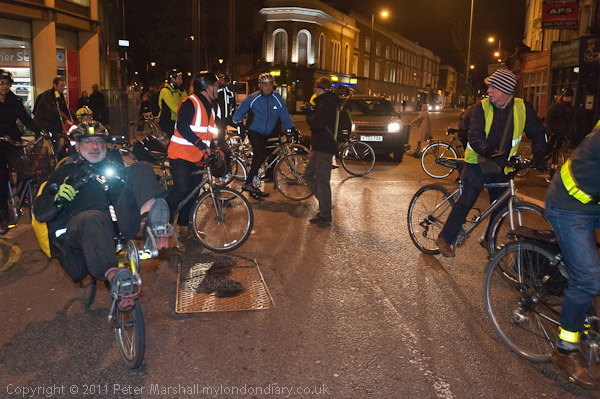
Arbaeen

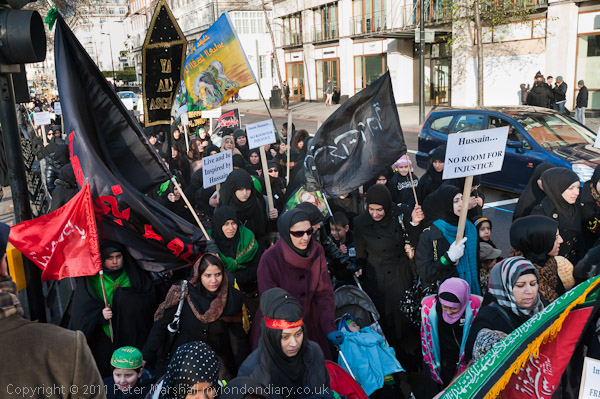
Sunday saw the 31st Arbaeen procession in central London, which is said to be the oldest Arbaeen/Chelum Procession of Imam Husain in the west, and is one of the larger annual Muslim processions in the UK, with around 5000 people taking part.

It was quite a contrast from the previous day, when I’d been photographing the English Defence League protesting against ‘Muslim extremists’ and it was certainly a much friendlier and more interesting event, if perhaps less newsworthy. As on previous occasions, I felt very much welcomed for taking an interest in this religious event, commemorating the end of an intense annual period of 40 days of mourning the massacre of Imam Hussain in 680AD.

It’s an event that has changed to some extent as I’ve photographed it over the past six or seven years, but even so, like all events that I’ve been to a number of times it gets harder to find something different to say in the pictures, rather than just to repeat myself.

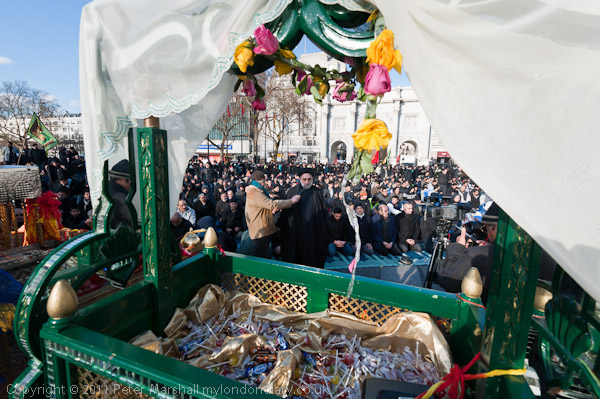
I was held up slightly by Sunday morning rail problems, with engineering works as usual, but these had caused some signalling problems, so the prayers had already started when I arrived.
© 2012, Peter Marshall

I played around a little, with framing them through the decorated cradle (Imam Hussain’s 6 month old son was also killed) or past the sides of the decorated replica shrines, but wasn’t really too happy with any of the images.

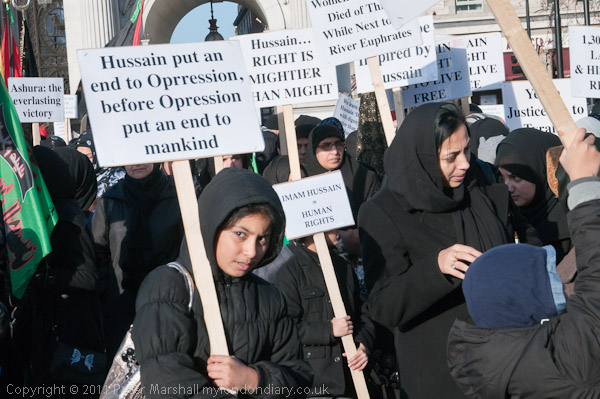
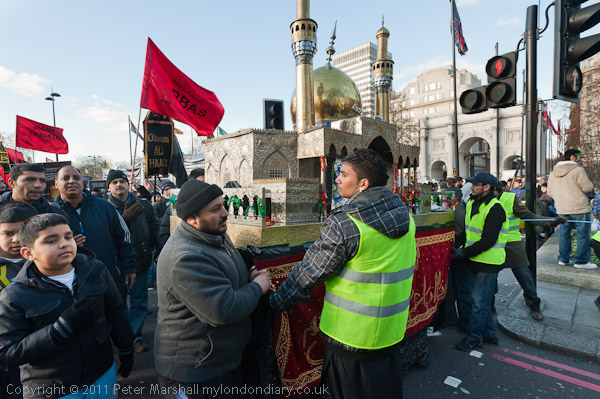
The paved area at Marble Arch was fairly crowded around the outside of all those at prayer, and as I walked around it I found relatively few opportunities for pictures. Two things that struck me were the many large flags this year, and also that most of the women seemed to have placards.
© 2012, Peter Marshall

There seemed to be less taking place at Marble Arch than in previous years, where there have sometime been various activities before the procession. This time there seemed only to be a few speeches after the prayers before it began.
© 2012, Peter Marshall

Photographically I was having problems with contrast. It was a beautiful sunny day with a clear blue sky and a strong low winter sun which seemed to send my camera metering haywire.  It doesn’t help that my normal reaction to tricky light is to work into it, probably because my first camera came with the advice something like “only take pictures on sunny days, and make sure that the sun is behind you” which Kodak used to give to Box Brownies, and I was ever contrary.

I wasn’t the only photographer having such problems, and another came up to me and told me all his pictures were getting ‘washed out’ and asked me what he should do. I told him to try some exposure compensation and got on with trying to sort out my own problems with rather less success.
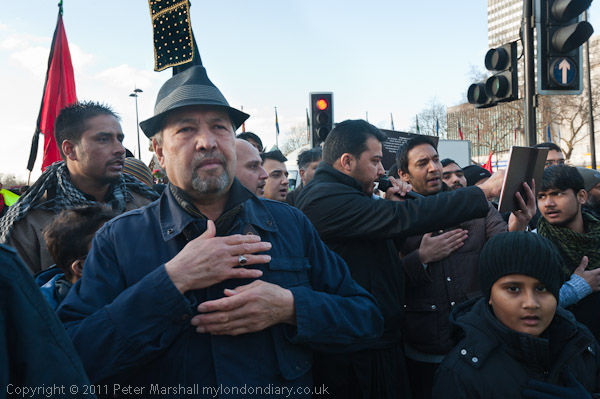
© 2012, Peter Marshall

I should have used flash fill, but there are some times when I think flash is just too obtrusive. Looking back I don’t think this was one of them, but for some reason I was reluctant to start using flash. And the pictures that I took suffered from it, some to the extent of being unusable.

Once the march turned into Park Lane, things got easier, as the sun was now coming over my left shoulder. I did manage to slip and fall slightly painfully getting down from the fairly low barrier at the edge of the roadway, but otherwise things were pretty straightforward. Then I found a nice solid block of concrete holding a traffic light which took me up around 4 feet and was stable enough even for a balance-challenged person like me. Once you’ve found a spot like this, it is hard to leave it, even if there might be better pictures if you got down on the ground again and got stuck in.  Because if you get down, you are certain to see another opportunity for a picture from up there, but equally certainly someone will have climbed up and now be where you need to be.

I decided to stay there until more or less the whole of the march had passed by – and it was pretty slow moving, so I was stuck there for around 25 minutes. Probably the best pictures were those with lots of flags and standards, such as this:
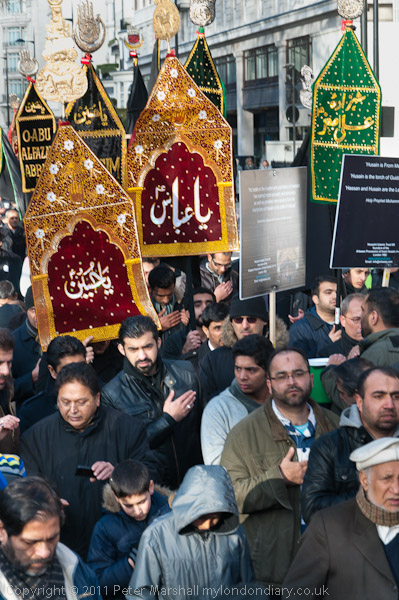
© 2012, Peter Marshall

or this of the women’s section:

© 2012, Peter Marshall

but certainly I was pleased to get down and photograph from somewhere where I could move around and select my viewpoint.

In some ways the most important aspect of the event in the beating of breasts in an expression of mourning, certainly in the more vigourous manner it is carried out by some of the groups of mainly younger men, who had by now stripped to the waist.

Most of the pictures I took where in an area where the central grass reservation is a couple of feet higher than the roadway, so I was able to look down on the men. But this wasn’t quite high enough, and also not quite close enough, so most of these images were taken holding the camera high andstretched out in front of me at arm’s length, using either the 16-35mm on the D700 or the 10.5mm semi-fisheye on the D300.

Sometimes the 16mm view worked quite well:
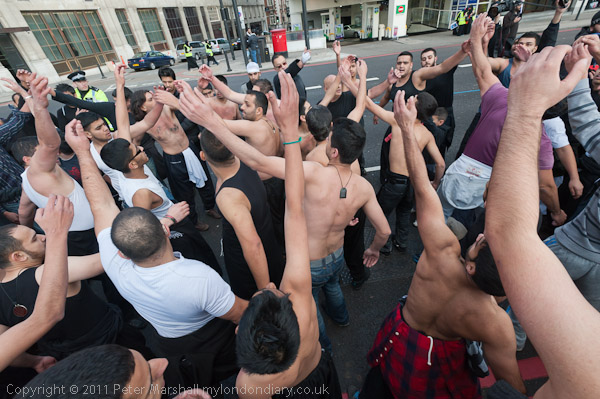
© 2012, Peter Marshall

but generally I prefer the images from the 10.5 mm, some of which are slightly corrected and some also cropped.
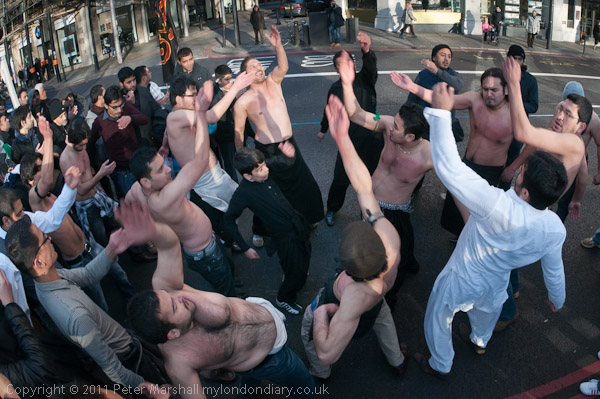
© 2012, Peter Marshall

The story and more pictures are on My London Dairy: Arbaeen Procession in London

________________________________________________________

My London Diary : Buildings of London : River Lea/Lee Valley : London’s Industrial Heritage

All photographs on this and my other sites, unless otherwise stated are by Peter Marshall and are available for reproduction or can be bought as prints.

To order prints or reproduce images

________________________________________________________
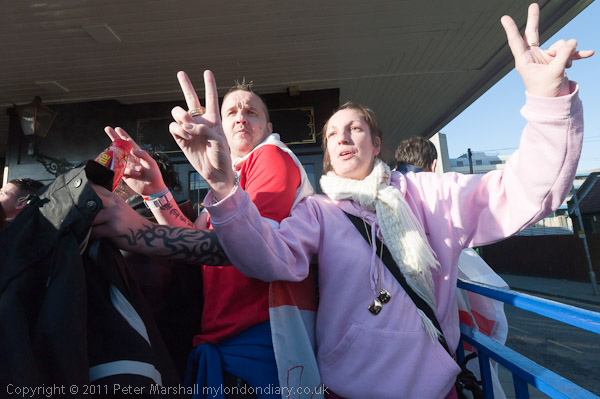
EDL Again

© 2012, Peter Marshall
EDL supporters outside the pub before the march in Barking

I didn’t have any great problems photographing the EDL march and rally in Barking on Saturday, although at times the atmosphere was a little tense. There were a number of people who I’ve met and photographed before at the event, including at least one who often reads My London Dairy, and thanked me for my reports of events.  The EDL and right-wing (or as they prefer to be called ‘patriotic’ groups are very suspicious of the press, and while I was taking pictures several people did ask me who I was working for and what happened to the pictures, including the woman in the picture above.

I told her I was freelance and that the pictures would appear on Demotix and My London Diary, and possibly also in other newspapers, magazines and books. And as I always do, I said that I thought it was important to try and report such events accurately, trying to faithfully represent the views of the groups concerned (in this case both the English Defence League and Unite Against Fascism who were holding a counter-protest) but that also I would state my own opinions, and that I had different views to the EDL. She agreed with me that this was a free country and that we were entitled to have different views.

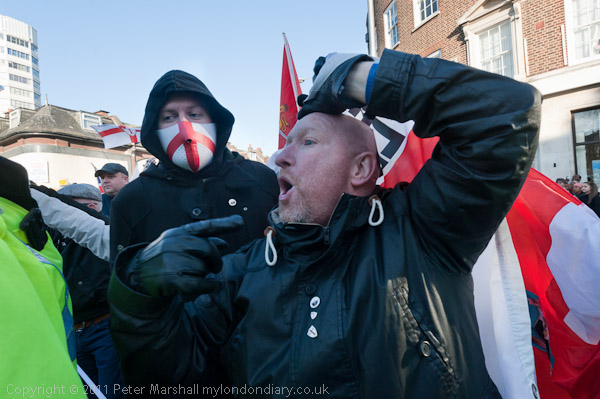
© 2012, Peter Marshall
EDL marcher shouts and gestures at UAF counter-demonstration
I think that the EDL (and other groups) deserve a fair and accurate press, although that certainly does not mean glossing over their activities. Those who don’t like what they say and do need I think to start by trying to understand what has led to their appeal to certain groups in our society.

Friends on the left sometimes tell me that I’m “too easy” on the EDL, while shortly after publishing my article about this event I received, not for the first time, a threatening e-mail.   Rather more pleasing are the various positive comments that I’ve also received about both pictures and text. But I think it says a lot about the kind of way the EDL thinks that one of their supporters writes to me “you better hope you dont get noticed next time ur at a demo….

Of course it isn’t the first time I’ve received such threats after covering their events of right-wing groups, or even during them. And many organisations do have their lunatic fringe, but it does seem rather more than a fringe with the EDL, although there are also others in the organisation who do believe in such English values as tolerance and fair play – and who I’ve at times been grateful for protecting me from harm.

I did get just a few very negative comments while taking the pictures, and there were a few people who obviously tried to avoid being photographed, something I find strange behaviour at a protest, which is surely all about getting publicity. Of course some people – both on the right and anarchists – wear masks to hide their identity, particularly if they intend to break the law. The police FIT teams (and there were a couple photographing at Barking) may object, and sometimes police force protesters to unmask, but most photographers actually find people with masks make more interesting pictures!

My pictures and the text show the EDL as they are and how they appear to other people. If they don’t like that, they should change how they behave rather than blame the photographer.

© 2012, Peter Marshall
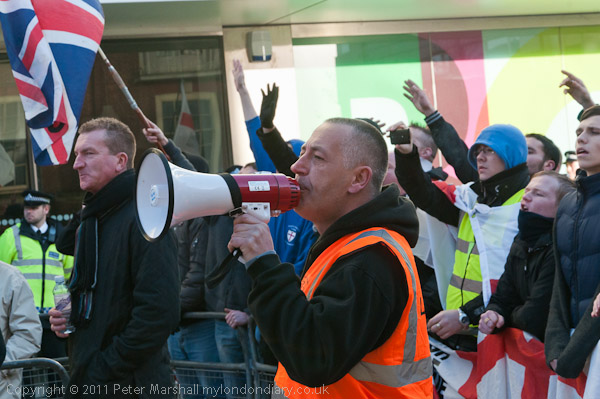
EDL wave at the UAF and call them racists

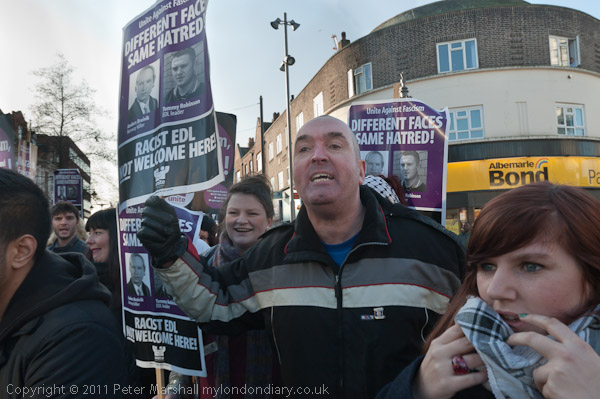
It was certainly very much easier to photograph the UAF who had come to protest against the EDL.

© 2012, Peter Marshall
UAF protesters react as EDL march draws close
One of the other photographers present did get rather more trouble than me, and at one point late in the day EDL stewards and police had to restrain one of the other EDL stewards who was attacking him.

Photographically things were fairly straightforward, and it was a fine day with good light. I’d thought a little about the event beforehand and had taken the 10.5mm out of may bag and replaced it with a Sigma 28-300mm (42-450mm equivalent on the D300), suspecting – as turned out the be the case – that I might some of the time have to work from further away than I like. I did use it for quite a few pictures, but the auto-focus is just a little slow compared with the Nikon 18-105mm which is usually the longest lens I carry, and the images aren’t quite as sharp. It doesn’t have image stabilisation either, but that wasn’t a great problem; in good light you can shoot at some very high speeds on digital as the D300 is fine at ISO800.

My account of the event and more pictures are on My London DiaryEDL March in Barking

________________________________________________________

My London Diary : Buildings of London : River Lea/Lee Valley : London’s Industrial Heritage

All photographs on this and my other sites, unless otherwise stated are by Peter Marshall and are available for reproduction or can be bought as prints.

To order prints or reproduce images

________________________________________________________
Homai Vyarawalla

I have to admit not knowing the name Homai Vyarawalla before I read today of her death at the age of 98.  She  had the distinction of being India’s first woman photojournalist, though most of her pictures were published under the name “Dalda 13”, according to Wikipedia chosen because she was born in 1913, married at the age of 13  and her first card had the number plate ‘DLD 13.

However in an interview for the Indian Frontline magazine she says that she first met her husband,  Manekshaw Vyarawalla, when she was 13, but they were not married until 15 years later (There is another good interview with her in The Hindu.) He was interested in photography, and she studied painting but became interested in the pictures he was taking and sending to the press. She began working with him, both in taking pictures and in the darkroom, and  when she was 25 or 26 took some pictures of the girls from her art school on an outing which were the first pictures taken on her own that were published. But many of her early pictures were taken when out with her husband when he was working on his stories, and she would grab his Rolleiflex to take pictures, which were then published under his name.

She became well known as a photographer during the war years, when both she and her husband worked in Delhi for the Far Eastern Bureau of the British Information Service and were also allowed to freelance for magazines. 

She took her last photograph – of Indira Ghandi – in 1970, around a year after her husband’s death. She left the profession partly because of the changing attitudes of photographers, who she felt no longer behaved with dignity and followed the rules, but also because of the increasing security that was making it difficult for photographers to work freely in the way she had been used to.

Not only was she the first woman to work in this field in India, she seems for many years to have been the only woman to do so, and it was only in the 1980s, a decade after Vyarawalla had laid down her camera, that a second generation of Indian woman photojournalists emerged.

A retrospective of her work was shown in 2010 , curated by Sabeena Gadihoke, and there have been numerous articles following her death, including in City Journal, The Hindu, and The Times of India.  You can watch a lengthy documentary about in which this remarkable woman talks at length, but is perhaps rather disappointing in showing little of her actual work.  Perhaps the best way to get a good idea of this is Google’s Image Search, where most of the black and white images on the first few pages are by her.

State of the Art B/W

I first came across the work of Jon Cone when he was making inks for Iris printers in the 1990s, although $150,000 price tag put me off using the system that he developed towards the end of that decade as ‘Digital Platinum’. When in 2000 he came out with his Piezography®BW software and inks for cheap desktop EPSON printers I immediately imported it from the USA and used it with an Epson 1160 fitted out with a continous inking system.

Prior to using it, I’d been reasonably happy with the colour prints I could make from this and other Epson printers using Epson’s own inks, but hadn’t felt that the black and white results were suitable for anything other than quick proofs.  Piezography was different, and I was (and still am) stunned by the subtlety of the results. In the 1980s and 90s I had worked with various methods of hand-coating to make photographic prints on watercolour papers, including kallitype, palladium and platinum prints. Now I could get the same qualities as these more or less at the push of a button, with perhaps just a little more richness and depth if I used some of the more expensive coated papers such Hahnemuhle’s German Etching (and later, Photorag.)

I was lucky to have few problems with Piezography inks, while some other users had frequent blockages of the printer heads. I’d recouped some of the costs by reviewing the system for the British Journal of Photography, so felt a little remorse when those who had taken up the inks on my recommendation had problems. Some were caused by a failure to properly close down the Epson printers, but I think there was also something of a matter of luck with Epson quality control. Good Epson printers parked their heads so they were sealed off, but Friday afternoon models didn’t and I think Epson had more than its share of Fridays.

The 1160 was a four ink printer, and Piezography replaced the cyan, magenta, yellow and black with a black and three shades of grey, as well as supplying a much improved printer driver (a Photoshop plugin) for black and white printing which used those grey tones to eliminate any visible “dottiness” in the prints, and I think improve detail. For ultimate results I think you needed to produce files at 720 dpi, while there was no point in going above 36o dpi with the normal Epson driver.

A couple of years later, Jon Cone produced some improved inks under the name Piezotone, and these were available in different grey tones. I went over to using the ‘warm neutral’ set, and when Cone was beta testing these for use with the Epson driver rather than proprietary software I was one of the beta testers. So prints made with my printer were pretty good, as the profiles had been fine-tuned to work with it.  Again some other users, thanks to Epson manufacturing tolerances, had slightly less good results.

Having been designed for my printer, the four ink Piezotones worked so well that I lost interest in the various improved systems being developed by Cone. Incredible though the K7 inks were, they would not work in my 4-ink hardware, and the gain in print quality seemed relatively small.

All my inkjet prints were matt, and I was quite happy with them. They had a quality that could not be matched on matt silver gelatin papers, which always had an inherent dullness to them, and matched that of the best non-silver prints (except for some carbon prints) but I still sometimes went into the darkroom when I wanted the different look of air-dried glossy silver gelatin, although once framed behind glass there was relatively little difference.

The next big change came with new fibre inkjet papers that promised to match fibre based glossy silver papers. Again I started printing on them with colour inks, using an Epson 2400, with great results.  Epson’s Ultrachrome K3 inks include 2 grays and a black, and can also produce pretty good black and white images using Epson’s own ABW (Advanced Black and White) option, which also adds a little coloured ink to make the tones neutral (or cool or warm as required.) ABW isn’t perfect, but usually produces better prints than I can in the darkroom, although some find their slight change in tone under different light  a problem.

I’ve also tried printing with the K3 inks without the colour inks using the Bowhaus RIP – and you can also do this with other RIPs including the Quad Tone RIP (QTR.)  Unfortunately this gives a slightly unattractive tone to the prints.

To get significantly better b/w prints (others have described those made using ABW as subtle and dramatic) I think I would need to invest in new hardware, at least if I want to keep the ability to make both black and white and colour prints, as 4 ink systems such as my two 1160s are no longer supported. The Piezotone inks I’m still very occasionally using (and are working long after their best-before date) are being discontinued in March 2012.

More interesting than my own experiences is Jon Cone’s The State of the State of the Arts in Black & White, in which he tells the story of his various ink developments, including  the “esoteric state of the art” system that he developed for Gregory Colbert‘s ‘Ashes and Diamonds‘ show, seen by more than ten million people.  The giant (8.5 x 14 ft) prints were produced by “a complex monochromatic methodology with twelve inks” using a Roland printer on Japanese hand-made paper sheets and each took 18 hours to print. Although this system isn’t one that could be marketed commercially, Cone used it as the starting point for his ‘Special Edition’ inks.

Even if you are not particularly interested in setting up to make your own fine black and white prints, the article is well worth reading for the insight that it does give into the work of some of those who have mastered digital printing, along with examples of their work. It comes too on a new website, ‘The Agnostic Print’ which has a number of other articles that look as if they will keep me busy reading for some time.

Time in Turkey

Thanks to Ami Vitale for posting on Facebook about ‘Time in Turkey‘, which includes work by some of the finest photojournalist from around the world who were invited to celebrate 25 years of publication by the daily newspaper Zaman by telling “stories in photos that reflect life and issues unique to Turkey from their particular points of view.”

The work is being put on site photographer by photographer, and at the moment Rena Effendi, Steve McCurry, Anders Petersen, Anthony Suau, Reza and Ami Vitale have their sets of pictures on line, so we  still have work by a very long list – Jane Evelyn Atwood, Bruno Barbey, Samuel Bollendorff, Eric Bouvet, Kathryn Cook, Claudine Doury, Carolyn Drake, Nikos Economopoulos, George Georgiou, Harry Gruyaert, Guillaume Herbaut, Ed Kashi, Massimo Mastrorillo, Davide Monteleone, Christopher Morris, Paolo Pellegrin, Gaël Turine, Michel Vanden Eeckhoudt and Vanessa Winship to look forward to.

The pictures from the project are also being published in the newspaper and displayed in shows around Turkey, and you can see some of the spreads and pictures of the shows on the news page of the site.

Ami’s pictures as always appeal to me for their clarity and warmth, and along with some rather amazing landscapes it is her pictures of people that I find move me most. I still have very fond memories of meeting her and hearing her talk in Poland some years ago, not to mention sharing pizzas at Alcatraz in Bielsko with her, Eikoh Hosoe and a few more photographers.

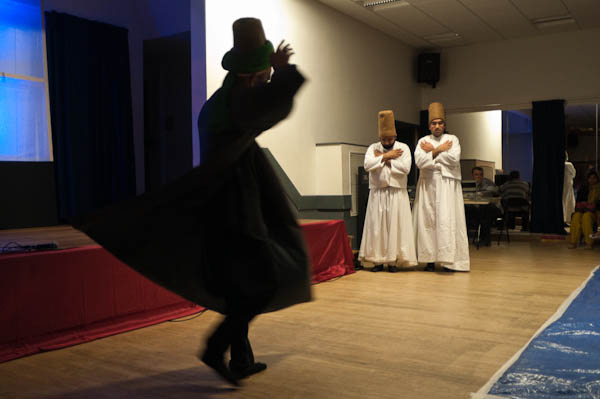
I also very much liked the set of pictures by Anders Petersen, perhaps a little more tender than some of his work. Rena Effendi has some nice pictures of people on the street and dancing, while Steve McCurry tackles whirling dervishes (a subject I’ve photographed a couple of times in Tooting!*) Anthony Suaa’s work I find more difficult to feel much empathy with, perhaps because of the kind of people and life he has photographed, dealing largely with the rich and successful, and I find it hard to see what he is saying about them although I admire some of the pictures. Reza’s long exposure blurs are perhaps just not my cup of tea, although sometimes it can be effective.

_______________________________________________________

*
© 2009 Peter Marshall
Whirling Dervishes from Lancashire perform in Tooting – Peter Marshall, 2009

________________________________________________________

My London Diary : Buildings of London : River Lea/Lee Valley : London’s Industrial Heritage

All photographs on this and my other sites, unless otherwise stated are by Peter Marshall and are available for reproduction or can be bought as prints.

To order prints or reproduce images

________________________________________________________
Bleak Housing 1978

© 1978, Peter Marshall

On a bitter cold but bright and sunny winter day in February 1978  I made the short trip of around 5 miles – a short journey on a suburban train and a few minutes walk – to take photographs on a public housing estate there. I’d often seen it from the train on my way into London, but had never stopped to visit before.

I’d known the area a little before and had family links. My mother had grown up in a house around half a mile away and her father had owned a shop on the nearby High St and later had been a market gardener just on the other side of the railway line. When I took these pictures one of his orchards was still visible, more or less surrounded by another recent housing estate, to the other side of the railway, and I had uncles and aunts who lived a short walk away.

Part of the reason for going to take these pictures was that I knew the estate was going to be redeveloped. Built I think in the early 60s it had been thrown up on the cheap using prefabricated units, and then used to rehouse ‘problem families’ because few people wanted to move out to Feltham. The area soon gained a terrible reputation, and became one to avoid.

A few years after I took these pictures, I went back to an adjoining area that was still standing, locked my bike to a lamp post and walked across the road to take a picture. As I turned around to do so I saw that already a small kid, perhaps around 8, was already hunting around inside the pannier I’d left on the bike, and I had to run back across the road and chase him away.  I wasn’t that surprised.

Looking back at my contact sheet, these pictures were virtually all I made there, along with a few very minor variants and one rather weaker overall view. Perhaps my favourite image was that at the top of this post, very much a graphic exercise in dividing the rectangular space into smaller rectangles.  It made those relatively small concrete slabs, perhaps each only around 2.5- 3 metres high, look immense, an effect I sometimes intensified by cropping the top and right of the image to remove the  top and right edges of that top right block, so that you could imagine them continuing for ever.

The feeling of immensity in part came from the framing and the position of the small windows of a distant building in the middle of the image, but also I think the path in the grass at the bottom played an important part. It was a kind of indicator of an absent human presence, but somehow one on which the figure my imagination supplied walking along it would actually be rather small.

It was an image I used in a small portfolio of my pictures published in a small magazine that year,  and also in a couple of magazines, as well as on the poster for a group show on urban life a couple of years later.

© 1978, Peter Marshall

This picture makes the estate feel a much friendlier place, although when I was taking it I thought of it very much as showing the estate as a cage, a prison for its inhabitants, this doesn’t really come across. Perhaps the neatness of the paths and those net curtains make it look too cosy. It’s also perhaps an image that reads too clearly in terms of space with the clear layout of the paths on the grass.

It somehow lacks the sinister which I felt I found in the next two images, both of which were for me visually dominated by that loop of rope at the top of the central post. I could only see it as a noose.

© 1978, Peter Marshall

There was not of course a body hanging from it. But I did find it spatially more interesting, and there was a kind of resonance set up within the image (at least for me) between visualising it in two or three dimensions. Almost as if those buildings were actually hanging on the foreground post rather than some distance behind.

© 1978, Peter Marshall

I tried to play a little more with that effect, moving slightly so that the post lined up more closely with the edge of both of the blocks, taking away the three-dimensional clue of the top corner of these cuboids, reducing them to quadrilaterals hanging from the post, like some odd signs.

It’s certainly a mistake to show both, because I think it reduces that effect. But I also rather like the first attempt, with the empty concrete rectangle at its centre split into two by the black line.

________________________________________________________

My London Diary : Buildings of London : River Lea/Lee Valley : London’s Industrial Heritage

All photographs on this and my other sites, unless otherwise stated are by Peter Marshall and are available for reproduction or can be bought as prints.

To order prints or reproduce images

________________________________________________________
34 Years On

Every so often I go back to the Herculean stable-cleaning task of scanning my early negatives. Since I’ve failed to to it in a single day it’s one I’m chained to for the rest of my natural. Or at least until the scanner breaks down.

At the moment I’ve reached 1978, a year when I was working full-time – with preparation and marking over 60 hours a week during term-time – at one of this country’s largest and most disorganised comprehensive schools. Most of my teaching was elementary science, but I’d also set up an ‘O’ level photography course, and there were various odds and sods that filled up my teaching timetable, on top of which like everyone else on the staff I lost much of what should have been preparation time covering for absent colleagues including a steady stream of those whose nerves had been wrecked by the job.

Nowadays most of the stress in teaching comes from Ofsted, but then it was mainly from the kids, and there were a few periods on my timetable where whatever the official designation, it was made pretty clear that so long as I prevented the kids from major vandalism or causing themselves or others grievous bodily harm I could do what I liked with them. Should I manage to teach them anything it was a bonus, and I think there were a few useful skills that I was able to impart about filling in forms, claiming benefits and the like. And if it was nice weather we’d go out for a walk, though that too had its problems.

© 2012, Peter Marshall

I didn’t often take photographs while I was at work, though I usually had a camera in my pocket, a Minox plastic folding clamshell thing, the smallest and lightest camera ever to use 35mm film, with a 35mm f2.8 lens and I think this picture, taken while I was on ‘break duty’ was made with that, though when I was teaching photography I would sometimes take in a Leica.

Some staff did break duty the easy way, taking a cup of tea to drink standing at one side of the yard and watching the kids kicking balls around, learning to ignore anything short of major insurrection. The more diligent (or stupid) of us ventured out into the peripheral areas of the fairly large school site, where mayhem of all sorts occurred (there were some schools where staff always picked up a walkie talkie for such duties, and we used to occasionally joke about picking up the AK47 as we left the staffroom, though I’d favour a blue beret. ) But these two youths are not really fighting, just indulging in a little of the horseplay that was the normal form of social intercourse amongst their group.

Possibly after photographing them (I took 3 frames, and the Minox was a pig to wind on, 2 strokes of a winder that sometimes took a great deal of pressure and  really bit into your thumb in cold weather) I went over and told them to take it easy, perhaps not. I did occasionally have to break up real fights, though fortunately these usually attracted other staff to help me deal with the large crowd that always formed around them. And once I did have to take a knife off a 12-year old who waved it at me, but that was in class. Fortunately he had no idea how to use it.

There are several reasons why I chose to photograph from behind. It clearly place it in the context of a school, with the playground in the distance, and the branches in the foreground seemed to add something to the picture. But most importantly I was thinking about the right to privacy of the two lads in this picture, who were probably 13 or 14 when I took it. Hard to think that they are now in their late 40s.
________________________________________________________

My London Diary : Buildings of London : River Lea/Lee Valley : London’s Industrial Heritage

All photographs on this and my other sites, unless otherwise stated are by Peter Marshall and are available for reproduction or can be bought as prints.

To order prints or reproduce images

________________________________________________________
Bhopal & The Olympics

© 2012, Peter Marshall

The story was about the Olympics and the campaign to get Dow Chemicals dropped as a sponsor for it because of their environmental record, and in particular for their refusal to take responsibility for the continuing poisoning of groundwater in Bhopal after the Union Carbide plant their was abandoned following the largest ever environmental disaster yet.

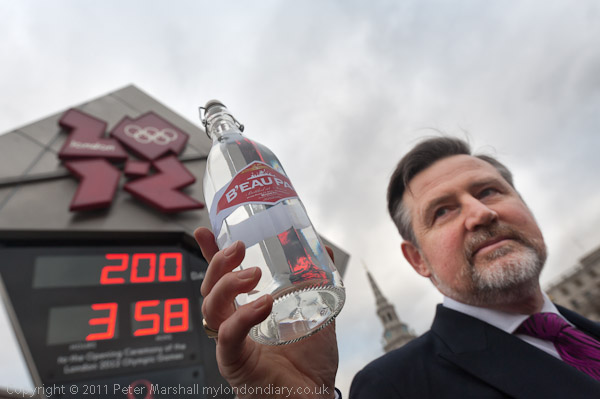
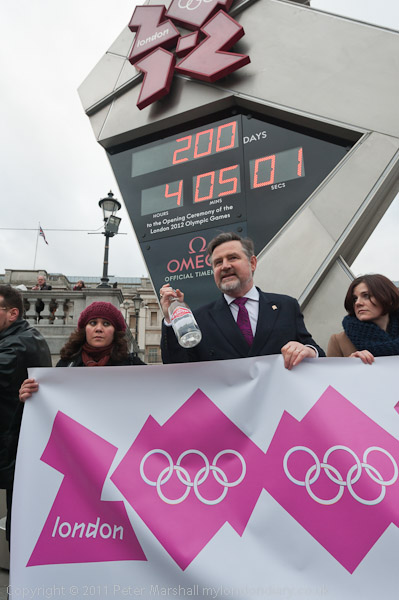
The Labour Friends of India had organised a ‘photo-opportunity’ to take place in Trafalgar Square in front of the Olympic clock exactly 200 days before the start of the London Olympics, with a banner reading ‘200 days to drop Dow’ in a passable pastiche of the Olympic logo and a bottle allegedly containing water from Bhopal with a rather nicely designed spoof mineral water label as ‘B’eau Pal’ water.

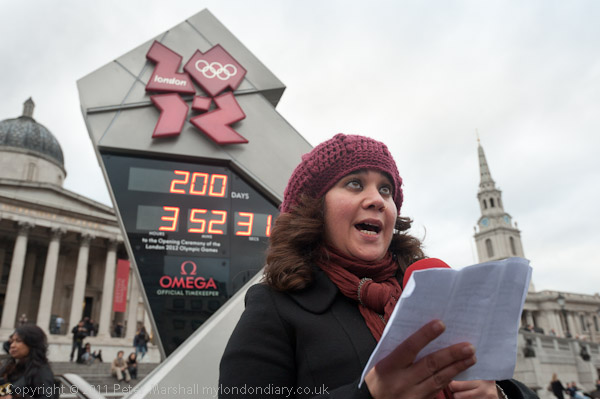
Holding this was Labour MP Barry Gardiner, and also present was a woman who had been in Bhopal at the time of the massive poison gas escape that killed thousands, including her aunt.  Also present, by the time things got underway were around 3o photographers and videographers, ensuring that there was something of a scrum, as well as several of the ‘Heritage Wardens’, the Mayor of London’s security staff who hadn’t known this was going to happen and were not too happy with it.

It was tricky to get anything just a little different in such a situation and I didn’t really manage it. A straightforward picture or two of the banner and people in front of the clock – perhaps this was the best:

© 2012, Peter Marshall

and several pictures of the MP with the bottle – here’s another

© 2012, Peter Marshall

as well as several of Bhopal survivor Farah Edwards, including some of her reading her speech

© 2012, Peter Marshall

were the best I could do in the circumstances. Perhaps I might have arranged something with a little more interest, but I don’t like to arrange things. I’ve not seen any of the pictures the other photographers got, but I doubt if they were very different.

Demotix were obviously very worried about running the story, perhaps because of the draconian legislation around the Olympics here, and their claims to own as trademarks things like London, 2012 and Olympics. I twice posted a comment to the story, but all that appeared was a message saying my comment was awaiting moderation. Two days later it still hasn’t appeared. I’ve never known comments being moderated before on the site, usually they have appeared immediately.

What I posted in the comment was simple history about  Dow Chemicals and their involvement in Vietnam, both producing napalm for use by US forces (and they continued to produce it after the other companies in the business had been persuaded to halt production) and as one of the companies producing Agent Orange, a dioxin contaminated herbicide which as well as killing the crops on which the rural population depended as an intended part of the military strategy also has resulted, according to the Vietnamese, in 400,000 people being killed or seriously maimed and half a million children born deformed because of its use.

Photographer Philip Jones Griffiths heard about the effects of Agent Orange, and returned to Vietnam to take pictures. He met with a great deal of cover-up – as he wrote in an introduction to his work on the Digital Journalist site:

In almost all cases I was denied access, usually by polite smiling nuns. At the risk of sounding paranoid I became convinced they had been told to keep the press away…  I left Vietnam in the summer of 1971 without ever seeing a victim.

After the war had ended he returned – and saw and photographed the full horror of the situation. The gallery of images on-line doesn’t make easy viewing and it is a history that for me makes Dow a totally unsuitable company to sponsor either the Olympics or the Paralympic Games.

________________________________________________________

My London Diary : Buildings of London : River Lea/Lee Valley : London’s Industrial Heritage

All photographs on this and my other sites, unless otherwise stated are by Peter Marshall and are available for reproduction or can be bought as prints.

To order prints or licence to reproduce images

________________________________________________________

Lightroom 4 Beta

I’ve not downloaded the beta version of Lightroom 4 now available from Adobe, because I’m getting on pretty well with Lightroom 3.6 and I’d prefer to let others discover any problems – and hope that Adobe will sort them out by the time of the official release “in early 2012.” It does sound like they have made a number of significant improvements, particularly for me to the “basic tonal adjustment controls” which they claim “extract the entire dynamic range from cameras for stunning shadow details and highlights” as well as “additional local adjustment controls, including Noise Reduction, Moire and White Balance.

Some will also find the new abilities with video useful, though I’m still trying hard to avoid working with video; though I do recognise it has its uses, I find it rather frustrating and limiting, perhaps because I’m so used to thinking in terms of still images.

I don’t make a great many prints, though I have just started making the occasional one from Lightroom, and the new ability to ‘soft-proof’ should help, though I’ve never found it entirely satisfactory in Photoshop.

But if there are any photographers using digital out there who haven’t yet discovered what Lightroom can do for you, this is a good opportunity to work with the software for a decent length of time for free.  Photoshop is still useful, particularly for working with the scans I’m still making from film, but Lightroom does much more for my digital images, and does it much faster and more intuitively than Photoshop ever did.

Almost the only thing I still need Photoshop for when working with digital images are one or two plugins, particularly one I like for sorting out fisheye images. Lightroom can convert them to rectilinear perspective (which is very seldom what you want) or do a partial conversion which is generally more useful, but I often prefer the Fisheye Hemi conversion.

Lightroom takes a little getting used to, and I still find myself having to look at the help at times, but mostly I find it more intuitive than Photoshop. You can work on images with the local tools and not have to bother with layers. Lightroom stores your original files and doesn’t mess with them, and when you work with files you are creating lists of commands to be performed on the original. When you need actual files to be output, these commands are run and the resulting files produced, and you can set up presets with the file size, quality, profile etc you need for different purposes – full size high quality jpegs SdobeRGB to send to libraries, medium size sRGB files for projection, small sRGB jpegs for the web, with or without watermarks etc.

Presets are simple to understand and greatly cut down the time it takes to do what you need. They also make sure you get things right and don’t forget things. Much of what we have to do is repetitive and presets will do it for us.

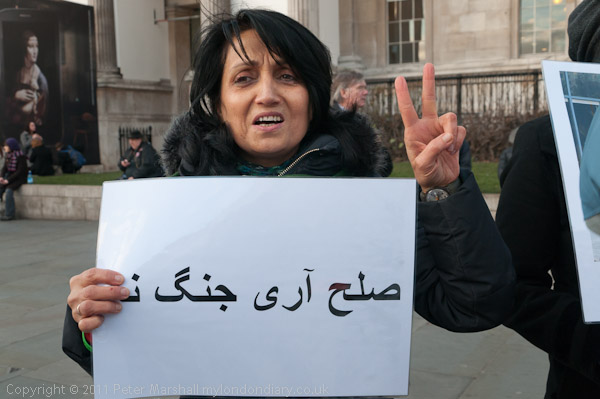
Lightroom works best for photographers who don’t mind getting their files organised.  So Lightroom automatically backs up my work as I bring it from card to computer, and automatically changes file names to give every image a unique name.  I think the best way to keep track of stuff is to use the date as the first part of every file name, so this image, taken last Saturday, gets a name that starts 20120107.

© 2012, Peter Marshall

Using the date ‘backwards’, yyyymmdd means that files will sort in proper order in any folder. Its full filename is 20120107-d0528 and the original RAW file has filetype .NEF while this version is a .jpg file.

Lightroom lets you store images in a systematic way – ordered by year, month and day – and then set up collections that order them in ways that make sense for you. So this particular image might be in a collection called ‘gestures’ and it could also be in another collection called ‘Iranian’ and another called ‘Trafalgar Square’ or whatever that represents how you want to classify images. You can also use keywords or any metadata to find groups of images.

And as you may be able to see, you can also put a watermark with the wrong year in it on your images. I did make a watermark file for 2012, but I’d changed back to the earlier one to write out some files from last November and had forgotten to change back.

There are some useful plugins for Lightroom, though these are different to Photoshop plugins. One cheap and useful one that I wouldn’t be without is Jeffrey Friedl’s Metadata Wrangler, strictly a ‘post-process filter’, a donation-ware program. And I’m pleased to read that this still works with Lightroom Beta 4, though it may cost a cent (or more if you wish) to upgrade.

Bikes Alive & Nikon Flash

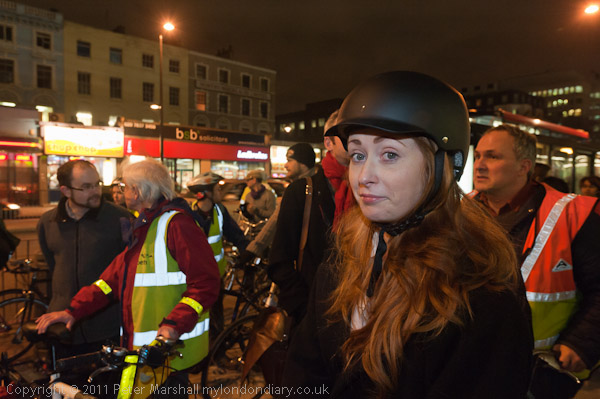
© 2012, Peter Marshall

Or perhaps I should have called this things I should have remembered on Monday night with Nikon flash. Some of the results weren’t bad, but I could have done a lot better, and found myself much of the time pressing the shutter release with nothing happening, because the camera was failing to focus, and I couldn’t work out why the focus assist illuminator wasn’t working. Two minutes and a quick check of the manual when I got home and I was kicking myself.

© 2012, Peter Marshall

I’d set Custom setting a9 AF-assist illuminator to ON, but had forgotten that this only works when the focus mode is set to S (single-servo autofocus) AND you are either focussing on the central focus point or using Auto-Area AF.

Without the illuminator, focus with the 16-35mm in low light is pretty tricky as I found, and I have the camera set (CS a2) only to take pictures when in focus. So I spent a lot of time pushing the release and nothing happening.

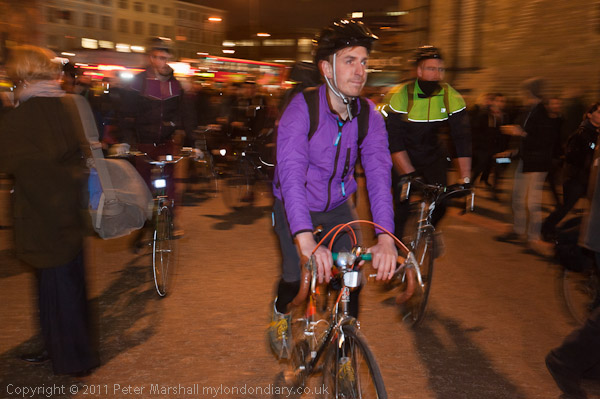
The other slight problem was that I had taken a picture at the start of the evening using Aperture priority, and although I had changed the working aperture back to f4 (wide open) I had forgotten to change the exposure mode back to S. Which means that the camera was adjusting the shutter speed to some quite long values to get correct exposure (or rather the selected -1 stop exposure) from whatever ambient light there was.

© 2012, Peter Marshall

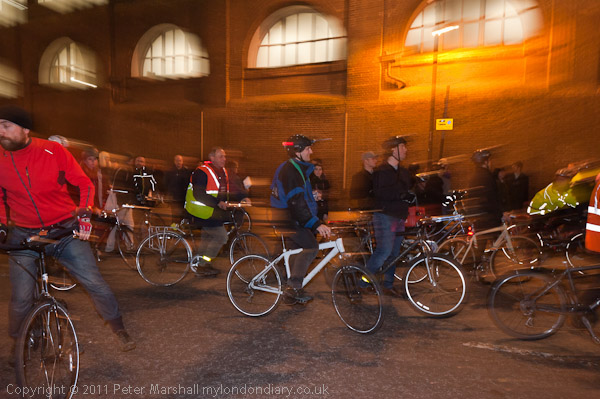
Generally it works better to set Shutter Priority, selecting the slowest speed that is suitable given the subject and ambient lighting. When you move into a darker area the flash to ambient ratio will change, giving a darker background, while the closer areas lit by the flash will stay more or less the same.

© 2012, Peter Marshall

You can read about the protest and see more pictures in Bikes Alive – End Killing Of Cyclists on My London Diary.
________________________________________________________

My London Diary : Buildings of London : River Lea/Lee Valley : London’s Industrial Heritage

All photographs on this and my other sites, unless otherwise stated are by Peter Marshall and are available for reproduction or can be bought as prints.

To order prints or licence to reproduce images

________________________________________________________