Country Doctor

Gene Smith‘s ‘Country Doctor’ was instantly recognised as a major achievement when first published in 1948 in Life, though had he been alive and working now he would have been lucky to have got more than 3 or 4 pictures in print. The Life Classic feature shows the 28 that made up this essay, and elsewhere another 11 that didn’t make the cut.

It’s certainly good to be able to look back at one of the great classic photo-essays on line, though perhaps a pity that they don’t show the page spreads as they were published.

Thanks to NPR for pointing me to this feature from their own Revisiting ‘Country Doctor,’ A 1948 Photo Essay though I’m surprised that they decided to put their own set of a few images from it in the article rather than linking to the full (and better quality) set at Life.

Yesterday I visited the  MA Photojournalism and Documentary Photography Final Show 2011 at the London College of Communication at the Elephant and Castle, entitled ‘Neither Snake Nor Lizard‘ which is supposedly open until Saturday, although unfortunately a few bits have already disappeared.

Probably the most impressive parts I could see were some of the books that the photographers had produced (using Blurb etc), along with one or two on-screen presentations. Other than those (and the videos may be on line) you are better off viewing the web sites of photographers that are linked from the show site. And certainly some student’s work did look better on screen than in the prints on the wall. This is perhaps as it should be, because if there is any outlet at all for documentary work it is probably either as books or as on-screen presentations. And photographic books as I read somewhere earlier today (and can’t remember where or the exact quote) are more of an “organised hobby” than a career option.

The work that I felt was strongest was almost entirely that which was more obviously documentary, whereas despite the course title some of what I saw seemed to lack the kind of purpose and clarity which is at the essence of the genre (and arguably of the medium as a whole.)  I did begin to wonder at times whether the course had been designed to divert photographers from documentary rather than nurture them in it, and certainly some looked more like commercial or fine art photographers (which will make it easier for them to earn a living!)  Fortunately they seem to have failed at least with some of the students and there was some work which showed the kind of dedication to the subject which might have gladdened Smith’s heart.

Free Shaker Aamer – A Plague of Photographers

On Saturday I went to photograph a protest marking 10 years of illegal detention in the US prison camp at Guantanamo Bay which was taking place on the North Terrace of Trafalgar Square. I’d put this in my diary some weeks earlier, having been given a flyer about it by one of the organisers, who had also sent me several press releases. I’ve photographed other related events over the years, sometimes being the only photographer present and more often with just a handful of others, though a few have been high profile media events.

© 2012, Peter Marshall
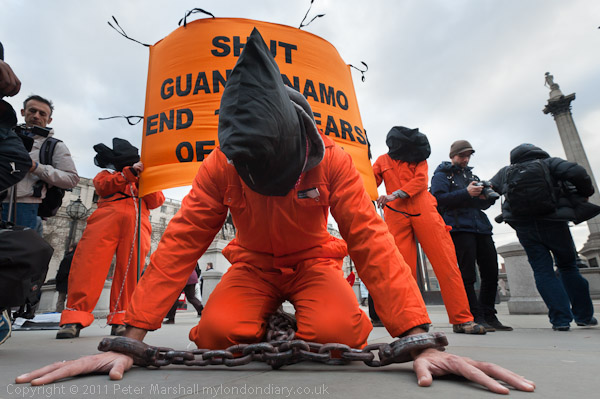
Shut Guantanamo – End 10 Years of Shame

I wasn’t pleased to receive an e-mail the day before the event which had been sent by an Editorial Assistant at Demotix, one of the on-line sites where I submit images and stories giving details of the event and begging photographers to cover it, because I knew that this would mean the event being swamped by people with cameras, and it was. In my account on Demotix I estimate the number of people present at the protest at around 200; what I didn’t say was that over a third of those were there to take photographs. Possibly they even outnumbered the protesters.

© 2012, Peter Marshall
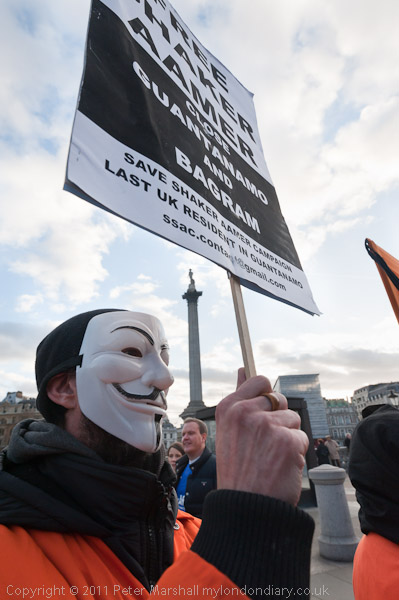
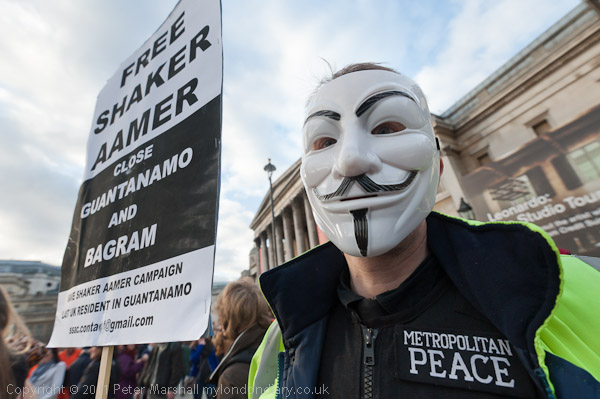
Free Shaker Aamer – an ‘Anonymous’ protester in a ‘V for Vendetta’ mask and ‘Metropolitan Peace’ uniform

Don’t get me wrong. Anyone present with a camera has as much right to be there and take pictures as I do. But among the photographers I met there were at least a dozen of us who regularly send pictures to Demotix, including some whose work is generally as good as anyone working for the press or conventional agencies (and a few of them were present too.)  Demotix would have had far more pictures than it needed without sending out the request. And almost certainly it would have had better pictures, because the crowd of photographers it had been partly responsible for generating made it difficult for all of us to work. It does seem to be shooting itself (and certainly its more regular photographers) in the foot.

© 2012, Peter Marshall
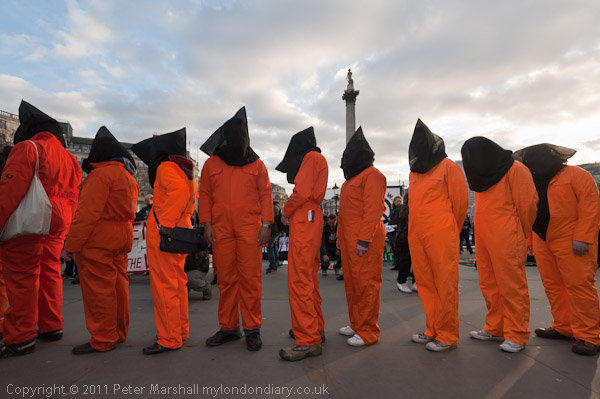
The line of ‘detainees’

The excessive number of photographers did not only make it difficult for us to work, with other photographers constantly walking into pictures as we were taking them (and I’m sure I walked into other people’s pictures – and a couple of times I realised I had done so and apologised) but also made the event less satisfying for those taking part.  One elderly woman grumbled to me “why do cameramen think they are more important than the rest of us” as I tried to get out of her way after taking a few pictures of one of the speakers, and I didn’t stop to enlighten her as I was busy working. Of course I try to disrupt events as little as possible and to keep out of people’s way as much as I can (although I admit some others are rather less careful) but in the end I have a job to do, and doing it badly would help no-one.

© 2012, Peter Marshall
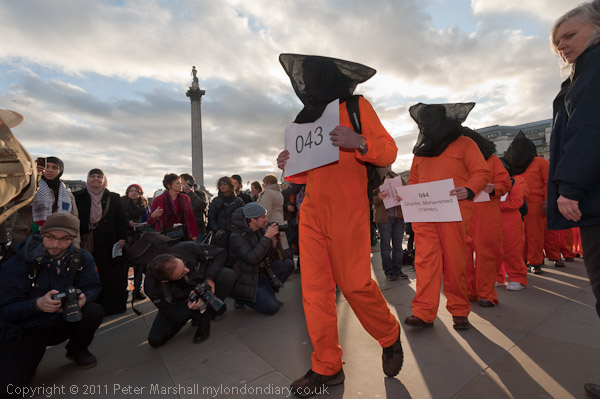
Photographers, protesters in orange jumpsuits with Guantanamo prisoner numbers and Nelson

Of course ‘cameramen’ – and ‘camerawomen’ of whom there were quite a few present  – are vital to events such as this, whose purpose is to gain publicity for the cause.   So I was sent a ‘media release’ (also on-line) which told me about the ‘Photo opportunity’ when ‘activists dressed in orange jumpsuits and black hoods will perform a visual display representing the 171 prisoners who remain at Guantánamo.’

© 2012, Peter Marshall
Free Shaker Aamer – a Londoner still in Guantanamo after almost 10 years

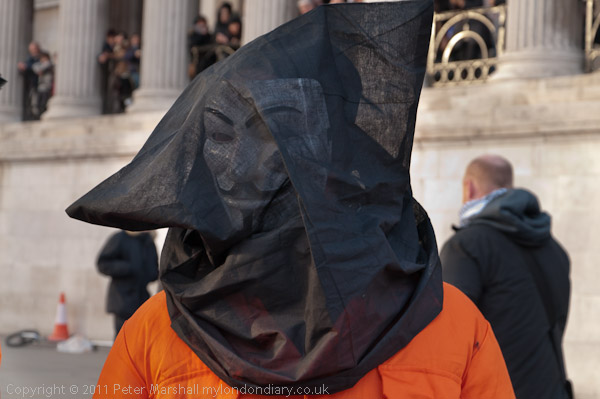
Photographically – apart from avoiding other photographers filling my frame and a few problems with exposure, particularly in some of the close pictures – if a black hood more or less fills the frame you do need to think more about exposure than the time allowed, as auto systems increase the exposure to make it mid-grey.  Then there was the problem of just how transparent you want those black hoods to appear – and Lightroom does sometimes make it possible to show rather more than could actually be seen.

© 2012, Peter Marshall
Anonymous ‘V for Vendetta’ Guy Fawkes mask inside a black hood

I also wanted to make clear exactly where the protest was held, and for most of the pictures chose to include either Nelson up there on his column, or the fairly recognisable portico of the National Gallery. And yes, quite a few of my pictures I did reject because they had photographers or parts of them in the wrong place – at times it just was not possible to avoid them when taking the pictures.

As I’ve remarked before, I’ve photographed quite a few events related to the illegal detention of prisoners at Guantanamo, and for some of these I have been either the only photographer taking pictures or one of a small group. Unlike most photographers, I almost always get my stories and pictures published somewhere, even if I have to do it myself here or on My London Diary. It’s a shame that few of them make the mass media, but even my own sites have a larger readership than many small publications. I started My London Diary in part because so much that was happening in London, and protests in particular, were ignored by the conventional media.

The focus of the rally was a call for the release of Shaker Aamer, held initially in Bagram and then at Guantanamo, imprisoned without trial and tortured repeatedly. He was cleared for release by the US military in 2007, and by Obama’s administration in 2009 but somehow remains held there, probably because of the embarrassment his testimony after release would cause to the US. A London resident who went to Afghanistan as a humanitarian worker, he has a British wife and four children, including a son aged 10 who he has never seen who live in Battersea, south London. There are grave concerns for his physical and mental health.

The protest also called for the Algerian detainee Ahmed Belbacha, who lived in Bournemouth from 1999 to 2001, shortly before his detention, to be allowed to return to the UK. He was also cleared for release by the US military in 2007 but cannot be released to Algeria because the threat to his life.

My story and pictures in Shut Guantánamo: End 10 Years of Shame on My London Diary.

________________________________________________________

My London Diary : Buildings of London : River Lea/Lee Valley : London’s Industrial Heritage

All photographs on this and my other sites, unless otherwise stated are by Peter Marshall and are available for reproduction or can be bought as prints.

To order prints or licence to reproduce images

________________________________________________________

Hard Disk Data Rescue

As I write, I’m copying files from a hard disk in one of my dead computers across to my new machine. Probably most if not all of the images are somewhere on a backup CD or DVD, but it is rather handier to have them more easily available.

Unless you are a geek rather than (or as well as) a photographer, you may not know that it is usually easy to recover files from hard disks. Even if the computer refuses to boot from the disk it will probably still be working and if so almost certainly still contains most if not all of your files. Of course I knew that police or military intelligence or expensive data-recovery services could get you work back. And I thought I could probably fit the old disk into a new computer (so long as it had the right kind of connectors.) But what I hadn’t really realised was how easy and cheap it was to simply transfer the data.

The tiny bit of gear I bought is a ‘USB 2.0 to SATA Hard Drive Kit + Power Adapter‘ and cost me £12.95, and can transfer from 2.5″ and 3.5″ IDE and SATA drives to a USB port. It comes with various connectors and also a power supply with various connector types. Finding the right ones to get a power and data connection to the hard disk took a couple of minutes as I couldn’t be bothered to remove the drive from the system unit and it wasn’t easy to see inside the box, but other than that it was simple.

If I could be bothered to undo a few screws (and I may in time) I could simply remove the old drive from the machine and slot it into a ‘Smart Dock’ which cost just a few pounds more, and I may do so in time. I did wonder if this might be a sensible alternative to the growing line of external hard drives on the desk to my right, but at the moment it seems to be slightly cheaper to buy these in sensible capacities that bare hard drives.

Something that most photographers possibly know is that if police or security grab your camera and delete images or even format the card in your camera it doesn’t really remove your images. You should also know that they have no right to do so, or to ask you to do so in the UK, but unfortunately  too many don’t know the law or chose to ignore it. If you are a journalist (and a UK press card will evidence this) they don’t even have the right to look at the images without a court order. So long as you take no more pictures on the card, the files will still be there and can be recovered on your computer using rescue software such as Sandisk Rescue Pro.

There was a rather unexpected bonus to unplugging one of my hard drives. After I’d finishing copying a hundred GB or so from it I shut it down, unplugged the USB lead from the other computer and the power supply lead from the transformer and then thought I’d just try starting up the old machine again. After sitting there useless for around a month (my IT technician who had rebuilt it has been having other problems) it started up without the slightest hiccough, although as well as the drive I had removed, another is not yet accessible. If I can work out which it is I’ll try connecting that up with the . That still leaves two rather large working drives and gives me access to a lot more files without having to find off-line backups on DVD, CD or currently unconnected external drives.

It’s also the machine into which my film scanner is plugged, and assuming it keeps on working, it means I can return to the slow business of producing  high res scans my ancient negatives with the Minolta Multi-Pro.

________________________________________________________

My London Diary : Buildings of London : River Lea/Lee Valley : London’s Industrial Heritage

All photographs on this and my other sites, unless otherwise stated are by Peter Marshall and are available for reproduction or can be bought as prints.

To order prints or licence to reproduce images

________________________________________________________

Dinosaur Bones?

I’m very much a fan of A D Coleman. Like him (and I hope he will not take offence at my simplistic reduction of views which he expresses so eloquently and in detail in the essay  ‘Dinosaur Bones: the End of Photo Criticism‘*) I subscribe to such antediluvian views that photography critics should know something about photography and actually take a good look at photographs if they want to say anything of value.

Dinosaur Bones is an essay well worth reading and thinking about and indeed discussing, and again I have nothing but admiration for the fact that Coleman decided, despite previous bad experiences, to take part in four on-line discussion groups which had expressed some wish to examine his ideas.

In the two most recent posts on his blog (Forumization and Its Malcontent (1) and Forumization and Its Malcontent (2) – a series to be continued) he addresses some of his dissatisfactions at that experience, which as he states, confirmed his earlier thoughts:

“However, I do want to note that, a decade-plus later, the lessons of 1999-2000 got confirmed: (a) forums inevitably descend to the level of the lowest common denominator of their participants, and (b) forums can suck up energies more fruitfully expended elsewhere, easily turning into rabbit holes down which you disappear.”

As someone who has taken part and still lurks in several such forums (only fora if you are an ancient Roman) these are truths I hold to be self-evident. That does not mean that these forums are of no use, but rather that you need to approach them with care and retain a certain emotional distance. It seldom takes long to decide which of the participants are worth listening to and on what, and that there are discussions best ignored or where having once firmly stated your point there is little to be gained from continuing an argument with the ignorant and obtuse.

Some of those lowest common denominator participants, even those who  have played leading roles in self-aggrandising flame wars, perhaps even the person who Coleman describes as “an equal opportunity bully” and a “loose canon” are those who actually get things done outside of the forum in the real world, often acting as a catalyst for others. Their bad behaviour on-line has sometimes been a misplaced application of a real passion for the subject, an enthusiasm to communicate this to others – and in some cases a pioneering mastery of some aspects of the subject of the forum.

Certainly there are some people who are just not good forum participants, and Coleman is probably one of them. A basic qualification is the ability at times to sit on your hands and not press the reply button. But in this particular experience it would not be fair to blame him in this respect, as he had been invited or persuaded to take part in discussions on his article.

Equally there are also people who take part willing to share, sometimes in great detail, their own practices, and to give information and advice when asked. These people are a great resource and it is not that difficult if you follow a forum for some time to sort them out from the know-all muppets (though it is a distinction many people fail to make over some equipment reviewers.)

Although I share many of Coleman’s thoughts about the act of criticism and particularly of photo criticism, I come to it from a different place. I have never thought I would be able to support myself as he has by criticism, although for a period of seven years it was a significant part of my writing about photography that did supply much of my income.

I started writing about the shows I went to as a personal diary in the 1970s, more or less as soon as I had the time to pursue a serious interest in photography. I felt then as I still do now that a study of the work of others, both historic and contemporary, was essential to my own intelligent progress as a photographer.

It always begins for me with an engagement with the image, whether standing in front of it on an exhibition wall, sitting at home with a book or looking at a computer screen. Of course it doesn’t stop there, but the actual images have to be at the centre of photographic criticism.

Surprisingly, very few people who have become well-known as photography critics or review photography shows in the mass media seem comfortable with thinking about images (Coleman is of course once of the exceptions.) It doesn’t surprise me to find that Susan Sontag, the writer of possibly the most widely read book which is on every college photo course reading list, ‘On Photography’ later said – as he quotes (at greater length) “I’m not a photography critic. I don’t know how to be one.”  I read the book when it came out, and my copy was soon covered in my scribbles on her failure to know or understand our medium. It was a good TV programme, full of nice effects and half-truths but little substance.

As Coleman later says, post-modernist critics have concentrated “on a small roster of photographers and artists using photography — Jeff Wall, the Bechers and their students, Barbara Kruger, Richard Prince, Cindy Sherman, Andres Serrano, Alfredo Jaar, Laurie Simmons, Robert Mapplethorpe...” at the expense of “much wider range of significant work, past and present.” I think it is a shared lack of a real knowledge of the history of the medium that lies at the root of this. And I also think that some of those on the approved list have contributed little or nothing to photography, as I’ve at times made clear on this site.

Dinosaur Bones‘ deserves a much longer study and discussion than I’ve so far given it, and certainly deserves a careful reading by all those with an interest in photography.

In it Coleman points out he was an early adopter of digital technology, like me publishing his first web site in 1995. He has gone to such recent productions as Pepper-Spray Cop: The Lt. John Pike Saga, first in a series of Kritikomix, as well as in his satirical alter-ego The Derrière Garde‘s  Megyn Kelly’s MK-9 Pepper Spray for Kids! which frankly I wish he hadn’t. He promises a video and a podcast of Dinosaur Bones for later too which will probably be of more interest.

In 2011: That Was The Year That was, Coleman publishes an impressive review of the year, which he begins by saying that the ‘Photocritic International‘ in 2011

“had served at least 200,000 pageviews and perhaps as many as 2 million since its premiere in spring 2009. (This unclarity results from divergent reports from several different site analysis programs.) Even at the low end of that estimate, it remains the most widely read blog by any critic/historian of photography.)”

Not a bad record, but the annual figures for this >Re:PHOTO blog which I’ve just checked after reading this are significantly higher for 2011, with over 600,000 total visits and over 1.4 million page impressions.  My other main site, My London Diary, got around 800,000 page impressions and the total for all my sites (including a few small non-photographic ones) was over 3.2 million. But then I’m primarily a photographer rather than a critic, and perhaps all this shows is that photography is more popular than criticism. If so, it’s probably healthy.

At the moment I get no direct income from any of my work on my own web sites, including this, and though the occasional sale of a print or repro licence probably more than covers the actual costs it doesn’t begin to pay for my time. At the time I began writing this blog I was writing for money on a site where adverts sometimes seemed to me to dominate the pages and I deliberately set this up – as my previous web sites had been – as an advert-free space.

Lately I’ve been wondering about adding a donations button or more probably a link to a donations page to these pages, or perhaps a Flattr button or some other way to generate a little income. I’d be interested in any comments on that either here or by email. For the moment I’ll perhaps just start adding a little advert for my own work at the bottom of my posts, something like this:

________________________________________________________

My London Diary : Buildings of London : River Lea/Lee Valley : London’s Industrial Heritage

All photographs on this and my other sites, unless otherwise stated are by Peter Marshall and are available for reproduction or can be bought as prints.

To order prints or licences to use images

________________________________________________________

* the text of a lecture he first gave at the Hotshoe Gallery in London on November 8, 2011 which I unfortunately missed.
Eggleston – Early Colour

The unseen chromes of legendary American photographer William Eggleston gives an interesting second view of his early work. Eggleston took 375 transparencies to show John Szarkowski at MoMA which he selected from a collection of around 5000. Szarkowski cut the number back to 75 for the  seminal 1976 ‘William Eggleston’s Guide’ and reduced that number still further to 48 for the exhibition catalogue.

Thomas Weski has gone back to the roughly 5000 Kodachromes (there were a few Ektachromes and Agfachromes in among them) which Eggleston made between 1969 and 1974 and together with the photographer selected a further 364 images which have now been published by Steidl in a 3 volume collection aimed at wealthy collectors (UK £220.00, US $345.00, EC €248.00), Chromes – you can see around 14 pictures on the Steidl site and rather more here.

Mark Holborn wrote an introduction for Eggleston’s book ‘Ancient And Modern‘ which mentions perhaps his most famous image, Red Ceiling, which most will be familiar with. The final image of the slideshow on ‘Wallpaper’ linked above, the blue volume of the three, came as something of a surprise.

RIP Kodak?

Load the BBC World service ‘Newshour‘ for  05/01/2012(2100GMT), click on ‘Listen now‘ to load the player and  then drag the slider to 49.07 and you can hear a short piece with Graham Harrison (look at the 10 pictures on Kodachrome 64 pushed one stop) talking about the history and demise of Kodak.

The gist of what Graham says in this short interview is in his blog post ‘Kodak’s Last Frame?‘ in which he comments on the likely end to the few remaining Kodak films with the Kodak Corporation being expected to file for Chapter 11 bankruptcy protection some time in the next few days. It’s major assets which it is trying hard to sell, are now a number of patents on digital technologies.

Graham’s conclusion in the programme was that “Kodak was too big, not fast enough to adapt to digital” although I think that its problems go back rather further. Having invented photography for the masses and the great slogan “You press the button, we do the rest“, they retained throughout their history the complacent assumption that they really knew how to do the rest better than anyone else. Photography was after all their baby. *

And, as Graham went on to say, they did produce some great films which gave fabulous looks – particularly Tri-X, Kodachrome and, his own particular favourite, Ektachrome 64. On the blog he writes they “gave photographers a wonderful but limited pallet within which to express themselves” which gave me a very strange image involving fork lift trucks – I’m sure it was down to  the spell checker. What he said and meant made more sense, that they had “a limited palette, but within that palette you could be very creative.”

Digital he went on to say is without the limitations of film, but that makes it harder to find ways to be creative with it, and he suggested it hasn’t happened yet.

While I’m very much in agreement with what he says about it being pointless to try and re-create a film look, I’m not sure that I agree with his suggestion that you “have to grasp the new medium and produce something new with it.” To me the great thing about digital is the purity, the naturalness of digital colour, and what really annoys me is when people Photoshop that to absurdity rather than accepting its own neutrality and working with it to make pictures. Colour has become in a way transparent, something we don’t need to worry about in the way we used to with film. It is now after all more or less how we see things. It’s perhaps too why I seldom now feel the urge to work in black and white.

For thirty years I did work mainly in black and white, with colour really being a little extra on the side. In the early years Tri-X was my favourite film, though I also liked the rather smoother look of Ilford’s FP4 and flirted with the almost grain-free detail of slow document films like Kodak Technical Pan, exposed at silly two-figure ISOs and developed in special soups for pictorial contrast.  Then along came chromogenic films, introduced by Ilford, which gave low grain and smooth tones at ISO 400 and made that splendid Tri-X grit a special effect rather than a necessity.

Kodak were slow to respond, though eventually they emulated Ilford’s lead. In printing papers too, Kodak had largely exited the specialist market,  discontinuing all their specialist materials leaving only rather ordinary products for the mass market; those of us interested in fine prints made them on Agfa paper, with Ilford’s Galerie and Multigrade later providing an alternative.

In colour, Kodachrome was king when I started, but in the mid-80s I jumped ship to the much more neutral colours and wider latitude of Fuji’s colour neg films. It wasn’t just the film, but also the Fuji colour paper, again with its cleaner colours and almost zero colour shift on burning or dodging.  Fuji had done its homework on print life too, and produced considerably more permanent prints (as previously had Ilford for printing from transparencies with the very different Cibachrome) than the Kodak papers with their guaranteed fading and browning.

Perhaps it was the efforts that Kodak had to make to catch up with the superior films and papers from other manufacturers – and in the end they more or less did so – that made them take their eye off digital. But I think it was more that they were always essentially a materials company, and with digital the lead went to the camera makers – you didn’t need film any more.

Kodak had got an early start with digital, but really needed to buy in modern camera expertise and that didn’t seem to fit the way the company worked. They ended up making some very good sensors and selling them to people who knew cameras – including Leica, Nikon, Canon, Hasselblad etc. It was a true measure of the company’s desperate state when that successful part of the business was sold to Platinum Equity in November.

There are still people working with film. I’ve got old cameras I still would like to use sometimes – like the Hasselblad Xpan (and its 30mm lens), but somehow I never get round to it. Silverprint still list black and white films from 10 manufacturers, so the loss of one is perhaps not a great problem, but with colour it is now more or less down to Kodak and Fuji. But since Kodachrome ended with Dwayne Steinle processing his pictures of “his house, his family and downtown Parsons” on 29 Dec 2010, Kodak have hardly been a player.

_________________________________________________________

*Perhaps I should declare an interest. Kodak failed to offer me a job when I went to Harrow for an interview in 1966 as a research chemist because they felt I didn’t have a serious interest in photography as I didn’t belong to a camera club.

Eve Arnold 1912-2012

Eve Arnold joined Magnum 60 years ago and became a full member in 1957. She was just around a hundred days short of a hundred years when she died on Wednesday, though I read she had not taken any pictures for five years or so, but certainly hers was a remarkable career.

There are 50 pictures in her Magnum portfolio, and perhaps the one I like best is an image of Marlene Dietrich taken in 1952. Somehow I find much of her later work a little disappointing, though perhaps I should warm to a photographer who could make Margaret Thatcher look so ill at ease. But that is a picture that for me at least just does not work. There are also several books on the Magnum site, and for me the best is Flashback! the Fifties. Of course she was a very good photographer, but I don’t feel she really lived up to the promise of this early work, becoming an excellent and dependable but rather corporate Magnum photographer, losing the excitement.

Arnold was best known for her pictures of Marilyn Monroe, and looking through these 62 images at Magnum there are indeed some fine pictures, but also others that seem rather ordinary. Some pictures show a great intimacy and give us some insight into the life and person of the star, but others seem more typical Hollywood publicity.

It is perhaps appropriate that the Monroe Gallery in Santa Fe, New Mexico, despite being named after its owners and not the star, should be collating a list of links to tributes to Eve Arnold , all of which I imagine will be rather more fulsome than mine. The Monroe gallery site, currently showing an exhibition of work, mainly portraits, by John Loengard is also worth a look, and I note that the Dietrich picture is one of three of Arnold’s works on it.

December Completed

December was a busy month for me, not just for photography, and of course there was Christmas and all that. Although I enjoy the food and the presents and family events etc it does get in the way a bit, particularly as most of this country now seems to close down for around ten days from Christmas eve to a couple of days after the New Year.

That week when most of the country seemed to be either dozing at home or fighting at the sales I was taking pictures most days, though some of them family images that I don’t  normally make public. But here are a couple of very different images from between Christmas and the New Year.

© 2011, Peter Marshall

One of many pictures that I took in Kensington High St, as close as protesters can get to the Israeli embassy down a private side-street, at a protest on the anniversary of the Israeli attack on Gaza, Operation Cast Lead, in which 13 Israeli soldiers and between 1000 and 1500 Palestinians, mainly civilians were killed. It’s an asymmetry that I think needs to be kept in mind when Israel talks about self-defence.

© 2011, Peter Marshall

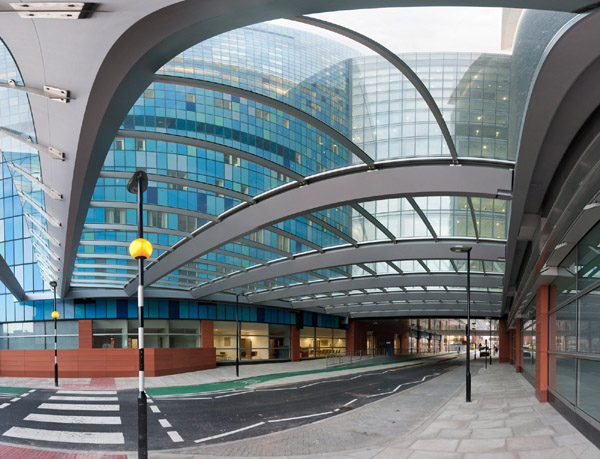
A day later I was in Whitechapel and photographing the Royal London Hospital. Like the above image it was taken with the D700, but while the demonstration image was a single exposure with the 16-35mm f4, this is stitched together from around a dozen, all made at the wide end. I’ll probably retake it at some time, as I would have liked just a little more foreground, and there are just a few minor stitching issues.

One of the problems is that there is no way to lock focus on the lens, which was manually focussed at infinity, and it is very easy to knock the focus ring which is close to the nodal point near the front of the lens. And this was taken hand-held without a tripod (I hadn’t expected to need one), which in any case makes it tricky to keep that nodal point in a fixed position between exposures.

The easier way to work would be to use a semi-fisheye lens to get a similar angle of view, although this results in rather smaller files than the 36Mp from which the small version above was produced.

More pictures and stories from last month are on My London Diary – and here are some links.

December 2011

Surrey Hills Walk
End The Siege Of Gaza
Staines & Stanwell Moor
Syrians Protest at London Embassy
Egyptians Protest At Embassy
Bradley Manning Birthday Demo
Iraqis and Syrians Protest At US
Congolese Protests Continue
Kurds Call For A Stop To Syrian Massacres
UK Uncut Xmas Protest At Vodaphone
UK Uncut Xmas Protest At Topshop
UK Uncut Santa Calls on Dave Hartnett
Congolese Election Protests Continue
London Night
10 Years Stop The War Book
Mumia Abu-Jamal 30th Anniversary Protest
USA Climate Treaty Wrecker
London Wandering
Congolese Protest Against Kabila Vote-Rigging
Stand Up For Climate Justice
Occupy LSX Climate Justice Workshops
City Xmas Celebrations
Britain First Support Emma West

Pie & Mash

A part of real London that I’ve never appreciated in terms of taste is pie and mash, though I’ve occasionally photographed the exteriors and interiors of the establishments that serve it, usually when empty. Back in the 1980s and early 1990s I did a fairly extensive survey of shop-fronts and some interiors across London, a few of which (but no pie shops) emerged as a book dummy and later a web project with the improbable title “Café Ideal, Cool Blondes & Paradise.”

So I was pleased to see today some fine images of London’s surviving pie and mash shops posted by Stuart Freedman on his Umbra Sumus blog in The Englishman and the eel. These are some of the unused pictures from a feature that was published in the German magazine Effilee, a magazine for eating and living which you can see in a tear sheet Stuart links to.  It’s a good example of how some of the best pictures somehow get missed by editors.  I’m still waiting for him to post his 5,500 word text on his blog in English.

_______________________________________________________

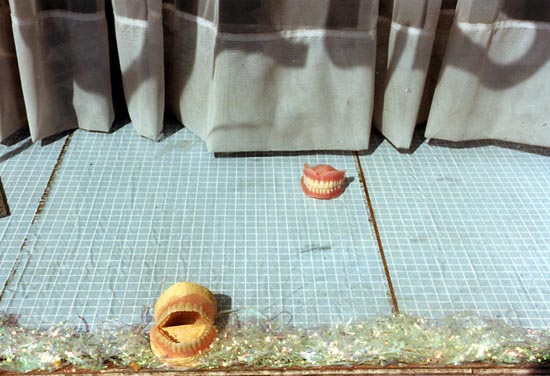
Although none of my pictures of pie shops made it to ‘Café  Ideal… there is a rather nice pair of teeth from Tooting:

© 1990, Peter Marshall

More at  Café Ideal, Cool Blondes & Paradise. And this is another project which, with some revisions, I hope will become a print on demand book some time this year.

30 UNDER 30

This is the third year of ‘30 UNDER 30 Women Photographers‘, and as in the previous years it includes some interesting work. For me the highlight was the work by Paula Gortázar*, a Spanish photographer based in London. After taking a law degree and a graduate diploma in business administration in Madrid she completed post-graduate studies at the Central St Martins before going on to an MA at the University of Westminster .

There are others whose work I find of less interest, with rather a lot of work that might be described as ‘art school attractive’ with an almost complete lack of documentary or photo-journalistic content. Although it is pleasant to look through and does include some interesting imagery it does seem a rather one-dimensional selection of work by women, and one that might be seen as reinforcing stereotypes about women’s photography. This is not of course in any way to criticise the work presented, but merely to point out that women photographers cover a much wider range of practice than is displayed here, indeed across the whole of photography.

As well as whole areas of practice, there is also a distinct lack of information on the site, and clicking the INFO link is am almost complete disappointment.  All it tells us is that the site is an ongoing project of the Artbox, “a Design + Communications Studio based in New York + Paris specialising in Interactive Media & Web Site creation” which has worked with “agencies on big brand campaigns as well as with individual artists to create compelling portfolio based web sites” and that its creative director is Mathew Hong, but says nothing about the criteria or selection of the 30 women for the site. Are the photographers simply chosen from those for whom the Artbox has designed web sites or is it a more open event? It would be nice to know, and the absence of any information makes us suspect the worst.

The information about many of the photographers is also very limited in some cases (and non-existent for one of them) and entirely lacks what is surely the essential piece of information – a link to their web sites – a rather surprising lack from a web design studio.

30 UNDER 30 is obviously based on the long established PDN 30, their prestigious annual “Choice of New And Emerging Photographers to Watch” which received nominations from roughly 70 named leading professionals in the business around the world, quite a few of whose opinions on photography even I would respect (though a few I think are firmly in the land of the Emperor’s new clothes.)  I couldn’t download the PDN gallery when I tried this morning, but you may have more luck with PDN’s flash site, which I did look at carefully earlier in the year (and it was working again this afternoon.)

But you can also find a list of all the 30 photographers (including a dozen or so women none of whom I think caught Mr Hong’s eye), with links to their web sites which was posted by A Photo Editor last March when the list was published, and which I mentioned at the time. The comments on that site are also of interest.

___________________________________________

*Some of Paula Gortazar’s work was included in a show by recent alumni of Central St Martins shown at the Protein Gallery as a part of the 2011 Photomonth in East London – her image on the Photomonth Gallery mosaic is from her ‘Common Spaces’ series. You can see more of her work including a documentary section from which a few pictures do appear on ‘30 Under 30‘ at her own web site.