The Near and Elsewhere

Although The Near and  The Elsewhere, showing at the PM Gallery in Ealing was in various ways a disappointment to me, I was still pleased that I had gone to see it (and it remains on show until 17 March, Tue-Fri 1-5pm, Sat 11-5pm) and would recommend a visit if you are in London – it’s a short walk from Ealing Broadway tube.  Firstly because of the setting, in a 20th century extension of Pitzhanger Manor-House, once the country home of Sir John Soane who rebuilt most of it between 1800 and 1810. It’s a splendid building and well restored, owned by the London Borough of Ealing, and looking quite dramatic when I arrived there in the dark for the opening. Just along the road from Ealing Studios, it has its own film history having starred as the Tate Gallery and Kensington Palace among other places, even appearing in Doctor Who.

Inside, the gallery is a fine large space and perhaps demands some at least of the large images that are on display, although for me most of them were rather lacking in interest. My first disappointment – a minor one – on hearing about the show was to find that it had no connection with the blog of the same name. The second, on reading that it “shows the physical growth and loss of urban architecture in cities across the world” was to find that photographers who would have been at the top of my list for addressing such issues were almost entirely absent. And thirdly, on looking around, I found that much of the space was taken up with frankly boring art works many on a very large scale. But fortunately there were still some things worth looking at, and others will have different interests to me. I’m a photographer after all.

My favourite picture was one of Ferit Kuyas‘s images from his ‘City of Ambition‘, a project taken in Chongqing, the largest city agglomeration in the world with a population in the city of around 32 million. It is a view looking down from a height on a construction site, taken in 2005 with the slight mist seen in many of his images of the city which he tells me is not pollution but the fog that the city is famed for. It’s a wide angle view and the site is packed with small details; as you look at it gradually you realise more and more men are working on the site. Although it is quite a large print, 100x125mm, I found myself walking right up to it so I could see details with my reading glasses, then moving back to take in the whole picture. This is an image you can look at for a long time and still find new things in.

His other work in the show, Jialing River Shore, a diptych of a vast concrete space, reminded me of some images taken underground in vast reservoirs and comes from a couple of years later, when he was deliberately avoiding including a horizon in his images. The two pictures are views made from the same place but looking in different directions, with a part of the subject repeated on both (they are mounted together as a diptych in the opposite way round to the view.)  There is a pleasing subtletly about the printing that was absent in some of the other works on display. Both of these works are in his book ‘City of Ambition‘ but neither seem to be on his web site, which does however have a fine selection of his work from the project.

One of Michael Wolf‘s distant views of Hong Kong’s blocks of housing was another impressive image, and I quite liked his 100×100, a set of 100 pictures of the residents of cramped 100 square feet single room homes in Hong Kong, a contrast to most of his images which are devoid of people. The relatively small images from this project are shown displayed as a tower block in a corner of the gallery, which works as an idea but does make actually viewing the upper images rather tricky.

Another interesting set of work was One million $ houses by Noel Jabour, showing buildings “turned into redundant monuments to greed” through the failed US mortage economy. These structures, like many of Kuyas’s images of Chongqing, emerge from the Galveston, Texas sea mist, giving them an air of unreality that mirrors the financial unreality which created them.

The invitation carried a dramatic image of a Shanghai house by Canadian photographer Greg Girard, whose book Phantom Shanghai captured the ruins of the pre-war international city, and were taken in 2005 just before (or as) they were being demolished, with highly theatrical night lighting and garish colour that somehow works. This was a pretty vast print,  210 x 180cm, and one of very few very large photographs that really merits its scale (and certainly the only one in this show.) The images are well reproduced well in his book, but ‘Rags, One Room Apartment, Liyang Lu, 2005′ in the print on the wall had one of the worst colour casts – a strong cyan – I’ve ever seen in an exhibition; it is unrecognisable as the same image in the book (and may perhaps be from another exposure made with different lighting.)

Girard’s book has an foreword by William Gibson, but it was another book, J G Ballard’s Empire of the Sun, that came to mind, and these pictures can truly be described as Ballardian, and I’ve just bought a copy on-line. Incidentally you can see a good set of Girard’s pictures on today’s New York Times Lens blog of US bases in Japan, Korean and on Guam, taken in 2008 – and this and more work on his web site.

I think Gregor Graf‘s work looks better on the web than on the wall; by digitally removing all signage and people from his pictures of cities he creates strangely alien places. Linz, in his Hidden Town – Situation 2, 2004 could be London or Warsaw, but the lack of textures makes it more than anything else resemble a cardboard model of a city than the real thing. Its a curious but perhaps just slightly more interesting reversal of those artists who build elaborate models to photograph.

Also in the show is work by Francis Alÿs, Sarah Beddington, James Casebere, Thomas Demand, Edgar Martins, Gaia Persico (who curated it), Peter Piller, Sara Ramo, Rachel Whiteread, and Cino Zucchi Architetti.

The gallery also has an interesting complement to this show in the small and almost monochrome paintings based on her recent photographs of small town America by Marguerite Horner, ‘The Seen and Unseen’ (closes 25 Feb) which I enjoyed seeing. It very much reminded me of the work made in similar places that formed a bedrock for much American photography of the last century, through  Wright Morris, Walker Evans, David Plowden and others to Robert Adams.

Copying Clichés Can Infringe Copyright

It would be hard to exaggerate the shock I feel at the ruling by Judge Birss at the Patents County Court in London on 12 January. There is a good account of the case on the Amateur Photographer site, and this links both to the full court ruling and the two pictures concerned.

The case concerned two pictures of a Routemaster Bus on Westminster Bridge, both of which had a bright red bus on a picture which had otherwise been converted to black and white. Both had the Houses of Parliament in the background. It would be hard to think of a more clichéd image of London and indeed that was in both cases the intention.

Although there were some common elements, as the defence tried to point out these are shared by many other pictures of London. In a quick search on Flickr I turned up around 20 similar images, and it would be hard to argue any real degree of originality in any of them (although in the judgement there is a discussion of this, which would seem to imply that almost any photograph is legally original, which is perhaps just as well for most of us photographers.)

The treatment converting the background to black and white is also surely a cliché. And despite the similarities of subject and treatment, the two pictures seem significantly different, for example in lighting, in viewpoint, in the angle of the bus to the camera and the angle of view (although the claimants apparently stated it was “at the same angle as the claimant’s work” but it clearly isn’t.)

The judge does go into his deliberation at great length but I find some of his statements rather odd. He writes “At the crudest level the two images in question simply look strikingly similar” and I just have to disagree. Given that both have a red bus and a black and white Houses of Parliament they look strikingly different.

It is actually a very interesting discussion about the originality and copyright of photographs but unfortunately one that I think has resulted in a fairly ludicrous judgement in this case.

In one of the many points the judge writes that the photograph claimed to be infringed is not what

I will call a mere photograph; by which I mean an image which is nothing more than the result of happening to click his camera in the right place at the right time. I do not need to grapple with the scope of copyright protection arising from such a photograph.

I think the corollary of this may be that those of us who are proud to be mere photographers have  little to worry about the outcome of this particular case.

Ponytail Pontifications

Derek Ridgers was recently interviewed by Oomska on the future of photography, the fourth in (so far) a five part series so far includes Ed Swinden,, George Plemper, Steve Gullick and Philip Greenspun.  Derek, who I’ve known for years is always interesting to talk to, and clicking on the fine portrait of Willie Dixon at the head of his piece will take you to his web site.

When I taught photography it was always a great pleasure when Derek came to talk to the students, who recognised far more of the people in his portraits than I did. But even if my knowledge of the pop scene from the 70s on was abysmal I could see the quality of his work. Too many portraits get published simply because the person in them is well-known, even though the pictures may be poor (and the walls of our National Portrait Gallery have more than their share of such work) but Derek’s work stands out.

Even if you have little interest in such music, there are still some interesting stories on Derek’s blog,  The Ponytail Pontifications,  where among other things you can find why both he and one of his photographic heroes Garry Winogrand “both had deadbolts on the inside of our darkrooms”.

Derek used to come to Framework, one of the photographer’s groups I was involved with in the 1980s and showed work in a number of the shows we organised. We all used to bring work along and discuss it with the group, and he was in some respects our most useful member; when we often wasted too much time in trying to find redeeming features in some of the more vacuous work that some people brought, his comments were generally rather more forthright.  And usually spot on.

The answers to the set of questions posed by  Oomska, “a new, UK-based online arts and pop culture magazine” which began in 2010 tell you rather more about the people questioned than casting much light on the future of photography. Photographically, apart from Derek, the most interesting work they led me to was by George Plemper, who in the late 70s was (like me) teaching as Head of Chemistry in a large comprehensive school. While I took a few pictures (and started a photographic course) he produced a very much larger body of work both inside the school and in the local community which you can see on Flickr. Perhaps the most interesting set I investigated is One moment in time: England 1975-1982.

Yurian Quintanas Nobel: Transfiguration Day

You may have to wait a day or two to access the web site of Yurian Quintanas Nobel which is currently getting rather a lot of traffic doubtless thanks to his essay Grabarka: Transfiguration Day which appeared on Burn on Friday. Burn “is an evolving journal for emerging photographers… curated by magnum photographer david alan harvey”  (and like My London Diary in its early days has a shortage of captial letters, although not it its articles) which publishes a great deal of good new work.

One of the things that drew my attention to Nobel’s feature was that it was in black and white, but also it was taken in Poland, a country I have fond memories of, and also looks at a religious event of which I have covered a few. It is a nicely structured set of 17 images, presented at high quality, almost good enough to be worth viewing at full screen on my largish display (most web displays aren’t, and look better small.)

Looking through the pictures, there are certainly some where black and white works well, particularly in making light coloured crosses stand out against a dark background. But there were a few others where I longed to see the picture in colour. Looking at it, the quality of some of the images in low light suggests to me it was actually taken on digital and then transfigured into colour.

But the use of black and white is appropriate for several reasons, not least that it fits with the ideas about darkness and light and the living and the dead that are at the heart of this mystical and spiritual location and the events there.

But – whether or not it would be appropriate here – I think that many photographic essays might benefit if photographers were to break what appears to be a taboo and mix colour and black and white images. It used to happen often somewhat randomly in the old days of magazines when only certain pages of publications were printed in colour, although too often it was the images that really needed colour were printed in black and white and vice-versa.

_______________________________________________

It still occasionally happens, though now it is largely a matter of designer whim as most printing is 4 colour, and there are several examples in my work in the Stop the War book.

© 2007, Peter Marshall

I obviously took this picture in colour, and for reasons best known to the editors it was used in the book as a black and white image. Not quite as well-converted as my black and white below, rather darker and duller, and of course cropped.

© 2007, Peter Marshall

In the black and white version, the placard at the bottom of the image pulls the eye far more strongly (perhaps why they printed it all darker) whereas in colour the focus is very much more on the warmly-lit faces of the two women clapping, and I think it works very much better.  I think I might have framed it rather differently if I had been thinking in black and white when I took the picture, although without being there it’s hard to decide. Obviously I was interested in the two prominent CND symbols as well as the group of people clapping.

It is only one of several pictures on a page, printed fairly small, and some of the others are in colour. It certainly doesn’t help the picture to be in black and white and I don’t think it makes for a better page either.

Magnum Advice For Young Photographers

Some years ago I was interviewed over the phone by one of the consumer digital photography magazines for a small feature on my work – I can’t immediately recall the details, except that I think it was one of the few occasions when I was stupid enough to decide that the publicity was worth letting them use a few pictures, all taken on film, without paying me – one of the questions was something like “what is the most important accessory for taking good photographs?” and my answer was “a really comfortable pair of shoes.” Though I can’t remember if that made it into print. But photography does often involve a lot of walking and a lot of standing around. And it’s no fun at all if your feet hurt or are wet and cold.

Shahidul News has just re-published some advice by 35 Magnum photographers, originally published in 2008 at the prompting of Alec Soth, and it still makes a lot of sense. The photographers were asked two questions, “When did you first get excited about photography?” and “What advice would you give young photographers?”

First to respond in the vaguely alphabetical listing in a Magnum document with the title ‘Wear Good Shoes: Advice to young photographers’ was Abbas, who made the doubtful claim to have have got excited about photography from birth and followed this with some sound advice “Get a good pair of walking shoes and… fall in love.

Everyday People & A Nightmare

Imagine going back to your parked car and finding someone had broken into it, stealing not just your camera and lens, but also your laptop and two external hard drives containing the raw files from your last six months of work. It must be one of the worst nightmares for a photographer (though mine is slightly different as I don’t have a car.)

It was Theron Humphrey‘s New Year present when he returned to his pick-up parked in Jackson, Mississippi, where he was half-way through a Kickstarter crowd-sourced project travelling across the USA making portraits of ordinary people, as Pete Brook recounts on his Rawfile blog.

Humphrey had got backers to put up over $15,000 for his project, promising them postcards, signed prints t-shirts and more depending on the amount they contributed, and at the higher end you could camp with him, nominate a person to be photographed as a part of the project or he would tattoo your name on his leg!

While he travels across the USA – and is able to continue with the project thanks to some more generous support when people heard about his loss, with loans from friends and $4000 from a donations page – his web developer Chris Barnes is putting up the work on his web site. There are certainly some interesting portraits in his cross-section of everyday Americans on This Wild Idea.

It’s also a reminder to us never to rely on a single backup of our raw files. Unlike negatives you can easily make a copy, and by storing it in a different location, keep your work safe against catastrophe.  Humphrey is now using cloud storage for his files as well as presumably still saving them to hard drives.

1978 Protest

Among the old negatives I’ve been scanning over the past week or two are a few from protests, which may perhaps be the first pictures that I took of protests, back in April 1978. Ten years earlier I had been taking part in a great many of the events of that year, mainly in Manchester where I was studying at the time, but had been far too busy marching and occupying to think about taking pictures, and had no money for film.  It didn’t help that my camera, a 35mm Halina, had never quite recovered from twenty minutes or so spent on the bed of the lake at Versailles a couple of years earlier, followed by my amateur attempts to clean it. The bladed shutter would sometimes stick open and the shutter speed was in the hands of the rust god.

© 2012, Peter Marshall

I’d continued going to protests, though rather less frequently, in the 1970s, but although I’d bought working cameras by then I can find no pictures, either because I took none, or perhaps because I wasn’t pleased enough with them to keep the results. By then I was keeping down costs by bulk-loading black and white film from 100ft cans and doing in all my processing, mixing up developers from large bottles of hydroquinone, metol and other ingredients, and printing in my kitchen with a cheap folding Russian enlarger. It was a good learning experience, but much of that early work ended in the bin for various reasons.

Things really are much easier with digital, and rather cheaper. Learning the old way wasn’t any better for being harder, and those old-timers who think it is somehow better to learn photography using black and white film in manual cameras are clearly deluding themselves. Learning with digital is cheaper and faster, though which is better is a matter of how and what you learn from it rather than if you use digital or film. But I certainly did it the hard way.

In 1978 the equipment I took the the protests with me would have included a buggy with a son approaching two and a wife, along with Olympus OM1 (and possibly an OM2 body.) Unless I meant to take colour as well as black and white I probably left the OM2 at home, so the OM1 could hang around my neck, with a couple of spare lenses in jacket pockets or a small ex-army shoulder bag, along with a Weston Master 5 exposure meter. Then, no serious photographer would ever leave the house without an exposure meter, and particularly if you used transparency film, you needed the Weston with it’s weird white plastic Invacone to take incident light readings, waving it in the air like a wizard’s magic wand before every exposure. The Weston was a great piece of kit, workmanlike and with no battery to run out, but with an Achilles heel, its meter needle going over a large and highly legible scale visible through the thinnest and most fragile glass window imaginable. After I’d paid good money to have this replaced half a dozen times I saw sense, removed the broken fragments and glued a suitably cut thin sheet of perspex in its place.

The images on these early sheets in my negative files come from two protests in 1978, but unlike now when we have EXIF data, including dates and times, I can’t tell you a great deal about them that isn’t actually recorded in the images. Probably I had a few more details in a diary at the time, though I never felt it necessary to record things like exposure times and aperture – like most other photographers at the time I took a rough guess when photography magazines asked for such things.

© 2012, Peter Marshall

Most of these early images are from one of several rallies in Trafalgar Square organised by Friends of the Earth (FoE) and supported by other groups against the re-processing of nuclear waste at Windscale. Estimates for the number who marched from Marble Arch to the rally on 29 April 1978 vary from around 12,000 to 30,000; it was an entirely peaceful event and the protesters dispersed without incident. A little earlier I had also take a few pictures at a Campaign Against Racism and Fascism (CARF) rally in Hyde Park.

© 2012, Peter Marshall

While now we are used to seeing results immediately, it would often take me several weeks at that time to actually get around to developing the films and then to contact print them. I was working full-time as a teacher and few of my images got published, and then only in magazines some time after the events. Sometimes one film contained images from several events if I had not used one of my cameras much – and I would seldom take more than 30 or 40 pictures at any event.

© 2012, Peter Marshall

© 2012, Peter Marshall

Placards are vital to make clear the object of the protest, though some are clearer than others.

© 2012, Peter Marshall

Signing petitions, then as now was an important part of many protests.  I think the hand with the pencil and the white forms in front of the dark coat on the top edge of the frame was a deliberate framing decision and not just chance:

© 2012, Peter Marshall

________________________________________________________

My London Diary : Buildings of London : River Lea/Lee Valley : London’s Industrial Heritage

All photographs on this and my other sites, unless otherwise stated are by Peter Marshall and are available for reproduction or can be bought as prints.

To order prints or reproduce images

________________________________________________________

OM Rebirth?

Almost 40 years ago, Olympus made a great leap forward in SLR camera design with the introduction of the OM-1 camera (initially they called it the M-1, but Leica didn’t like that and threatened to sue.)  It wasn’t a camera for everyone, with many pros complaining it was too small and too light to be serious, and certainly it didn’t have the tank-like qualities of some of the rival models. It was relatively small and light and came with a superbly bright viewfinder and a pretty decent set of lenses, some of which made the big guns look pretty sick.

The OM1 had its faults. It didn’t show the aperture in the viewfinder. Photographers used to having the shutter speed dial on top of the camera didn’t like the far better placement around the lens mount which meant you didn’t have to lose your grip on the camera to alter the shutter speed. It’s a shame it didn’t catch on.  Probably its weakest point was just a slight ‘iffiness’ at times about the shutter release, which could sometimes mean nothing happened when you pressed it the first time (something we are rather more used to when cameras have autofocus, but there was no reason for it in the manual days.)

By the time it had developed into the OM4 it was a real classic, and I had two of them together with a pretty comprehensive lens set in a very much smaller and lighter bag than I now need for the two Nikons. The OM4 had what was certainly the best metering system ever made for any film SLR, and was great for those who liked to think about exposure, allowing you to place an area on a particular zone with ease. Or you could just leave it on automatic, and it seemed to do better than the rather more complex electronic systems manage now.

Now Olympus are sending out teasers about a new OM series camera, the OM-D, supposedly a digital successor to the OM series. I think it has come around 10 years too late, but I hope I won’t be too disappointed.  You can read more about the likely spec at 43 Rumours.

I’m afraid the similarity will largely be cosmetic, an attempt to trade on the old reputation. Of course it won’t have anything like such a good viewfinder – it will be electronic. I suspect too that the dial we see a little of on the top plate is a shutter speed dial.

We already know more about another new camera, the Fuji  X-Pro1, also with a 16Mp sensor, though the slightly larger APS-C format, and one that promises to produce sharper images with a different sensor layout which cuts down the effect of moire. That looks rather more interesting as a camera, and is obviously aping Leica – just as the Fuji X-100 was. The X-Pro1 with its interchangeable lenses looks very much like the camera the Leica M9 should have been, so I’m waiting with rather more interest the first detailed reviews. So far the various ‘hands-on’ pieces although interesting really tell us only a little more than the press release.

But I’m already getting the feeling that this might just be the year I jump ship from Nikon to something smaller and lighter, at least for much of my work.

History Recoloured

It has always been accepted wisdom in writing about photography that black and white was somehow more gritty, more realistic, more serious in presenting news and reality, and I’ve never been entirely convinced. With almost all the news appearing in colour for some years now, it has long been clear that this particular cultural conditioning is losing, perhaps has completely lost it’s grip on us.

A week ago, Swedish artist Sanna Dullaway posted a message (as MyGrapeFruit) on Reddit  “For my second cakeday I thought I’d show my best colourizations and some restorations that I’ve been doing for fun. Hope you enjoy!” which linked (and still does) to a photo album on photo-sharing site Imgur, although since then her pairs of vintage black and white images – including such truly iconic photographs such as Dorothea Lange’s Migrant Mother and Timothy O’Sullivan’s Harvest of Death, as well as others clearly still copyright – have been copied to more blogs than I knew existed.

On her web site and her DeviantArt page you can read a statement from her about the copyright problems involved in some of the pictures. In part she says

“Ignorance is not an excuse and I (now) know some of the photos are not public domain but copyrighted. Please note I do not take credit for the iconic photos I colourized, only the actual colouring.”

Later she makes clear:

‘I did not want to “improve” nor “replace” the photos I DID colourize as some of you may think. I just wanted to show you a new perspective of the black & white old world, it used to be in colour, too. I thought famous photos would touch most hearts. Focus on the photos, not me.’

Of course copyright is important, and I try carefully to respect it here both for words and pictures. Her ignorance is not unusual for internet users or bloggers, but perhaps surprising for someone who is setting up in business as a restorer and colouriser of black and white images. That she is using other people’s copyright images and gaining publicity for a business she is setting up makes her offence more serious.  I don’t agree with those who suggest it is “sacrilege” to colour photographs such as Eddie Adams’s 1968 Saigon Execution picture, but it does certainly offend against his moral rights and copyright.  As Adams himself died in 2004 we can’t know what he would have thought of it.

Personally I think it is sensitively done and don’t find it offensive, but it isn’t my picture. But on several occasions artists have asked  to use my images in various ways as a basis for their work. The vital difference is of course that they asked – and paid.

What do I think about them? Some perhaps don’t quite ring true; that Migrant Mother for example perhaps looks just a little too healthy and well-fed in colour, but many I think are improvements on the black and white original.  Of course we can’t know how true they were to the actual scene that was photographed, and one problem with working with colour is that there are often very distracting elements in a scene.

Margaret Bourke-White’s 1937 ‘The American Way’ (see it at Life too, where it is shown more dramatically)  completely changes its dynamics. In the original, the dark and sombre line of flood victims  dominate the light greys of the background billboard, reality against dream, while in the coloured version the bright tones of the poster overpower the dull line. And in reality, someone might just have been wearing a bright red jacket or tie, which would have rather changed the picture.

Now we have colour, and most of the time it makes sense to use it. But a few things perhaps still look better in black and white, and it can certainly simplify some images.  What I find rather silly and sometimes very annoying are some photographers who have never learnt to use black and white who shoot in colour and then routinely (and usually poorly) convert the pictures to black and white thinking that it makes their work more serious as photojournalism.

Nurses Get Militant?

One of this morning’s news headlines was that the Royal College of Nursing, the professional body that represents qualified nurses, along with the Royal College of Midwives, have finally joined all the other professional healthcare organisations representing doctors, physiotherapists etc and come out against the government’s Health Care Bill.

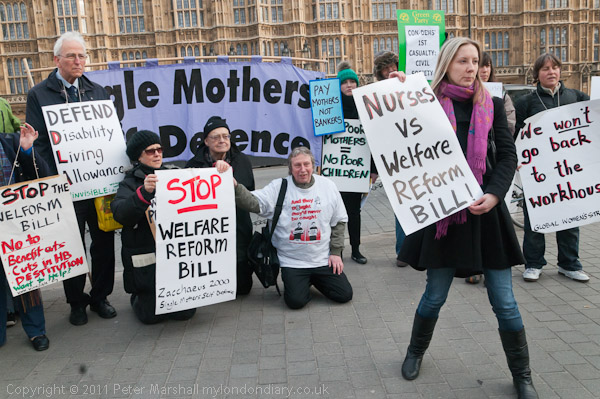
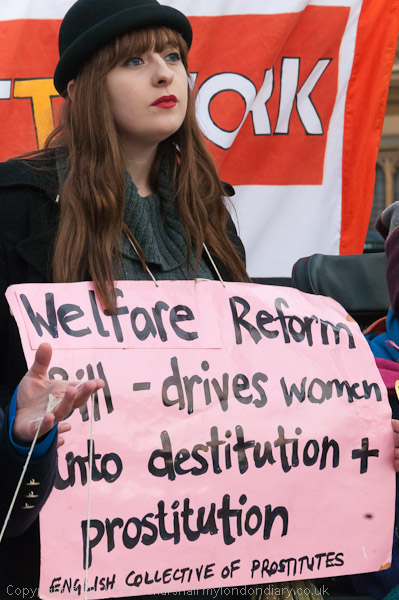
Two days ago, I was photographing an event opposite the Houses of Parliament against another controversial government bill which the House of Lords were to be debating later that afternoon, the Welfare Reform Bill, which will remove funding and support from many of the disabled and least well off, adversely affecting, among others, many with terminal cancer.

© 2012, Peter Marshall

It wasn’t a large protest, but had representatives of single mothers, disabled activists and others including the Rev Paul Nicolson, chairman of the Zacchaeus 2000 Trust, a London-based charity which addresses poverty issues caused by unfairness in the law, legal and benefits system, which had organised the event together with Single Mothers Self-Defence and WinVisible, a grassroots group for women with visible as well as invisible disabilities. At the front of the group of protesters was a woman holding a placard ‘Nurses vs Welfare Reform Bill!‘ being photographed for publication in a nursing magazine.

One other and possibly older profession was also mentioned in the placards.

© 2012, Peter Marshall

See more at Welfare Reform Bill Lobby at Parliament on My London Diary.

________________________________________________________

My London Diary : Buildings of London : River Lea/Lee Valley : London’s Industrial Heritage

All photographs on this and my other sites, unless otherwise stated are by Peter Marshall and are available for reproduction or can be bought as prints.

To order prints or reproduce images

________________________________________________________