Let Truth be the Prejudice

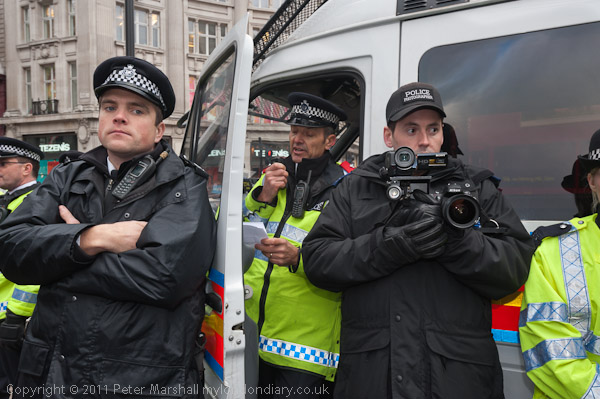
AFP photographer Hazem Bader photographed a Palestinian construction worker screaming in agony as an Israeli army driver drove a trailer over his legs on a construction site on 25 Jan. The Israeli army had turned up to seize the tractor and trailer as the Palestinians were building on land that they owned in an occupied zone where Israel has forbidden them to build.  The picture – and it is a striking image – was widely published in the USA and the Israeli embassy in Washington wrote to the US newspapers alleging that the vehicle shown was stationary, that the worker was not injured and suggesting the picture was staged, and asking the newspapers to issue a correction,  and to “to consider ceasing to publish the photographs of Hazem Bader“.

AFP have now issued a statement which includes a translation of the medical certificate confirming the injuries sustained by the worker and an interview where he describes what happened. Their press release, which includes the picture concludes:

In the light of these inquiries and based on the trust we have in our photojournalist, AFP Management does not believes that this event could ever have been staged.

Given the ferocity of the attacks against the AFP Photo service, we have decided to release this statement in order to set the record straight. We will not make any further comment.

The Committee for Accuracy in Middle East Reporting in America  continues to dispute the veracity of this image, although some of the points it raises appear to be minor quibbles, for example when they state that the confiscation operation would be a “civil administration mission where soldiers provide security rather than an army operation and so any driver would not have been a soldier.  You can also read similar comments on the CiF Watch site, which also attacks Bader for the contents of his web site, which they say “quite consistently portray Palestinians as victims of Israeli villainy (something of a specialty for Bader), and further demonstrates an egregious pro-Palestinian bias decidedly at odds with any pretense of objective photo-journalism.”

I can’t tell you for sure about the exact circumstances of the particular image, I wasn’t there when it happened, though I have an opinion on it, but I can say something about photo-journalism. Having looked through a considerable number of the pictures on Bader’s site – with some difficulty as it is an exemplar of poor web design – I think his work as a whole seems very much in the fine traditions of the genre.

I thought of the work of one of the great heroes of the genre, Gene Smith. Would CiF Watch find his work at Minimata unacceptable because of his concentration on the tragic effects of mercury poisoning on the inhabitants of that fishing village?

The photo-journalist is a witness, one who tells the story that he or she sees; in Smith’s phrase “Let Truth be the Prejudice.”  At its heart is subjectivity. It isn’t the same as bias or distortion. And there is fortunately no such thing as objective photo-journalism – which would be a real pretence.

But perhaps for me the the most important part of the story is not about the detail of a particular picture but about laws and ways of thinking that make it seem normal and acceptable that when people start building on land that they own, soldiers should come that their equipment should be confiscated at gunpoint and the building destroyed.
Snow Business

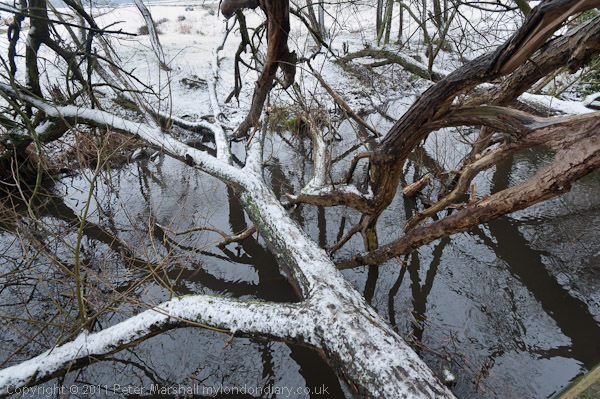
A couple of days ago the Daily Mash carried a feature  “‘UK braced for mediocre weather photography‘ SNOWY weather will result in a million of pictures of nothing much, experts have warned” and this morning I decided to play my part in making this prophecy come true.

It had looked pretty promising the night before as I walked home through the falling snow, making the Staines back streets look almost fairy-tale, at least with the benefit of the best part of a bottle of a rather fine Sauvignon Blanc inside me. I should get out and take some pictures I thought, but not for long as I reached a warm house, coffee and biscuits and bed.

So this morning, bright and early (not that early, but the only footprints other than ours from the night before on our local stretch of pavements were those of the neighbourhood fox) I donned long-johns and an extra pair of socks underneath my normal boots, bags and jacket and with two pairs of gloves and a woolly hat sweated my way around Staines.

© 2012, Peter Marshall
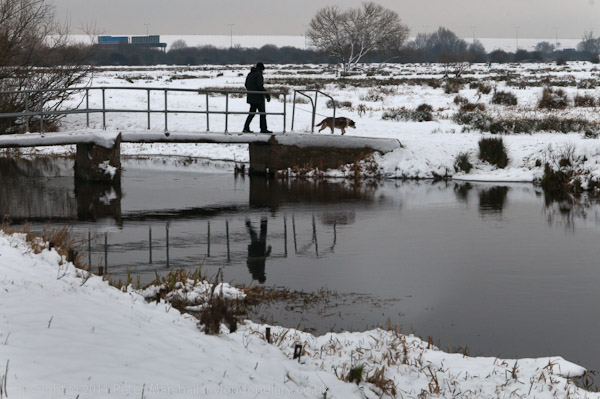
Bridge over River Colne, Staines Moor (D300, 70/105mm)

Staines unlike Rome, is built around seven rivers, or possibly more. The main one of these is of course the Colne, which reaches the Thames here, and the rest are (or were) bits of water from the Colne finding their own way into the Thames, and my route took me to the County Ditch and across the Wyradisbury River, the River Colne, Bonehead Ditch and Sweeps Ditch. We also have several rather mysterious streams that appear around Moor Lane and Yeoveney either from the Colne or old gravel workings and then disappear, doubtless into culverts, but the one I count as the seventh is an artificial ditch, the Staines Aqueduct, taking water from the Thames to various reservoirs.

© 2012, Peter Marshall
My bridge over Bonehead Ditch, Staines Moor (D700, 16mm)

So the Romans, who called Staines ‘Ad Pontes’ or ‘at the bridges’ knew what they were talking about, and my route included a number of them, including two on Staines Moor, one of which was natural rather than man-made.

© 2012, Peter Marshall
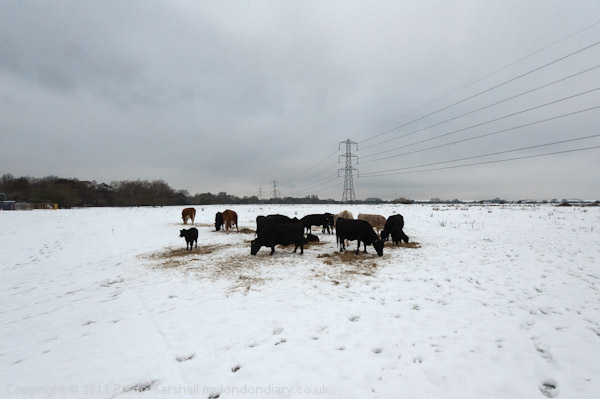
Animals feeding in snow on Staines Moor (D700, 17mm)

I’ll write more about Staines and my route in a day or two on My London Diary, but here I’ll concentrate on the photographic aspects. Digital makes photographing snow a lot easier, both in taking the pictures and in ‘developing’ them. Probably every photographer knows that cameras have exposure problems in snow, because exposure generally relies on scenes ‘averaging to grey’. Many of us back in the old days used to carry around a ‘gray card’ specially produced (and priced) with a neutral gray that reflected 18% of the incident light. When taking stuff on colour neg it was handy to put that in one corner of the image so you could balance using it when printing, and for getting the exposure spot-on you stuck it in your scene and took a light reading from it.

Nowadays I usually let the camera more or less work it out, though today for snow I set it to give an extra stop of exposure and then checked that the histogram looked more or less fine, going more or less all the way across to the right of the graph, but not past it. On many of the scenes I could have used two stops more and still been OK, but there would have been too great a chance of blocked highlights.

© 2012, Peter Marshall
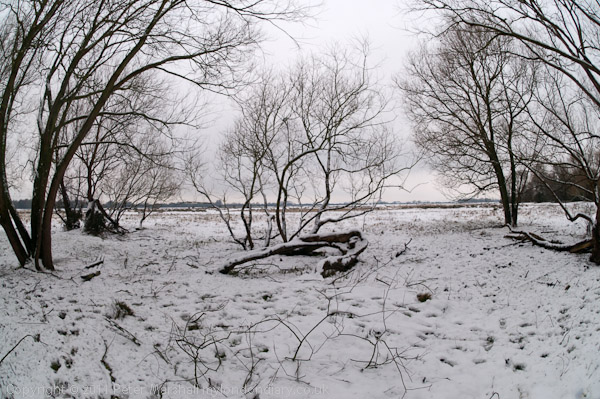
Part of circle of trees on Staines Moor (D300, 10.5mm)

In Lightroom, most of these images did need a positive tweak to the exposure to bring the brightest highlights right across the the right hand side of the histogram. Then I had to bring down the brightness to get the kind of texture I wanted for the snow. Apparently the next version of Lightroom won’t have the two controls, which leaves me wondering how I’m going to do that kind of thing – I think it will probably mean I’ll have to go back to working with the ‘Tone Curve’ as I used to with the previous Raw Shooter software. The slider that I’d actually like to get rid of is the ‘Recovery’ one, which I’ve learnt always to set at zero. Not that you don’t sometimes need to recover highlights, but that it is always best to do so on a local basis rather than the overall image degradation that the ‘Recovery’ slider provides.

My D300 is now severely in need of a service – or a replacement. I’ve been hoping for a while that Nikon would bring out a replacement either for the D300s or the D700 or both so I can retire it. Apart from the cracked plastic on the top-plate LCD which doen’t bother me, it now sometimes fails to return the mirror after an exposure, and simply stops working, which obviously does.

© 2012, Peter Marshall
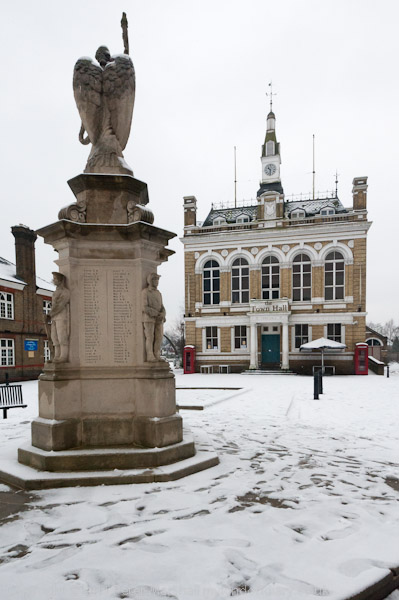
Staines Town Hall, sold by the local council for pennies and now a pub.(D700, 21mm, slight crop)

It happened for the first time a month or two back, and after a lot of cursing I found a way round. Use the menu and select to raise the mirror for cleaning, press OK and then the shutter release to ‘raise’ it (though it’s already raised), then switch off the camera and it comes down just as it should, and when you switch the camera back on it works properly again.

If it happens – as it has recently – perhaps once a day it’s annoying but not a problem. But this morning it did it at least a dozen times, which became rather a pain.

© 2012, Peter Marshall
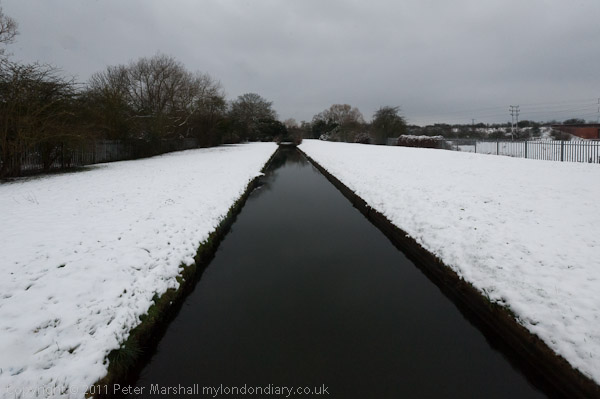
Staines Aqueduct which carries Thames water to the reservoirs. (D700, 16mm)

It’s also sometimes having problems focussing. A few times it did a bit of hunting rather than the usual fast focus. In the end I switched to manual focus, but by that time I was in any case working with the 10.5mm fisheye, where there is very seldom any need to focus at all.  The only problem with manual focus is that when you switch to manual there is virtually no resistance to turning the focus ring, and it is easy to knock it away from the infinity setting that normally works for virtually any distance.

More pictures and more about Staines on My London Diary shortly.

________________________________________________________

My London Diary : Buildings of London : River Lea/Lee Valley : London’s Industrial Heritage

All photographs on this and my other sites, unless otherwise stated are by Peter Marshall and are available for reproduction or can be bought as prints.

To order prints or reproduce images

________________________________________________________

Oomska!

Ten days ago, in Ponytail Pontifications, I wrote a little about an old friend of mine, Derek Ridgers, who had just been invited to give his thoughts on the ‘future of photography’ on the Oomska blog, the fourth photographer in what was then a five-part series.  I commented there that the responses to the questions “tell you rather more about the people questioned than casting much light on the future of photography.”

As a result I got invited to give my answers to those same questions, and I suspect the same is true about me – and you can judge for yourself in what is now part 10 of the series, with Carlein van der Beek, Tamara Bogolasky, Emma Jay and  Nick Turpin also having had their say. Comments are of course welcome, both at Oomska and here.

What I found a real problem was not answering the questions but deciding which two pictures I should send to be published with them, and, perhaps even harder, finding a picture of myself to send with them.

John Carvill who runs Oomska had actually asked me for a ‘self-portrait’ though I think he meant a picture of me. I have taken some in the past, but probably it is thirty years since I made anything but a mug-shot for ID purposes. Some of those were pretty poor by any standards, and I wince every time I pull out my press card, with a picture of me taken perhaps 15 years ago which shows me as a desperate criminal. It really isn’t even at all recognisable now and I have tried to change it by supplying a more recent (and more flattering) image on renewing the card, but the system doesn’t seem to allow for this.

Over the years other photographers have taken a number of pictures of me, some in more compromising situations than others, but there are just a few that I’ve used on line. One that I use on Facebook was taken in a rather nice London pub just after I’d got a new digital camera and several friends were passing it around and took pictures on it. But the one I chose was from the only proper portrait session I’ve sat for (I don’t count those where I sat in as a teaching aid for my students.) A friend of mine, Tony Mayne, decided around ten years ago to take a series of portraits of photographers, and brought his lights along to my house for a session.  Photographing photographers is probably always difficult, but I think he did it admirably, although some of his other sitters were undoubtedly more photogenic. And being the generous person that he was, as well as supplying me a set of proofs from the session he also gave me permission to make use of the pictures as I liked, though of course I’ve always credited the image to him, unfortunately now posthumously.

You can see that picture, and the two that I selected to go with my thoughts on Oomska.

Going back to Derek Ridgers, yesterday I went to the exhibition at the Saatchi Gallery where the Sunday Times is celebrating 50 years of their magazine. I’ll possibly write about it at greater length shortly, but if you are around there before 19 Feb it is worth a visit (though it is closed Feb 11-14.) There is a special anniversary issue of the magazine on Sunday 5 Feb, though I think it looks rather disappointing, and it and the show reminds me why I gave up buying the paper. But certainly in its early years and at times since it has used some fine photography, particularly in the early years by Don McCullin. But of a number of portraits on display as large backlit images, one for me was head and shoulders (sorry!) above the rest, Derek’s fine image of Keith Richards.

Scuffles at Stop The War Protest

© 2012, Peter Marshall
Anonymous: Obama Bin Lying!

I was happily photographing a group in ‘Anonymous‘ masks holding a banner ‘Obama Bin Lying!’ in the garden of Grosvenor Square in front of the US Embassy, and was taking a few rather closer images of the masked figures when I realised there was a lot of noise coming from the No War In Iran & Syria protest on the other side of the hedge closer to the Embassy.

Looking over the hedge it was clear there was some kind of disturbance, and so I ran towards the gate in the corner of the gardens (it isn’t the kine of hedge you can get over or through) and started to make my way through the crowd to where things were happening. But the crowd was too dense to get through at any speed, even with the kind of experience and facility at doing so that comes with years of experience, and I soon gave up, retraced my steps and went round the other side, where a long packed line of photographers was standing on the edge  of a raised flower bed looking down from a few feet on the rally.

© 2012, Peter Marshall
Abbas Edalat speaking –  and the Free Iran protesters wanted to put their view too

© 2012, Peter Marshall
A noisy argument with some pushing and shoving in the crowd

I managed to squeeze a lens through between two of them and see where things were happening and took a couple of pictures, but I wasn’t going to get the kind of pictures I wanted from there. So I apologised to the two photographers on each side and went between them and lowered myself down the three or four feet from the wall (rather carefully, as my knee was still painful from a fall a week earlier) and through a very thin hedge and around some metal barriers into the crowd.

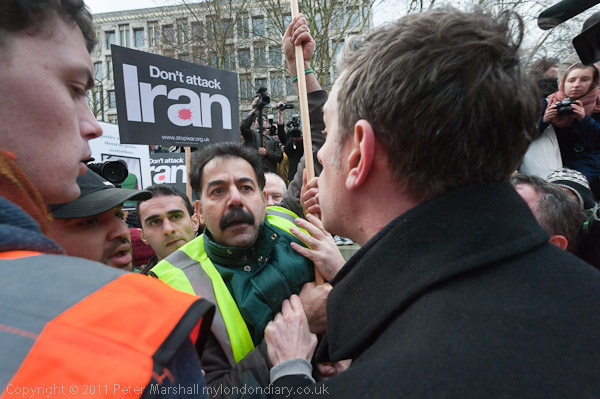
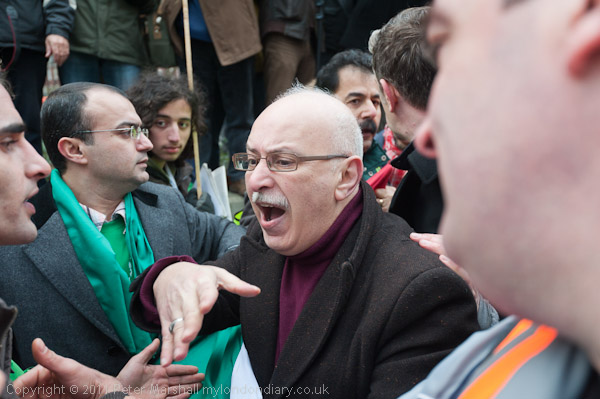
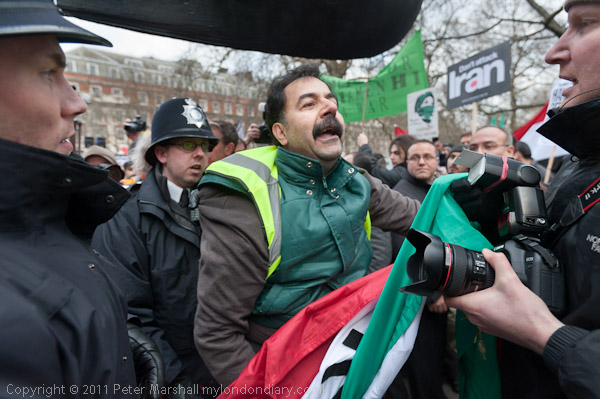
Once down in among them, it was hard to see what was happening, and probably the best guide was the noise, and I squeezed through to find a shouted confrontation taking place between a man who I later found was from the Free Iran Green Movement and the Stop the War Stewards. Things were so noisy it was hard to hear what they were shouting about, with almost everyone around except me and a couple of other photographers joining in. I was getting pushed around a lot and it was hard to keep in positions where I could see to take pictures – and a few times I had to lift the camera up above my head or push it out in front of me and hope, but mostly I was still working with the camera to my eye. As the people were getting pushed back, I had to move around in front of the way they were going and find new positions from which to photograph, and much of the time my view was blocked by what seemed rather randomly moving bodies.

© 2012, Peter Marshall
Iranian Greens argue with Stop the War stewards

© 2012, Peter Marshall
Iranian Greens stop their ‘Free Iran’ banner being taken away from them

Eventually three rather bemused constables waded into the crowd and tried to sort things out, though like me I think they had great problems knowing what was going on. Eventually they managed to bring the Iran Greens who had been fighting to keep their Free Iran banner out from the protest and let them mount their own in the area usually kept free directly in front of the embassy.

© 2012, Peter Marshall
The Met start to get things sorted out

Perhaps those photographers who kept up on the wall got a better overall view, but I doubt if they got much in the way of pictures. It’s often a tricky decision whether to get down and in the middle of things when they get a little heated, and a large DSLR with a flashgun stuck on top is just a little fragile. But despite the anger that some of the protesters were showing towards each other, I didn’t feel any of it was directed towards me, and I felt little danger.

What is always difficult in crowds like this is getting sufficient distance – even with a 16mm – to show enough of the scene. If you try to move back a little, then protesters or other photographers will fill the gap. All of the images I took in the crowd were made with the 16-35mm on the D700, mostly in the 16-24mm range.

I was photographing this incident for around 8 minutes and took around 180 frames, all as single exposures. Had I been using film, I would have had to withdraw from the action a few times to reload, and would have taken considerably fewer images – and probably missed the better moments. Of those 180, almost all are reasonably sharp, thanks both to autofocus and relatively fast shutter speeds as I had the camera at ISO 1000. Exposures varied but were mostly around 1/200 f5.6, but some as low as 1/125. On film I’d have been working at ISO 400, again probably working at f5.6 to give sufficient depth of field even with the wide angle, and the slower speeds would certainly have meant fewer sharp images.

It was a very confusing event, and I think in my initial account on Demotix I got mixed up a little over who was who, certainly in a later part of my account. Stop the War also seem to me to be a little mixed up over the different views in Iran and Syria, and appear to have sided with the ruling regimes there and be opposed to the opposition groups who are also against military intervention.

Both Syria and Iran give financial and political support to Hezbollah which is widely seen as a resistance movement against imperialism across much of the Arab world (and as terrorists by the West), but both regimes also oppress and commit atrocities against their own populations –  news from Syria tells us daily of the protesters killed, and today is the 30th anniversary of the Hama massacre of 1982, which left 100,000 refugees, 60,000 prisoners, 40,000 martyrs, 15,000 missing & 5,000 homeless.

Groups such as the Iranian Green movement are strongly opposed to US attacks on Iran, believing that they would have the effect of strengthening the regime there and keeping it in power for another 50 years. Stop the War appears to have become closely aligned with groups supporting these tyrannical regimes and I think needs as a coalition to walk the more difficult route of uniting all those opposed to the war rather than taking sides.

My London Diary has a longer report on the actual protest, together with more pictures of the event, including more of these scuffles in No War Against Iran & Syria.

________________________________________________________

My London Diary : Buildings of London : River Lea/Lee Valley : London’s Industrial Heritage

All photographs on this and my other sites, unless otherwise stated are by Peter Marshall and are available for reproduction or can be bought as prints.

To order prints or reproduce images

________________________________________________________

Disabled Block Road

© 2012, Peter Marshall
Protesters met outside Holborn Station

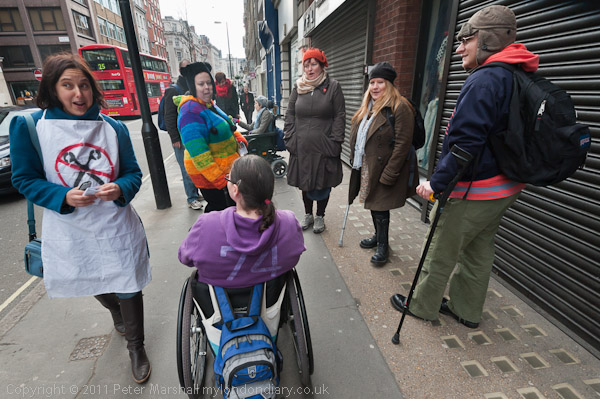
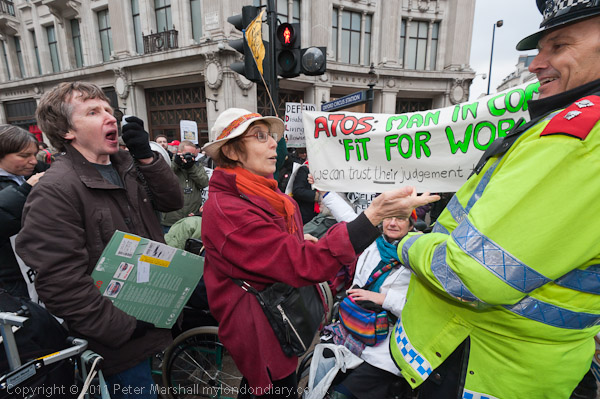
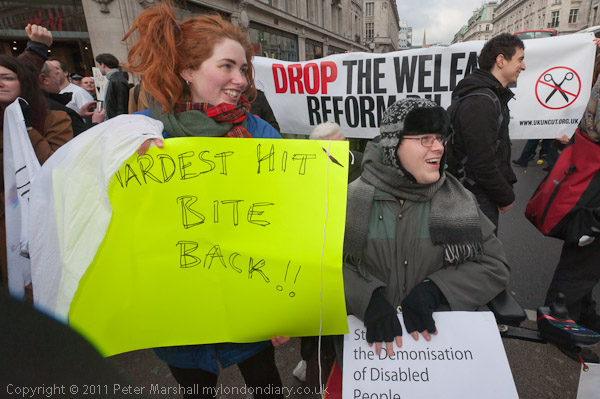
Saturday morning I arrived at Holborn Underground station to find almost every other photographer in London was there. We’d all come for the start of what the press release had described as “group of disabled, sick and elderly people … going to engage in a daring and disruptive act of civil disobedience” at a “secret location” in protest against the benefit cuts of the Welfare Reform Bill, currently going through our parliament.

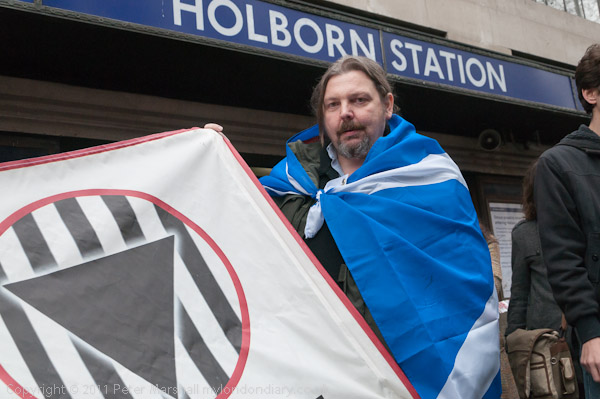
It didn’t look too hopeful, as there were only a few protesters, perhaps around 20 and probably around a hundred photographers, videographers and reporters. But as I was there, I got down to taking a few pictures, taking care to get the station name in at least some of them. As well as photographing some of the half-dozen or so in wheelchairs I also took a picture of two guys with the banner of one of the organising groups.

We were all hanging around, waiting to be directed to the “secret location”, when I saw the banner being rolled up and the two carrying it hurrying into the station. I started to follow them, then stopped, deciding wrongly it would be a better story to stick with the wheelchairs.

© 2012, Peter Marshall
Protesters make their way to Oxford Circus from the taxi drop-off point

We were all still hanging around being told nothing, and then I saw that the people in wheelchairs were beginning to get into taxis. I can’t afford taxis – and generally they are a slow way to get around London – but I did overhear where the taxis were taking them, so decided to take the tube to Oxford Circus and walk the short distance to that point, getting there more than five minutes before the taxi. Unfortunately by the time they had arrived and we had walked to the protest I had just missed the start.

© 2012, Peter Marshall
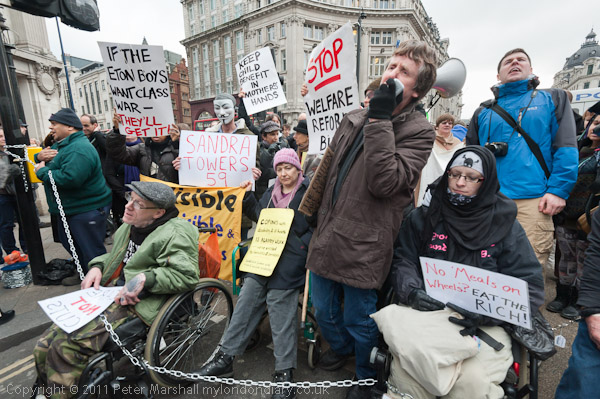
Protesters on the road with the chain across them

Most of the protesters had obviously met elsewhere and together with the press who by then had been taken to Oxford Circus where the protest was. Sometimes using a little initiative doesn’t really pay off!

I don’t think I had missed much, and the main problem now was that there were still probably more photographers etc than protesters, and it was hard to take photographs without getting in other people’s way and them getting in yours. What really annoys me are those people – mainly not the pros – who keep pushing their cameras out at arms length directly in front of your lens.

I’m always trying to think in terms of the story as well as the picture, perhaps a slightly different perspective to many of the press and agency photographers. They know that probably at best only one or two of their photographs from any event will get used, while I know that I’ll put a whole story both on Demotix and also in greater depth on My London Diary, and also hope I may get a picture published elsewhere.

© 2012, Peter Marshall
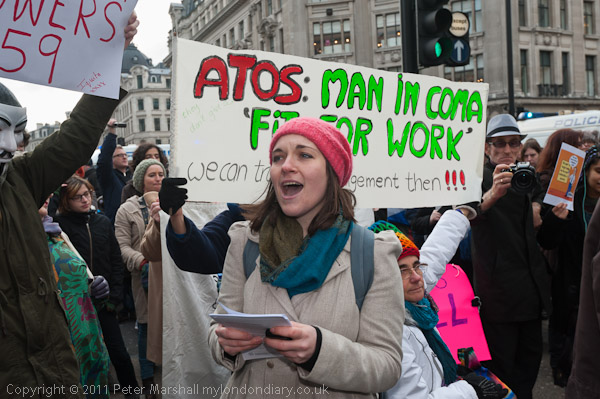
Woman leads the ‘human microphone’ against the Welfare Reform Bill

© 2012, Peter Marshall
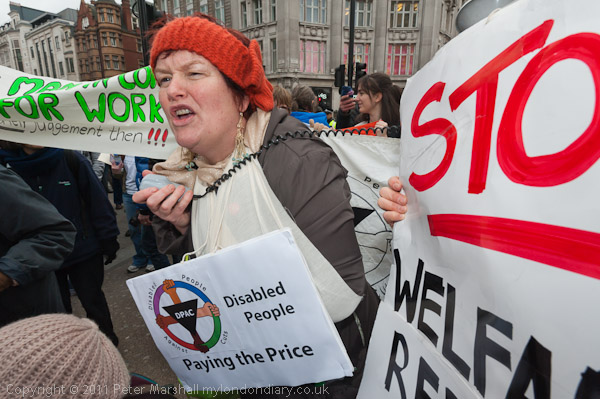
One of many people who spoke at the protest

© 2012, Peter Marshall
Police officer in charge warns protesters they are committing an offence

© 2012, Peter Marshall
Protesters confront police officer

Other than photographers getting in the way (and of course they have the same right to be there as me, though there are a few who really need to learn manners) my other main problem was Nikon’s lousy lenshoods, a subject I’ve mentioned before.

© 2012, Peter Marshall
The dark area at bottom left is my lens hood

Working in crowds, lenshoods get knocked – and the main reason I use one is often as protection – they get knocked rather than the lens. Cheap substitutes from e-bay can be a little better than the Nikon originals, and the one that cost me around a tenth of the genuine Nikon is a little firmer and gets knocked completely off rather less often (and eventually after I’d picked the original up a few dozen times from the ground it was cracked) but they still have the same fairly useless bayonet mount which makes them easily turned round, and it’s easy to miss that this has happened for a while when taking pictures. I’m someone who usually frames tightly, and it is seldom possible to rescue the situation by cropping the images. But here is one where I could crop at top right, and the lens hood at bottom left isn’t a great problem – it could easily be someone’s shoulder, and if I didn’t tell you you wouldn’t know what had happened.

It was also a fairly large intrusion into the image, which in a way was fortunate because I fairly quickly noticed it and twisted it back into position. But a well-designed lens hood would have a much more positive lock.

The other problem I had was down to a little of my own finger-twiddling (probably also a design fault, but not one I can blame Nikon for.) At some point I managed to move one of the sliders on the 16-35 lens barrel from Auto to Manual focus. Working at 16mm, images didn’t look particularly un-sharp in the viewfinder when slightly out of focus, and rather oddly the camera still occasionally makes little focusing noises even when it isn’t! However it soon became obvious something was wrong when I zoomed out to 35mm, but not before I’d taken a few rather soft pictures.

The slider on the barrel is sensibly quite difficult to move accidentally, but somehow I managed it though I can’t quite understand how. It was a cold day and I was wearing thin synthetic woolly gloves which make handling the camera a little less positive. More often I wear thinner silk gloves that retain a little more feel.

The story and more pictures are now on My London Diary .

________________________________________________________

My London Diary : Buildings of London : River Lea/Lee Valley : London’s Industrial Heritage

All photographs on this and my other sites, unless otherwise stated are by Peter Marshall and are available for reproduction or can be bought as prints.

To order prints or reproduce images

________________________________________________________

Wet Hole

Another image from 1978 which I scanned yesterday, ‘Wet Hole‘ seemed to me then to sum up my feelings about Bracknell, the by then not so New Town where I was working, and where I’d lived for three years earlier in the decade, although by this time I was enjoying a pleasant commute of a dozen miles with a colleague, or occasionally by a convenient train service.

© 1978, Peter Marshall

I was finding my teaching job hard work, with long hours needed to make the necessary preparation and marking was a real bind. It was a badly managed school and much of what should have been preparation time was lost to supervise classes for absent colleagues, much of the absence stress-related.

Bracknell was still a large building site, with large new estates being added around its fringes and the centre, where this picture was made, continually being redeveloped.

It wasn’t really a modern town, which much of the housing perhaps tediously old-fashioned domestic, developed with the car in mind and separating traffic from pedestrians, which almost always seemed to mean doubling the distance from A to B on foot – so most of us walked along the edges of the roads, particularly at the more dangerous junctions. The town centre was always just a mess, but what depressed me most about the place was a lack of vision, of style. Being the most boring of the New Towns wouldn’t perhaps have been a bad thing if it worked well, but it didn’t.

Even the train service, one of its best aspects, was ridiculously slow – and got even slower while I was there. 28 miles from London in a direct line, the 32 mile rail journey now takes slightly over an hour, an average speed of 31.5 mph on trains which the operating company laughably calls ‘fast.’

But the picture wasn’t just about my feelings about Bracknell, it was also a comment on the often dreary depths of architectural modernism here in the sixties and seventies. If anything the temporary structures at the bottom of the image are visually more interesting than the buildings behind. Again it perhaps wouldn’t have been too bad a thing if it worked well, but too often it didn’t.

At the time I took this picture, I was working on my first major project on Hull, and in particular the vast redevelopment that was taking place there, much of which is now in my book ‘Still Occupied.’

© 1980, Peter Marshall

My work there had partly been spurred on by my experiences in the previous decade as a grass-roots activist on housing and redevelopment issues in Hulme and Moss Side, Manchester. So although I’ve never thought of myself as an architectural photographer I did have a keen interest in urban planning and urban landscape, which more recently was reflected in the Urban Landscapes web site I set up with Mike Seaborne around ten years ago. But in Hull I was largely concerned with what was being lost rather than the new.

© 2007 Peter Marshall

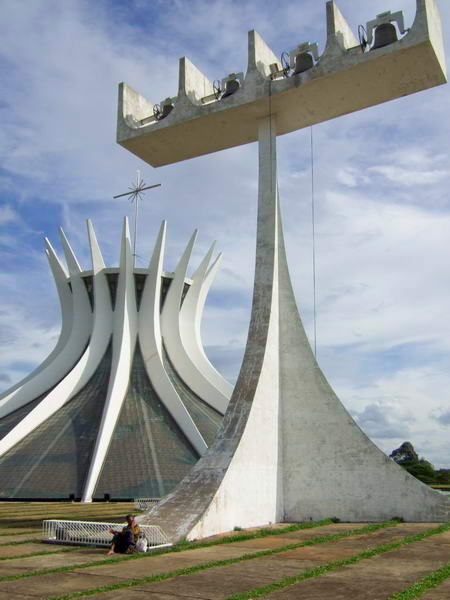
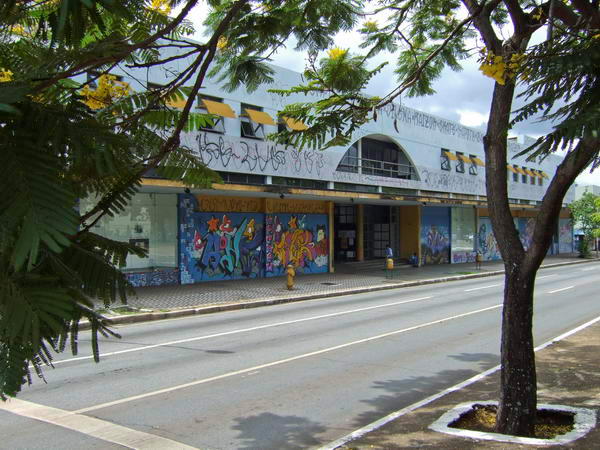
Almost 30 years later I got to visit Brasilia, where modernism essentially ended – and incredibly its architect Oscar Niemeyer is still alive at 104. I arrived there the day after his 100th birthday, and was shown around much of the city by the daughter of one of the planning team who worked with Lucio Costa (1902-98 – who incidentally went to secondary school in Newcastle upon Tyne.) It was of course a prestige project and its signature buildings still lift the spirit despite the city’s faults.

© 2007 Peter Marshall

On a smaller scale, Costa’s “superquadras“, the neighbourhoods which repeat across the city, seem so much more lively and human than anything our own New Towns have to offer.  Simone de Beauvoir wrote of their “air of elegant monotony”, but perhaps they have matured with age, and certainly some of the elegance is still there, along with a vibrancy we can’t match.

Harmondsworth Great Barn Saved

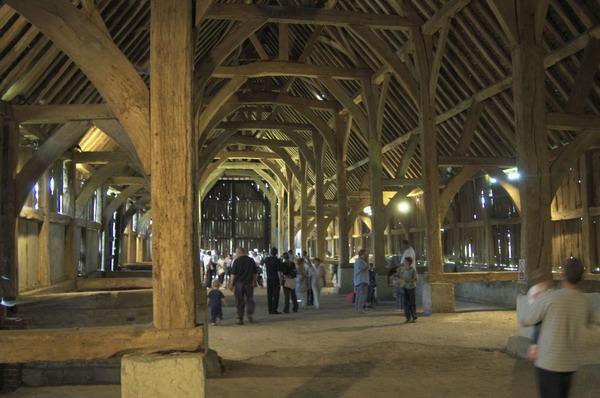
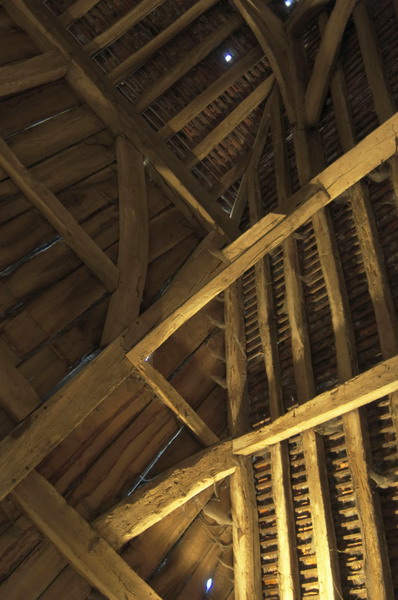
Half-awake in bed this morning I was lifted out of my dreams by an item on the Radio 4 Today programme, about Harmondsworth Great Barn, which has apparently been bought for the nation for a knock-down £20,000. It’s a sum that would hardly buy a garage or a garden shed out here in West London, and the barn is notable among other respects in its size. I think the BBC reporter said it was 20 metres long, which she helpfully added is almost 60 feet. Or as we say in the real world, just over 65 ft. But it was early morning and I could be wrong. On the ground the barn is over 60 metres long – 192 ft – and 11 metres high (37 ft) really giving the impression of a vast wooden cathedral (John Betjeman called it ‘The Cathedral of Middlesex‘, with a central nave and two side aisles giving a total width of around 12 metres (38 ft.) Its 12 bays are supported by giant oak columns, whole trees selected and cut to shape, with a tremendous amount of woodwork, of which over 95% is thought to date from 1426 when the barn was built by Winchester College to house the vast yield of wheat from its lands.

© 2003 Peter Marshall
The people give a good indication of the size of the Great Barn

It was a typical BBC report, sprinkled with such inaccuracies – she spent some time telling us we might have flown over it on our way in or out of Heathrow, and about the planes flying overhead. Unless they take a sharp left or right halfway down the runway they don’t – the Great Barn is 1.3 km directly north of the northern runway. You can hear the planes, see them shortly after they leave or reach the ground, but they don’t go overhead either on take-off or landing. That treat is reserved mainly for the residents of Hounslow and London to the east and Poyle and other places to the west.

© 2003 Peter Marshall
Splendid oak beams, cut in 1426 support the tiled roof.

In truth English Heritage paid £199,999 more of our money than they needed to, as they were offered the Great Barn for £1 in 2003, but amazingly declined to buy. The Guardian quotes Simon Thurley, chief executive of EH as saying “Harmondsworth Barn is one of the greatest medieval buildings in Britain, built by the same skilled carpenters who worked on our magnificent medieval cathedrals. Its rescue is at the heart of what English Heritage does.” You would have thought it would have been worth a quid – particularly before the recession and the cuts! Three years later the owners were bankrupt and it was bought by a trust who paid a pound for it, and more or less left it to rot, presumably hoping to make money from the sale of the site for the airport extension.

The site, as the Society for the Protection of Ancient Buildings, (better known as SPAB) explains, is both a Grade One listed building and a Scheduled Ancient Monument (SAM). Unfortunately the SAM listing means that enforcement powers which can be used against owners of listed buildings to force repairs do not apply. Bizarrely there are no comparable powers for SAMs, which have to rely on the slow process of English Heritage getting permission from the Department for Culture, Media and Sport to get things done. Although it had been well-maintained until around 2003, since then it has been neglected, falling to pieces over the past 8 or 9 years and costing us more to put right.

© 2003 Peter Marshall
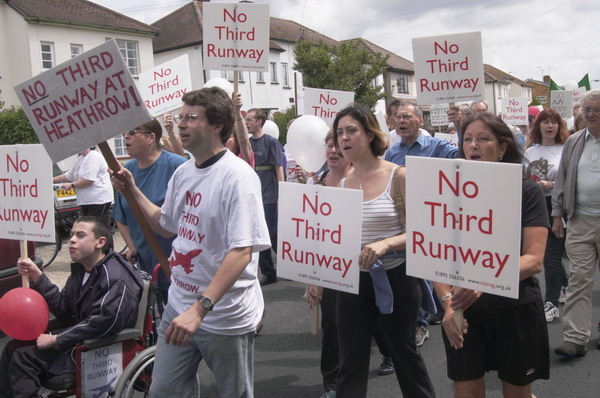
Protesters march from Harlington to a rally at Harmondsworth in 2003

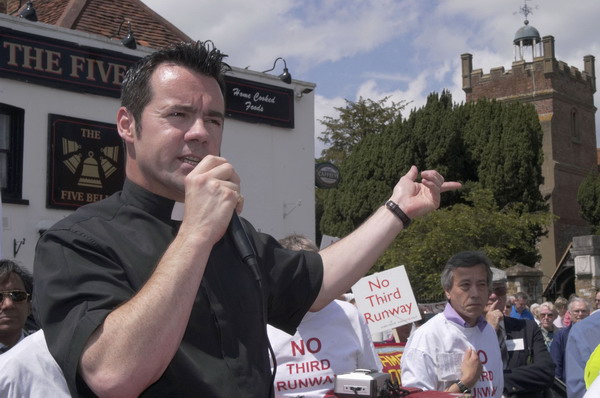
The most significant omission from the BBC report was any mention of the fight to stop the third runway at Heathrow – its western end would have been just a few metres from the barn and the church a few yards away. As well as the runway, the plans also included the building of a new and busy road past the site. At the moment it’s just off a quiet (apart from the planes three-quarters of a mile away) triangular village green with pub, church and cottages on a road that leads to nowhere – on a bike you can continue to Harmondsworth Moor and walk or ride along by the River Colne or the Wraysbury River, an area of grass and woodland away from anywhere except aurally, with the noise of the planes largely drowned by the continual rumble of the M25 and M4!

I visited the barn and took pictures inside it on the day of the first large protest march against the third runway. We held the rally on the green outside the pub, and there was a specially brewed beer for the campaign. Despite the closeness of the airport, the area retains something of the character of the Middlesex villages I rode through on my bike as a boy in the 1950s.

© 2003 Peter Marshall
The rally on Harmondsworth’s village green, outside the Five Bells – the barn is just a few yards down past the right of the pub

Even in the fifties, we knew that Heathrow Airport was in the wrong place for London’s major airport as the planes thundered over shaking our Hounslow house just two and a half miles from touchdown. The aviation industry who planned it in the 1940s knew that they could only get it there by stealth, under the pretence it was needed for military purposes, a deliberate deception which has since been acknowledged. By the 1980s and 90s the need to build a new airport was so clear that it seems criminal that successive governments ignored it. Then as now, the obvious site was not ‘Boris island‘ but somewhere to the north-west of London, close to the M1 and the west coast mainline, perhaps in an area already despoiled by abandoned brick workings, and with flight paths that avoid our major centres of population.  But government after government fudged the issue and instead gave way to pressure from the aviation industry to expand Heathrow, terminal by terminal, each one promised to be the final expansion. It’s long past time we got a vision for the future of Heathrow that looks at the site as an opportunity for a future new town rather than as an airport.

© 2009 Peter Marshall
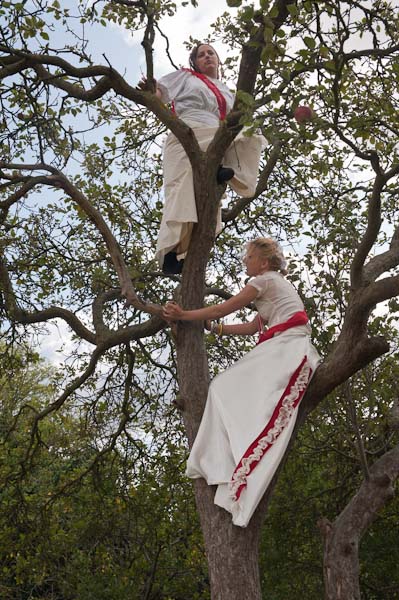
Climate Rush scrumping at the nearby Heathrow Airplot, September 2009

The Great Barn has for some years only been open on special occasions – mainly the annual Open House Day. According to The Guardian report cited above, it will be open two Sundays a month from April, free to the public, thanks to volunteers from the local Friends of Harmondsworth Barn, and it is well worth a visit, though I hope there will not be too many cars blocking the local lane’. There is a car park for the Colne Valley park a fairly short walk away which I hope visitors will be encouraged to use. I hope too you will be able to enjoy fruit from the adjoining orchard, seldom harvested in recent years, which Grow Heathrow paid a visit last October. Before the airport, this was an area famed for its market gardens and orchards, one of the agriculturally most productive areas of the country (and the home of the ultimate apple, Cox’s Orange Pippin – and Richard Cox was buried in the churchyard) – which is why Winchester needed such a huge barn.

There Be Dragons (and Lions)

 © 2000 Peter Marshall
Chinese New Year, Soho, London, Feb 2000

2012 sees the Year of the Dragon, just as it did in 2000, but this year it is the water dragon and then was the metal. But London’s Chinatown will be full to bursting again today as the Chinese New Year is celebrated, though this year I won’t be going to join the crowds.

© 2000 Peter Marshall
Chinese New Year, Soho, London, Feb 2000

I’ve photographed the Chinese New Year on quite a few occasions, and it was one of those events that even before everyone was a digital photographer was decidedly over-saturated with photographers. All of the amateur photographic magazines listed it in their ‘events to photograph’ and clubs organised day trips to the event.

© 2000 Peter Marshall
Chinese New Year, Soho, London, Feb 2000

It can still be enjoyable to be there, though perhaps Chinatown is better almost any day of the year if you want to eat there or take pictures of anything other than the lions or dragons. I quite like photographing in crowds, but today it will just be too full of people. If I went I might not even bother to take a camera, though actually I’d take one – perhaps just the Fuji X100 – just in case something came up.

© 2000 Peter Marshall
Chinese New Year, Soho, London, Feb 2000

In 2000 I took three cameras, and one was the Konica Hexar, the film equivalent of that Fuji, with a fixed 35mm f2 lens, which achieved cult status as the ultimate available light fixed lens camera and in ‘stealth mode’ had the quietest shutter and motorised film advance ever made for 35mm, although this was hardly needed at such a noisy event. Using it I took around 20 frames on Ilford XP2 black and white chromogenic film.

© 2000 Peter Marshall
Chinese New Year, Soho, London, Feb 2000

My second camera was also a Konica, the then very new Hexar RF, a camera that was everything the Leica M7 a couple of years later should have been and wasn’t, surely the ultimate film Leica, though like the later Leica models not engineered as well as the M2. It could have been one of the two other Leica fitting bodies I owned. I took around a dozen frames and then obviously gave up, and went to do a little urban landscape elsewhere in London away from the crowds. All the pictures I took with the camera that day were with a very wide angle lens, the 15mm Voigtlander which had come out the previous year, and seems to have been the only lens I took with me.

© 2000 Peter Marshall
Chinese New Year, Soho, London, Feb 2000

But this was also the first time that I tried working with a digital camera, although one that was fairly primitive by today’s standards, a FujiFilm MX-2700 which was one of the first 2.3 megapixel cameras available in mid-1999, with a fixed 7.6mm (equiv to 35mm) F3.25 lens. The pictures – up with the best at least in consumer digitals of the time – as you can see here are a little crude, with rather garish colour and a distinct lack of detail in the skin tones, and I struggled to get a decent 6×9 inch print from the 1800×1200 pixel jpegs even when taken at the finest quality. But they do give some idea of what it was like, and it probably won’t be very much different this year.

Some years I stuck it out longer in Chinatown and took rather more and better pictures – including one that has made me a decent amount of money over the years in a few books, although I don’t think it was anything very special. But today I think I’m going to stay at home and rest my aching knee, still recovering from a minor slip getting down from a fence a couple of weeks ago.

Stereo With One Eye

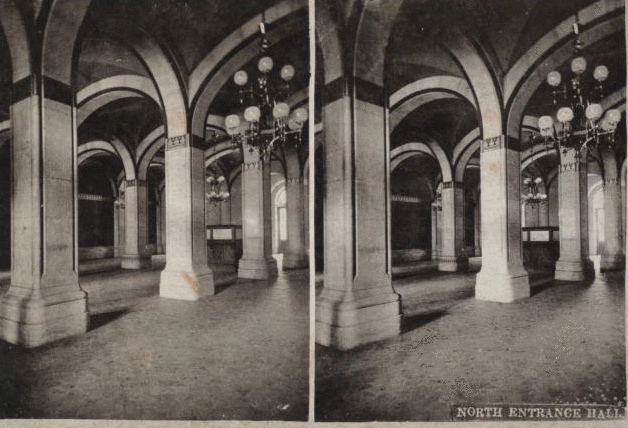
One of several presents I gave my wife for Christmas was a book of old stereo views of London which came with a built-in viewer to see them. It wasn’t a great publication, though there were a few interesting pictures, it didn’t really give a very good overview of the city.

Back in Victorian times, no parlour was complete without a stereo viewer, usually wooden with two lenses to hold at your eyes and a slot the correct distance away to hold the stereo cards, which enabled you to view all the wonder of the world in your own home.

We passed the book around on Christmas afternoon and everybody had a look. Some people found it difficult to see the pictures in stereo, there is a slight knack to it and it gets much easier with a little practice. At least for most people it does, but there are some who just can’t do it, and my elder son is one of them. Born with a squint that was cured by an operation when he was small, although his sight is fine his two eyes just don’t work together.

So I’ll be interested in how he gets on with the Stereogranimator from the New York Public Library, which they developed to let people look at around 40,000 stereo views from their collection, either as  “wiggle stereographs” or ‘anaglyphs’. Anaglyphs are the familiar two-colour views that you need special two colour glasses to view, but the ‘wiggles’ were new to me. They make seeing the images in stereo without glasses very easy, almost impossible not to see, by displaying the two images in the same frame as two images in an animated gif, wobbling rapidly between the two. It’s a bit annoying but definitely 3D.

GIF made with the NYPL Labs Stereogranimator - view more at http://stereo.nypl.org/gallery/index
GIF made with the NYPL Labs Stereogranimator

Of course if you have your red/cyan glasses handy it will look a lot better as an anaglyph – I just made this one on the NYPL site:

ANAGLYPH made with the NYPL Labs Stereogranimator - view more at http://stereo.nypl.org/gallery/index
ANAGLYPH made with the NYPL Labs Stereogranimator

Years ago I made some high quality anaglyphs using a pair of Olympus OM4 cameras joined together at the base by a short length of screw thread which fitted both tripod threads, letting you screw the two cameras, each fitted with a 50mm f1.8 lens into a nicely solid lump with the two lenses pointed in the same direction.  The lens centres were at roughly the same distance apart as my eyes which gives a nicely natural stereo effect.

The rig was completed with two cable releases tied together and the two plungers joined (I think I could have bought a double release, but that would have cost money) and it was possible to use handheld, taking pictures onto black and white film. The lack of the normal orange mask caused some problems when printing onto normal colour paper  (later Kodak produced an orange-masked black and white chromogenic film to make printing on colour paper easier, but what I needed were not neutral exposures, but a red and cyan exposure, one from each neg, made one after the other vaguely in register on one sheet of paper, adjusted so that where both where the same the print was roughly neutral. It took a little trial and error to get the best effect.

Thanks to PetaPixel for the information about the NYPL site, and there are a few good examples on their site, but you can go to the NYPL and select from their huge collection, or make a new one from their images as I did for the anaglyph.  It wouldn’t be too difficult to make some from your own pictures with Photoshop either – just take a couple of pictures from a short distance apart – perhaps 3 or 4 inches –  as  your starting point

Ansel Adams on Film

Ansel Adams is not one of my real favourite photographers, perhaps because his view is both very American and also from an earlier era*; it’s fine to admire what he did (and in many ways I do) but it has inspired too many to try and do the same, and the results are almost always uninspiring and insipid.

I did learn a lot from him, and his ‘Basic Photo‘ series in particular, teaching myself to print from an old copy of one of the volumes that I came across by accident in our local library when I moved to a new home in 1974. I ended up buying my own copy of ‘The Print’ and the other volumes in the series. But Ansel taught me how to print, and it was then a true master-class, though later editions of the work did get somewhat dumbed down.

I sat down at the computer today to write about something completely different, then spent the best part of 80 minutes (I did fast-forward a little) watching  the PBS documentary on Adams that I found on the Peta-Pixel site. As it says, “an elegant, moving, and lyrical portrait” though perhaps sometimes lacking in critical bite about his photography.

After watching it, I went to take another look at some of his photographs, which he also deserves to be remembered for and are too often forgotten, on the Library of Congress site, Ansel Adams’s Photographs of Japanese-American Internment at Manzanar.

Ten years ago, at the time of the centenary show of his work, I wrote about Ansel Adams at some length as well as reviewing the show, but those features are no longer available. Written at the same time and published in The Atlantic Monthly was a long piece by Kenneth Brower, still available on-line and worth reading.   Among many other things he tells how MoMA in New York censored the show of his Manzanar work, insisting on the removal of a panel by Nancy Newhall referring to a letter written by Lincoln and including the words:

As a nation we began by declaring that “all men are created equal.” We now practically read it as “all men are created equal except Negroes.” 

MoMA insisted on the removal of this panel and that the original title of the show be changed from “Born Free and Equal” to “Manzanar: Photographs by Ansel Adams of Loyal Japanese American Relocation Center.

_____________________________________________

*But that doesn’t stop me liking Walker Evans.  I think there is a line between creating creative landscape images and pretty pictures that just sometimes Ansel Adams got the wrong side of. Or perhaps I just prefer the classical to the romantic. Or think it wrong that there were people who failed to realise that Edward Weston was so much a better photographer!