NHS Protests Continue

Pressure is mounting on the UK Government to abandon its ‘reform’ of the National Health Service, which many see as privatisation, and it has become something of a scandal with the revelations of the extent of involvement of a discredited US healthcare company in its planning.

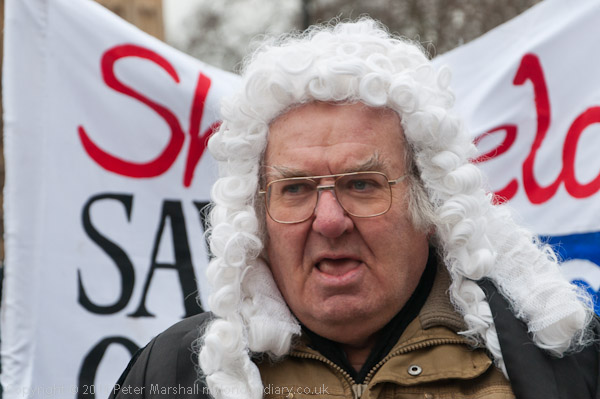
As someone who grew up with our Welfare State, I was with the protesters both physically and in spirit as they held a mock trial of  Andrew Lansley, the minister responsible opposite parliament as the debate continued inside over the Health and Social Care Bill. The trial wasn’t really very visual, though at least in street theatre if no longer in courts judges do come with very splendid wigs.
© 2012, Peter Marshall

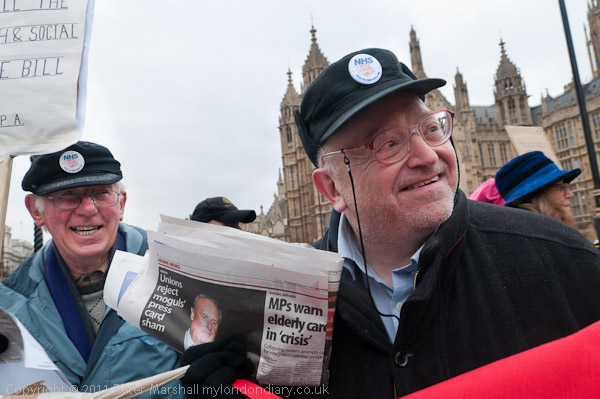
I’d tried to photograph a group of pensioners in the protest, but hadn’t been very happy with the results, but standing to one side while a colleague went in close and made a portrait of one of them gave me the time to think more about it. After he had finished I moved in and made a few exposures, including one that I was pleased with.
© 2012, Peter Marshall

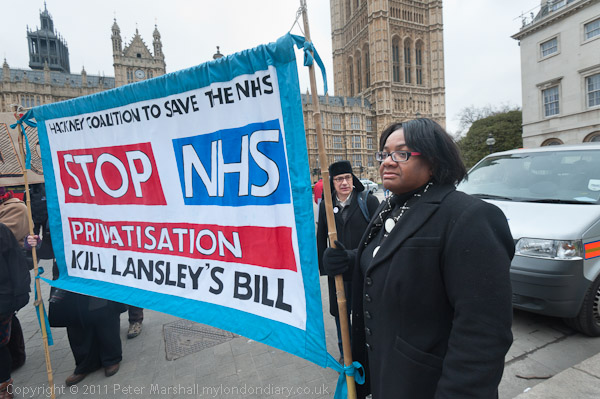
Probably the most news-worthy aspect of the was perhaps rather less interesting, with Diane Abbott MP, Shadow Minister for Public Health coming to support her constituents who had organised the protest. I didn’t manage to find any way more than a workaday image showing her holding the banner with parliament in the  background.
© 2012, Peter Marshall

I was on my way to another protest and had stopped to talk with the three people at Brian Haw’s Parliament Square Peace Campaign, still keeping up a 24/7 vigil there – now for 10 years 8 months – despite the police removing Barbara Tucker’s tent, other personal possession and anything else that could give her comfort or shelter in mid-January when I saw the NHS protest was continuing and dashed across the rather busy road to photograph a small group now touring around Parliament Square.

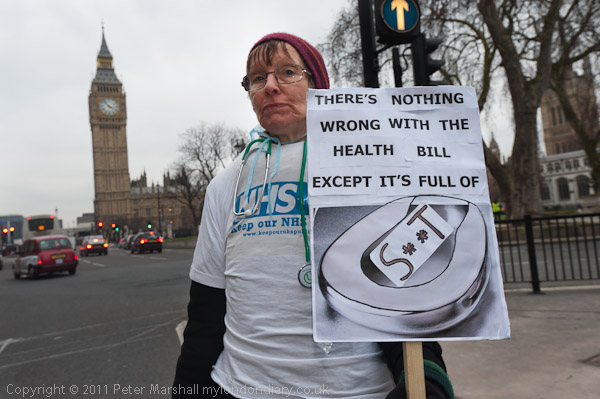
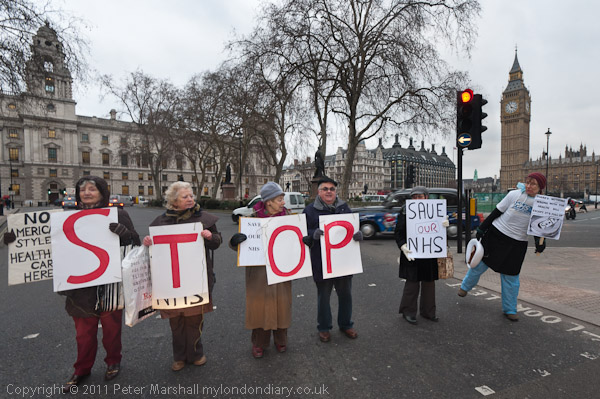
There were six of them, equipped with placards ‘Save Our NHS’, ”No US Style Healthcare Here’, the four letters ‘S’, ‘T’, ‘O’ and ‘P’ (which they sometimes got in correct order) and a bedpan with its own placard ‘There’s Nothing Wrong With The Health Bill Except It’s Full of S**t’.
© 2012, Peter Marshall

I didn’t have long to work, as they only stopped on the crossings while the green man was showing and were being urged to move along by a couple of police.
© 2012, Peter Marshall

This was perhaps the best frame, as not only are all the placards more or less readable, but I liked the woman with the bedpan and placard apparently doing a little dance on one foot in front of Big Ben.

More at Stop NHS Privatisation – Kill Lansley’s Bill.

________________________________________________________

My London Diary : Buildings of London : River Lea/Lee Valley : London’s Industrial Heritage

All photographs on this and my other sites, unless otherwise stated are by Peter Marshall and are available for reproduction or can be bought as prints.

To order prints or reproduce images

________________________________________________________
New York Prints

Where I in New York rather than old England, I would be making my way to the  Howard Greenberg Gallery, which currently has several shows worth a visit.

New York in Colour has quite a few interesting images, but it perhaps somewhat of a ragbag show of gallery inventory.  The odd web design probably means many visitors never get to see the 42 images on show, as the link from the thumbnail only works close to its top edge. In the main it is the earlier work that has most interest for me, and perhaps the only interesting image from this century is one of Abelardo Morell’s Camera Obscura images.

Among the earlier work are some good images by a number of photographers, including Danny Lyon, Micha Bar’am, Evelyn Hofer, Helen Levitt and Erwin Blumenfeld (and a few rather weak works by some others) but I was particularly pleased to be introduced to the work of Marvin Newman, who has an enviable biography, having studied for his BA with Walter Rosenblum who suggested he take classes with John Ebstel at the Photo League, and later studing with Harry Callahan and Aaron Siskind at the Chicago Institute of Design where he was one of the first students to gain an MS in photography in 1952. The best place to see more of his work is probably at the Bruce Silverstein gallery.

Those who manage to find the 24 images for An Italian Perpective will also find some images worth looking at. I’ve always found the work of Luigi Ghirri (1943-92) extremely uneven, but there are a few intriguing images among those shown here even if it is hard to imagine why he felt others worth taking or printing. I’m always pleased to see work by Gabriele Basilico, and there isn’t too much else. And although there is a picture by Massimo Vitali, his work always looks much better small on the web than it does large on the gallery wall, where I find it curiously devitalising.

But most interesting of all for me is the third show, like the others ending 17 March 2012, on the work of the Photo League, including pictures by some of the well known names as well as a couple I’ve hardly heard of before.  But of course the place to go to see more of their work is the Jewish Museum, where the show
The Radical Camera: New York’s Photo League, 1936-1951 continues until 25 March 2012, and has a fine web site, which I could and probably will spend hours looking through. I wrote several pieces about the Photo League in my earlier on-line life, as well as on a number of the photographers involved, and ten years ago there really was very little information about them on the web.

One oddity which emerges in the New York in Colour show is in the description of the prints. Greenberg appears to have invented the “Chromogenic inkjet print“, a curious hybrid of two very different and competing methods.

Chromogenic refers to silver halide based processes in which the development of a silver image is accompanied by the production of coloured dyes from the oxidised developer molecules by reaction with dye couplers. Normally we call such prints ‘C types’. Nowadays most C types are made from digital images – something that is sometimes called a ‘digital chromogenic print’ – and you can see and hear on his web site what Richard Benson thinks about that.

Benson points out that digital chromogenic prints have all the disadvantages of darkroom C-types – fairly poor colour reproduction and rapid deterioration, whereas good inkjet prints can give much better colour and last longer than the photographers who make them. But he stresses more that while digital chromogenic prints require hugely expensive lab equipment, good inkjet prints can be made on cheap printers, enabling photographers to do their own printing.

I don’t particularly buy that. The important part of printing, the magic laying on of hands that we used to do in the darkroom that made some people better printers than others has now moved away from the actual physical printmaking stage to the preparation of the file on the computer. And if I then send my file off to the lab, I’ve already done the creative part of the process.

But of course ‘chromogenic inkjet print‘ is just nonsense. Either it is chromogenic – a C-type – or it is an inkjet. Certainly not both. Just another indication that many guys in galleries don’t have a great deal of knowledge or understanding of our medium. Their expertise and knowledge is all about making money.

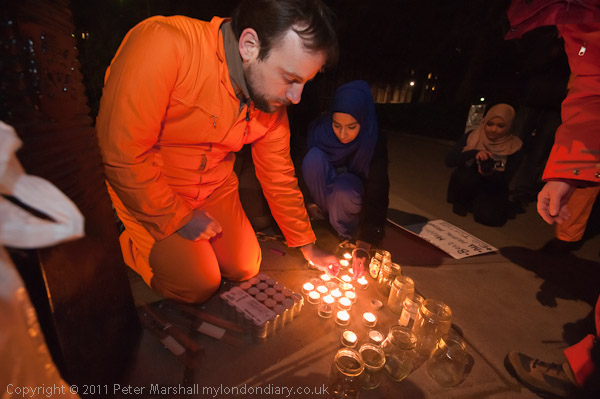
Candles at the Embassy

I suppose it’s the time of year, but I seem to have been spending rather a lot of my time taking pictures in the dark recently.  Although I work mainly in the centre of a major city, I find it surprising how stygian some parts of it can be.

© 2012, Peter Marshall
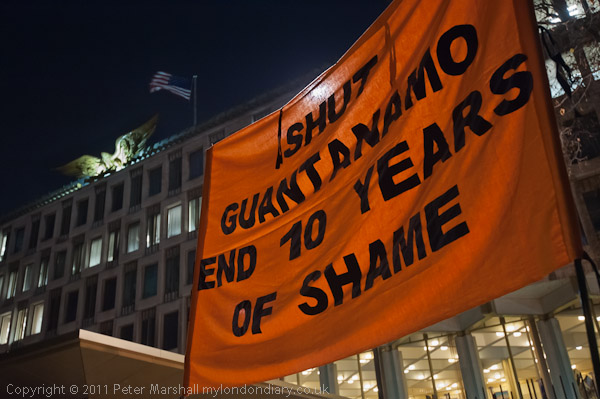
One of few pictures without flash: ISO3200 1/4s f4, hiding a spotlight behind the banner

The lighting along the west side of Grosvenor Square seems to rely mainly on the many windows along the rather formidable frontage of the US Embassy, and for some reason (surely not energy-saving from a country that seems rampantly denying climate change) most of those in the centre of the building were off.  It made me think that here was a building hiding its face in shame, as well it might over its treatment of detainees at Guantanamo.  There was lighting away from the centre of the building, and a little on the head of the eagle lowering on its roof, though the wings and flag rather faded into the darkness. A little burning and dodging was needed to bring them out in the picture above.

Photographically the situation was made worse as penetrating the general gloom were a few powerful spotlights. They didn’t seem to give a great deal of light anywhere, but could and did produce some nasty flare that ruined some of my pictures, as well as completely fooling the exposure system in my Nikons.  I generally use the matrix metering, which I thought was supposed to be able to cope with such things as backlit scenes and small light sources in the image, but experience shows it to be pretty hopeless, though it does work well with more normal situations.

© 2012, Peter Marshall
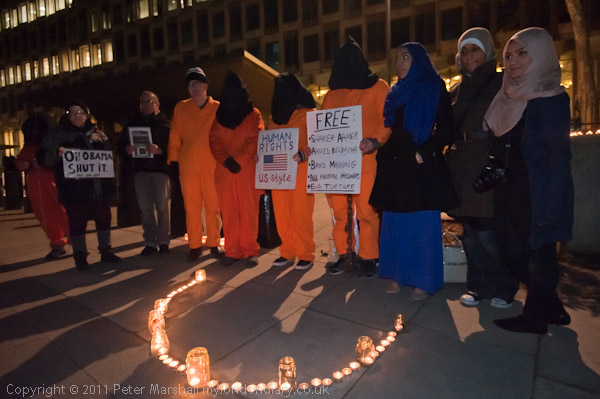
The heads and hoods only became visible with flash

Of course we now have cameras that give excellent results at ISOs that just a few years ago were almost totally unusable, so I was quite happy using the D700 at ISO 3200.  But there just wasn’t enough light even so to get decent pictures at shutter speeds suitable for hand-holding or photographing people who were not posing for pictures.

Had people been holding candles at chest level, there might have been enough light on their faces to give some pictures, but the candles were on the ground, and a group with well-illuminated knees doesn’t usually appeal. So for most of the pictures  I took I had to use flash.

© 2012, Peter Marshall
Lots of candles, but I still needed flash

It was an obvious decision, if one that goes against all the precepts of the available light school, those many articles I read over the years telling me how photographers destroy the atmosphere if they use flash.  And certainly you can, and many people have done and continue to do so, but I hope to do better. Too often I still see pictures with people caught like rabbits in the car headlights (Bill Brandt did it rather nicely in 1945 for Picture Post) which are seldom successful.

I set a high ISO – perhaps 3200 – and work with the camera on S – shutter preference auto – setting a speed which will probably produce a reasonably sharp result depending on the focal length and the amount of subject movement etc. Often a little blurring from gestures or people moving will add the the image. Typically this might be around 1/20 or 1/30s.  The exposure compensation is set to underexpose this by anything from 2/3 to around 2 stops, chimping until it looks around right. The flash is on its full auto flash fill setting, (TTL BL FP) and also set to something like -2/3 to -2 stops, again with a bit of fiddling if I have time. Probably I’m doing it all wrong, but it seems to work, so long as I don’t forget it will overexpose at closer than a couple of feet from the subject and I need to stop things down more.

The Nikon SB-800 flash I use does seem to be a little temperamental. Or perhaps it is the camera, once the two electronic systems are wedded together it’s hard to know which to blame. Every so often I seem to get a frame or a few frames that are hopelessly over-exposed. And recently when I’ve got the flash attached and on the camera it’s taken to emitting the occasional random flash when I’m not taking pictures. I sense an expensive repair coming on.

Text about the event and more pictures – almost all using flash – in London Guantánamo Campaign Candlelit Vigil on My London Diary.

________________________________________________________

My London Diary : Buildings of London : River Lea/Lee Valley : London’s Industrial Heritage

All photographs on this and my other sites, unless otherwise stated are by Peter Marshall and are available for reproduction or can be bought as prints.

To order prints or reproduce images

________________________________________________________
Cruel & Unusual

Regular readers will know that I’ve often mentioned Pete Brook’s Prison Photography blog on these pages, as well as his posts on ‘Wired’s ‘Raw File‘ blog. He’s someone who has often raised interesting issues, both photographic and political, and the forthcoming show Cruel and Unusual at Noorderlicht which he is curating together with Hester Keijser which runs from Feb 18 to April 1, 2012 looks to continue in that vein.

I’ve just been looking through an preview copy of the catalogue, which has just gone to the printers. Designed as a newspaper, 4000 copies are being printed in newsprint, and it will be available free at the gallery, and with a small handling & shipping charge through the Noorderlicht webshop shortly. Worth getting in fast when it goes on line as copies should go quickly.

And here I should declare a small interest, as one page of the publication is given over to (free and by invitation only) adverts for photography blogs, and its an honour for >Re:PHOTO to be listed there with many that I admire.

Thanks to Peggy Sue Amison, Artistic director at the Sirius Arts Centre in Cobh, Co. Cork for posting a link on Facebook to a couple of good and well-illustrated preview features on Elizabeth Avedon’s blog (and I think the answer to the question you may be asking is yes) CRUEL AND UNUSUAL: Prison Photography Exhibition Part I  and Part 2.

[Observant readers will notice that this post only went on line after my second post on the show, Cruel & Unusual 2.  It was written two days earlier but somehow I clicked ‘Save’ rather than ‘Publish’! as I hurried out to take some pictures.]

Cruel & Unusual 2

There is now a link to the Cruel and Unusual newspaper on the Noorderlicht Photogallery Exhibition page.  Here are some pictures of it sent to whet my – and I hope your – appetite:

Image from H Keijser

Image from H Keijser

Image from H Keijser

The show is at Noorderlicht in Groningen from Feb 18 – April 1, 2012 and is open Wednesdays to Sundays 12-6pm and is free. Don’t miss clicking on the more photos link on the exhibition page or use the links below to see work by Araminta de Clermont, Amy Elkins, Christiane Feser, Brenda Ann Kenneally, Jane Lindsay, Deborah Luster, Nathalie Mohadjer, Yana Payusova, Lizzie Sadin and Lori Waselchuk.

Paper copies of the newsletter will be available from 18 Feb.

[A posting error meant that this post was published before Cruel & Unusual  written a couple of days earlier]

World Press Photo

Spanish photographer Samuel Aranda‘s picture from Yemen showing a woman holding a wounded relative in her arms inside a mosque used as a field hospital by demonstrators against the rule of President Ali Abdullah Saleh looks to be a worthy winner of the 2012 World Press Photo.

And a quick glance at the other images on the front page of the site – which includes some familiar names and images along with many new to me – suggests that this might be a better year than some for the contest. But it will certainly take some time to have a real look through all the work.

Pictures Not Words?

I tend to agree with Ctein‘s view on The Online Photographer “that most decent art is capable of speaking for itself. With occasional exceptions—and there are always exceptions—I think that work that cannot be understood in its own vernacular is not successful work.”

And having belonged to a number of informal photographic groups over the years – although none that centred around a “potluck” or my waistline might be rather larger – I certainly think that there are some photographers who talk too much about their own work. But that doesn’t mean I’m against talk, just that if you are going to benefit from such meetings (other than in culinary satisfaction) then you need to come ready to listen and reflect on what other people have to say about your work rather than try to con them into thinking how you do.

And I’ve learnt much (or at least I think I have) from looking carefully and thoughtfully at the work of other people and then attempting to articulate those thoughts. It’s a process of sharing ideas that can be stimulating, and has often been stimulated by the presence of a little alcohol, though too much can lead to trouble.

I’ve also been to many exhibitions where the true work of art has not been the photographs on the wall but the artist’s statement – and some of our fine art photography courses seem to be far more directed to producing these than meaningful and well-crafted images.

But although I’ve never been to San Francisco and visited Andy Pilara‘s Pier 24, a photography museum (entrance free but by reservation only) which displays work without text in the galleries – though there is an exhibition book you can pick up which may give you some basic information, I think that unlike Ctein I would find the experience annoying rather than indescribable.

I felt a little of this at the brief visit I was able to pay to Lise Sarfati‘s exhibition ‘She‘ at London’s Brancolini Grimaldi gallery in Albermarle St (as usual I was in Mayfair to photograph a protest outside the US Embassy.) Although there was what I think is an excellent gallery handout, with information on the photographer and the work – and with San Francisco connections, with the text – written in English rather than Artspeak – was by Sandra S Phillips, Senior Curator of Photography at the San Francisco Museum of Modern Art and some of the pictures were taken in San Francisco, the 27 pictures in ‘She‘ were displayed on an otherwise bare white wall.

Very arty perhaps, but not very practical as I struggled to relate the positions on the wall to the numbers on a plan of the gallery. Because ‘She’ is a work about identity, and all of the 27 images show one of four American women, two sisters and the two daughters of one of them, who often wear wigs or makeup that makes them hard to distinguish, it is  important at some stage in viewing (though possibly not initially) to know who it is in the picture. I would certainly have welcomed some small and discreet labels that gave me the information such as ‘Christine #10 Hollywood, CA 2006‘ or at least the numbers of the images rather than having what seemed to me to make it into a kind of parlour game, working out from the position on the wall the number of the picture I was viewing and then turning over the sheet to consult the list to find the caption.

Perhaps if I was the kind of person who, in an otherwise empty gallery, would look at the plan first and then go around it in the sequence indicated by the numbers I would have found it easier. In crowded galleries you really have to stay in line, which is one reason why I tend to avoid the blockbuster art shows; I always like to do things my own way.

But ‘She’ is certainly a show worth visiting, and continues until 17 March 2012. I’ve written about Lise Sarfati before, mainly elsewhere, though I did find the five pictures from  ‘She’ on the Brancolini Grimaldi stand one of the highlights of my 2010 trip to  Paris Photo. She was one of the three or four Magnum members I remember enthusing about on a lengthy car journey with a person from Magnum in 2005, not long after I had written about her work. You can read a review of the show by Sean O’Hagan in The Guardian, which also has a short video and seven of the images.

So while I often find the words on gallery walls or the photographer’s spiel an annoying distraction, I think that it isn’t because there are word with pictures, but because they are things that don’t help you to confront the images. But there are sometimes words that are necessary, and sometimes those that enhance the experience. Let’s have shows with that kind of texts and not just pictures on blank walls.

January 2012

© 2012, Peter Marshall
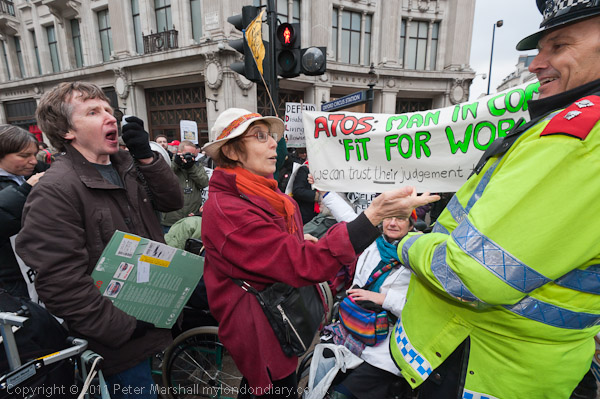
Disabled argue with police at Oxford Circus protest
I’ve finally decided that January has ended and that I’ve put all the work that I’m going to post for it on My London Diary.  I’ve mentioned most of the stories on here before, but here’s the set of links for the month so you can go directly to any of them.

No War Against Iran & Syria
Disabled Welfare Reform Road Block
Around Trafalgar Square
Westminster Bikers Parking Protest
Egyptians Protest Against SCAF
Peace For Iran – No To War
Congolese Keep Up Protests
Parliament Square Peace Camp
National Gallery on Strike
Welfare Reform Bill Lobby at Parliament
Parliament Square Protests Continue
Arbaeen Procession in London
EDL March in Barking
Bikes Alive – End Killing Of Cyclists
Bhopal: Drop Dow From London Olympics
London Mourning Mothers of Iran
Shut Guantánamo: End 10 Years of Shame
53 Years Of Cuban Revolution

Although they may look slightly different because of a different style-sheet, these are the links that are on the left of the January 2012 page. If you use Firefox they conveniently stay fixed when you scroll down the page, but I’ve never managed to get Internet Explorer to do that – and there are other minor differences between how the two browsers display things. It sometimes annoys me, but never enough to get me actually trying to solve the problem, and I notice quite a few sites where similar things happen.

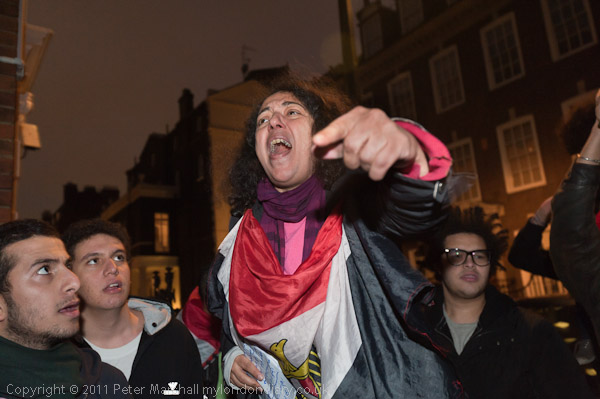
© 2012, Peter Marshall
At a stupid trivia quiz on Saturday I couldn’t even remember that Egypt has a bird on its flag!

I’ve been deliberately trying to cut down on work a little, and to start catching up with things – like scanning my work from the 1970s, and also wanted to get work on My London Diary rather faster than I had been doing.  I’ve had some success – after all it’s only a few days into February and I noticed the other day I still haven’t managed to post my pictures for October 2002 – and there are a few other gaps in the diary elsewhere too.

February will of course follow shortly!

D800 Announced

I imagine like many photographers my first reaction to Nikon’s D800/800E announcement was ‘Oh No, who needs 36Mp!’ or something rather less polite, but thinking a little more about it I’m not so upset, particularly as it offers a 15.4Mp DX option.

I’m also very pleased that at last Nikon have introduced a new Auto ISO system that relates the minimum shutter speed to the focal length in use, something I’ve long suggested –  since before cameras had auto ISO.

Other useful improvements appear to include a better LCD monitor and USB 3.0, though I’ve already moved over to faster transfers simply by using a USB 3.0 card reader. And certainly some with be pleased with the video, though it isn’t something that greatly interests me at the moment.

Of course my first reaction on hearing about it was to go to the ‘Hands-on Preview‘ on DPReview, much easier to read than Nikon’s own pages, and giving a little more idea of what it might be like to use. But as always it will be some time before any proper reviews that actually give us the details and in particular the performance of actual production cameras emerge.

But despite what Nikon calls its ‘light weight and compact size’, at 146 x 123 x 81.5 mm (5.7 x 4.8 x 3.2 in.) and 1,000 g (2 lb 3.3 oz) with battery and SD memory card it’s rather too big and heavy for me, more or less the same as the D700 I already have which is still working well, and which I don’t really have a need to replace. If I could persuade myself I could work with a single camera, I’d think much more carefully about it, as the ability to switch to DX mode and still get good size files would make a lot of sense. That 16-35mm would double as a 24-47mm as well as being able to use my existing DX lenses – such as the 10.5mm on the camera. Perhaps when I see the full reviews I’ll decide I can and get one to replace both the D700 and ailing D300.

But for the moment, I think I’m waiting for later in the year when perhaps we can expect the D400 (or whatever Nikon decide the D300S replacement should be called) – possibly to be announced in March, though likely rather later in the year. We may also see a replacement for the D7000 which might also be possible in place of the D300.

Nikon do rather seem to be making the running in DSLRs at the moment, just a shame they haven’t produced a serious competitor in the mirrorless class.

Old Snow

The winter of 1978/9 we had snow fairly seriously, and in the last few days I’ve been going through my contact sheets from that time, including quite a few pictures taken in the snow.

I went up to another workshop at the Photographers Place in Derbyshire with Paul Hill and Ray Moore, I think in early January, and it seemed quite likely that we would get snowed in. I’m not sure that we would have minded all that much, as we were all having a good time, though of course we all had work to get back to. As usual we went out a few times together taking pictures, including a visit to a snow-covered Alton Towers, but one of the few images I now felt worth preserving was one from a walk on my own along a snow-covered lane.  Most of those taken on the outings I seemed to be trying too hard to be ‘arty’.

© 1979, Peter Marshall

It didn’t help that the Leica M2 which I took most of the pictures (though I think the one above was with an Olympus OM2) with turned out to have a shutter fault – perhaps it didn’t like the cold weather, and it gave uneven exposure, with a strip at the right hand edge of the frame getting rather less than it should. As soon as I developed the films it went off for repair (at excessive cost, being a Leica) but by then I’d ruined quite a few images. I did manage to print some of the pictures fairly well, dodging the affected area – at least the boundary was a nice straight line, so a simple straight piece of card held in the right place and height above the paper could do the job. And now of course with digital it would me much simpler to correct.

© 1979, Peter Marshall

But we did manage to get home on time (I think with Peter Goldfield driving his van through the snowy roads), and I went back to work, but soon there was more snow, and there were several days when my colleague and I spent an hour or so trying to drive to work before finding roads closed or impassable. So I had a little unexpected time to wander around with a camera in the snow. But again most of the pictures I made seem now to have little interest. Again the exceptions were mainly those which were more straightforward – such as the surprisingly almost car-free Crooked Billet roundabout above.

© 1979, Peter Marshall

Perhaps the best of my snow images from 1978-9 was a scene in the snow at Marble Hill Park, on the banks of the Thames in Twickenham, where a group of boys were cycling on the snow-covered grass. I only had time for a couple of frames as they were moving around, and the first, taken a second or two earlier shows a fourth cyclist going away to the right of the group.  I moved to more accurately line up the cyclists with the house and managed to take this frame with just the three of them in a tight group in a near-silhouette against the snow. Although it has a wide-angle feel with that wide expanse of snow, I think the only lens I had for the Leica (fortunately now repaired and working well) on which it was taken at the time was the collapsible 50mm f2.8 Elmar. Taken in a hurry it also had quite a slope to the horizon and needed a little rotation and subsequent cropping.

© 1979, Peter Marshall

Here was the only example of the ‘artier’ snow pictures I bothered to scan, and this shows the entire frame.  I suspect when I took it I didn’t mean to include the black spot near the top right corner, but decided not to crop it. The picture has a certain mystery about it that I like (it could be an alien landing site) and I’m not going to dispel by telling anyone much about it!