Workfare

Although London and the South-east of England are suffering from a drought, with low rainfall over the past 18 months and bans on the use of hose-pipes coming in, I started March photographing in the rain on Oxford St, though it did clear up a little later. It was only light rain that day, but since then most days I’ve been out taking pictures it’s also rained, enough to make photography a little tricky on a couple of occasions.
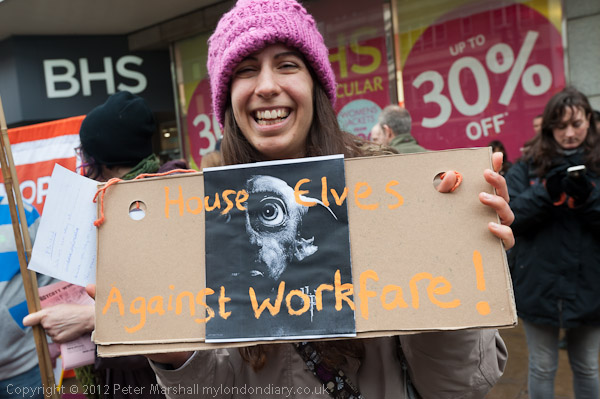
© 2012, Peter Marshall
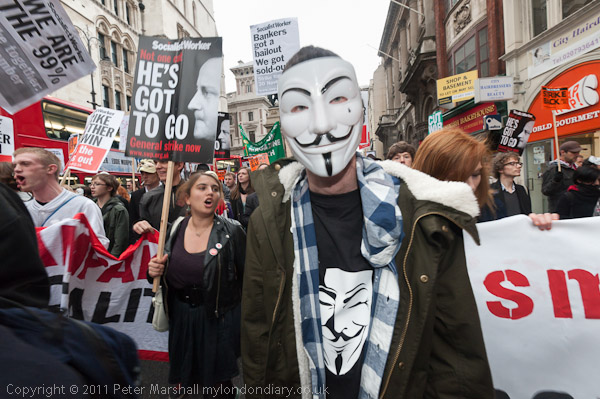
A Harry Potter reference

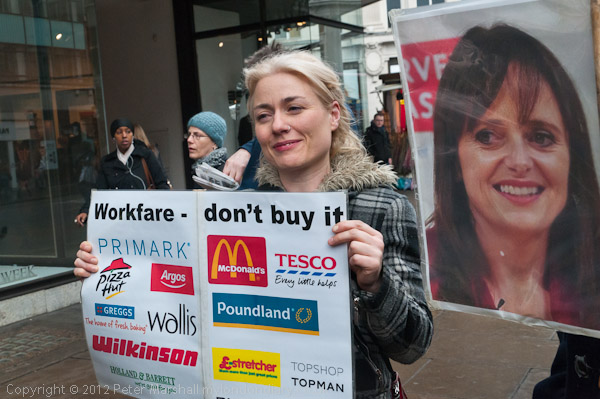
I was on Oxford St to photograph a protest against the government’s workfare scheme, which involves those out of work being forced to take unpaid jobs, supposedly to get experience of work, with major employers who have elected to be a part of the scheme, in order to retain their benefits. The companies involved get workers for nothing, and the benefits amount to around £1.78 an hour compared to a national minimum wage of just over £6.
© 2012, Peter Marshall
It was tricky to get both the message and logo and Emma of A4e

If the workers were really being trained it might be an acceptable scheme, but in most cases they are simply being used for unskilled work, replacing paid workers. Not surprisingly it has been labelled ‘slave labour’ by many.

For once this is an issue where protests have clearly been effective, with quite a few companies actually withdrawing from the scheme. The protesters met outside BHS, and the protest started by hearing that since it had been organised, BHS had decided to stop participating, so they were off to protest elsewhere. The instruction, to protesters (and of course also photographers and police) was to follow the two flags to the next destination.
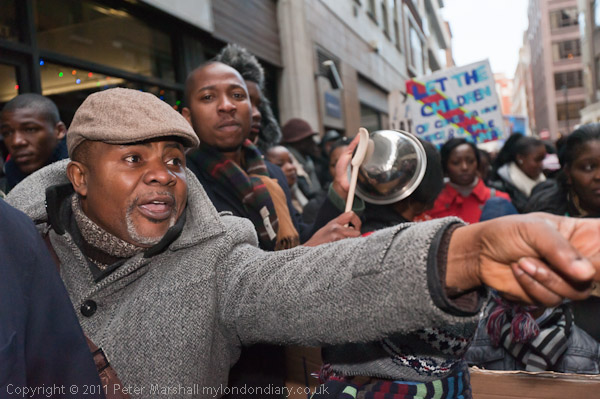
© 2012, Peter Marshall
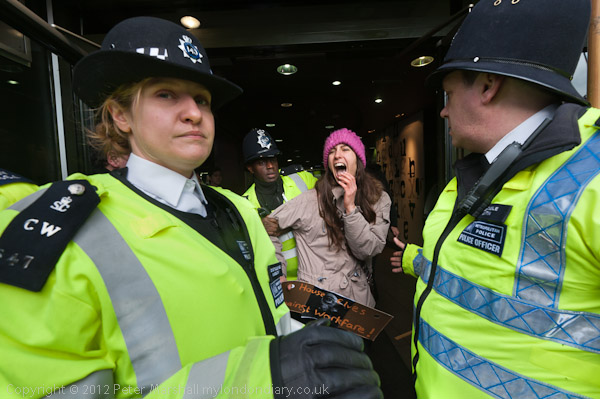
A protester is thrown out of MacDonalds

There followed something of a cat and mouse game along Oxford St, made a little easier to follow after the first protest outside Pizza Hut when a map was given out with some of those taking part in the scheme marked on it. Of course the flag carriers were sometimes used to deliberately mislead the police and in the rather confused events it wasn’t always possible to keep my eye on the key protesters, so I wasn’t always able to be in the right place at the right time, though I did rather better than the police.
© 2012, Peter Marshall
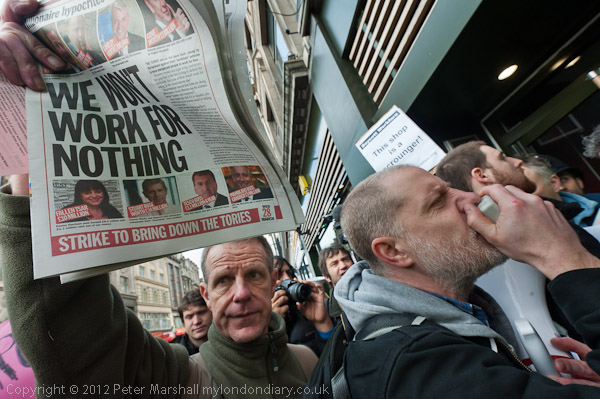
My favourite image from the protest – at 16mm I was very close!

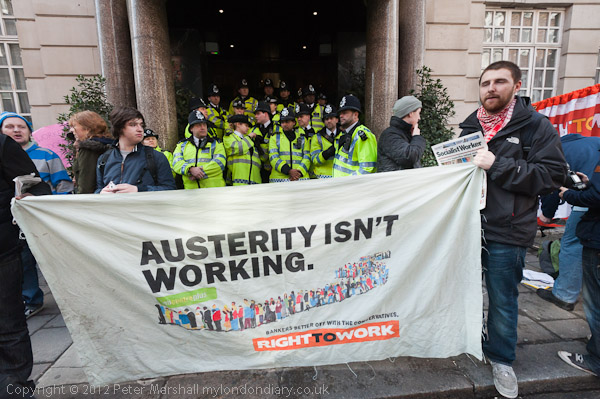
Sometimes of course you have to make a guess, and it can go wrong. I spent some time waiting outside a well-known charity that takes part in the scheme expecting the protesters to make at least a token protest there, but they had decided against it, and in doing so missed just a little of the action, and had to run to catch up when the group moved away to its next location.
© 2012, Peter Marshall

It’s also often difficult to know when it’s safe to leave, and I wanted to cover another event, and in this case my guess was correct, as I learnt later that the Holiday Inn was the final destination of the protest.

More pictures on My London Diary in Boycott Workfare – Oxford St.

________________________________________________________

My London Diary : Buildings of London : River Lea/Lee Valley : London’s Industrial Heritage

All photographs on this and my other sites, unless otherwise stated are by Peter Marshall and are available for reproduction or can be bought as prints.

To order prints or reproduce images

________________________________________________________
St Paul’s – An Inside Job

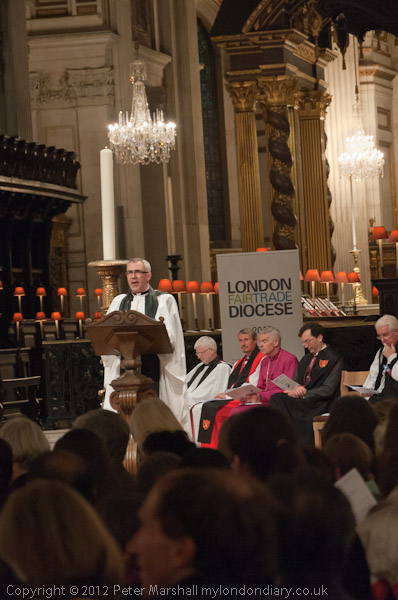
I’ve done two rather unusual jobs for me this week (along with several protests), and both presented me with something of a challenge. But here I’ll just deal with the first, last Sunday evening, when I covered a church service. Not in any old church, but in perhaps the best known old church in Britain, St Paul’s Cathedral.

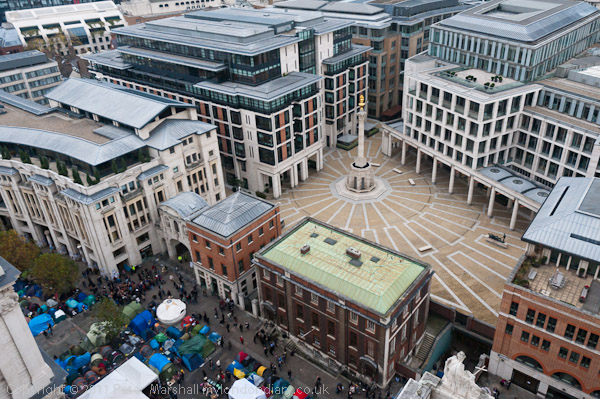
If you’ve been to St Paul’s in recent years, one of the first things you will see when you enter an pay the small fortune to look around the place is a sign saying ‘no photography’. About the only place it is usually allowed is when you get outside around the dome, something I took advantage of when I visited the Cathedral on one of the two days a year when entry is free last year – as you can see in London From St Paul’s on My London Diary.

© 2011, Peter Marshall
Occupy London and Stock Exchange from St Paul’s.  Nov 2011

Some years ago, I was asked by a charity to photograph an event they were organising inside St Paul’s, but they had problems in getting permission from the cathedral authorities. Although when I arrived a helpful verger escorted me to a suitable position, shortly afterwards a more senior official came to escort me outside again, as they had an agreement with an agency who objected to other photographers taking pictures.

So this time, I made very sure that I would be able to take pictures, and had a talk with the Press Office there about how I would be able to work. I would be allowed to stand in an area with my back to one of the pillars of the dome, where I would have a good view to the centre of the cathedral, and during the service I would not be allowed to move around or use flash. There were some events at the end of the service and I could move to cover them, although again they weren’t too happy about flash, suggesting I should ask for permission at the time if I needed to use it.

And it was in some ways a good position, but there were several problems. First was the lighting, which as this was an evening event was pretty dim. The cathedral is a very large space and the general light levels are low, although there are a few better lit areas where some of the action takes place. But even at ISO 3200 I was still only getting exposure readings like 1/40 f5.6.

I should have borrowed a long fast lens for the event as I don’t own one. I’d hoped to get by with a Sigma 24-70 f2.8, but it wasn’t long enough, and in any case the pictures I was getting weren’t quite sharp enough. The Sigma 28-300 f3.5-6.3, a perfectly adequate performer in good light, also proved hopeless in these conditions. I tried using the Nikon 18-105 on the D300, but that wasn’t too great either, but then I had a thought and switched it to the D700 and things began to work much more sweetly. It wasn’t quite long enough (a 157mm equivalent) and being a DX lens it reduces the camera to 6Mp, but it was still fine – and I found I could even get better results by using it at ISO 2000. They weren’t great pictures, but they did what was needed – and I could even crop them a bit later.

© 2012, Peter Marshall
From my viewpoint with the 18-105mm at full stretch (slightly cropped)

The following day I spent some time trying to work out why the two Sigma lenses hadn’t done the job. Testing them in decent light they seemed to have no problems, but I had noticed that part of the problem in the cathedral was getting accurate focus. I realised that because I’d not had problems before I’d not got around to using the ‘AF Fine Tune’ for either lens (it’s in the Set up Menu), so I spent some time adjusting that – and it did make just a little difference.

But I think the biggest difference is probably that the 18-105 is the only one of the three that is a ‘VR’ lens (and for once I remembered to make sure it was on.) Most of the time I don’t notice any difference with VR, but these are the kind of conditions where it really does become useful.

© 2012, Peter Marshall

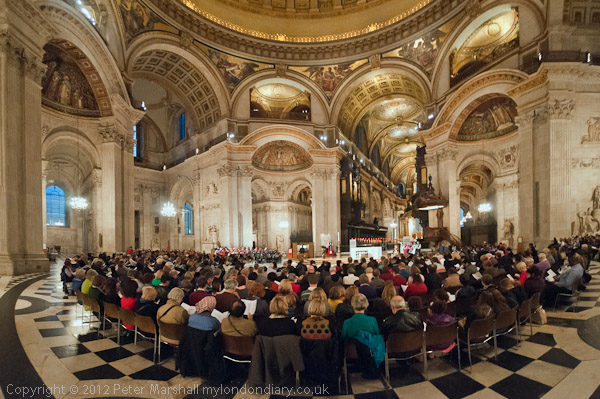
The other lens that was really useful was the 10.5mm, which let me take some overall views, stretching up at arms length to see well over the section of the congregation sitting in front of me. Who were another major problem. For those parts of the service where they remained seating I could see over them to the various bishops and others leading the event, at least at waist level and above. But once the congregation stood up, I might as well have been outside the building. And they did a lot of standing.

© 2012, Peter Marshall

Camera shake is seldom a problem with the 10.5mm, and the f2.8 maximum aperture helps. As often, I’ve converted the image to a cylindrical perspective to get the pillars of the dome upright and straight. Framing is a little tricky when holding the lens well above your head, but it was easy to take a few tries until I got it right, holding the camera more or less level and getting a little of the curve of the dome at the top of the frame. As well as the perspective change I also used Lightroom’s manual lens corrections to tidy the image up a little and get the verticals more or less vertical.

Despite the cathedrals ‘no photography’ rule – and a note in the order of service reminded people of it – there were people much closer than me to what was taking place using cameras and phone cameras through most of the event, and when the children’s choirs started singing around fifty people rushing forward in front of me to get closer and take pictures. So at that point, despite my instructions I joined them, though unlike quite a few of them I didn’t use flash because I didn’t have it on my camera at that time.
© 2012, Peter Marshall

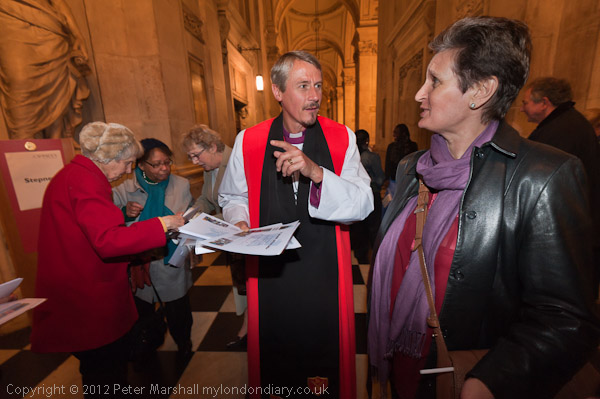
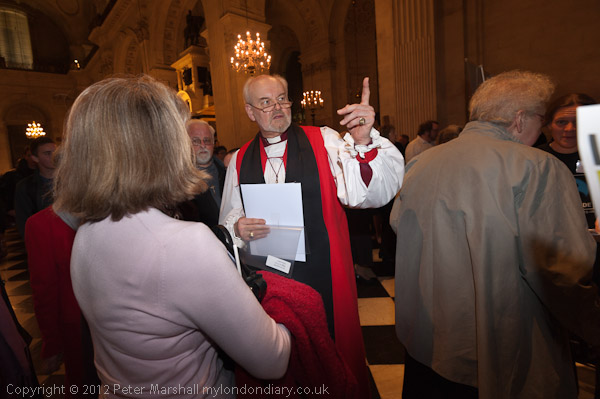
I had a long list of things the organisers wanted me to photograph at the end of the service, but there were so many people milling around it was impossible to follow the instructions. Given that everyone else was taking pictures in the chaos, I just stuck my flash on the camera and got on with things as best I could, now using the 16-35mm.

© 2012, Peter Marshall

Bishop of London, Richard Chartres, waving a finger in the air in this picture, is now in the news as one of the leading candidates to succeed  Rowan Williams as Archbishop of Canterbury. Chartres, who lost out to Williams in the last round is now listed by William Hill at 7/4, narrowly trailing the 6/4 favourite, John Sentamu, Archbishop of York.

Olympic Course

 © 2011, Peter Marshall
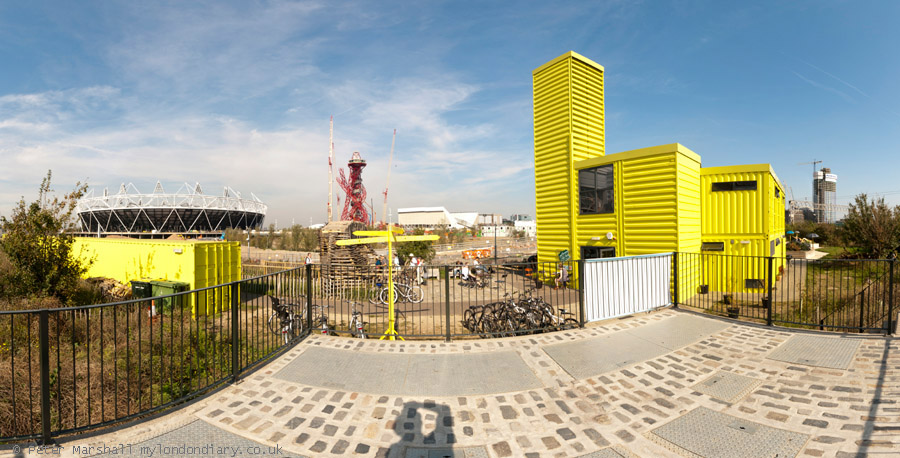
The course will be based at the View Tube – the yellow block at right of picture

There are now further details available about the course I’m leading for the Museum of London on the edge of the London Olympic site which I mentioned earlier in Lea Valley 7 Mervyn Day 1. You can find out more at Art of …photography: Stratford and the Olympic Park on the Museum’s web site, which also has a link to a PDF document giving the course timetable, learning outcomes and find out more about the course tutor.

© 2006 Peter Marshall
The Olympic site in 2006 taken a few yards from where the View Tube now stands

Of course, almost everything that was on the site has gone, and the Olympic site itself is closed to the public. Although I’ve planned several walks to take pictures as a part of the course, by April there may be different path closures and the exact routes may have to change. But as well as the Greenway and the View Tube, where the course will be based, we will also be going on other footpaths close to the site, as well as the viewing areas open to the public in the Westfield Centre.

© 2007 Peter Marshall
Marshgate Lane underneath the Greenway in 2007.
No longer accessible to the public and busy with Olympic site traffic.

© 2011, Peter Marshall
The Olympic Stadium from the View Tube

Those who come on the course – limited to 15 people –  will bring their digital cameras to use so we will be able to look at the work that people have taken. We will also be inviting all those taking part to put a small selection of their pictures from the event on the Museum of London website.

I think it should be fun – and am busy praying and making sacrifices for good weather for that weekend, Saturday 21 and Sunday 22 April 2012 from 10.30am-4pm. Enrolment is now open through the Museum of London Office on 0207 001 9844, and the two day course costs £100 (concs £35).

Tomasz Wiech’s Poland

Some of Tomasz Wiech‘s pictures in today’s NYT Lens blog feature Poland’s Great Adventure made me smile, which is a good enough reason to mention them here.  They are part of a collection of work soon to be published as his book  Poland, In Search of Diamonds of what is described as “absurdist and abstract work.” Fortunately although sometimes joyfully absurd, the work is never abstract, but very much situated in the real.

It’s worth going to Wiech’s own web site, where you can see a larger (and I think better) selection of this work – simply called In Poland.  If the work appeals to you it is also worth going on to his po polsce blog which I think he uses to show his work in progress, with brief comments in both Polish and English.  At the start he writes:

Blog is part of my project about Poland. It was made thanks to scholarship from Ministry of Polish Culture. Project tells about my country, that is nor pretty neither ugly. Nor catholic, neither secular. They tell about a country that is strongly influenced by history and tradition. 

My own visits to Poland have impressed me both with the breadth of Polish photographic culture and also the support that photography (and I think other cultural areas) receives both from municipal and national authorities. It comes as a shock to someone used to the disdain of the British art mandarins who’ve always treated our medium as something to be handled at arms length in tongs while holding your nose – except of course when it happens to be made by people who are quite clearly doing art rather than photography.

Poland is in many ways a country of contradictions which make it a fertile ground for Wiech’s ironic observations. Even under socialist rule it remained a devoutly Catholic country, and in the rush to capitalism it still retains aspects of its socialist past – including the respect accorded to the arts.

There are other documentary projects and features also worth a look on Wiech’s site along with other work. I was moved by his Generation 1906, triptychs of eight people at the age of 100, though I would have liked to see these black and white images on a rather larger scale. He also has another blog, ‘Simple Observations‘ on which he posts the occasional image of something that he has observed, just as simple images without text, although people sometimes comment on them.

My First e-Book – London’s May Queens

Just published on Blurb is my first e-book, London’s May Queens, also available considerably more expensively as a paperback.

© 2012, Peter Marshall

I’ve written quite a few times here and elsewhere about my photographs of London May Queens. I’d lived in London for most of my life and knew virtually nothing about them until I was writing a presentation about Tony Ray-Jones to deliver in Poland in 2005 and my imagination was stirred by a picture of a large group of May Queens under a very large maypole which was captioned as being at Faversham in Kent.

Rather idly I Googled about May Queens, and found very little, but enough to make me fairly sure that the event he had photographed was the ‘Merrie England and London May Queen Festival’ not at Faversham but at Hayes in south-east London (still often known as Hayes, Kent although now in the London Borough of Bromley to distinguish it from Hayes, Middlesex – now in LB Hillingdon.) Rather to my surprise I came across an article in a south London newspaper web site which mentioned the festival and gave the date for 2005, and I decided to go along and photograph it.

You can see the results on ‘My London Diary’ for May 2005 – some way down the page, where I also give a very brief history of the event. Photographing young girls might present some challenges, and I started by going to the event organisers and talking with them. Once they found I was not from the local press they were a lot happier with me being there – they were worried that some of the girls taking part might be embarrassed if their pictures were printed in the local papers.

It was the start of a lengthy project, made longer by most of the events taking place over a few weeks of the year, and weeks when I’m usually fairly tied up with other events, but three years later I had enough work to be promised a show at one of London’s better venues – only for it to be cancelled at the final stage when suddenly money became short.

All of the work in the e-book/book London’s May Queens has actually appeared on My London Diary where there are probably around a thousand of the 12,000 or so pictures I took of May Queen events. But the pictures on the web are always a rush job, and every one of the 72 images for the book has been carefully reprocessed from the RAW file and they are really like exhibition prints compared to the proofs on the web.

I’ve also written a rather longer essay on May and May Queens and the Merrie England and London May Queen in particular, although I still have hopes of one day producing a larger and more scholarly work by a suitably qualified friend with a more thoroughly researched text making much more use of the original sources than my own effort. Though perhaps my more straightforward account is more suitable for a wider audience.

I set out from when I started producing this book around 4 months ago with the idea that it would be available both in print and electronic format. Blurb offers to convert your normal book project into an e-book, and it does seem to look very similar. There is one major limitation in that only a very restricted range of fonts can be used in the e-books, so I have to choose a different font to my previous works.

I had another small problem in that Blurb’s e-books are in an  iPad/iPhone format for use on Apple® iBooks®, and I don’t have that kind of equipment. So I’ve only viewed the e-book using the Firefox EPUBReader plugin, where it seems to work fine except for the front and back cover where there are some slightly odd differences from the book, with the images being shown a little out of correct proportion. I hope this is just a glitch in the plugin rather than in the actual file.

The big advantage of the e-book, apart from being rather handy for those who have an iPad or iPhone is of course price. The e-book download costs only £2.49 rather than the £26.94 for the print version. The difference is even greater when you’ve added Blurb’s rather excessive delivery cost of around a fiver for the book, and of course you get it by download in a minute or two rather than the 10 days or so for printing and postal delivery.  There is a short preview – 19 of the 80 pages – of the book available on Blurb.

Here’s the back cover:

© 2012, Peter Marshall


My London Diary : Buildings of London : River Lea/Lee Valley : London’s Industrial Heritage

All photographs on this and my other sites, unless otherwise stated are by Peter Marshall and are available for reproduction or can be bought as prints.

To order prints or reproduce images

________________________________________________________
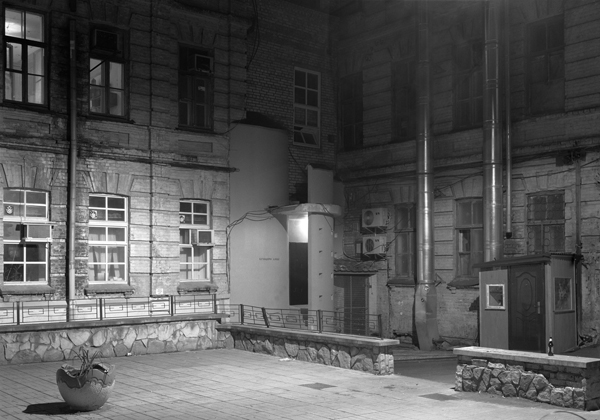
Backyards of Kiev

This week I’ve added a new gallery to the Urban Landscape web site, work by Herman Schartman (b1963) a Dutch photographer living in The Hague.

On his own web site he stated that he “is intrigued by the transformation of cities” and seeks “images that have an aesthetic appeal but may at a closer look raise questions about the people living in this place or the causes of the transformation of the landscape that is depicted.”

Schartman works on 4×5″ and has photographed cities across Europe. His first project on our Urban Landscape web site is ‘Backyards of Kiev‘, a fascinating set of ten black and white images, taken in the backyards of building blocks in that city. As in most other East European cities, these are public places but also very much places that the people living in these buildings let their private lives spill over into, often with intriguing results. As he says:

You will find lots of parking spaces, old derelict buildings and new high-rise buildings, gardens and trees. You will meet young women driving a SUV, an older woman delivering the bottles she collected, a man walking his dog, a couple drinking a beer or a security guard.

But the images he presents of of these places are not of the life which throngs them by day but the empty stages at night, with an atmosphere of their own, and often exquisite lighting depicted in highly detailed rich tonalities.

© 2011, Herman Schartman

Submissions are always welcome to the Urban Landscape site, and the contribute page gives some details of what we are interested in. You should also look at What is an urban landscape? to see if your work is likely to be suitable.

Currently the photographers with work on the site are: John DaviesPhilip A Dente , Lorena EndaraPablo FernandoBee FlowersNicola HulettPeter MarshallPaul Anthony MelhadoNeal OshimaPaul RaphaelsonHerman Schartman, Mike Seaborne and Luca Tommasi, and includes work from Europe, Asia and North and Central America.

Trespassing on Gallery Walls

As always, Shahidul Alam writes a thoughtful article on photography in his Trespassing on Gallery Walls in which he looks at the peculiar nature of the photograph that empowers it. Something that means that as the art world ingests our medium, “It has led to concerned photography being considered passé. In the hallowed world of limited-edition copies, the fine art print is about the object and not its purpose. Form triumphs over content.”

As he goes on to point out, photography has at times altered the course of history, changing people’s views – and regimes such as that in Bangladesh continue to provide evidence of its power when they close down shows such as “Into Exile: Tibet 1949 to 2009” and “Crossfire”. But do read his article, written as the introductory piece for the February issue of PIX, a photographic quarterly from India, where you can download this issue on the theme of Trespass. It contains some fine work, and I particularly enjoyed the black and white essays by Mark Esplin, Siddhartha Hajra, Aparna Jayakumar and Devansh Jhaveri.

Esplin’s digitally taken diptychs in City Builders (2010) pair portraits of New Delhi’s homeless with night images from the streets of the city. Hajra in ‘Opera Monorama‘ has photographed the performances of “Monorama or Rajuda (as he is commonly called in his neighbourhood)… a transgendered person who ‘performs’ in closed community spaces during the spring season which is associated with Sitala puja.” It is sensitive and intriguing work. Jayakumar in ‘On the Wrong Side of the Equator” is working in the surreal world of the film set, a Bollywood recreation of an Angolan hamlet in India. Jhaveri in Trespass looks at the Hindu cremation rituals.

In his piece, Alam makes reference to the “amateur grabs of Abu Ghraib“, with which we are all familiar, but an earlier  – and  non-photographic post on his blog, Control by seed, written by Najma Sadeque, is about a far more serious grab which occurred at Abu Ghraib, the home of Iraq’s national seed gene bank.

Under the control of Paul Bremer, military head of the Provisional Authority in 2004, Order 81 dealt  with plant varieties and patents. It allowed plant forms to be patented and genetically-modified organisms to be introduced. Farmers were strictly banned from saving their own seeds. Its “goal was brutally clear-cut and sweeping — to wipe out Iraq’s traditional, sustainable agriculture and replace it with oil-chemical-genetically-modified-seed-based industrial agriculture.”

As Sadeque writes: It’s not for nothing international researchers have termed the deliberate annihilation of Iraqi agriculture the ‘ultimate war crime’.

Eve Arnold On Show

I went to see the Eve Arnold show in London yesterday mainly because I had some spare time between photographing a couple of events and it was just a short walk down the road. It was cold and wet outside, so spending time in a warm dry gallery seemed like a good idea.

I actually enjoyed the show, though it didn’t change my opinion of her as a photographer. The picture that really stood out for me was her portrait of Marlene Dietrich at work – and it was a very large print.  Arnold studied photography briefly with Alexey Brodovitch, and according to her obituary in The Telegraph:  “The class, which included ambitious professionals such as Richard Avedon, mercilessly criticised Eve Arnold’s amateur efforts.”  Brodovitch’s classes at New School for Social Research in New York have a legendary status as a tough school, one that worked by tearing people’s work to pieces – and those who could take it profited greatly.

Arnold talks about this with Colin Ford in the BBC Five Master Photographers Series recorded in 1990. She picked herself up and rather by chance set herself a testing project to meet the class assignment of ‘Fashion’, going into Harlem to photograph the informal black fashion shows that were held regularly in former churches there. That work gained plaudits when she took it to class – and later led to her getting the cooperation of Malcolm X for some more fine work, and after her husband sent it to Tom Hopkinson who published 8 pages in Picture Post it got her a place in Magnum, where, along with Inge Morath, she was the first woman member.

I spent a long time in the gallery, Art Sensus, just off Victoria St at 7 Howick Place. It’s not a gallery I’ve visited before, a large space on the second floor with a very expensive feel. The gallery says it “has a clear mission; to promote and support the very best up and coming contemporary artists on cutting-edge projects” though it perhaps isn’t clear how a photographer whose work was essentially formed in what was a relatively conventional style sixty years ago quite fits in with that, though I suspect her work is of more interest to me than anything else they are likely to show. The show is on until 27 April, and there is a page with links to a Radio 4 clip and reviews which may perhaps have a more balanced view then mine.

Although the exhibition page at the gallery concentrates almost exclusively on her pictures of Monroe and other stars, the exhibition is actually a fairly decent cross-section of her work.  I spent rather more time watching a video the BBC made on her quite a few years ago (I think at the time of her Barbican retrospective in 1996) now than looking at the pictures – it is quite a long program, but I enjoyed listening to her talk. There are a few interesting stories told on it too.

On the wall next to where the video is being shown is a list apparently of every project that she took. Although someone on the video makes a comment on how many different things she did, the list seems to me to tell a different story, with a relatively small number of assignments even in her busiest years.

The V&A has recently acquired one of the better works from her later years, her picture of the ‘Brides of Christ‘ at Godalming, about to enter the nunnery.

Greenbelt Utopias

After yesterday’s brickbat, today a qualified bouquet for the New York Times and a Lens blog feature on Jason Reblando’s project ‘New Deal Utopias‘.

Of course, as so often, you can see the work better on Reblando’s own web site – and the NYT does supply a link to the front page of this – and it has also been featured on the Design Observer ‘Places’.

It’s a nice enough feature with the pictures, linking to some useful sites to tell you more about Ebenezer Howard and garden cities, and giving some basic information and links about the three New Deal planned villages of Greenbelt (and here), Maryland, Greenhills, Ohio and Greendale, Wisconsin, though one might quibble whether the pages Lens links to are always the most informative and whether Answers.com is a particularly useful and credible source of information. Though at least it is in one feature – on Wikipedia you have to hunt around a little.

Its perhaps surprising that there doesn’t appear to be a feature on these settlements on the New Deal Network‘s web site, but they were of course documented by the FSA/OWI under Roy Stryker (who does get a link – but one that doesn’t mention Greenbelt.) You can find links to the three towns in the subject index of the collection of their pictures on the Library of Congress American Memory site, which has roughly 570 pictures from Greenbelt, 120 from Greendale and almost 180 from Greenhills, all taken in the late 1930s and early 1940s, which provide a useful background to Reblando’s work. Among them are many photographs by

LC-USF34- 005639-E Library of Congress - Arthur Rothstein
Completed home. Greenbelt, Maryland. Arthur Rothstein, LoC.

Arthur Rothstein, (1915-1985), Marion Post Wolcott, (1910-1990), John Vachon, (1914-1975), Russell Lee (1903-86) and Carl Mydans, so Reblando is entering into formidable territory. Again it is perhaps surprising that there appears to be no feature on these developments on the American Memory site – perhaps it’s a part of their history that too many Americans would like to forget.

LC-USF33- 001440-M4 Library of Congress - John Vachon (1914-75)
Assistant community manager talking with members of maintenance crew, Greendale, Wisconsin, John Vachon (1914-75), LoC.

LC-USF33- 030018-M1 Library of Congress - Marion Post Wolcott (1910-1990)
Family on terrace in Greenbelt, Maryland. Marion Post Wolcott (1910-1990), LoC

The period of the New Deal and WW2 was arguably America’s finest hour – and certainly the FSA/OWI one of the truly great documentary projects. Since then, with Korea, Vietnam, Iraq, Afghanistan and the Tea Party it has been downhill all the way, and any mention of social projects such as the Greenbelt towns must have the rabid right spitting blood into their tea cups and reaching for their guns. So it’s great that the NYT and Reblando are drawing attention to these visionary projects again.

On Reblando’s site you can also see two other housing-related projects, Lathrop Homes and Outside Public Housing, both of which I found more satisfying than his work on the New Deal Utopias, where I couldn’t really see what he was trying to show through the work. Perhaps it is a project on which he is still working, and I hope so, as I’m sure there is much more that could be done.

Although I’ve not visited any of these towns, Greendale in particular seems to have turned in to something of a curiously mixed celebration of a largely mythical American history, including “A Dickens of a Christmas… gazebo concerts, green markets, a reenactment of a civil war ncampment, a tour of Greendale “Original” homes, a vintage baseball tournament, and a garden-gazing walk.” Surely rich scope for an ironist.

London’s Overthrow

London’s Overthrow is a very different diary of London in Nov-Dec 2011, superbly written by China Miéville, part of which was featured in the New York Times, though their piece lacks the unity of the full work, which includes Miéville’s mobile phone images. In the NYT the text was accompanied by the very polished and polite images taken by Mark Neville for The New York Times. Although these are fine in their own way, and would look good perhaps in some company annual report or government document, they really have no point of contact with the visceral anger of the text. 

Miéville’s images may sometimes be blurred and indistinct (in one example beyond the limits of legibility) but their emotion matches the piece splendidly.  The NYT presentation is an unholy marriage that traduces both writer and photographer, an example of blatant visual illiteracy, an exhibition of stunning incompetence that should be a hanging – or at least a sacking – offence for the picture editor concerned.

My own My London Diary, as well as my work over the years elsewhere, touches on some of same events and themes that Miéville, though in a my own rather more reserved register.

© 2011, Peter Marshall
London in November 2011 – more on My LondonDiary

© 2011, Peter Marshall
and more from December 2011 too.