Students Protest Fees

 © 2012, Peter Marshall
The march reaches Aldwych on its way to Westminster. 14 March 2012

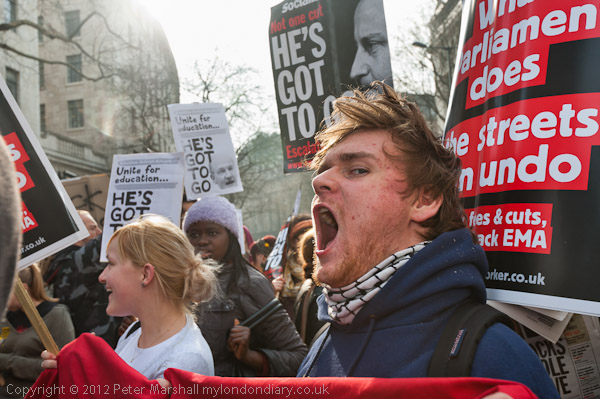
Student protests this year have seemed rather muted compared to the event around the end of 2010, but the march a couple of weeks ago brought back memories of these, as one of the main foci of of protest was the forthcoming trial of student Alfie Meadows, rushed to hospital at death’s door after having been batoned on the head by police on Dec 9th and only saved after lengthy brain surgery, but now on trial for ‘violent disorder’, presumably for violently attacking a police baton with his head. The trial of him and four others began this Monday and is expected to last several weeks.
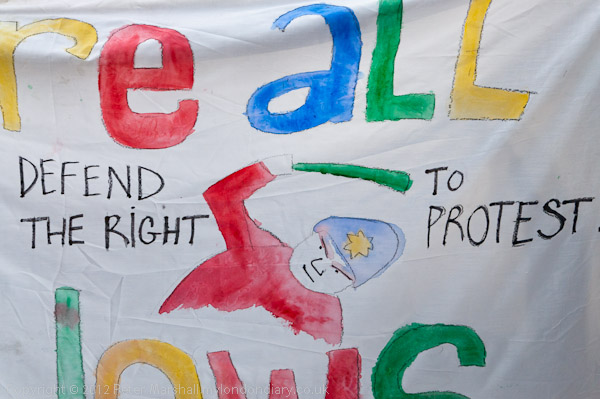
© 2012, Peter Marshall
Detail of banner ‘We are all Alfie Meadows – Defend the Right to Protest’
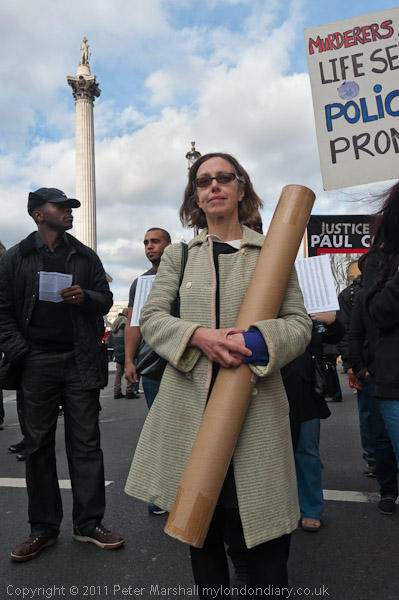
© 2011, Peter Marshall
Susan Meadows, mother of Alfie at last October’s ‘United Families and Friends‘ march

The tricky part of photographing protests is being in the right place at the right time, and often the interesting things happen without any warning. There were several places where I thought it likely that something might happen, and opposite Downing Street was one of them. So I made sure I was at the side of the march opposite the gates and waited as the front of the march moved passed me and suddenly a few seconds later everyone sat down on the road. Most of the photographers (and there were an awful lot there) were ahead of the march in front of the main banner, but I was able to quickly move into the crowd as they were sitting down and chose a suitable place to photograph.
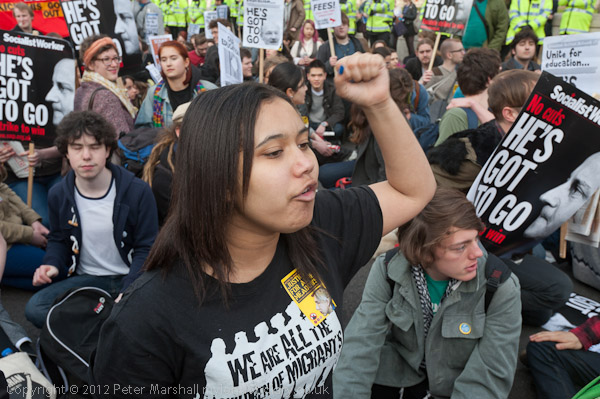
© 2012, Peter Marshall

I took a whole series of this animated young woman, working very close to her with the D700 and 16-35mm, and then was in an ideal position when Clare Solomon stood up and spoke.
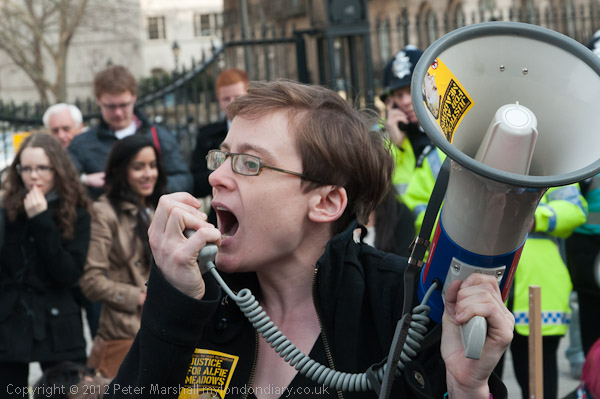
© 2012, Peter Marshall

This time I was working with the D300 and the 18-105mm and she was just over 2 metres away – the lens at 66mm (99mm equivalent.)  I hadn’t known exactly what was going to happen, and the exact details came as a bonus, but I was in the right position because I’d thought ahead.

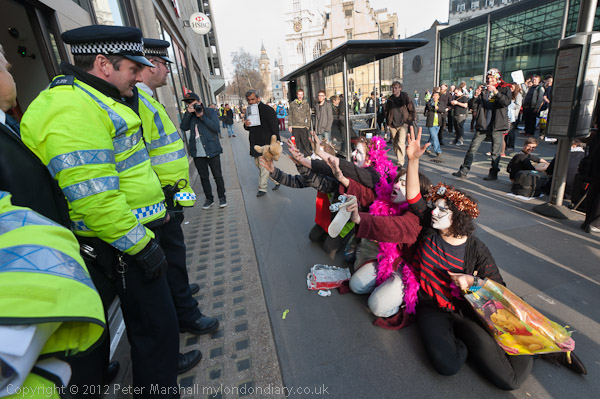
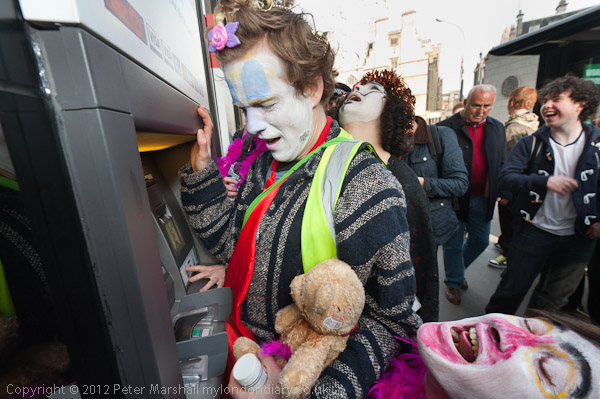
Of course it doesn’t always work out, and often- including a couple of times on this event – I’d anticipated possible outcomes that didn’t occur. But later, after the protest had reached its destination outside the ministry responsible for higher education I cam across a small group of clowns, and although they were not telling people what they were going to do, I was fairly sure they were going to do something, and it seemed more than likely from where they had gathered in a huddle that it was going to involve the bank opposite the ministry.
© 2012, Peter Marshall
Only one other photographer seems to have noticed at this point

So I was ready when they started rushing around and screaming, and down on the pavement by the police standing at the bank door almost before they were. The light wasn’t too good and I didn’t get a picture that really satisfied me, but when they moved off and then rushed one of the cash machines I was still with them, and the pictures as they kissed this and then sat on the ground and burnt a £5 note were rather better, though by the time that happened there were so many other photographers around me that I couldn’t move.
© 2012, Peter Marshall

You can see many more pictures from the march and protest in Students March Against Fees on My London Diary. And after that large event I went on to photograph a rather smaller event with a leprechaun leading a protest against fracking outside a  conference  –  Frack Off Big Oil!  Some days things just work out well, and this was one of them.

________________________________________________________

My London Diary : Buildings of London : River Lea/Lee Valley : London’s Industrial Heritage

All photographs on this and my other sites, unless otherwise stated are by Peter Marshall and are available for reproduction or can be bought as prints.

To order prints or reproduce images

________________________________________________________
The Legendary Jimmy Jarché

I’d forgotten how bad the adverts on TV are, not normally watching television. The ITV player doesn’t seem to let me fast forward past them, but at least you can mute them.

Perspectives – David Suchet – People I Have Shot on ITV1 about his grandfather, the famous Fleet Street photographer James ‘Jimmy’ Jarché (1890 – 1965) is worth watching, though there is perhaps around 500% too much of David Suchet for my taste. Actor Suchet was Jarché’s grandson, and grew up with him living in the family home; grandad taught him photography and gave him his Leica, and he doesn’t do badly with it (a very nice picture of sheep for example), but I’d have welcomed much more about Jarché and much less about Suchet and you do have to put up with quite a lot of his physical and mental wandering.

Jarché was really too good a photographer to need Suchet, and Suchet the actor doesn’t need the kind of self-promotion that he gets here. A more straightforward account of the photographer’s life and work – including a brief interview with his grandson – would have been a far better tribute to him, but unlikely to appeal to TV executives.

Of course Jarché is a name known to all with an interest in photographic history, if mainly for a single image taken in 1925 of naked kids being chased along the banks of the Serpentine, published in the Gernheims’ ‘Concise History of Photography‘ in the year that he died and which for many years was almost the only widely available comprehensive volume on the subject. And there were a number of other images I’d seen before in the film, along with some new ones.

It wasn’t a film that changed my idea of Jarché, who has always been one of the legends of British press photography, and in the somewhat farcical expert discussion (really these guys aren’t as stupid as this makes them seem) at the end of the film in the Michael Hoppen gallery, Colin Ford makes clear he isn’t quite ready to think of him along with Cartier-Bresson and the rest either. But if he is perhaps less well-known now than he might be, the fault lies with another organisation that appears in a rather better light in the film, Getty Images, in whose immense warehouses his images are stored.

Mad Men

Henri Cartier-Bresson, Burt Glinn, Leonard Freed, Inge Morath, Elliot Erwitt, Dennis Stock, Philippe Halsman, Cornell Capa, Bruce Davidson, Sergio Lorain and Eric Hartmann are not a bad eleven, and even if a few of the team aren’t on their best form,  The Mad Men Era, Magnum/Slates ‘Today’s Pictures’ a week ago are an interesting selection.

The 19 images, which date from around 1958 to 1968, are largely from New York and from the offices of the advertising industry of the era, and doubtless some are from Madison Avenue itself and largely represent that kind of business culture. But as a set on that title, it would have been stronger had the selection been a little tighter, and I think there are several that really don’t fit (and one I’d have put straight in my own reject pile let alone Magnum’s.)

Though one of those I would have rejected as not really fitting the subject is one of my favourite images from the era, just from a very different culture and style to Mad Men. Sergio Larrain’s out of focus commuter in front of the escalator at Baker St is a part of a very different business and photographic culture to the rest of the batch.

Had I been editing a set of the same title from those on Slate, I would probably have ended with 12 pictures rather than the 19 here. Of course if I was working with Magnum’s library there would almost certainly have been others I would have wanted to add, but I think it makes a nice exercise to take this set and edit them, perhaps even sequence them.

I’m not – at least not for the moment – going to say which other images I think don’t really belong in the set either because they don’t belong or simply aren’t strong enough. I’d be interest to hear whether other people agree with me that there are pictures that would better have been omitted, and if so, whether they images they would cull are the same as mine. I’d argue that there are around two others than don’t really fit the theme, and about the same number that simply don’t quite make it as pictures or lack the kind of ironic viewpoint that is common to the rest.

Brassaï (Gyula Halász) on YouTube

A Facebook post this morning to a YouTube clip featuring the work of Brassai took me on a short look at other clips about him there and also to reflect a little on how photography should be reflected on screen.

The link was to BRASSAÏ Paris la nuit circuit Brésil and the pictures are well reproduced – and it can even be viewed full screen without losing too much, but you never quite get to see them (or can’t tell if you do.) It shows details and zooms around far too much for my taste; photography is a medium where the frame and framing (or in Brassai’s case, cropping) is truly vital. But the approach does bring over something of the interest and excitement in his work, and I can imagine people watching this and wanting to know more and to really see the photographs, just a shame that they were not shown as pictures before the camera played with them. I also found the music quite unsuited to the work – too staid and stately – and simply had to mute it  after a minute or so to continue watching.

Brassaï, fotógrafo shows his pictures in their entirety, but perhaps not such a good selection, and the quality of reproduction is not as good – it certainly isn’t worth viewing this at full screen.  The soundtrack, ErikSatie’s Gymnopedie No. 1, seems far more sympathetic to the subject matter.  But there are images where it would have been good to zoom in to show details.

Ted Forbes in The Art of Photography talks breathlessly about Brassai and flips over a few pages of the book Paris By Night, but seems to me not to have little real insight into what Brassai was about (or even what photography is about) but determined not to let a microsecond of silence give the viewer time to think. What little Forbes has to say that is worth saying – largely the facts about Brassai – could have been said in a few seconds but he talks throughout at a great rate, as if he hadn’t bothered to write a script. Badly videoed with annoying slips of paper markers covering up some of the pictures and reflections on the pages and you hardly see the pictures. It fails to even show any of his best work. It seems to me axiomatic that in a video about a photographer you should let the pictures do most of the talking and concentrate far less on the presenter.

Another video with a fine musical soundtrack is Brassai with Phillip L Wilcher “CONSOLATION”, and again sympathetic  is Paris by Night (Photographs by Brassaï)  with many of his best pictures shown to the soundtrack of ‘Dark-eyed sister’ by Brian Eno & Harold Budd.

A search on YouTube putting in the name Brassai brings up many more videos, and I’ve already spent more time than I should this morning watching them. If you find a better (or an even worse) one than I’ve mentioned above, feel free to add it as a comment.

Thanks to Diana Sampey for her post on Facebook which led me to the first of these videos. Of course YouTube isn’t the only place you can watch videos. Another that I enjoyed this morning was on BBC News Magazine, where Elliot Erwitt talks about some of the picture sequences in his book Sequentially Yours.

Fuji X100 Firmware Update

Today I downloaded and applied the latest firmware update, 1.20, for the Fuji X100 and although the list of new features in the manual update seems short and unimpressive – the ability to assign the ‘RAW’ button to other purposes, a slightly handier menu position for auto ISO, the ability to zoom in on the focus area in AF-S mode and a playback zoom that may automatically detect faces – the actual differences in operation seem a little more impressive.

Fuji do actually give a slightly longer list elsewhere, where the earlier improvements in previous firmware updates are also listed. But somehow the camera just seems a little ‘snappier’  (sorry:-) and even the start up delay seemed a little shorter. Or perhaps I was just imagining it. Perhaps it was just the good weather (and a little good wine) that made everything feel better.

But it’s certainly good news that Fuji are continuing to improve what was from the start a fairly impressive camera in most ways. It’s interesting to see how the DxOMark ratings for this camera compare with those for the Leica M9 – which it outranks on every score, if not always by a great deal. My own experience puts it between the Nikon D300 and D700 for overall quality and also for use in low-light, and the DxO figures are also in agreement with this. Of course with a fixed lens it is limited in some ways compared to these other cameras.

But perhaps the most surprising of DxOMark ratings I’ve seen are those recently published for the D800, with the highest score of any “35mm” camera and which put it up into the large-format league. Most surprising of all, and something that has wrong-footed most of the pundits is its low-light rating, more or less the same as the D4 and only slightly below the leading D3S.

Holi Thoughts

 © 2012, Peter Marshall

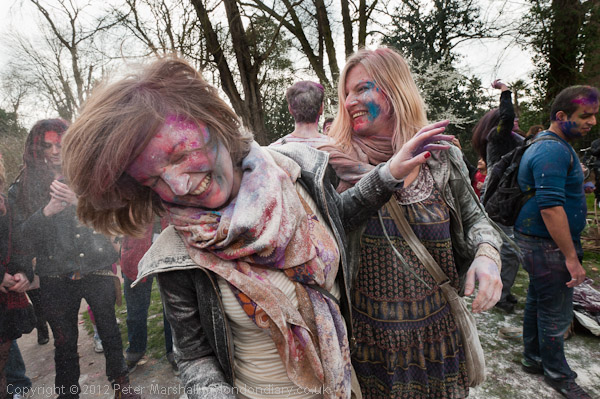
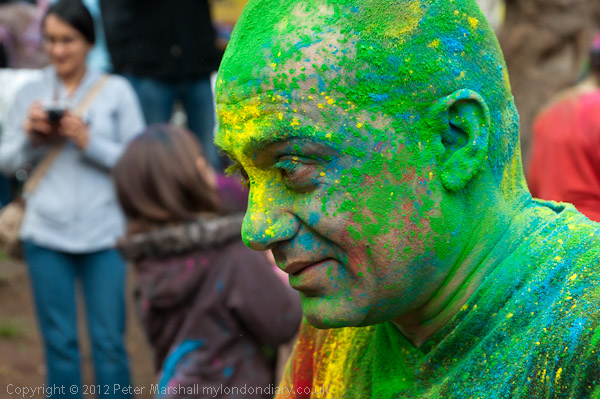
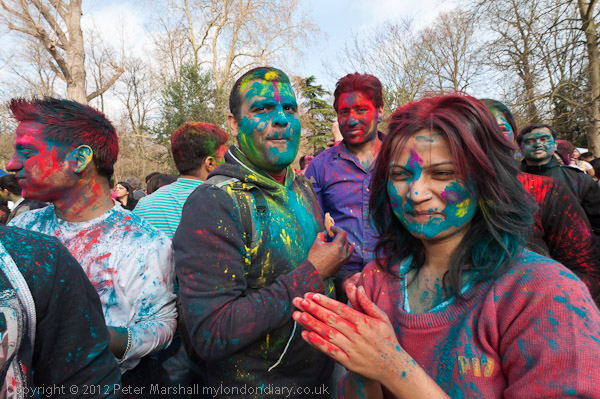
Photographing the Hindu festival of Holi, at which people throw coloured powder at each other brought back several memories. My first full-time job back in the 1960s was as a chemist for a company making dyestuffs, and walking through parts of the factory I would often see men covered in the products, perhaps from emptying barrels of dye into a packing machine. Most of the labourers at that time were from India, mainly Sikhs, and the part of the site which was my lab is now occupied by a Gurdwara.

I don’t think that some of those dyes would have washed off easily, but unlike the paint I got covered with last year during a black bloc protest, most of the colour from Holi washed off more or less immediately, though I did attract quite a bit of attention on my way home from the festival as although I’d removed some of it there was still a noticeable amount on my face and hair.

© 2012, Peter Marshall

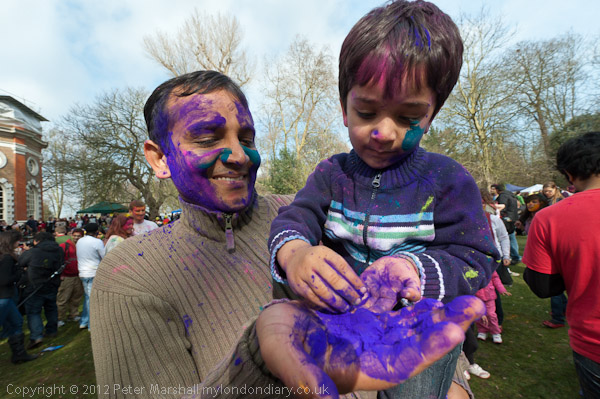
It isn’t the kind of thing you can photograph without taking part in, getting close to people. Although I didn’t want to get entirely covered with colour I really felt a little out of things until I had some thrown at me. Then one of the younger participants clearly wanted to smear more blue over me, though I had too move just a little closer still so he could reach.

© 2012, Peter Marshall

As you can see from the trees in the background, I’ve processed these images normally and haven’t increased the contrast or saturation. Most of them were taken with the 16-35mm on the D700, and in situations like this I usually find it better to use the ‘Auto-Area AF Mode’ where the camera decides what to focus on. It’s supposed to be able to pick out people from the background and focus on them, and it seems usually to have got it right despite the odd colours.  This mode also seems to work better with flash (which I also used on most pictures) whereas with single point AF and continuous servo AF there is often quite a delay before the camera is happy enough with focus for the flash to fire.

Back in the old days, working with cameras without autofocus, I would simply have set the lens to a suitable distance, perhaps 1.5 meters, stopped down perhaps to f8 and let depth of field cover things. It would probably still have been a better solution, but the camera did quite well.

© 2012, Peter Marshall

Of course the hardest thing is always being in the right place and making the exposure at the right time, especially when things are moving fast. I took quite a few exposures of the two women in this picture before I managed to catch what I wanted. It might had been a little easier if I had chosen to work with the camera on a continuous exposure setting – either of 3 or 5 fps, but that would have generated huge numbers of exposures, and I was taking far too many working in single exposure mode.

You can see quite a few of those in Holi Festival, Twickenham on My London Diary. I had really only gone for the throwing of colour and the pictures don’t really do justice to the other aspects of the festival.

________________________________________________________

My London Diary : Buildings of London : River Lea/Lee Valley : London’s Industrial Heritage

All photographs on this and my other sites, unless otherwise stated are by Peter Marshall and are available for reproduction or can be bought as prints.

To order prints or reproduce images

________________________________________________________
The New York Photo League

I’ve long been a fan of the work which came out of the New York Photo League. Founded in 1936 it became the basis of a tremendous energy in photography in America in the 1940s and beyond, and was a key influence on the kind of photography that for me is central to the medium. I wrote my first article about it in 2001, when there was really very little available about it on the web, and it was a piece that got a wide readership and many responses, including from several of the photographers who had been involved (a couple actually asked me for advice.) Later I wrote more about the league and a number of those who had taken an active part in it.

In the eleven years since then, I’ve been pleased to see articles and features about some of those then less well known photographers appearing, and more of their work available on the web and through galleries. Some in particular had previously been busy promoting their work, in particular the  Stephen Daiter Gallery in Chicago, who had published Anne Wilkes Tucker’s book ‘This Was The Photo League’ earlier in 2001 with photographs by Morris Engel, Walter Rosenblum, Morris Huberland, Sid Grossman, Sol Libsohn and Dan Weiner.  Years earlier in 1979 I’d read Tucker’s article on the Photo League in ‘Modern Photography’ magazine,  probably the first time I was aware of it’s importance in photography.

Here’s a short section of the roughly 3000 word essay I published in 2001:

The major figure in keeping the activities running over the years was Sid Grossman, described as an organisational genius, as well as a fine photographer, but many others, including Walter Rosenblum (president for many years), Dan Weiner and Sol Libsohn played vital roles. Paul Strand was always on hand for advice and also taught and lectured (Rosenblum describes a class by him in his essay mentioned earlier). Aaron Siskind led the Harlem project for four years, and there were many others. All those involved in the League’s programs gave their time without charge.

Most of those who belonged to the Photo League, at least before the late 1940s, were working class New Yorkers, from the lower east side, from Brooklyn and from the Bronx. Most were in their teens and twenties when they joined; many were the sons and daughters of first generation immigrants living in these working class areas, and they were predominantly of Jewish origin. Few were professional photographers, most were working in low paid jobs

The LEAGUE set up in a second floor loft – the former FPL premises in East Twenty-first Street. This small base became exhibition hall, meeting room, darkroom and school for the members.

They were attracted in particular by the low cost (the teaching staff were not paid) and high standard of the photographic tuition on offer. The League school, directed by Sid Grossman, offered courses in the techniques, history, aesthetics and practice of photography. As well as Grossman, a gifted teacher, and Libsohn who together ran the documentary class, there were also courses and guest appearances by many well-known photographers. Teaching in the photography classes was very much based on practice, with the students being sent out to record life in the various communities of Manhattan, taking photographs that were then criticised – at times extremely forcefully – and discussed in class.

The Photo League School was at the time, as Hal Greenwood noted in 1947, the’ only non-commercial photo school in America’, and in the years it was open, trained over 1500 photographers. It used a ‘ progressive educational method: the student learns by doing’ which was unusual for its time and aimed ‘ to help the student ‘discover the world; to develop a personal, philosophic, and visual perception which would load to an individual direction in photography’. It’s success can be seen in the work of those who passed through it, and also by the later adoption of similar methods by many courses in photography in our schools of art. Unfortunately few of them did it anything like as well.

What prompted me to recall this was a feature Redeeming a Life in Photography in today’s Lens blog with Sid Grossman’s widow, Miriam Grossman, now 85 (Sid died of a heart attack in 1955, when she was only 28) in which she talks of having waited since his death “for some kind of redemption, , and it never came.” As writer David Gonzalez comments, it has now, with the show ‘The Radical Camera‘ which has been showing at the Jewish Museum in New York and closes this Sunday. The Museum of the City of New York has 77 images by Grossman on-line  (open one of them as a larger image and you can then go through them all as a slide show.)

Last week the Lens blog had another feature, A Liberating League on the women of the Photo League, which includes an interview with another photographer I wrote about some years back, Rebecca Lepkoff, as well as two women I didn’t mention, Vivian Cherry and Sonia Handelman Meyer, all now in their nineties.

BJP, Sensor Size & Book Design.

My eyes widened somewhat when I read on the BJP site that they were reviewing a new “large-sensor compact” camera from Canon. Was this something I had missed elsewhere? I didn’t get to read the feature, which was part of their “premium content” and I cancelled my subscription to the magazine a few months after it went monthly and haven’t yet found a reason to take it up again (perhaps I’ll think again if I ever get an iPad.)

But I immediately went and looked up the camera concerned, the Canon Powershot S100 on Digital Photography Review and found that what I had missed was simply a re-definition of the term ‘large-sensor’. The S100 has ‘a 1/1.7″ format (approx 7.5 x 5.5mm)’sensor, with an area of 41.35 square millimetres, under 1/10 of the area of a large sensor as I know it such as the Nikon D300, and 1/20th of the D700.

I like the reviews in DPreview for their detail and care, and you know exactly what you are getting. Like all camera reviews you need to think about the aspects that you would find important in a camera, and your priorities as a photographer (or at least mine) are probably very different to those of the reviewer. Their reviews give you a lot of evidence on which too base an opinion of whether the camera concerned might be one that would work for you.

BJP’s style of review in the past was far more idiosyncratic, and what you got was largely one working photographer’s opinions, rather like asking a mate about his camera, though with a little more detail thrown in. Usually they were written by people with considerable experience in the field at which the camera was aimed, and I often found them enlightening, though there were times when I found them way off beam.

Of course I can’t tell you what they thought of the S100, which appears to be a pretty decent compact camera so long as you are happy with sticking to low ISOs. But if you want something which will keep up with large-sensor cameras when the light gets dim, forget it. It’s a camera I might consider for those times when I can’t be bothered to carry a camera. If you’ve not noticed, DPReview have recently posted their first impressions of the Nikon D800, which also make interesting reading. As they say, ‘You may be surprised by the outcome.’

Worth a look on the BJP site is a feature by someone rather better-known on line, Jörg Colberg (of the Conscientious blog), Better by Design: The role of design in the making of five modern photobooks, which looks at Alec Soth’s ‘Broken Manual‘, ‘Redheaded Peckerwood‘ by Christian Patterson, Christopher Anderson’s ‘Capitolio‘, Geert van Kesteren’s ‘Baghdad Calling‘ and Andrej Krementschouk’s ‘Come Bury Me‘.  None of them are books that particularly appeal to me, and perhaps their design has something to do with this.

Colberg quotes Dutch photobook designer Hans Gremmen as saying “Everything should always be tailored to the book. If this is done well, the reader probably won’t even notice because all the details will work as an organic whole” and I can only agree, but what all these works have in common is that exactly what I notice is the design, and for me it gets in the way of looking at the photographs. (It’s probably also true that I don’t in most of them find many photographs of particular interest.)

The five books chosen seem to be books that are somehow trying to pretend they are not books, breaking away from the generally accepted conventions of book design for the sake of it. There is much to be said for keeping photography books simple and straightforward.

NHS

I was a post-war baby. Just, born a week after Hitler packed it in though the war was still continuing against Japan. So I grew up in our post-war welfare state, drinking clinic orange juice and cod liver oil, and from the age of three enjoyed the free healthcare provided by the National Health Service. The nation was rightly proud of a public service that was comprehensive, based on clinical need and not the ability to pay and free at the point of delivery.

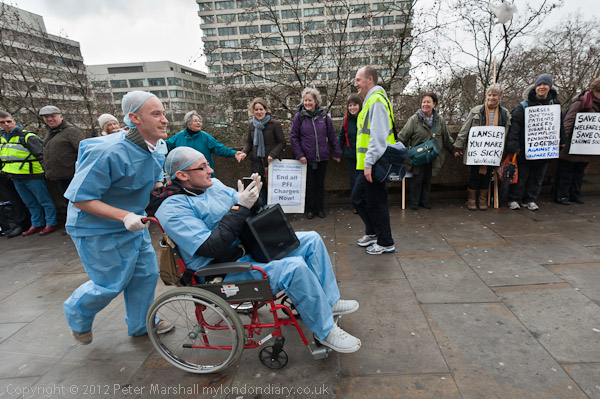
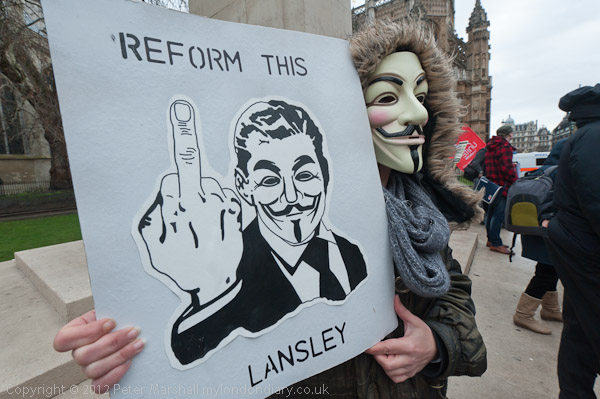
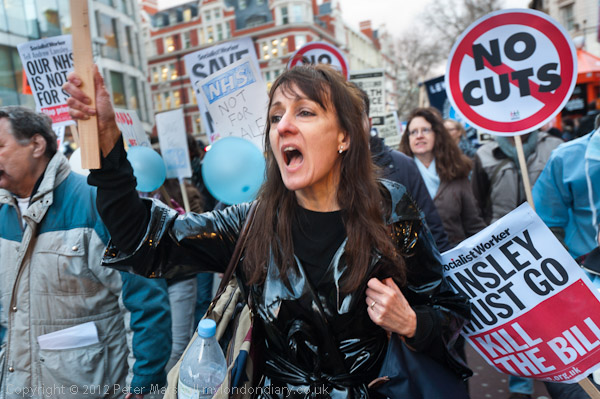
It’s hard not to see the Health and Social Care Bill, recently passed by parliament as anything but an attack on the principles of the NHS,  and as someone who is now  reliant on it – and liable to be increasingly so in future – I personally feel uneasy. We’ve seen the kind of short cuts and poor service that private providers have been responsible for in other areas. The kind of companies that will be involved have shown that they are interested only in making profits and not in providing high quality services.

© 2012, Peter Marshall

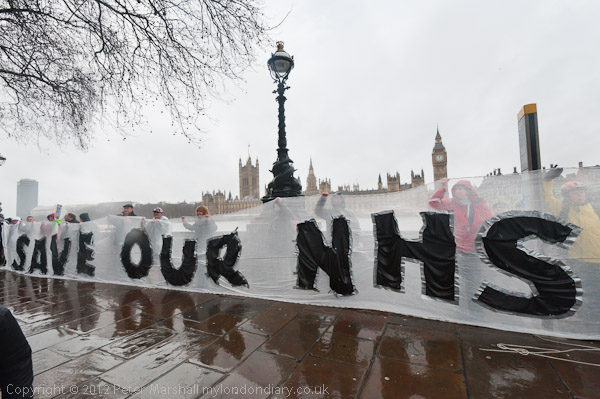
If I had not been photographing the protests against the bill on 7 March I might well have been there protesting, although the pouring rain might have put me off. I don’t often photograph holding an umbrella, but there was no choice when I started taking pictures – I needed it to keep the rain off the lens, and even wiping the filter with a cloth immediately before each exposure I still had some images spoiled by water droplets on the glass.  But at least the wet conditions did give some reflections on what would otherwise have been a rather empty pavement.

© 2012, Peter Marshall

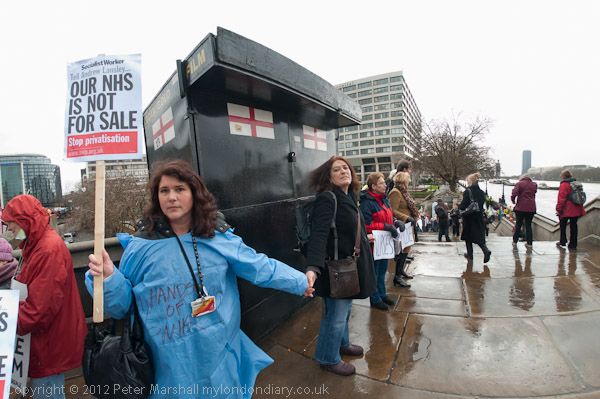
The protest was meant to be a human chain around St Thomas’s Hospital, opposite Parliament where the bill was being debated, but there weren’t enough people to go all the way round. And getting everyone to keep holding hands wasn’t easy, especially as many were holding placards. The picture above, taken on a corner using the 10.5 mm starts with a placard. It was perhaps a pity that the closed stall with its St George’s flags rather blocked the view of the hospital.

The 10.5 gives a very wide angle of view, and I used it for quite a few situations at this event, despite its slightly bulbous unprotected front element being a tremendously efficient rain drop collector. It also let me show both the protest and the Houses of Parliament in a single image, though the protest banner is only very small in the image.

© 2012, Peter Marshall

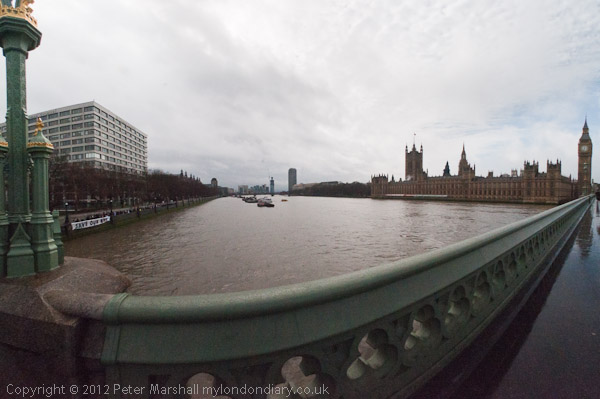
Like most of the images I take with the lens, this has been corrected to a cylindrical perspective, making the verticals straight rather than curved. The balustrade of the bridge is in reality straight too, though in the image it appears to curve through something approaching 90 degrees. The two banks of the river are of course roughly parallel rather than converging as shown, and the horizontal angle of view of the picture is around 145 degrees.

© 2012, Peter Marshall

The protests continued throughout the day with a lobby of parliament and protest opposite it:

© 2012, Peter Marshall

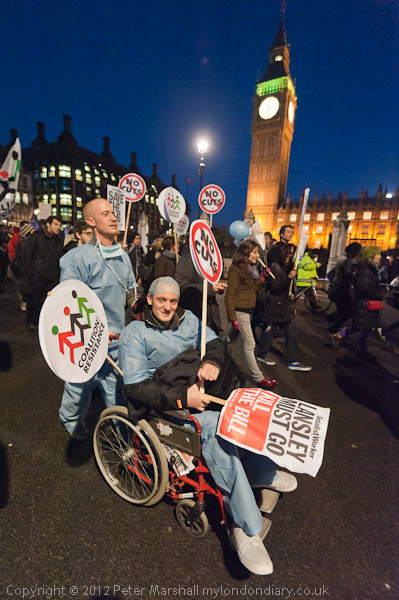
It was still raining for the lobby, but fortunately by the time for the doctors and students to march at around 5pm it had stopped.

© 2012, Peter Marshall

© 2012, Peter Marshall

Though of course it soon got dark, and by this time I think the water had affected my flash which was working only as and when it pleased.

More pictures on My London Diary:

Doctors & Students NHS March
NHS Not For Sale Lobby
Save Our NHS Human Chain

________________________________________________________

My London Diary : Buildings of London : River Lea/Lee Valley : London’s Industrial Heritage

All photographs on this and my other sites, unless otherwise stated are by Peter Marshall and are available for reproduction or can be bought as prints.

To order prints or reproduce images

________________________________________________________
Women On The March

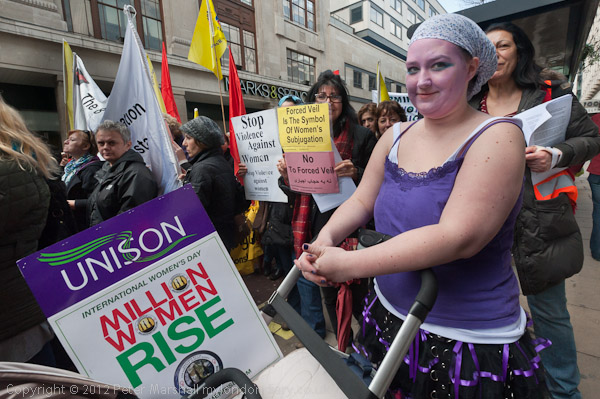
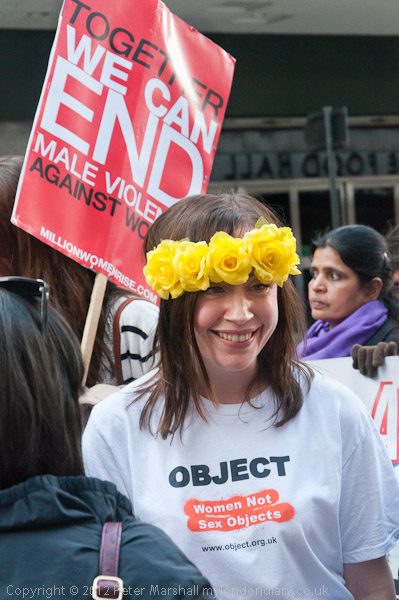
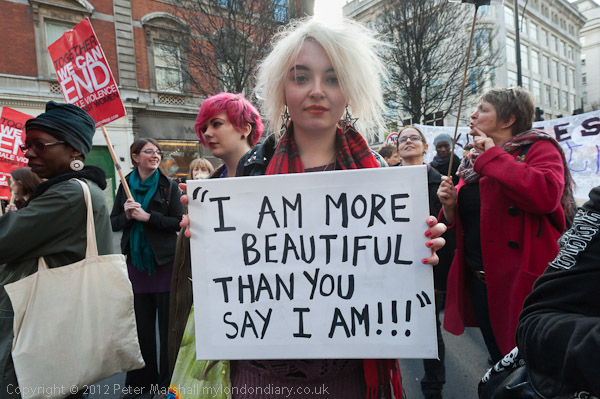
From the Workfare protest I rushed a quarter of a mile west to Orchard St, where an all-women march was forming up. The Million Women Rise is an annual international event held close to International Women’s Day, campaigning to end violence against women.

© 2012, Peter Marshall

Of course there were not a million women on the streets of London, perhaps a little over a thousand, but it was still a sizeable event, and one of relatively few that makes its way down London’s main shopping street, and I took most of my photographs on Oxford St.

© 2012, Peter Marshall

I’ve photographed it I think every year since it began a few years back, and I’ve occasionally had some rather hostile reactions from a few of the women taking part – including some of the students. It’s certainly an event it would be rather easier for a woman to photograph, and I can’t work in my normal manner.  I didn’t have any problems this year, but in previous years the march stewards have sometimes been rather aggressive towards men who stepped off the pavement while the march was on the road.

© 2012, Peter Marshall

I don’t like to stand back and use a long lens, but I did use the 18-105 towards the longer end rather more than I usually do. Possibly I needn’t have been worried, because on the few occasions I did go onto the roadway to take pictures this year I didn’t get hassled, whereas in past years I’ve suffered some pretty heavy stewarding for as much as letting a toe go over the edge of the pavement. Perhaps attitudes are changing.  One of the placards many women were carrying stated ‘Together We Can End Male Violence Against Women’, but I think it will need men as well as women to do so. Most of us are against violence in person relationships, whether by men or by women on women or men.

You can see more pictures in Million Women Rise March on My London Diary.