Cropping

I don’t like to crop pictures. Other than the slight adjustments that are sometimes needed to make the image a little closer to what I saw (or thought I saw) in the viewfinder, as even with digital SLRs the match is seldom perfect, and with some other cameras the differences are huge. Occasionally I’ll trim out an errant foot or bag or head etc that either wasn’t visible or I failed to notice on an edge, while usually keeping to the same aspect ratio. And just occasionally I’ll do rather more.

One of the first cameras I owned when I started out seriously in photography was a rough Russian copy of a screw fit Leica, and perhaps the way it most faithfully aped the original was the inaccuracy of its viewfinder. It’s always amused me that the high priest of anti-cropping who insisted on having his images printed in an oversize negative carrier so that the frame borders were visible, based on a philosophy of presenting the vision he saw at the moment of exposure had produced much of his early work on a camera which had such a poor correspondence between viewfinder and film image. It was perhaps a peculiarly French logic, and much though I admire his work and even adhere to his philosophy, I’m rather more of a realist and a pragmatist.

Of course, Henri Cartier-Bresson‘s purity was also tempered by expediency, and perhaps his most famous single image, that man attempting a leap across a puddle caught just before its inevitable watery end, is from less from the whole negative. He never cropped – except when necessary, something I think a good example to follow.

His attitude was made in a different environment to that we now exist in. Photographers were largely seen as craftsmen (they were mainly men) producing images for others to use, and were taught or expected to produce images that would be cropped. Many used cameras that produced a square format image, and deliberately photographed to allow their pictures to be cropped to landscape or portrait formats – the whole square was seldom used. ‘Filling the frame’ only really became important as a technical necessity with the introduction of what were then known as ‘miniature cameras’  that used 35mm film, particularly when using the fast films of the day (perhaps equivalent to ISO100) which were very grainy compared to later emulsions. It came in with ‘fine grain developers’ to do what their name suggests, as well as ‘acutance’ developers to produce apparently sharper results.

Now most photographs aren’t cropped, or at least not by the photographer, who shovels them on to Flickr and elsewhere usually straight from the camera, either unaware of the possibility of cropping or lacking any feeling of responsibility for the image.  Though of course the on-line print services impose their standard unthinking crop on all they touch, just as the photo-finishers used to.

Anyway, here is one that I cropped:
© 2012, Peter Marshall

and here is the full-frame version:

© 2012, Peter Marshall

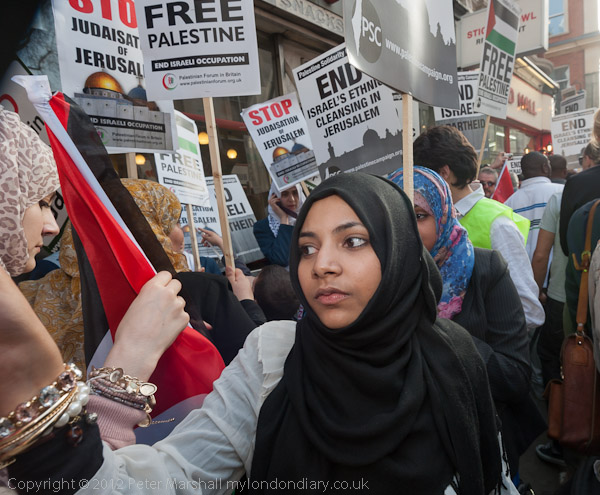
As you can see it has a problem. I was working in a very crowded area in a narrow pen for protesters opposite the Israeli embassy on Palestine Land Day, and making my way through the crowd the lens hood on my 16-35mm had been knocked out of position, producing the vignetting at top left and bottom right. Things were happening pretty fast and despite the obvious intrusion I took 8 frames in the few seconds before I noticed it – so much for my seeing everything in the frame! Working very wide-angle at speed it becomes impossible to examine every corner.

The 16mm actually makes things look rather less crowded than they were, and the woman’s wrist was very close to me. Now I’ve pointed it out, the lens hood at the top left of the cropped version is pretty obvious, but I don’t think otherwise it is too intrusive. If it had not been for the problem I had, I might well have cropped the original a little, as there is too much of the back of the woman on the right, and perhaps the Palestinian flag on the placard at the top pulls the attention away from what made me take the picture. Removing it does make the text ‘Free Palestine’ more important in the image.

Lens hoods are one of the weaker aspects of the Nikon system, although my habit of walking them into lamp posts doesn’t help. I’d done it with this one a couple of days earlier, and it hasn’t quite recovered, but better to damage a lens hood rather than around a thousand pounds of lens. Time though to go on e-Bay for another lens hood, though not a Nikon original as the copies are better and roughly a tenth of the price.
© 2012, Peter Marshall

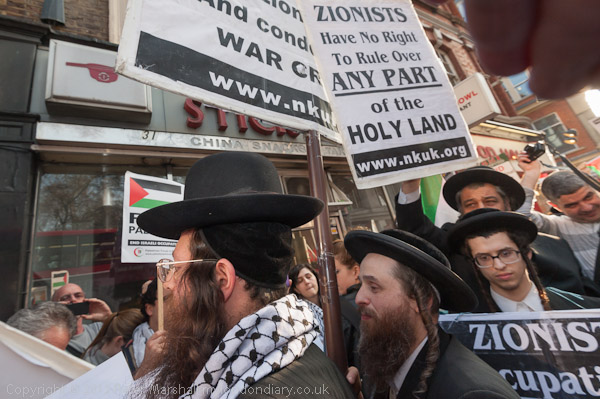
This is one I didn’t crop from the same event, with the anti-Zionist Neturei Karta Jews making their way through the same pen. It was evening and the sun was low and streaming in from the top right, and the lens hood didn’t cut the flare – so those are my out of focus fingers at top right. The framing is very tight on three sides of the image and it would lose too much from any crop. Somehow I don’t mind the irregular shape of those fingers – and they could have been a real part of the subject.

The main trouble I had covering the event was with the police, who just were not happy with me standing where I thought a photographer needed to stand, and I spent some minutes arguing with several officers to be able to photograph from in front of the barriers. Later a woman officer spent a minute or two trying to push me through a barrier while I was busy taking pictures and ignoring her before turning round to ask her to stop pushing me around; she wasn’t happy. But it certainly isn’t the job of police to get in our way and I was really behaving very reasonably while trying to insist on my rights and telling the police they were unreasonable. At least we can usually do that in London – but I certainly wouldn’t try it in Greece.

Eventually the resistance by myself and others paid off and the police did more or less stop harassing photographers, or at least those like me who do their best to keep out of the way of both police and the public. As well as the images where I had problems I took others that I think worked – which you can see on My London Diary in Palestine Land Day: Solidarity For Jerusalem.

________________________________________________________

My London Diary : Buildings of London : River Lea/Lee Valley : London’s Industrial Heritage

All photographs on this and my other sites, unless otherwise stated are by Peter Marshall and are available for reproduction or can be bought as prints.

To order prints or reproduce images

________________________________________________________

Lightroom 4

I’ve now been using Lightroom 4 for a couple of weeks, and although there are many things I’ve yet to find out, generally I think it is a very useful improvement over the previous version, though I’m hoping it won’t be long before 4.1 is out – and a release candidate is already available. There are a few bugs, but it generally works pretty well. If you are already a Lightroom user, you will almost certainly have upgraded already to LR4, but if not there is no reason to wait. If you are a photographer and don’t use LR,  LR4 means you are missing out more.

LR4 now does almost everything that the digital photographer could want and has become considerably more affordable, while Photoshop becomes more expensive every time I look at the prices.  Very few photographers now really need it rather than the more reasonably priced Elements and if you think you do you are spending far too much time on post-processing and not enough on taking pictures :-) Though I still find my ancient Photoshop 7 easier to use than the much flashier latest Elements. For me it’s a simple basic sharp knife compared to some fancy new toolset that tries to make things easy for those who don’t understand what they are doing. But if I had to I would get used to Elements and get the same results.

LR does take a little time and effort to learn, and that has put some photographers off, but I’d have to agree with another reviewer who noted that their were only two classes of photographers who didn’t like it and use it. Those who had never tried it and those who had played with it for a short time and given up without making the effort.

Perhaps I’d add just a little to that. LR does need reasonably powerful hardware – the difference when I moved from a five year old 32 bit system to my current 64bit machine with roughly 3 times the usable RAM was noticeable, and the change to a good USB 3.0 card reader made a truly huge difference in the time taken to ingest a card full of images into the catalogue – from an hour or two down to perhaps 10 minutes. So if you need to file on location with an underpowered notebook, there are better choices such as Photo Mechanic, though you will probably still want to have LR on you main machine.I’m not sure that the results I’m getting are any better on average than those from LR3, but certainly it is taking me less time to process them, with considerably fewer images needing local modifications (which can be very time-consuming.) The most important changes for me are in the Develop module, where the sliders now work rather differently, even where the names are the same – which takes some getting used to.

LR3 had an Exposure slider and a Brightness one, and LR4’s Exposure slider seems to work rather more like the Brightness in LR3, increasing the brightness of the image without pushing many more pixels beyond the end of the histogram.

The good news is that they have got rid of ‘Fill Light’ and ‘Highlight Recovery’  neither of which really worked properly. Fill light seldom gave good results at values of over 20 and almost never greater than 30, while Highlight Recovery was always best kept at zero (with local highlight areas being taken out by suitable local treatment.) I even  feel a little cheated however, as it had taken me a lot of time and effort to find ways of getting around these limitations and the new version lets anyone do the job properly!

As with LR3, you should work from top to bottom in the Basic panel. The first step seems to be to get the colour balance right, and then mid-tones right (and particularly flesh tones) using Exposure and Contrast.  While in LR3 you then had to burn down excessive highlights locally and get the required shadow detail with a combination of the Fill and local brightness, you can usually get a usable result with the Highlights and Shadows sliders and adjusting the White and Black sliders to fill the whole span of the histogram. The Auto button actually does the job for you more often than not, certainly much more often than in LR3.  Occasionally some local adjustment is still necessary, and often you will in any case want to do a little dodging and burning.

When using the brush or the gradient tool there are some very useful new options – colour temperature and noise, and one that will probably attract any buyers of the Nikon 800E, Moire. The colour temperature is a really useful change, enabling you to deal with images where mixed colour lighting is otherwise a tricky problem.

Also in the Develop module there are welcome changes in the Lens correction, with a better removal of Chromatic Aberration, and when set this this works automatically on any image and isn’t dependent on having a lens profile as in LR3. It’s particularly worth importing old images taken with my compact cameras and using this on them, as well as the Defringe box on the Manual panel of the Lens Correction set to all edges. Along with a little noise reduction it really does improve them, and you can make them almost look as if they were taken with a larger camera.

The Tone Curve is also improved, with much greater flexibility, though it isn’t something I use much. My standard import preset used to give it a little tweak of extra contrast. but in LR4 it defaults to ‘Linear’. When I update images I’ve processed before to the new 2012 process they often benefit from just a little more contrast than this provides, though not quite as much as that provided by going into the Tone Curve panel and choosing ‘Medium Contrast’. If you select this and then adjust the curve to get the effect you want it is possible to save this as a User development preset, but I can’t find a way to add it to the options in the Tone Curve section itself.

There are many more new features (and existing ones of LR3) that I’ve still to investigate. I don’t yet do much printing from LR, but if I did the soft proofing would certainly be useful, and it may be good enough for me to switch to using this in place of Photoshop. Something I am going to try is the new Book module, which can produce either a Blurb book or a PDF. It looks a very easy way to produce image-based books, and appears to handle captions and titles better than Blurb’s Booksmart, as well as allowing you to print a proof copy without an annoying watermark. But for anything with much text – or where you want true flexibility of design – InDesign will continue to be the answer.

In the UK at least it’s actually slightly cheaper to buy LR on disk than download it, a small issue I think Adobe should address. I’m not even quite sure about the legality  involved in charging it’s UK customers VAT at the higher Irish rate, and certainly I’ve had to pay the UK vat rate on some downloads from countries with lower tax rates. But surely they could supply software from a UK server if necessary. Personally I like to have a disk on my shelf, much handier should I have to re-install on this or a replacement computer, and would expect at least a small discount on downloaded software.

Doisneau & Gentilly

Robert Doisneau was born April 14th 1912 in Gentilly, just outside the southern boundary of Paris, and already tributes are coming on-line to the man who produced so many pictures full of humour, human warmth and sometimes pathos. La Lettre de la Photographie has 47 unpublished images found in the archive of Rapho Photo Agency (now Gamma Rapho) and Le Figaro shows ten of the best.

For an overview of his life and work the Atelier Robert Doisneau is online and easy to navigate even if you don’t read French. A few years ago I visited the actual Atelier in Mountrouge, a short walk from Gentilly in the building where Doisneau lived and worked for more than 50 years until his death in 1994.


My picture is of the centre of Gentilly, and was taken on a very pocketable compact camera, the Canon Digital Ixus 400, in 2004. This was a 3.87Mp camera with a tendency to get round to taking the picture around a second or two after I had pressed the release and too often after I’d assumed it had already done the job and was putting it back in my pocket, but the basic quality of this image, taken at 1/500 f2.8 ISO50, was pretty good, though I had not had it very long and hadn’t then managed to tone down its default over-sharpening.

I’ve found it’s worth processing these images in Lightroom 4, which has enabled me to bring out a little more tone in the sky, slightly adjust the colour temperature to give a cleaner looking result and perhaps most importantly remove some of the fringing and most of the mild chromatic aberration. The final image is really a remarkable result from a sensor that is less than 1/20 the area of a 35mm negative. Although the image is only 2272×1604 pixels it would really make a pretty respectable A4 print, and at say 7×5 inches on a book page would be difficult to tell from one taken with a much larger camera. It’s only when I make a large print from one of the files from this camera that I remember why it’s worth carrying a camera about ten times the size and weight.

We Need A Noorderlicht Here

I’ve just been reading Pete Brook’s post Some thoughts on, and thanks to, Noorderlicht Photo Gallery following his experiences there with the highly successful show Cruel and Unusual which he co-curated with Hester Keijser which closes there on April 8. And successful isn’t in this case just marketing-speak. He writes:

Cruel and Unusual was extended by a week due to public demand. Visitor numbers have been substantial and the Dutch press went doolally over it. National radio, newspapers, magazine features – the whole shebang.

As he makes clear, this show was not just important for showing some fine photography but mainly for the issues that it raised, and showing that photography can still have a substantial impact on how people think about social issues.

As grand an ambition it may sound, Hester and I hoped the show would be a warning shot across the bows of Europe: DON’T REPEAT AMERICA’S MISTAKES. DON’T MASS INCARCERATE!

It’s a message that needs to be heard in other countries across Europe, and particularly in Britain, where our current government seems to have an obsession with aping failed US policies, in health and welfare, education, immigration and prisons. (Failed that is in providing solutions for social benefit, though highly successful in providing profits for the companies that increasingly run these services for –  or rather against – us.)

But Noorderlicht  has a great record in organising its festivals, inviting open submissions for its projects and tackling difficult or novel subjects. Reading Pete Brook’s post gives a real insight into the kind of place it is and why it works so well.  It certainly made me feel that we need an organisation like Noorderlicht here.

Behind With The News

It isn’t often that My London Diary can claim a scoop, but I was interested to read a story in today’s Independent newspaper which begins “A new wave of disruptive protests will take place in London in May”and mentions OccupyLSX’s plans.

© 2012, Peter Marshall
The Occupy General meeting – numbers grew a little later on

Just over a month ago, on Saturday 3 March, I posted a story on Demotix, and a couple of days later on My London Diary as Greeks Protest With OccupyLSX in which I wrote:

I was surprised to find a general meeting of OccupyLSX was still taking place there this afternoon. After spending some time discussing the role of the police in society, this then moved on to planning further events, possibly a major protest on May Day or May 15, the anniversary of the start of last year’s protests in Spain.

Of course we always have events occurring on May Day, and it was more the May 15 anniversary of the beginning of the Spanish protests that was the more significant date, as postings on various other sites have confirmed. I’m not sure why the Independent now thinks it is news. I took the picture above early on in the general meeting and by the time I left an hour or so later there were possibly almost twice as many present, doubtless including at least two or three undercover police, though occasionally at some events I think they are in a majority – Chesterton’s ‘The Man Who Was Thursday’ sometimes seems fact rather than fiction.

© 2012, Peter Marshall

I was of course more interested in the Greeks and their protest, and most of my pictures were of that, taking place a few yards away from the Occupy general meeting, which also welcomed the Greeks and heard from one of them about the events in Greece.

Also not very new news is the film ‘Chimping’, which I learnt about on the dvaphoto blog,  where they mentioned it a couple of weeks ago, but I’ve only just got around to watching. Posted on Vimeo by director/produced Dan Perez de la Garza, this is a film about what photojournalists do and the future of photojournalism, featuring “Pulitzer Prize winners Preston Gannaway and Rick Loomis, Emmy Award winner Paula Lerner, along with Todd Maisel, Chris Usher, Angela Rowlings, Edward Greenberg, Stan Wolfson, and Rita Reed” and although it has the copyright date of 2007, the issues it raises are still current.

Perhaps the most interesting comments come from Intellectual Rights attorney Edward Greenberg who describes photojournalists as “passive, ignorant, childlike and unwilling to stand up for themselves and as possessing the fatal flaw of many artists which is an overriding desire to be liked” and says “the pat on the head is unfortunately so important to the egos of many creative people that they forget they are in business… ” and that they have to make a living.  He also talks about annual earnings for some photojournalists as dropping from $80,000 to $30,000 over the past five years, though even the lower figure would seem like a golden age for most now.

Of course it is no longer possible to dismiss mobile phone cameras as not having the quality that newspapers need – particularly now that rather than 1.5 megapixels we now have monsters including the 41 Mp Nokia 808 Pureview. It’s no longer pixels or even technical quality that separates the pro from the citizen; on one side you have the quality of vision and on the other being there in the middle of things when they happen.

Several years ago at an NUJ photographers conference I heard a speaker talking about the need for photojournalists to adopt a hybrid approach to selling their work, making use of exactly the kind of new sites that were setting out to market the work of citizen journalist, and I started trying to sell my work through some of them, as just one of a several ways of getting an income from my work. After a very slow start it is beginning to increase, while other sources of income have gone down.

 A very different video which I also watched this morning is about perhaps the most famous film ever made about a photographer, Hitchcock’s ‘Rear Window‘, made in 1954, and now turned into an incredible three minute single panoramic time-lapse video by filmmaker Jeff Desom and featured on PetaPixel.


Lea Bridge Road

 © 2012, Peter Marshall
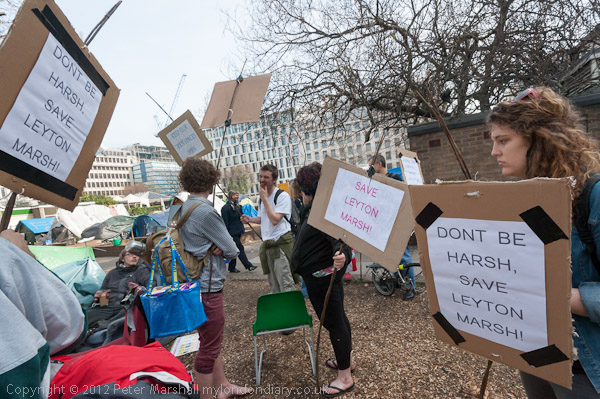
Preparing to leave Finsbury Square for the march to Leyton Marsh

Astute observers reading my account of the Leyton Marsh Olympic Protest which took place ten days ago (and was posted at the time with around half the number of pictures on Demotix) will have noticed the curious omission of what might perhaps have been expected to be the climax of the day, the arrival of the marchers from Occupy Finsbury Square at Leyton Marsh.

I’d seen this as the key moment of the day, and had gone on ahead by bus to Leyton Marsh (my knee was in no state to walk the four miles or so in any case) and had been busy taking pictures of the local residents and the site, and of another group of Occupy protesters who had made it separately (and had got very lost on their way.)

I’d actually left the Marsh to meet the marchers, but had become involved in other things, and when they actually arrived I was thirty years away in my own dream space of when I first visited the area, photographing some of the ways it had changed and completely failed to notice the small group passing by me a couple of hundred yards away. Fortunately a straggler from the march saw me and came over to tell me they had gone past and I hurried with her after them, but was just too late to photograph their arrival at the site.

© 2012, Peter Marshall
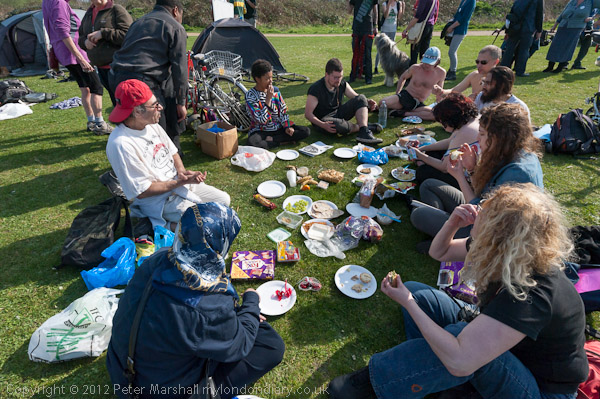
Marchers from Finsbury Square enjoy a picnic on Leyton Marsh

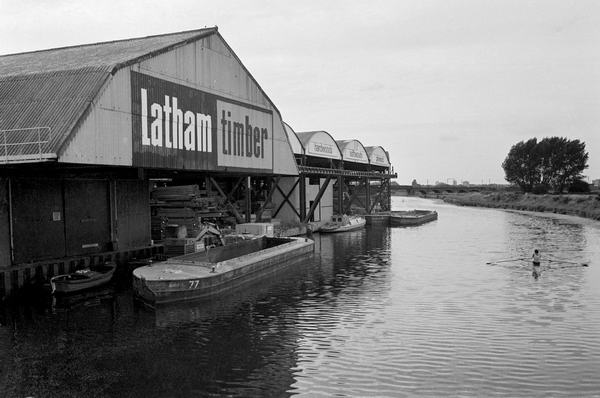
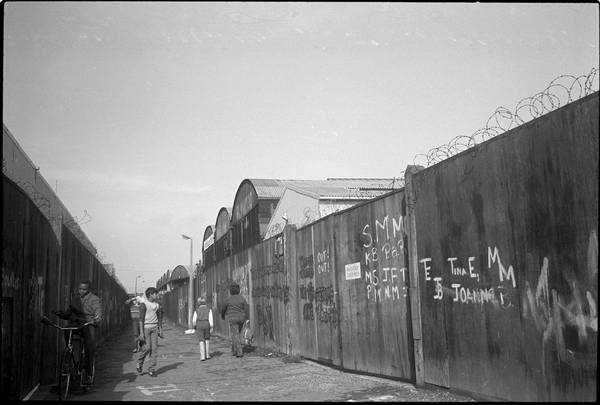
Here are a some views of what used to be on the Middlesex bank opposite Leyton Marsh (which is on the Essex side) but is now occupied by some fairly boring flats and grassed open space.
© 1983, Peter Marshall

© 1983, Peter Marshall

© 1983, Peter Marshall

You can see these (cleaned up a bit) and some other pictures from the area in my book ‘Before The Olympics‘ – with a full preview available on Blurb.

I hadn’t done wandering down memory lane for the day. One of the first times I remember coming to London took me along the Lea Bridge Road where Leyton Marsh is, to the shop of  Marston & Heard Photographic, then at 378 Lea Bridge Rd. In the mid-70s they purchased large remnant stocks of Ilford Bromide paper after Ilford started producing RC materials and also the entire remaining stock of Agfa Portriga Rapid. Those of us who were around at the time will find the page on Phototec on Maurice Fisher’s Photomemorabilia site of interest, and I had dealings with most of the companies mentioned over the years.

Photography at the time was still expensive and those of us who weren’t bankers, city merchants or company directors (as some leading amateur photographers were) relied on companies like Marston & Heard for cheap paper (they also sold benzotriazole, an anti-foggant that was often needed with it) and for tins of cheap film, which I think was often ends of 35mm movie stock.

I don’t remember how I got there at the time, perhaps by the same bus route as I used to get to Leyton Marsh from central London (though many buses then had much longer routes than they do now) but I do remember that I got off at one end and discovered that Lea Bridge Road was a very long road, though I think I probably only walked along half of its 5 km or so. Coming back loaded down with heavy boxes I took another bus.

Although most of their Agfa stock was the very warm-toned chloro-bromide Portriga Rapid, only available in a limited grade range, they also had smaller amounts of Brovira and Record Rapid. Brovira was a cold black and it’s only good point was that it was supposedly available in a very high contrast Grade 5, though by the time it got remaindered and sold to me I think it had lost a grade or two. But the small amounts of warm black Record Rapid were the beginning of a love affair that was later to take me to Muswell Hill and Goldfinger, and finally to Silverprint, ending when they had to remove the cadmium in the late 80s because of its health and safety issues. I never got on with the reformulated paper and soon switched to Ilford Multigrade FB – until Jon Cone showed the world how to print with inkjets for the new millennium.

His latest Piezography2, coming shortly, may even tempt me to buy a new printer to run it, perhaps the Epson Stylus Photo 1500 (which I think is known in the US as the Epson Artisan 1430) and has the big advantage of a wi-fi interface and could thus sit in my old darkroom as I’ve no room for another printer next to my computer. Cone says that the smaller drop size of these printers enables them to give comparable results to the top of the range Epson PRO 9900 printer while running with fewer shades of gray. With Piezography2 you will be able to print on both matt and glossy media without having to change over cartridges – it will include both matt and gloss blacks.

________________________________________________________

My London Diary : Buildings of London : River Lea/Lee Valley : London’s Industrial Heritage

All photographs on this and my other sites, unless otherwise stated are by Peter Marshall and are available for reproduction or can be bought as prints.

To order prints or reproduce images

________________________________________________________
St Patrick’s Day

It seems a long time ago now, but St Patrick’s Day was only around two weeks ago, with the main London event on the Sunday following the day itself. Although I’ve photographed this a few times, like many events it seems to have grown rather less interesting over the years, and I decided not to bother photographing it this year. If it had been passing my doorstep I would have gone out, but travelling up to London on a Sunday tends to be a very slow affair, with train services usually disrupted by line closures for engineering work, and there are plenty of things for me to get on with at home – like trying to get My London Diary up to date or scanning some of my extensive archive of negatives.

But I’ve always enjoyed the rather smaller-scale local celebrations on the actual day – which this year happened on a Saturday – at Willesden Green in Brent, and I’d put that event down in my diary. But there was a small problem, that I was also covering a major demonstration by Syrians the same day, starting before and ending after the Brent parade.

© 2012, Peter Marshall

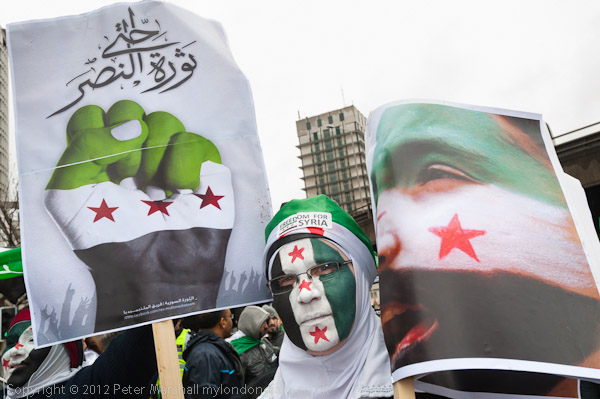
The Free Syria supporters were gathering at Paddington Green for their march to the embassy, and I went there after an hour or so standing around on Oxford St where too few people had come for a workfare protest to really be effective. Probably the weather, light but steady rain, had put some off coming, but fortunately except for five minutes or so  when I did go outside the small shopping centre to take a few pictures of the hardier who had arrived, I was able to sit down inside and keep dry. But it was still raining at Paddington Green, raining enough that despite frequent lens-wiping, many pictures still had blurred areas from water on the front glass, and Sod’s Law being as it is, usually in a critical area of the image. Fortunately it had slackened off a little by the time the march began, but I was still pleased to leave it after it had gone a quarter mile or so and run to the nearby tube station, catching the two trains I needed to take me to Willesden Green, where I arrived around 20 minutes before the parade started.

© 2012, Peter Marshall

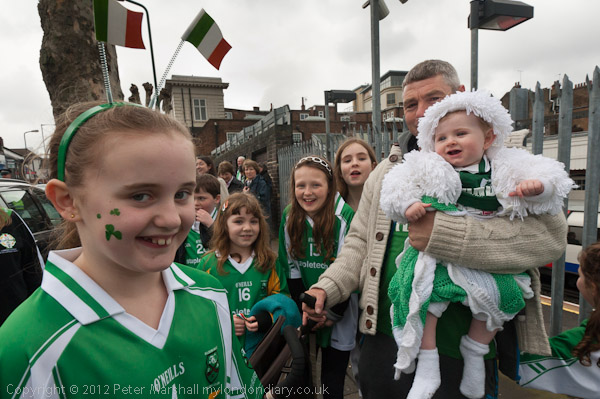
For most such events, the best time to get pictures is while people are getting ready for them, particularly the last few minutes before the start. People are generally standing around and waiting, often closer together than they will be during the actual event, and, if you want them to pose (and I usually don’t – my problem is usually stopping people posing) they have time to do so. It’s also a good time to photograph the crowds around the start, although I also like to photograph them along the route as the parade makes its way to the library and everyone comes out of the shops and bars to watch, as well as at the end of the procession where there are various performances.

© 2012, Peter Marshall

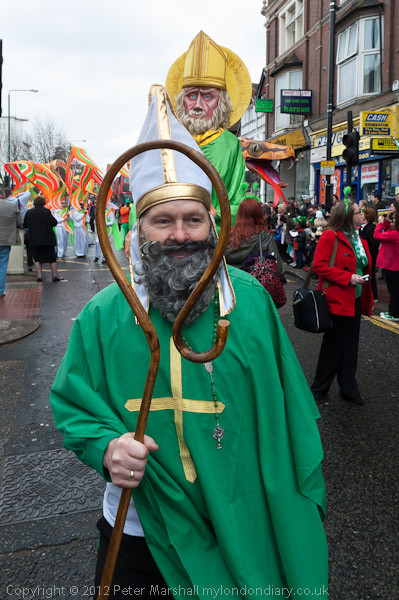
Of course there was a parade, and St Patrick was in it (twice) along with lots of others including the Mayor, and we were all Irish for the day.

© 2012, Peter Marshall
Seeing double?

I was sorry that I had to rush off as the parade was ending, back to the tube and this time to the destination of the Syrian march, the embassy in Belgrave Square, arriving a short time after the march had got there, but in plenty of time to take more pictures. I hadn’t expected anything much to happen on its route, and talking to some of the other photographers covering the event I’d missed nothing.

© 2012, Peter Marshall

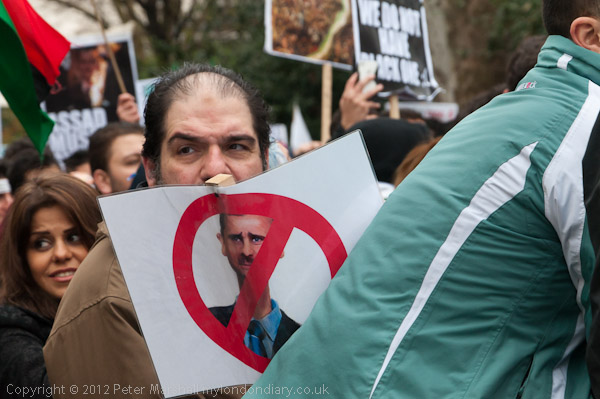
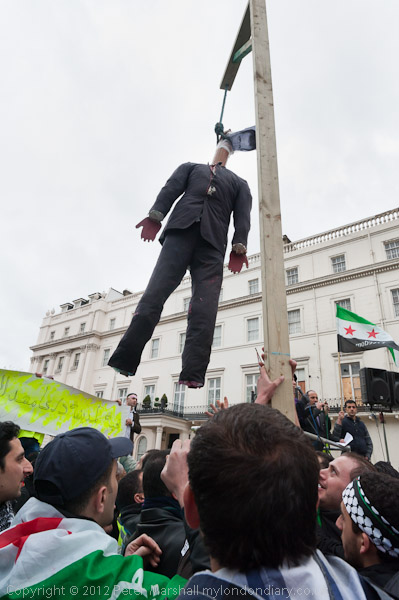
I tried a few things with this man and his eyes along with those in the poster – and in this frame, which I think was the best, added a third pair. But perhaps I should have framed more tightly, though I do rather like the ear at top left.  One thing I just could not get exactly how I wanted it was the gallows with an effigy of Asad, and after chasing it for a while through a pretty solid and seething crowd I decided I’d done my best and abandoned the attempt.

© 2012, Peter Marshall

I’d had enough of the crowd and taken some pictures I felt reasonably happy with, so it was time to leave and go the short distance along the road to the smaller pen holding the supporters of the Asad regime. Here there was no crowding and physically it was much easier to work, but somehow I felt the whole thing lacking. It seemed rather more like a PR stunt than a protest, with slickly produced portraits of the dictator and truly deafening music.

Even though I’m sure that these people were genuine in their support for their president I found it hard to get inside things, perhaps because my own views are so different to theirs.

© 2012, Peter Marshall

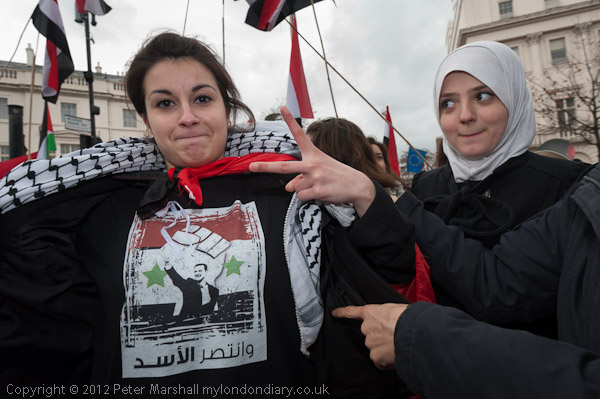
This was the picture I liked most of those I took, and perhaps it’s because of the two very different faces the women are making, and that the image of the president is less glossy than the others on show, but also because half of the image is almost dead black, and those two hand gestures which could be read as miming shooting give it, at least for me, something of the sinister.

You can see more of my pictures (and accounts) from the day on My London Diary:

Free Syrians Protest
Brent St Patrick’s Day
Asad Supporters Counter-Protest

________________________________________________________

My London Diary : Buildings of London : River Lea/Lee Valley : London’s Industrial Heritage

All photographs on this and my other sites, unless otherwise stated are by Peter Marshall and are available for reproduction or can be bought as prints.

To order prints or reproduce images

________________________________________________________
10 Photographers You Should Ignore

Bryan Formhals of LPV Magazine and photographer and blogger Blake Andrews (of photoblog B) make some hilarious and often oh so true comments on why would-be photographers should ignore the examples of Ansel Adams, Stephen Shore, Garry Winogrand, Alec Soth, Robert Frank, Nan Goldin, Henri Cartier-Bresson, Diane Arbus, William Eggleston and, er, Ryan McGinley. Surely they must be joking about him?

10 Photographers You Should Ignore is full of things I wish I’d written – in particular about the revenge of the banal in the comment on Eggleston. And even some of the things that I have written or said before are done far more wittily. Don’t miss it.

Center Awards

I learn from PDN Online that the not-for-profit public service organization, CENTER, founded in 1994 in Santa Fe, New Mexico, has recently announced its 2012 winners of its various prizes. Center’s tag-line is ‘Exposing Great Photography’ and says that it “honors, supports, and provides opportunities to gifted and committed photographers” through its programme.

Both in the judging panel and in the awards there is a certain British interest, with the top award (and a $10,000 prize) in the Project competition going to English/Swedish documentary photographer and member of VII Anastasia Taylor-Lind for her fine project  ‘The National Womb’ on the Nagorno Kabakh’s government birth encouragement programme.

The web site shows work by various photographers who won awards in the five different competitions run by CENTER, and there is plenty of other interesting work. A second fine set of work in the Project competition was Pablo Martínez‘s ‘The Line’, but work from the other competitions – Project Launch,  Curator’s Choice, Editor’s Choice, and Gallerist’s Choice is also worth looking at, although rather varied, and including some that had me thinking that perhaps it just doesn’t come over on the web. And genuinely there are some things that don’t work at small scale on a screen.

On the site you can also see work by the winner of the biennial Santa Fe prize, entry to which is by nomination from “approximately 100 industry leaders including representatives from National Geographic, TIME magazine, Art Institute of Chicago” and also carries a $10,000 prize. You need to go to her own web site to see more of her work as the couple of images on the CENTER site really give very little idea of it.

More Women

 © 2012, Peter Marshall
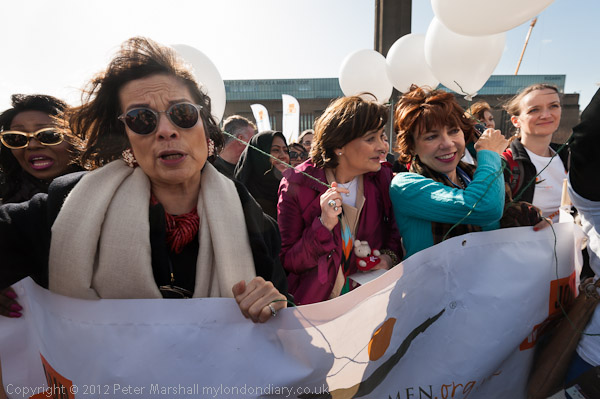
I could recognise Cherie Blair but none of the other women at the front of the march.

Although I took these pictures just over 3 weeks ago, I’ve only just got around to adding them to My London Diary. I’d sent some off elsewhere on the day I took them and just forgot to add them to my own web site. I was having a pretty busy few days and they just slipped my mind.

Mornings just aren’t my best time at the moment, and I’d been up very late the previous night working on the pictures I’d taken at three events the previous day and hadn’t got as much sleep as I needed. It wasn’t a really early start, but I was still half asleep when things started around 10.30 am, and somehow I managed to leave the Nikon D300 on manual setting at a fairly unsuitable exposure setting for the bright morning sun – probably what I had been using in the dull rainy conditions of the previous afternoon.

Of course I should have noticed, and if I’d been properly awake would have done so, but I’d taken rather a lot of badly overexposed images by the time I looked more carefully and discovered my mistake. As usual I’d been working mainly with the D700 and the 16-35mm, just grabbing the D300 for the occasional image that needed a longer lens. And in the bright sun the images on the back of the camera looked OK, but I hadn’t checked either the exposure details in the viewfinder or the histogram.

© 2012, Peter Marshall

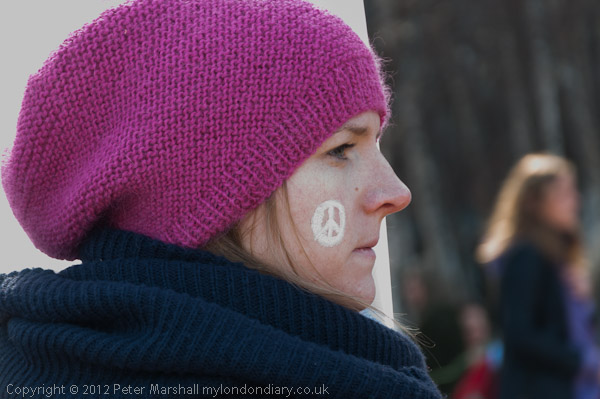
Most of the overexposed images were beyond saving, and the few I could salvage – such as this woman with a peace symbol on her cheek – didn’t quite have the normal tonal quality. Most of the other pictures could only be turned into rather odd poster images, not the kind of effect that interests me.

It didn’t help that I was also having problems with the SB800 flash that had stopped working the previous evening, either because of the rain or through over-heating, and was now either not firing at all or giving unpredictable output (I’d been having some problems with it for a while.) There was a strong low sun and I really needed to use flash fill. b

I’ve now got two out of commission SB800s and am wondering if it is worth taking them in for repair or simply buying a new flash. In the meantime I’m working with a cheap Nissin unit that doesn’t always seem to do what I want. Nikon’s SB910 is bigger and heavier than I like, apart from being expensive and in the end I decided to go for the SB700, which I ordered today and should get early next week.

© 2012, Peter Marshall

Not all my problems with ‘Women on the Bridge’ were technical. The press had been invited to a photo-call on the bridge at which some of the celebrities at the front of the march were to release white doves. But the event security stopped us from going up there, and I stood for a quarter of an hour in a slowly seething crowd of photographers muttering to each other but not quite deciding to push past security to get on with the job. Finally we were allowed onto the bridge and I ran up with the others, but we were still far too far away when the few pigeons flew up. Whoever was in charge of the event had got things seriously wrong. They had their own photographer and video there but not the press, and missed an opportunity to get the publicity they wanted. Of course it probably wouldn’t have been a great picture anyway.

Personally I also had a problem in that I could only recognise one of the celebrities who were there. I’d expected to find the names of the others on the event web site, but there was no information at all when I was writing my story. I don’t have a great deal of interest in celebrity, and don’t watch TV so there are few that I can recognise. Usually I have to ask the other photographers, but at this event I couldn’t be bothered. I didn’t stay for the speeches – when I might have found who some of them were, and I suspect some were very worthy.

© 2012, Peter Marshall

And perhaps because I missed the speeches it was an event that for me seemed rather corporate and rather lacking in political edge. Held on International Women’s Day which came out of the Communist Second International, this somehow seemed too tame, too moderate, too uncommitted as a celebration of that event. Rather like getting the Chamber of Commerce to organise the events for May Day.