Encore Sapeurs

I was interested (as I often am) by a post on Conscientious, Joerg Colberg‘s blog on Congolese photographer Baudouin Mouanda, who had a show I missed at Gasworks in Vauxhall last summer following a residency there. I quite probably walked past it, as it’s a stone’s throw from London’s best repair shop, Fixation, and in an area I know well, from long before it had galleries, where friends of mine I visited regularly lived in a council flat close to the Oval cricket ground. The page at Gasworks has some information and a few pictures as well as installation views from three of his projects: La Sapologie, (2008), Délestage, (2010) and Sur la Trottoir du Savoir, (2011).

Colberg’s post links to a set of pictures Hip Hop & société / Libreville on Afrique in Visu, and  to the web site of the Brazzaville Generation Elili collective where there is some French text about Mouanda, and I also found some pictures of young women working as car mechanics in Brazzaville I felt were of rather less interest than the other projects, along with a rather more promising set on the elections in Congo.

But in some respects the most interesting work – and the image chosen by Colberg for his post came from this – was the project featured on the Leica Camera site that he links to, La Sapologie. As well as the pictures there is also an interview with the photographer about the work.

Readers of this blog with a long memory may remember that I wrote a post on Sapology around two years ago, following the opening in London of photographer Daniele Tamagni’s ‘Gentlemen of Bacongo‘ and the publication of his book of the same title. A portfolio of work from this project had earlier won him the portfolio prize in the Young Photographers Canon Award 2007.

© 2010, Peter Marshall
A sapeur poses in front of Daniele Tamagni’s pictures at Michael Hoppen (Peter Marshall, 2010)

It was a memorable opening in particular for the presence of one of the’ People of Elegance‘, who I photographed for the blog. Mouanda’s (and Tamagni’s) pictures of the sapeurs are of course very much better than my quick snaps on that occasion.

French Photography Museum of Bièvres

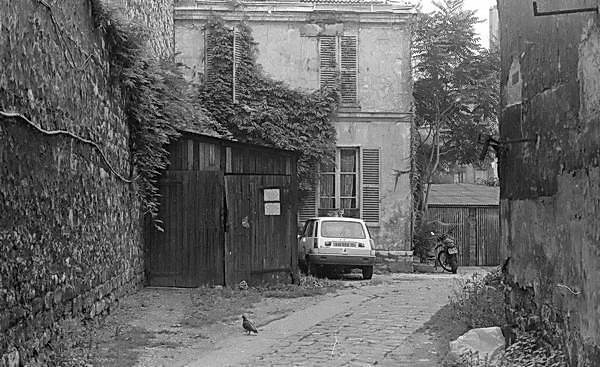
I’ve never visited the French Photography Museum of Bièvres, although it is only a short trip from Paris on the RER and only a short bus ride (or a longish walk) from where I stayed on my first visit to Paris. The River Bièvre one of two streams through the small town, features in some of Atget’s photographs taken around the start of the twentieth century in the 13th arrondissement in the south of the city, but was at that time being hidden below ground, though I walked along some of its course in the city in 1984 when photographing for my project Paris Revisited – more recently published as ‘In Search of Atget‘. But I’ve yet to visit Bièvres for real, though I spent some time today both on the web site of this ‘village at the gates of Paris’ with a remarkable number of clubs for its just over 5000 inhabitants.

© 1984, Peter Marshall
Paris 13e, August 1984 Peter Marshall
One of these associations is the Photo Club Paris Val-de-Bièvre, founded in 1949 by Jean Fage (1905-1991) and his son André Fage, the news of whose death aged 85 on April 16, 2012 I read in La Lettre de la Photographie (in English.) They also founded the annual Bièvres Photo Fair and began the collection of equipment and images that became the first French museum of photography, opening to the general public in premises provided by the council in the early 1960, and in 1964 the Association du Musée Français de la Photographie was formed. The collection was  donated to the Conseil Général de l’Essonne in 1986 on condition that it remained in Bièvre and that a new museum be built to house it.

You can see the museum on its web site, and as well as viewing some on-line presentations including a general history of photography, portraits of artists by Sabine Weiss and anti-Nazi photomontages by Marinus, you can also wander for ages around images of the many items in its collection. I think there are images on line of 11759 items, and although the site is is French it is still easy to navigate. The museum is an incredible monument to the two men who founded it.

Pillow Fights

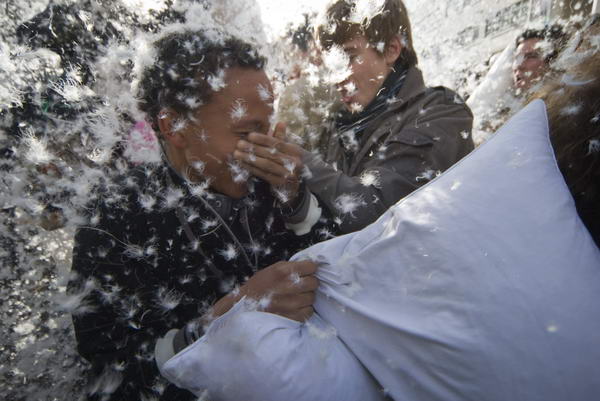
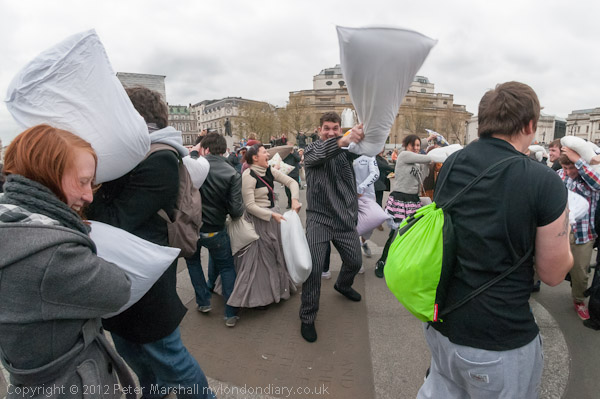
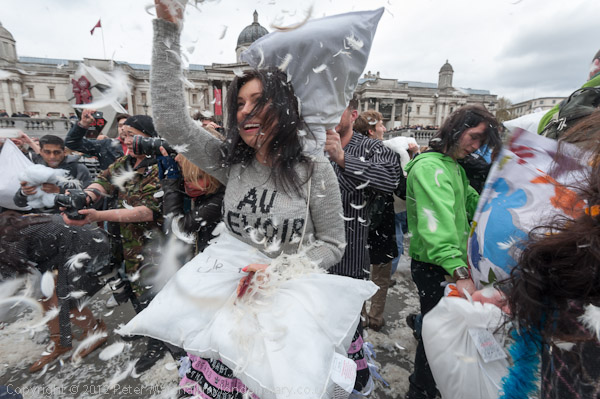
It’s good at least occasionally to have a rest from more serious events, and International Pillow Fight Day provided that on April 7.

© 2012, Peter Marshall

It was hard to pick out a single image from the many I took during the 30 minutes, though the set does I think give a good idea of the event.

I first photographed International Pillow Fight Day in March 2008, when the London event took place in Leicester Square.

© 2008 Peter Marshall

It was perhaps a little easier then to get in among the midst of things as the fight was in a slightly more confined space, and it was easier to take photographs because there were relatively few photographers present. This year there were hordes of us, and rather a lot of those taking part were busily performing for the press rather than just getting on with having a good time belting hell out of each other with their pillows. The pillow fight day is an idea of the urban playground movement, which aims to get people off the couch and taking part in things, and I’m not sure that I think acting up for the media is really much better than being a passive consumer of it. People should get on with their own thing.

This year I had some technical problems. My D300 suffered a mirror lock-up – which it frequently does – and in the heat of the moment I couldn’t clear this. Normally it’s simply a matter of using the menu item which is supposed to lock it up for cleaning, pressing the shutter release to lock it up, then turn the camera off for it to come back down into place. But the menu item was greyed out and unavailable. Once I had time to think about it I realised that this simply meant the battery was getting low, but in the heat of the pillow fight I simply thought the thing had finally given up the ghost. I’d been intending to use the10.5mm fisheye and get in really close, but only managed a single frame during the actual fight before the camera locked up.

© 2012, Peter Marshall
My one frame at the start of the fight with the 10.5mm

I was also perhaps a little nervous about my equipment, having just got a new Nikon SB700 flash, I carefully put it away in my bag before the feathers started to fly. If you photograph in the middle of things, pillow fights can get pretty physical, and I didn’t want it to get damaged before I’d really had a chance to use it. Although my cameras stood up well to a little battering, I did get the D300 I was holding to my eye hit hard by a pillow and knocked into my upper lip, which hit a tooth and I was photographing for a few minutes with blood dripping.

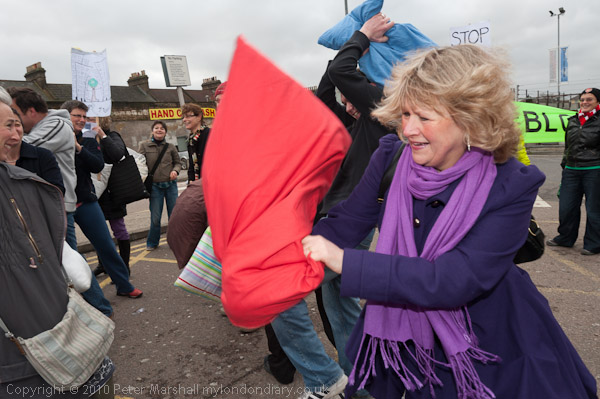
I’ve also photographed a pillow fight that had a more straightforward purpose, in January 2011 outside Walthamstow station over the plans by developers Solum Regeneration to build a 14 storey hotel and 8 storey blocks of flats.

© 2011, Peter Marshall

It was rather too spread out to generate the same kind of energy as the larger events, and that shows in the pictures.

________________________________________________________

My London Diary : Buildings of London : River Lea/Lee Valley : London’s Industrial Heritage

All photographs on this and my other sites, unless otherwise stated are by Peter Marshall and are available for reproduction or can be bought as prints.

To order prints or reproduce images

________________________________________________________

A Long March

 © 2012, Peter Marshall
London Dyke March 2012 was the final event I covered on the evening of March 31

March 2012 was a long and busy month for me, and I find that I put over 30 events on line on My London Diary – and there were a few minor things that didn’t seem worth posting about too. Perhaps a bit too busy, and I had to take it easy a few days at the start of April to rest my left knee, which was making it rather painful to work.

London Dyke March 2012
Protest for Trayvon Martin
Disarm The National Gallery

© 2012, Peter Marshall
Stop Harassment At Abortion Clinic

Palestine Land Day: Solidarity For Jerusalem
Teachers Keep Up The Pensions Fight
Bikes Alive King’s Cross
Olympic Site From Westfield
Leyton Marsh Olympic Protest
STARR Homicide’s 9th Anniversary
Justice for Hollie Greig

© 2012, Peter Marshall
Budget Media Village Protest
Budget Day At Downing St
Medmenham Walk
Brent St Patrick’s Day
Asad Supporters Counter-Protest

© 2012, Peter Marshall
Free Syrians Protest
Frack Off Big Oil!

© 2012, Peter Marshall
Students March Against Fees
London Diocese Celebrate Fairtrade
Holi Festival, Twickenham
Stop Namibia’s Seal Slaughter
Republicans Protest BBC Pro-Monarchy Bias
Swaziland Vigil
Tibet Freedom March
London Fairtrade Diocese
Women on the Bridge

© 2012, Peter Marshall
Doctors & Students NHS March
NHS Not For Sale Lobby
Save Our NHS Human Chain
Greeks Protest At St Paul’s

© 2012, Peter Marshall
Million Women Rise March
Boycott Workfare – Oxford St

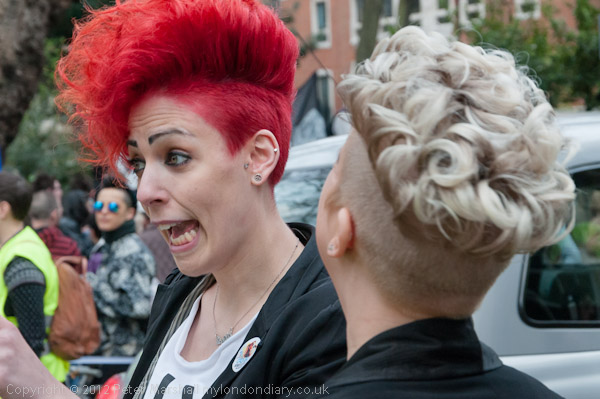
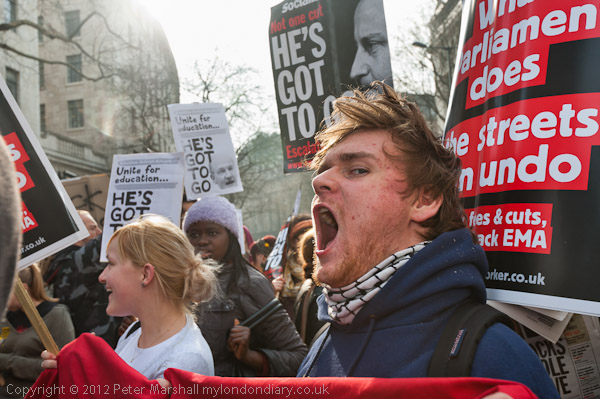
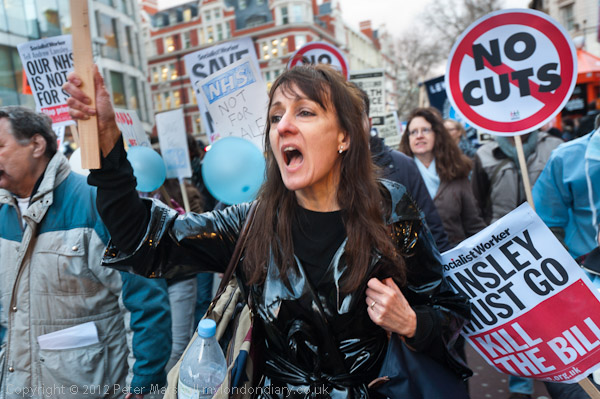
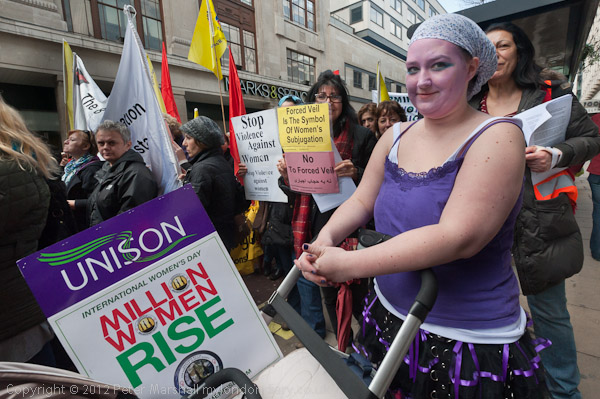
Picking out a few of the images that I liked most from the month was difficult, but almost all of those I’ve chosen all concentrate on a single figure and their gesture or expression – and there are four with their mouths open shouting. I think most of my best pictures are of women too – perhaps because they tend to be more expressive – or perhaps for other reasons.

Photography and Privacy

The Wire has some useful advice for photographers by Cleland Thom arising from a complaint brought to the Press Complaints Commission over a case involving a guy smoking a hookah in a Glasgow café.

Of course the PCC isn’t exactly everyone’s favourite at the moment, and its rulings aren’t law, although they often reflect their view of the current UK law. Of course this differs in various countries, and in Glasgow it is in any case Scottish rather than English law that would apply. But even so it it probably pretty good advice for keeping out of trouble, though perhaps a little over-restrictive.

The case was dismissed, though with some criticism that the photographer had perhaps misled the complainant over a technicality.

The advice says that a small café or restaurant is a private place, where a person would have a reasonable expectation of privacy, whereas I think in the only similar case I can remember a judge decided it on the basis that someone at the back of a café could reasonably expect this, while had they sat in a prominent position they would have had no such expectation.

Further the advice suggests that the photographer should identify himself, the publication that he/she is working for and the particular use that will be made of the picture. There are problems here for the freelance and I think that usually a rather less detailed and more inclusive statement will have to do. But obviously as Thom says, if the subject places restrictions on how a photograph may be taken or used – such at not showing his or her face – then the photographer should respect these and see that they are passed on with the image. (This paragraph also relates to the fifth point about re-use of the image.)

Probably the least clear of Thom’s five points is:

It is OK to includes images of ‘bystanders’ in the background, provided they are unlikely to object. If consent is not given, then do not take the photo, unless the photographer is already aware of a clear public interest issue.

The second sentence here seems to contradict the first, suggesting that consent is necessary, while the first leaves it to the photographer to decide whether or not they would be likely to object. It would seem to me that if they are easily recognisable in an image they are not ‘bystanders’ but a part of the subject and should receive the same consideration as the main subject. If they are not readily recognisable then there is no problem in including them.

Fortunately most of my images are taken in public or quasi-public places where no one has any expectation of privacy, so I don’t need to worry about consent. Though I still do get occasionally get people who come and tell me “You can’t take my photograph” or  “You should ask before you photograph me” and demand that I delete the pictures.
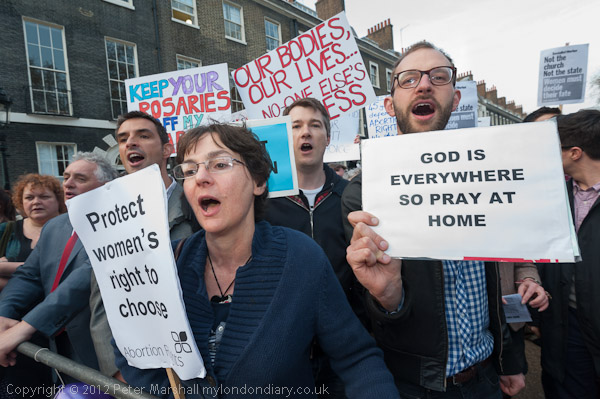
© 2012, Peter Marshall
Pro-choice protesters against ’40 Days for Life’ pickets at BPAS clinic

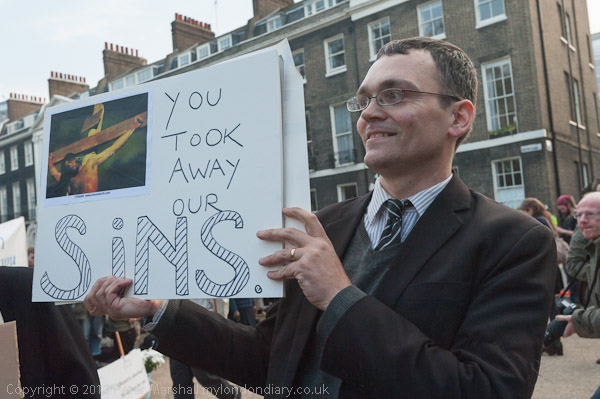
This happened again when I was photographing a protest last Sunday (not the one shown above), and I tried to point out to the person concerned that the point of public protest was to try to get publicity for a particular cause, and that taking part in such a public event she had implied her permission to be photographed. Not of course that I needed any such consent. (And of course as a photographer I’m pleased when people at such events decide to wear masks if they wish to hide their identity as it usually makes for more interesting images.)
© 2012, Peter Marshall
An anti-abortion campaigner supporting the 40 Days For Life pickets outside BPAS clinic. Later in the event he was attempting to hide from photographers behind this poster and at a previous protest he told me I could not photograph him or use his picture. Of course I could and did.

In the UK at least you do not in general need permission to photograph anyone or anything in public places, although many places which we think of as public are actually private. In general there are no restrictions on photographing people without their consent, and the publication of the images is only restricted by the possibility of defamation.  (There is also the possibility of public order offences related to images of an indecent nature, and some restrictions on photography of police, security services, military establishments etc, but these are special cases.)

There are often times when I do ask people if I may take a picture, usually when it involves getting very close to them, invading what we think of as our personal space, or when I want their cooperation in some way. It’s generally more a matter of politeness than anything else. But I hadn’t even noticed this person when I was taking pictures – she was just one person among around 20 in one of them. And of course I didn’t delete the image.

More pictures from Stop Harassment At Abortion Clinic protest on My London Diary.

________________________________________________________

My London Diary : Buildings of London : River Lea/Lee Valley : London’s Industrial Heritage

All photographs on this and my other sites, unless otherwise stated are by Peter Marshall and are available for reproduction or can be bought as prints.

To order prints or reproduce images

________________________________________________________

Limited Editions?

I’ve never been in favour of ‘limited editions’ of photographs. It has always seemed to me to be a repudiation of one of the intrinsic properties of our medium, its reproducibility.

It also seemed unnecessary, as most photographs are produced as actual photographic prints in relatively limited numbers – few photographers sell more than a few copies of any image as actual photographic prints, although they may get reproduced in thousands or even millions in newspapers, magazines, books or images on screen. Paradoxically while limited editions have been seen and marketed as a way to artificially produce scarcity, in many cases they will actually have resulted in more prints of an image being made.

Over the years many photographers have indulged in dubious practices on limited editions in various ways. Often an edition is not actually printed, but prints are actually made to demand, and may differ significantly from each other. Others have produced several limited editions from the same original – a practice that would be acceptable if made clear at the time that the first was being marketed, but perhaps not if decided on at a later date.

Of course there are positive aspects of limited editions. Some photographers like them because they feel they enable them to put a finish to older work and allow them to concentrate on new projects. Others see them as a useful marketing tool to make a living, and I’ve nothing against photographers making a living, although there are photographers who have managed it without limited editions.

The recent sale record-breaking sale of new prints of old work by William Eggleston has raised some interesting questions, not least about limited editions, with one major collector of his work who owns a number of his limited edition dye-transfer prints suing over the new limited edition of these same photographs. The details of the case so far are well covered in the three links from PDN Online that I won’t go into them further. It’s also interesting to read about them and the possible museum in Eggleston’s home town MemphisNewsPaper.

But this case also raises interesting questions about the photographic obsession with ‘vintage prints’, with the new large ‘pigment prints’ selling for an order of magnitude more than the orginal dye transfer edition. Possibly because they are better prints (though I’ve not had the chance to compare) and almost certainly because they are larger.

The new Eggleston prints are inkjet prints, or as the galleries prefer to call them ‘digital pigment prints.’  I don’t know on what paper, printer or inks these were made, but they are basically similar to those many of us can produce on our own printers, except for the size of 44″ x 60.

Craig J Sterling on Beyond the F-Stop  comments “the digital print, in my opinion, has finally been legitimized … yes!”  Looking around the giant dealer trade show in Paris eighteen months ago I’d certainly come to the same opinion, although as with these prints the labels went to great lengths not to include ‘I’ word; “inkjet” is still taboo in the trade. Sterling has also written about Limited Edition Prints, and includes the idea that it only became possible to produce true editions of photographs with the advent of digital – in the darkroom every print is an individual performance.

Although I rather doubt if the case against Eggleston will be successful (but I’m not a lawyer) it may perhaps serve to make photographers rather more careful particularly in those US states that have laws about editioning of art works. But what I would really like to see is more photographers adopting a democratic rather than an elitist stance towards selling photographs.

Eggleston’s work doesn’t need to be printed huge, and I’ve often thought that much if not all of it works better in books than on the exhibition wall (and the same is true of most photographs.)  You can buy a copy of his ‘The Democratic Forest’, arguably his best book, for around £30 if you shop around, which gets you not just one but a sequence of 150 of his images for something like $578,460 less than that single large image of a tricycle. I know which makes more sense.

Arthur Tress On The Street

Discoveries in street photography aren’t always what they are hyped up to be, but Arthur Tress‘s rediscovery of some of his early work holds more promise than most. Tress took around 900 photos during a short stay in San Francisco in the summer of 1964, and stored the prints that be made from them in a community darkroom there wrapped up in a parcel at his sister’s house when he went off to work elsewhere.

Forty-five years later in 2009 he came across them again and decided they were interesting, and took them to show curator James Ganz at the de Young Museum.

The show Arthur Tress: San Francisco 1964 opened there on 3 March and runs until 3 June 2012, and there is just a little more information in the press release. If you – like me – can’t get to San Francisco, the best place to see them is on Tress’s own web site. Of course his later and better known work is also worth a long look. Accompanying the show is a book of the same title, and also worth reading is an interview with him by Jim Kasson from 2002 on the web site of The Center for Photographic Art in Carmel. Although I wrote about Tress’s work on several occasions on another site I’m surprised to find that this seems to be his first mention here on >Re:PHOTO.

The Listening Eye

There is a very nice essay on the work of Vanessa Winship on The Great Leap Sideways blog, along with a gallery of her work: The Listening Eye: the work of Vanessa Winship.

A site new to me, TGLS is edited by Stanley Wolukau-Wanambwa and describes itself thus:

The Great Leap Sideways is a gallery space primarily, but not exclusively, dedicated to showcasing photography. The site comprises small and extended surveys of work by contemporary photographers alongside extended interviews, features, videos and extracts from texts that illuminate the practise of photography and its wider context.”

It’s worth taking a look at the Archive on the site too, which has some interesting features and interviews, though sometimes with a rather different outlook to mine, although it does feature several other photographers whose work I’ve mentioned here or elsewhere in the past as well as Winship.

Justice For Trayvon

 © 2012, Peter Marshall

Like most people – or rather everyone I’ve talked to about it – I was appalled at the shooting of Trayvon Martin, a teenager going home from his local shop after buying a soft drink and some sweets, shot by a white man who claimed he felt threatened by this young black in a hoodie, apparently sufficient justification to get away with murder under Florida law.

Although this was clearly a crime committed because the victim was black, it surprised me that the protest at the US Embassy did not attract much wider support from the left in the UK. Not only were the great majority of those at the protest black, but even most of the photographers I met there were. The SWP had as almost always produced a placard – this one reading ‘No Justice No Peace‘ and a few members were present with a bookstall but otherwise there was relatively little evidence of solidarity.

Trayvon was killed in Florida, but the racism which led to his death is active here, and as recent events have brought again to public attention, very much present in our police force. As I noted in my post Protest for Trayvon Martin on Demotix and My London Diary, the speakers at the event were introduced by “Merlin Emmanuel, brother of Smiley Culture, killed by police in his own kitchen, and speakers included Marcia, the brother of Sean Rigg, murdered in Brixton Police Station.”

© 2012, Peter Marshall

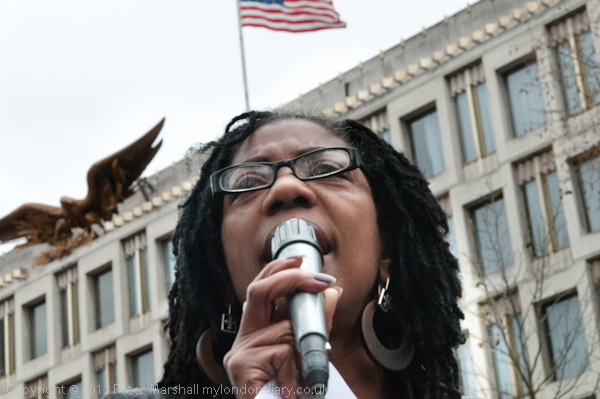
The picture above is not the most flattering I’ve taken of Marcia Rigg on the various occasions I’ve met her since her brother’s murder, but the angle and framing were carefully chosen to include the American eagle and flag flying on top of the embassy building. And it was intended not to flatter but to show something of her righteous anger at both the killing of her brother and the deception and lies the family have met with from police, IPCC and CPS in trying to find the truth of what happened in Brixton Police Station and to get justice.

Flags very seldom fly out straight in London’s unpredictable breezes and it took quite a few attempts to get this how I wanted it, working at around 90mm equivalent using the 18-105mm on the D300 in very overcast light. A little flash helped to keep a sensible tonality in her face, though I had to bring it out more in post-processing – adding a little brightness and contrast in some areas and burning down the flare from the brighter sky on her forehead. The sky and the flag also needed burning in.

The picture was taken nominally at ISO1250 but with one stop of underexposure – so really ISO 600 – and stopped down to f ll to get the background fairly sharp, and this gave me a shutter speed of 1/320. Both my Nikon flashes are waiting for me to take them in to see if they can be fixed, and this was taken using a cheap Nissin unit, which I don’t find gives as reliable exposure. Looking at the results from this and the other events during the day made me order a Nikon SB700. It seemed a bargain (though I think six times what I paid for the Nissin) compared to the larger, heavier, considerably more expensive and only slightly more powerful SB910.

© 2012, Peter Marshall

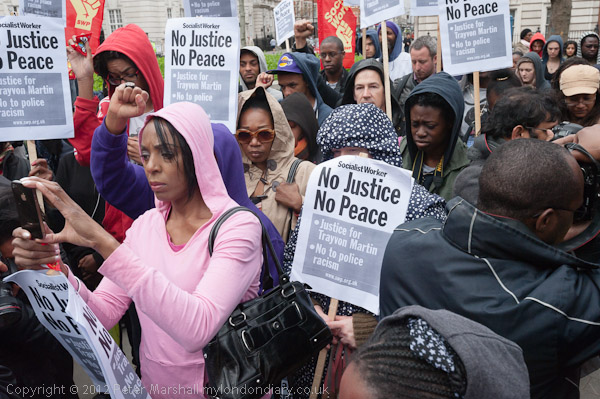
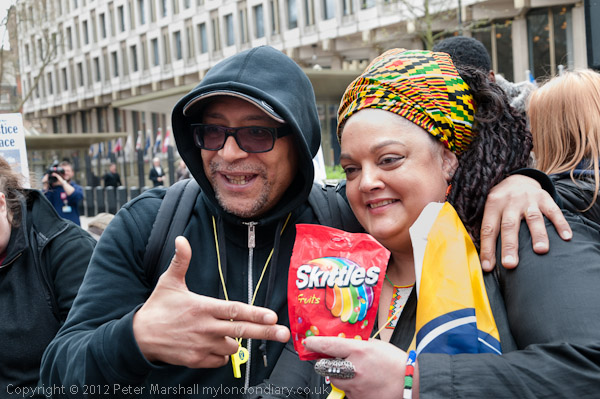
People had been asked to come to the protest wearing hoodies and to bring packets of the sweets Trayvon had bought – Skittles – and bottles of the soft drink, and there were many opportunities to take people posing with these. I don’t like posed pictures, but I did take rather a lot of them at this event, and a few made it to the web pages at Protest for Trayvon Martin on My London Diary.  The one above at least shows a certain spontaneity, as well as featuring the two joint chairs of BARAC, Black Activists Rising Against Cuts, Lee Jasper and Zita Holbourne.

________________________________________________________

My London Diary : Buildings of London : River Lea/Lee Valley : London’s Industrial Heritage

All photographs on this and my other sites, unless otherwise stated are by Peter Marshall and are available for reproduction or can be bought as prints.

To order prints or reproduce images

________________________________________________________
Artists At The Gallery

March for me went out with a very busy day, covering three protests in London, but for once they were fairly well-spaced across the day, even giving me time for a short rest (and a couple of beers with another photographer) before rushing to the final location.

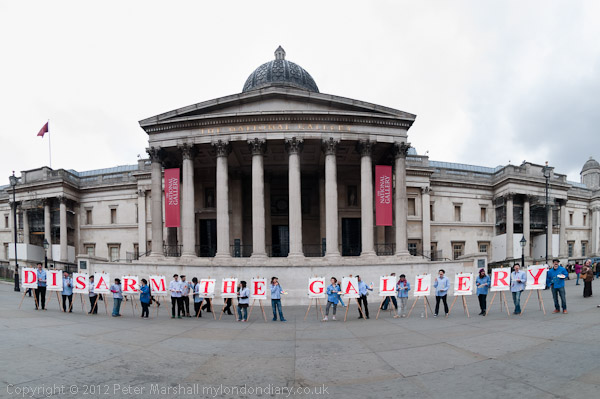
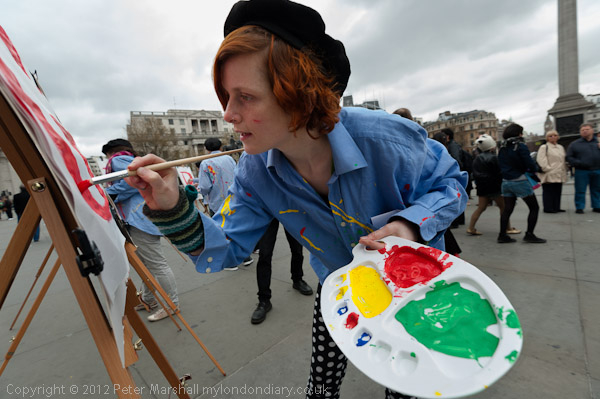
Disarm the National Gallery was my starting point, where a team of ‘artists’, each with paint-stained smock, black beret and moustache (optional for the women), palette and easel painted a single letter of the slogan in a long row in front of the National Gallery. I’d been there earlier in the year when activists from the Campaign Against the Arms Trade had tried to run into the gallery when they were hosting a dinner for VIP guests to the DSEi Arms Fair in London (see Arms Unfair 4), and on this occasion the gallery was taking no chances of a repeat and had shut their main entrance on the portico overlooking Trafalgar Square. Today’s protest was quiet and entirely orderly and drew the attention of the public, including those in the long queue to enter the gallery by a small and easily guarded lower door, but it was hard to find a way to photograph it except for the obvious.

© 2012, Peter Marshall

On My London Diary in Disarm The National Gallery you can see a few variations on this. It wasn’t too easy to get a picture like this, mainly because this area is actually a busy walkway, and it really wasn’t possible to work from a great enough distance to use a normal wide-angle or get a better perspective on the gallery building. When they did it for the second time the easels were a little better placed, and there are other images that are better.  But this was I think the concept behind this protest. I was able to get the whole message in by using the 10.5mm fisheye, and then to get the verticals straight by converting to cylindrical perspective. The horizontal angle of view that this gives is something like 147 degrees, while anything more than around 100 degrees gets impossibly stretched at the edges with rectilinear perspective.

© 2012, Peter Marshall

There was plenty of time to take pictures, though I had to be careful to keep out of the way of the people from CAAT who were videoing the event – except when they decided to video me photographing. So I could take pictures of the artists painting and other things that were happening, although it was hard to get away from a sameness in the images with almost everyone taking part being in the same uniform and doing the same things.

________________________________________________________
My London Diary : Buildings of London : River Lea/Lee Valley : London’s Industrial Heritage

All photographs on this and my other sites, unless otherwise stated are by Peter Marshall and are available for reproduction or can be bought as prints.

To order prints or reproduce images

________________________________________________________