Big Ride And More

It was a gloomy and damp day, the rain varying between the occasional spot and heavy downpour as I rushed from what for me counts as a early morning event – 10.30am at Tower Hill for Workers Memorial Day with speeches and wreath-laying at the statue of the Building Worker there to Park Lane in Mayfair for the Big Ride. Of course 10.30am isn’t really early, and only meant me leaving home around 8.45am, but I’ve long got out of the habit of early rising (and had not got to bed until after 1am.) On weekdays I don’t like to travel in the morning rush hour if I can avoid it, because it costs me two or three times as much for the privilege of often standing in a crowded train for 30 or 40 minutes. But this was a Saturday, so at least I was travelling rather cheaper and got a seat.

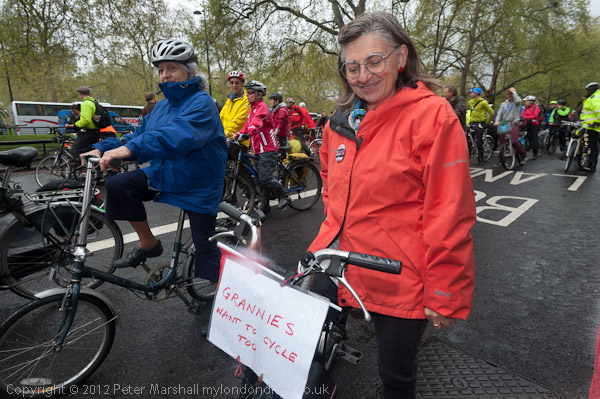
I arrived at Park Lane just a few minutes after the time I’d been told people would start gathering at Brook St, to see everyone around there cycling away, and thought I might have missed it.  Running with a fairly heavy camera bag isn’t my idea of fun, and I could have done without the 700 yard dash to find where the front of the ride was actually assembling and I was able to take some pictures.  The rain wasn’t too heavy, though it did cause some problems, and working as I do most of the time with a very wide-angle means their is no way to stop drops of rain getting on the lens, its effects usually impossible to spot on the small images on the back of the camera, and this made a few images unusable. Sometimes you are lucky and it isn’t in a really critical area of the picture, as in this case:
© 2012, Peter Marshall

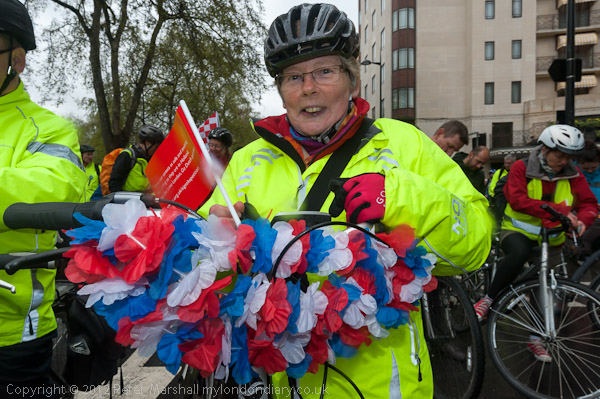
You can clearly see the diffusion it has given on the top left of the sign reading ‘Grannies Want To Cycle Too’  although I’ve reduced the effect considerably in post-processing in Lightroom by darkening the area and increasing contrast and sharpness. You can see it again on the bottom of the flag in this picture:
© 2012, Peter Marshall

I was also trying hard to remember that 16mm is usually a mistake with bicycle wheels at the edges of the frame, and trying to work more towards the 35mm end of the lens.

Although the SB700 flash unit’s instructions are very clear about not letting it get wet, it seemed to keep working fine, and I needed a little fill from it for most of these pictures of people. I still am not quite used to the various buttons and switches on this unit, and after seeing the results  when I got home reached for my black tape.  Since I take more than 99% of the pictures on the TTL setting the unit now has a small piece of tape preventing me from shifting it from that position accidentally. It does take a bit of doing without the tape, but I found I had managed it. Similarly the switch which changes from even to standard and centre-weighted coverage is fixed at the even end. It’s easy to peel off the tape should I need to change the setting.

Incidentally I’ve been pleased so far with the SB700, though even on the wide setting I don’t think it has the same evenness of coverage I got with the SB800. But a little fall-off around the edges is often a good thing. Using the built-in ‘wide panel’ or  the clip on diffusion dome should give more even coverage for those pictures that need it. Without the wide panel in place on the full-frame camera the flash is reasonably even only for focal lengths of 28mm and above. With it the 17mm indicated on the panel isn’t quite true, but using this or the diffusion dome is generally pretty even, and with the two together, things are excellent. But there is a catch. Using the panel or the dome makes the unit much less efficient and increases the recycling time. So almost all the time I work without either.

It is largely a myth that these things make your flash softer. Neither greatly increases the size of the light source, and diffusion without an increase in size simply reduces the amount of the light emitted that misses the subject – unless there are suitable surfaces around to bounce some of it back. To get a softer effect you need a large diffuser or reflector.

For using as fill I now have the flash usually set at -0.3EV and the two camera bodies also with some negative setting, typically also -0.3 or -0.7EV. Often I seem to want a little less fill with the longer lens on the D300, so it’s convenient to use the flash compensation on the bodies to allow for this. Quite why Nikon hide away what is probably the most important information on using the flash in pages E23-E24 of the manual, after a lot of esoteric stuff on advanced wireless operation is hard to understand.

As usual I was spending almost all of the time between actually taking pictures holding my microfibre cloth over the front of the lens to keep it dry, though occasionally using it to wipe the flash too. Mostly it worked, as you can see in Big Ride for Safe Cycling on My London Diary, where there are some better pictures than in this post.

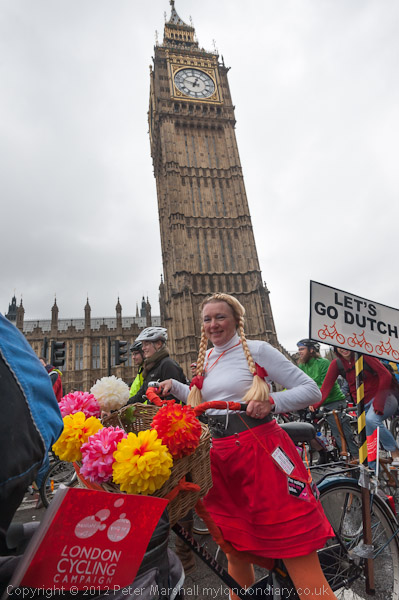
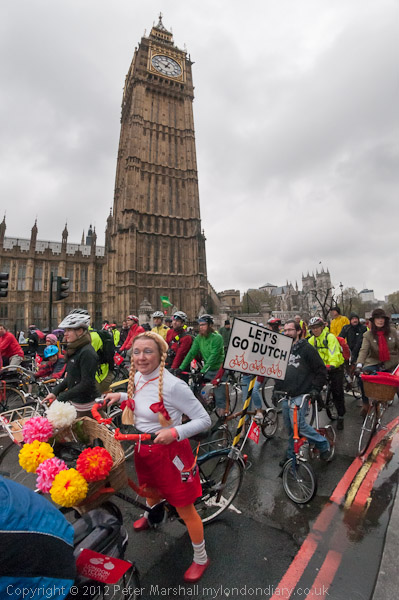
Continuing on the vaguely tech side of thing, here is a pair of pictures, one take on the D700 at 16mm with its normal rectangular perspective and the other on the D300 with the 10.5mm fisheye (almost impossible to keep raindrop free) and then converted to cylindrical perspective.
© 2012, Peter Marshall

© 2012, Peter Marshall

Of course they are from a different viewpoint but give a good idea of the different ways the two depict more or less the same subject.

After then end of the Big Ride (and again I was annoyed to find that while the organisers had said the finish would be near Blackfriars it was actually more or less at Temple, another unnecessary 700 yards I could have done without and which meant me arriving a few minutes too late) I dried out and warmed up in one of my favourite London galleries, the Courtauld Gallery.To be honest I wasn’t that impressed by the current show there, Mondrian || Nicholson In Parallel, though I did feel that while Nicholson’s work looked better for actually seeing the works, Mondrian is actually more impressive in reproduction. But the Courtauld has one of the finest collections anywhere of Impressionist and Post-Impressionist works.

Then, feeling rather better I took a bus to my final event for the day, in Whitehall, opposite Downing St, Support For Palestinian Hunger Strike. By this time the rain had almost stopped too. Again here is a pair of pictures taken with the 10.5mm and 16-35mm from a very similar position which I think demonstrate the uses of both lenses. It was of course a tableau set up for the media, the kind of thing I don’t generally relish.
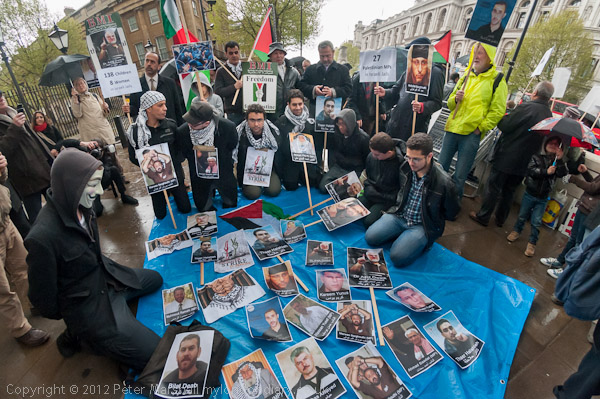
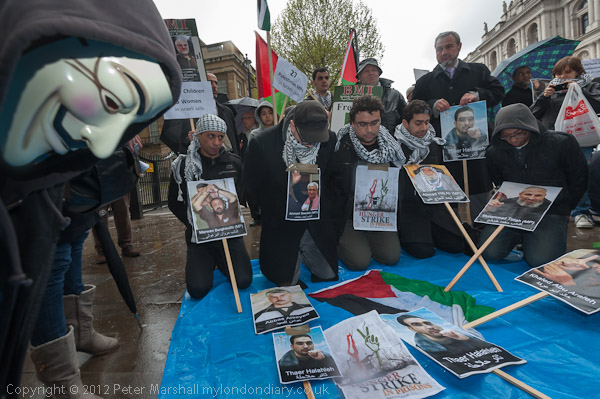
© 2012, Peter Marshall

© 2012, Peter Marshall

________________________________________________________

My London Diary : Buildings of London : River Lea/Lee Valley : London’s Industrial Heritage

All photographs on this and my other sites, unless otherwise stated are by Peter Marshall and are available for reproduction or can be bought as prints.

To order prints or reproduce images

________________________________________________________
Two To Tango

One of the things that I find relatively few photographers really seem to appreciate is that much of photography is really a collaborative art. It’s perhaps obvious in some branches of photography – where would Bailey have been without Shrimpton? But most of the collaborations I’ve been involved with have been considerably less intimate, often a matter of a few fractions of a second, and are often unwitting at least in detail on the part of my photographic co-respondents.

I’ve never been a great fan of David Bailey (or of fashion as a genre, though it has provided a living for some fine photographers), but when I was invited to apply for a post writing about photography for an Internet site back in 1999 by sending a trial article, I chose to make him the subject. He had made his name by going to New York with the Shrimp in 1962, and it amused me to make my own debut as a Londoner for a New York based company with a piece about another Londoner. Looking back, it isn’t a piece I’m particularly proud of (perhaps one of the few of the hundreds I wrote that I’m pleased is no longer on line), but it had a certain edge and humour and it got me the job.

I didn’t see BBC4’s We’ll Take Manhattan which was screened in January, though I suspect I would have been unable to watch it in its entirety, but the video about its making is almost certainly a more interesting piece, and considerably shorter. It’s also worth noting, as ‘Daks’ comments on the The Arts Desk piece that as usual film-makers rewrite history to suit their purposes – as well as presenting a highly censored version of Bailey-speak.

It should also be noted that the shoot was January 1962, and Diana Vreeland did not join Vogue until April 1962; in January she was still editor-in-chief of Harper’s Bazaar. Bailey also claimed to have met Shrimpton at VOGUE studios where she was being photographed for a Kelloggs advert by Brian Duffy, who was one of the ‘terrible three’ (Bailey, Duffy, Donovan), so the BBC production was also not accurate with how they met. (Fashion Theory, Lustrum Press 1978)

Daks also goes on to point out that the BBC also showed ” a great documentary on Bailey – Four beats to the bar and no cheating“. You can watch it as four clips from a broadcast on Swedish TV starting here on YouTube. I’ve only watched a little of it so far. Or you could just watch Blow Up again.

I’ve always thought of My London Diary as being at least in part for the people who collaborate with me in the making of the pictures, some more actively than others. It’s one reason why I put so many pictures of most events on it – so that the people I’ve photographed can see the pictures I took of them. Often people will ask me where they can see the them – or if I can send them a copy – and it’s easier to give them my card and tell them they will be on the site in a few days, and that they can e-mail me.

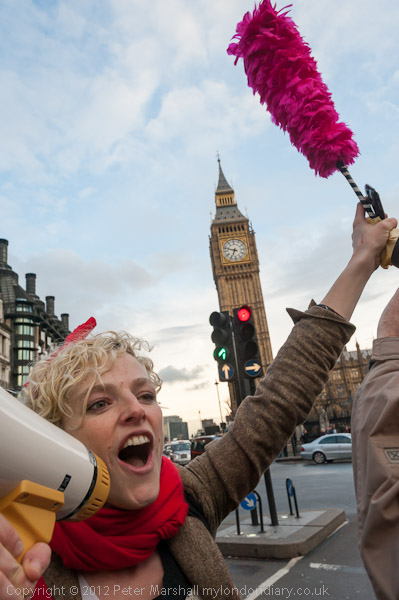
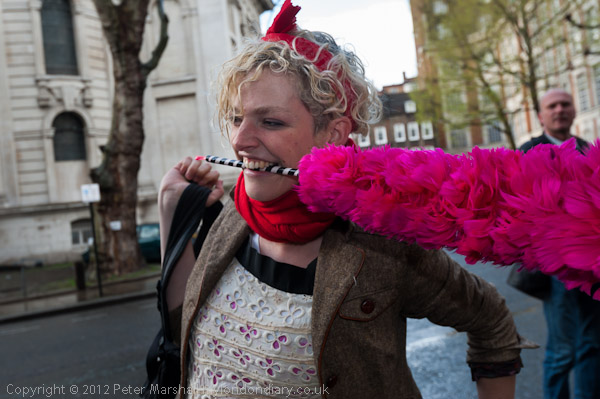
One group I like photographing is Climate Rush, and I was with them a couple of times towards the end of April. Here’s Tamsin Omond cleaning up the London Air:

© 2012, Peter Marshall

and I think this is the best – though you can see some others too in Climate Rush Spring Clean London’s Air on My London Diary. Earlier I’d grabbed a picture of her with the duster between her teeth that I quite liked too.

© 2012, Peter Marshall

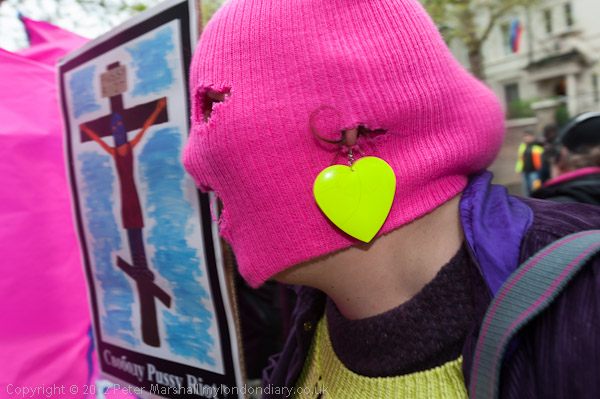
But of course Climate Rush, whose tagline is Laurel Thatcher Ulrich’s “Well behaved women seldom make history” and have adopted the suffragette slogan ‘Deeds Not Words‘ isn’t just Tamsin.  She was at the solidarity protest for the Russian anonymous women’s punk band Pussy Riot the following Monday, but the best pictures I took  in Protest Supports ‘Pussy Riot’ were not of her.

© 2012, Peter Marshall

It wasn’t easy to make a picture that included the flag of the Russian embassy (not that anyone recognises the Russian flag now) visible at the top right, and the placard – from Pussy Riot in Moscow – is perhaps a little less clear than in some of the more obvious images I took, but I felt this was an image that reflected Pussy Riot more than the others which you can see on My London Diary.

________________________________________________________

My London Diary : Buildings of London : River Lea/Lee Valley : London’s Industrial Heritage

All photographs on this and my other sites, unless otherwise stated are by Peter Marshall and are available for reproduction or can be bought as prints.

To order prints or reproduce images

________________________________________________________
Course Report

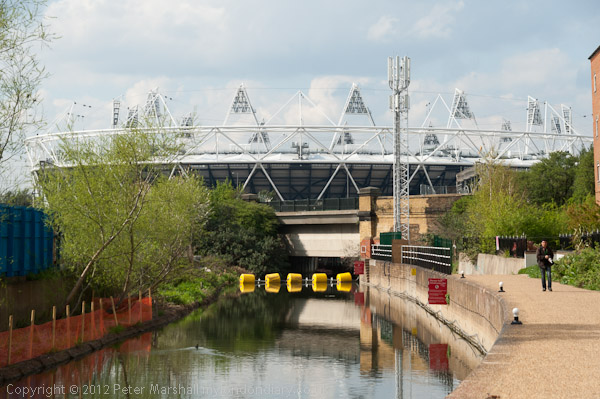
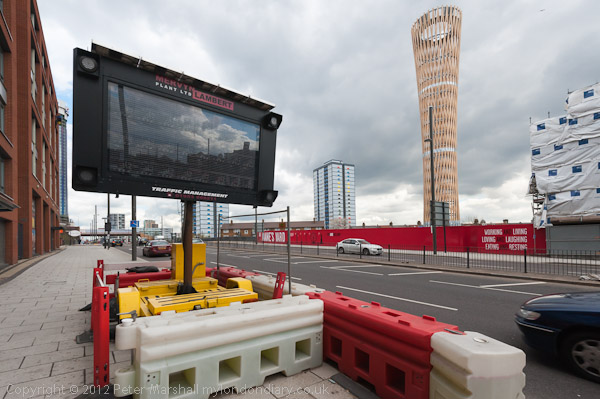
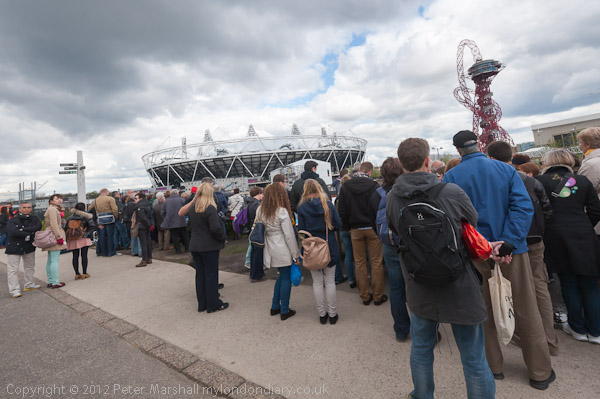
I didn’t take many pictures on the weekend of April 21-2 because I was at a photographic workshop.  If that seems odd, perhaps I should say I was running it, although facilitating would be a better word. Based at the View Tube, overlooking the London Olympic site during one of the last few weekends when that viewpoint will be available to the public, there were some disappointments, but I think we managed to have an enjoyable and fruitful time.

© 2012, Peter Marshall
Olympic traffic management sign and Olympic torch

As usual, the main joy of the workshop was seeing how other photographers tackle the same challenges, in particular the others taking part in the workshop. Shortly I hope to be able to link to a mini web-site of some of the work that we produced which the Museum of London promised to host.

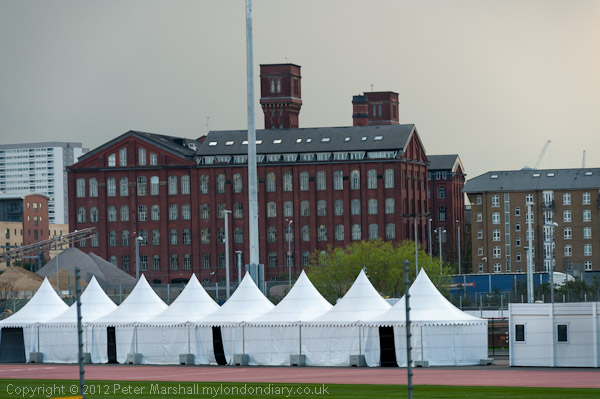
© 2012, Peter Marshall
Olympic warm up area and former Bryant & May match factory, April 2003

I started the course by trying to show how other photographers and film makers had reacted to the area, including of course my own work on the  River Lea/Lee Valley 1980-2010  web site some of which is also in the Blurb book Before the Olympics, but also showing quite a range of other work, including images by the photographers featured on David Boulogne’s 2012 pics blog (which also has a little of my own work.) It was a shame that the View Tube didn’t have the facilities to display this or own work more than dimly.

One of the buildings overlooking the venue was of course the former Bryant & May match factory (above, taken a week before the course) which has been in the news this week as there are likely to be guided missiles based on one of its towers during the Olympics.  It would certainly be an ideal site from which to attack the Olympic site, but hard to see it as a good defensive position, and in the thankfully unlikely event that any of the missiles was fired and hit a target the result could be terrible casualties in the East End.

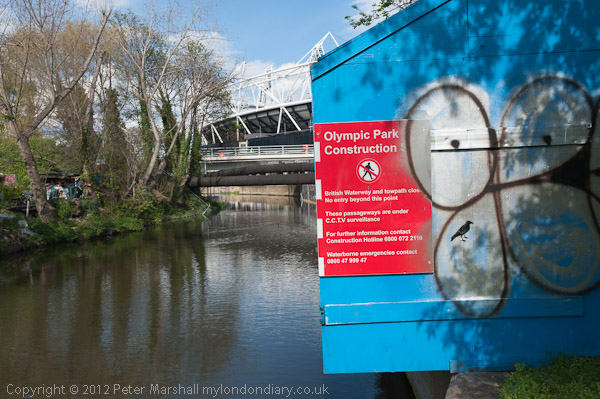
© 2012, Peter Marshall

We didn’t have any special access to the Olympic area, and the closures already in force were something of a pain, requiring some lengthy detours. Of course many of the paths that used to give access to the area – such as this one – were closed years ago.

© 2012, Peter Marshall

This picture illustrates some of the changes that have taken place. A few years ago the path here would have been narrow, surrounded by grass and low bushes and empty. The view would not have been a huge building site with the stadium and other venues but a busy and thriving industrial area with factories, oil storage and office buildings. Somewhat run down – with some of the premises serving as artist’s studios – including the interestingly named ‘Tate Moss’, in 2007 when I took the picture below already severely affected by Olympic blight and the imminent demolition. Now there is serious pedestrian congestion.

© 2007 Peter Marshall

More pictures from the area in Feb 2007 on My London Diary.

You can now see more of the pictures I took while walking around the area with the other photographers on My London Diary in Olympic Course Day 1 and Olympic Course Day 2.

________________________________________________________

My London Diary : Buildings of London : River Lea/Lee Valley : London’s Industrial Heritage

All photographs on this and my other sites, unless otherwise stated are by Peter Marshall and are available for reproduction or can be bought as prints.

To order prints or reproduce images

________________________________________________________
Handling Disabled Protests

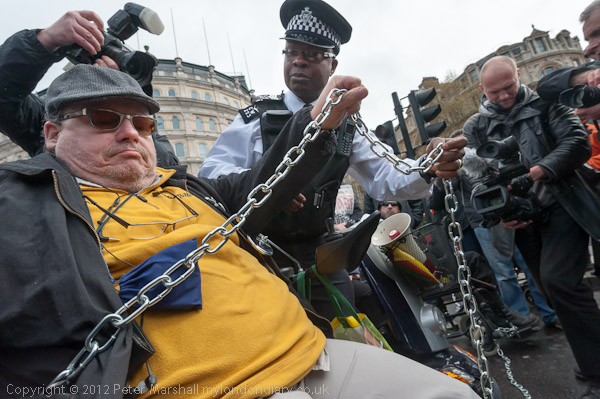
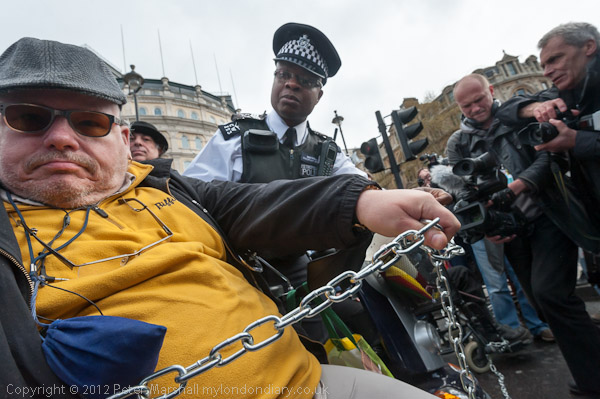
I don’t have any problems with protests by the disabled, but the police don’t quite seem to know how to deal with them, particularly when they have attracted enough attention for there to be crowds of photographers present. The latest protest by DPAC (Disabled People Against Cuts) again resulted in them being able to block a major road through central London, just as their protest in January (Disabled Welfare Reform Road Block) though this time it was at Trafalgar Square rather than Oxford Circus and on a weekday rather than a Saturday.

I can’t decide which of the two similar pictures I prefer:

© 2012, Peter Marshall

or

© 2012, Peter Marshall

When I sent off the story to Demotix, I chose the lower of the two, where I’m closer to the face of the man in the foreground and the chain is a little larger. That he is looking in my direction also makes for a stronger image. But on putting the work on My London Diary in the post Disabled Activists Block Trafalgar Square I chose the upper picture for the ‘front page’.  I like the two hands of protester and police officer on the chain, clearly linking them together. I think when I first saw them I thought that the hand and camera of another photographer at top left was an unfortunate intrusion; now I’m inclined to think that it works together with the videographer and photographer at the right to show how this protest took place with pretty massive press interest.

Incidentally, the guy with the video camera has himself been in the news, fighting not to hand over his work from the Dale Farm eviction to the police in what is clearly a ‘fishing expedition’, a move by the police that could seriously endanger the often tricky relationship between photographers and protesters. As NUJ General Secretary Michelle Stanistreet says,

“This case is a defence of press freedom – journalists are not evidence gatherers for the police.”

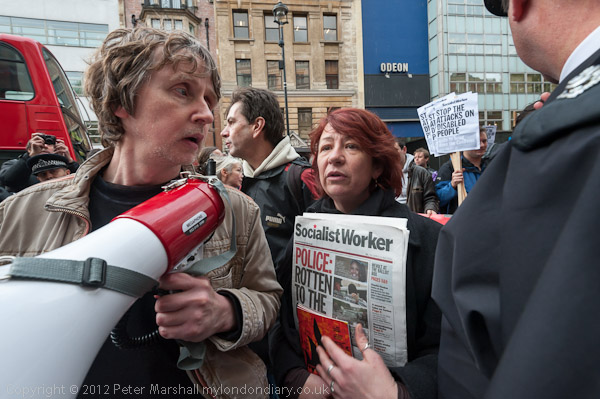
Earlier in the DPAC protest there had been an incident that seemed to be to be of near farce, when the police stopped the protest on the Charing Cross Road, and tried to insist that it proceed on the pavement rather than on the roadway.

© 2012, Peter Marshall

This is just one of a number of pictures that I took while police argued with protesters who they had stopped, creating a far greater traffic hold-up than if they had simply allowed the march to continue.

It wasn’t a request that the protesters were likely to accede to, not least because it was hardly a practical suggestion, given the fairly narrow and somewhat cluttered pavement and a protest with a number of people taking part in wheelchairs and mobility scooters. But it did provide a good opportunity for photographs.

Disabled people are rightly very angry, with recent changes in welfare provision and in particular the imposition of testing procedures that are ill-thought out and administered with an incredible lack of common sense, common decency and competence by a private company highly paid on a contract that rewards them for refusing benefits rather than doing the job properly.

More about the protest at Disabled Activists Block Trafalgar Square on My London Diary.

________________________________________________________

My London Diary : Buildings of London : River Lea/Lee Valley : London’s Industrial Heritage

All photographs on this and my other sites, unless otherwise stated are by Peter Marshall and are available for reproduction or can be bought as prints.

To order prints or reproduce images

________________________________________________________
May Day Mayhem

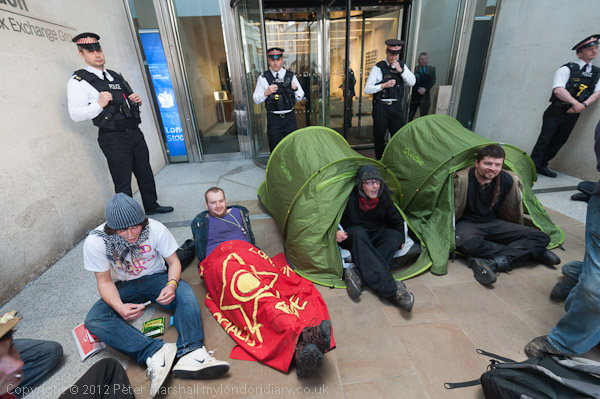
Curious things were afoot elsewhere on the web on May Day. I was busy taking pictures most of the day, finishing at the London Stock Exchange a little after 7pm where I was one of very few photographers present when OccupyLSX actually arrived at its doors and set up a token camp.

© 2012, Peter Marshall

It’s a nice story and I had some decent pictures – though it had been a day when I’d forgotten to increase the ISO as the light had dropped, and not all of them were sharp enough. People will move, and the best pictures are usually when they are moving.

So for once I put myself out and got the work ready to file within around 90 minutes of taking them. But it proved impossible to upload them to Demotix, whose servers were severely overloaded, and when I did finally manage to upload them, the server failed to process them. After an hour or so of trying I had a story with a single image visible on Demotix and it took another thirty minutes and many retries to get the rest there.

You can see the piece at Occupy London gets to London Stock Exchange on May Day
on Demotix. And eventually it will be posted in more depth on My London Diary, where of course you can see my account of their October attempt in Occupy London Kept Out Of Stock Exchange.

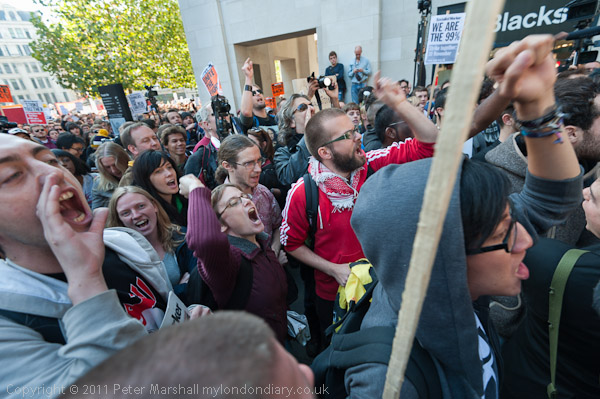
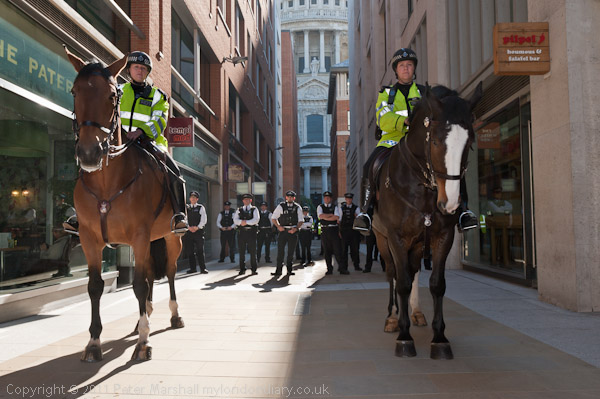
© 2011, Peter Marshall
In October police stopped Occupy from getting to the Stock Exchange
© 2011, Peter Marshall

I had three other stories to post from earlier in the day, but I needed to eat and sleep. I hope Demotix will have quietened down enough for me to post those later today.

Apologies For Nonsense

More nonsense than usual that is.  Somehow early this morning four posts appeared on the blog that I hadn’t published. This was most likely an error by my ISP who host this blog rather than a hacking attempt.

Thanks to ‘tdar’ who pointed this out to me in a comment to one of the pieces, all of which were from the ‘drafts’ folder on the site where I had cut and pasted things from various articles that were waiting for my comments, along with a few of my thoughts on some of them.

Vaisakhi Gravesend

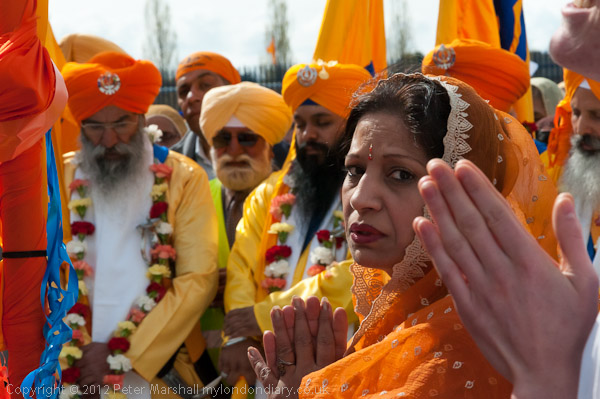
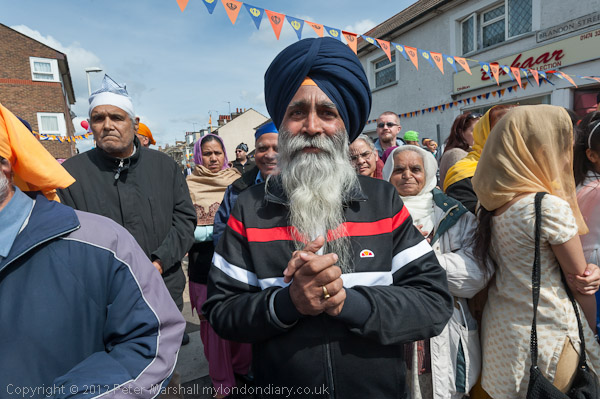
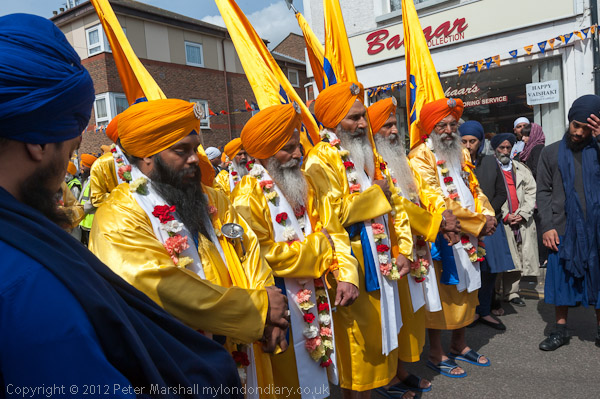
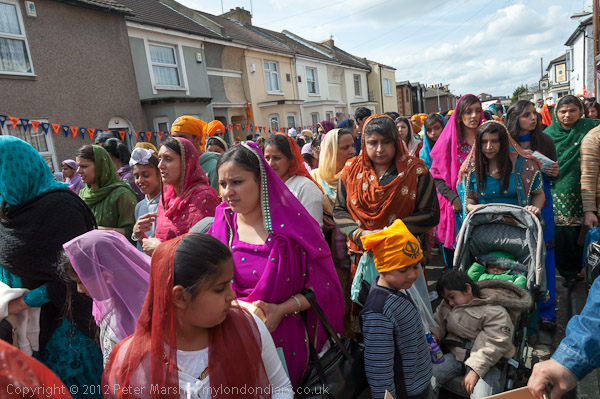
I always enjoy photographing Vaisakhi celebrations. They are colourful and the Sikhs always welcome people taking an interest in them, and are very open to being photographed. So although I think I’ve probably photographed enough over the years I find it hard not to go and photograph another. Although the events follow a similar pattern, every Gurdwara does things a little differently and I’ve tried not to return to the same places too often  to get a little variety.

Of course like all religious festivals you need to behave with suitable respect, and that means wearing a suitable head-covering (I keep a suitable head scarf in my camera bag in April, given to me on one of my first visits to a Gurdwara – though these are normally available at the entrance to most Gurdwaras) and I make sure I wear a decent pair of socks without holes for when I take my shoes off inside the Gurdwara. Occasionally you need to take off shoes on the street, and I wear a pair that will fit in my camera bag in place of my cameras – which will be round my neck.

© 2012, Peter Marshall

This was the first time I’d been to the Gurdwara at Gravesend, although I’ve photographed around the area – a little under 30 miles east of central London on the Thames, and taken the ferry across from here to Tilbury, the site of London’s remaining docks.  Gravesend is the major town in the area and has a large Sikh population, with perhaps 5000 people coming to Vaisakhi from across Kent and south-east London. There has been a Gurdwara in Gravesend since 1956, but the present one only opened two years ago; one of the largest in Britain it cost £12 million.

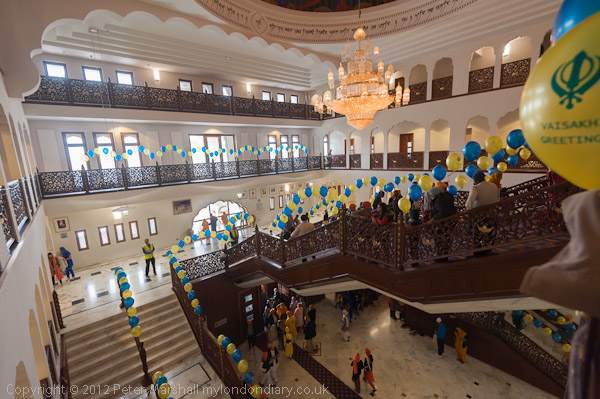
It certainly is a grand building, and on a very large scale, but I found it less impressive than Southall and lacking the friendly intimacy of smaller Gurdwara I’ve visited. Even with the large crowds around for the occasion it seemed rather empty, perhaps because there seemed to be little going on inside. At most other Vaisakhi events I’ve attended the worship hall has been packed with people for a lengthy service culminating in the ceremonial taking out of the Guru Granth Sahib (the Sikh holy scripture) to be carried around the neighbourhood in the procession, but when I looked in the room was almost empty.

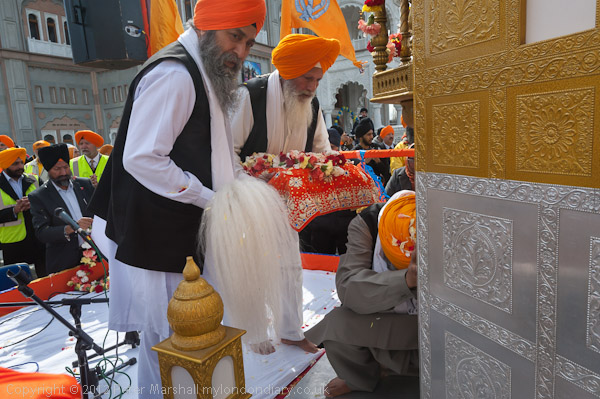
© 2012, Peter Marshall
The Guru Granth Sahib is carried out

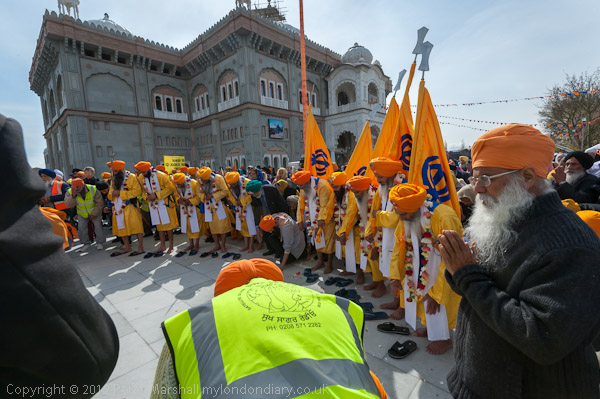
I went outside and stood in the crowd watching a demonstration of Sikh martial arts, when I noticed a commotion at the other side of the yard, and made my way through a dense crowd to see what was happening. It turned out to be the bringing out of the Guru Granth Sahib, which most of those present had failed to notice, though the crowd was beginning to gather close to the float on which it was to travel.  I should have talked to some of the organisers and found out in advance what was likely to happen and when rather than assuming it would happen as I expected.

© 2012, Peter Marshall
and is reverently placed inside a replica of the Golden Temple for the procession.

Fortunately I was able to get some good pictures of the ceremony once I was there, and the Gurdwara made a good backdrop for some of the pictures, although the sun caused a few problems.

© 2012, Peter Marshall

As you can see from the shadows it was only just out of the picture here. For some of the pictures I had to hold up a hand to act as an extra (and more efficient) lens hood.

I was also having problems with the D300, now very much in need of repair or replacement. I’m still dithering about what to do. Two things put me off the D800 – the giant files and the weight of the body. There’s the price as well, but though I certainly couldn’t justify it to my accountant, I could find the money. Unless Nikon come out with something new that suits me better I might end up getting one mainly to use in DX mode with DX lenses.

© 2012, Peter Marshall

Sometimes the D300 works fine for quite a few frames, but then the mirror will stick up. I’m getting used to dealing with it, and have added “Lock Mirror Up For Cleaning” to my custom menu, and work with this available at the touch of the menu button. Then it’s just press the OK button twice, followed by the shutter release, turn the camera off and on and you are back in business – almost as fast as winding on film in the old days. Except that now it doesn’t always work the first time, and occasionally needs 2 or 3 cycles to bring it down. And while I can sometimes work for 20 or 30 or even more frames without it sticking, sometimes it does it after a single frame. It goes without saying that this is far more likely to happen when things turn interesting and I need to take pictures fast. So probably there are rather more pictures taken on the D700 with the 16-35mm than usual. Though at times I was so close to the action that it was the only possible lens.

© 2012, Peter Marshall

Though perhaps I might otherwise have used the D300 with the 10.5mm fisheye. The procession took a couple of hours to go around town, but there are only so many pictures you can take, and I took advantage of the free food that is on offer at these events. Some delicious minty curried beans, several vegetable samosas, a cup of chai and some fruit juice.

© 2012, Peter Marshall

I’d decided earlier when I looked at the route that things might be interesting in the back streets around the much smaller Ravidas Gurdwara which the Vaisakhi procession was to pass. There were a lot of stalls giving away food around there and the procession stopped and there were speeches, but none I could understand.

© 2012, Peter Marshall

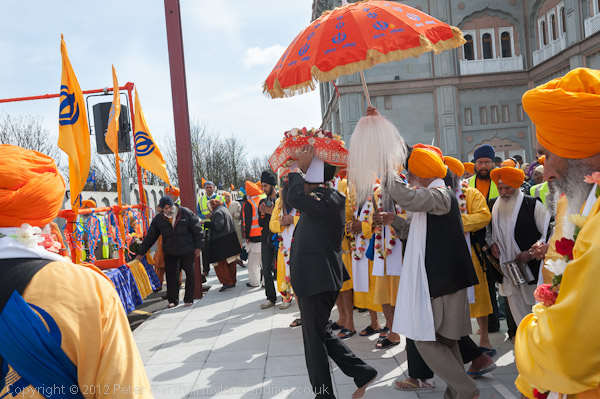
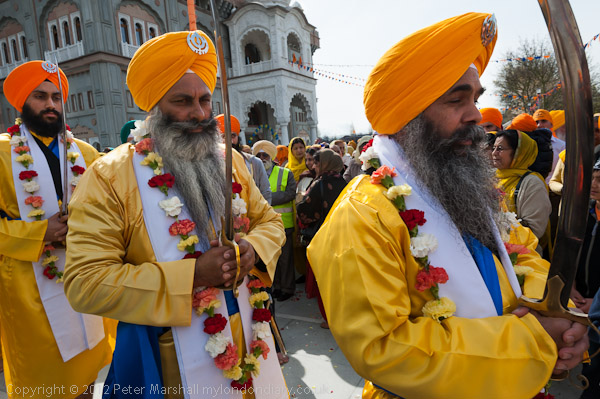
Here I made my way back along the length of the procession filling the narrow street and photographed some of the lorries, coaches and floats coming behind the congregations on foot which follow behind the Nagara drum, the Sikh standards, the Panj Piyare  with their raised swords and the Guru Granth Sahib.

© 2012, Peter Marshall

You can see pictures of some of these, and many more in Gravesend Vaisakhi on My London Diary. I left the procession as the end of it passed the civic centre on its way back to the Gurdwara where the celebrations were to continue both on that day and with a service the following day.

________________________________________________________

My London Diary : Buildings of London : River Lea/Lee Valley : London’s Industrial Heritage

All photographs on this and my other sites, unless otherwise stated are by Peter Marshall and are available for reproduction or can be bought as prints.

To order prints or reproduce images

________________________________________________________
Olympic Site Lock Down

This weekend is the last time – at least until the end of September – when you will be able to walk the section of the Capital Ring that goes along the Greenway from close to Pudding Mill Lane station to Hackney Wick.  For a couple of weeks you will still be able to access the You Tube from Pudding Mill Lane Station, but all access will cease and the View Tube close down a couple of weeks later.

© 2012, Peter Marshall

I went there on Friday April 13 for two reasons, firstly to check what was still open for the workshop I was running in 8 days time for the Museum of London based at the View Tube, and secondly as I’d been asked by a friend who works for a foreign news agency to show him around the area.

We walked down from Stratford Station, a much busier area now that the Westfield shopping centre has opened, going through the 60s council estate which seems to be being deliberately run-down  – with many empty flats despite Newham’s desperate housing shortage which got them in the news this week for trying to rehouse their homeless more than a hundred miles away. It’s certainly a prime site for private development, with large new blocks of flats and hotels appearing on nearby Stratford High Street every time I pay a visit.

© 1990 Peter Marshall
City Mill Lock, 1990

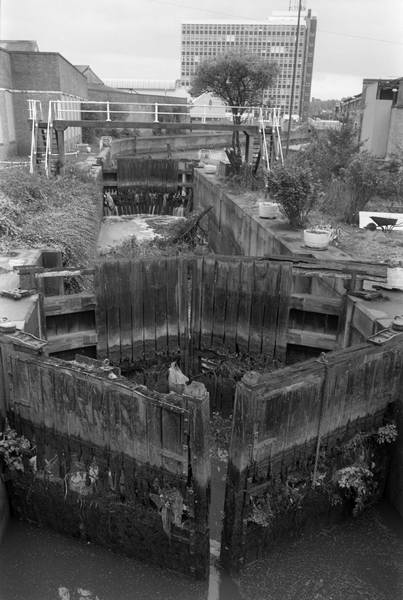
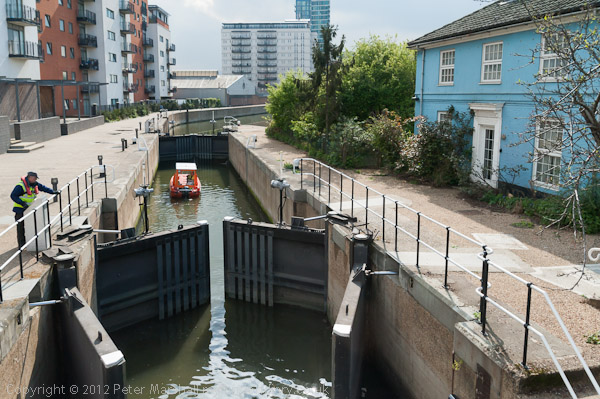
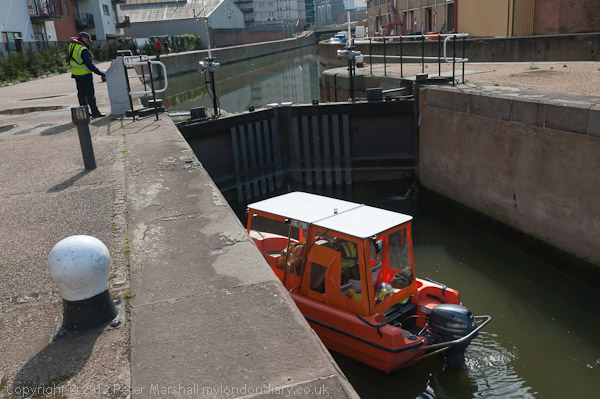
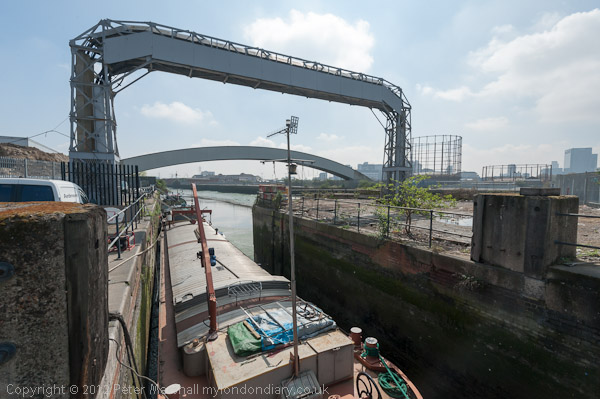
At City Mill Lock I was surprised to see a small boat actually in the lock. Until a few years ago, this had old wooden gates that were long beyond use. The City Mill River was widened and made navigable for large barges as a part of a flood defence and employment provision scheme covering the area in the 1930s, but seems never to have been used by barges, and was more or less completely abandoned by the 1960s. Those wooden gates don’t look as if they were replaced in the 1930s, but a few years back I watched the lock being completely refurbished with completely new gates. But this was the first time I’d actually seen them in use.

© 2012, Peter Marshall

The double gate was needed because the Waterworks River which it leads to, underneath the bridge from which I was photographing used to be tidal, and its level could be either above or below that of St Thomas’s Creek and the City Mill River at the further end of the lock. Probably it was never really needed, as the Waterworks River was only navigable around high tide, so the lock would only be needed when the level was the same or higher, and with the new lock on the Prescott Channel, built but hardly used for the Olympics, the river is no longer tidal.

My friend also took some pictures, and we walked down the steps to the lock side, where the man operating the lock – a G4S security guard – objected to having his picture taken. My friend laughed at the man, and told him he had every right to take photographs and the argument continued for a minute or so.  I stood a little to one side as a witness, ready to take pictures should the situation escalate, thinking to myself that it was a pity my camera didn’t take videos or at least record audio, as still images really didn’t capture the situation.

Although the security man objected to being photographed, it became clear that he wasn’t actually going to do anything about it.  His objection was that it would have been polite to ask his permission rather than security related.

I talked to him briefly about the lock and the Bow Back rivers, and we had a polite conversation, though I found he knew rather less than me. Had I been on my own, after taking the overall picture from the bridge I would probably have done this before going on to take his picture, but that’s just a difference in the way we chose to work, not something I need to do. If he’d been reluctant to be photographed and I needed the picture I would have still have taken one, but usually people don’t mind if they know what you are doing. But I didn’t particularly want a closer picture of him – I was more interested in the boat going through the lock and a picture that showed that and him operating the gates.

© 2012, Peter Marshall

We went on and up to the Greenway and the View Tube, and although we saw (and he photographed) some of the other security men around, none of them objected. Of course they are used by now to crowds of tourists with cameras. But in other areas around the Olympic site there can still be problems with over-zealous security men who don’t know or understand the law, as some of my colleagues found a few days later. A group of them were stopped and two were assaulted while photographing the Olympic site from the public highway. What was particularly worrying was that their manager who came out after a minute or two defended their behaviour and is reported to have said that ” they were trained to deter people from taking photographs.” The report continues: “We asked for police to attend and two SO23 officers soon arrived, confirmed that our behaviour was entirely lawful and the G4S guards retreated back into the Olympic site.”

There will I’m sure be further such incidents, and G4S and other security companies really do have to address the issue of keeping within the law and giving their personnel the training that is needed to do the job properly. Any manager who thinks that they should be “trained to deter people from taking photographs” should at least be severely disciplined and sent for re-training in a proper attitude towards the public, if not dismissed.

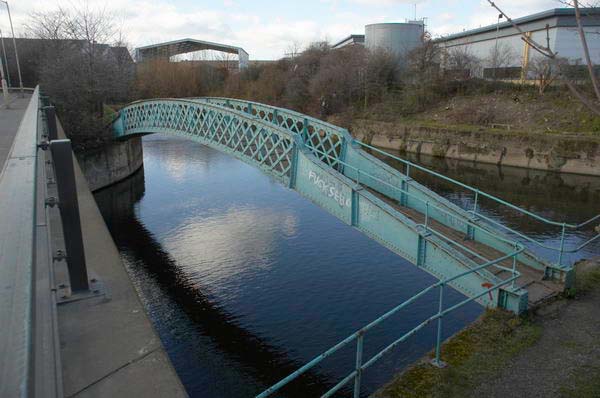
© 2005 Peter Marshall
Paths like the one across this bridge were closed years back – and no doubt that iconic ‘F**k Seb Coe’ graffiti we all photographed has disappeared

Most of the rights of way that existed across the Olympic site were extinguished some years ago, leaving only the Greenway and the Lea Navigation towpath. Part of the Greenway has been closed for some time, at first for the Olympics and following on for the construction of Crossrail, and this section is expected to remain closed for another couple of years.  After the end of May there will be no public access to the rights of way in the area at least until the end of September.

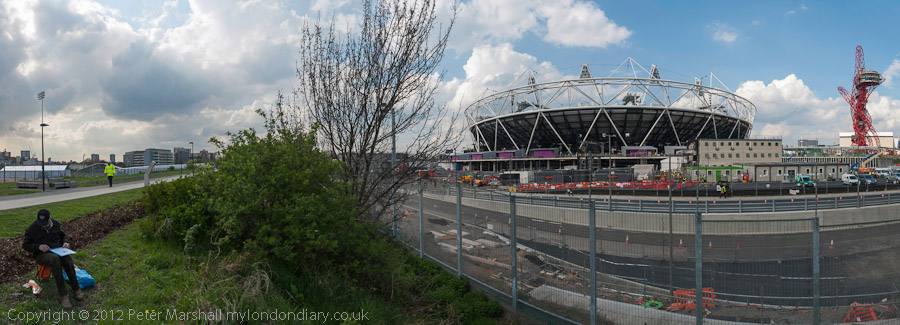
While I was there I made several new panoramas, including this from the exact spot where I photographed around ten years ago before any of the disruption, and have continued to do so except when access was impossible or for a period when the view was almost completely blocked by the blue fence. I found someone sitting close to it and painting the scene.

© 2012, Peter Marshall
Greenway and Olympic site – 155 degree view
Rt click &’View Image’ for larger version

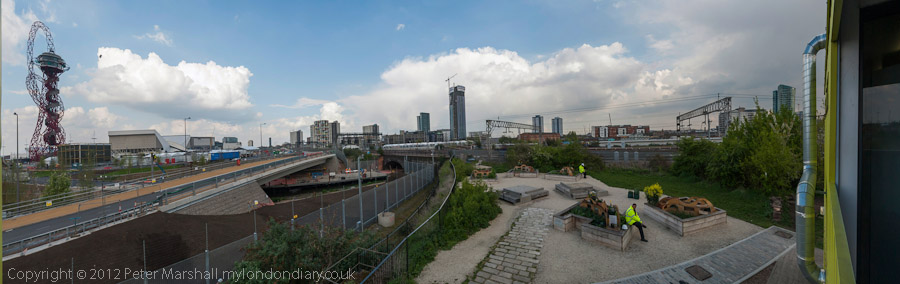
and continuing around the site a further view from a different viewpoint – the side window of the viewing gallery at the View Tube.

© 2012, Peter Marshall
Southern end of Olympic site from View Tube – 200 degree view
Rt click &’View Image’ for larger version

The two views use a different projection, the upper one is equi-rectangular and the lower cylindrical, usually more suitable for extreme angles of view. Both are quick stitches using PTGui, and not quite finished images, and a little on the dark side.

More pictures at  Olympic Site Revisited.

________________________________________________________

My London Diary : Buildings of London : River Lea/Lee Valley : London’s Industrial Heritage

All photographs on this and my other sites, unless otherwise stated are by Peter Marshall and are available for reproduction or can be bought as prints.

To order prints or reproduce images

________________________________________________________
Cody Dock

In February 2010 I took a ride on my Brompton (a vital photo-accessory for the urban landscape photographer) along the short length of the ridiculously named ‘Fatwalk’ beside Bow Creek. It was a dull rather turgid day, and probably I would have put off my trip to a later date but I’d been asked to go and record an interview with a student film crew at the View Tube overlooking the Olympic site a mile or two away that afternoon, so it seemed a good idea to do this on the way.

Apart from the silly name, the stretch of footpath, although it has some interesting views – which you can see at Bow and The Fatwalk (looking rather gloomier than the image below, processed in Lightroom 4 for this post) but is ultimately frustrating, coming to an end at the fence in the picture.

© 2010, Peter Marshall
Cody Dock from the ‘Fatwalk’ in Feb 2010

The fenced area is Cody Dock (aka Gasworks Dock) and the end is more frustrating as past the pipe bridge at the right of the image is another section of the path, only accessible from a private industrial estate.

A couple of weeks ago, I was able to visit Cody Dock, going inside rather than simply peering through the fence. In 2010 the ground inside was more or less covered with piled up  containers and other material, in parts around 10 ft high, and it was a surprise to see that now virtually the whole area was cleared.

© 2012, Peter Marshall
Cody Dock in April 2012

Work is going ahead on an ambitious project to turn the long-disused dock into a community resource with moorings, visitor centre & café, an exhibition space, an industrial heritage archive and museum, affordable studio and workshop space and dry dock facilities and a lively programme of activities. Already a Docklands Community Boat is in operation.

The Gasworks Dock Partnership needs funding and volunteers to complete the project, which intends to open to the public this summer, and you can find out more about it and contribute to it on  Spacehive. They need to raise £140,276 by 6 June.

There is more information on Cody Dock and the project – as well as many more images – on My London Diary in Gasworks Dock Revived. I spent around an hour on the site, talking with Simon Myers who noticed the site from his boat as he went up Bow Creek and decided to find out more, eventually setting up the Gasworks Dock Partnership as a social enterprise and then as a charity to redevelop the site where others had told him this was impossible, and taking pictures, then asked Simon to let me out onto the riverside path so I could walk along by the river to Stratford where I needed to check the paths for my forthcoming workshop.

One of the benefits of opening up the dock is that it will open up a further length of the riverside path – and they need funding for a wooden swing bridge across the dock entrance when the current fixed barrier is removed to give access to the dock.  It should then be straightforward to extend the end of the existing inaccessible section of path to join with an existing path to take walkers to the Bow Creek Nature reserve and also along to the Thames at East India Dock and the Trinity Buoy Wharf arts area. Whether the riverside walkway by Canning Town station, completed in the 1990s, will ever be opened to the public remains unclear.

________________________________________________________

My London Diary : Buildings of London : River Lea/Lee Valley : London’s Industrial Heritage

All photographs on this and my other sites, unless otherwise stated are by Peter Marshall and are available for reproduction or can be bought as prints.

To order prints or reproduce images

________________________________________________________
Roma Nation Day

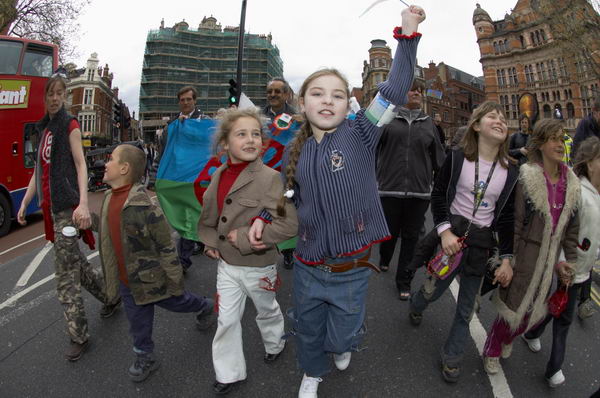
© 2005 Peter Marshall
Roma Nation Day march in London, 2005

The atmosphere of this year’s Roma Nation Day march in London this year was very different from that I photographed a few years ago. Then the march seemed almost entirely to me made up of Roma, with many women and children among them, and few non-Roma.

© 2005 Peter Marshall
Children lead Roma Nation Day march in London, 2005

It is an event that celebrates the first World Roma Congress which was held in the UK in 1971, and remembers the genocide of around 500,000 Roma and Sinti in the Nazi holocaust. In 2005 the event began with a service in St James’s Piccadilly, after which they marched through central London, harassed rather by the police (and I was threatened with arrest) to keep moving fast.) But little has changed. In 2005 I wrote:

Roma from several countries marched across London against the ethnic-cleansing of 30,000 gypsies from their own land and in protest over threatened evictions at Dale Farm, Essex, Smithy Fen, Cambridgeshire, and elsewhere.

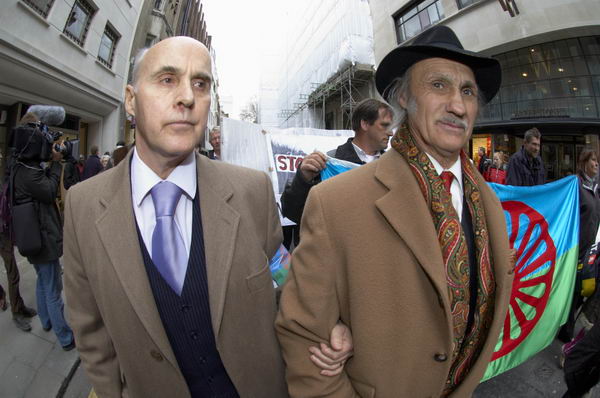
At Dale Farm, evictions finally went ahead last year and made the national news – and further evictions have followed there more recently with rather less publicity. This year at the protest there were Roma from Europe where the persecution of Roma appears also to have intensified, but there were few Roma women and children to be seen.There were also noticeably more non-Roma supporters, including some of those protesters who had been at Dale Farm and opposed the evictions.

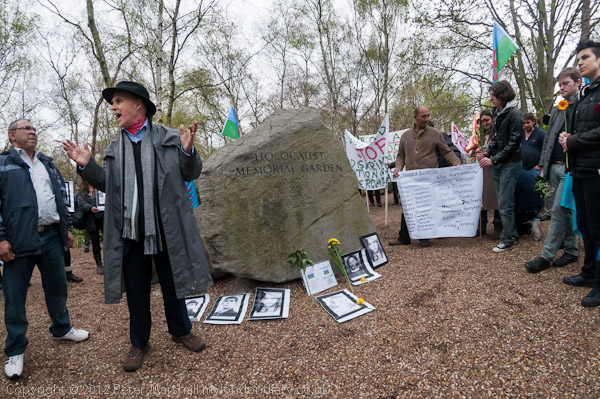
© 2012, Peter Marshall
Grattan Puxon speaking in the Holocaust Memorial Garden in Hyde Park, 2012

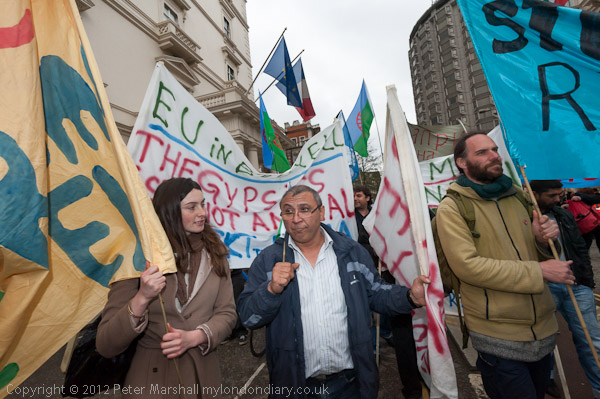
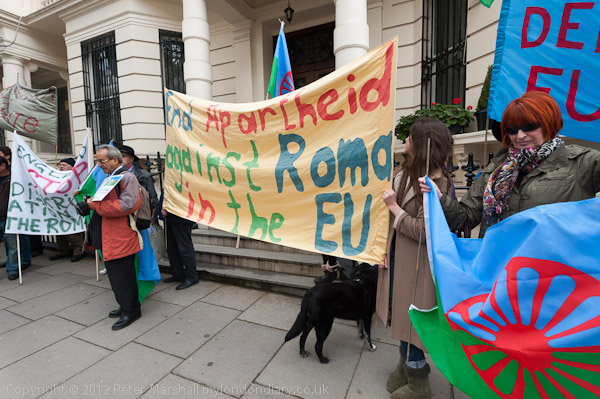
This year the march started in Hyde Park, and went to the Holocaust Memorial Garden there, where after brief speeches, flowers were laid. From there the group visited several embassies of countries where the civil rights of Roma are under attack to protest outside them.

© 2012, Peter Marshall
Leaving the French embassy, 2012

© 2012, Peter Marshall
Outside the Bulgarian Embassy

You can read more about this year’s march at Roma Nation Day Of Resistance.

________________________________________________________
My London Diary : Buildings of London : River Lea/Lee Valley : London’s Industrial Heritage

All photographs on this and my other sites, unless otherwise stated are by Peter Marshall and are available for reproduction or can be bought as prints.

To order prints or reproduce images

________________________________________________________