Simmery Axe

© 2012, Peter Marshall
London, Feb 2012 – Peter Marshall – see text

This isn’t by any means a perfect panorama*, though I’ve just spent over an hour trying to put it in order.  There are still few fairly obvious problems, and though with perhaps another half hours work I could eliminate most of them by appropriate masking of the images, I decided I’d done enough for what is only really a preparatory sketch, make when I just happened to have a spare few minutes in a location I’d been meaning to visit as part of a joint project with an artist friend I’ve been working on for some time.

I hadn’t gone out to take panoramas, and didn’t have a tripod with me, and it isn’t easy to keep a hand-held camera in the same position over the 13 frames that made up this 360 degree image. So it isn’t possible to get quite everything joining perfectly, as you can see in the jump in the yellow line at the right of the image around a quarter of the way up the frame and the sweep of the steps at bottom centre.

There are also problems with the various people who walked through the area while I was making the set of exposures. Some of them were recorded several times in different frames, and I wanted to avoid showing them more than once in the final image. More annoyingly, there were different people occupying the same space in different frames, and I had to choose between the woman clutching her blue folder and a man with a banana, whose image I obliterated.

There was also a problem with changing lighting, with the sun disappearing behind small clouds as I took the pictures. The main problems this gave me were in some sky areas, where white clouds rather dramatically darkened. There is also an interesting lighting effect here with strong reflections from the ‘Gherkin’ at centre right giving one man a strong visible shadow although like the rest of the figures in the scene he is actually in the shade, and the shadow is pointing in the direction of the sun.

I seldom find 360 degree panoramas very interesting as prints, although it’s often interesting to explore them through a small viewing window on-line. This square on St Mary Axe known to Londoners as ‘Simmery Axe’ (that church was demolished in 1561) in the business district opposite Lloyds is surrounded by tall modern buildings (and the cranes where another is being added) along with some  older architecture, notably St Andrew Undershaft. Until recently a maypole (the ‘shaft’) was kept horizontally on hooks on the side of one of the now-demolished buildings. The original maypole was taken down in 1517 after violent May Day rioting by London’s apprentices in which several foreigners were killed and was sawn into pieces around 30 years later after an inflammatory sermon against the excesses of May Day preached at St Paul’s. It was replaced st the Restoration in 1660 and finally taken down in 1717. Although the maypole was said in medieval times to tower above the surrounding buildings, it would look rather smaller now.

Working in the middle of large buildings such as those around the square needs a very wide view to encompass the tops of them all, but with a very wide view – particularly 360 degrees – it is then difficult to give a real impression of height. Working with a very large vertical angle also gives huge problems with distortion when producing flat prints. Some of the possible projections for smaller angles of view become unusable. For this image I chose an equi-rectangular projection, which works fairly well but used ‘neat’ seems to rather squash the taller buildings. A variable slider in PtGui (the best panorama stitching software) allows you to stretch everything out a bit.

Lightroom added to my problems by forgetting the profile setting that I had saved for the Nikkon AF DX Fisheye-Nikkor 10.5mm lens. For some unknown reason the default profile that comes with it attempts to convert the images to rectilinear perspective – which really doesn’t work, at least not without considerable cropping, as there are simply not enough pixels in the corners when the image is straightened out. It’s best not to remove the distortion at all, or at most around 20-30%, or to use other software such as my favourite Fisheye-Hemi plugin or other ways to convert to a cylindrical perspective. For working with PtGui, it’s pretty well essential to leave the images without conversion. So my first step this morning was to go back to Lightroom and rework the source images for the panorama.

With a proper rig for taking panoramas I think the 10.5mm should be able to create a spherical panorama with only six images, but working hand-held you need more even if you are satisfied – as I am – with a relatively narrow strip image. Thirteen is far more than needed, but I wanted to be sure not to get any gaps in the strip I wanted. But there may be some I could eliminate completely and get more accurate joins.

I made around half a dozen test panoramas while I was there, and I think my final picture if I decide to make one will be rather less than 360 degrees. Perhaps more like this one.
© 2012, Peter Marshall
Stitched from many exposures with the 16-35mm rectilinear lens at 16mm

or even this

© 2012, Peter Marshall
Stitched from two exposures with the 10.5mm semi-fisheye


*
A decent browser will display this image twice the size – right click and select ‘View Image’
________________________________________________________

My London Diary : Buildings of London : River Lea/Lee Valley : London’s Industrial Heritage

All photographs on this and my other sites, unless otherwise stated are by Peter Marshall and are available for reproduction or can be bought as prints.

To order prints or reproduce images

________________________________________________________
Leap Year

 © 2012, Peter Marshall
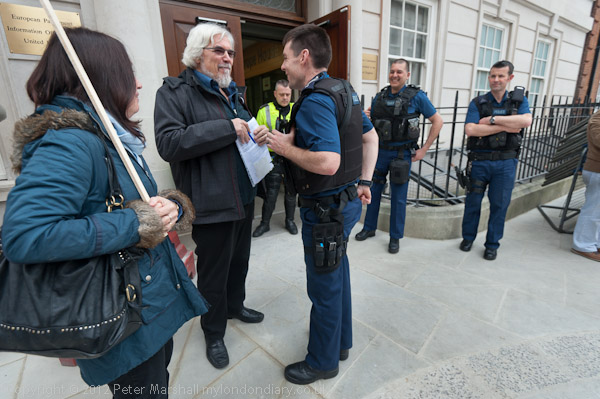
Paul Mackney jokes with ‘Taserman’ on Feb 29

February had an extra day this year, but even so I’ve managed to finish putting my work from the month onto My London Diary in record time, despite spending a couple of days last week in the country. Actually that makes it slightly easier, because although I did take a few pictures in Derbyshire they don’t really belong on that site; had I stayed home there would have been more work to put up.

© 2012, Peter Marshall
I saw this picture and rushed 20 yards to take it

There do seem to be a lot of things happening on the streets of London at the moment, and as I mentioned in a previous post I arrived home to find several messages about events I would have liked to have covered while I was away. But I did manage to get to quite a few things over the month.

No Cuts – Solidarity With The Greek Resistance
Pancakes in the City – Leadenhall Market
Pancakes in the City – Guildhall
More Staines Moors
Reclaim Love – Occupy Your Heart!
Shaker Aamer – 10 years in Guantanamo
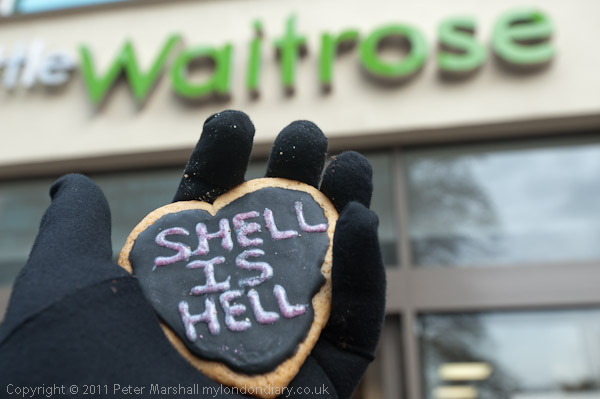
Waitrose Told Break Up With Shell
Disabled Protest Loss of ILF
Defend Freedom of Expression
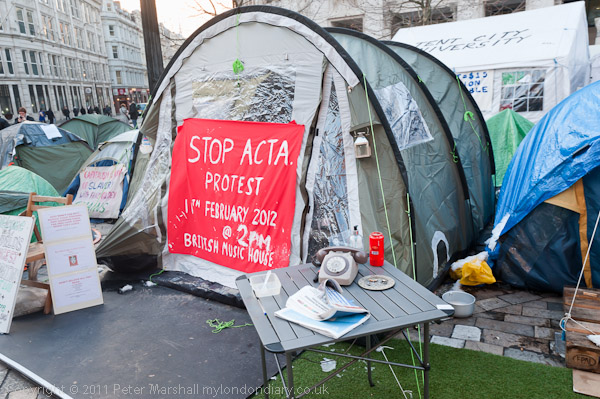
Stop ACTA – London Protest
Victory to the Intifada Picket
Amnesty Protest For Human Rights
IWW Cleaners Demand Reinstate Alberto
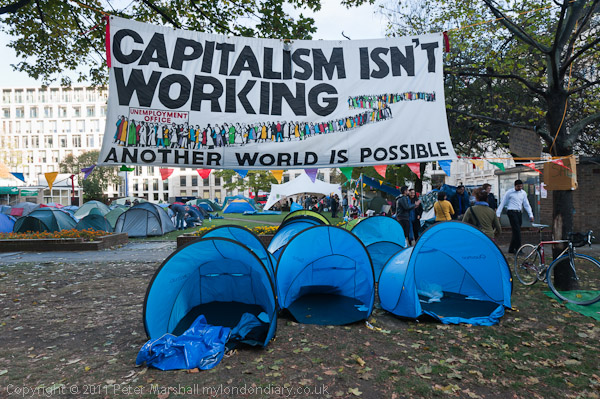
Occupy London Still At St Pauls
Release The Bologna 12
Parliament Square & No War in Iran
Stop NHS Privatisation – Kill Lansley’s Bill
Ukrainians Told ‘Release Hunger Strikers’
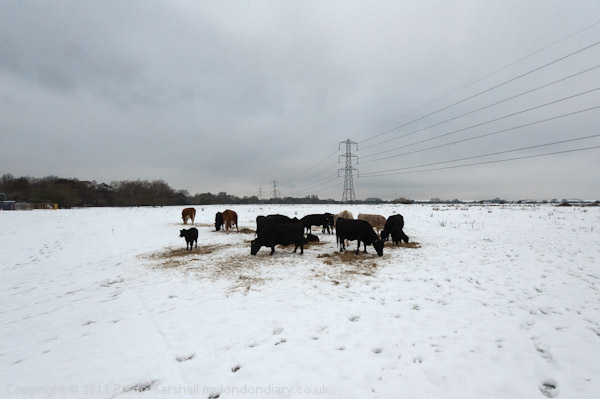
Staines Walk In The Snow
London Guantánamo Campaign Candlelit Vigil
Disabled Protest Supports the Atos Two
London Walking

© 2012, Peter Marshall
Black silk gloves are great for photography but don’t often feature in my pictures

© 2012, Peter Marshall
I was wearing two pairs of gloves when I took this, a short walk from my home

Marketing Fools Rule

As with so many things these days its the guys in marketing that call the shots, even though they know nothing about things. And this is what seems to have happened with the official promotional video for the new Nikon D800, produced for Nikon Thailand for the launch in Bangkok (a very boring video which shows why such events are best missed.) The people who made the video just went and found some nice footage to use, just unfortunate that at least some of it wasn’t even shot on Nikon, and I doubt in any was actually shot on a D800.

One of the clips used in the video came from Norwegian landscape photographer Terje Sørgjerd, who notes on his Facebook page that he is sponsored by Canon and uses a Canon 5DII. According to the comments there, the promo also contained work taken from a Red Bull snowboarding movie – which again did not use Nikon – as well as some produced on a Samsung NX10.

Nikon have apparently said they will apologise to the photographer and state that the video was not produced by them but made by an external company, though that is hardly an excuse as they used it.  They have also apparently agreed to pay Sørgjerd twice the normal fee for the use, though that seems rather low given what has happened. But on his Facebook page he says that Nikon “have taken every step to have the video removed, and will do everything possible to avoid this from happening again in the future. This matter is now fully resolved between the two of us“.

Of course it has given Sørgjerd a great deal of free publicity – including this mention here, as well as some extra but rather negative publicity for Nikon. The D800 should sell on its merits, and promoting it with images produced on other cameras seems entirely dishonest, though apparently such practices are not unusual in advertising. I remember being told by a photographer many years ago that his pictures that were used in the UK advertising campaign for a new Japanese camera had actually been taken on a Nikon and not on the make being advertised.

Nikon Rumours doesn’t so far as I know have any video shot with the D800, but they do have some genuinely made with other Nikon cameras including the D700,  pretty clever as it doesn’t have a video mode, along with some taken with other Nikons. But I’m still waiting for proper reviews to tell me if the D800 is a body worth considering as a (larger format) replacement for my ailing D300. Perhaps Nikon will come out with the D400 some time this year – it has been rumoured as imminent since mid-2009, though as yet there is not even any agreement between the rumour-mongers as to whether it will be DX or FX!

Film Slides Away

The announcement by Kodak, reported by the BJP,  that they are to discontinue Kodak Professional Ektachrome E100G, Kodak Professional Ektachrome E100VS Film and Kodak Professional Elite Chrome Extra Color 100 means an end to their E6 colour film line, though the production of Portra, Ektar and other colour negative films and their black and white films will continue while demand keeps up.

On the Kodak UK shop site it states : ‘We estimate that, based on current sales pace, supplies … are expected to be available in the market for the next six to nine months; however, inventories may run out before then, depending on demand.‘ If some buy stocks of these materials to put in the fridge for later they may well run out faster, though this may not be a sensible idea. I’ve got stocks of various outdated photographic materials in a large cupboard here that I can’t quite bring myself to throw away, including over a thousand sheets of 8×10 colour and black and white papers. Perhaps one day I’ll feel like going in the darkroom again and it might just be usable, but I think both are unlikely.

Kodak were one of the pioneers of colour photography with their Kodachrome introduced in 1935 and discontinued in 2009. Ektachrome came out in the 1940s, at first with the E1 process. Later versions of the process, E4 and finally E6 became the standard colour negative process for virtually all manufacturers, and Kodak are continuing the production of E6 chemicals, though I always found their products highly over-priced compared with the competition, at least for low volume users.

Of course those who have a particular need for transparency film or are of a peculiarly masochistic bent can still buy and use slide film, something I largely abandoned in the mid-1980s. Fuji have been making better film than Kodak since then, and Kodak have only really been kept in the business by a curious consumer loyalty to the yellow box, perhaps fuelled in America by a kind of jingoistic protectionism that insists that US products are always the best. But then why is anyone still using film?

Doug Menuez tried to give a reason a few years back in a piece called The Zen of Film vs Digital Gratification. If like he apparently does you feel your work in digital somehow lacks lustre you might buy his argument, but I’m of the opinion that my work has improved with digital. But I almost never work in the way that he suggests photographers do with digital:

But while you have your head down checking the LCD guess what? You just missed your pulitzer. That LCD is crack. You just can’t get enough. We all want instant gratification and here you have it. Bliss. Yet the act of constantly checking the back of the camera is taking your head out of the game.”

I get far too involved in taking pictures to do much checking on the LCD while I’m busy taking them. I try to remember to occasionally take a quick peek to check I’m not really messing things up, but the first time I seem most of my pictures on the back of the camera is after I think I’ve finished the job. Often not until I’m sitting on a train on my way home. The main exception is when I’m photographing speakers at events, where  a single button press will zoom in on the eyes I’ve focussed on and let me check the person didn’t blink. There is a point in checking because most speakers are fairly repetitive in their gestures and you can usually re-make the image.

So I don’t share Menuez’s attitude to digital. It isn’t actually about the medium but about how he has chosen to use it. I welcome the new things it makes possible, but haven’t let it change me in the way he suggests.

Lea Valley 7 Mervyn Day 1

What Have You Done Today, Mervyn Day? is a film made by pop group Saint Etienne with director Paul Kelly in 2005, as a farewell tribute to the Lea Valley, just condemned to disappear. Filmed over a couple of months, this story of a wandering paper-boy (named after a West Ham goalkeeping legend) getting lost in an often dreamy lower Lea landscape is set on the day after the announcement that London has won the Olympic bid – July 7, 2005 – also the day of the London Bombings.

© 2004 Peter Marshall
Photographs in this post are from the Lower Lea around 2004-5 by Peter Marshall
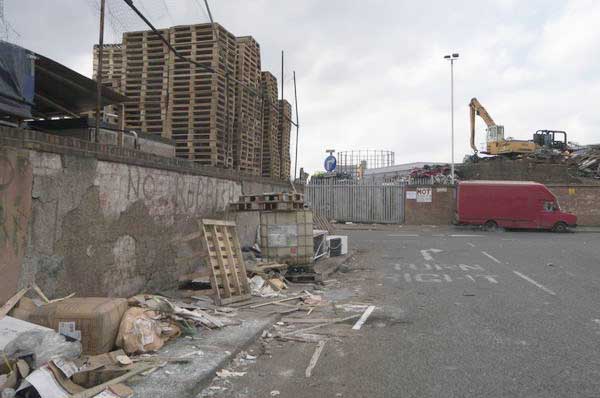
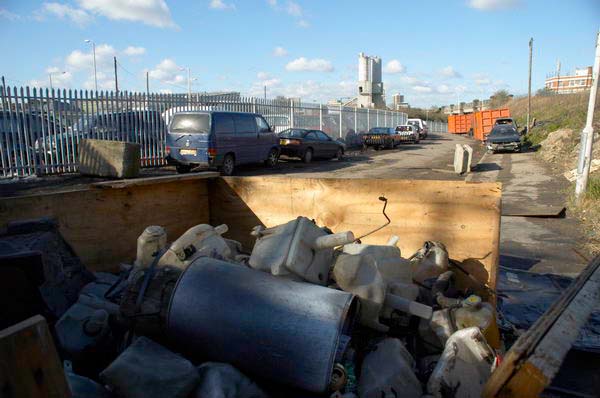
Palletts and scrapyard at Canning Town.

So many of the images in the film are familiar to me, and it ranges fairly widely over the whole of the Lower Lea, occasionally jumping several miles at the turn of a pedal. It’s not of course meant to be topographically accurate, but to those of us who know the area it can be a little disconcerting, and there are a few pictures which actually show the River Thames that might mislead some into thinking the Lea becomes rather grander than it does. They seem to have pretty thoroughly combed the area from Bow Creek to Hackney Wick with a few trips further north in their search for images.

© 2004 Peter Marshall
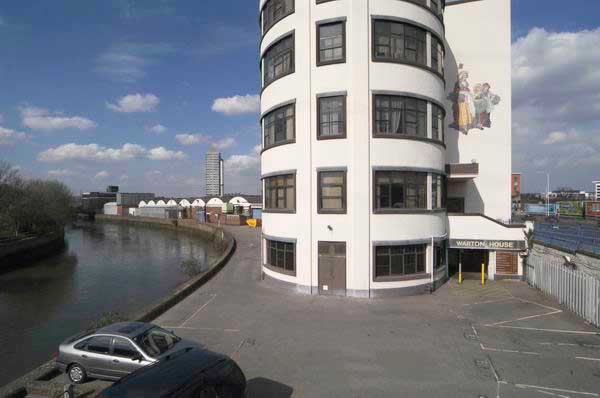
Waterworks River and Warton House, Stratford High St
© 2005 Peter Marshall
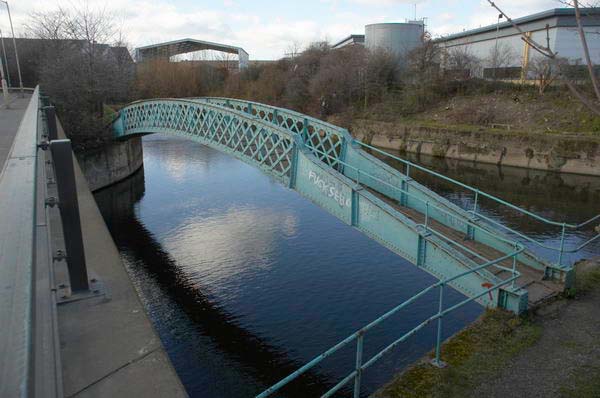
F**k Seb Coe graffito on footbridge over City Mill River as it leaves the Old River Lea

The pictures and script – with voices playing the boy’s mother and father give a good feel of the history and community of the area, although again a few incorrect details grate.  For example, the River Lea does definitely not start at Ware (but at Leagrave or close by at Houghton Regis), though perhaps this misstatement was meant to reflect what is a general lack of knowledge – even by those who live there – about the Lea valley, which isn’t really a concept for most of the population.

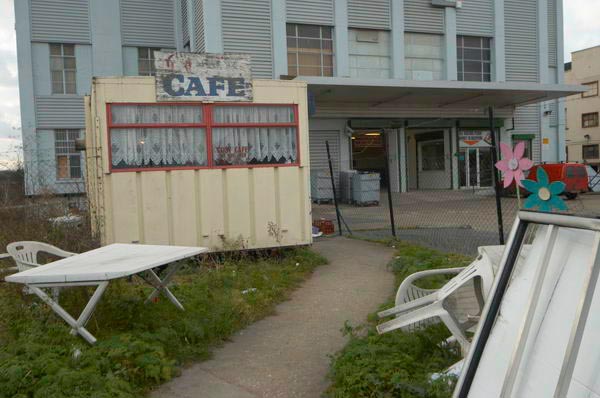
The music isn’t bad either, and the track list apart from the title track and and Mervyn’s Theme – Sugarhouse Lane, Hope Chemical, Eton Manor, Quartermile Bridge, Cosy Café, Lee Navigation, Pudding Mill Lane, Channelsea, White Post Lane, The Pylons, Parkesine, Lesney Factory, Swan Wharf, Pioneers, Trinity Wharf, Blackwall Reach – could more or less have  taken from my captions and is a tribute to the real star of the film, the Lea valley.

© 2004 Peter Marshall
Carpenters Rd and Warton Rd

Thanks to Tim Soar,  a fine architectural photographer with studios in the Wick, for pointing me towards a full version of film – around 48 minutes – available on the web at Bambuser.com, which has resulted in me failing to do much work this morning!

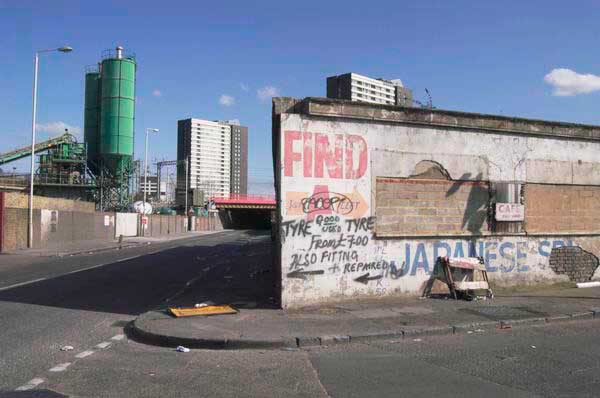
There are also excerpts from the film at other sites. It’s a film you listen to for the music and watch for the views it gives of the area, although perhaps it overworks both the extreme telephoto and close-up detail, with too little of the kind of distance and context I like in my image above – and a part of that wall is in the film.

© 2005 Peter Marshall
Marshgate Lane

© 2005 Peter Marshall
East Cross Centre, Waterden Rd

The film is really a great snapshot of the lower Lea Valley at a particular point in time (though with a rather pointless narrative imposed on it, and the uncut footage could perhaps yield more.)  And as illustrations to this post I’ve included a few of my own pictures from roughly the same period. You can see more on my River Lea/ LeaValley site, or in my book Before The Olympics (it can be viewed in full in the Blurb on-line preview.)

© 2012, Peter Marshall
Wick Lane

In April, the Museum of London has me running a workshop based at the View Tube overlooking the Olympic site, Art of …photography: Stratford and the Olympic Park, and I spent some time today planning it. Booking has only recently opened and there are still plenty of places left on the course which is on April 21-2.
________________________________________________________

My London Diary : Buildings of London : River Lea/Lee Valley : London’s Industrial Heritage

All photographs on this and my other sites, unless otherwise stated are by Peter Marshall and are available for reproduction or can be bought as prints.

To order prints or reproduce images

________________________________________________________
One I Made Earlier

Here’s a picture I made earlier, around 32 years ago, and which I can’t remember having printed before, though I probably at least made a small proof at the time, and always made and kept contact sheets of all my black and white work.

© 1980 Peter Marshall

It does look better a little larger than you see it here, but I think it’s an interesting image. I’ve slightly cropped the frame to remove the backside of a person at the left, but have kept the little patch of light at top right and also the angle at which I took the picture, both of which I think were probably deliberate, although few of my pictures are taken exactly level – I seem to have a slight built in list!

I took seven frames in this children’s play area, the kind of place I would be rather doubtful about photographing in now. Though perhaps if – as on this occasion – I had gone there with two children of my own I would still feel it safe to take pictures, without fear of being pounced upon as some kind of pervert. Though neither of my two are actually in the frame. This was the third of three frames in which I had chosen to put this dog in the foreground – in the two others I had included a larger area above the wall, including some branches of a tree. In the next frame I photographed the kids on the swings without the foreground animal. But I think this is a better picture, one that for me seemed to be a statement about the urban situation and growing up in the city, fenced and walled in, and the contrast with the energy and feeling of freedom on the swings.

I was on an outing with the family to visit the windmill in Brixton, and I think this playground was more or less next to it. I can’t at the moment find any pictures of the windmill itself, which was in a fairly poor state, and has recently been renovated at a cost of around £400,000 and reopened – and although now it has ‘friends’ I think back in 1980 there was little sign of them.

This picture had rather got lost in my negative collection as most of the images on the same film were from Hull, and I’ve still got the contact sheets for that work filed separately from when I was selecting the work for a show in the early 1980s. A year or two ago I did manage to find one other image from that afternoon in Brixton, taken around half an hour later as we walked through some of the back streets, and it’s one I’ve previously posted here.

© 1980 Peter Marshall

I took only two frames of this text-covered basement, more or less identical, though I’m sure now I would have explored the situation in greater depth. But film – even when bought in 100 ft cans and loaded into cassettes at home, like the ISO 400 Tri-X used for these pictures – was relatively expensive, and I had a family and a mortgage to support.

Occupy London

I was sorry to hear about the eviction of Occupy London from their site outside St Paul’s Cathedral, although it had seemed inevitable. Last Thursday afternoon, when I was standing on a hillside in Derbyshire I got a text message suggesting I might like to photography at the St Paul’s camp later that evening when they would be taking some of their tents down to move elsewhere, and was sorry I was unable to go and do so, but it was a sign that some at least of those occupying had decided to move before they were pushed.

Monday night and Tuesday morning when the eviction happened I was back home and in bed with my phone and computer turned off, and only heard the news the next morning. But in any case, although I only live a little over 20 miles away, it isn’t too practicable for me to get to London in the middle of the night – it would take me a couple of hours on my bike.

I knew of course that other photographers would be there, covering the events more or less from the start, so there was little point in my making the effort had I been awake.

© 2011, Peter Marshall
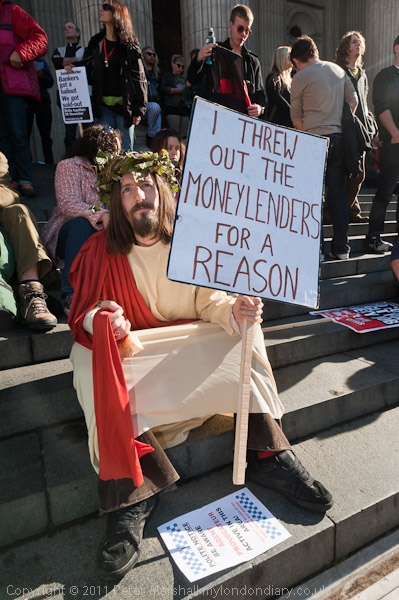
A message for St Paul’s from OccupyLSX on the morning they started

I was sad to hear what happened, because OccupySLX has I think had an impact that few of us could have predicted, creating and influencing public debates about issues that would otherwise have remained brushed under the carpets. And of course the eviction doesn’t end the Occupy movement in London, with one site, Finsbury Square, still going and few would dismiss the chance that others may begin (certainly the police haven’t.) But what we have seen so far doesn’t deserve the gloating that some politicians and bloggers have been making much of over the last day. It is very much a story of success that we should celebrate – and hope for the future.

© 2011, Peter Marshall
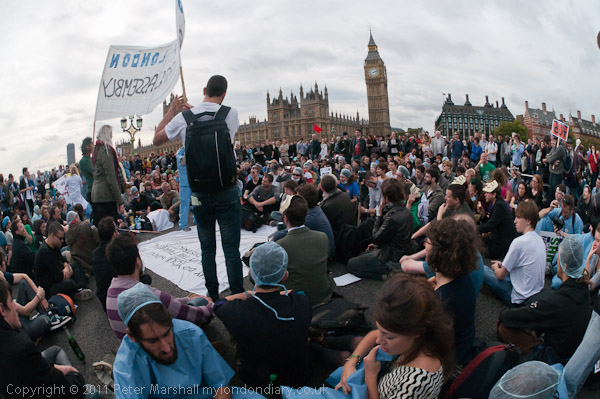
The meeting on Westminster Bridge, October 9, 2011

Few of us who were at the general meeting on Westminster Bridge on October 9, six days before the occupation started that took a decision to occupy the Stock Exchange thought that this had any chance of success.

© 2011, Peter Marshall
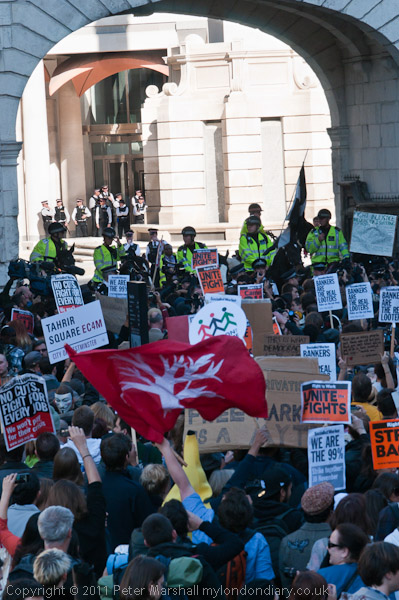
OccupyLSX blocked at Temple Bar in sight of the Stock Exchange

And when it failed on October 15, to many this seemed the end. Even when it became clear that some of those present were determined to set up camp in front of St Paul’s, many predicted it would be cleared within 24 hours. Even the most optimistic of us thought that it would certainly all be over well before Christmas – certainly when the first cold weather came.

© 2012, Peter Marshall
OccupyLSX still at St Pauls in February 2012

But of course it stayed much longer than the few weeks most people gave it. And it didn’t just stay, but spawned other sites, including Finsbury Square, the nearby Bank of Ideas, a court in Shoreditch etc. Only Finsbury Square currently remains, as the School of Ideas was also evicted on Monday night – and to make sure it stayed evicted bulldozers flattened it early on Tuesday morning.

© 2011, Peter Marshall
Occupy Finsbury Square in Nov 2011

It didn’t just stay. It worked, it protested, it taught. It attracted many influential and well-known names to come and visit, to give their support and talk. At first people may have laughed at the idea of the “tent university” but it became something of a graduate school.

I’m not a part of Occupy London, although I sympathise with many of the ideas they put forward. I dropped in for the occasional visit, often when passing on my way to other things, but didn’t have the time to commit to being a part of it. I’m not sure I would have done even so, as there were things I was uncomfortable with, apart from being rather old and fixed in more comfortable ways. But I am sure that their presence has enriched London. And I look forward to more of the story.

Photographer Meets Photographed

I used to be a great fan of the BBC, but experience in reporting events over the years as well as some aspects of their output have at least to some extent changed my mind, though they are still obviously rather better than many other broadcasters.I strongly support the idea of broadcasting as a public service and they do produce some very fine programmes in various genres.

But of course they are still over-manned,  still over-complacent, and still deliberately misreporting many events. Still giving far too much air time to bigots, racists and climate change deniers. And still wasting far too much money on rubbish which may be popular but would be done more or less as well by commercial broadcasters.

One of the finest aspects of the BBC’s work has always been the World Service, today celebrating 80 years of existence, though celebrating this by massive cuts, leaving its long-time home in Bush House and insulting its retired employees.

Thanks yet again to Duckrabbit and a post by Ciara LeemingThe face of the Gujarat riots meets his photographer ‘saviour‘ for bringing an interesting piece from BBC News India to my attention.

In 2002, Arko Datta photographed tailor Qutubuddin Ansari praying for help during religious riots in Gujarat during which around a thousand people, mainly Muslims, were killed – the worst riots since Independence. It was a picture that summed up the fear and desperation of many, and was printed on front pages around the world.

A week later, Mr Ansari became aware of the picture for the first time, when a foreign journalist hunted him out in a refugee camp and showed him a newspaper with it across a whole page. It made him notorious and “followed me wherever I went. It haunted me, and drove me out of my job, and my state.”  He lost half a dozen jobs and continued to be hounded by journalists. Ten years on,  BBC Hindi’s Rupa Jha was present when a meeting had been arranged between the two men.

Datta has been in a military vehicle and had taken a few frames of Ansari with a telephoto lens as he had pleaded with the soldiers to rescue him and a few other Muslims from a Hindu mob. Then he told the soldiers to stop and do something, and he and others in the van said they were not leaving until they did something to help the trapped people.

Although Datta’s photograph caused Ansari considerable grief, the journalists’ insistence that the military take action almost certainly saved the lives of the trapped Muslims, as well as bringing what was happening in Gujarat to the attention of the world.

Towards the end of their meeting, Ansari tells the photographer “Nobody is to blame, brother. You did your job. I was doing mine, trying to save my life. Your picture showed the world what was happening here.

Few photographs have the impact that this image does, either as a picture or on the subjects in it, or indeed on the world and on the photographer, but it is a reminder that photography can have consequences we fail to foresee.

This is not the only time Datta has returned to meet the subject of one of his award-winning images. You can watch a video in which he talks about photographing the aftermath of the Asian tsunami and how he retuned to find the Indian woman mourning a dead relative which was the World Press Photo of the Year in 2004.

Nokia 808 Pureview

Could my – or your – next camera be a phone? Certainly the Nokia 808 Pureview looks a fairly amazing piece of kit and the sample photos are impressive, certainly for a cameraphone. Of course we don’t need 41Mp, but by combining pixels to give 8Mp or 5Mp image output the Pureview is able to get better quality, as well of course giving it the ability to digitally zoom at decent quality. The zoom stops when the area of the sensor it covers has the number of pixels for the output.

So starting from 41Mp and reducing to 8Mp means going down to 8/41 of the sensor area, which I think gives a linear zoom of 2.26 (the square root of 41/8) while with a 5Mp image the corresponding zoom is 2.86, neither huge. The roughly 28mm equivalent f2.4 Carl Zeiss lens becomes a 28-63mm or  28-80mm respectively, which isn’t too bad, but the system really comes into its own with smaller image sizes. It will also have the slightly odd effect of quality being significantly better at the wider end of the range, and I imagine this will become pretty noticeable at higher ISO.

Of course 28mm for the 4:3 format (26mm for 16×9) isn’t particularly wide, and this is one reason why this won’t be my next camera. But it does seem to represent a real breakthrough in camera-phones, although it won’t be my next phone either, as I think it’s Symbian operating system is one to avoid, but perhaps with their next model it could really become the camera I’d take with me when I can’t be bothered to carry the real thing.

POYi Flowchart

I’m often surprised and amused by how things link together when I’m looking at pages on the web, often finding things that link to posts I’ve made or thoughts I’ve had but not quite got around to writing about.

One of the latter was about another of those annual awards, POYi, (Pictures of the Year international) which is unusual in conducting its business in public, web-casting the judging with 99 on-line publicly open seats in a chatroom.  The judging is spread out over most of the month, and has now more or less ended – so you will need to wait until next year to take part.

The Photojournalism Contest entry flowchart  on the Shit Photojournalists Like blog has more than an element of truth in it, judging from the various shows and lists of winners I’ve seen over the years. Certainly they lead me to the conclusion I’ve always had about such competitions, “Save your entry fee and buy gear.”  They also link to the POYi Chat Room Heroes blog, though I think you have to have been their to get much out of that.

One photographer who gets a particular mention is Melissa Little, whose work was apparently “pulled in, kicked out, pulled in, then kicked out again.” I don’t know what she had in for POYi, but you can see some interesting work on her own web site, where I find that in 2001 she was a student at the Eddie Adams Workshop and “have been honored to return for the last seven years as staff, where I’ve done everything from mow the grass and rake the leaves to documenting everything in sight as workshop photographer to leading, finding stories and coaching a team of 10 students. ”

I’ve not yet looked at all the awards for POYi, but did enjoy looking through the results for the ‘News Picture Story – Newspaper’ class, where first place went to
Michael Robinson Chavez (Los Angeles Times) for DECONSTRUCTING MUBARAK, second to Mads Nissen (Berlingske / Panos Pictures) for pictures of the LIBYAN REVOLUTION, third to Hiroto Sekiguchi (Yomiuri Shimbun) for TSUNAMI AFTERMATH and the ‘Award of Excellence to Craig Walker (The Denver Post) for his pictures of OCCUPY DENVER. And I mention this not just because there are some fine pictures in these stories (which are always of more interest to me than the single picture awards) but because of the controversy I may have mentioned earlier over World Press Photo, when some judges anounced publicly that they had seen no pictures of the Occupy movement worthy of an award. I don’t know if Walker’s work went to WPP as well, but certainly some other very worthy images did.