October 12th 2019

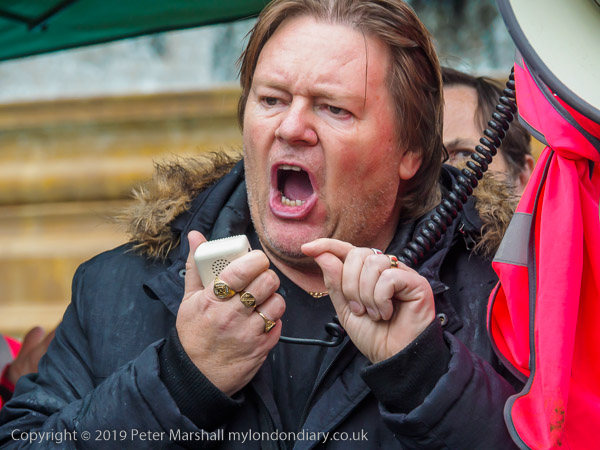
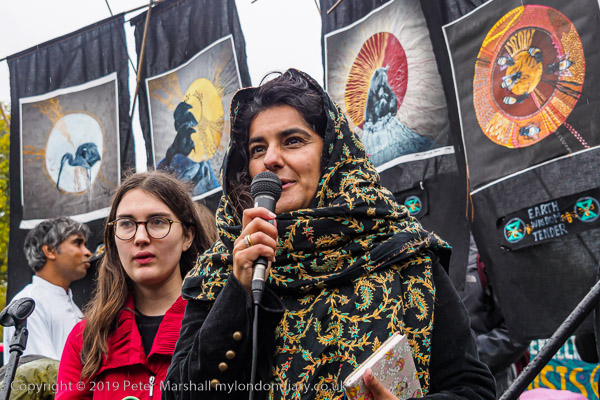
Ian Hodson, National President of the Baker’s Union BFAWU speaking

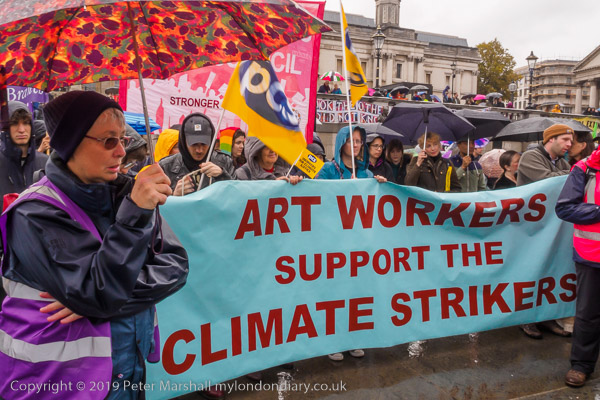
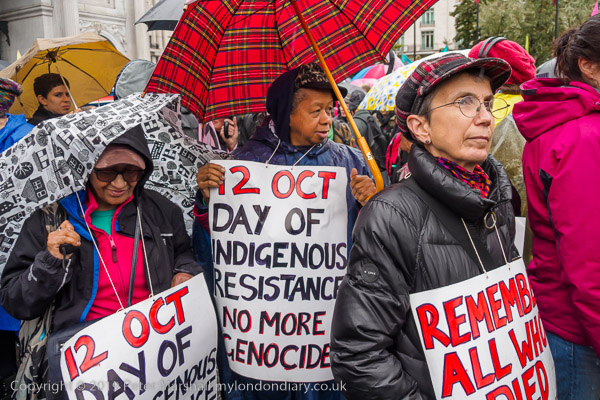
I was back with Extinction Rebellion on Saturday 12th October 2019, beginning in a rather wet Trafalgar Square, where Trade unionists were holding a rally in driving rain to show their solidarity with Extinction Rebellion and the school climate strikers. It was raining hard enough to make it difficult to take pictures, with rain drops settling immediately on my lens filters as soon as I wiped them off with my chamois leather held in my left hand.

It’s hard to hold an umbrella and take photographs, though I did for some pictures, and sheltered under other people’s for others. But umbrellas both greatly restrict movement and also other people’s view and I don’t like to use one.

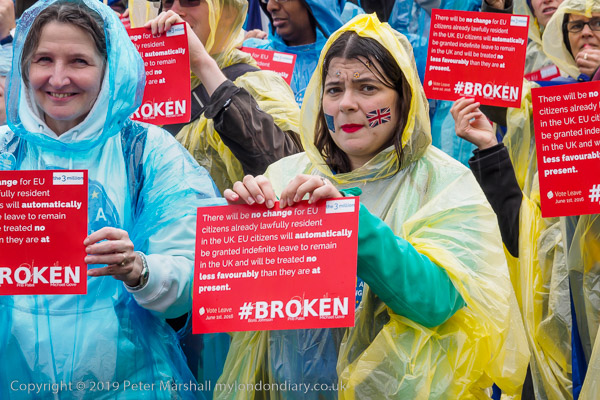
But Global Extinction was the only issue that campaigners were protesting about in Trafalgar Square, there were also a hundred or two campaigners from the 3 million organisation, EU residents living in the UK who were protesting against the promise broken by Vote Leave that “There will be no change for EU citizens already lawfully resident in the UK. EU citizens will automatically be granted indefinite leave to remain in the UK and will be treated no less favourably than they are at present.” They had dressed for their protest in blue and yellow rain ponchos, highly suitable for the weather.

From Trafalgar Square I got on a bus to take me to Marble Arch. Although police had cleared XR from their road blocks and got the buses running, rain in London always results in slow-moving traffic, but the journey did give me time both to dry off a little myself and more importantly to clear most of the interior condensation which was misting up my lenses.

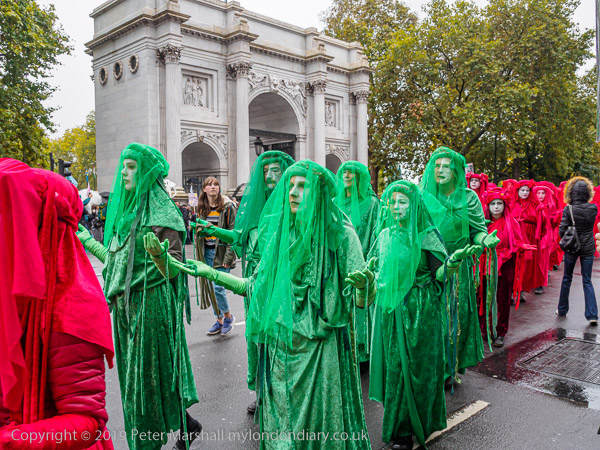
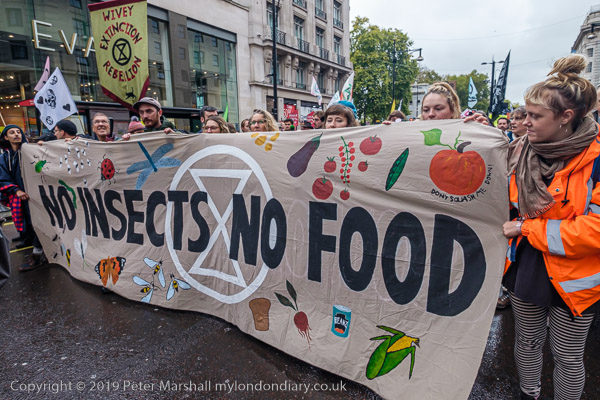
Extinction Rebellion’s main event was their ‘Strength in Grief ‘ procession on the Day of Indigenous Resistance marking the anniversary of Colombus’s landing in the Americas. It began with a number of speakers representing various communities across the world as well as others reflecting on both injustice and grief and the effects of global climate change already causing deaths and suffering across the Global South.

Fortunately the rain had eased off considerably, and had almost stopped by the time the rally ended and the march moved off down Oxford St, going to another rally outside the BBC who are largely failing in their duty to inform us about the threat of global extinction and the failures of our political systems to respond to it.

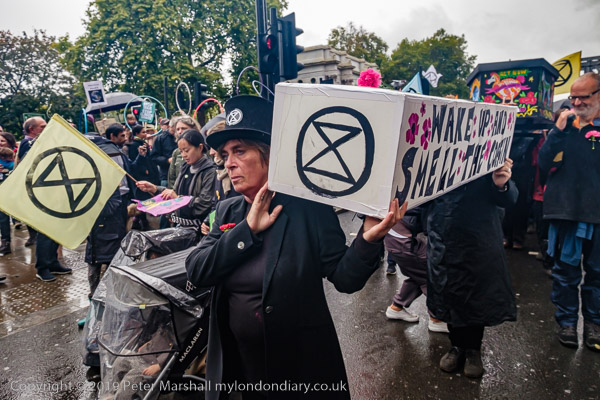
The campaigners marched on, but I’d had enough. I’d been working with my jacket open at the top so I could put my camera under it, but that meant the rain could get in around my neck, and after several hours I was rather cold and wet, and my lenses were steaming up again. I stopped close to Bond Street station and photographed the rest of the march – several thousand, many in interesting costumes – as it went along Oxford Street until the last marchers had passed me, then made my way down to the station.

Many more pictures from the three events on My London Diary:

XR Strength in Grief Procession
Brexit unfair for EU citizens
Trade Unionists join the Rebellion


All photographs on this and my other sites, unless otherwise stated, are taken by and copyright of Peter Marshall, and are available for reproduction or can be bought as prints.


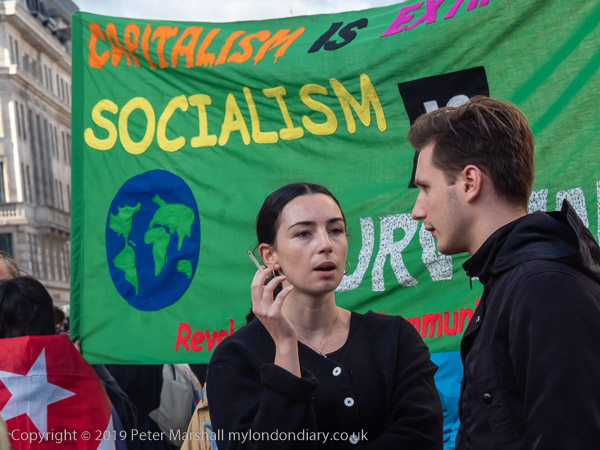
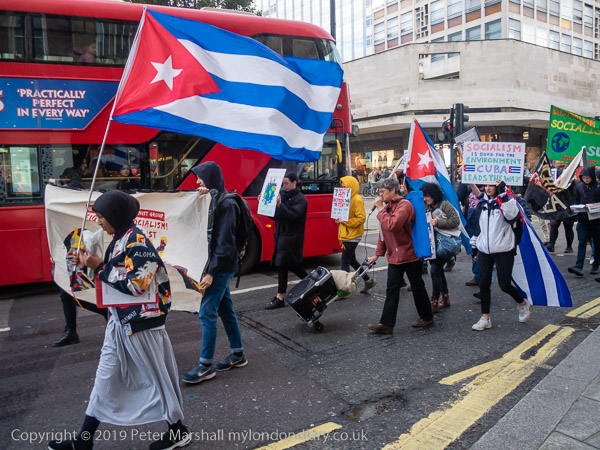
Socialism is Survival

Capitalism is Extinction – Socialism is Survival’

In 2008 Richard Wilkinson wrote an opinion in The Guardian, ‘Follow Cuba’s emissions standard‘ in which he states:

“According to the WWF, Cuba is the only country that has managed to combine an environmentally sustainable footprint per head of population with an acceptably high quality of life as measured by the UN Human Development Index. And if Cuba can do that without the latest and most economical technology, how much easier should it be for us?”

Follow Cuba’s emissions standard

Part of the reason for this is, as he also states, that resources in Cuba, though relatively limited are shared much more equally than in market-led democracies such as the UK and the US. He makes the point that material differences between people are destructive, reducing well-being and quality of life and leading to many social problems, and that wealthy societies such as our should be concentrating on reducing inequalities rather than pursuing economic growth.

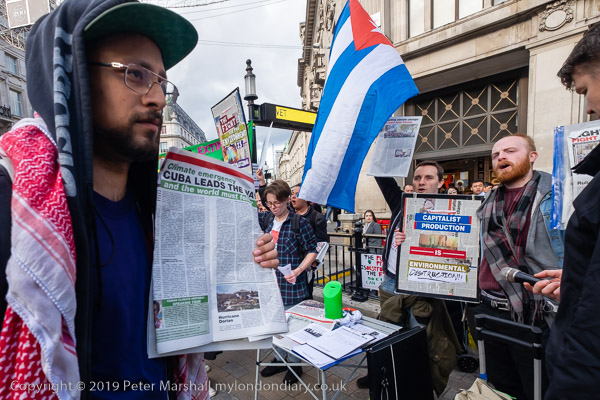
Cuba Leads the Way

To put it simply, we already have enough, and the important thing is now that everyone gets a decent share. We don’t need exact equality, but we do need to avoid the kind of indecent excess we now see, with the rich with more money than they can ever sensibly spend and the poor unable to afford decent food and safe housing, with too many sleeping on the streets or in overcrowded properties, often with little or no security of tenure and too many in jobs on less than a living wage and often zero hours contracts.

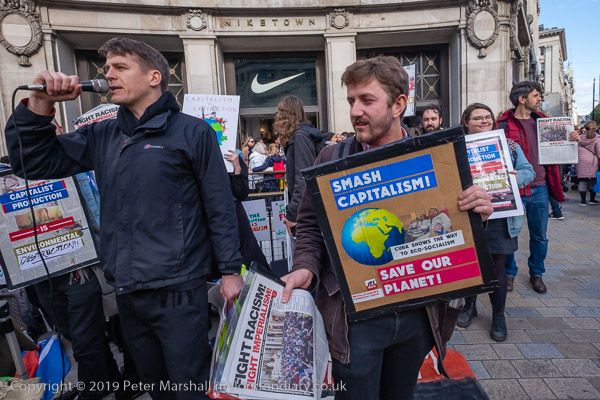
Smach Capitalism! Save Our Planet!

The biggest challenge we face as a world and as a nation is of course not the largely irrelevant matter of Brexit but climate change, and inequality also drives that – both directly by the senseless consumption of the ultra-rich and the poor quality environment of the poor, and indirectly by the encouragement to consume of living in the same society as those who feature most largely in our advertising and media coverage. We are going to have to make huge changes to survive, cutting down our footprint on the world’s resources to perhaps a quarter of the current UK levels, a change that it is hard to see a market-led capitalist system adapting to. And while Wilkinson suggests it should be easier for us, I think our current wealth and political system probably make it impossible. At least without a real revolution.

The Solution is Socialism

The Revolutionary Communist Group put it more starkly and simply than Wilkinson: “Capitalism is Extinction – Socialism is Survival’ but also base their conclusion on the closest we have in the world to a socialist state, Cuba. Despite punitive economic sanctions imposed by the USA (and perhaps sometimes as a result of them) Cuba under communism has made enormous strides in some areas, producing universal literacy and one of the leading health services in the world – and its medical services are one of the country’s main sources of foreign income. Increased life expectancy – to values similar to much rich countries such as the USA and UK – in a roughly static population is now presenting familiar problems. Energy use has remained relatively low with per-capita consumption only around a quarter of that in the UK.

Of course that isn’t the whole story, though it is perhaps difficult to know exactly what is, as all sources of information about the country reflect considerable bias. Many in the RCG have been to Cuba and seen the country at first hand, but what and who they saw will to some extent be affected by their own political affiliations and those of their hosts. Much of the more commonly spread information in the media comes from émigrés who left the country because of their dissatisfaction with the situation and the regime, or from anti-communist individuals and and capitalist organisations.

‘Practically Perfect In Every Way’

Castro and his guerrilla band took the country back from one of the worst and most corrupt governments in history, a dictator who had seized power in a military coup in 1952, but haven’t managed to eliminate corruption – though it is now said to be is the 60 least corrupt nation out of 180 countries by Transparency International. It would be hard not to admire a country which has withstood the sanctions and intrigues of the USA for so many years. Castro himself was apparently the target of over 600 assassination attempts by the United States’ Central Intelligence Agency but died of natural causes in 2016.

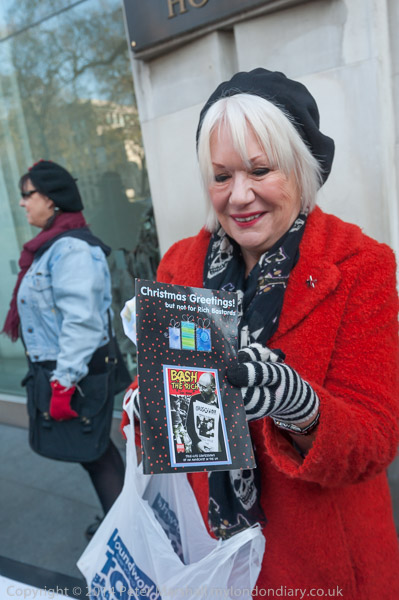
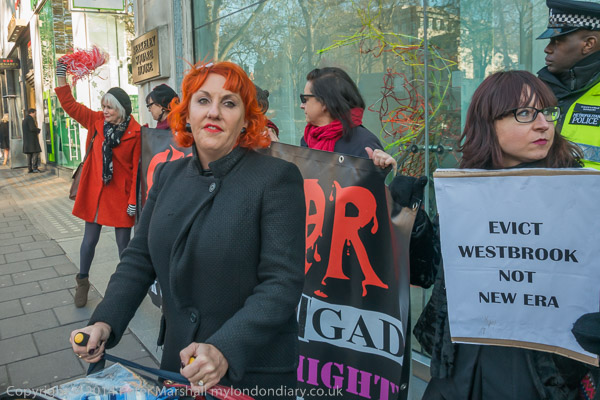
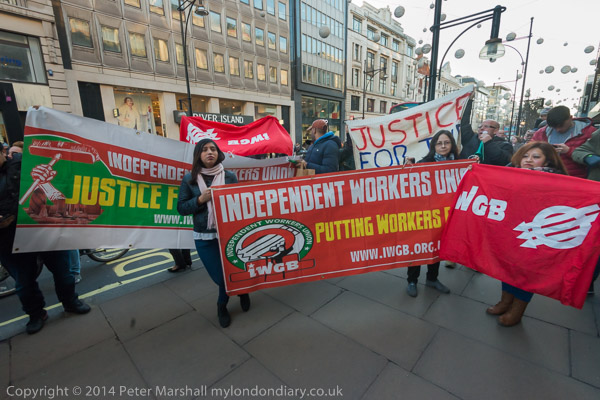
You can read more about the protest and rolling picket outside various temples of consumerism on Oxford St at Cuba leads on climate say RCG.


All photographs on this and my other sites, unless otherwise stated, are taken by and copyright of Peter Marshall, and are available for reproduction or can be bought as prints.