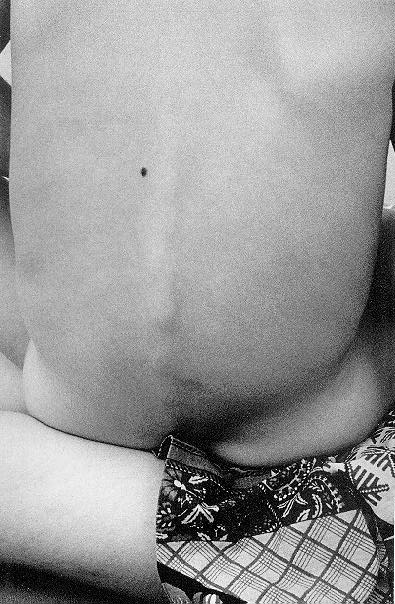
Inside in France

Like me you probably missed the show Prisons: 2011 – 2014 by Grégoire Korganow which was at the Maison Européenne de la Photographie (MEP) from Feb 4th-May 4th, 2015. I’ve been just too busy to go over to Paris for a while, much though I would like to.

In 2010, Korganow was working in French prisons on the making of a doucmentary film about the man in charge of them, Jean Marie Delarue, The Comptroller General of Places of Deprivation of Liberty (CGPL). At the end of the filming, Delarue asked him if he would photograph the French prison system, and Korganaw had the unique opportunity to work in twenty prisons, spending 5-10 days in each of them over the next three years.

Korganow was made an ‘inspector of prisons‘ and he writes on his web site “I’m able to photograph everything; the inside of the cells, the exercise yard, the visiting rooms, showers, the ‘cooler’ (solitary confinement unit)… Day and night. I have access to all areas.”

As Pete Brook writes: “Korganow has made the most of his phenomenal access producing an unrivaled and varied of body of work about the French prisons.” It really does seem to be a remarkable study. As well as the exhibition, there is also a book, Prisons-67065 (the number is the total of prisoners in French prisons on Jan 1st, 2014), with 432 pages (ISBN-13 979-10-92388-05-3) which I’ve not seen. It seems to be a relatively small format but rather fat book from the dimensions on the publishers page of 17 x 22.5 x 5.2 cm and its weight of three and a quarter pounds. I can’t see anywhere the number of photographs it contains.

I read about the show on Pete Brook’s Prison Photography site, and the same feature, with larger illustrations is also on Vantage, which seems a site well worth looking at.  On its ‘About’ page it reveals simply “We are fans of photography” but then goes on to list an impressive list of editors and writers including of course Pete Brook, but also a number of other names I recognise.

Vantage is a part of Medium, which is a kind of publishing network and looks very interesting – you can find out more about it in Ten reasons why I love writing on Medium. If I didn’t already have too many other things to do I might be thinking about using it.


Landscape of Murder


Antonio Zazueta Olmos
Last night I attended the opening of a photographic show by Mexican-born photographer Antonio Zazueta Olmos, based in London since 1994 and well known for his work for The Observer and other publications, and now for workshops in street photography he has led as a part of the Guardian Masterclass series.

The Landscape of Murder, on show at Rich Mix on London’s Bethnal Green Road until 30th May 2015 is the distillation of a remarkable project by Tony, in which he photographed the location of every one of the 210 murders that took place in London within the M25 over the two years 2011-2012. Rich Mix is more or less opposite Shoreditch Station, and a short walk or bus ride from Liverpool St.


A small crime at Rich Mix – Tony loses a hand

I wrote in 2010, before he began the project about his contribution to one of the best evenings at London’s Photoforum, and in particular the advice he passed on that ‘if you find yourself surrounded by photographers when taking pictures, you are almost certainly in the wrong place.’ in 2013, in a post Murder & Masterclass I looked briefly at some reports of his street photography classes and his Landscape of Murder project, recommending the dedicated web site, where you can see many of the images in this show.


But it was soon recovered


Sean O’Hagan

I won’t write much about the show itself, as you can read the text written by The Guardian’s Sean O’Hagan, who was present at the opening. A longer version of that article appears as the foreword in the book ‘The Landscape of Murder‘ which includes 79 of the images, along with a short text giving some details of the crime which also accompany the scenes on the wall at Rich Mix. The show there has very much fewer pictures on the wall and is perhaps stronger for it, though a few of my favourites from the book are missing. There is a projection in the rather dim mezzanine space where the show is held, and as seems to be usual for such things they were quite noticeably out of focus.

Although Rich Mix has hosted a few good photography shows, I get the impression that their heart is not really in it (for example see my comments in Paul Trevor at Rich Mix.) It’s centre is cinema, and those going into the cinema will walk past Olmos’s picture and I’m sure many will stop and look – as Tony tells me they were when he was there to help with the hanging. The lighting on some of the works is a little too dim, a shame as they seem superbly printed. But Rich Mix is a lively and stimulating arts centre that hosts many great events, and it’s good to see another fine photography show there, ad very bad news that the future of this place is now under threat – as indeed after yesterdays election results so much else is too.

London isn’t a violent city. It’s one I’ve walked around for 40 years and seldom felt at risk – and then mostly from riot police. The book ends with a short analysis by crime reporter and author Peter Stubley of murders in London and then details of all the 210 murders, along with thumbnails of Olmos’s images of the scenes.  The end papers present a map of the area marked with the locations – which is far more effective as a single large map in red on the gallery wall.
Continue reading Landscape of Murder

Stanley Greene in Brixton

Stanley Greene is one of the best photojournalists around (see his work on Noor if you have any doubts), and someone I’ve written about before, particularly over his coverage of Chechnya. You can – though I don’t now for how long – see his coverage of the UK elections on Catch Up on Channel 4 News.  Asking him to cover the it was certainly a great idea,  and you can see the results in a video which combines  video footage with his black and white images at From Beirut to Brixton: war photographer on election trail. And there is an article about it.


One of my pictures from earlier in the day in Brixton

I was in Brixton earlier in the day at the event which he covered, but didn’t see him there.  Much of his coverage from Brixton (it starts at 7m30s) is of people that I know and that I also photographed, and its great to see how a real master does it (though I did get a few decent pictures too.)


One of my photographs of Lisa McKenzie in Brixton

The piece does a fine job of combining video clips with the still images and also is nicely edited, combining well-selected opinions from people on the street – including Class War’s election candidate standing in Chingford against Iain Duncan Smith, Lisa McKenzie – with Greene’s own intelligent and somewhat laconic insights.  As he concludes, there is plenty of politics happening on the streets, “but it seems to me, its the politicians who aren’t taking part.”

Camera buffs will no doubt find the equipment hung around Greene’s neck of interest. In Brixton at least there were two cameras, one of which has the word ‘Nikon’ on it, but I don’t recognise it. Certainly it isn’t a D3s which he mentions in a 2012 interview on ClueCult :

I’ve got it all figured it out. I’m shooting Leica for black and white, Nikon D3s for big jobs where you pull out the camera to say “I am the photographer”. I’m shooting the Leica M-9 when it’s a digital work with an artistic flavor and I can match it up. I’m using the Olympus to do daily life, it is my diary.

Embedded in that interview is a short video trailer for his book Black Passport, which is better viewed at higher resolution on Viewtube. There is also a video interview with him by the French magazine Polka which is also worth watching.

Often I find photographs produced now in black and white an annoying affectation, with photographers sometimes thinking that working that way makes their images more ‘documentary‘. But there is a big difference between a photographer who thinks in black and white – as Greene clearly does here, and those who work in colour and simply convert the images to monochrome.  In the Channel 4 video, choosing to work with black and white photographs clearly also has the function of separating them from the video clips.
Continue reading Stanley Greene in Brixton

Same Circus, Different Clowns

This isn’t a post about our general election, though I suspect the headline might do for the possible result, which might be a marginal improvement on the equally likely Same Circus, Same Clowns but isn’t I feel going to change things a great deal. Of course I shall still go out to vote, though only to register my opinion, which I think is important to do, however impotent politically.

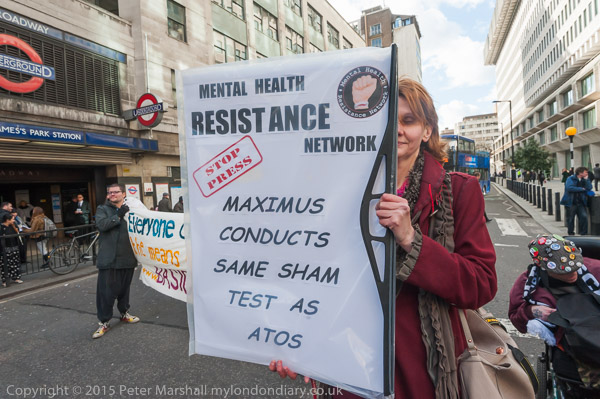
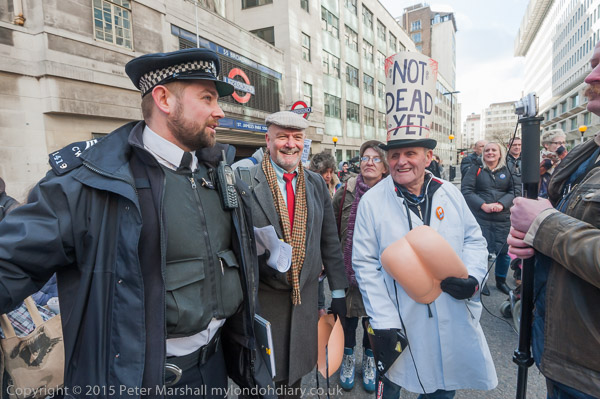
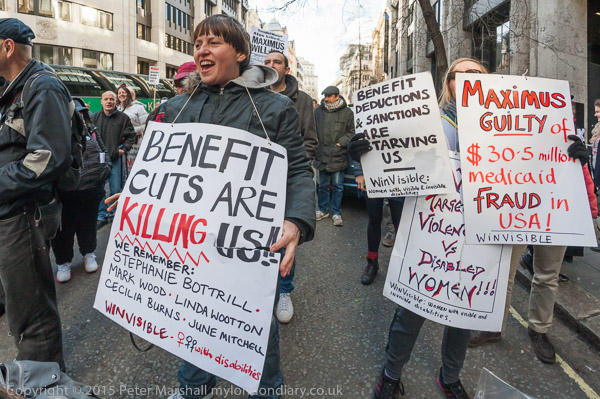
But as Maximus – Same Circus, Different Clowns makes clear, this was an event about a different company taking over the administration of Work Capability Assessments for sickness and disability benefits from Atos, who have been so hounded (and justifiably so) by protesters that they have thrown in the towel.

People didn’t protest because Atos were conducting the tests, but because the tests themselves, based on box-ticking computer questions are generally agreed to be woefully unfair and inadequate, and mainly because of the way that Atos pressured those largely unsuitably skilled people administrating them to do so in a way that was grossly unfair to claimants. It’s possible, though perhaps unlikely that Maximus will do the job better, though they will still presumably have the same financial incentive to fail as many people as possible. No fair system would pay more for failing more or set targets for the number to be failed.

Of course the tests should be scrapped, and replaced by assessments based on medical evidence provided by properly qualified people, and protests will continue until this happens, and this was just the first against the new administrators, Maximus, a US company with a UK office close to the Dept of Work and Pensions.

DPAC (Disabled People Against Cuts) and other disabled groups represent people who have been hardest hit by the coalition government’s welfare reforms, with Minister Iain Duncan Smith cynically seeing them as an easy target. Events have proved him wrong; their disabilities have made them one of the toughest groups of protesters in the country, both on the streets and in the courts, where they have inflicted a number of defeats on the government – though the response has been largely for the DWP to ignore the verdicts.

DPAC are determined because so much is at stake for them – and many know friends who have committed suicide because of losing essential benefits or the continual harassment of regular incorrect assessments and appeals which eventually overturn these.  Their protests also rightly attract a great deal of public sympathy, not least among the police, who also fear the bad image that reports and photographs of them treating the disabled as they sometimes do the general population would give.

There is also a great reserve of often unused and under-appreciated talent among people with disabilities, some of which leads to their protests being more inventive and more visual than most. It’s always a pleasure to photograph their protests, and you are never quite sure what will happen, though it is likely that something interesting will. And the public appreciation of the poor deal they have had from the government does result in greater interest in the media – and my pictures of events involving the disabled have been more widely used than those of other protests.

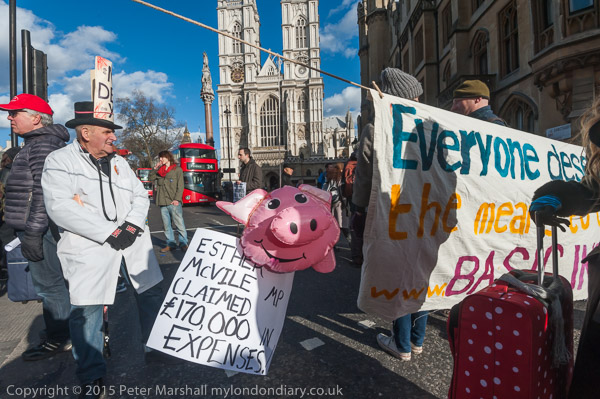
It’s not everyday you get the opportunity to take a rather different image of Westminster Abbey complete with a flying pink pig, and I’m not sure I really made the most of it, though I tried a few times. You can read the account of the event and see more pictures at Maximus – Same Circus, Different Clowns.  As usual I was working with the Nikon D700 with 16-35mm f4 and the D800E with 18-105mm DX, as well as just a few frames with the 16mm fisheye on the D700. The top image in this post was made with the D800E, others all with the D700.
Continue reading Same Circus, Different Clowns

The New York Photo League

Like many of my articles, the piece on the Photo League I published in 2001 was based on work I had done earlier, either for teaching or for articles in a small magazine that I edited for some years, later reworking and adding material to them for publication.

And rather than relying on the images in books and magazines, and on slides I made from these as well as commercial film-strips and a few videos mainly recorded from TV, I had to find images and articles I could link to on the web.

Many of those links no longer work, but there is now far more material on the web and it is much easier to find than in the days before Google. So I’ve removed any links from this piece, and leave it to the reader to research those aspects that they find of interest. Anyway, here’s the piece from 2001 without those links:


The New York Photo League

Origins

The Photo League was one of the most important movements in twentieth century photography, its influence spreading wide from New York. Yet it remains one of the least well known areas of photography, with many half truths and some downright fiction in the history books and on web sites. In this feature I hope to state some of the main points about it, and also to state why I believe it to be so important. Along the way I hope to blow away some of the myths.

Of course, there are long scholarly and no doubt more accurate accounts than this, although some historians perhaps lose sight of the wood as they concentrate on the leaves. This is an outline only. In future features I’ll look in more depth at some of the photographers who were members or otherwise associated with the organisation.

Anne W Tucker, Clare Cass & Stephen Daiter’s book ‘This Was The photo League: Compassion and the Camera from the Depression to the Cold War’, published by the Stephen Daiter Gallery, Chicago in 2001 is probably a good – if expensive – reference for those who want more detail. Anne Tucker also contributed a chapter, ‘Strand as Mentor’, to the book ‘Paul Strand: Essays on his life and Work’ edited by Maren Strange, Aperture, 1990. Some information in this feature was taken from her and other essays in this book, including one by Walter Rosenblum.

The ‘Film and Photo League’ was founded in 1930, but its origins lay in the earlier Workers’ Camera Club of New York which had been active for some years. As the name suggests, this was a communist inspired organisation. Workers’ International Relief , which was the American chapter of the Internationale Arbeiterhilfe, part of the Communist International, sponsored the merger of the Workers’ Camera Club with an organisation of similar nature, the Labor Defender Photo Group, into the New York Film and Photo League.(FPL)

The object of the League was to make film and photographs that supported workers in their struggles against the bosses, that stood for the rights of the working people and fought for a better life for them. These movements drew their inspiration from the German worker-photographer movement organised by Will Munzenberg. They aimed to awaken the working class and train them in the use of film and photography in the production of politically committed pictures.

Film occupied an important place in Russian culture of the era, and the FPL also aimed to project a positive picture of Soviet cultural achievements in this area as well as producing it s on films. Although still photography was seen as important and the majority of members were still photographers, the movement in the early years was dominated by the film-makers, some, including Paul Strand were also well known as still photographers.

The late 1920s and 1930s were a period when intellectual life in the Western world was dominantly left wing. Capitalism was seen as having led to the carnage of the First World War and later the failures of the Depression. Following the Russian Revolution in 1919, a new society was being created in the Soviet Union that would lead to a freer and more equal society. Of course it didn’t quite work out like that in practice. At the time however, many if not most photographers in the USA shared the at least broadly socialist or left wing sympathies and hopes of their generation.

In 1935, various arguments within the FPL led to a three-way split; the film-makers who stuck more closely to party lines keeping in the FPL (it faded away a couple of years later) while those who wanted to make more ambitious documentary films formed a production company, Frontier Films. The still photographers, who largely took the side of Frontier Films, formed a new organisation, the Photo League. Frontier Films was closely allied to the Photo League throughout its existence. Paul Strand, the President of Frontier, was a member of the Advisory Board of the Photo League and played an important role in its activities until he left for France in 1949.

Activities

Although the split from the Film and Photo League marked a certain degree of distancing from the Communist Party, there is no doubt that a number of its leading members – almost certainly including Strand – were also party members. However many others were simply people who shared the general left wing views of the times.

After the split, the League had no support from outside bodies and was entirely dependent on membership fees and the charges for courses and lectures. It was open to all photographers, and had a bold belief in the true purpose of photography. In the document ‘For A League Of American Photographers‘, its executive board stated:

Photography has tremendous social value. Upon the photographer rests the responsibility and duty of recording a true image of the world as it is today. Moreover, he must not only show us how we live, but indicate the logical development of our lives.

The major figure in keeping the activities running over the years was Sid Grossman, described as an organisational genius as well as a fine photographer, but many others, including Walter Rosenblum (president for many years), Dan Weiner and Sol Libsohn played vital roles. Paul Strand was always on hand for advice and also taught and lectured (Rosenblum describes a class by him in his essay mentioned earlier). Aaron Siskind led the Harlem project for four years, and there were many others. All those involved in the League’s programs gave their time without charge.

Most of those who belonged to the Photo League, at least before the late 1940s, were working class New Yorkers, from the lower east side, from Brooklyn and from the Bronx. Most were in their teens and twenties when they joined; many were the sons and daughters of first generation immigrants living in these working class areas, and they were predominantly of Jewish origin. Few were professional photographers, most were working in low paid jobs

The League set up in a second floor loft – the former FPL premises in East Twenty-first Street. This small base became exhibition hall, meeting room, darkroom and school for the members.

They were attracted in particular by the low cost (the teaching staff were not paid) and high standard of the photographic tuition on offer. The League school, directed by Sid Grossman, offered courses in the techniques, history, aesthetics and practice of photography. As well as Grossman, a gifted teacher, and Libsohn who together ran the documentary class, there were also courses and guest appearances by many well-known photographers. Teaching in the photography classes was very much based on practice, with the students being sent out to record life in the various communities of Manhattan, taking photographs that were then criticised – at times extremely forcefully – and discussed in class.

The Photo League School was, at the time as Hal Greenwood noted in 1947, the ‘only non-commercial photo school in America‘, and in the years it was open, trained over 1500 photographers. It used a ‘progressive educational method: the student learns by doing’ which was unusual for its time and aimed ‘to help the student ‘discover the world; to develop a personal, philosophic, and visual perception which would load to an individual direction in photography’. Its success can be seen in the work of those who passed through it, and also by the later adoption of similar methods by many courses in photography in our schools of art. Unfortunately few of them did it anything like as well.

Hine and recent scandal

As well as Strand, other notable photographers, including Berenice Abbot and Margaret Bourke-White – sat on the advisory board and persuaded other well known figures to come and talk and also to exhibit their work, including Edward Weston, Ansel Adams, Henri Cartier-Bresson and Lewis Hine. Weegee had his first exhibition at the Photo League and became an enthusiastic member.

Hine, occupied a special place in the pantheon of the League. His campaigning around the turn of the century, fighting for better protection for children in the workplace (and the enforcement of existing laws designed to protect them) was the epitome of the type of photography they existed to promote, although their interests did range much wider to cover the whole range of what might be called expressive photography, and included almost anything but outright commercialism and the pictorialism of the amateur club movement. Their list of heroes very much derived from Strand’s views on straight photography, expressed forcefully in the 1920s in opposition to pictorialism. A typical list would include Stieglitz, Strand, Hine, Jacob Riis (the first photographer to record the conditions of the poor in New York), the FSA photographers, Atget, and Edward Weston, all photographers who used the camera without manipulation.

When Hine died in 1940, his collection of pictures and negatives was presented to the League; when the League was wound up, this collection ended up with the former president, Walter Rosenblum, eventually becoming a part of the George Eastman House collection. The provenance of some prints apparently signed by Hine but made on paper which was not produced until the 1950s has been a recent cause célèbre among gallerists and collectors, involving an out of court settlement and possible continuing legal action.

(‘Vintage prints’, generally accepted as those made by the photographer within a couple of years of the date of the negative, sell for a considerable premium over those made at a later date by other hands. Although later prints are often both better printed and in better condition, they never have the same rarity as vintage prints.)

Photo Notes

One of the other vital activities of the League was the publication of a monthly bulletin, ‘Photo Notes‘. By today’s standards this was very crudely reproduced, poor quality type from a stencil duplicator. Despite the lack of photographs, it became the most important photographic magazine of its times. Edited for four years by Rosalie Gwathmey, (other editors included Lou Stoumen) it gave details of the League’s events, published reviews of current photographic shows, and published both new writing on photography and also reprints of some of the classic articles.* Among those who wrote for it was perhaps the best-known critic of documentary photography, Elizabeth McCausland. Photo Notes was distributed free to museums and galleries and reached a large audience, attracting them to League events. Although the league’s actual membership was never high, many other photographers participated in its activities

The War

The USA entered the war in 1941, and most of the men in the League were of fighting age. For many of them the war provided an opportunity for photography. Among League members who served in the military were Walter Rosenblum (he was among those to land first on D-Day), Morris Engel, Sid Grossman, Morris Huberland, Theodore Gumbs, Sam Solomon, Bess Maslow (with the Red Cross), Louis Clyde-Stoumen, Maz Zobel, Sam Dinin, Kenneth Miller, Albert Fenn, George Gelberg, J P Connolly and Dan Weiner.

Those left at home photographed in various ways to support the war effort; a Photo Notes editorial urged members ‘to make photographs for the defense project which the League is working on. To make photographs of the people of America as they organize themselves to defeat fascism’ and to help the League ‘to utilize all the resources of the League, our exhibitions, our project, our school, our relationship with other organizations; with the aim of doing the most that we can towards the successful prosecution of this war.’

Subversive Activities

Editorial!

In the immediate post-war period the future looked bright for the League. Many old members had returned and there was an influx in new members, so much so that the League had got together the money for a move into new, larger premises, when a bombshell fell. The first the League knew about it was when they received a phone call from a newspaper, asking if they would like to comment on their listing by the Attorney General as an organisation subversive to the United States.

The group called an emergency meeting, at which Strand spoke eloquently about the need to defend democracy and our rights. You can read his speech in the ‘Special Number’ of Photo Notes, together with contributions by Walter Rosenblum, Ansel Adams, Barbara Morgan and others. Strand and Nancy Newhall drafted a protest telegram that was sent by the meeting to the Attorney General, congressmen and the papers, while Gene Smith was working on the draft of a more detailed letter. A petition was started. Following a suggestion by Barbara Morgan, Beaumont Newhall was appointed to produce a historical article to submit to magazines showing the League in the context of documentary photography, and work began on an exhibition, ‘This is the Photo League’ which included work by both Richard Avedon and Ansel Adams.

Special Number

The immediate result of the blacklisting was an increase in membership, with many noted photographers from across the USA joining in support of the organisation, seeing it as being a fight for photography and against political interference. However, as the years went on the cold war hysteria intensified. In 1949 there were further allegations made against the League and Sid Grossman was named in a trial by a former League member who claimed to have been recruited by him into the Communist party. Grossman was blacklisted and had to resign from his position in the League and abandon his teaching career.

Although the accusations against the League were clearly unfounded, in that its activities were photographic rather than political, in the paranoia of the McCarthy era, any well-founded suspicion that some of its prominent members were Communists was enough to prove guilt by association.

Paul Strand left to live in France as things started to become difficult for him, others found difficulties in getting work or passports because of their League membership, and so left. The school had to close; newspapers would no longer mention League events and so audiences for events dropped dramatically. Finally in 1951 it could no longer pay the rent and had to close.

For 15 years the League had provided a vital support mechanism for photographers in New York. It had educated them, given them encouragement and new ideas. It was a place to go to meet and talk with other photographers It had made an important contribution to the growth of photography and public awareness of photography in New York at a time when that city was becoming the world centre for photography. It was a movement in which others – notably pioneers such as Steiglitz, Steichen and others at the Museum of Modern Art – played a part, but it was the Photo League that brought photography to the heart of the city.

How the League would have developed, and the consequences for photography if it were not for the accusation is a matter of pure conjecture. In some ways it was very much a product of the 1930s and the spirit of brotherhood and selfless generosity and idealism of the times. Those involved still- in the main – look back in their eighties and nineties with justified pride at what they achieved, and their work is a legacy we can still enjoy.

Peter Marshall, 2001.


* Photo Notes was something I had in mind when I was editor of the magazine of London Independent Photography, LipService, in the 1990a. It did include images, but only as rather diagrammatic photocopies of photographic prints.
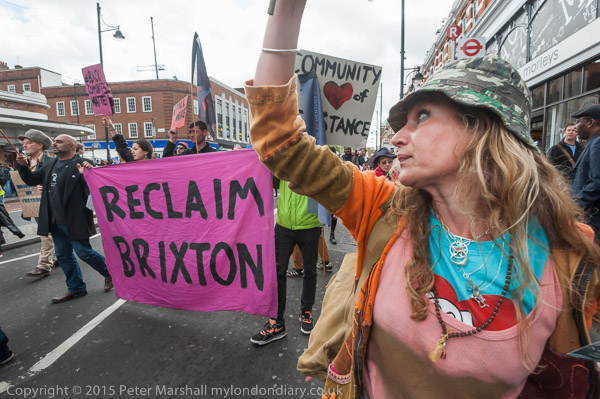
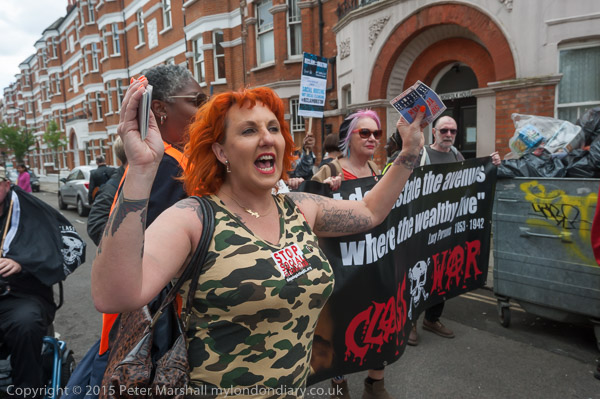
More Liebling

Exactly a year ago I wrote a post Liebling Revisited, prompted by an article that had appeared in the New York Times Lens blog.  And today I find myself writing again, urging you not to miss another feature, this time in Slate, How One Photographer Captured a Changing New York City Over 50 Years in connection with a show at the Steven Kasher Gallery in New York until June 6, 2015 and which includes some previously unseen work.

I wrote a whole series of articles about the New York Photo League and a number of the individual photographers who were a part of it at a time when it was little talked about either here on in the US.

At more or less the same time Anne W Tucker, Clare Cass, & Stephen Daiter’s book ‘This Was The photo League: Compassion and the Camera from the Depression to the Cold War, was published by the Stephen Daiter Gallery, Chicago in 2001, I wrote five page introduction to the Photo League, with a long list of web links to the few articles then on the web about it and a rather longer list to individual photographers who had been associated with it, some better known than others: Morris Engel, Sid Grossman, Arthur Leipzig, Rebecca Lepkoff, Sol Libsohn, Jerome Liebling, Marion Palfi, Rae Russel, Larry Silver, Erika Stone and Dan Weiner. I had by that time already written about some others including Paul Strand, Lewis Hine, Walter Rosenblum, Gene Smith, Berenice Abbott and Aaron Siskind, and promised to write more about some of the others in later posts.

And for some of them I did, though I think I never got around to writing about Jerome Liebling at any length. I’m not sure why, for ‘The People, Yes‘ was certainly a fine book and one I got when it came out in the 1990’s  and it is still available secondhand at a reasonable price. You can find out more about him on the Jerome Liebling web site.

Five Year Growth

Someone asked me yesterday if the only thing I photographed was protests. It was a genuine query, because she had seen me working at every protest she had attended in recent months, but my answer was “not quite”. But I went on to say that there were just so many protests at the moment that they had more or less forced everything else out of my diary – and out of My London Diary.  I used to cover a rather wider range of events.

It’s perhaps partly the election coming on, though I don’t really see a huge decrease in the activity of protesters after May 7, whichever party or parties form our new government. The policies that are behind what seems to be a growing resentment and militancy were many of them begun by Labour although the screw has certainly been tightened by the Conservative-LibDem coalition government. To mix a metaphor, Labour might release a little of the pressure, but it still looks to me as if growing inequality is stoking up a boiler on its way to bursting point.

Other photographers occasionally ask me how I find out about all the protests I cover, but really it isn’t a problem. My problem is more about choosing which of the many going on to decide to attend. Yesterday there were half a dozen things in various parts of London I knew about (and some I only heard about after the event) but I only got to one. And the pressure of work is such that I’ve been getting over-tired, not getting enough sleep and finding that I have to stop work after a few hours -at times I begin to feel my age.

It’s been a few days longer than usual since my last post here, mainly because I’ve been out working every day, and its likely to happen again. Today I’m able to sit here writing this because I didn’t manage to finish yesterday’s work at the computer, simply falling asleep as I tried to write, eventually dragging myself off to bed. So this morning I had work to finish and also still needed to rest. Otherwise there were a couple of protests in the centre of London and another following on from yesterday’s protests in Brixton I might be photographing. But I need a day off. Perhaps when I’ve finished writing this I’ll go for a quiet walk, taking as usual a camera with me, but probably not making and photographs.


X-Pro1, 10-24mm, 20mm

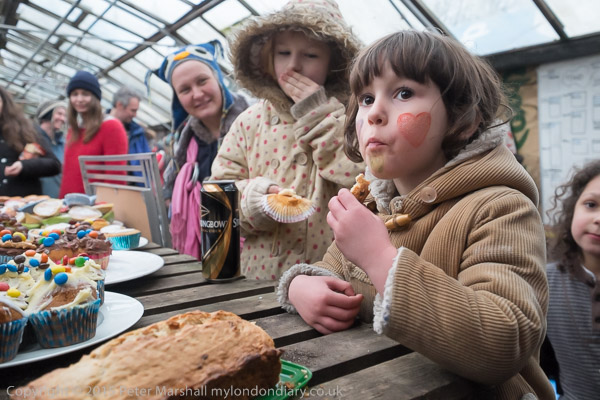
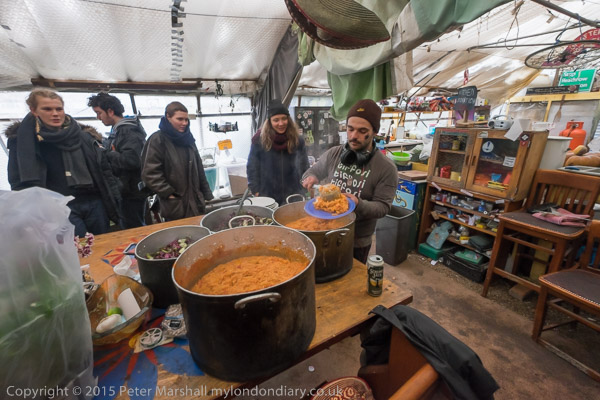
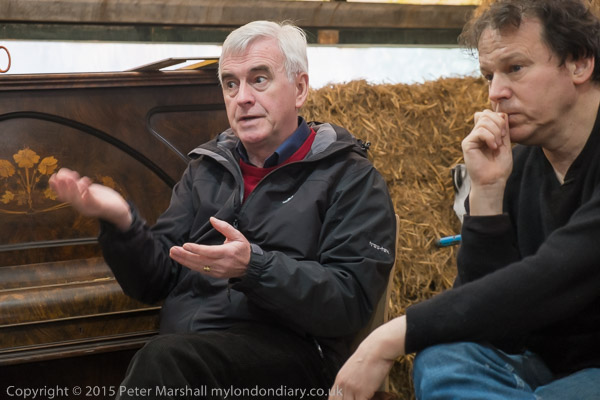
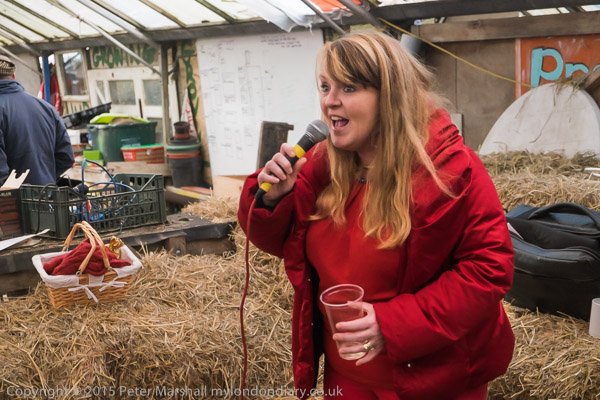
Sometimes I still do manage to photograph things that are really a day off from protests, and there was one such at the end of Febraury, when I went to a party to celebrate five years of Grow Heathrow. I’d first visited the site very briefly shortly after it had opened, just a short walk from an extremely small plot of land I had become a “beneficial owner” of at Heathrow Airplot in Sipson as a part of the campaign against a ‘third runway’ for Heathrow, and had returned for a couple more visits over the years.  Every time I went I thought it would be my last visit, with court cases and evictions always looming, and it was something of a surprise to find they were still there and active after 5 years.


X-T1, 10-20, 10mm

I’d thought a little about taking photographs, and decided it would be an ideal occasion to use the Fuji cameras, taking with me both the Fuji X-T1 and X-Pro1 bodies. I had four lenses, the 10-24mm and 18-55mm zooms, the 18mm f2 and the Samyang 8mm fisheye, though I didn’t use this. I’d taken the 18mm in case I had to work in low light, though it only has a one stop advantage over the 18-55 zoom at the same focal length. It’s also a nicely light and compact lens which is handy to have on a body hung around my neck when travelling, and my favourite focal length, but in the end I only made a few images with it. Eleven out of just over four hundred. Most used was the 18-55mm (266) with just over half as many (142) on the 10-24mm.


X-Pro1, 18-55mm, 55mm

I like the optical viewfinder of the X-Pro1, but ended up taking more pictures with it using the electronic viewfinder and the 10-24 zoom, and wishing that I had two X-T1 bodies. One thing I did miss was a longer lens than the 18-55mm, particularly when photographing the panellists at a discussion where I could not move in closer. I’ve rather got used to using the 18-105mm on the Nikon, and if I ever decide to use the Fujis seriously would certainly buy something longer, perhaps the 18-135mm.


X-T1, 18-55mm, 37.4mm

I had the usual battery problems – I got through four in the four hours I was there, and occasionally the focus was just a little slow, but otherwise things worked fine. I’m getting used to using the exposure compensation dials, though moving the focus point around is still a little tricky. The X-T1 viewfinder is really good in low light too.

There was a huge advantage in using the Fujis in quiet conditions close to other people in that I could take as many pictures as I liked without being a distraction. I often feel intrusive when photographing with the Nikons, although I know the shutter sound is louder to me than to other people, it is still loud enough to be annoying. Almost as annoying as a Canon :-)  though less so than a cannon. With the X-T1 you can use the electronic shutter and all there is to hear is a slight whir as the lens focusses. Usually I leave the shutter in mechanical mode, which is pretty quiet, but does give you some feedback that you have taken a picture. Sometimes I found myself having to review an image to be sure I had really pressed the button.


X-Pro1, 10-24mm, 17.4mm

It was a pleasant afternoon, and good to meet a few old friends as well. Of course you can read more about Grow Heathrow and see more pictures on My London Diary in Grow Heathrow’s 5th Birthday.

Continue reading Five Year Growth

Terry King (1938-2015)

I was shocked last night to hear that an old friend of mine, well known to many photographers in the UK and around the world with an interest in alternative processes, had died yesterday afternoon of a heart attack.


Terry King reads one of his poems at his 70th birthday party

I wrote a post here in August 2008, Terry King at 70, which went into some of my personal involvement with him, and I won’t repeat those stories here. Terry was one of the first in the UK to kick-start interest in the potential of many historic processes with his lectures and workshops, and founded the international APIS (Alternative Processes International Symposium) meetings as well as paying an important role in keeping the Historical Group of the RPS going over the years when closure seemed inevitable.

When I first met him, I found his work using colour transparency film beautifully romantic, and a number of these images were later transformed into the fine gum bichromate images which gained his FRPS. His work and his approach were quite different to my more classical approach, but we shared many views about photography, not least about the dead end of academic theory that was beginning to blight photography – and particularly photographic education – at the time.

Terry’s was always a no-nonsense approach, seeking to cut through mystification. He read the historical accounts as well as the more recent publications, revelling in such details as the ‘raspberry syrup process’ and names like Mungo Ponton, with his magnificent beard,  the Scottish grandfather of the gum bichromate. And his sometimes chemically illiterate hands-on investigations of alternative methods led him to develop new and interesting variants on old processes such as the chrysotype rex and cyanotype rex. The latter provided a way of relieving what we both considered the great weakness of they cyanotype process, that the prints were always blue.

Terry’s company was always stimulating, and his Hands On Pictures web site is an good reflection of his character if a rather messy piece of web design.  One of the links on it is to his 2009 Blurb book, Beware of the Oxymoron, which the preview allows you to view in full with fine images matched by his sonnets and other poems.

My own photographic interests diverged fairly completely from Terry’s in the 1990s, and I saw him relatively infrequently after that time, but it was always a pleasure to meet him – as I last did in September last year, when he had a fine show of his work at the new studios he had just moved to in Kingston. And I have many happy memories of our outings together, sometimes with an 8×10″ camera lent to Terry by a photographer who lived down the road from me. It had it’s first outing with us at the bottom of my garden, photographing (badly) Sweeps Ditch with a lens that didn’t quite cover the format. Later I took pictures with it in Richmond, and helped Terry make some good exposures of the stones at Avebury. At the time I wrote one or two articles for Amateur Photographer about some of our outings along with other photographers to places like Bedlams Bottom. Perhaps one day I’ll dust off those memories and republish them.


Terry King with red umbrella at Pewsey, 1980
Continue reading Terry King (1938-2015)

Another Family

Back in the 1970s, one of the first photographic books I bought, well certainly one of the first hundred or so, was the Aperture Monograph on Ralph Eugene Meatyard. Never a photographer I’ve felt much inclination to deliberately ape, I did find his work of interest at a time I was searching for direction, even if his was not a direction I ever took.

Inside the front cover is an introduction by James Baker Hall, an American poet, novelist, photographer and teacher who came from Kentucky, where Meatyard moved at the age of 25 in 1950 to work as an optician and bought his first camera on the birth of his first child to take pictures of him.

Four years later Meatyard joined the Lexington Camera Club and took a photography class with F Van Deren Coke who was also a member and who became his first mentor; Van Deren Coke included his work in a major group show and the two later exhibited together. He also bought a Leica, and the following year a Rolleiflex – and most of his well-known work was with the square format. In 1956 he attended a summer workshop where his teachers were Minor White and Henry Holmes Smith

But as Hall makes clear, Meatyard was a part of a wider cultural scene – influenced by literature and painting and “Many of his friends were writers – Wendell Berry, Guy Davenport, Jonathan Greene, Thomas Merton, Jonathan Williams; through them , and through his own steadily increasing reputation he came to know poets, publishers, filmakers, and photographers from all over the country.”

His reputation was widened after his early death from terminal cancer at the age of 46 in 1972. In his last two years, knowing he was dying, he worked on the Aperture Monograph and on a new set of images, The Family Album of Lucybelle Crater, both published in 1974. I remember looking through both of them and only being able to afford one.

I was reminded of Meatyard, who I wrote about some years ago, but I think only published a short note, by a feature in Lens, Meatyard at Home in Kentucky’s Cultural Scene, by

There is a good selection of images by Meatyard on the web at George Eastman House, and a nicely reproduced set at Masters of Photography.  The Fraenkel Gallery has a good page with links to articles and other exhibitions as well as its own. There is an article in the Smithsonian magazine, and American Suburb X has a page with links to half a dozen features, of which I found that by Guy Davenport particularly interesting. One particular quote struck me: “he developed his film only once a year; he didn’t want to be tyrannized by impatience.

In the Family Way

Most parents photograph their children. Or at least those of us fortunate enough to live at least reasonably comfortably and with our families do. Almost certainly now the great majority of those pictures will be taken on mobile phones, and many will be shared through social media. Some parents will share them privately, while others, either by accident or design will make them visible to the world. I’ve occasionally come across some which I would rather not have seen – usually on aesthetic grounds – on my Facebook feed, but usually I just hit the space bar to scroll down to the next post.

Occasionally I’ve told Facebook I don’t want to see any more posts like this (usually of cats or food) but it seems to have no real effect. A few people who only seem to post that kind of content I’ve blocked or unfriended, and some posts I’ve reported as spam.  If I saw anything that was clearly illegal I’d certainly report it to Facebook, but so far I haven’t had to do so.

Today on Facebook I read two different posts about people who have received an avalanche of negative comments after making photographic projects photographing their own children and publishing these images, prompting me to write this post, and I’ll mention both later.

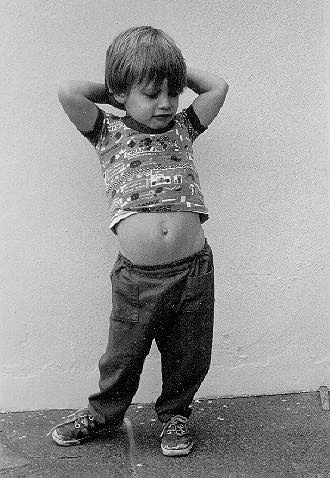
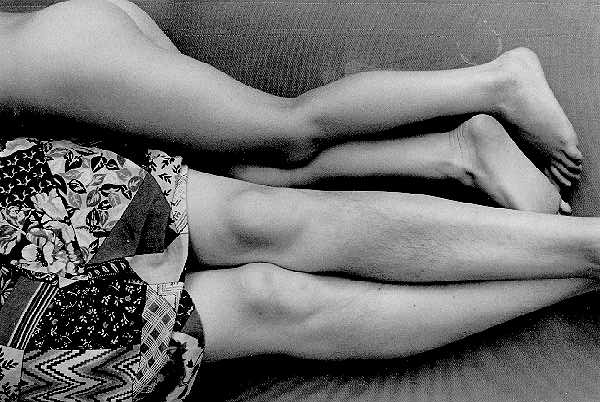
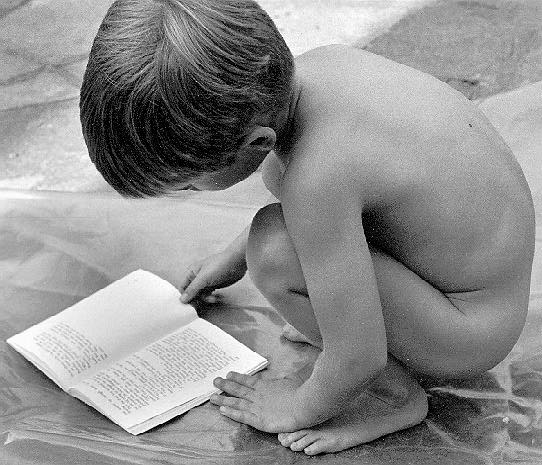
Firstly I was reminded that the first web site that used my own pictures was a small site with the title ‘Family Pictures‘, with images of my own two boys and some of their friends. I chose the images carefully as those which I felt would have an appeal outside my own family.  I was also careful to remove a few more revealing images of the children playing with friends in paddling pools and elsewhere on hot summer days that cause amusement in family circles but might have transgressed the ISP’s guidance on nudity.

By the time when these black and white images went live on the web in 1995, those two boys were in their late teens, and they helped me hand code the html for a rather basic web site and upload it to an ISP that was offering small amounts of free web space.

I updated the images a few months later to reduce image size, as some of the originals were around 100Kb and very slow to load on a dial-up connection, and got the whole site showing 16 jpeg images (and thumbnails of them) with 17 pages of html down to under 1Mb.

I transferred it to my own web space a few years later, and made a few changes to the code, removing the pre-loading of images we had thought up, which had appeared to speed up the site when going though the images in order. A full stop on each page of the site was actually the next image in the sequence resized down to a 1 or 2 pixel square. As modems got faster, such tricks became redundant, and just complicated matters. But visually the site is as it was almost 20 years ago – still the same scans, rather poor by modern standards and worsened by jpeg artifacts. You can still see all 16 images online.

Personally I find the pictures taken by photographer Wyatt Neumann during a trip with his 2-year-old daughter a charming record of childhood innocence and the relationship between father and daughter. What I find disturbing is the kind of comments that some have made about them – and also I dislike the way these images are introduced on the Upworthy site, alhtough the video is rather better than you might expect.  You can read the photographer’s own introduction to the work, which he has exhibited and published as I Feel Sorry For Your Children, on his own web site.  Those people who look at this work and see “sexual victimization and violence,” I feel sorry for their children too, and like Neumann would say “I choose life.”

Another photographer whose work has aroused similar controversy is Sally Mann, and in a long article in the New York Times, Sally Mann’s Exposure, she writes in great detail about the problems caused by such controversy, and the actions of some desperately sick people, one in particular that she goes into detail about. I’ve written before about my great admiration for Mann’s work, and a little about the misguided criticism of her for it, but had not realised the full extent of the persecution she and her family have had to suffer. It’s a moving article, and one that only strengthens my regard for her, and for the need to keep up the struggle for freedom of expression and the kind of positive family and societal values that underlie the work of these photographers and others.


Continue reading In the Family Way