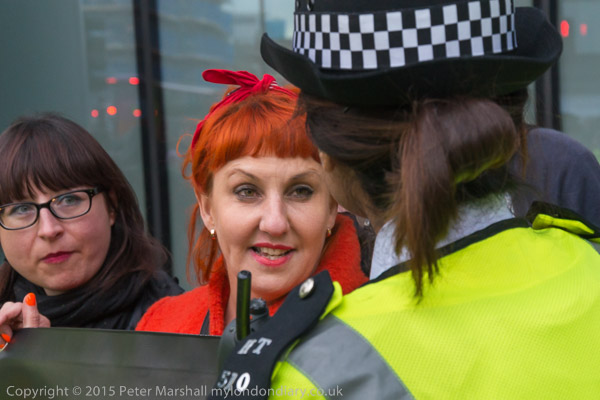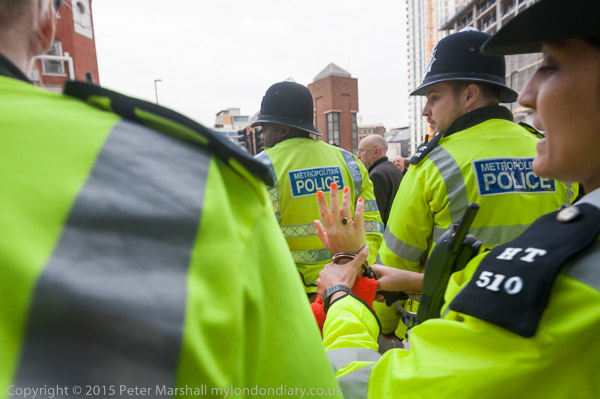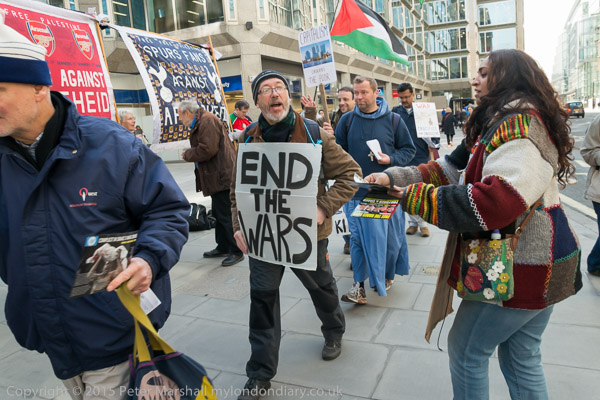
Police and Protest

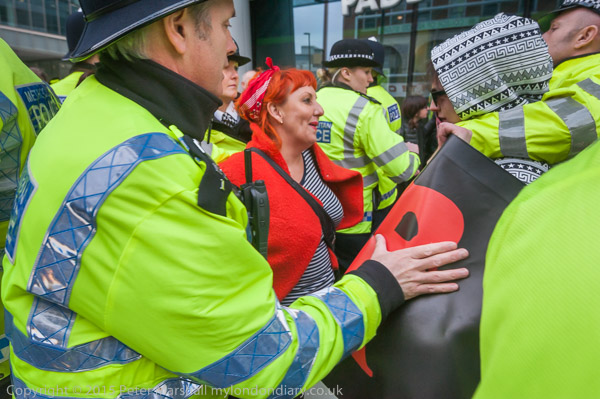
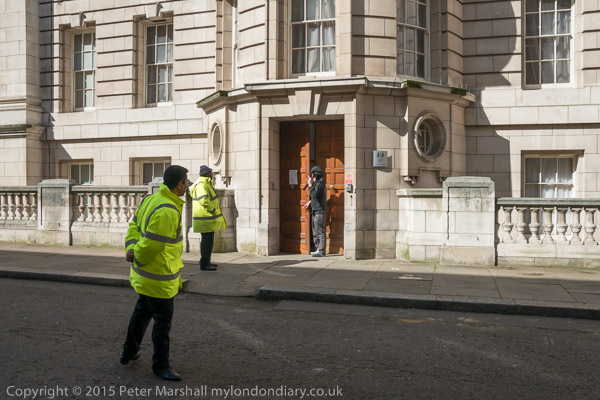
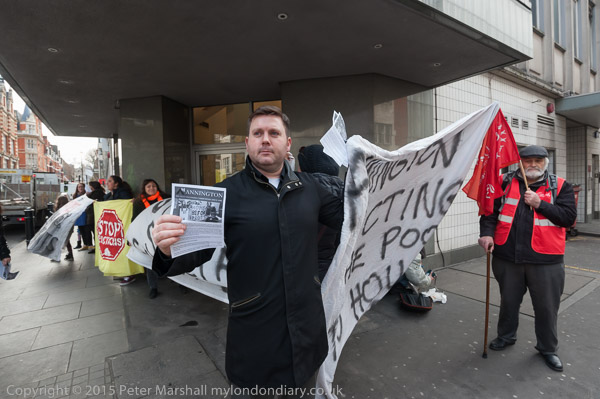
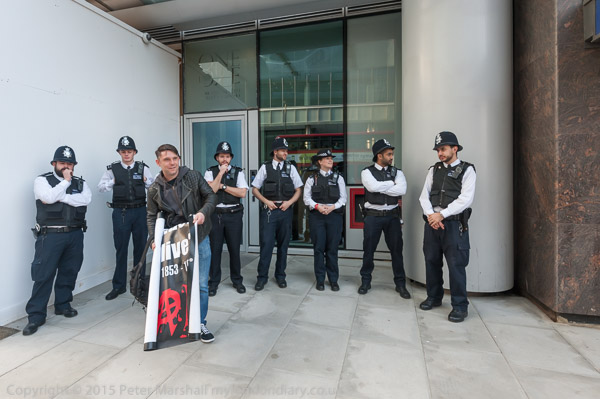
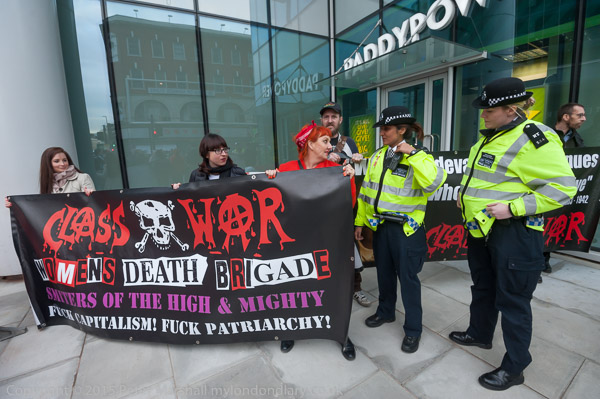
Police seemed almost pleased to see Class War as they turned up for the weekly protest outside the ‘rich door’ of One Commercial St. In general these events are a fairly easy and straightforward part of their job, just standing around in front of a doorway, and the protesters are generally little problem. The door wasn’t in use, and the entrance foyer seemed empty and in darkness; presumably the wealthy residents had been told to leave and enter by another route, perhaps through an interconnecting door with the hotel or another of the businesses with a ground floor entrance on one of the three roads around the block. Not however through the ‘poor door’ in the alley, although they can normally enter or exit through this if they choose. At least one resident uses it when walking her dog!
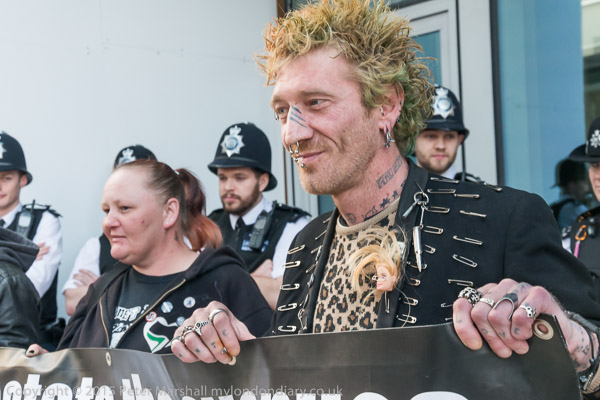
The protesters provide the police with a little entertainment – and sometimes a little fairly gentle ribbing, reminding them they are class traitors, protecting the interests of the ruling class who have, the protesters remind them, been attacking police pay and conditions.
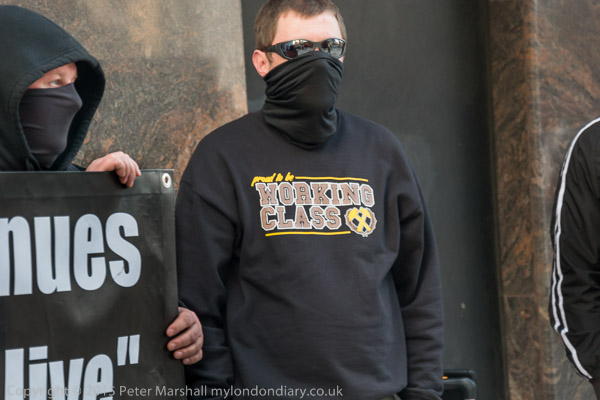
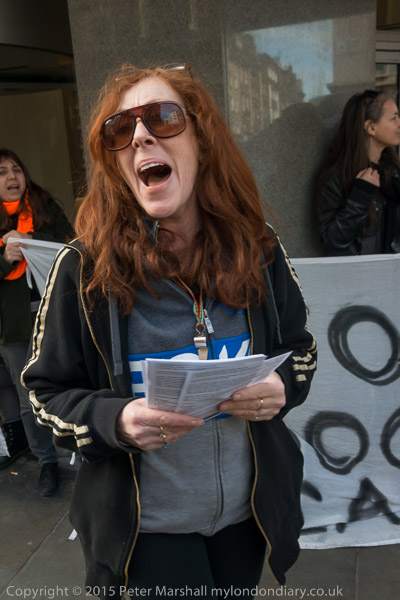
One of the protesters was wearing a sweatshirt with the message ‘proud to be Working Class‘ and the protesters appealed to the police to be proud of their class origins and come and join them in the protest, but it surprised none of us present they did not take up the offer.

The officers were perhaps disappointed when the protest ended early – as one of the organisers pointed out they would get less overtime. But Class War had received a request for support from the two groups, Squatters and Homeless Autonomy and Autonomous Nation of Anarchist Libertarians, occupying some offices in St James’s Square, empty for some years after having been used by the Institute of Directors, who were being illegally harassed by bailiffs, and I was invited to accompany a group of them who were making their way there.

The laws on squatting are quite clear. In non-residential properties trespass is not a criminal offence, and there are proper procedures that property owners should employ to regain their property, including going to court to get a possession order.  Usually these give squatters 24 hours notice to leave, after which staying in the property is a criminal offence, and police can aid bailiffs in a properly managed eviction.

Other laws protect the rights of occupiers of property (whether squatters or not) giving them the right to leave and enter the property. There are also laws against assault, and governing the actions of security guards.

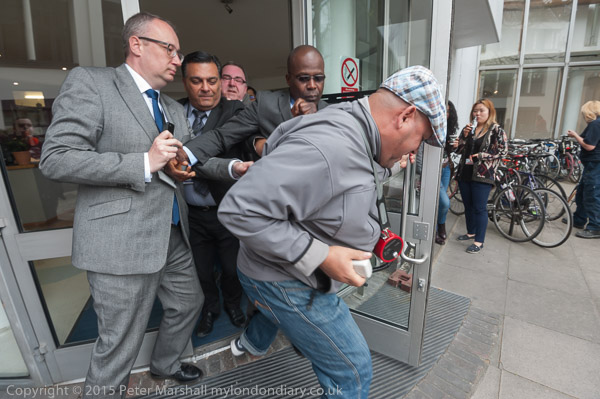
Clearly when we arrived, several of these laws were being broken. People were being prevented from entering the premises by men dressed in black. And by not wearing visibly their SIA licence these security guards were committing a criminal offence under the Private Security Industry Act 2001 which should result in their losing their licence; it’s an offence punishable by up to 6 months in prison – nd/or a fine of up to £5,000. When people attempted to enter, they were also clearly being assaulted by these men.

As in many other cases, the police generally seem to be choosing not to apply the law against these illegal activities by security guards, employed by companies that boast of being able to get around the delays of legal evictions. The same company that these men were working for have also been employed by Southwark Council to work in a similar illegal fashion on the Aylesbury estate.

The police (or their political masters) should not be allowed to chose which laws to enforce and which to ignore in this way. On this particular occasion, Class War were able to help the protesters to persuade the police to act, if only in a fairly desultory fashion. The officer who eventually turned up – I think following a complaint by someone from Class War did listen to the protesters and did make some attempt to sort things out, but was unable to get the security guards to comply with the law. There were no arrests, no people facing prosecution for their illegal actions, but eventually the security firm was persuaded to call off their action after getting a phone call from the police station. They left smiling and returned the following morning to illegally finish the job with the help of police.

When it comes down to it, we do have one law for the rich, which generally overrides the interests of the 99% and the niceties and fair dealing that Parliament has decided in its legislation.

It isn’t always easy to photograph at events like this. There are people who don’t trust the media and their lack of trust is unfortunately often well-deserved, with protesters often being treated very unfairly in print and on screen.  Though it’s normally by editors and journalists who were not at the scene rather than by photographers. But I had been invited by some of those present, and knew a number of the others present, at least slightly, from other protests that I’ve taken pictures of, and had few problems.  The protesters too had the law (if not the police) on their side, and it was others that were breaking it.

I’d set both cameras (Nikon D700 ande 800E) to ISO 3200 on the tube journey, as the light was beginning to fall outside, and when I started taking pictures, I was getting exposures around 1/250 at f8; by the time I left it was down to 1/30 f3.5, and it was getting too low to work sensibly as people were moving. I don’t really have any fast lenses for the Nikons, partly to cut down weight; nothing faster than f2.8, and the only f2.8 lens I had with me was the 16mm fisheye, which I didn’t use. The 16-35mm is an f4 lens and the 18-105mm is f/3.5-5.6, getting rather slow at the longer end. Towards the end of the time I was there I was feeling the lack of something faster. I had some problems with subject movement during the few scuffles too, with shutter speeds of around 1/125 causing some images to be blurred.
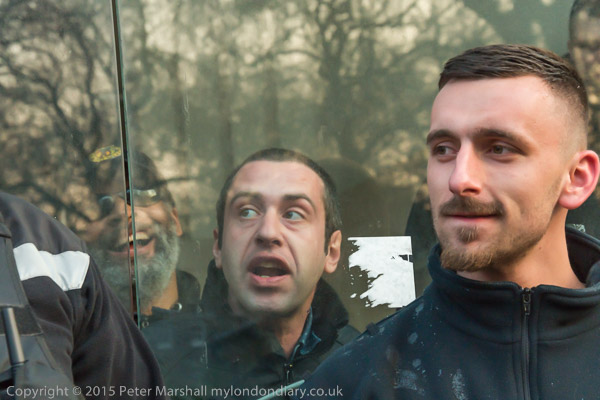
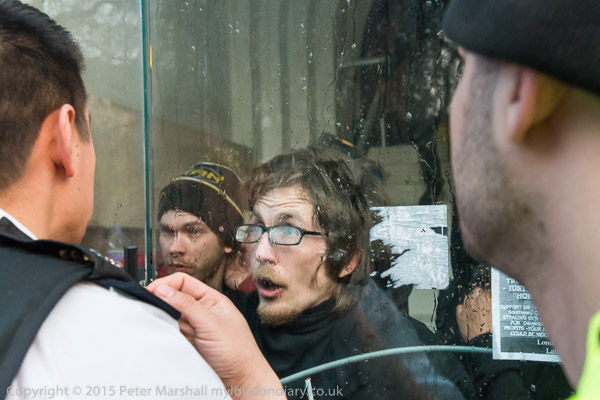
One problem – but also something that made many of the pictures possible, was that the doors which were being blocked were glass. It meant I could see through them, but also that at times reflections in them limited what I could do.
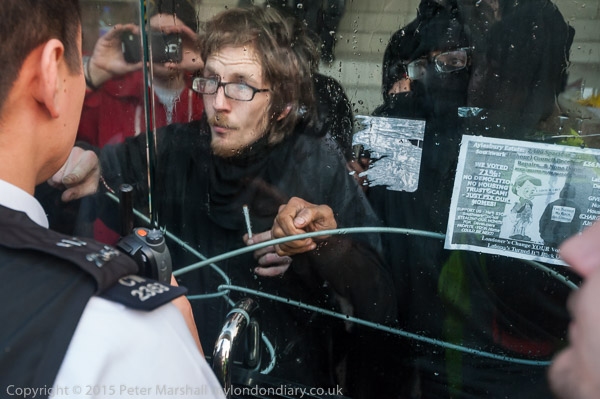
Photographing the people inside them through the glass was possible, but the glass was rather dirty – the building had been out of use for some years – and also got wet in places when some water was thrown from an upper balcony.
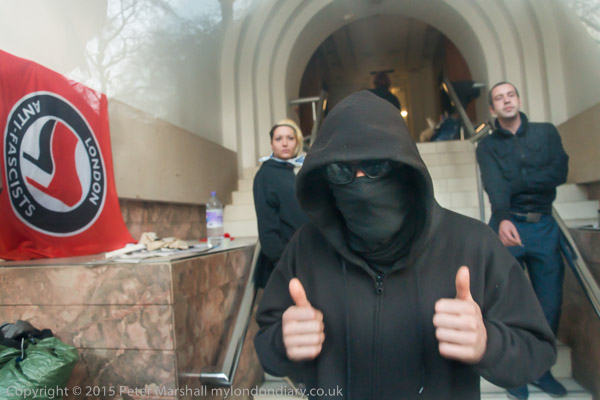
The light fell off very rapidly away from the doors inside the building, but I was able to take a few pictures with the lens held close to the glass to avoid reflections, using a hand to block some of them.

More pictures at Class War keeps up Poor Door protests and Illegal Security blocks St James occupation.
Continue reading Police and Protest
A Political Arrest


D700: 19mm

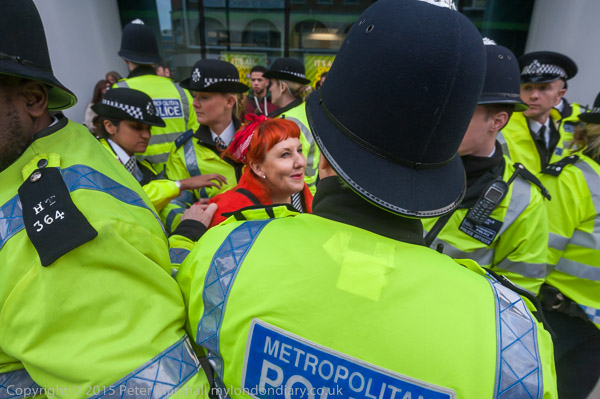
One of the more noticeable aspects of the long series of protests outside One Commercial St have been the various changes in the police response. At a personal level, relations between police and protesters have usually been cordial, with the protesters and police sometimes greeting each other on arrival as old friends. Though good anarchists with a firm belief that the police are an arm of state oppression and often expressing the view summed up in the acronym ACAB, they perhaps see the individual officers as duped members of the working class rather than the real enemies – the rich. “You should be on our side” they often tell the bill.

Class War’s protests are largely theatre, and many of the police at times show considerable evidence of being amused by them, more often obviously trying to suppress this.

But the most obvious aspect of the police response to the protests is inconsistency. I get the feeling that this is a result of political pressure on the police coming both from the complaints of the owners of the building and their influential political friends (the current owner is a Texan property tycoon and friend of Prince Harry), and also, since Class War entered the party political arena by standing candidates for the General Election, from high up the in the government.


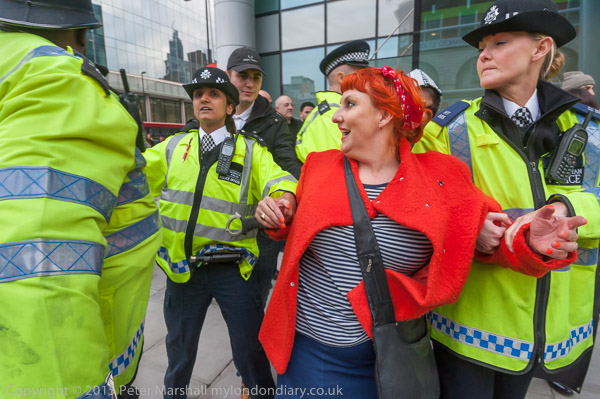
A woman officer approaches Lisa McKenzie and tells her she is being arrested. D700: 16mm

It’s beyond belief that what happened outside One Commercial St on April 2nd was not a result of Lisa McKenzie standing for Class War against controversial government minister Iain Duncan Smith in Chingford.


D800: 93mm eq

The political sensitivity over this was something that led to the ridiculous over-policing of her election launch visit there in March, where a van full of police sat waiting in the station car park half an hour before they arrived and followed their every move around town until they all came out of the pub and took the train out of town. Even a single bobby on a bike would have been something of overkill.

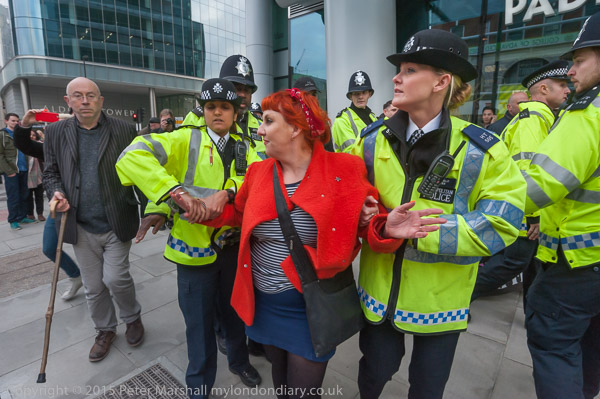
There is no other explanation other than the political for the singling out of McKenzie and her arrest by a large snatch squad that took place towards the end of the protest on April 2nd. Police stated at the time of her arrest that it was for putting stickers on the window of One Commercial St (which they say is ‘criminal damage’) during the protest two weeks earlier.

Police put the handcuffs on Lisa McKenzie and take her away. D700: 20mm

Certainly people did put stickers on the windows at that protest, but Lisa was not among the perhaps five or ten who did so. If she had done, I would have taken a photo showing it, as I too was paying special attention to her because of her Chingford candidacy. No other person was arrested.

They are still charging her with placing stickers, alleging that this caused £50 of criminal damage, but have also added two other charges, of using threatening / abusive words / behaviour or disorderly behaviour and displaying a poster with intent to cause harassment / alarm or distress. The poster in question is an old Class War one, used at many protests and base on an old magazine cover, a graphic showing crosses in an extensive graveyard leading away to the distance, with the text ‘We have found new homes for the rich.’

It may – like most other Class War posters and banners – be thought by many to be in poor taste, but I find it impossible to see it as personally threatening and likely to cause distress. It will be a very sad day for freedom of speech in the UK if any court comes to a different conclusion.


D700: 20mm

Lisa McKenzie has been refused legal aid – something that few people can now get in the UK – and set up an appeal on a crowd-funding site, Lisa Mckenzie’s Campaign: The Right to Protest, to get the money to fight her case. It used – without my permission – the image from the head of this post on it (for once I don’t have any problem with this.) The appeal reached its initial goal within about a day, but more cash is still welcome.


D700: 19mm

Probably the hardest thing about taking the pictures at this and other arrests is keeping calm. I don’t always manage it. There was quite a lot of jostling and quite a few of the images I took were unsharp. Quite a few were obscured by police helmets or protesters.


D700: 22mm

Things also happen fast – from the first picture as police officers approached Lisa to her being thrown into the police van took 83s.

There were other people – including quite a few of the protesters as well as several photographers – also taking pictures of the arrest. The important thing is perhaps to keep thinking and keep anticipating. I was in the right place when they rushed with her towards the police van because I’d stopped taking pictures and moved there before the police did.

All of the images except one were taken with the 16-35mm on the D700. I didn’t really have time to change cameras and didn’t need to, but there are small differences in the zoom focal length, perhaps showing I was thinking about framing. A few of the pictures are cropped slightly, so I didn’t always have time to get it right, but the best are with the full frame.

You can see more of the sequence of 11 covering the arrest in order in Chingford candidate arrested at Poor Doors, along with images from the other 58 minutes of the protest.
Continue reading A Political Arrest

Four More

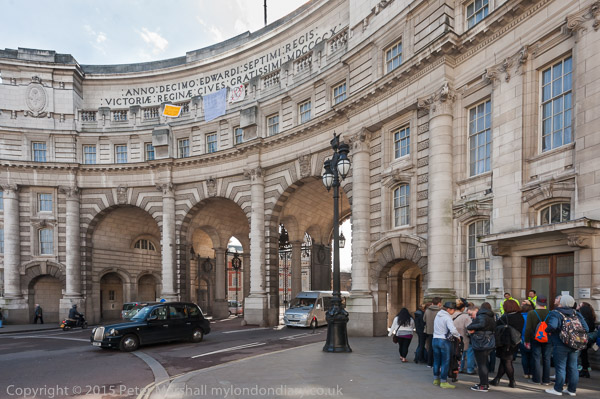
From the protest at Annington Homes at the end of the previous post, I took a bus to Trafalgar Square to follow up an e-mail I’d had from one of a group of protesters who had occupied the Admiralty Arch, an Edwardian building (1912) by one of the leading architects of the day. Sir Aston Webb’s building – a memorial to Queen Victoria which acts as the entrance to the Mall, leading to Buckingham Palace – shows perhaps the best and the worst of that era, a rather ponderous, over-fussy and grandiose Grade 1 listed white elephant.

It’s also something which rather reflects the state of our nation. Built to demonstrate national pride and as a fitting part of headquarters of the largest and most powerful navy and empire the world has ever seen, the address of the First Sea Lord, it was reported in 2012 as having been sold off on a 125 year lease to a Spanish property developer to become a luxury hotel. Although planning approval was obtained in 2013 and completion expected for 2016, work does not yet appear to have been started on the conversion.

I’d been very surprised earlier that morning to get the e-mail telling me that occupiers had entered the building by the roof in the night, and inviting me to go there. I wasn’t sure if I believed it, and wondered what the guy had been smoking, and hadn’t dropped everything to get there fast. In any case, it would have taken me an hour to get there, and other photographers closer to the spot were likely to be there well before me. So I took my time.

The story turned out to be true, with banners on the upper levels of the building clearly visible as I arrived. I walked around the building with another photographer, taking pictures of the rather odd and surely spurious ‘Notice to Vacate‘ posted “On behalf of the Secretary of State for Communities and Local Government” at intervals around the outside of the building, wondering what to do. We met only a couple of other journalists there, who told us that they had photographed people putting out the banners earlier on, but nothing else seemed to be happening, with just a few security guards outside some of the doors.

We stood waiting and wondering what to do next, trying a few phone numbers to contact the occupiers inside without success. Then a door opened, and a man emerged, carrying a large torch, and we went to talk to him. He was rather suspicious of us, didn’t want to be photographed, and appeared to have been drinking, but after a while offered to take us inside to take some pictures. Unfortunately when he turned to do so he found that he had locked himself out!

I was just a little disappointed as I’ve never been inside the building and it might have been interesting to see. But I was also just a little worried that I might have got stuck inside as there were other things I was on my way to starting shortly.

When finally he managed to phone other occupiers and get them to let him back in and they told us we could only enter if we brought them some cigarettes and drink, I decided not to bother. More pictures at Admiralty Arch Occupied by A.N.A.L.

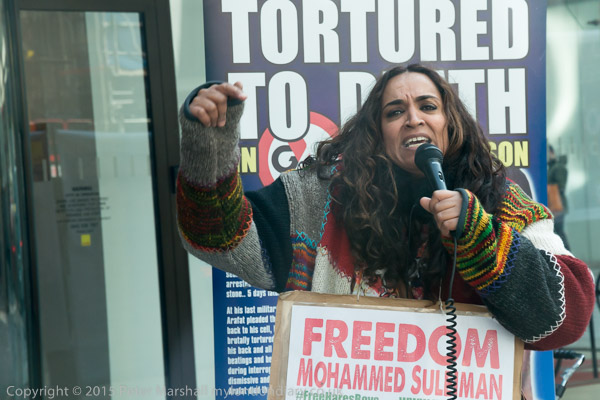
We took a bus to our next location, for Free the Palestinian Children outside the London HQ of G4S, the company that helps run the Israeli prisons in which they are held and tortured, and sometimes sexually abused. This was one in a whole series of regular protests against G4S by the Palestinian Prisoners Campaign, but included a speaker I hadn’t seen at previous events. As well as talking about those people, particularly young children such as the boys from Hares, picked up after a story was made up by an Israeli settler, and still held without charge over a year later, she told how while going to visit Palestinian prisoners she had been forced to remove her clothes and stand naked for inspection in public.

After she had finished speaking, another protest came walking towards us along Victoria St, going through the Palestinian protest. This was a peace protest, a Stations of the Cross Pilgrimage led by London Catholic Workers around locations in London connected with the arms trade. I’d hoped to catch up with this at some point on its route, but instead it had caught up with me, and I went with it to its next two prayer points before returning briefly to the Palestinian protest.

It was only a brief visit because I had another engagement in my diary, due to start in a few minutes a short bus journey away – and the bus stop was next to the protest. When the right bus came along the street I jumped on it, and was taken to Piccadilly Circus, close to the Le Meridien hotel in Piccadilly.

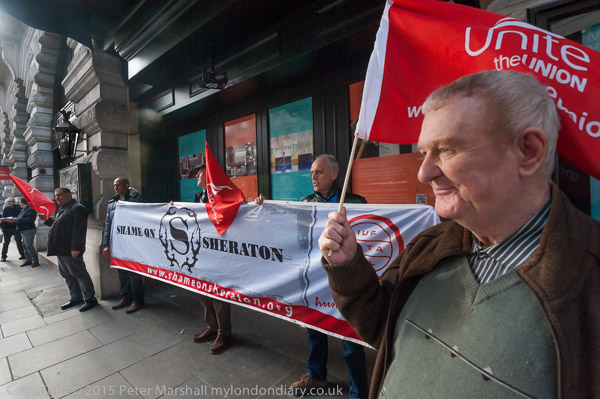
I don’t go much to hotels in Mayfair, and had never noticed this one before, and can’t tell you much about it now, except that it is a part of the Sheraton group, who have luxury hotels around the world. The protest was organised by the Hotel workers branch of Unite the Union. Most of the hotel workers in the UK who do the housekeeping, act as porters and work in the kitchens and restuarants are from overseas, and are one of the most marginalised groups of workers in the UK, and many are exploited because their English is poor or non-existent. They may work in luxury hotels, but often their conditions of work – employed by various outsourced contractors – fail to meet even our basic UK standards. Unite is at last having some success in organising them to stand up for their legal rights, although many can still get sacked for joining the union.

This strike was not however about their own conditions, but in solidarity with workers at Sheraton hotels in in Ethiopia and the Maldives who have been sacked for union organising. Pictures from here and outside another Sheraton hotel in Mayfair are at Shame on Sheraton – Hotel Workers.

My day was still not finished, with one more protest to cover. But that I’ll leave for another post.
Continue reading Four More

Spontaneous Images

I’ve little idea exactly how many protests I’ve photographed about the continuing shame of Guantanamo, and of the incarceration and torture there of innocent prisoners, particularly of London charity worker Shaker Aamer, held there since its early days over 13 years ago. At the moment we are hearing encouraging rumours about his possible release, but there have been hopes before that have come to nothing. Both US and UK security services are thought to be hoping he dies in captivity rather than emerges to give evidence that would severely embarrass them about his own torture and that of others, and he is still being subjected to regular beatings and other mistreatment.

The London Guantanamo campaign have been holding a monthly protest at the US Embassy for over 8 years, and although try to attend any special protests they and other groups arrange, I only cover these regular protests if I’m going to be in the area for other reasons. They are generally rather small events, just a handful of people, with perhaps one or two in orange jumpsuits and black hoods, with a few posters, but mainly that there is little to photograph that I haven’t already done and done again. It’s a very worthy cause, but one that it is hard to make news.

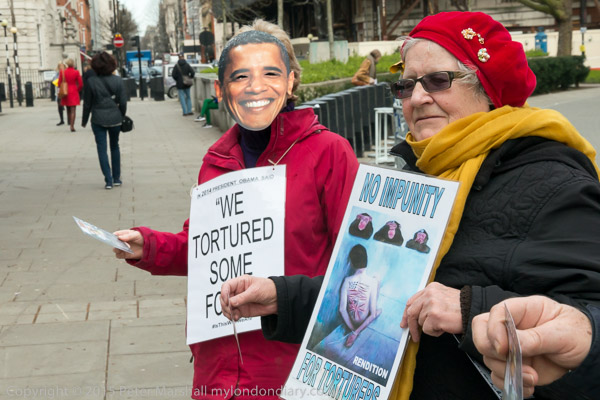
As you can see from the small set of pictures at Shut Guantánamo! I didn’t stay long at the April protest, and didn’t find a great deal to photograph. I do rather like the one at the top of this post, because it presents the major elements that were present – the Obama mask, the Obama quote ‘We tortured some fo..’ (I hope most people will supply the missing ‘lks‘) and another poster about rendition with images and text ‘No Impunity for Torturers‘, and I think it does so in a lively way, with an extra hand at right holding out a card and at first glance Obama almost looking convincing.

Of course it isn’t a great photograph. There are a few things I would like to have been just a little different (including that hand which obscures the ‘lks’). If I’d been directing a scene the second take would probably have had the messages on the cards visible too. But this has a spontaneity that would be lost in posing.

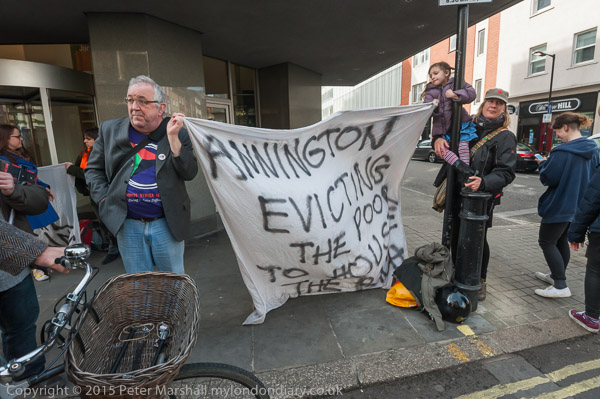
The second protest I was on my way to was a short walk away outside the offices of Annington Homes, the company that is evicting people from Sweets Way in North London. The company hopes to make millions from these ex-military properties it bought on the cheap by knocking them down and redeveloping the site. It’s something that is happening all over London, cheap housing, often social housing being redeveloped into ‘luxury’ flats, usually with little or no regard for the people who live there either from developers or the local councils.

The great shortage of housing in London has led to huge increases in house prices and market rents. We need a huge growth in council housing to house the people we need to keep London running who can no longer afford even the so-called ‘affordable’ rents, but instead what is getting built are expensive properties for the wealthy, including many who will not even live in them, but own them as investments, cashing in on the ever increasing prices.

Again this is a picture I like for its spontaneity. The gestures and expression of the man holding the banner (and of course the child at the other end.) The deliberate cutting off of the cyclist at left. Taken at 16mm I was very close to the bike. You can see at Sweets Way at Annington Homes a few of the series of pictures that led up to this one.

It was a protest I enjoyed photographing, with plenty of movement and different situations, although the street had enough traffic on it to make it difficult to always be at the right place without getting knocked down.

The pavements are fairly narrow, and most pictures that I took required me to be standing in the road. Fortunately in these fairly narrow streets the traffic was normally slow-moving, and I was in little danger.

This was a long and busy day for me, and I’ll perhaps write about some of the rest of it later, after I get back from taking some more pictures.

Continue reading Spontaneous Images

Celebrating Magna Carta

This weekend, everyone in Britain and quite a few others around the world are celebrating Magna Carta. I’m not quite sure why, unless you happen to be a Baron, as it was really only a couple of years later in 1217 with the Charter of the Forest that ordinary people had much to celebrate, and even that applied only for Freemen, not to the serfs from which most of us are descended.

Of course, over the years, some of those rights awarded to the wealthy and powerful have kind of trickled down to the rest of us in countries like the US and the UK, though there is still very much one law for the rich and another for the poor.

One group that wanted to celebrate Magna Carta were the residents of the Runnymede Eco Village, founded three years ago this week when they set up camp on a long-disused area of woodland overlooking the area where Magna Carta was signed.


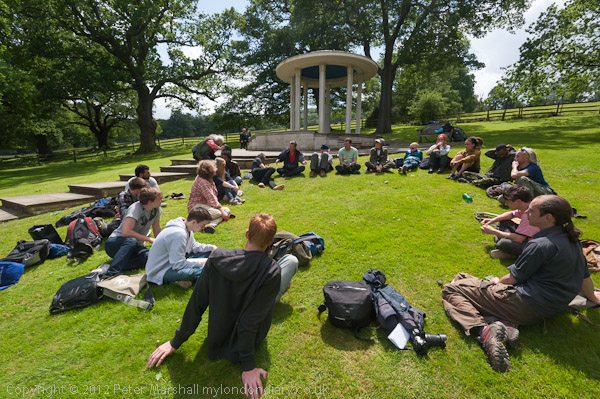
Diggers meet at the Runnymede Memorial and agree to celebrate Magna Carta in 3 years time

I sat with them on 16th June 2012 at the Runnymede Memorial erected by the US Bar Council as they discussed their land occupation and the idea of them hosting a celebration of the 2015 anniversary was put forward and agreed with enthusiasm. That’s my camera bag and coat in the foreground left there as I moved back slightly to frame the circle.


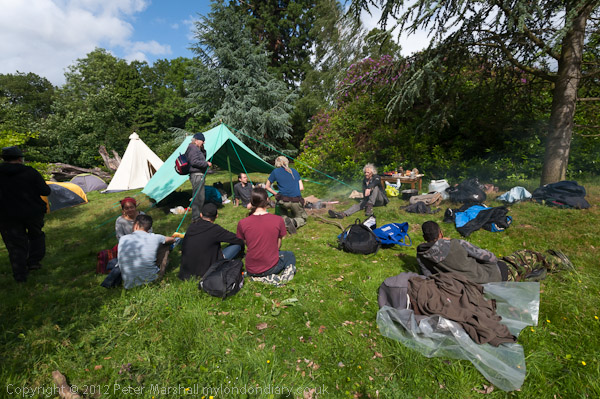
The first camp at Runnymede Eco Village in June 2012

I hadn’t really expected the Runnymede Eco Village still to be there three years later, but it is, and greatly expanded from the few tents that were there then, with many residents having built low impact off-grid homes in a variety of styles from materials mainly recycled from skips and demolition sites. Various court proceedings have meant it having to move a few yards down the hill to a wooded area on the slopes of Cooper’s Hill (incidentally the view from which inspired the first British poem about landscape, by Sir John Denham in 1642.).

The Eco Village has enjoyed good relations with its neighbours with many supporters in the neighbouring ‘village’ of Englefield Green. That one of the first things they did was to clear several skip loads of illegally fly-tipped rubbish from the area got them off to a good start.


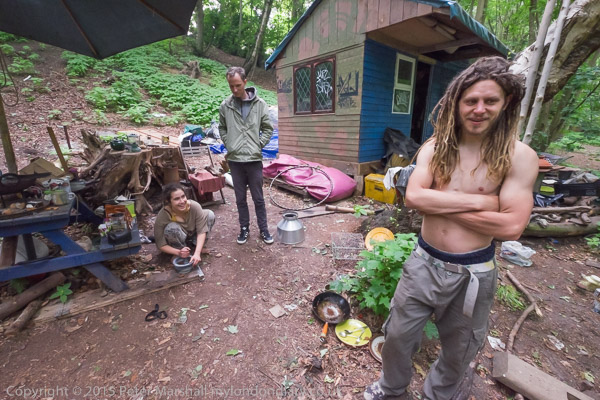
Luke (right) a trained forester, stands in front of the home he built almost entirely from material in skips and demolition sites

Yesterday I arrived at the Runnymede site for the first day of a four day festival celebrating Magna Carta and three years of settlement by the Eco Village, and was warmly welcomed and shown round. As well as various musicians, the festival events included poetry, workshops and a number of distinguished visiting speakers who were to talk and lead discussions.  The Festival For Democracy should have been starting in earnest today, and continuing until Monday.

Unfortunately our authorities seem to have decided to do their worst and not to allow it. They started by pressuring the owners of the site to try and get the occupiers evicted, but an attempt to steamroller this through the courts was blocked by a judge who decided that the occupiers seemed to have some kind of agreement with the owners to occupy the area and adjourned the case to give the Eco Village more time to prepare their case.

It is unlikely to be a co-incidence that a few days ago the date for the court appearance was set as this Monday, 16 June, the last day of their festival and when the official celebrations at Runnymede (two miles away according to the BBC, but for those who can walk rather than drive, around half a mile distant) reach their peak.

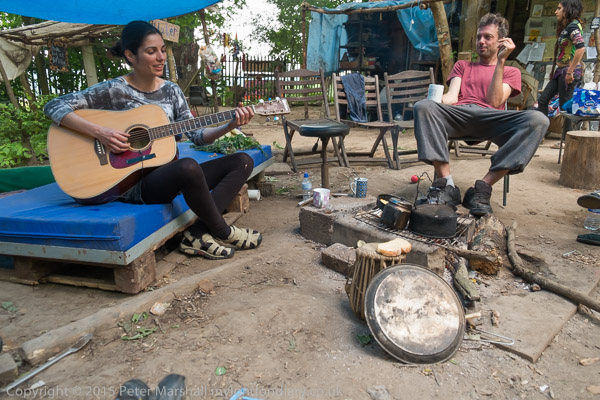
A woman plays guitar for the TV crew to use in their film and others listen around the fire outside the Long House at the Runnymede Eco Village.
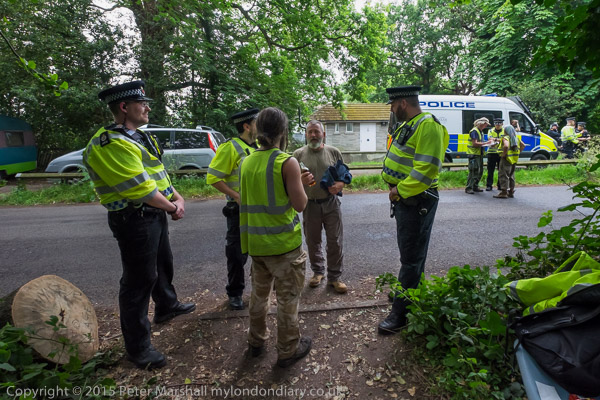
Police and some residents stand at the main entrance, where police are refusing entry to somee. Across the road Phoenix negotiates with police to let the Festival For Democracy – Land, Freedom & Community continue.

But apparently that wasn’t enough for the political taskmasters of the police, and a little after noon small groups of officers appeared around each of the entrances to the site, and began to stop people entering. They claimed to be allowing the site residents to enter and leave freely, but were stopping others. A couple of weeks previously a rumour had been put out that there would be an illegal rave taking place on the rugby field adjoining the Eco Village, and this was being used as a pretext to issue an order under Section 63 of the The Criminal Justice and Public Order Act 1994  which allows police power to restrict access, remove people and issue exclusion orders.

There appears to be no real evidence of any actual attempt to hold a ‘rave’, and the programme for the Eco Village’s festival clearly demonstrates that it would not be in breach of Section 63 (which applies only to ‘amplified music’ played during the night.)  The rumours are suggested by some to have been promoted by the authorities to justify the draconian police action.

As I wrote yesterday:

As I left it was unclear if the free festival, with its long and distinguished line up of speakers, poets, singers and performers will be able to continue and in what form. It would indeed seem a travesty if  at a time when we are celebrating 800 years of freedom under the law against the arbitrary power of the state achieved at Runnymede, the authorities should abuse the law by using those arbitrary powers to prevent a people’s celebration of freedom.

Perhaps rather than celebrating Magna Carta we should all now be out on the streets and demanding a new charter for the freedoms we thought had been won 800 years ago.


More pictures from inside the Runnymede Eco Village in my feature from yesterday on Demotix, Magna Carta celebration at Runnymede threatened by police. And from the initial gathering at the Magna Carta Memorial on My London Diary. That meeting was attended by just one friendly police officer.
Continue reading Celebrating Magna Carta

Abir Abdullah on Nepal

On Shahidul Alams‘s ShahidulNews you can see Resilience and Reasons, with some large colour images made by Abdullah immediately following the Nepal earthquake, along with text by another photographer, Syed Latif Hossain. It’s a rather more positive view of the country and people after the quake than those in the Western press.

The New York Times Lens Blog published an interview with Abdullah about his project ‘Death Traps’, a project on the disastrous fires in Dhaka in 2012, with a slide show of 17 pictures.

Abir Abdullah (b. 1971)was one of the first batch of students at Pathshala, South Asian Media Academy in Dhaka and later a vice principal at the academy. Still based in Bangladesh, he is now a photographer for european pressphoto agency.

You can also see more of his fine work on his own web site.

Capa’s Story

I continue to be amazed at the revelations about the ten or so exposures that Robert Capa made on Omaha Beach on D-Day in the huge series of posts by A D Coleman and various guests on Photocritic International.

The series having disposed more than adequately of the legend about the darkroom mishap and the myth of the missing negatives that never were, the latest two-part contribution by military historian Charles Herrick, a former officer in various roles in the US Army and a military contractor shows convincingly that the caption and almost universally accepted interpretation of a couple of the photographs was incorrect. It’s a conclusion that also must alter our evaluation of the remaining images.

Capa himself must have known what the people he photographed were doing, but sent no information with the film. As Herrick points out, “Captioning the images was therefore left to those who had never witnessed an amphibious assault, much less the Omaha Beach landings.” The caption they wrote was to fit the story they wanted to illustrate and bears little relation to what the image actually shows to the trained eye of Herrick.

Capa had gone back to Normandy immediately after giving his film to a courier and by the time he became aware of the misleading caption, he would also have been aware of the impact the image had made, and a correction would have spoiled his story and blemished LIFE’s reputation. But it would be hard to believe he didn’t discuss it later with his picture editor in the London office along with the rest of the story when next they met.

As Herrick points out, the picture is used on an official US Navy Seals web site with a the correct interpretation. Rather than people struggling to shore in the second wave sheltering behind the obstacles on the beach under heavy fire, Capa photographed a dedicated team of engineers at work rather later in clearing these obstacles. Dangerous work that was made possible by this being “a stretch that was under relatively light fire.

Capa was fortunate to have landed on a part of the beach where the relative lack of opposition had enabled the first waves of the invading forces to make considerable progress – and the engineers were clearing the way for further troops. Working unprotected to remove the obstacles was a hazardous job – of the 175 engineers working on Omaha beach, the Seals web site states  that  31 were killed and 60 wounded, but this section was where the most progress was able to be made.

Herrick’s interpretation makes sense of some things I had been unable to understand about this image – if the soldiers were under heavy fire, why were they not more clearly sheltering in the lee of the obstacle, and what were the ropes that were clearly visible. I’d thought that perhaps they were wires that were in some way a part of the defences, though it was hard to see in that case they had not been cut through.

Herrick concludes:

What a travesty, then, that these very men who made decisive contributions to the success of the campaign, despite every danger and hindrance, should have become poster boys for lack of resolve under fire.

And all as the result of a caption in LIFE magazine that told the wrong story.”

He perhaps should have added “and those who knew the right story – the photographer and presumably his editor – failed to correct it” – and so it became a legend.

My own conclusions are also about the failures of much photographic criticism. As I’ve often found myself having to comment, it really does need to start by looking at the pictures carefully and critically. Whereas all too often it starts from false assumptions and the lazy repetition of what others have said. Most fail to consult what are after all the primary sources.

As this case demonstrates, it often also needs some specialist knowledge of the situation , enabling the recognition of the helmet markings as those of US Navy engineers and of those ropes or wires as Primacord detonation cord.

But in this case, perhaps more than anything else it needs the courage to think out loud the unthinkable, that people and institutions that have been revered for years have been deliberately repeating a lie.   Or in this case, perpetuating lies and a mistaken interpretation.

It isn’t of course unusual for photographs to be deliberately used in a misleading way, though the initial incorrect captioning was almost certainly made in good faith in this case. Regularly pictures published on social media (and often picked up from there in the mass media) alleging to show something are shown to have been taken elsewhere at a different time or place or to have been digitally altered.

M. Scott Brauer wrote an article on his dvaphoto site on 8 June with the lengthy title Bellingcat’s conflict crowdsourcing: analyzing photos and video to learn more about war. Bell¿ngcat is a web site which crowd-sources specialised information of every type from people around the world to provide a detailed analysis that has been able to produce a remarkable level of previously unknown information about some conflict images that those publishing them wished to hide.

Sensibly, Brauer concludes with a warning that you shouldn’t believe everything that you read on the web.

One wrong click and you’re down the conspiracy theory rabbit hole where there’s a political motive behind every photo, all of which are staged.

Articles like that by Herrick and the whole series by Coleman and his other guests are convincing, in part because of the experience and obvious expertise of those concerned, but also because of the careful and precise building of their case and the presentation of evidence for it. Coleman’s work has already been recognised by the 2014 Society of Professional Journalists Sigma Delta Chi (SDX) Award for Research About Journalism and being nominated for two other awards.

Murdoch Moloch

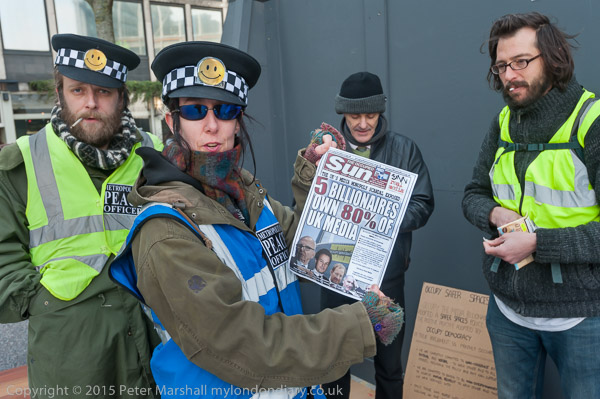
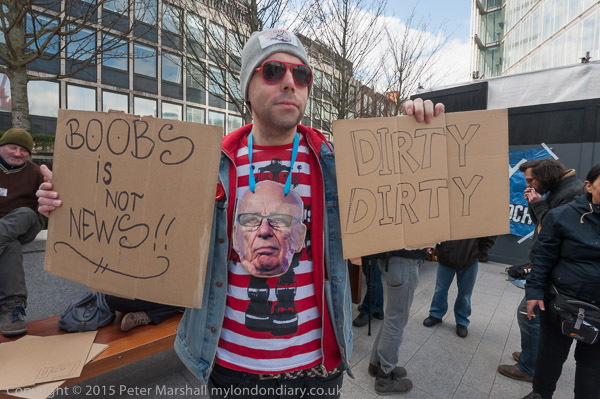
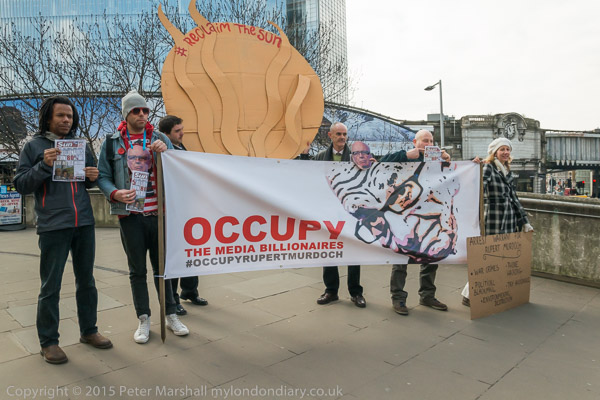
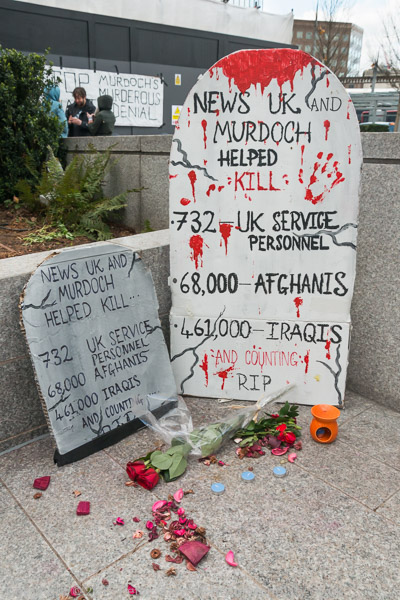
We may not actually be sacrificing children to Rupert Murdoch and the like, but I think there is a good case to be made that we are sacrificing our culture to him and a few others, with “5 billionaires owning 80% of the media” as the protesters at’Occupy Murdoch‘ pointed out.

Of course this is not unique to the UK, although the spectacular increase in inequality we have seen here over the past 35 years  (a particularly steep rise from 1979-1991, with a slower growth until a slight hiccough in 2008 from which it has now recovered) have transformed us into one of the most unequal societies among the wealthier countries.

I grew up in a period where our society was much more equal, and a welfare state provided at least a basic support for those on low incomes or out of work, and government saw its role as supporting the people who needed it rather than penalising them.

It’s The Sun Wot Won It” was the triumphant headline after the 1992 election victory of John Major, having ended a long campaign of putting the boot into Labour with the election day headline “If Kinnock wins today will the last person to leave Britain please turn out the lights.” And equally, at the next election, it was again the Sun who claimed the the role of king-maker for Tony Blair, having managed to turn the Labour party into a vehicle for its own political views.

Of course it wasn’t just The Sun. There was also The Times, The Telegraph, The Daily Express, The Daily Mail… all together setting a cultural and political agenda, increasingly helped by the BBC as well as commercial broadcasters largely owned by the same small group of people as the newspapers.

But while I have a great deal of sympathy and agreement with the case that ‘Occupy Rupert Murdoch’ were making, it wasn’t an easy event to photograph, not least because the the fairly low level of support actually on the ground. Starting a protest at 10.30am on a Monday morning is probably not a good idea to attract large numbers of politically active people, most of whom, contrary to the myths put about by the press, actually have jobs to go to. So while many expressed support, most were unable to be there. Though there was a rather fine main banner with a portrait of Murdoch, and a rather less promising Sun. Along with a very well drawn large cartoon and an impressive four page newspaper, ‘The Occupied Sun’.

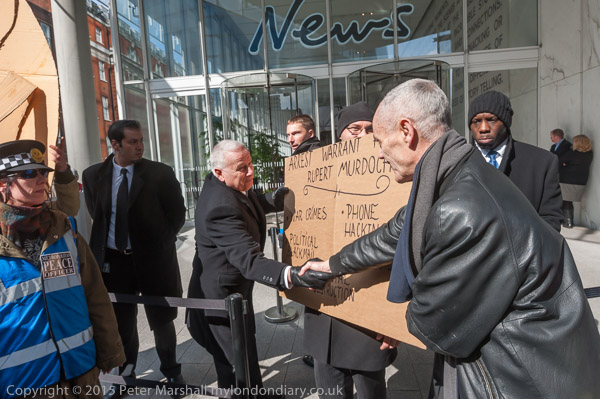
By the time that the marchers set off on the short walk to present the people’s warrant for the arrest of Rupert Murdoch (listing just a few of his areas of offending – war crimes, phone hacking, political blackmail, tax avoidance and environmental destruction) there was a small but respectable group, although the warrant was a little disappointing for photographers, a replacement having to be drawn up on the spot with a whiteboard pen on a large brown sheet of corrugated cardboard as the more carefully prepared version failed to arrive on time due to travel problems. But it was handed over to one of Murdoch’s employees who – perhaps rather sportingly – came out to receive it at a remarkably civilised ceremony, shaking hands with the organiser, environmental campaigner Donnachadh McCarthy, though keeping his gloves on to do so. There was a cold wind.

It was an event where it was difficult to anticipate exactly what would happen, and where there were around as many photographers as protesters. As the group carrying the arrest warrant made their way towards the barrier outside the News International building I left the group of photographers crowding around them and tried to envisage where the handover would take place and chose exactly where to stand to get the picture I wanted. It seemed important to get the ‘News’ sign in the image. As the rest of the press gathered around, I had to move in a little closer to keep them out of the frame, and also zoom in slightly from 16mm to 20mm, but essentially was able to take the image I wanted.

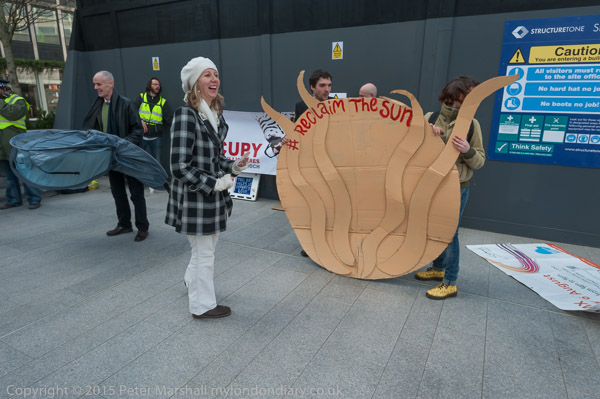
After the delivery of the warrant, the group moved to occupy a part of the plaza in front of News International, though some temporary building works blocked its view of the door. I was rather taken by surprise when Donnachadh picked up a token tent and it sprang out, but caught the moment if not in a very well-composed fashion. I had rather ‘taken my eye off the ball’ photographing and talking with some of the other protesters.

The protest was to last for a whole week, and much of the time when I dropped by there was very little happening, and I didn’t always stop to take pictures. Things got busy every evening, with various events and more people arriving after work but I had other things to do and couldn’t stay, but I promised to come back on Saturday for the mock trial of Murdoch.

More pictures at Arrest Warrant for Rupert Murdoch and Occupy Rupert Murdoch. I’ll perhaps write about the trial later.

Continue reading Murdoch Moloch

April at Last


The arrest of Class War’s candidate for Chingford, Lisa Mckenzie

A little behind the time (as usual) I have at last finished upload my pictures from April 2015 on to My London Dairy.

April may only have 30 days, but it was a long month for me, with 45 stories on My London Diary and getting it all on-line has certainly dragged out. And out. Partly it was extra busy because of the coming election, and also I’m still feeling a sense of despondency over the election result which has made it hard at times to get down to work. Not that I think for a moment life would have been entirely rosy under a Labour majority or minority government, but that it would certainly have been a little more promising.

As we move to celebrating (perhaps incorrectly) the signing of Magna Carta as a milestone if not the foundation of democracy, it’s ironic that we also go into a new government elected on a vote of 37% under what must be the least democratic election system in the free world.

We are fortunate in the UK to live under a relatively benign rule, where – at least within certain limits – protest is allowed, and Magna Carta was certainly important in establishing the basis of the rule of law – at least for barons.


Site stats

In April 2015, this site, http://re-photo.co.uk had 240,151 page views (8000 per day), with the average visitor spending 1.5 minutes on the site and looking at 2.16 pages. Site analysis for My London Diary is harder as its pages can be accessed under several domains, but taking the three I think are most popular it got 133,859 page views (just under 3,900 per day.) My other photography sites, some of which also have work by other photographers got around 110,000 views.

Continue reading April at Last

Another Massive Saving

If your are a Leica addict, I can save you a small fortune by letting you into a secret. I’ve just been reading When Leica announced the M60 By Kristian Dowling on Steve Huff Photo.com, an article spun on his “about an hour with the camera” on loan from one of his friends.

The big difference between the M60 and the M640, apart from the $18,500 price tag (the M240 on which it is based is a mere $6,380) is that it has no LCD on the back. It’s also made with stainless steel outer metal parts, and includes a newly designed stainless steel bodied Summulux-M 35mm f1.4 lens and a special carrying case – they designed it without strap lugs too.

The camera is a curious mixture of the practical, stripped to the basics, and the cosmetic, and as the edition of only 600 (and a few prototypes including the one that Dowling was loaned) and price indicates is clearly meant for collectors rather actual photographers.

The price difference isn’t quite as large as the figures above (based on Leica store Miami prices) would suggest, as the M240 comes without a lens, and a 35mm f1.4 will set you back $4,532 – and I suspect the lens-hood is an expensive extra. The 35mm f1.4 has never been a cheap lens – when I bought mine second-hand back around 1980 it cost the best part of a month’s wages, and the new lens-hood I finally bought last year for it (not a genuine Leica part, as they gave up making the correct fitting many years ago) cost me I think £70.

But even allowing for these, the price differential between the M60 and the M240 seems to work out at around $7,700 – or around £5000. It seems to me a lot to pay for not having a LCD screen on the back of the camera.

As a photographer who seldom looks at the LCD screen when working, I’ve never experienced the insecurity that Dowling claims to have developed, “derived from digital technology, allowing me to view images immediately after pressing the shutter button. This insecurity has led to many missed opportunities, missed moments, and ultimately – missed shots, and this results in a form of failure.”

If anything I suffer from the opposite, kicking myself at times for not having looked, for example when I find I’ve mistakenly left the exposure on manual and taken a whole hour of pictures around 6 stops under (fortunately I was rescued by having used two cameras and one of them was on P.) And there are certain situations – like the blinking problem I wrote about a few days ago – where the LCD review is so useful that I’d find my work suffered without it.

But Dowling is right to suggest that excessive viewing of images – ‘chimping’ – while working is a mistake. It breaks the vital involvement with the subject. But just because you can do it doesn’t mean that you have to and it’s a habit you can learn to avoid. I suppose when I first got a digital camera (a fat cigarette-pack sized Fuji that took not very sharp 2.2Mp images) back in 1999, I did do a lot of looking at them on the screen, but I wasn’t working with that camera, though I did take it out with me as well as the Leica on New Year’s Eve for the year-early Millennium celebrations. When I did buy a digital camera to do serious work with (a Nikon D100 in 2002) I used it more or less the same as the film cameras I was using alongside it. Mostly the first I saw the images on the camera back was when sitting on the train going home. It’s still the same now.


Fuji MX-2700 7.60mm ISO120, 1/30 f3.2 London 31/12/1999

The MX-2700 had a viewfinder, but with many digital cameras the only view is on the camera back. Optical viewfinders and the EVFs that are replacing them in many cameras leave you viewing your subject through the camera – even with a good EVF, like that on the Fuji X-T1 it still gives you the same feeling of connection with the subject. You look through a viewfinder, whereas with cameras without a viewfinder – and phones and tablets – you are always looking at something in your hand. It seems to me a very different experience, and one that – like chimping – breaks the link between you and what you are photographing.

I sometimes think of taking pictures – particularly of events – as like dancing along the street with the subject. If you keep breaking step you lose connection, lose the rhythm, lose concentration, and it will show in your images. So I’m sympathetic to an extent to the idea behind the M60, though I think it unnecessary to physically remove the LCD, and a camera without a LCD should surely cost less rather than more than twice as much.

So the short way to save that $7,700 is simply to stop yourself looking at the camera back. But if you want to ensure that you get that M60 experience (or know you are weak-willed), you can cut a rectangle of black card to the size of the LCD on your camera back, and fix it firmly in place with four strips of black masking tape. The same tape we used to use on Leicas before Leica finally realised that most photographers don’t want shiny cameras (even if this one is stainless.) It will look almost as good as the M60 and will save you enough to buy at least one more lens, even at Leica prices.