Hull Photos: 17/11/17 – 24/11/17

Another digest of daily posts during Hull2017 on Facebook, about the pictures added daily on the intro page at Hull Photos. Comments and corrections to the captions and texts about the pictures are always welcome here or on Facebook.

Hull Photos

17th November

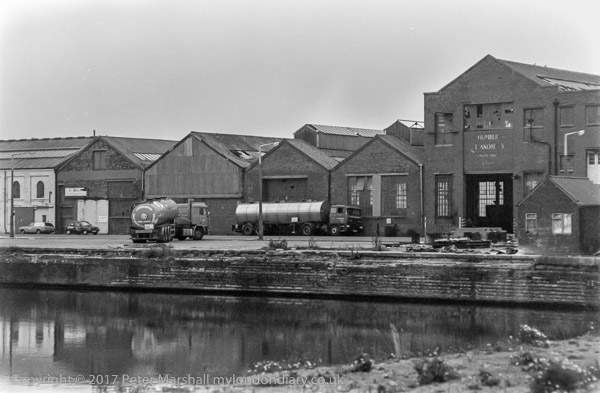
The view towards the east end of the dock with the Lord Line building, distinctive post-war offices for the trawler owners, which are currently being allowed to decay and when I visited in February were left open for vandals.

The Lord Line building deserves listing because of its part in Hull’s heritage and reasonably distinctive architecture, and it was sad it was not included in the 10 new listings announced to celebrate Hull2017 – and it is arguably rather more deserving than some that were included.

The tower of the Grade II listed hydraulic power accumulator stands out from the cluster of buildings at the right, but most of the other buildings have since been demolished, along with those to the left of Lord Line. Harpmyth Limited became Hytec Electrical (Hull) Ltd in 1984 and was wound up in 1992. Its postal address was North East Corner, St Andrews Dock, Hull, HU3 4S.
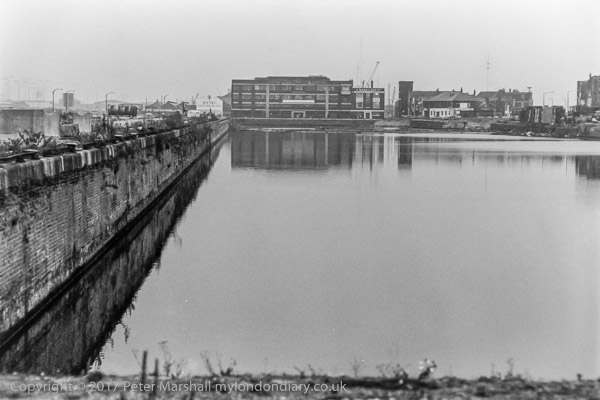

85-10k-24: St Andrew’s Dock & Lord Line building, 1985 – Docks

18th November

Taken from the identical viewpoint as the previous image, these two views were probably intended to be seen as a panoramic image of St Andrew’s Dock. Although the dock had closed ten years earlier there was still considerable business going as as the parked cars and vans indicate. The River Humber is on the far side of these buildings and the fence at right.

Only a single building still stands on the south side of the dock, and I think it is hidden by other buildings in this picture.
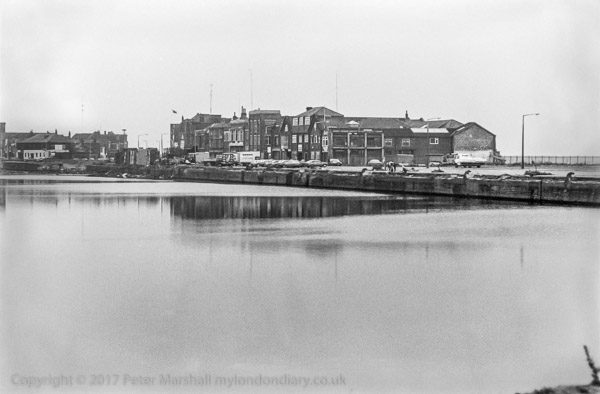

85-10k-25: St Andrew’s Dock, 1985 – Dock

19th November
A third view of St Andrew’s Dock, taken from a similar position at the north-west corner of the dock, but where I stepped back to include some of the rotting north dockside. The extension dock was to the right of this picture, with a channel at the south side leading through to it.

Hull’s ‘Billingsgate’ or Fish Market was formerly on the quayside here, but presumably moved with the trawlers to William Wright/Albert Dock in 1975. A new ‘state of the art’ market, ‘Fishgate’, was opened in 2001, but it sold mainly fish from the Icelandic fleet, and in 2011 they moved their sales to Grimsby.
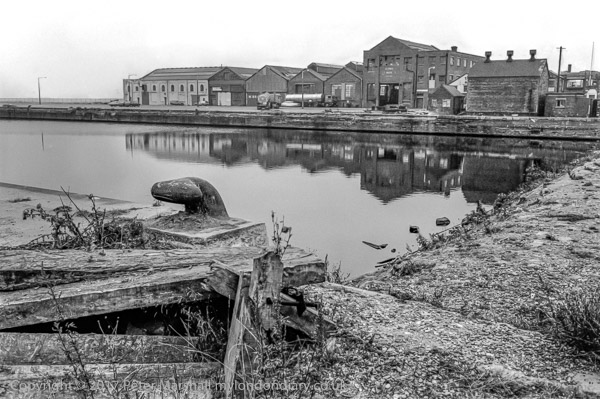

85-10k-26: St Andrew’s Dock, 1985 – Dock

20th November
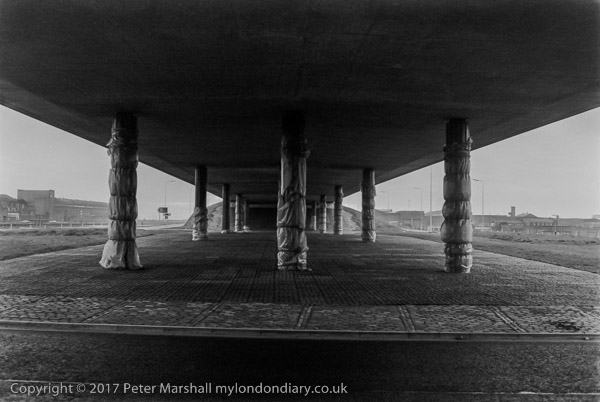
Another view of those curiously wrapped pillars which support the Clive Sullivan Way viaduct over the roundabout. The large striped shed in the background is still there on Brighton St in the Brighton St Industrial Estate, though there are now other buildings in front of it, and is or was part of the Birds Eye factory with the Norbert Dentressangle logo on it.


85-10k-55: Under Clive Sullivan Way, St Andrews Dock roundabout, 1985 – Docks

21st November

This rather distinctive industrial building was built in 1898 as Hull’s main tram depot when the city got permission for an electric tram system. It seems to have been built as a church to industry. After the trams stopped it was used by buses and then as a store by KHCT, known locally as the Ball Bearing or ‘Bolly’ Shed. Although still in good exterior condition when I photographed it, it later became derelict and a playground fro local kids and was eventually demolished and the whole area is now Asda.

In the background at left is a long factory building which again seems to have disappeared.
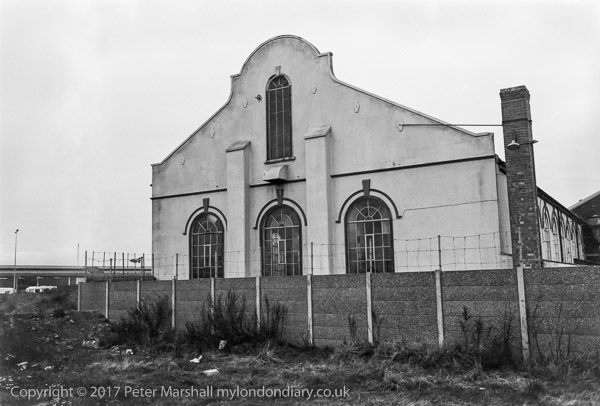

85-10k-62: Former City of Hull Tramways depot, Liverpool St, 1985 – Hessle Rd

22nd November

Hull corporation got permission from Parliament to construct and operated an electric tram system in 1896, and the first rail was ceremonially laid in June 1898. Siemens supplied the electrical equipment and the system used an unusual centre groove rail from Belgium. The Liverpool St depot in the pictures was built in 1898 as the main depot and workshop, and a number of the trams were built their until 1925. The first trams ran along Hessle Rd on July 5th, 1989 and they were replaced by trolleybuses between 1936 and 1945 and the building became a bus depot.

Over the years the name changed from City of Hull Tramways to Corporation Tramways in in 1919, then in 1931 to Hull Corporation Transport. In 1945, after the trams were replaced by buses it became Kingston upon Hull Corporation Transport, and finally in 1975 Kingston upon Hull City Transport or KHCT. The lack of any signage on this and the previous image suggests it might have been no longer in use when I took the photograph.
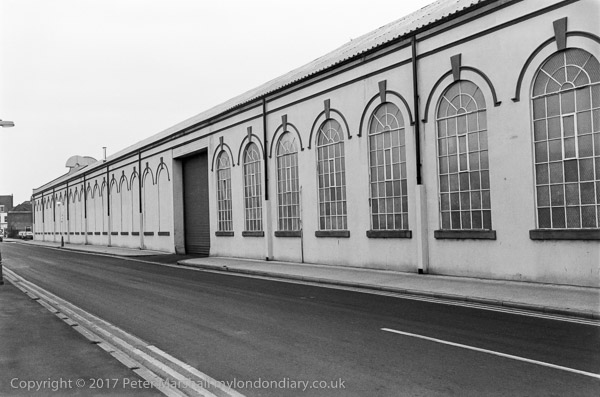

85-10k-63: Former City of Hull Tramways depot, Liverpool St, 1985 – Hessle Rd

23rd November

At the left is the newly built Clive Sullivan Way, named after his death in 1985, but built as the South Docks Road, and the road leading down to the roundabout at the end of Brighton St. These sidings used to lead to the docks but were retained when the area was redeveloped.

I think the large factory building just to the right of centre is still there on the Brighton St Industrial estate, but there are many more recent buildings around. Just one rail line remains and all the track on the right side has gone.
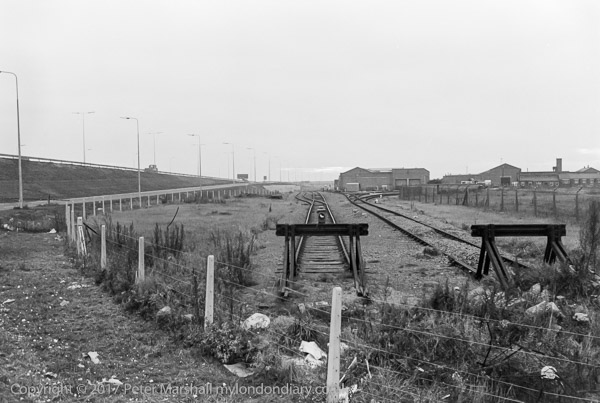

85-10k-65: Railway Sidings, near Brighton St, 1985 – Hessle Rd

24th November

Tower St is on the East side of the River Hull and now runs to The Deep, and the boats and buildings in this picture are all gone, except for the Tidal Barrier at top right of the image.

Hull is mainly built on land that was reclaimed from salt marsh, and around 90% of the city is below high tide level. The city is under threat from flooding both by the tide from the Humber and water from the River Hull and the water draining from its extensive catchment area. Various civil engineering works since medieval times have been carried out both to stop this flooding and drain the land for agricultural use, with lengthy drains discharging into the River Hull and the Humber, and banks built up along the river.

The tidal barrier, built in 1980, is lowered when exceptionally high tides are expected (though everyone in Hull believes that the first time after it was completed it was needed those responsible forgot to do so.) But at least since then it has protected the city, though it was a close thing in 2013, and some parts of the dockside flood walls were overtopped, and have now had a couple of feet added to them.

But Hull is still vulnerable to flooding from exceptional rainfall in the hinterland, and in 2007 8,600 homes and 13,000 businesses were flooded.
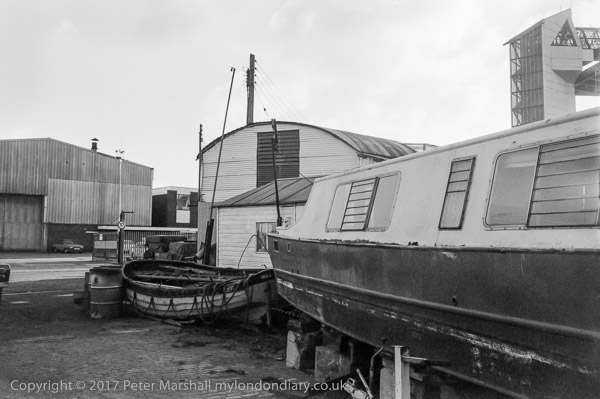

85-10l-12: Boats in yard and Tidal Barrier, Tower St, 1985 – River Hull


You can see the new pictures added each day at Hull Photos, and I post them with the short comments above on Facebook.
Comments and corrections to captions are welcome here or on Facebook.
Continue reading Hull Photos: 17/11/17 – 24/11/17
Grenfell

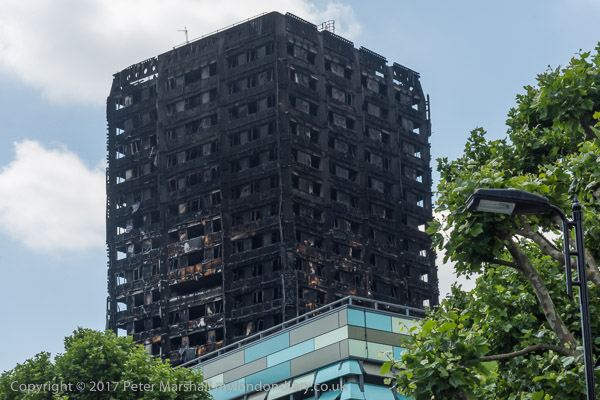
June 14th is now an important date in British history. The day of the great fire. On a smaller scale that the Great Fire of London, though killing perhaps a dozen times as many people. And a public spectacle that shocked us all with an immediacy that the earlier event lacked, shown live on TV. Though the TV pictures showed nothing of the true horror of people being burnt alive inside their homes.

Several of my friends had connections with Grenfell Tower. It was where one had lived for several years when he first came to London, and I think one of my Facebook Friends – who I didn’t know personally – was a resident and a victim.

When I woke to the news at 7 am I thought briefly about whether I should go there. It was obviously a huge news story, but it would be a couple of hours before I could be there, and I was sure there would be many others covering it. And it isn’t the kind of news I feel particularly well equipped to cover, either in terms of lenses or personality and I don’t have the kind of direct links for getting the story out that you need for a major incident. The kind of story of it I would be interested in too would require a long-term commitment, making contacts, getting to know people in the community and going day after day, and I wasn’t ready to give that. I thought that going there I would just be in the way, and stayed home.

Some of my photographer friends were there even while I was still in bed, woken by calls to cover the event or ealy risers who switched on the radio, heard the news, picked up their cameras and jumped on their bikes. Had I been younger and closer I might have done the same. Others I know rushed there as volunteers to see what they could do to help, and some remained going there day after day – and I followed their reports on Facebook.

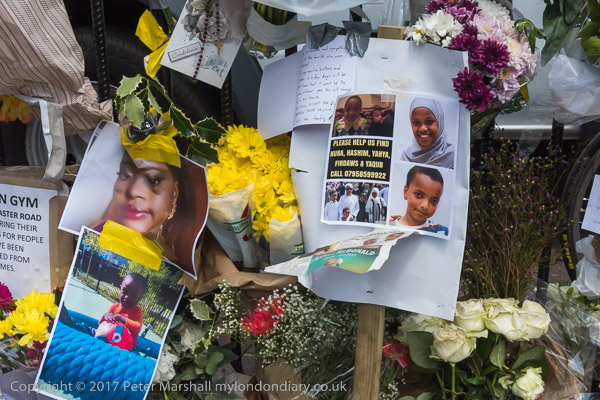
It was three days after the event that I first walked close enough to see the blackened tower, going to pay my respects at the shrine outside Notting Hill Methodist. The media were still there behind the police tape sealing off a large area around but I didn’t really feel one of them, I was there as a human being, not a journalist, though I did take a few pictures and sent some to my agency who I knew wanted them.

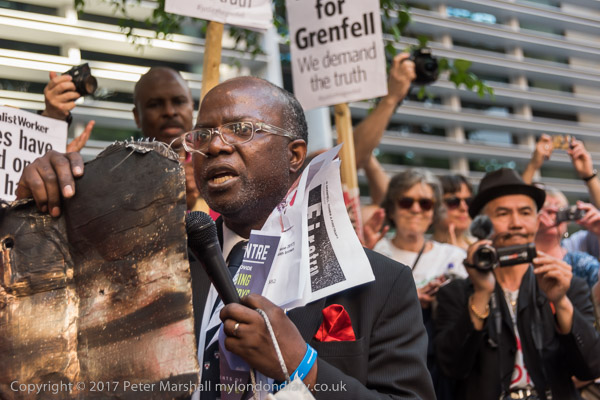
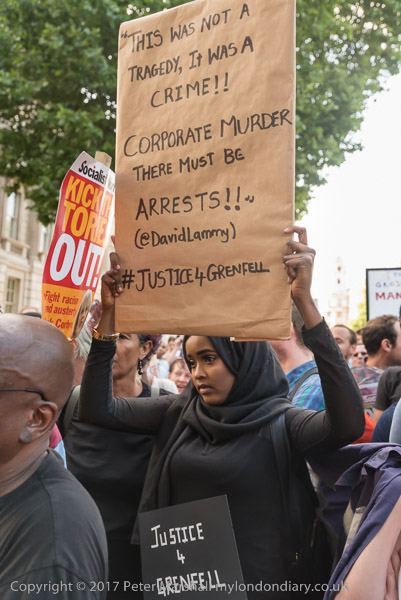
The evening before my visit I’d photographed a protest about Grenfell, beginning at the Home Office, after which most of those present marched to Downing St. There were speeches from a man who was announced as a local councillor but I think was just a local resident who seemed obviously still in shock, describing how he had seen people buring in their homes and jumping to their death, holding a square of the flammable panels which had spread the flames rapidly up the building (we learnt later it was not intended for use on high buildings and had been installed without the proper fire gaps.)

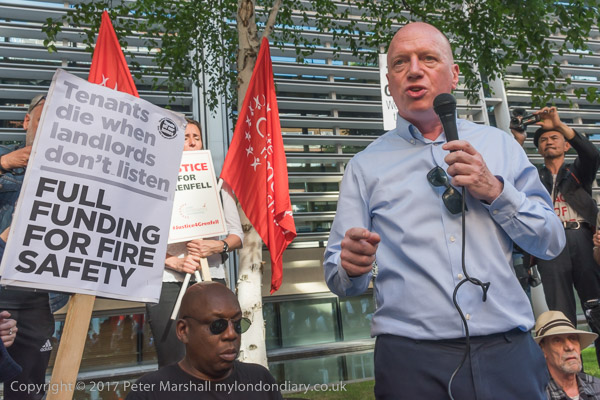
And Matt Wrack, General Secretary of the Fire Brigades Union, spoke about how cuts had inhibited the ability of firefighters to deal with events such as this, and that the system of fire inspection had been deliberately made less rigorous to allow councils such as the Royal Borough of Kensington and Chelsea to save money on making necessary modifications. Again later we heard the TMO they set up to administer their council properties had deliberately employed an inspector who would not insist on proper measures as a way of cutting their costs.

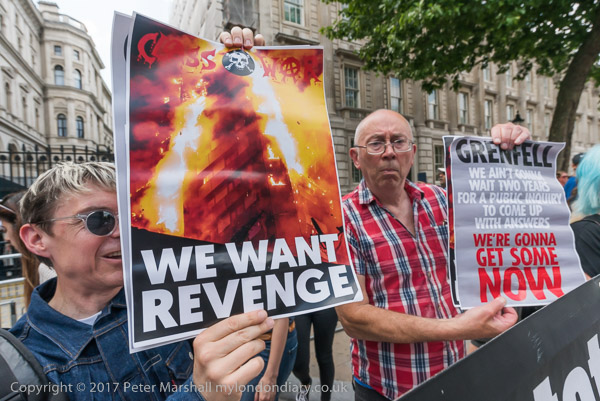
And on the Saturday when I returned from visiting Grenfell, I found Class War holding a brief protest at Downing St.

A day or two ago, an official inquiry – not the Grenfell inquiry – came out with an interim report about fire safety, having taken evidence from over 300 interested people and bodies – and is continuing its work. But many see such official inquiries as a way of putting off action and of sweeping issues under the carpet.

If you want to know the truth about the fire and its causes, read The Truth about Grenfell Tower: A Report by Architects for Social Housing, (PDF available here: The Truth about Grenfell Tower) which was published 5 weeks after the fire (it does start with one small error – the fire began in the early morning of 14th June and so was actually on a Wednesday.)  It is a remarkable report and although not definitive (and there are some pertinent comments at the end by Robert Singer) it does I think make the major issues clear.  And if a small – if expert – group like ASH can produce this in a few weeks, surely we should have a full official report – and proceedings beginning in the courts – over six months after the tragedy.


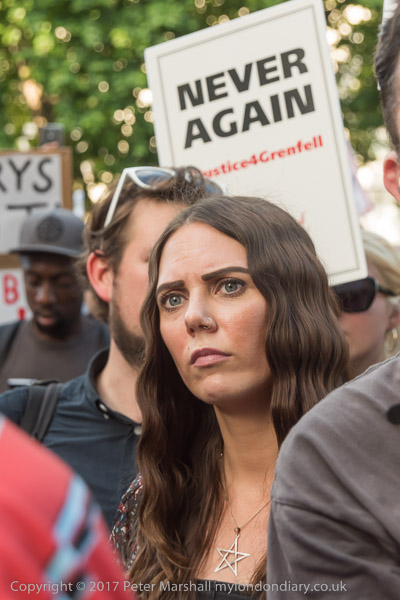
‘Never Again’.

But it will happen again unless we bring back proper fire safety inspections and provide
safe housing for those who live in social housing and if the government continue to make
profit take priority over the safety of people.

Grenfell
Justice for Grenfell Downing St protest
Justice for Grenfell Ministry protest

Continue reading Grenfell

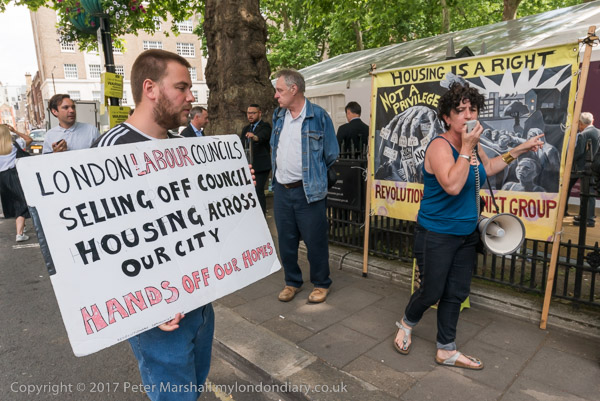
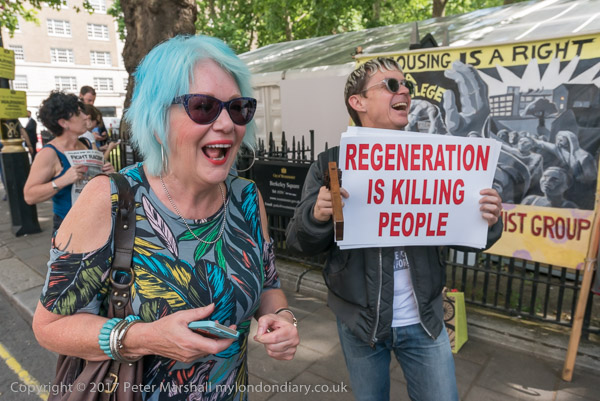
Save Council Housing

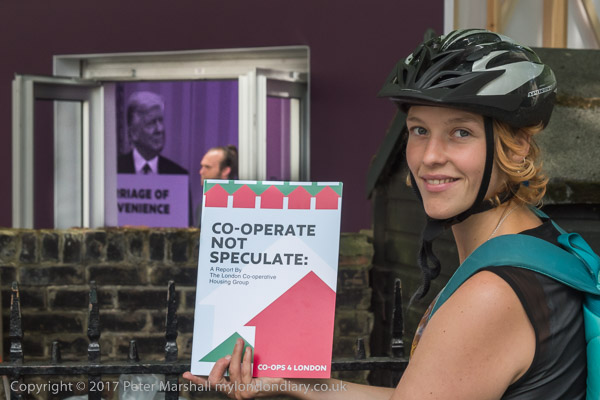
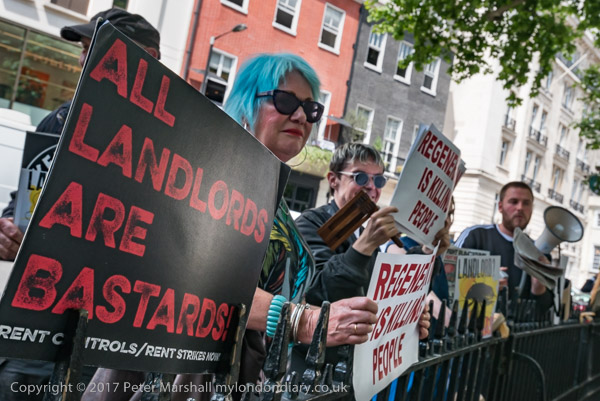
In June I photographed three events connected to the housing crisis in London, and in particular to the loss of social housing as London councils, mainly Labour dominated, rush to realise the asset value of the sites that council estates are built on.

Many London council estates are built in places that have good transport links to the City and West End where some are fortunate to have well-paid jobs and want somewhere convenient to live and can afford to pay the ridiculously high London market rates – well beyond the means of the average worker and of key public sector workers including teachers, social workers, police etc. Many Londoners are forced to live on the outskirts and travel in to work, often with long journey times.

Council housing generally pays for itself with rents half or often considerably less than market rents, providing housing that those on average or lower incomes can afford. But when council estates are demolished, their replacements involve little if any truly low cost housing, and often only a token amount of ‘affordable’ housing, which at up to 80% of market cost is usually well beyond most people. Often existing tenants are made promises of rehousing, but end up paying twice as much rent as before and with a less secure tenancy and usually in a far less convenient area. Those who have bought their properties find the compensation they get is only around half the cost of inferior properties built on the site of their former homes, and are forced to move, often to the edges of London and beyond.

Councils team up with private developers or with housing associations which are now little different to private developers, with the result that huge publically owned estates and properties become privately owned. It’s a bonanza for the shareholders, but a tragedy for the residents, and often fails to deliver for the councils, though a few councillors and council officers seem to end up with lucrative jobs in the private housing sector. Calling it ‘Regeneration’ is a con, though the policy comes from New Labour but its application is part of a long history of corruption in local politics by politicians of all parties.

The first two protests were outside the Berkelely Square London Real Estate Forum, an annual event involving council, architects and developers all after a piece of the lucrative cake from the private development of what is currently public housing, transforming what are now homes for the low paid into homes for the wealthy and investments often kept empty for overseas investors relying on the increase in prices on the London housing market.

Some of the estates that have been demolished or that councils intend to flatten are of genuine architectural merit, and many more are communities that have developed to give a decent life to those who live there and want to remain. Often they have suffered from a lack of maintenance over the years and need some bringing up to current standards for example of insulation, but most older properties were built to higher standards of space and basic construction than currently apply.
The Heygate estate deservedly won an architectural medal and its basic concepts were sound and despite a long attempt by Southwark to demonise it, using it to house problem residents and employing a PR firm to do it down, remained popular with many residents and was developing into a maturity. The council actually gave it away, making a loss on the deal which has converted it into the private Elephant Park. And rather than learning from their mistakes they are currently repeating them on the nearby Aylesbury Estate and others in the pipeline.

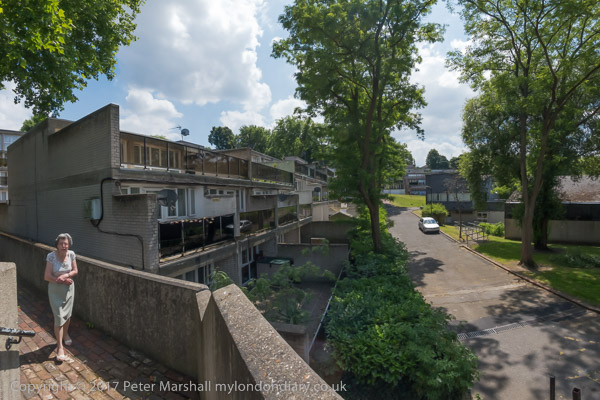
Another fine estate under threat, this time from Lambeth Council, is Central Hill and I was pleased to be able to be there when former Lambeth Council leader Ted Knight came to speak about the vision that led to its building, that nothing was too good for the working class. Now Lambeth want the working class to be forced out of the area. Our current listing process, run by Historic England, has shown itself to be averse to listing large projects of considerable architectural merit such as this, or the Robin Hood estate in Poplar, in favour of quirky oddities with some popular appeal (such as Philip Larkin’s former flat in Hull) which involve little or no financial considerations.

Stop demolishing council estates
London Co-operative Housing Group report
Ted Knight speaks for Central Hill

Continue reading Save Council Housing

May Has to Go…

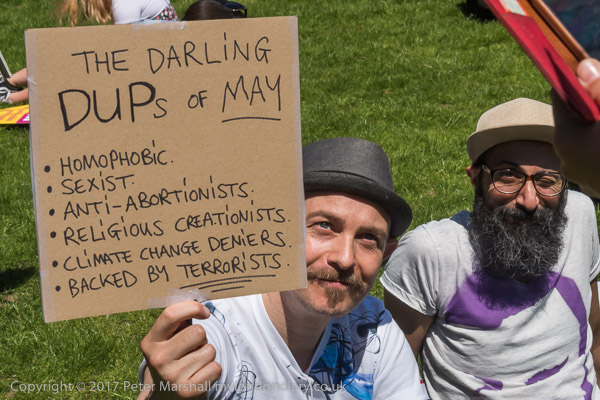
But she didn’t go. Not yet. Despite losing her absolute majority in the General Election, the Tories were still the majority party. None of the other parties was keen to form a coalition to support her, but despite the need for austerity she was able to put together a large enough bribe to gain the support of the DUP, the so-called Democratic Unionist Party, founded and dominated for 37 years by the Rev Ian Paisley. It is a right-wing party, opposed to anything that threatens ‘Protestant’ domination of Ulster or in any way advances the rights of nationalists or human rights generally in Northern Ireland, and according to Wikipedia, it:

“was involved in setting up the paramilitary movements Third Force and Ulster Resistance.

It is right-wing and socially conservative, being anti-abortion and opposing same-sex marriage.”

It’s social policies are dominated by the bigotry of the Free Presbyterian Church of Ulster, another Paisley creation, with just 15,000 members, mainly in Northern Ireland.  Its continuing opposition to social reforms have meant that there is very much a different law applicable in Northern Ireland to that in the rest of the UK, and make it hard for many of us to understand any real object to different laws relating to the movement of goods – as customs boundary at the Irish Sea.


The people have spoken’ – but not quite clearly enough

So far the ‘support agreement’ between the Tories and the DUP has held, though it appears to have needed some further bribery to get the recent agreement with the EU to enable the talks with them to move on to the next stage, and it seems likely that as talks develop further it may be impossible to keep the DUP on side. And since the coalition between the Tories and Lib-Dems from 2010-2015 led to the near demise of the Lib Dems and has made coalition a poisonous concept in UK politics it seems more than likely we will have a further election well before 2022.

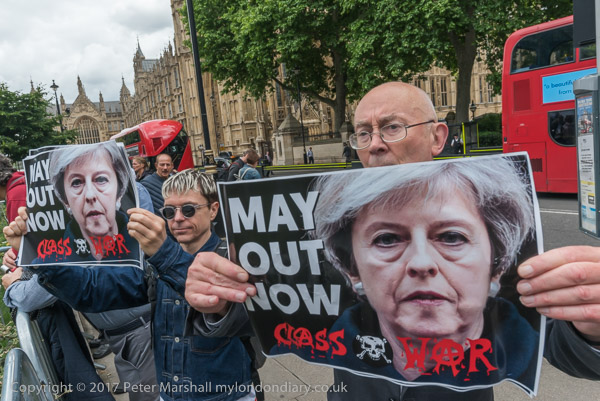
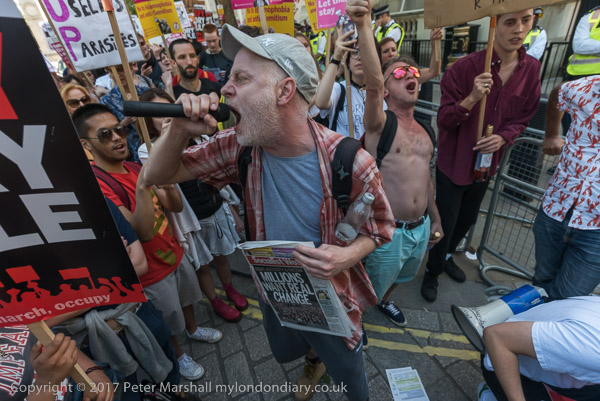
But back in early June, immediately after the election it seemed unlikely that May could hang on, and protesters were out on the streets  with the message ‘May Must Go.’  I went to Downing St on the morning after the results and photographed protesters there and outside the temporary media village on College Green.

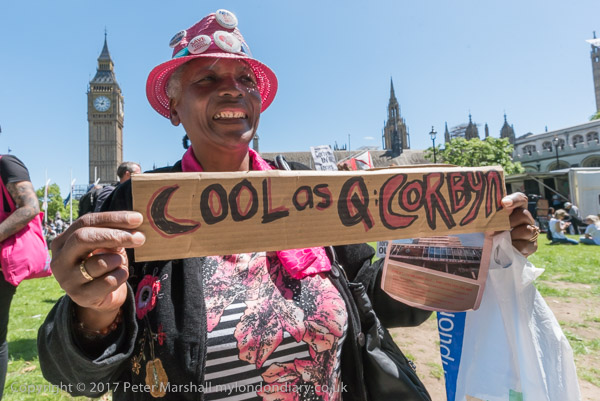
The following day was a Saturday and there was a May Has To Go Party/Protest #notourgovernment in Parliament Square, celebrating Jeremy Corbyn’s performance in bringing Labour close to victory, despite the opposition to him within his own party. The result showed clearly that he was electable even if not this time, destroying the arguments of his right-wing critics, though some continue to mutter and plot.

At the end of the rally, most of those present marched to Downing St and protested there for a while, before marching off. But there was no plan, and nobody knew where to go, and at Trafalgar Square they simply turned around and marched back to Parliament Square where I left them.

Protests follow Hung Parliament Vote
May has to go rally!
May has to go march!

Continue reading May Has to Go…

Hull Photos: 10/11/17 – 16/11/17

Another digest of daily posts during Hull2017 on Facebook, about the pictures added daily on the intro page at Hull Photos. Comments and corrections to the captions and texts about the pictures are always welcome here or on Facebook.

Hull Photos

10th November

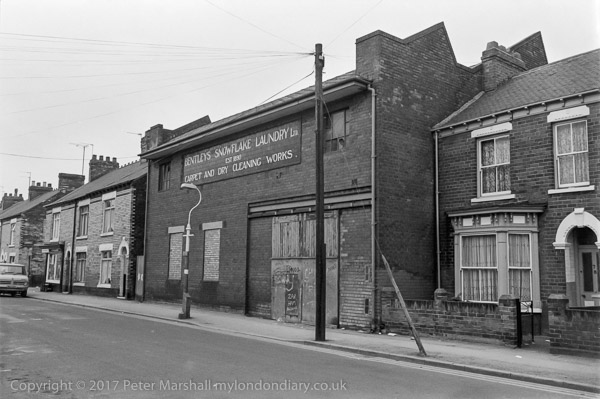
Another view of Bentleys Snowflake Laundry. The house at the right is number 78 and a few doors down from the laundry building is a terrace entry with a small shop on the nearer corner, but I failed to remember or identify the street. The address of Bentley’s laundry business was Plane St, though later it moved to more modern premises in Harrow St. Plane street is still largely intact and the houses in this picture are not the same.

The laundry site was a large one, and thanks to Pauline, Rimmmer, Wendy Woo, Lesley Gowen and others in the ‘Hulll The good old days’ Facebook group I can confirm that this warehouse was at 74-76 Greek St, just around the corner from the main entrance in Plane St. There are now two semis – 4 houses – where the laundry entrance was at 110-116 Plane St, with some behind in Bentley Court which is named after the works.

On Greek St the telephone post in this picture is still there, with a single fairly recent semi-detached house, No 74-6 exactly where the laundry building – evidently a warehouse where wash powder was kept – used to be, though the rest of that side of the street as far as Hawthorne Ave was an empty site when Google Steetview last went down there in 2015.


85-10j-56: Bentleys Snowflake Laundry, Greek St, 1985 – Hessle Rd

11th November

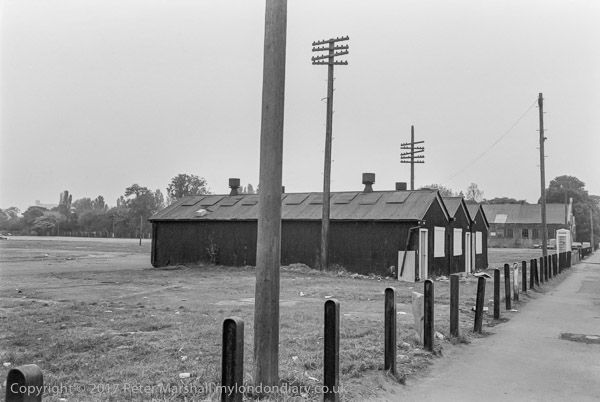
Another view of the sheds on the Hull Fair site in Walton St which were demolished in 2009, though the larger building beyond had gone earlier. The Hull telephone box is still there.


85-10j-62: Hull Fair Site, Walton St, 1985 – Argyle St

12th November

Underneath the Clive Sullivan Way (A63) at the roundabout leading to St Andrews Quay retail development, looking roughly west. There are now trees planted on the roundabout that obscure the view, but I think nothing visible in this picture other than the roads and the supporting columns (now without their plastic wrapping) is still standing.


85-10k-13: Under Clive Sullivan Way, St Andrews Dock roundabout, 1985 – Hessle Rd

13th November

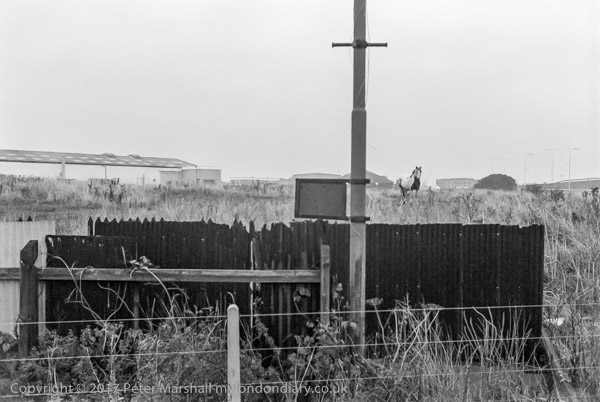
The footpath from the end of Liverpool St led over a footbridge across the railway lines into the dock. . The Lord Line building, long allowed to rot but still there despite attempts to get permission for demolition, opposed by those who see it as representing an important part of Hull’s heritage is in the distance just to the right of the horse.


85-10k-15: Horse in Field, footpath to St Andrew’s Dock, 1985

14th November

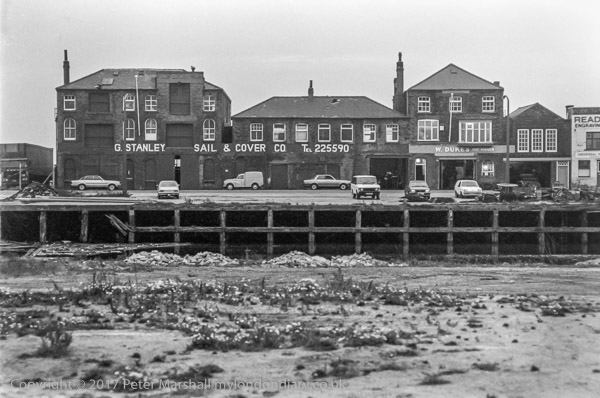
G Stanley – Sail & Cover Co. and W Dukes Ship Riggers. Dukes was only incorporated in 1983, but had traded previously for a few months as Mendanengine Limited.

St Andrew’s Dock, originally planned for the coal trade became Hull’s Fish Dock when it opened in 1883 as the fishing industry was expanding rapidly with the introduction of steam trawlers and the rail network which could rapidly move the fish across the country. The expansion was so great that a dock extension was opened in 1897.

Road transport took over from rail, with the last fish train from Hull running in 1965. Fishing had a boom in the 1970s, and with larger trawlers and deteriorating buildings around the St Andrew’s Dock the fish docks moved to William Wright dock/Albert Dock, only for the industry to disappear with the cod wars. The dock extension was filled in to become a retail area, St Andrew’s Quay. In 1990 Hull Council declared the area around the entrance lock a conservation area but the area is still in limbo. Various schemes have been proposed for the development of the remaining dock area with a marina, an education campus, a heritage museum and more, but the remaining buildings have been allowed or encouraged to become derelict and unless the council takes some radical action are likely to be lost.


85-10k-21: St Andrew’s Dock, 1985 – Docks

15th November

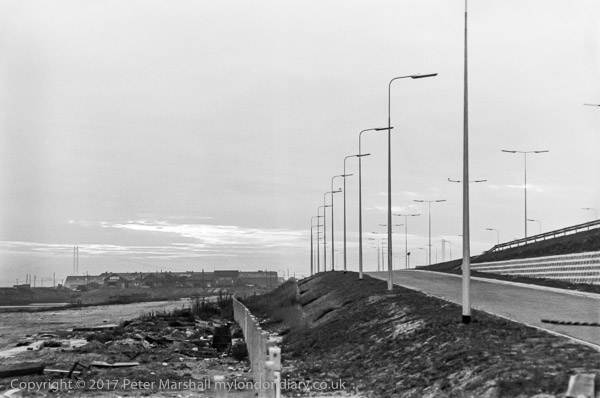
At left is the St Andrew’s Dock Extension; an approach road at right leads up to Clive Sullivan Way. In the background the Humber Bridge stretches across most of the image.

85-10k22: St Andrews Dock Extension, Humber Bridge and Clive Sullivan Way, 1985 – Docks

16th November

The Humber St Andrew’s Engineering Co Ltd was incorporated in 1946 to take over the business of of Humber Shipwright Co. Ltd and the St. Andrews Engineering and Shipwright Co. Ltd. One of Hull’s trawler firms, Hellyer Bros. was the majority shareholder by the 1970s and the company became a a wholly owned subsidiary of their successor B.U.T (British United Trawlers) and closed in 1976.

Hellyer Bros had started in Brixham as Devon Fishing Company Ltd in the nineteenth century and moved up to Hull in the 1850s when large herring stocks were discovered in the North Sea. By the 1960s were the largest trawler company in Hull and probably the UK, with a reputation for being ruthless employers. They became a part of Associated Fisheries Ltd in 1961.


85-10k-23: Humber St Andrew’s Engineering Co Ltd, St Andrew’s Dock, 1985 – Docks


You can see the new pictures added each day until the end of Hull2017 at Hull Photos, and I post them with the short comments above on Facebook.
Comments and corrections to captions are welcome here or on Facebook.
Continue reading Hull Photos: 10/11/17 – 16/11/17
DPAC at Maidenhead

As regular readers will know, I seldom travel outside London simply to photograph events, the main exception recently being a number of visits to Yarl’s Wood for the protests their about immigration detention. But when Disabled People Against Cuts (DPAC) announced they were going to protest at Maidenhead, I added that to my diary.


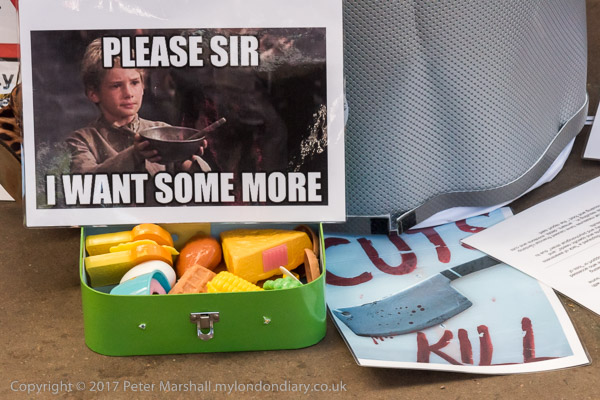
‘Please Sir, I want some more’ and a lunchbox – May was promising to replace free school lunches with a 7p breakfast

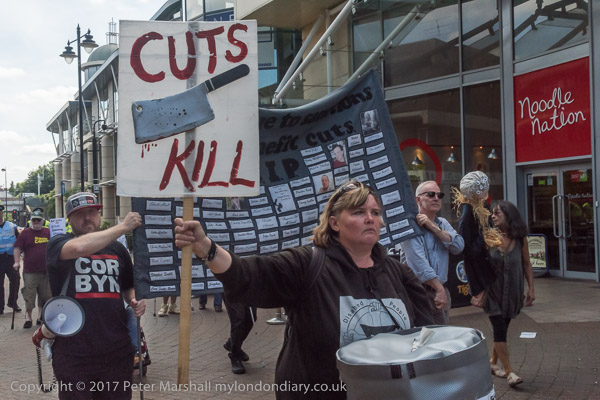
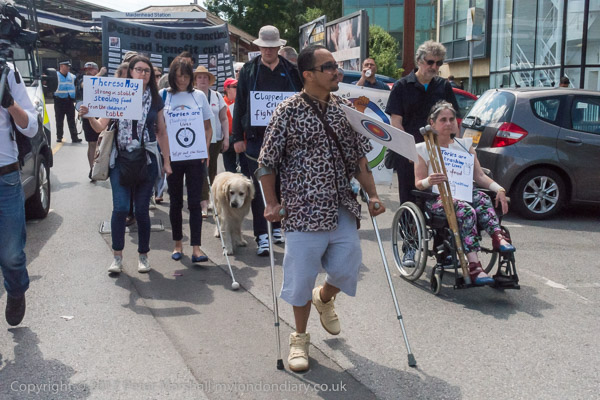
Maidenhead is the constituency of Prime Minister Theresa May, and the General Election she had called was only a few days away. The disabled have suffered most from the Tory cuts since 2010; DPAC say Tory polices are heartless and are starving, isolating and ultimately killing the disabled and that they regard them as unproductive members of society, a sentiment recently stated rather clearly by the Chancellor, Philip Hammond. They also point out that a UN investigation has found the UK guilty of grave and systematic violations of disabled people’s human rights – though of course that verdict was rejected by the Conservative government.

Maidenhead is also not very far from where I live, a part of the true blue London fringe of wealth tax avoidance and complacency (though my particular area is rather more down-market, but electorally swamped by its neighbours.) I could have gone there by bicycle, mostly a pleasant ride of around 13 miles along towpath and various tracks with just a little on main roads, or slightly faster by keeping to the roads, and it was a nice day. But it was rather hot and I was feeling lazy and decided to take the bus – or rather two buses – which was only a little slower.

Buses still exist but are neither frequent nor very liable in these outer areas, and the service to Maidenhead from Windsor was roughly hourly in the main part of the day. And should there be problems I could always return – if rather slowly and expensively by train. By three trains (and a short walk between stations!) Most of those taking part in the protest had a much shorter journey than me with a fast and direct service from London Paddington, and they met up with local protesters to march from the station.

The bus journey to Maidenhead proved a little more difficult that expected, when my bus arrived at a different stop to that shown on-line, I think thanks to a one-way system, and a quick look on my phone showed I needed to be a quarter of a mile away in two minutes. I made it, somewhat out of breath, and the second bus was seven minutes late in arriving. Things came more or less to time on the way home, and the schedule meant I had 19 minutes to make the change – and from the same stop. All would have been fine had I not reached into my pocket for my phone when I arrived home and found it missing – I must have left it on the second bus.

I was able to confirm this, tracking its progress on my computer as it slowly made its way back to the depot at Slough, with nobody answering my calls. But the software enabled me to put a message on to it with my phone number, and I was relieved an hour or so later to get a call from the driver to tell me he had found it and it would be in the depot at Slough where I could collect it the next working day – Monday.

This time I did get on my bike, though it was a rather cooler and windy day with the odd spot of rain in the air, and was pleased to get to Slough rather faster than the bus would have taken me (it does go a rather longer way round) and relieved to get my phone back in one piece.

There were no problems in photographing the protest, though it was rather less lively than some by DPAC, and there were relatively few Maidenhead residents in the pedestrian area outside the shopping centre where the police suggested was the best place to protest (and I think they were probably right.) After the protest they marched back to the station where they had met, and a couple of photographers who had travelled by train from London left. I stayed on because I was sure something would happen.

Most of the police had left too, and the protesters then turned around and as I expected, blocked the road at a busy junction close to the station. The police were soon back and trying to persuade them to leave, with rather less patience than the Met usually show.

Police were a little mystified when one of the protesters identified himself as identified himself as General William Taggart of the NCA and claimed the law gave the military privilege a right to block roads in times of national emergencies such as these, but they shortly decided to argue with DPAC’s Paula Peters instead, threatening her with arrest unless she got off the road. Slowly the protesters moved off the road having blocked it for around 15 minutes, and the last were just leaving as I walked away to try to find the bus stop for my bus that was due shortly. Fortunately it was a few minutes late as the stop was not quite where Google marked it and not in the street it was named after.

Theresa May of course won comfortably in her constituency, though her share of the vote was down very slightly at 64.8%; the Labour vote was up 7.5% but still under 20% and even the Lib Dems gained slightly to get 11.2%. The remaining ten candidates shared a little over 4%.

DPAC Trash The Tories in Maidenhead
Continue reading DPAC at Maidenhead

LSE Cleaners struggle and win

June 2017 began for me with three protests related to the campaign by cleaners at the LSE. At the start of the month I wrote:
After 8 months of their campaign for equality the LSE have only offered derisory concessions and are refusing to recognise the UVW and and hold sensible talks with them, or to reinstate a sacked worker.

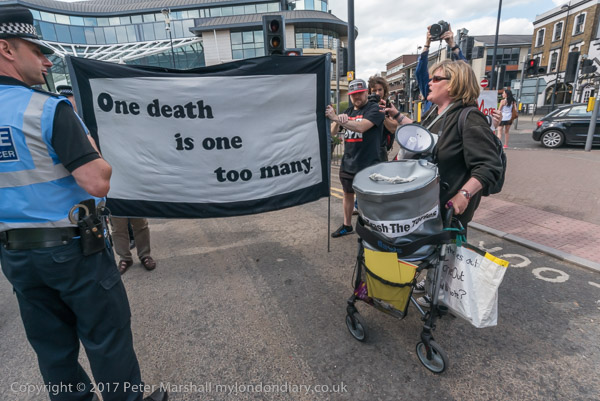
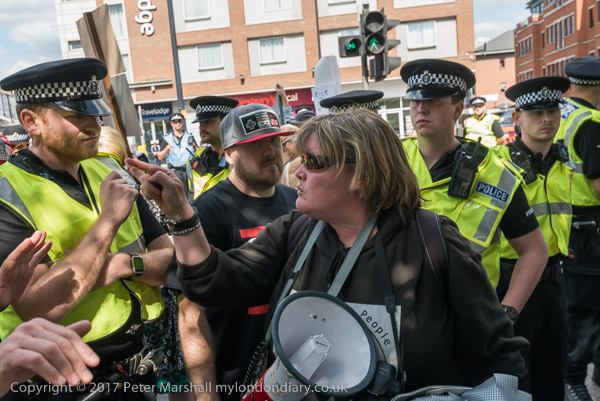
and I went to the LSE to photograph the sixth and seventh days they were on strike.  On both days the cleaners had been there since early in the morning, forming a picket line to lobby workers coming to work to try and persuade them to support the strike. There are strict rules limiting the activities of pickets, putting a limit on numbers (I think a maximum of 6) and what they can do, but the union can also hold rallies and protests so long as these are clearly not a part of the picket, and supporters came to these on both days.

This was a campaign I’d been involved with from the start, having been invited to photograph the initial meeting last year when cleaners and students decided to work together, and it had led to some interesting events, but I’d rather hoped – doubtless with the cleaners – that the campaign would have ended rather sooner.  Noonan and the LSE were obviously hoping they would wear the cleaners down, and losing seven days pay is a considerable hardship for people who don’t have enough to live on to start with, though there was a strike fund with donations from other trade union branches and individuals that will probably have alleviated the worst of the hardship.

United Voices of the World is a small grass-roots union, run on a shoestring from members subscriptions and donations from supporters. It’s total annual staff costs for 2016 were under £10,000  and its legal fees slightly greater.  But it has taken on organisations that have budgets in billions and won, and it was great to hear later in the month that they had reached a successful settlement with the LSE and employer Noonan, and it was good to be able to attend and photograph their victory party.

It’s hard to know how much the protests by Life Not Money at the LSE’  contributed to the LSE’s decision to settle the dispute, though they were certainly a noisy embarrassment which added to the pressure to settle.

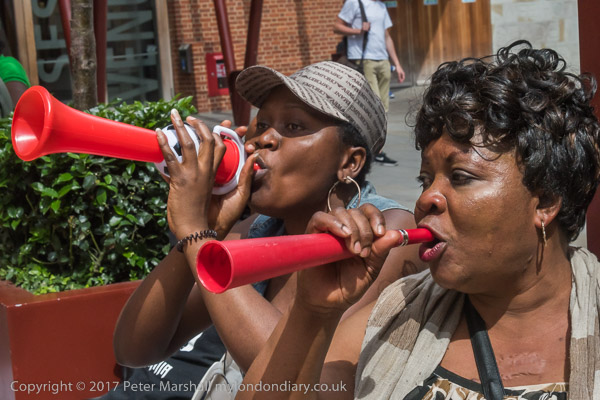
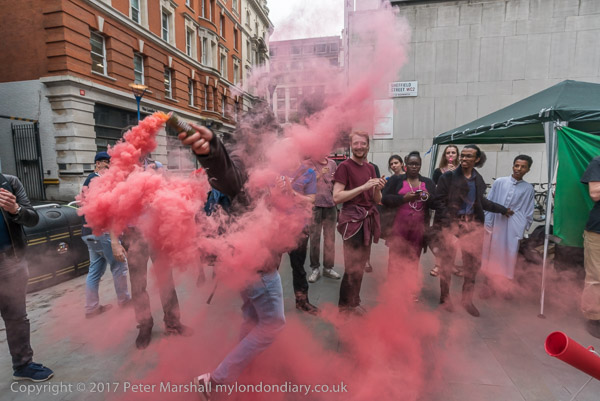
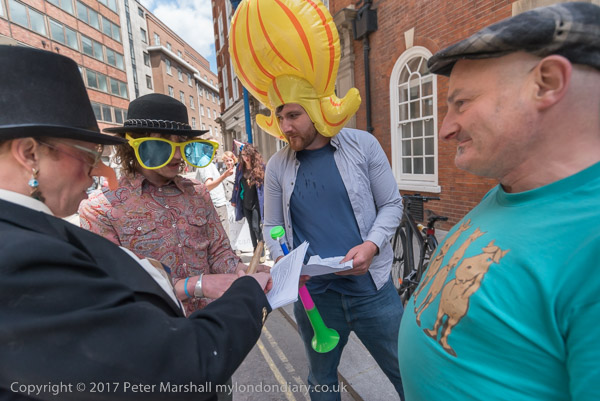
It’s difficult as a photographer to keep photographing a whole series of essentially similar events, and to take pictures which are fresh.  There may be an infinite number of ways to photograph people blowing vuvuzelas and holding posters, but they do tend to look rather similar when it is the same people and often in the same places. I guess it is a challenge, and one I haven’t always been too successful at, though it does help when the people are as interesting as some of the students and cleaners involved in this long-running protest. And there were a few little incidents that kept up my interest at most of the events I photographed.

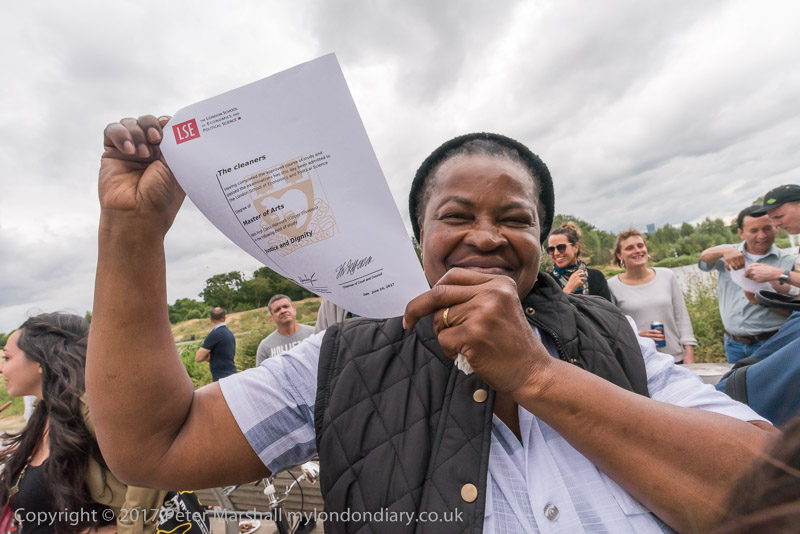
So of course I was delighted to hear that a further protest had been called off because the cleaners demands had been accepted by the LSE and Noonan (although it took a little longer for one outstanding matter, the illegal sacking of a worker to also be settled.) And pleased to be invited and able to attend the victory celebration where the LSE students awarded the cleaners  ‘Masters of Arts’ certificates with First Class Honours in Justice and Dignity.

LSE Cleaners strike for equality
LSE Cleaners strike Day 7
Street Theatre against LSE Inequality
LSE Cleaners Victory Party

Continue reading LSE Cleaners struggle and win

Civil Rights for Photographers too

It’s some while since I last mentioned a post from the New York Times Lens blog, which publishes something of interest most days.

Today’s story, A Look at the Heart-Wrenching Moments From Equal Rights Battles, comes with a slide show of 18 amazing images, many of which have become well-known. One of the most striking of them shows a row of Memphis sanitation workers and supporters walking with posters ‘I AM A MAN’ (and one man without) past a row of the fixed bayonets of the Tennessee National Guard fixed bayonets  in 1968. What upsets me somewhat is that the picture is not attributed.

It isn’t the fault of Lens. I’ve searched the web and not found any better attribution than ‘Unknown photographer’, though I’m sure that there are still people out there who were on Beale St in 1968 and will know who took it. Probably it would be a name none of us have heard of, perhaps an amateur, perhaps a press photographer ‘working for hire’. It might be someone who had good reasons to keep their name out of it.

But generally I think photographs should always be attributed to the photographer. It annoys me that some of my pictures have been published as by Alamy or Corbis or some other agency and without my name, or with no name at all. Many pictures that I know who they were taken by have been published as if Hulton or Getty was a photographer – and the civil rights image is published as if it was by Bettmann Collection/Getty Images.

Fox Sake May

I don’t usually work on Bank Holidays. Actually now they don’t have a great deal of significance for me, working as a freelance, they are just another day. I don’t drive so I’m not going to spend hours sitting in a traffic jam to some popular destination. Sometimes its a day or a weekend where we go away and stay with family who have an extra day off work, or we go out for a longish walk. But generally for us it’s a day just like any other.

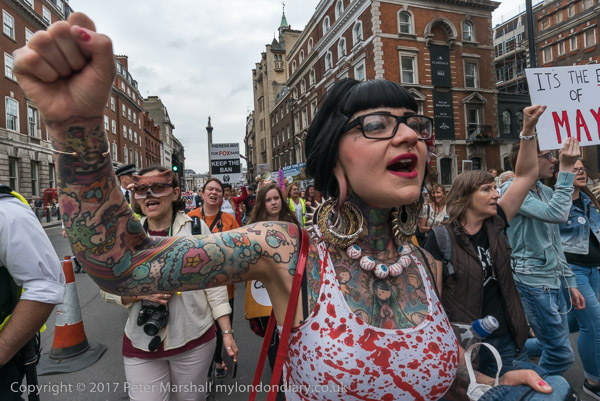
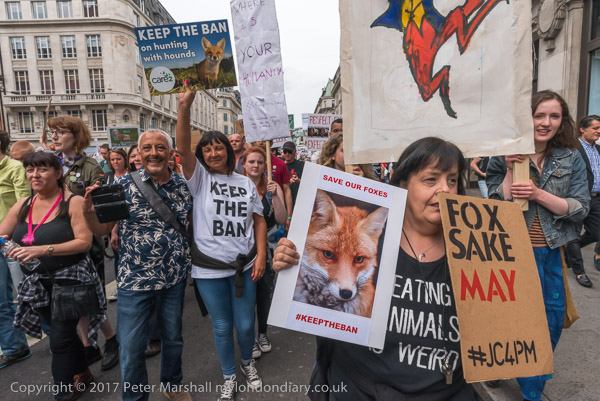
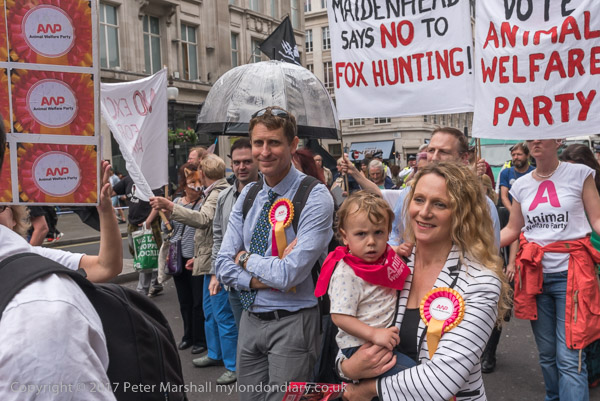
This year, in our rather silly late May Bank Holiday (a kind of fixed Whitsun) there was a protest to tell the Prime Minister that the public are against having a vote in Parliament on the fox hunting bill. It’s a cruel and barbaric practice, chasing a terrified animal across country and often ending with it being torn apart by dogs. Something there should be no place for – like bear-baiting and dog fighting. Something that still goes on despite the act, and the efforts of hunt sabs – and often with police turning the other way so they can’t see either the illegal hunting or the violence against the sabs.

It has never been an effective way of controlling the numbers of foxes – and of course always depended on foxes being kept alive to hunt. Foxes can be a problem, as the bloody mess of chickens in one of my friends coops a few years back made only too obvious. But where necessary they can be killed humanely without making it a so-called sport.

I wouldn’t join the sabs because although I’m against it, there are many other things I feel more strongly about, but I rather admire them for standing up for their principles, despite the abuse and violence they are often met with. If we had a local hunt I’d probably go along and take pictures of that and try to expose what they are subjected to.

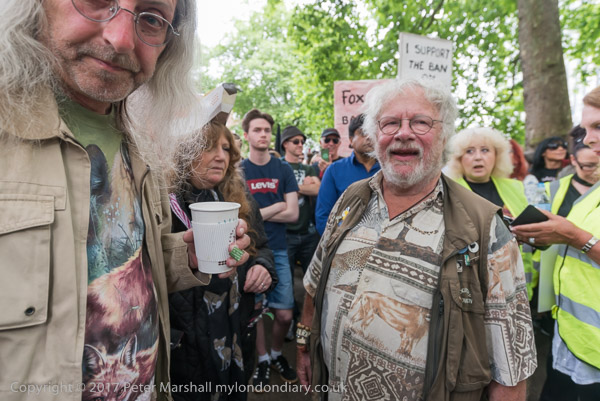
Despite a little celebrity support (and the little celebrity in this case was Bill Oddy) it was a protest that got relatively little coverage in the media, partly because the organisers determination to keep it well-behaved and entirely legal made it a little boring and predictable. The police were obviously expecting something rather more interesting and came in force, including some sniffer dogs, though I did wonder if they got extra overtime pay for working on a Bank Holiday.

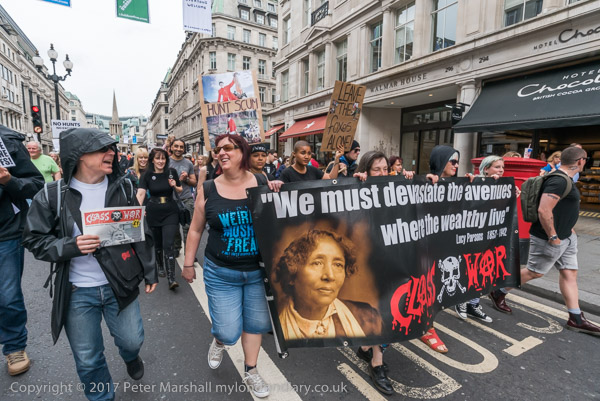
And of course hunting is very much a class issue, more so now than ever. Keeping a horse is an expensive business, and packs of hounds even more so, though it does provide a small amount of employment in the countryside. So it wasn’t surprising to find Class War on the march, but like me they soon lost interest in the speeches opposite Downing St and went to the pub.

Class War were not standing any candidates in the General Election a couple of weeks later, but the Animal Welfare Party were, in Theresa May’s Maidenhead constituency. And although their banner read ‘Maidenhead Says No to Fox Hunting’, Andrew Knight got only 282 votes, around a third of that of the Green Party and UKIP and was rather comprehensively eclipsed by May’s 37,718 – though perhaps they contributed to this being down by 1.1%.

And the Animal Welfare Party did get rather more votes than Lord Buckethead, Grant Smith, Howling ‘Laud’ Hope of the Monster Raving Loony Party, the Christian Peoples Alliance candidate Edmonds Victor, The Just Political Party’s Julian Reid and Yemi Hailemariam and Bobby Smith!

Keep the Fox Hunting Ban

Continue reading Fox Sake May

Friday Protests

I’ve had a few busy days and not had time to write on this blog, partly with several events to photograph, but also with other things to do and to worry about, but also with trying to get my main web site, My London Diary, a little more up-to-date with events. A diary should really be something you write up at the time, not as I’ve been doing recently around a month later. But should you click on the link above today when I post this, you should find that it only a day or two adrift – and later today it should include some of the latest pictures I’ve taken from Saturday.

Yesterday, Sunday, as I came around in bed the curtains were open and I could see snow falling, and when an hour or two later, having posted my daily picture of Hull I turned to post this onto Facebook I was greeted by picture after picture (mainly by rather bad picture after picture) showing people’s back gardens and streets with a little snow on them. I’d been wondering whether to go and photograph a couple of things in London, but decided not to; although I could have coped with the snow, our transport system would probably be on the blink. Later several of the things I’d had in mind were cancelled due to the weather, and there were reports of transport chaos. And more bad snow pictures.

It wasn’t much of a snowfall where I live (and today it has all disappeared and we are getting cold rain with the odd snowflake mixed in) and I decided not to bother to try and take photographs of it. We had snow rather better in the past, with weeks in the 70s and 80s where it lay inches deep – and drifts of a foot or more, with many suburban roads only passable with difficulty on foot and some closed to traffic for several days, and I felt I’d already served my share of snow pictures.

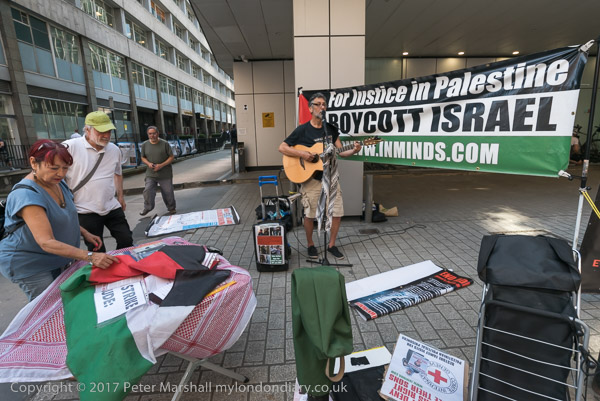
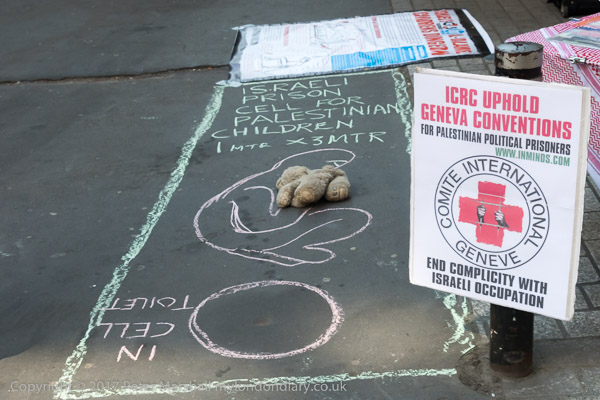
Today it feels quite good to look back to when days were longer and warmer around the end of May, and another Friday where I was busy, starting with a very similar event. Human rights group Inminds holds regular fortnightly protests about Palestine, usually on a Friday afternoon, drawing attention to the human rights abuses by Israel against the Palestinians, and calling for freedom for Palestine and for a boycott of Israel, and when I’m free and in London I try to cover these events, although often my visits to them are rather brief. The protest on this occasion was outside the Moorgate offices of the UK Mission of the International Committee of the Red Cross, demanding it end complicity with Israel’s violation of the rights of Palestinian prisoners, many of whom were then taking part in a hunger strike.

It was easier to photograph than most of their protests, partly because it was a new location, but also because there were specific posters for the event, and unlike some other of their protests there was little traffic and few pedestrians to get in my way as I was taking pictures; it was almost a private event, so photographs, mine and also those that Inminds itself take – had an added importance as the only way it reached the public.

There are accusations made that some of those who belong to Inminds are antisemitic, but protests such as this are clearly against particular illegal activities of the Israeli state and part of their campaign against the occupation of Palestine. I’m clear that it is possible to support the Palestinian cause without being antisemitic, though it isn’t possible to do so without being accused by some of antisemitism. I’m also clear that I’m not a member of Inminds, but a journalist who reports on some of their protests – as I do on protests by many other groups.

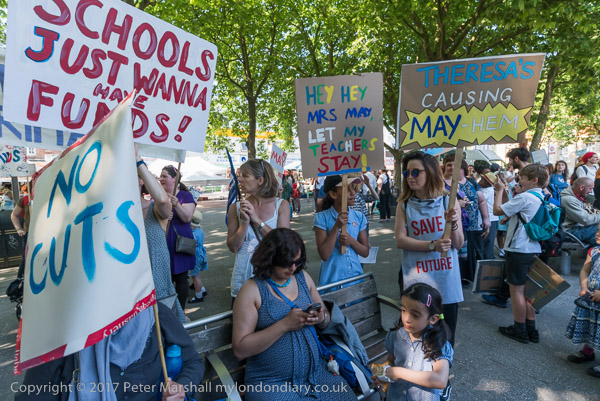
From Moorgate my next stop was Walthamstow Central, where parents and children were marching after school to a rally against education cuts. Photographing children has become difficult now, and photographers are always under suspicion if they point a camera at a child for whatever reason, and I did feel a little difficult doing so. In the past there were so many great photographs of children and I think it is a shame that we are now so inhibited about taking pictures of them. Of course there are terrible abuses of children and it’s right to do all we can to prevent the activities of abusers, but there is no real connection between those abuses and people taking pictures on the streets.

If taking photographs will not generally harm children, the changes in funding for schools certainly will, and that effect will be greatest in city areas such as London E17, where Waltham Forest schools were to lose over £25m from their annual budgets – £672 per pupil on average, with some schools losing over £1000 per pupil. It means fewer teachers – coincidentally also around 672 fewer in Waltham Forest, and at a time when numbers in schools are increasing. As a retired member of the NUT as well as a current member of the NUJ I have a particular concern.

I listened to a few of the speeches, but then had to leave, traveling back to the centre of London with the Victoria line taking me direct to Westminster. I’d missed the pre-election protest by Stop Killing Cyclists a few days earlier outside the Labour HQ, but this evening it was the turn of the Tories in Matthew Parker St, a short walk from Parliament.

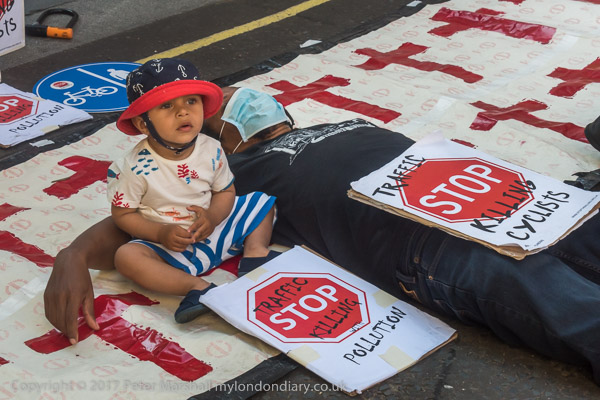
There I photographed another child, wearing a face mask sitting beside his father who was lying ‘dead’ on the ground outside as a part of a protest against traffic and air pollution both killing cyclists in London. Not just cyclists of course, traffic and pollution both kill pedestrians and drivers too, but cyclists face a particular risk when riding amongst faster moving and much more massive vehicles, and breathing their fumes on the road.

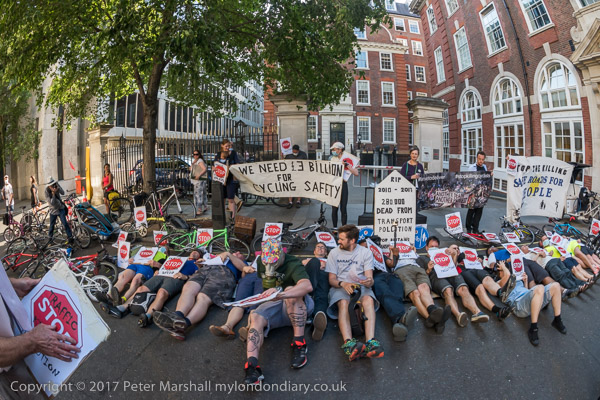
Later enough of the cyclists lay down to fill the frame of my fish-eye lens – and the house in the centre behind them is the Tory HQ.  Money spent on making safe protected cycle paths encourages many more to use their bikes to get around the city, reducing transport pollution which currently results in over 9,000 premature deaths a year in London as well as much suffering from illness, and more people getting on their bikes also means more people getting a little exercise to improve their healths.  More people cycling also cuts traffic congestion – with an increase in road space considerably greater than the loss caused by building protected cycle routes. In fact the only downside is that it leads to greater traffic speeds and so greater impact damage when vehicles hit people, something that needs to be mitigated by greater use and enforcement of 20mph zones.

But policies are generally driven not by facts, not be research, not by safety but by lobbying of politicians and the prejudices of the press, also  firmly guided by the saloon bar ‘common sense’ (not that we still have saloon bars – but we still have the attitudes.) Neither of the main parties had a sensible road traffic policy and was willing to spend the amounts needed to encourage cycling by making it safer.

Red Cross act for Hunger Strikers
E17 Protest Against School Cuts
Cyclists Tory HQ die-in against pollution

Continue reading Friday Protests