More Hull photos

Just because Hull’s year in the limelight at UK City of Culture has ended does not mean I have stopped adding pictures to my Hull web site, Still Occupied – A View of Hull. Although I’m no longer posting an image every day (and to my surprise I managed to keep that up through 2017) I have been occasionally posting images, along with some Facebook posts about them. But those posts recede in hours into Facebook history, hard to find again even if you know they are there, so I intend to post occasional digests here, where they will have a more permanent presence and can be easily found.

So here is the first set of some of those from 1985 I’ve posted this year. Clicking on the images will take you to the image on the Hull Photos web site where they appear slightly larger than on this blog.

Hull Photos – from 1985

The Humber Conservancy Board built a slipway at Sammy’s Point in 1961 with a yard and shed for the storage of buoys. Trinity House had been made responsible for safe navigation in the Humber estuary around 1512, but the responsibility for buoys etc passed to the Humber Conservancy Board in 1907. Following the nationalisation of the British Transport Docks Board in 1981 this work is now carried out by ABP Humber Estuary Services.

The buoy close to camera in this picture taken with the camera lens poking through the fence has ‘WRECK’ in large letters, if in need of a little de-rusting and repainting. Through and above the fence at left is the tidal barrier and some of the buildings along the west bank of the River Hull.

This site is now occupied by The Deep, Hull’s popular visitor attraction.
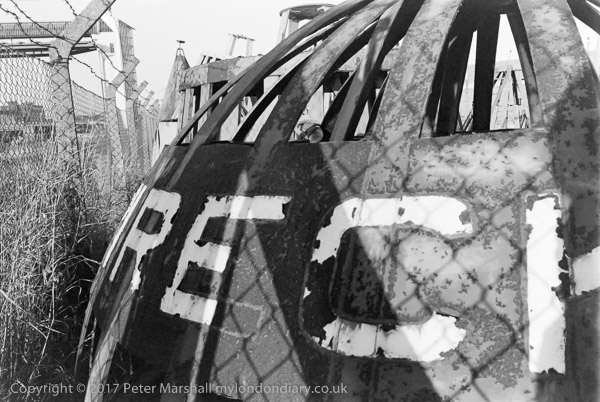
Wreck Buoy, Sammy's Point
85-10m-52: Wreck Buoy, Sammy’s Point, 1985 – River Hull


Another view of the buoy storage yard of ABP Humber Estuary Services at Sammy’s Point on the site now occupied by The Deep.
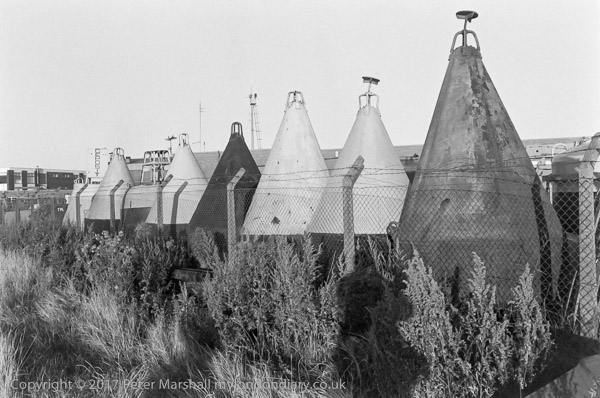
Buoy storage yard, Sammy's Point
85-10m-53: Buoy storage yard, Sammy’s Point, 1985 – – River Hull


A curious affect of sunlight shining directly into the camera lens, something which every photographer was taught to avoid, the effects of which in the days of film were impossible to predict but almost always thought to ruin the image.

Knowing this, I still took the picture, and rather like its many faults, though it is an image that really remained unprintable without the use of digital scanning and processing, over thirty years later.

The kind of marbling effect in the lower left quarter reminds me of the scales of some fish, which seems appropriate, and there is a subtle gradation in the greys of the distant view with the ship passing the mouth of the River Hull on its way down the Humber, with the pier and the trees. The full-size image has a sharp and prominent grain exaggerated by the over-exposure and has something of the feeling of a mezzoprint.
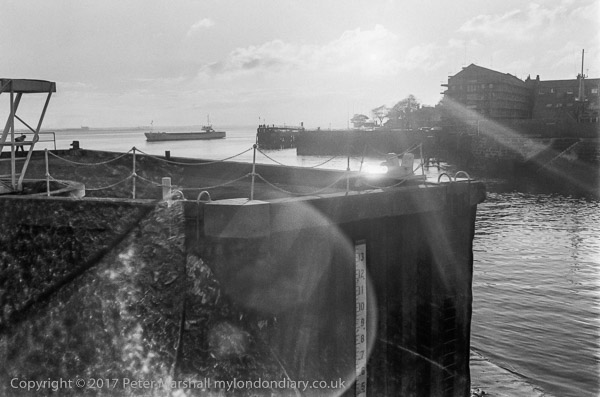
The mouth of the River Hull
85-10m-54: The mouth of the River Hull, 1985 – River Hull


A Ford Anglia, a ship’s boat on a roof and a large shed at the premises of Allen R Worfolk, Ship Repairers & Marine Engineers on the bank of the River Hull at Tower St.
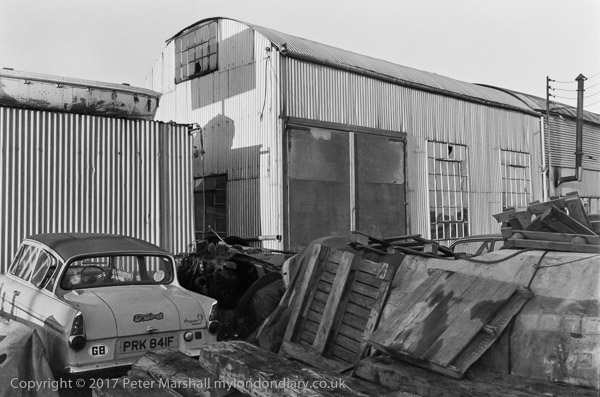
Allen R Worfolk, Ship Repairers & Marine Engineers, Tower St
85-10m-55: Allen R Worfolk, Ship Repairers & Marine Engineers, Tower St, 1985


Mooring buoys (I’m told by Iain Ralph in a FB post they are Admiralty 3 point mooring buoys) on the derelict land that was once a part of the Victoria dock estate close to Sammy’s Point near South Bridge Road. This area, like much of the land around the dock was formerly a timber yard.

I can’t positively identify the structure behind the two buoys at right of centre, perhaps a former dock gate on its side, nor the buildings in the distance at left which have a boat on the ground in front of them, though I think these are close to the Humber entrance to Victoria Dock.

The area where this was taken is probably now a part of the car park for The Deep.
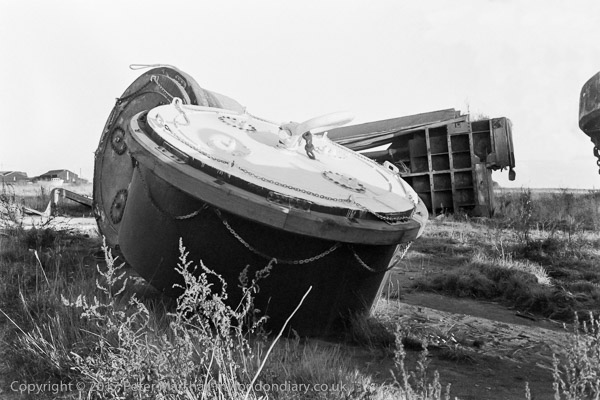
Mooring buoys etc on land, Victoria Dock
85-10m-56: Mooring buoys etc on land, Victoria Dock, 1985 – Docks


Another picture taken deliberately into the sun, but with less drastic light effects. The pier is in the background, and behind it the buildings of Albert Dock, with a ship moored at the riverside quay. There are a could of small vessels by the pier (one possibly the pilot boat) and a larger one on the other side of the Humber.
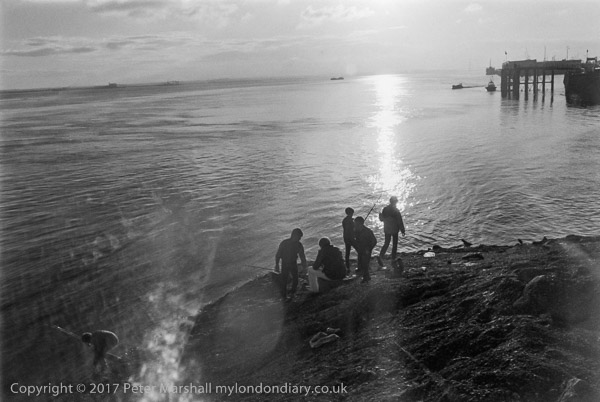
Boys fishing at Sammy's Point
85-10m-61: Boys fishing at Sammy’s Point, 1985 – Humber


A short telephoto lens gives a closer view of the pier and just avoids much flare from the direct sun (which lightens the left edge) though this has resulted in over-exposure. One of the boats in the previous picture is now heading up the River Hull.
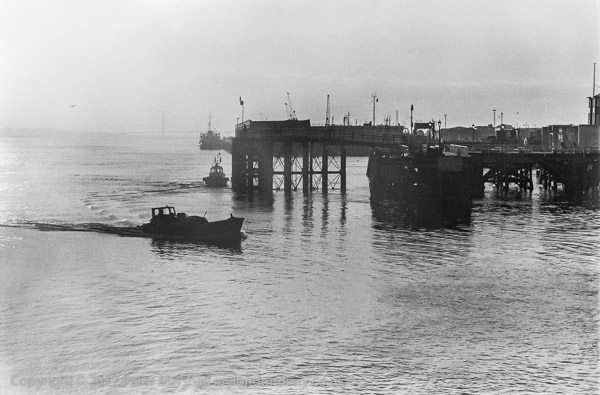
Victoria Pier from Sammy's Point
85-10m-64: Victoria Pier from Sammy’s Point, 1985 – Humber


Hull Central Dry Dock is still there, though now underneath a new event venue. When I took this picture there was a ship inside it being worked on. Holy Trinity Church is still much the same, though now renamed Hull Minster. At the right of the picture is a small dredger, with the river then being regularly dredged, while now the mud has been allowed to build up considerably.
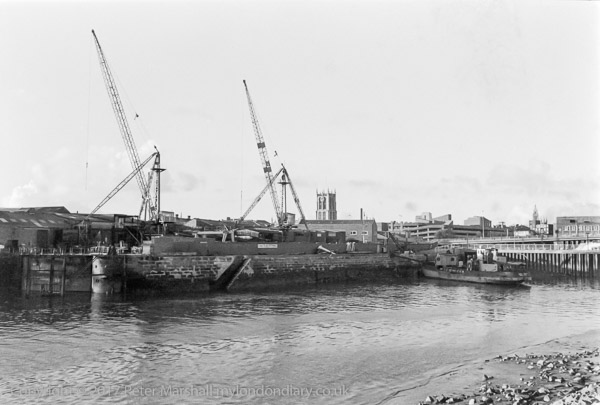
River Hull, Dry Dock and Holy Trinity from Sammy's Point
85-10m-66: River Hull, Dry Dock and Holy Trinity from Sammy’s Point, 1985 – River Hull
Continue reading More Hull photos
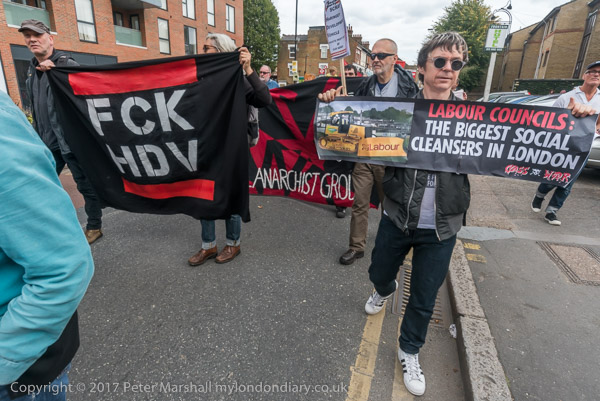
Haringey march against HDV

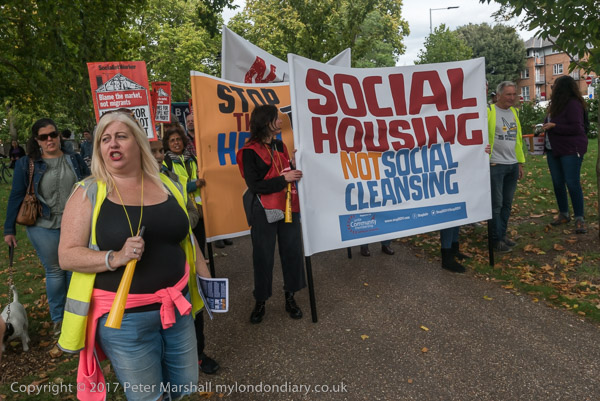
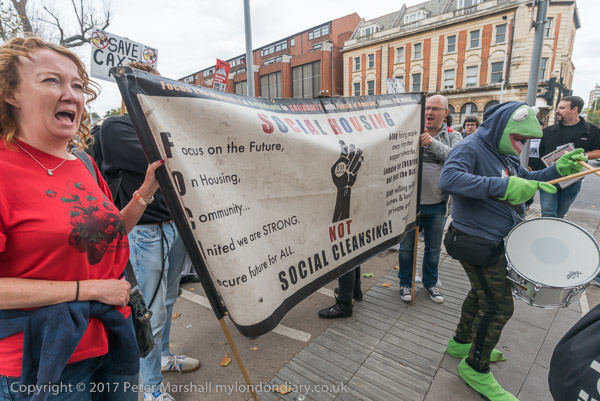
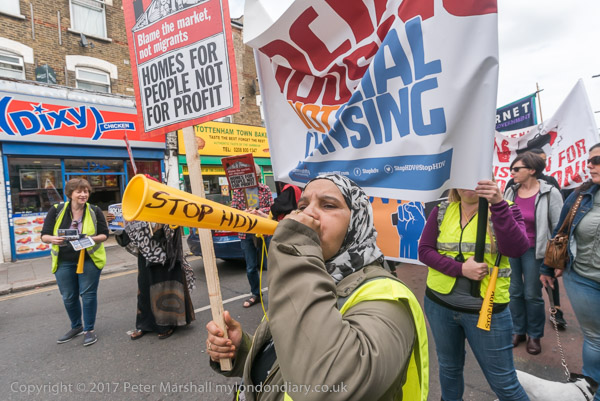
People from Haringey, including many who would lose there homes under the council’s plans for a £2 billion give-away of estates for private development, which might include some affordable housing, were joined by housing campaigners from across London for a march against the plans, the so-called Haringey Developmnet Vehicle, or HDV.

It now seems hopeful that with a change in Labour party housing policies and the likely results of this May’s council elections the plan will be stopped, though officers and councillors who perhaps stand to benefit from it appear still to be attempting to push it through. Their argument that the private development would somehow be good for the people of the area has been thoroughly discredited, and the tightening of some of the loopholes that the developer would certainly have intended to exploit announced this week by the government might also give Lendlease some second thoughts about the desirability of the project.

It was a rather long march and went slowly, starting by Tottenham Town Hall and walking a slightly long way round to Finsbury Park. I found it a little tiring, carrying a fairly heavy camera bag and of course adding to the length by walking up and down to take pictures rather than simply going straight along the road. Often I was walking backwards, which is also more tiring, though at least I managed not to walk into street furniture or trip down kerbs.

I’d intended to go the whole distance to Finsbury Park, where there was supposed to be another rally, but in the end had to give up a little before the end as I had run out of time. There had been a rather longer rally before the march moved off than expected and it had started late, and I was due at another protest.

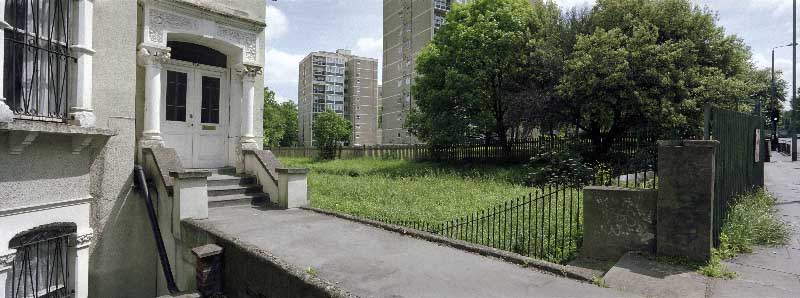
I almost got to Finsbury Park, and abandoned the slow march at Manor House, when we had already passed at least a couple of places that I’d photographed in my work on Finsbury Park in 2002, taken with the Hassleblad X-Pan, mainly using the 30mm lens. Another picture taken just a few yards off the road to the left was the winning image in a competition about the area, though I think others that I took are more representative of the area.

Haringey against council housing sell-off

Continue reading Haringey march against HDV

Trafalgar Square Road Block

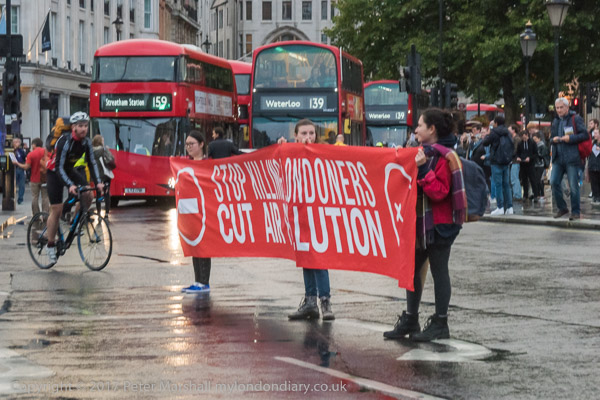
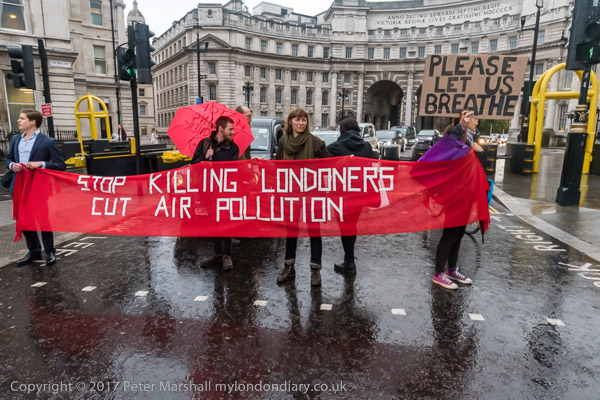
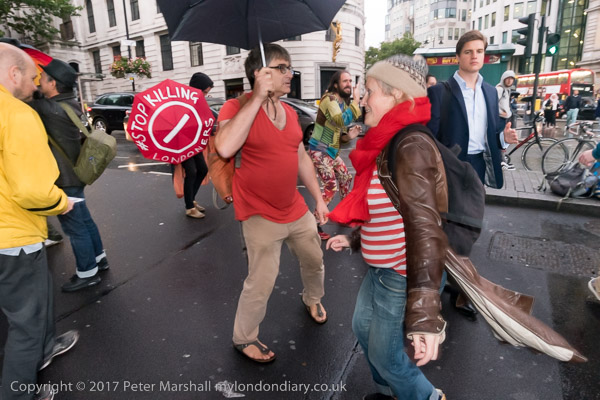
I have to say that I thought taking on Trafalgar Square for a protest by Stop Killing Londoners was perhaps over-ambitious. But the operation had been carefully planned and there was a rather larger group gathering when I arrived at the meeting point for the protesters. It had been a dull day and was raining a little, and half an hour before ‘sunset’ and I was getting just a little fed-up waiting for anything to happen as the the light was beginning to fade.
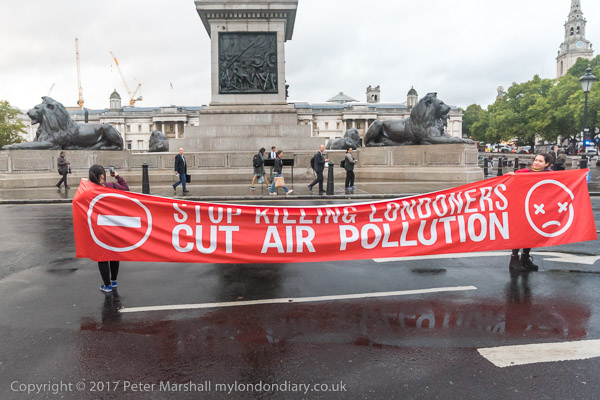
The organiser also had a very clear idea about the photograph they wanted to get, and as often it didn’t sound too good to me. Their banner in an traffic-free Trafalgar Square with Nelson on his column might sound a good idea, but that column is 52 metres tall, and even their large banner would seem pretty insignificant if I moved back far enough to include him where they were planning to stand.

I’d set both cameras to ISO 2,500 by the time the groups began to move into place to stop traffic on all the roads feeding onto the roundabout at the south end of the square around the Charles II statue – St Martin’s Place, The Strand, Northumberland Ave, Whitehall, The Mall and Cockspur St.
I wanted to photograph all the groups blocking the road – I think there must have been six of them – but only managed five despite running around dementedly during the short period the roads were blocked for, as well as taking as best I could the banner in front of Nelson. I settled in the end for including the two lions at the base, but cutting out all of the column above its bas-reliefs. Of course I wasn’t the only photographer present, and getting a clear view without people in the way took some patience, difficult as the whole total block was only for around 5 minutes.

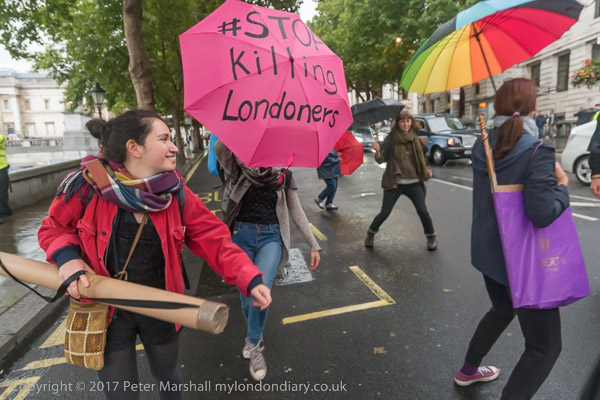
The group then moved into the centre of Trafalgar Square, pleased with its success, and after another five minutes moved together to block St Martin’s Place, this time accompanied by music and dancing, until after almost ten minutes the police, who had stood back and watched during the earlier protest, made a more determined attempt and persuaded them to finish and they moved off without much argument. This part of the square is very much shaded by trees, and the light was pretty low. Because of this and the movement, most of the pictures I took were at higher ISOs and for some I also added some flash, taking care not to completely overpower the ambient lighting.

As with their previous road blocks, this was intended to gain publicity for the almost 10,000 premature deaths and many more people suffering from the excessive air pollution in London, mainly caused by traffic. But although it got some publicity, neither the Mayor of London or Transport for London, although aware of the problem and making some minor improvements, have taken the kind of drastic action that this serious problem requires, and Stop Killing London are keeping up their campaign.

Trafalgar Square blocked over pollution

Continue reading Trafalgar Square Road Block

My London Diary Feb 2018

A little snow in Staines

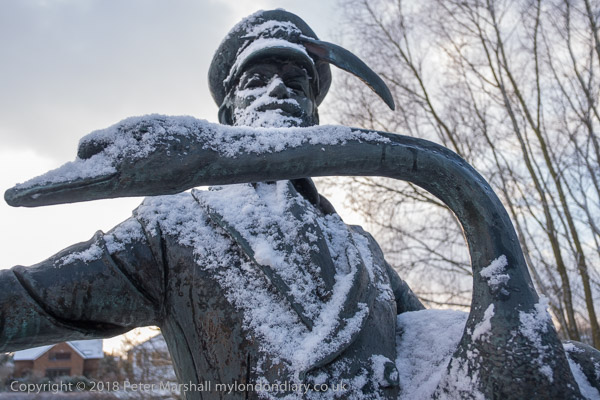
It has been relatively easy to finish my ‘My London Diary’ entries for last month – and I finally did so around 11pm on March 2nd. It was helped by having almost a week off after a minor dental operation, as well as some reduced activity because of the cold weather and snow, both as I was reluctant to go out and as a number of events I would otherwise have photographed were called off.  We didn’t have a great deal of snow where I live, but of course I did take a few pictures of it, though I’ve no great interest in weather images.

Feb 2018

Solidarity with Yarl's Wood hunger strikers

Solidarity with Yarl’s Wood hunger strikers
HE & FE rally for pensions and jobs
HE and FE march for pensions and jobs
London Snow
A little snow in Staines

Class War's Lambeth Walk
Class War’s Lambeth Walk for housing
More London

15th Reclaim Love Valentine Party
Against US war plans for Ukraine
‘Stay Put’ monthly Sewol silent protest
Protect Venezuelan democracy
Bolivians protest against President Morales

Lambeth Council opens fake Carnegie library
Grenfell Remembered – 8 Months On
Russia Stop the Killing, Leave Syria

Ladbroke Grove Pret-a-Manger land theft
Class War protest at Shard
Class War victory against Qatari Royals
Plasticus the Whale at Parliament
Sling the Mesh say campaigners
Fair Votes Hunger Strike for Democracy

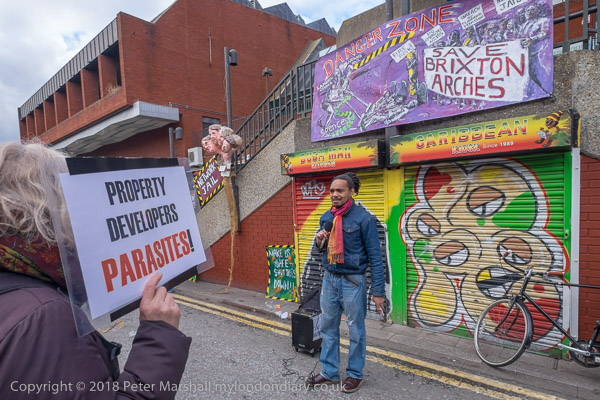
Save Brixton Arches
Save Brixton Arches: 3rd Anniversary Action
Fix the NHS Crisis Now
TINAG Living Archive & Sylvia McAdam

London Images

Sex, Lies and Lemmings

Sex, Lies, and Lemmings: Hossein Fatemi and the Toxification of Photojournalism is the provocative title of a detailed article by on PetaPixel by Benjamin Chesterton, known to many of us through his Duckrabbit blog, where this and many other thoughtful and incisive articles first appeared.

In it, Chesterton looks in some detail at the abysmal failure of World Press Photo‘s ‘investigation’ and the equally guilty collaborations by Fatemi’s agency, the generally well-respected Panos, Time, the New York Times and others in dismissing the evidence from fellow Iranian photographers and two Iranian women who worked with him in the making of the pictures (though not in their subsequent misuse), one of whom was falsely labelled in the caption as being a prostitute working to support two young children, a complete fabrication, which could result in severe penalties for the woman in the picture.

Rather than make investigations and take appropriate action, WPP and others appear to have decided on a campaign to discredit fellow Iranian photographer Ramin Talaie who first raised the issues about Fatemi’s work, which has now been shown by WPP around the world. The evidence against Fatemi, as related by Chesterton, much of which comes from investigations by Talaie as neither the WPP, Panos, Time or others has bothered to contact the people in the pictures, seems completely damning.

One of the strengths of Chesterton’s article is that he doesn’t stop there, but goes on to suggest how the matter should have been dealt with – an approach which he says he suspects would have made Fatemi withdraw his work before the issues became public, rather than lead to “the charade on show.” It seems good sense, and an approach that were it taken would lead photographers to think much more carefully about photojournalistic standards rather than, as in the current case, to put forward theatrically staged images with false captions. They may be powerful pictures and I have nothing against the creation of fictional narratives using photography, but it needs to be clearly identified as such and has no place in photojournalism.

You should read Chesterton’s article, and I’ve deliberately not given much of its content here to encourage you to do so. The real scandal is not the photographs themselves, although Fatemi appears to have used them and his subjects irresponsibly, but “the incomprehensible decisions that led to Fatemi’s work being given such a massive platform to deceive.” And as he says in his conclusion:

“World Press Photo set a new standard for photojournalism: NO standard. Basically, you can get away with pretty much anything. Just as long as there are no pixels out of place and you stick to your story, any s**t goes.

You can be certain: lemmings in search of awards will follow.”

Human Rights – UK and Eritrea

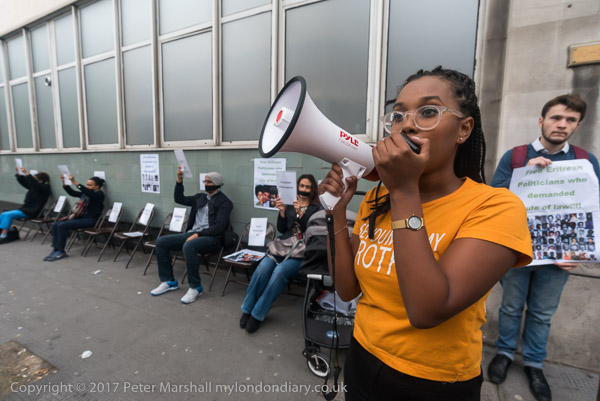
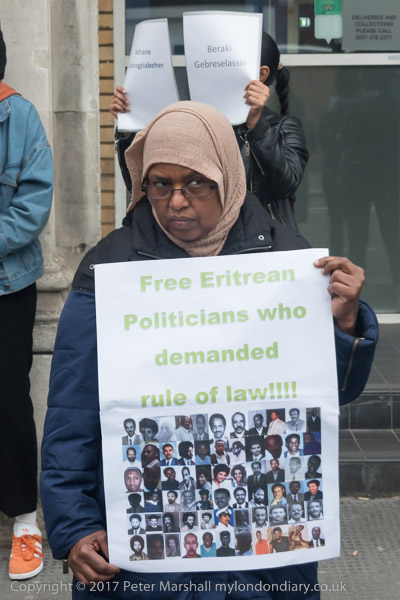
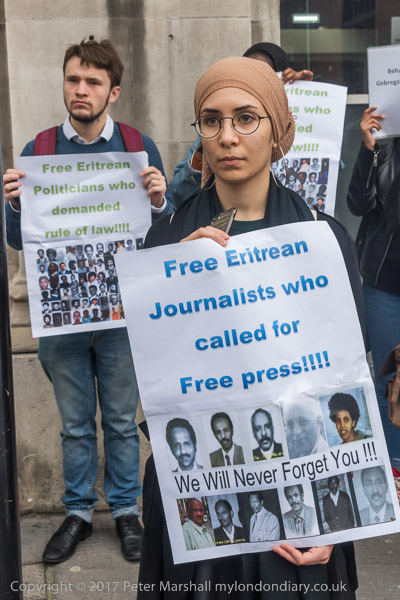
In 2001, Eritrean dictator Isayas Afewerk closed down the free press and imprisoned leading opposition politicians and journalists. Since then ten leading journalists have been kept in isolation without charge, without trial and without contact with the outside world. Nobody knows their whereabouts and only four are now thought to be still alive.

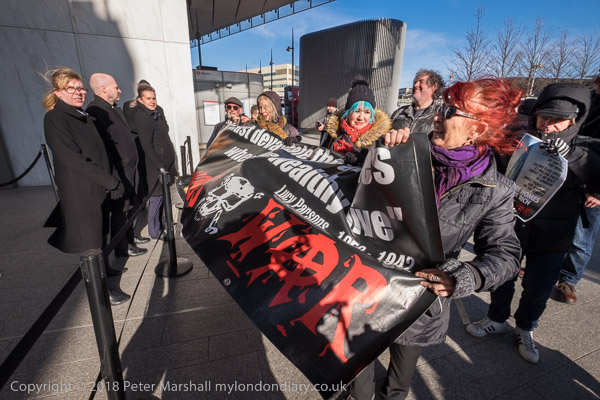
The journalists were represented at the protest by a row of ten chairs opposite the Eritrean embassy in north London. Most were empty, with four people sitting with black gags holding up the names of those thought still be living, while to the side there were speakers and others holding posters about the disappeared journalists and politicians. The protest was organised by One Day Seyoum, a human rights movement working for the release of journalist Seyoum Tsehaye, one of the four thought still alive.

Lonely Planet‘s web site describes Eritrea thus:

“Historically intriguing, culturally compelling and scenically inspiring, Eritrea is one of the most secretive countries in Africa. For those with a hankering for off-the-beaten-track places, it offers challenges and excitement alike, with a unique blend of natural and cultural highlights.”

although the page does have a warning across the top about the Foreign office advice to UK citizens which should probably put anyone off visiting there, and certainly against going outside the capital, Asmara, which is apparently a fascinating place. The UK offers no consular services  elsewhere as it takes diplomats a week to get a permit required to travel outside, and tourists are subject to some pretty draconian restrictions.

A better description of the country comes from Human Rights Watch:

“Despite occasional vague promises of improvement, Eritrea’s respect for human rights obligations remains abysmal. In 2016, a United Nations Commission of Inquiry established by the Human Rights Council found the government’s “totalitarian practices” and disrespect for the rule of law manifested “wholesale disregard for the liberty” of its citizens. Thousands of Eritreans flee the country monthly to avoid “national service,” conscription that lasts indefinitely. Eritreans are subject to arbitrary arrest and harsh treatment in detention. Eritrea has had no national elections, no legislature, no independent media, and no independent nongovernmental organizations since 2001. Religious freedom remains severely curtailed.”

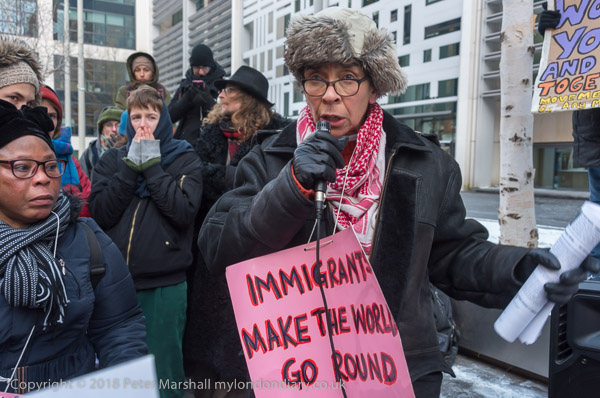
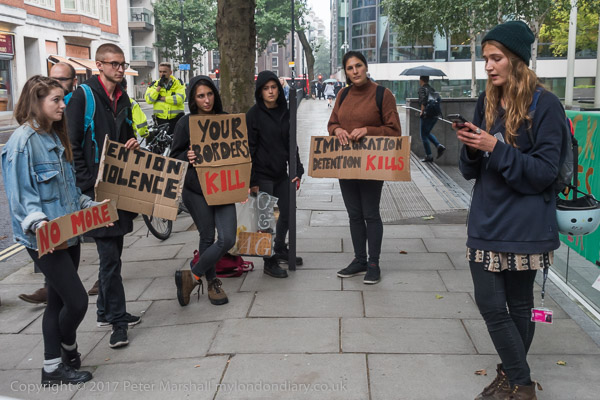
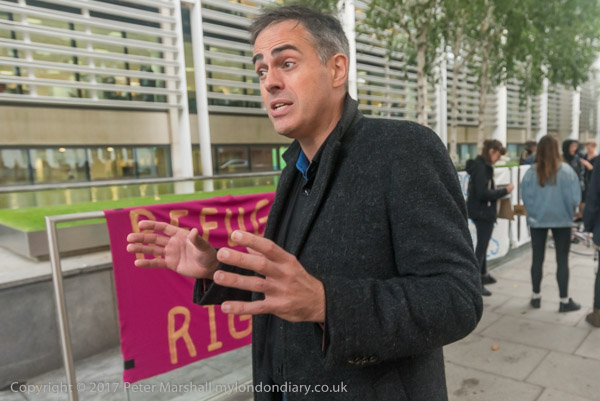
From Islington a couple of buses took me to the Home Office, where SOAS Detainee Support had called an emergency demonstration after another death in an immigration detention centre. The death of a Chinese man in Dungavel immigration detention centre followed the death earlier this month of a Polish man who took his own life in Harmondsworth (now called Heathrow Immigration Removal Centre) after the Home Office refused to release him despite the courts having granted him bail.

There are now too many cases since 2010 in which the government refuses to accept the decisions of the courts, often taking them through needless appeals and failing to take appropriate action even when they finally lose. I don’t think this has ever happened before and shows the current government’s contempt for the law and human rights. Parliament  this week voted against including the European Charter of Fundamental Rights in UK law after Brexit.

People are sent to immigration detention centres without any trial, and are held for indefinite lengths of time, which can be for extended periods – Mabel Gawanas was sent to Yarl’s Wood on May 12th 2014 and only released on bail on May 10th 2017, a few days short of 3 years later. Conditions in a Yarls Wood led to it being described as a ‘place of national concern’ by HM Inspectorate of Prisons in 2015, though perhaps national shame would be a more accurate term.

Green Party co-leader Jonathan Bartley was among the speakers at the protest, called at short notice after the news of the death broke.

Free forgotten jailed Eritrean Journalists
No More Deaths in immigration detention
Continue reading Human Rights – UK and Eritrea

A Day in London

September 16th was certainly a busy day in London, but then most are. I could have stood all day in queues waiting to visit some of the more interesting of the city’s buildings, as it was Open House Weekend, a two day event when many buildings open their doors to the public. It’s a great idea which came from Europe, beginning in France in 1983 and starting in London in 1992, and over the years I’ve visited quite a few places either generally closed to the public or which normally charge an entrance fee.

In the early years you just turned up and queues were generally non-existent or short, but the event has grown tremendously in popularity, and advance booking is needed for many of the more interesting sites and there are very long queues for some of the others, sometimes taking several hours. So I’ve largely stopped bothering.

I’ve never had a great interest in photographing interiors, and of course although this is an opportunity to take photographs (hard to stop anyway now that almost everyone has a camera on the phone in their pockets), permission to take photographs gives you no right to make any commercial use of them, though generally it would not be a problem to put them on non-commercial blogs such as this which generate no income (*though I’m always pleased to accept donations!)

I hadn’t intended to visit the Banqueting House on Whitehall, but was walking past it and noticed it was open and there was no queue. So when I found the protest I had come to photograph opposite Downing St was not there. I turned around and came back.

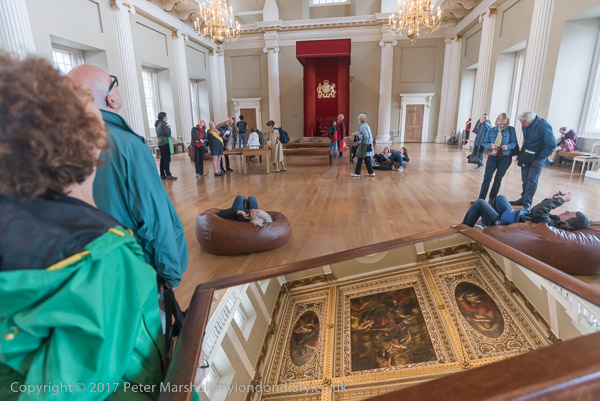
It’s a fine building, Palladio via Inigo Jones, built in 1619-22, the earliest neo-classical building in England. It provided a useful ascent to the scaffold for the only English monarch to get the end he deserved, the son of the man who commanded it to be built. King Charles I stepped out of a side window to be beheaded outside it in 1649.  The interior is almost entirely a single large room, used for grand official events over the years, and would be rather plain except for its ceiling.  Charles obviously thought so, and commissioned Peter Paul Rubens to paint it.  Rubens did it in pieces in his Antwerp studio and they were shipped to London and installed. It is a very high ceiling, and to save visitors getting a crick in the neck there a several large mirror-topped cabinets in the room where you can look down and see up.

Alternatively there are cushions so you can lie on your back and contemplate it at your leisure, but I was rather afraid I might not be able to get up from these. I’m not a particular fan of Rubens, but the ceiling is certainly impressive.

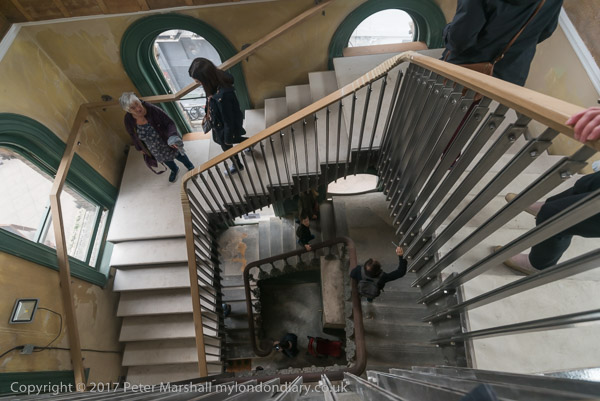
The building I had been intending to visit was the Old Waiting Room at platform level at Peckham Rye Station, reached by the impressive stairs in the picture, though my interest was perhaps more in the exhibition of local photographs that was taking place there. As someone who photographed Peckham in the 1980s and have seen the changes since I was interested to see more earlier pictures of the place. The show also included some more recent pictures, though I found these a little disappointing. There was another show of recent local pictures on a wall a little way down Rye Lane that was rather more lively that I also wanted to see, as well as going to Copeland Park, where other Peckham festival events were taking place, but I was too early for there to be much of interest happening.

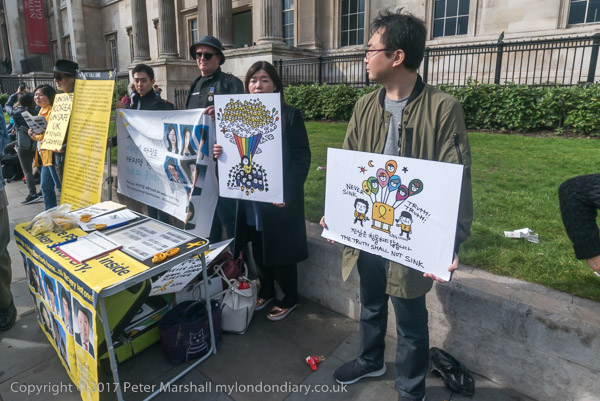
Back in the centre of London at Trafalgar Square I took a few pictures of the monthly protest about the Sewol ferry disaster. It was the 41st such event calling on the South Korean government to conduct a thorough inquiry into the disaster, recover all missing victims, punish those responsible and enact special anti-disaster regulations.

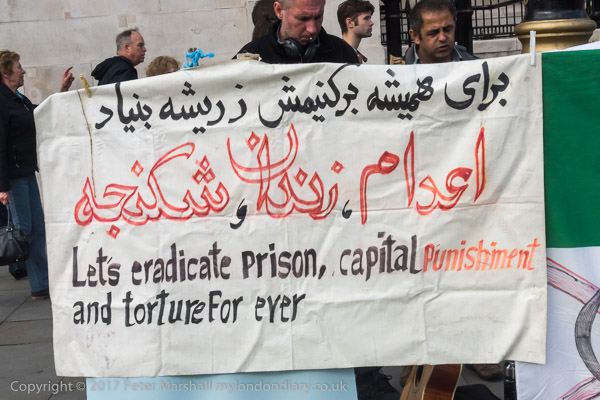
A few yards away, the 8 march women’s organisation (Iran-Afghanistan)  were starting their protest on the  29th anniversary of the massacre of political prisoners in Iraq in which over 30,000 political prisoners, mostly members of the main opposition People’s Mojahedin Organization of Iran(PMOI/MEK) were executed.

Repression of course continues in Iran, led by a fundamentalist Islamic regime, and there were around 500 executions in 2017 and many trade unionists and human rights activists are imprisoned, with torture being used on a large scale to extract confessions which are used if they are brought to trial. Various religious groups are also subject to particular persecution, as too are the Ahwazi Arabs whose land in the Khuzestan Province in southern Iran is rich in natural resouces, and where Iran has long pursued a process of ‘Persianisation’, beginning with the rise of the Pahlavi regime in the 1920s attempting to eliminate the Ahwazi language and culture and take over the region.

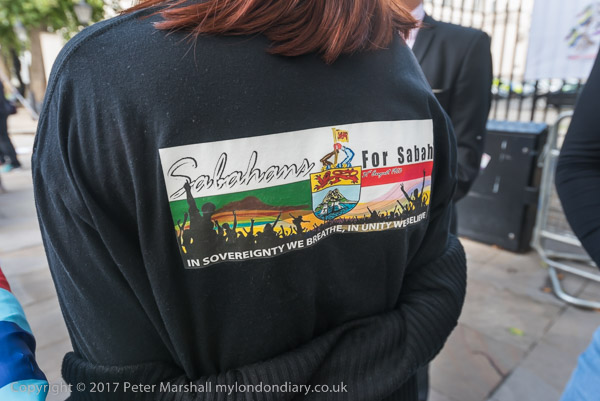
A short walk away opposite Downing St, a Malaysia Day protest was taking place by Sabahans and Sarawkians. They say Malaysia Day is a ‘Black Day for Sabah and Sarawak‘ and they call for a restoration of human rights and the repeal of the Sedition Act and and freedom for Sarawak and Sabah, the main areas of what Malaysia calls  East Malaysia.

These two former British colonies on Borneo became part of the new Federation of Malaysia in 1963 with considerable autonomy, but this was greatly reduced ten years later.  They argue that they entered the federation with equal status to Malaya but are now treated as simply constituent states on the same level as the states of Malaya, and there is a strong nationalist movement for secession.

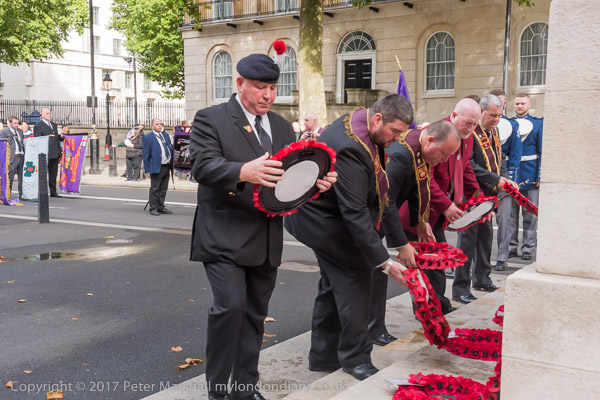
Finally I had been watching out for the annual Lord Carson Memorial Parade by lodges of the Orange Order including the various lodges dedicated to the Apprentice Boys of Derry and others remembering the Ulster regiments that fought on the Somme.  I knew where they were meeting, but had decided not to go there as on some previous occasions I have been threatened when photographing their parades (though I don’t know why they should resent my reports, and others taking part have congratulated me), so was waiting for them on Whitehall, where I knew they would be coming to lay wreaths.

I’m not a supporter of the Orange Order, but I’ve always tried to report objectively on their activities in London. In my reports I have sometimes given some information about the past which they perhaps find uncomfortable – as for instance on this occasion where I state that Lord Carson, one of the founders of a unionist militia that became the Ulster Volunteer Force,  later warned Unionists not to alienate Catholics in the north of Ireland – which parades such as this through some Catholic areas clearly do – though in London they are considerably less controversial.

Open House – Banqueting House
Open House & more – Peckham
41st monthly Sewol ‘Stay Put!’ vigil
Overthrow the Islamic Regime of Iran
Black Day for Sabah & Sarawak
Lord Carson Memorial Parade

Continue reading A Day in London

‘A Day in the Life’ and Magnum

It’s hard for photographers to view Magnum dispassionately, with the huge amount of myth that surrounds it. It’s members have included some of the greatest legends of photography, and certainly some of its greatest egos. We’ve grown up being fed with the idea of its great crusade for photographers, and it came as something of a shock for me to realise, years ago when I got an application form for some great project, the small print which informed me that Magnum photographers would get paid at twice the rate of the hoi polloi, that it was more a fight for Magnum members than the rest of us, though perhaps some of its benefits have trickled down.

Most of what we know about Magnum is the official story, as told by Magnum and allied organisations including the ICP. And interesting though Russell Miller‘s ‘Magnum: Fifty Years at the Front Line of History’ was, as would be expected from the title (and the sub-title Fifty Years at the Front Line of History – The Story of the Legendary Photo Agency) it too was largely celebratory rather than offering a truly objective story.

Reading Robert Dannin‘s series of posts, The Dannin Papers, on A D Coleman‘s Photocritic International site fills in the story and offers a unique insight, warts and all (perhaps mainly warts.) Dannin was from 1985-90 Editorial Director of Magnum Photos and has a remarkable memory for events and for how Magnum actually worked in those years.

The latest series of posts, which begins with Guest Post 24: Robert Dannin on the “Day in the Life” Projects (a) (January 21, 2018), and is currently on the fifth of seven instalments. Dannin describes the Collins Day in the Life of … series of books which covered 11 countries and two US states as “the first spectacular disruption aimed at transforming professional photographers into undervalued content providers, the unfortunate state of affairs that today confronts those wishing to make a career of making images.

The series, like his earlier series on Magnum which began last October makes interesting reading for anyone involved in photojournalism.

Brixton air pollution protest

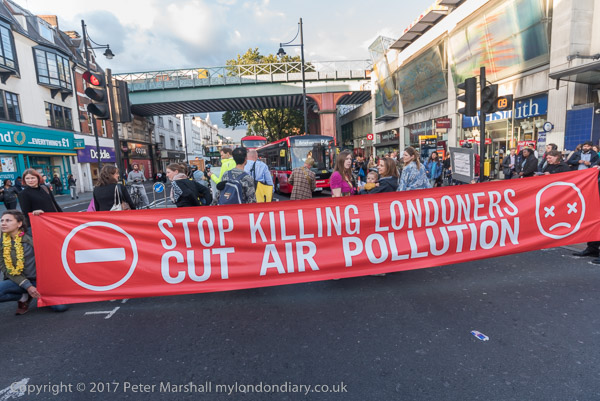
I took the bus from Clapham Junction to Brixton on my way to photograph a protest by Stop Killing Londoners against the terrible levels of air pollution in London. And it pulled up in a queue of traffic leading up to the traffic lights by the Northcote pub. The lights changed and we moved forward a few yards. Then back to red. Eventually the lights changed again, but we hardly moved. On the next green we moved forward a little, but I think it was the fourth green light before we finally reached the junction and our 37 bus took the left turn towards Clapham.

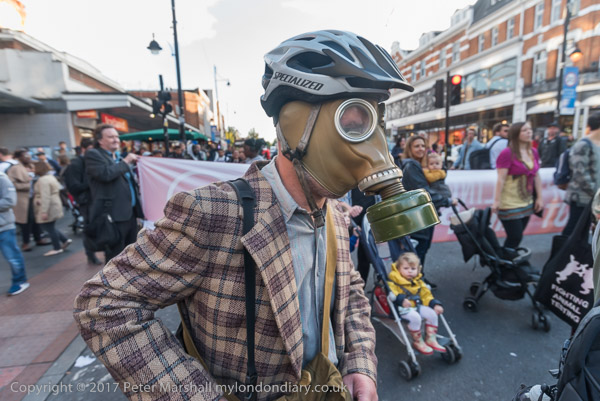
I don’t know what held us up, but it isn’t unusual to have a fairly long wait here, as I’ve found on many occasions on this route which I’ve been riding occasionally for over 40 years. Clapham High Street, where the bus waits to make a right turn can also cause similar hold-ups. And though the exhaust fumes from cars and buses are generally invisible, they are still lethal, part of the toxic air pollution that leads to almost ten thousand premature deaths in our city every year, as well as a great deal of suffering by the many more people suffering from lung diseases.

Back when I was young, air pollution in the city was rather more visible, and made its presence felt and seen at certain periods of the year as ‘pea-soupers’, dense and acrid fogs, which hung around for days and sent many to hospitals and their deaths. Thanks to the Clean Air Acts which banned the burning of coal, we no longer get this, but today’s pollution is more insidious, and keeps at high levels throughout the year peaking dangerously at times.

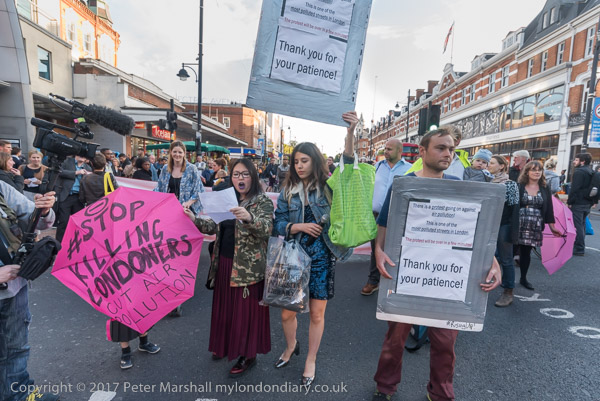
In 2017, Brixton Road in the centre of Brixton reached the annual limit for the year allowed under EU Regulation only five days after the start of the year, and over the whole year the street was the second most polluted in the capital (narrowly beaten by Putney High St.) So it was an appropriate location for a protest by ‘Stop Killing Londoners’, (SKL), a group that is trying to force London’s Mayor to take urgent action to cut air pollution.

Sadiq Khan has expressed concern about pollution, and there are some cautious half-measures being put into effect, but not the kind of drastic action that is needed to really tackle the problem. SKL believe that by mounting high-profile protests, and if necessary getting arrested for doing so, they will force the the Mayor, TfL and the government to act more decisively.

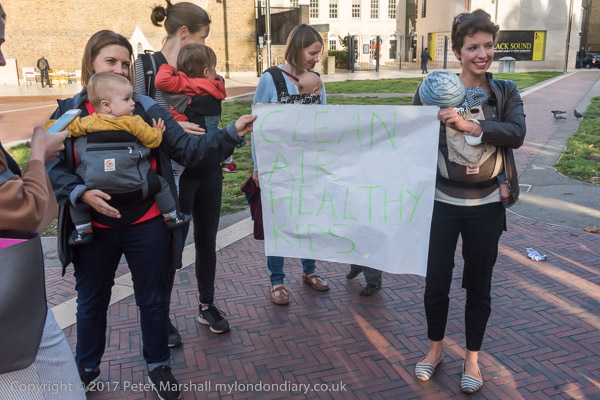
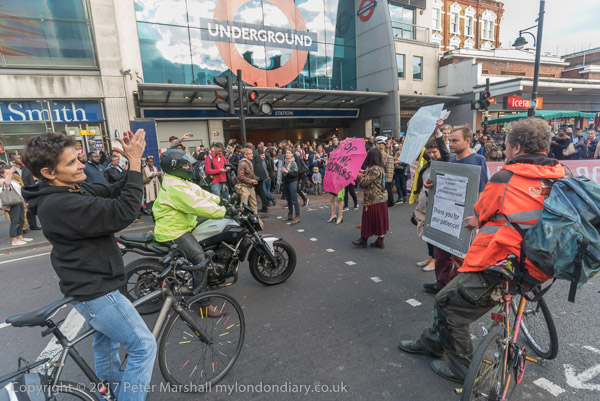
The action at Brixton was the first in South London, and the first that a number present had taken part in, and the protesters included several young mothers with children, who suffer disproportionately from air pollution. They went onto the pedestrian crossing outside Brixton Underground Station with their banner and blocked the south-bound carriageway for around 5-10 minutes, little if at all longer than my hold-up in Battersea on the way to the protest.

Despite telling the drivers what they were doing and why, and assuring them that they would not be held up for long, there were a few motorists who became rather angry. Few if any took the advice to cut their engines while waiting to reduce the pollution. There were others, including some pedestrians and cyclists who congratulated them too. After the short road block they went back onto the pavement and let the traffic clear.

Police then appeared and came to talk with them, but after a short conversation when the protesters assured them they were only going to make another short protest before leaving they walked away and watched from a distance. As promised there was a second short protest and then the campaigners dispersed, and I caught my bus back to Clapham Junction, this time without delays.

There is simply too much traffic in London, and though it is not the only cause of air pollution it is the major one. More drastic action is clearly needed. There does need to be a much greater push to provide safe cycle routes, to get people out of cars and onto cycles, and for many it is the dangers of cycling on roads with busy traffic that stops them getting on their bikes. We also need improvements in public transport, and lower costs, particularly for rail services, which are so much more expensive in London than in most other cities. Increasing the area covered by the congestion charge would help a little, though would penalise those on lower incomes. Other cities have banned private cars with odd or even registration numbers on alternate days, and even banned all private cars from large areas. Central London has too many taxis, private hire vehicles and tourist buses, and there are more places where service buses could be given priority or allowed to take short cuts.

Air Pollution protest blocks Brixton
Continue reading Brixton air pollution protest

Wreath for the victims of the arms trade


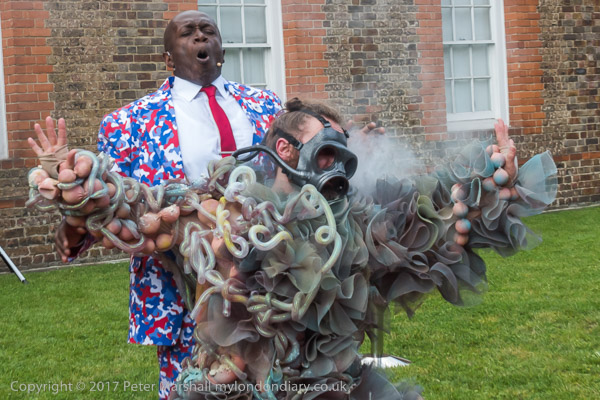
An arms dealer coughs as CS Gas releases tear gas

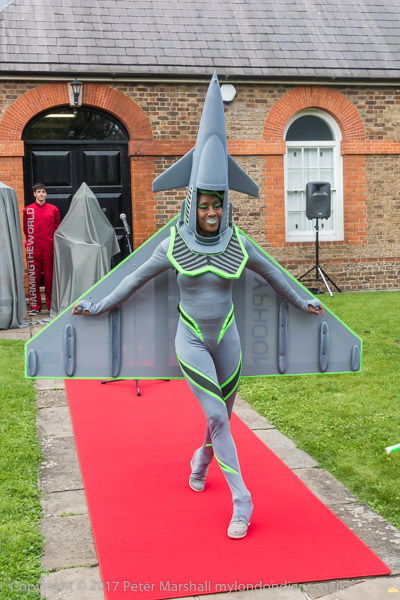
The week of blockades and protests organised by Campaign Against Arms Trade ended on the Monday night before the DSEI arms fair actually opened, but the following day I was at work again, photographing the first performance of #ArmingTheWorld, a project by Ice & Fire theatre and Teatro Vivo with designer Takis at Woolwich Arsenal, with actors dressed as arms dealers, a Paveway IV Missile, a Eurofighter Typhoon and CS Gas.


A Paveway IV Missile on the catwalk

The audience at Woolwich was small but appreciative and the dramatic performance illustrated some of the facts about the arms trade that should be much more widely known. Further performances later in the week included one in Trafalgar Square and will have attracted rather larger crowds.

#Arming The World

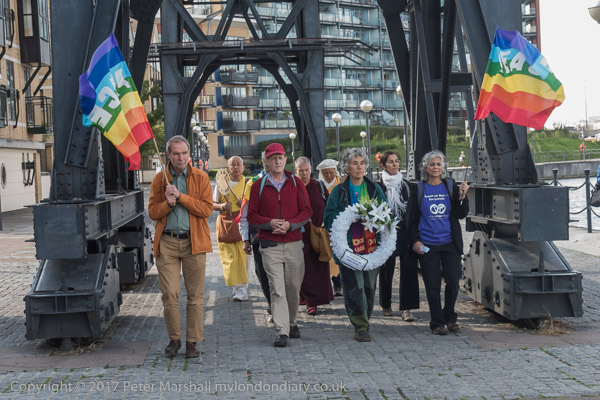
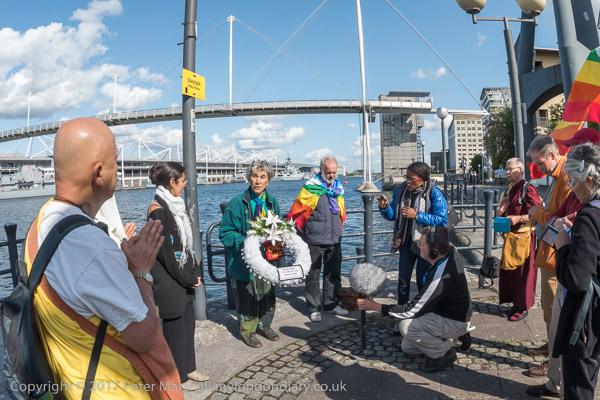
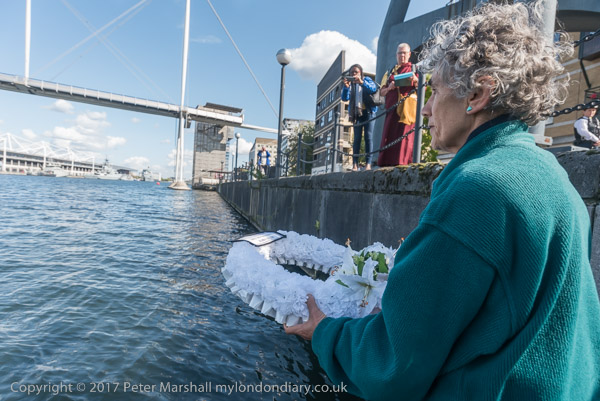
Thanks to the DLR I was able to rush back to Royal Victoria Station where East London Against Arms Fair were carrying out their annual walk around the Royal Victoria Dock to float a wreath on the dock opposite the DSEI arms fair in memory of the victims killed by arms traded their in earlier years and for those who will be killed because of the deals now being made. Numbers were a little down on previous years as some were unable to take part because of police bail conditions imposed after their arrest the previous week.

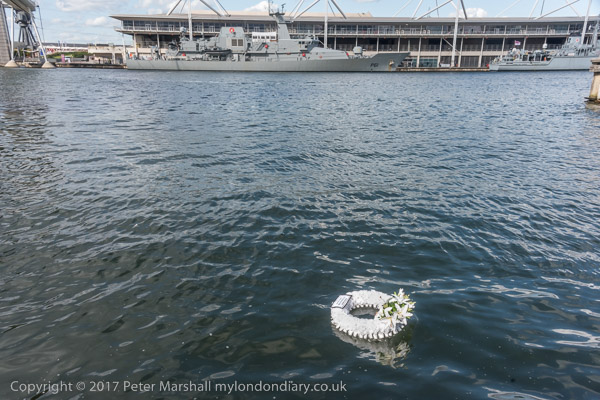
After a procession around the dock with the Reverend Sister Yoshie Maruta and Reverend Gyoro Nagase praying and drumming there was a brief ceremony, and the wreath was then placed onto the water in the dock.

where it floated away, opposite the line of warships that were moored alongside the ExCeL centre as a part of the DSEI arms fair.

There was then a period of silence in memory of the dead and some prayers.

Wreath for victims of the arms trade

Continue reading Wreath for the victims of the arms trade