LIP at 21

I was sorry to miss the 21st birthday celebrations of London Independent Photography last night, but I didn’t feel up to it. As the first membership secretary of LIP I was also member No 1 and my membership card still has that number.

LIP was started by a small group of enthusiasts who had attended courses at Paul Hill‘s workshop’s in Bradbourne, Derbyshire and had wanted to form a group to continue their interests in photography. At the time I was involved in two groups in London, both loosely organised, one around the young photographers group that met monthly at the Photographers’ Gallery, and the other, Framework, organised by Terry King with help from myself and others that had been meeting at various places in west London for around ten years. There were also other groups around the capital, including the ‘Box Brownies‘ in East London.

I think the PG had for some time been looking for a way to get rid of its group, which was troublesome and showing rather too much independence, and jumped at the chance to encourage someone else to take over the work. The inaugural meeting and some early events of LIP were held on its premises, almost 22 years ago. But the first real event held by LIP was a ‘Blutak show’ to which 46 photographers (half the membership) arrived with pictures to stick on the wall of the Hammersmith and West London College on 26 Sept 1987. The first AGM was held at another ‘Blutak Show‘, this time at the Drill Hall in Chenies St, on 23 Jan 1988.

Framework had been very much a group about photographers sharing enthusiasms, discussing their work in progress and exhibiting together, but unlike LIP never felt the need for a constitution or formal membership. Over the years an impressive list of photographers showed with us, including Paul Baldesare, Sandra Balsells, Jim Barron, James Bartholomew, William Bishop, Edward Bowman, Robert Claxton, Charles Coultas, Townly Cooke, Steve Deakin, Richard Eldred, Lynn Fuss, Carol Hudson, Richard Ingle, Peter Jennings, T Herbert Jones, Lucie Jones, Terry King, Kirsty McLaren, Virginia Khuri, David Malarkey, Peter Marshall, Tony Mayne, Yoke Matze, Franta Provaznik, Derek Ridgers, Mike Seaborne, Len Salem, Jo Spence, Clive Tanner, John R J Taylor, Suzi Tooke, Laurence Ward, Randall Webb and Anton Williams, Robin Williams and Scott Younger (apologies to those I’ve missed out) and others brought their work to show and talk about with the group. Many of those involved were also LIP members, but it also contributed to LIP in other ways, both by providing the portfolio that got LIP it’s first show at the Mermaid Theatre and also as the model for the local groups (Satellite Meetings) which have for a long time been the most vital part of LIP. But with the formation of LIP it was more or less inevitable that Framework would come to an end, which it did a few years later.

LIP was also fortunate to have Roger Estop as the first editor for its newsletter, which soon developed into rather more of a magazine, with some serious (as well as some fairly humorous) writing about photography. His final issue, entitled ‘Show‘ was an all picture issue showcasing members work. After a short interregnum I became editor of ‘LipService’, producing 3 issues a year for 5 years.

Lipservice cover

I also wrote much, if not most of the content, and in 1997 decided to start putting LipService on line. It can probably claim to have been the first serious on line photography magazine, and you can still read some of the issues in their original format, for example the November 1998 issue, which I think was the first issue to use colour, as I’d just bought a colour scanner. The March 1998 issue has what I think is an important document for those concerned with the history of recent British photography, a review by Paul Trevor of a book about Camerawork.

By the time I gave up editing LipService – having been poached by an editor who had read the online issues to write the ‘About Photography‘ web site, I had decided that there was little point in continuing with a print issue, but I failed to persuade the other LIP members on that point. I still hope at some point it is a path LIP will decide to take!

Although I continued to show work in the annual exhibitions until around 2005, the last major LIP project I was involved in was the 1999 millenium year project, which came from an original idea by Quentin Ball.  As web-master at the time I was highly involved and  my son Samuel produced the elegant design (it should have won prizes for its simplicity) and wrote the scripts that put up a fresh picture to the site every day through the year 2000. You can still view the Countdown2000 project on line as a part of the LIP web site. I’m very pleased among other things that I manage to persuade Jim Barron to keep contributing work to the project throughout the year.

countdown web page

a photographic profile of the last year of the twentieth century

… a major collection of photographic images exploring London’s zeitgeist from a wide range of personal perspectives and it creates historical reference points for the future. The images reflect culturally significant dates, places and events in London and also the any-day, every-day way of life of the metropolis.

Its a project which I think LIP has yet to better.
Lens Culture

Despite apparently spending all his time making posts on Twitter, Jim Caspar has also managed to put some interesting material on Lensculture recently.  Some examples:

  • For fans of Ansel Adams, there is a link on his blog to a mildly engaging video of the man saying nothing very much or very original.
  • Most of us will find the transcript of a lengthy interview with Malick Sidibé, born in Mali around 1935, fascinating, and it comes with an interesting gallery of his work. 
  • And a really interesting set of pictures by Japanese photographer Shigeichi Nagano from his book Hong Kong Reminiscence 1958 with a review by Marc Feustel

Helen Levitt (1919-2009)

Helen Levitt, who died in her sleep at her Manhattan home on Sunday 29 March, age 95, was truly one of the finest photographers of the twentieth century. She photographed on the streets of New York where she was born for over 70 years, becoming very much a photographer’s photographer. Although she lacked the public profile of Henri Cartier-Bresson, she was a photographer very much in the same mould, but perhaps more lyrical, and the best of her work certainly ranked with his.

Inspired by the work of H C-B and Walker Evans, she bought a Leica in 1936 and began taking pictures, getting her first solo show at MoMA in 1943. You can read more about her in the piece I wrote in October 2007,  Helen Levitt – Street Colour and another post the following month after visiting her show at the  Fondation Cartier-Bresson in Paris.

Also on >Re:PHOTO is John Benton Harris‘s review of a show by her and Henri Cartier-Bresson last year in New York, Kings of the Street.

Pirkle Jones (1914 – 2009)

The New York Times has a nice obituary of Pirkle Jones  who died on March 15, at the age of 95.  From 1947-53 he worked as assistant to Ansel Adams, printing his work.

His best known photographs were from a 1956 collaboration with Dorothea Lange The Death of a Valley, which filled a whole issue of Aperture in 1960, and in 1968 after his wife, the Berlin-born photographer Ruth-Marian Boruch (1922-97) became a friend of Eldridge Cleaver’s wife, the two of them photographed the Black Panthers in California. Their pictures of this controversial group drew crowds to the gallery when shown later that year at a San Francisco museum.

As well as the slide show on the NYT and the Black Panther pictures by Jones and Baruch, you can see 10 pictures including some Adamesque landscapes at Joseph Bellows Gallery, a small selection on Artnet and 22 pictures at SFMoMA.

Prague Poet Remembered

I’ve long been a fan of Josef Sudek – and my copy of the first edition of the monograph on him published in the West in 1978, two years after his death, edited by Sonja Bullaty shows considerable signs of use.  Bullaty, a photographer who shared some of his lyrical approach, had been held in Nazi concentration camps (including Auschwitz)  before managing to escape from a death march and return to Prague as the war was ending.  There she found none of her family had survived. She became Sudek’s apprentice until she was able to leave for New York in 1947.

Sudek’s images in the book were finely printed in gravure, and have a quality that often very much echoes the originals. His work very much showed a different sensibility and an alternative photographic printmaking syntax to the bravura zone-based silver prints of American photographers such as Ansel Adams or the glossy bromides of photojournalism. Complex, sometimes brooding, and always with feeling, whether on matte silver or pigment his prints had an interest in surface and depth. It was work in a different register to the prevailing US hegemony.

Later I bought a few more books of his work, and around 1980 organised a small gallery display of Czech photography that included at least one of his prints along with these. I’ve had another gravure of one of his images hanging on my front room wall for many years. And of course I wrote about the man and his work for About Photography.

So I was pleased to see a mention on The Online Photographer  (though I think to call him “one of the fathers of 20th-century photography in the Czech nation” belittles a man who was truly one of the greats of  20th century photography full stop) directing me to a note marking the anniversary of his birth on March 17, 1896 at the Disability Studies site of Temple University.

Sudek fought in Italy in the First World War, losing his right arm, and it was this very disability that brought him into photography, as he was given a camera while convalescing from the amputation, and his disability pension allowed him to study photography. The site also links to an extensive gallery of his work and you can also see some at Iphoto Central  and Luminous Lint.

One aspect of his work that I developed a particular interest in was his use of panoramic photography – something indeed that led me to buy and use a number of panoramic cameras. The internet doesn’t lend itself too well to the  format and not many of his (or mine) appear to be on line.

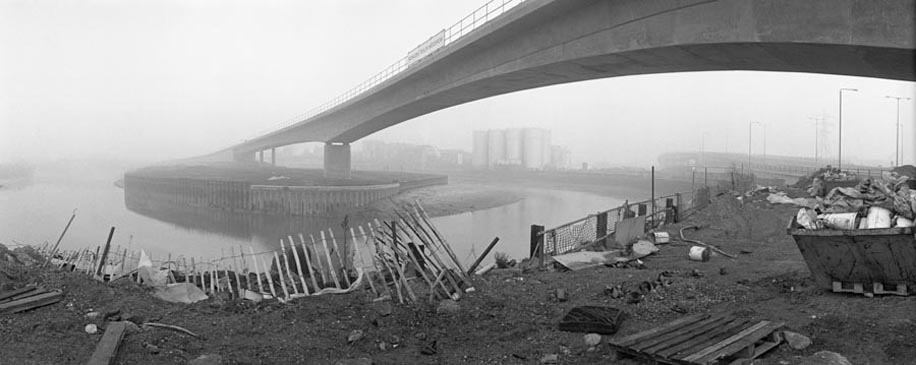
DLR at Bow Creek, © 1992 Peter Marshall
Definitely not Sudek, but one of my panoramas – some others are on the Urban Landscape web site.
Right Click in sensible browsers and select ‘View image’ to see the picture larger.

One site that has a few (it is poorly written – scroll far to the right to find images) compares some of Sudek’s Praha Panoramaticka images with 1992 images at the same locations by  Peter Sramek. Although it is sometimes interesting to see the differences time has made, Sudek’s work has a quality that sets it at a quite different level to the later work.

Peter Goldfield

It was with great regret that I heard this morning of the death of Peter Goldfield who gave so much to many photographers through the workshops he ran at Duckspool as well as his own photography and teaching at various universities over the years.  He was a clever and kind man who was always a pleasure to meet and although I’ve seen him only infrequently over the years I’ll miss him; it is a great loss for photography in the UK, and of course much more so for his family and close friends to who I extend my sympathies.

I first came across Peter, like me a Londoner born in 1945, in the room above his pharmacy in Muswell Hill in the early 1970s. Goldfinger Photographic was for many of us an introduction to ideas of fine printing particularly with the publication of the Goldfinger Manual, and perhaps more importantly was the source of that Holy Grail for fine printing, Agfa Record Rapid, imported specially by Goldfinger and not otherwise available in the UK.

A couple of years later I met him briefly at his home nearby and was introduced to his family before being driven by him to a workshop – I think it was with Lewis Balz – at Paul Hill‘s Photographers’ Place in Bradbourne, Derbyshire.

It wasn’t the first visit there for either of us, and it was a place that played a vital role in both of our lives, particularly pivotal for Peter. It was perhaps surprising we hadn’t met there before, but we found we knew many of the same people and similar ideas, as well as appreciating many of the same photographers. For him the forming experience had been a workshop with Charles Harbutt, while for me a series of meetings with Raymond Moore made a lasting impression.

You can see and read much more about him on his web site (he started on the web in 1995, the same year that I wrote my first web site.)

I went to two workshops at Duckspool, where Peter and his wife Sue were splendid hosts, and have happy memories of both. One was with Charles Harbutt, and it was indeed a memorable and thought-provoking experience; perhaps had I met him 20 years earlier it would have changed my life too.  The second, in 1998, was with Leonard Freed who I warmed too rather less, but it was great to be at Duckspool again.

I wrote an article about the experience for a small magazine I was editing at the time, London Independent Photography’s LIPService, and I’ll reproduce here most of the text from that, as well as the pictures from the workshop I used to illustrate it. I hope it will bring back some fond memories to some of my readers as it does to me.

Duckspool

Readers who have yet to make it to Duckspool are missing one of the more rewarding and intensive experiences available to the photographer. The chance to work with one of many well-known photographers (including John Blakemore, Mark Power, Martin Parr, Homer Sykes, Fay Godwin, John Davies, John Goto from this country and distinguished visitors such as Judy Dater, Susan Meisalas and Charles Harbutt) as well as the other keen and often very talented photographers who are your fellow travellers.

Sidmouth, 1998 © Peter Marshall

Your only difficulty is in chosing which workshop to attend. Probably the best advice is to read the workshop descriptions very carefully and to talk to as many people who have already The best-known photographers are not always the best teachers so you may get better value from some of the less familiar names. One workshop I’d recommend from personal experience – and I know has changed some people’s lives radically – is Charles Harbutt’s. (Peter Goldfield went to it at the Photographers’ Place and decided to sell up his business and found Duckspool!) One of the first photo books I bought was Harbutt’s Travelog published by MIT in 1973.

Sidmouth, 1998 © Peter Marshall

Since 1986, Peter and Sue Goldfield have opened the doors of their rural Somerset home to photographers with some 25 workshops this year – and you really are made to feel at home. The accommodation in shared rooms is comfortable and the food was even better than when I last visited some five years ago, which takes some doing. However possibly not every workshop will have a meal cooked by a visiting French chef and enjoy one of the best pub meals I’ve had, but the Goldfield standard is in any case a hard one to beat.

Sidmouth, 1998 © Peter Marshall

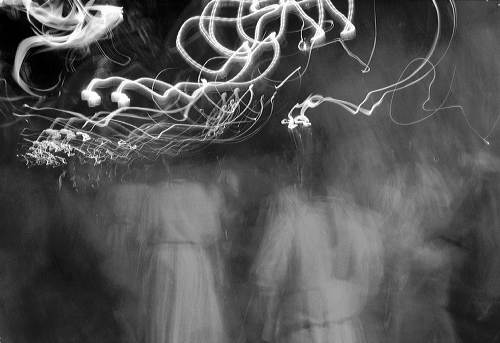
I’m told the darkroom is much improved since my last visit, although I didn’t use it, with developing and contact printing being done expertly by the artist in residence (thanks again Julia!), leaving us more time to talk photography and take pictures (we photographed Sidmouth, then in the throes of its annual Folk Festival – reducing the average age on its streets by a factor of at least three – which climaxed with a torchlit procession to the sea).Some people also made use of Peter’s expertise in the digital darkroom, with interesting results. My only regret was having to leave Duckspool at the end of the workshop (worse, a little before the end, as I had a train to catch) as there was so much more I would have liked to have done and said. And the food!

Amen Sister!

2008 has been a year that has seen a few interesting developments in photography in the UK, although also a year that has left many of us considerably poorer. Many photographers have seen their incomes fall sharply with clients going out of business, staff jobs being axed and an increasing use of images from free or cheap sources. Many publications seem to think that anything that will fill a suitable size rectangle on the page will do and are not willing to pay the rate needed to sustain professional work.

I heard a week or so back of one local newspaper offering a ‘day rate’ of £25 – and still finding people who would take it, while others are now relying on amateurs to send them pictures for nothing but having their name in small print next to them.

Not of course that their is anything necessarily wrong with amateurs – much of the most interesting photography over the whole history of the medium has come from people who supported themselves by other means (or relied on partners, friends or families to support them,) or was the personal work of photographers whose professional work was generally tedious and mundane.

And many photographers who became famous through their actual professional work of course still often produced a great mass of uninspired bread and butter images. One of the problems we now have is that curators have a great delight in bringing this out and presenting it on walls as great previously unknown art. The truth generally remains that there are very good reasons why these images were obscure, but there is no career-enhancing kudos for curators in repeating – for example – to show the pictures that Henri Cartier-Bresson chose to include in his ‘The Decisive Moment.’  (You can now usefully see the entire book online, although of course the quality of reproductions is so much better in the real thing.) And yes, even H C-B had his off-days, and it is hardly surprising that the title “the Pope of Photography” has most often been applied to a curator – John Szarkowski – rather than a photographer.)

There have been some encouraging developments this year. Photographers often like to bitch about the British Journal of Photography (not least when it asks to use their work without payment) and there are sometimes very good reasons for this, particularly in some of their coverage of equipment which at its worst can be little more than a round-up of press releases or a display of personal prejudices, but in my eyes their coverage of photography has certainly improved. This was brought home to me when I cleared out the shelves containing several years of back-issues before Christmas.

One innovation for the BJP this year was its rather curiously named blog, 1854, a reminder that the print magazine is extremely long in the tooth. One of the great things about blogging is that it forces you to read other blogs, and although 1854 hasn’t yet become a useful source of information for me (usually I’ve read it first on the same blogs as them!) it does mean that its writers, “the editors of the British Journal of Photography, the world’s oldest photography magazine” at least keep up to date with “photographic news, from the latest gear to the best exhibitions to the best insights on ongoing and upcoming trends in the industry” which I’m fairly sure accounts for the improvement I’ve noticed in the print issues. Though there are perhaps one or two of their contributors who still need to start blogging!

At least for those of us who live in London, one of the big developments of the year – and one the BJP largely neglected – was the tremendous growth of the East London Photomonth. Of course there are some other photo festivals in the UK, but this is the only one of any moment in the capital and with around a hundred events this year beginning to make an impact.


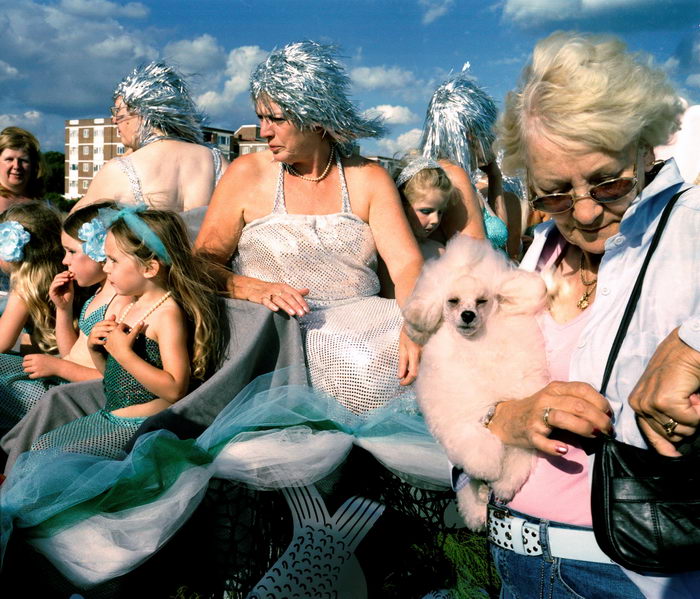
The Mermaids and the Poodle, Hayling Island Carnival, 2005.  Paul Baldesare from the show “English Carnival“, part of the Photomonth I was also in.

Of course it still has a very long way to go to rival Paris – which is why I spent eight days in that capital this November (which you can read about in great detail both in many posts about the shows here on >Re:PHOTO and also in my  Paris Supplement to My London Diary.

One of my first posts on arriving back from Paris was Paris and London: MEP & PG which compared our London Photographers’ Gallery with the Maison Europeene de la Photographie (MEP).

The main thrust of my piece was in the third paragraph:

but the biggest difference so far as photography is concerned is one of attitude. The MEP clearly believes in photography, celebrates it and promotes it, while for many years the PG has seemed rather ashamed of it, with a programme that has seemed to be clearly aimed at attempting to legitimise it as a genuine – if rather minor – aspect of art.

So I was interested to see that when the BJP’s report (BJP 17/12/2008 p6) of the PG’s opening on its new London site (my account,  Zombies in Ramillies Street, on >Re:PHOTO was rather different) commented that gallery director Brett Rogers “hopes that the gallery will reach an equal footing with organisations such as the Maison Europeene de la Photographie in Paris“.

Amen sister! So do I, but I’ve yet to be convinced that we are singing from the same hymn sheet!

Hard Sixties

Another interesting show from Le Mois was at Galerie Galerie David Guirand  in the rue du Perche with John Bulmers ‘Hard Sixties: L’Angleterre post-industrielle,’ which closes 20 Dec.   This small gallery had a series of black and white and colour images from the 1960s taken in the north of England, particularly around Manchester.

Bulmer studied engineering at Cambridge, going on to become a freelance photographer working for the Daily Express and Town Magazine before The Sunday Times, Life, Look and other magazines sent him around the world. In 1972 he worked as photographer (cinematographer) on a BBC film directed by Mai Zetterling about Vincent Van Gogh which won a BAFTA award for documentary, and after this he made his career mainly in film, although continuing to take still pictures as well.

He has directed over 30 films, photographing on many of them and also on other films. Now approaching 70, he lives in rural Herefordshire (not far from where another Bulmer, Percy, founded a cider empire in 1887) and is working with his archive of images, most of which have never been published. As yet he doesn’t appear to have put any on the web.

The show contains some dramatic images of the times, showing a clear liking for fairly extreme wide-angle views – several looked as if taken with a 21mm lens. The harsh printing of the black and white work also added to the gritty feel of the work, which did very much seem to mirror life in some of the poor and deprived working class areas which they depict.

This was a time when the colour supplements and magazines were increasingly publishing colour images, although many documentary photographers were reluctant to use colour, with its added technical problems. The magazines wanted colour transparency, and many of an older generation of photographers had never had to bother with exposure meters before. Bulmer’s colour work stands out from this era, although I felt his black and white images were more confident and perhaps more true to the subject.

For most of the sixties I was a student, and seven years of my life were spent in Manchester.  For much of that time I lived in working class areas not a great deal different from many of those where he took his pictures, but although I owned a camera (a Halina 35x), I didn’t have the money for film. Photography then was still largely a hobby for the middle class, and those of us with little money made do with a film a year  for our holidays.  At the time setting up a darkroom was beyond my dreams. Living in small flats there was no room – and we had no money.

My daily journey across Manchester in 1970 to my first job in a small town in its northern outskirts took me on the smoke-filled upper deck of a bus through miles of closely packed terrace houses,  across the dead and dreary wastes of council estates, past a working colliery and varied industries including a wire works, canals, mills and the inevitable gas works and gas holders.It was a vivid grandstand view of a slice of the industrial north for a few pence twice a day.

All of these industrial sites were on the edge of extinction and much of those older areas of housing have been bull-dozed. My journey today would be completely different  Bulmer’s work is a valuable record of and England that has changed, if not always for the better.

Retour en Lorraine, bar Floréal & Willy Ronis

Retour en Lorraine
bar Floréal
43, rue des Couronnes, 20e
7-30 Nov, 2008

In 1979, when workers in the steel industries of Lorraine were under threat of closure and there were strikes and violent disorder, centred around the steelworks of the basin of Longwy, Alex Jordan et André Lejarre went there to photograph the people and the dispute, producing some powerful black and white images in the ‘concerned photography’ tradition. Despite a long struggle in which their pictures played a part, as did the first free radio station, Lorraine Coeur d’acier (Heart of Steel), the industries closed.

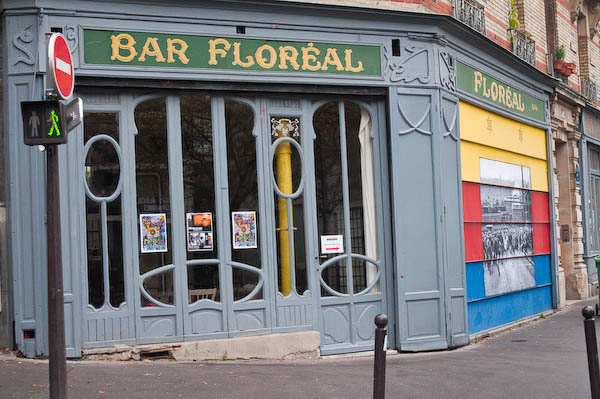
Jordan and Lejarre went on to found  le bar Floréal photographie in 1985, a photographic centre in Belleville in the north-east of Paris (20e). It became a thriving centre for photography in the area, run by a collective of photographers, and noted for its great shows and crowded openings. The name comes from the eighth month of the revolutionary calendar and means flowering, and ran for the 30 days (3 decades) starting on April 20 or April 21.

In 2008, the ten members of the collective, including Jordan and Lejarre returned to Lorraine to photograph the same area – the others were Jean-Christophe Bardot, Bernard Baudin, Sophie Carlier, Éric Facon, Marc Gibert, Olivier Pasquiers, Caroline Pottier and Nicolas Quinette. (You can see more about the photographers with links to their work elsewhere on the Bar Floréal photographers page.)

What they found was in many ways depressing but typical, with many former skilled workers unable to find suitable work, some moving across the bored to Luxembourg to find work, ex-miners retraining to become Smurfs in an entertainment park…  As we have seen in many areas of this country, de-industrialisation isn’t easy.

This was certainly one of the more interesting shows in the Mois de la Photo, and one Linda and I would have liked to spend much more time at. I think if I lived in Paris I would end up spending an awful lot of time at this particular bar. But then I was born on the 25th (or Carpe) Floréal CLIII!

The show was also on at la Maison des métallos, a cultural centre owned by the city of Paris, not far away in the 11e. Next year there will be a book published to accompany the show as it opens in Lorraine, at first in Mont-Saint-Martin and later in Longwy itself.

At the bar Floréal, I notice a thin book about one of the great photographers of Paris (and one I wrote a long feature on a few years ago) Willy Ronis, whose finest work was all from Belleville, where he started taking pictures in 1947. Published for a show they had of his work in 1990, it described his favourite walk around the area by contact prints and illustrated with larger reproductions of some of his better images.

La Traversée de Belleville isn’t listed on their page of books, but it was truly a bargain, as when I offered the 5 euros to buy a copy, I was told that they were all damaged by damp during storage and given a copy for nothing. A few pages were slightly stuck, but with a little careful handling came apart with no damage.

It was pleasing but perhaps a little disappointing to discover that Ronis’s favourite route around the area was almost identical to mine, and that I had already walked most of it yet again a couple of days before. But we decided to fit in another walk following his footsteps if we had time before we went home. I’ll post my pictures from that walk on My London Diary in a few days.

Daring to Look

The latest issue of The Digital Journalist as always contains much of interest. One item that particularly struck me was a review by by J B Colson of the book by Anne Whiston Spirn, “Daring to Look,” which takes a new look at the work of Dorothea Lange and appears to give a much more detailed insight into how she actually worked.  She concentrates her attention on the projects Lange undertook in 1939.

The link at the bottom of the page leads to a good selection of Lange’s work, mainly from the collection of the Library of Congress.  You can of course go and see more there;  a Creator serach on Dorothea Lange returns over 4000 records, and most appear to have digitised images. So here is one you almost certainly haven’t seen before!

Library of Congress Prints and Photographs Division LC-USF34-009747-E
Wife and sick child of tubercular itinerant, stranded in New Mexico, Dorothea Lange, 1936 Library of Congress Prints and Photographs Division,

There is a special feature on the variants of her ‘Migrant Mother‘ picture and if you would like your own print to hang on your wall you can download a 55Mb Tiff file made from the original nitrate negative (55 Mb may well take some time to download.)  A 30Mb TIFF made from a print is also available, but shows considedrable damage to the print.

You can also read the story of this picture from another point of view. According to the grandson of Florence (Owens) Thompson, the woman in the picture, a well-dressed woman jumped out of a smart newish car and started taking pictures, getting closer with each shot. Florence decide to ignore her.

After taking the pictures, Lange is said to have told Florence who she was and that she was working for the Farm Security Administration and to have promised that the pictures would not be published. Next day they made the front page of all the newspapers.