Hopper & Photography

Edward Hopper has long been one of my favourite artists, and Walker Evans one of my favourite photographers. Both of them had their first show at the Museum of Modern Art in the same year – 1933, and that certainly isn’t simply coincidence. But it may make it rather hard to disentangle their relative influences on our medium.

Apparently there was a show in Essen, Germany in 1992 on Hopper’s influence on photography, but I don’t recall reading about it at the time, though I suspect there is something hidden away in the piles of old photo magazines in my ‘study’, and that and another post on the same blog talk about the Vienna show last winter, Western Motel. Edward Hopper and Contemporary Art, including work by photographers Philip Lorca diCorcia and Jeff Wall and other artists.

A short search on the web also reveals images such as Jack Delano’s 1940 ‘Children in the tenement district, Brockton, Massachusetts’ posted under the heading Paging Edward Hopper: 1940, and posts such as Linda Marion‘s about the 2003 show at the Whitney, ‘Edward Hopper and Urban  Realism‘ perhaps go a long way toward explaining the coincidences between painting and photography. The Washington Post’s photography columnist, Frank van Riper, also contributed a very readable piece on Hopper when there was a huge Hopper retrospective at the National Gallery of Art in Washington in 2007-8.

But it’s still welcome to see Edwin Hopper & Company by Jeffrey Fraenkel (of the Fraenkel Gallery) with an essay by Robert Adams, and some of the articles related to it in the media, including Edward Hopper’s Influence by Claire O’Neill (on NPR) and The New York Times feature on the show earlier this year at the Fraenkel Gallery – and there is also a related slide show.

And if like me you didn’t make it to San Francisco, you can see a series of installation views of the show on the Fraenkel Gallery site. It all adds up to rather a treat for lovers of Hopper and photography, whatever conclusions you draw about it.

New Topographics – Broadcast

Curator of photographs at George Eastman House, Alison Nordstrom talks to Brenda Tremblay  of Greater Rochester area public broadcasting organisation WXXI about the rather curious history of a small photographic exhibition that almost nobody saw which influenced a whole generation of photographers.

Of course we all know about the ‘New Topograpics’ or at least we think we do.  But certainly I found her short talk of considerable interest.

Of course I wrote previously about the new version of this show currently at George Eastman House and later touring – though not here.  Nordstrom mentions the slim catalogue for the original show – you can see a picture of it here. It had 23 black and white and one colour photographs- and 2500 copies were printed. The price Nordstrom suggests is considerably more than that paid in this 2004 auction. Also on Photoeye you can see more about the new book on the show by Nordstrom and Britt Salvesen, coming from Steidl at the end of the year. 

PHotoEspaña 2009 Awards

You can read the details of the PHotoEspaña 2009 Awards on their web page (in English) but the two major awards, the PHotoEspaña Baume & Mercier 2009 Award went to Malick Sidibé (Mali, 1935 or 6), and the  Bartolome Ros Award to Spanish photographer Isabel Muñoz, born in Barcelona in 1951 and based in Madrid.

 Malick Sidibé

I’ve written on several occasions about Sidibé who has become deservedly well-known over recent years and last year was  given the 2008 ICP Infinity Lifetime Achievement award. He opened his portrait studio in Bamako in 1962 and among his other awards are the Hasselblad Foundation International Award in 2003. Lensculture has some pictures by Sidibé, and a transcription of an interview with him.   Hacklebury  also has a selection of his pictures and a brief biography while the Jack Shainman Gallery have an installation view of one of his shows and some works in their frames.

Isabel Muñoz

What strikes me immediately about the work of Isabel Muñoz, which you can see on her web site (her projects are under the link ‘La Obra‘, but ‘Making Off‘ throws some light on her methods) is both the precision of her black and white work, but also its enormous theatricality. It’s work that I admire greatly, but perhaps it sometimes leaves me a little cold.

There is also a gallery of her pictures from Ethiopia on LensCulture, as well as ten minutes (plus three)  of her in conversation with Jim Casper – another of his often revealing interviews (needs Quicktime – unfortunately QuickTime Plugin, v7.1 is blocked by Firefox 3  on Windows. ” Reason: remote code execution in multiple versions” so I had to switch to Internet Explorer – and presumably take a a risk!)  Muñoz talks in some detail about the subjects of her pictures and working with them.  She works on medium format, making large digital negatives (thanks to Dan Burkholder‘s methods) for platinum prints as well as normal silver prints.  In Ethiopia she also used a digital camera and made colour prints – and found the digital camera gave her a different relationship with her subjects.

Capa Again

Do we care if that picture of a falling soldier really does or doesn’t show the actual moment when a Republican fighter died for his cause?  Whether it was taken during actual fighting, or during a training exercise, or when a soldier acting out an attack for the camera got into the sight of a distant sniper? What does seem clear if you look at the surviving images by Capa is that neither Phillip Knightly or Richard Whelan (link above)  provided a believable solution to the enigma (see in particular comments #7 and #10 on the piece.)

The story seems to be one that will never come to an end – and you can read about the latest instalment in a feature, Wrong place, wrong man? Fresh doubts on Capa’s famed war photo, published in the Observer last Sunday. There is an audio slide show which takes a look at some of the evidence. Although I’d need to see rather  more before making any judgement; in particular it’s a shame that the José Manuel Susperregui, whose book Sombras de la Fotografía gives the evidence, apparently didn’t take a rather better photograph, preferably in black and white and with suitable lighting, than the one shown.

Capa’s picture was I think captioned and published in his absence by Vu magazine in September 1936, and it may well have come as rather a shock to him when he first saw it on the magazine page, although the caption there was almost certainly deliberately vague, and it was Life the following year who made it into the legend of the Falling Soldier. He was – as his writings show  – a great story-teller, and whatever the real story behind this image it would have been very hard to resist that provided in first publication.

Photojournalism is very much about telling stories, about giving our view of events, of finding ways to express what we feel about what we see; CCTV seldom provides great news images.  The power and fascination of our medium is very much tied up in the relationship between reality and the image and also between our experience and how we relate it in images. Susan Sontag, quoted at the end of the audio clip, really oversimplifies to the point of irrelevance. (But that’s ‘On Photography‘ for you.)

But images, particularly ones as iconic as ‘Falling Soldier’ have their own lives.  Although when made it was news, it soon became something else, a symbol, detached from the actual events (whatever they were) of its creation.

So while it was of vital import at the time the picture was made – and the public was almost certainly mislead at least to some extent – it is now frankly of academic interest.  And of course this is a book by an academic, if one that seems rather more  interesting than most such productions.

New Topographics Revived – No UK Show

In 1975, I was one of many youngish photographers to be excited and to an extent influenced by the work shown in an exhibition at George Eastman House curated by William Jenkins called “New Topographics: Photographs of a Man-Altered Landscape.” Not that I went to Rochester, but I read the reports in the US magazines, looked at books and catalogues, and at pictures which did come over to exhibitions here, and even went and did a workshop with one of the photographers included, Lewis Balz. (The full listing of those included: Robert Adams, Lewis Baltz, Bernd and Hilla Becher, Joe Deal, Frank Gohlke, Nicholas Nixon, John Schott, Stephen Shore, and Henry Wessel Jr.)

I think you can see a certain influence in some of the work I’ve done since then, particularly on the urban landscape, a genre central to the show.  Without it I don’t think I would have set up the Urban Landscape web site, or produced many of the images on it – such as this of the DLR at Blackwall:

Blackwall © 1984 Peter Marshall
DLR Blackwall, 1994, Peter Marshall

The NPR article on the show, with a slide show of a dozen images that is worth viewing at full screen – for once you really do get larger images, not just fuzzier ones, is surely quite wrong to state that the paradigm shift this show produced “was imperceptible at the time.”  To photographers such as myself it was as imperceptible as a thunderbolt.

The reason for the feature is that a new version of this show, new version of this seminal exhibition, organized by  George Eastman House with the Center for Creative Photography at the University of Arizona opens at GEH on Saturday, June 13 and runs until Sunday, September 27, 2009. As well as 100 works from the 1975 show, it also has “some 30 prints and books by other relevant artists to provide additional historical and contemporary context.”

After Rochester the show will travel to eight international venues.

  • Los Angeles County Museum of Art (Oct. 25, 2009–Jan. 3, 2010);
  • Center for Creative Photography (Feb. 19–May 16, 2010);
  • San Francisco Museum of Modern Art (July 17–Oct. 3, 2010);
  • Landesgalerie Linz, Austria (Nov. 10, 2010–Jan. 9, 2011),
  • Photographische Sammlung Stiftung Kultur, Cologne (Jan. 27–April 3, 2011);
  • Jeu de Paume, Paris (April 11–June 12, 2011);
  • Nederlands Fotomuseum Rotterdam, the Netherlands (July 2–Sept. 11, 2011);
  • Bilbao Fine Arts Museum, Bilbao (November 2011–January 2012).

Like me you may well be devastated but hardly surprised that no venue in the UK is on this list. After all it is a major photography show, so you can’t expect the Photographers’ Gallery or the Hayward or the Barbican to take much interest.

Top Taos?

I’ve never been to Taos, New Mexico but the The Church of St. Francis of Assisi is very familiar, having been photographed and painted by many. James Dansiger posted three photographs, by Ansel Adams, Laura Gilpin and Paul Strand – all intrigued by the forms of the rear of the building – the other day in Spirit West and asked readers to pick their favourite – and also to send in their own pictures.

Danziger says you can no longer take a view like Adams et al, as the adobe church is now surrounded by power lines and buildings.  In Reader Comments,  he includes a number of more recent photographs, which perhaps suggest the situation  isn’t as bad as he suggests. His readers don’t manage to come up with any very great pictures – and display their lack of taste by preferring Adams to Strand. But more interesting is the image at the top of that second post, another image of the back of the church, inviting us to guess who took it.

Looking at it, and particularly the tonality and and hooded figure in the foreground my mind immediately jumped to the great Spanish pictorialist and master of the direct carbon process, Jose Ortiz Echague, but a closer look – by clicking on the image – told me I was wrong – perhaps misled by a poor reproduction of an indifferent print. I won’t give the game away, but look carefully at the top edge of that picture and you too may immediately come to the same – correct – conclusion as me.

You need a clue? Page down

.

.

.

.

.

.

.

.

.

.

.

.

.

.

.

.

.

.

.

.

.

Those Leicas were very fiddly to load! But even when he got it wrong he almost never cropped.

Don McCullin’s Selection

The National Media Museum has a fine collection of early photography, and Don McCullin, one of the better British photojournalists of the 20th century was invited to pick images of archaeological sites around the Mediterranean taken in the 19th and early 20th century to go on line on Flickr (he has a new book of similar sites taken recently.) They are also available as a slide show, which I found technically disappointing.

Possibly better still, if you can manage to get to the Museum’s Collections & Research Centre – for some reason they call it Insight on Wednesday 3 or10 June at 2pm or Sundays 7 and 14 June at 12pm you, together with all the others who’ve come, can see them for real.  It may be in a rather obscure place, but  even so I’d be surprised if the numbers are small enough to make this a worthwhile experience.

McCullin’s show at the Museum until Sunday 27 September 2009 in covers his personal vision of England, and is certain to be worth a visit – and the web site also has a number of video clips of the man talking about his life and work. There is also the full 70-minute podcast of Don’s talk with exhibition curator Colin Harding, recorded live on 8 May which you can access from this page.

According to the Flickr page, “Copies of the photographs selected by Don can be obtained through the Museum’s picture library, the Science and Society Picture Library.” It’s a pity that there isn’t a little more co-operation between the Museum and its picture library. I searched for one of the pictures, “Maxime Du Camp (1822-1894); ‘Haute Égypte, Grand Temple de Denderah, vue genérale’ (Upper Egypt, Great Temple of Dendera, general view), 1852 ; Salt print; 16.2 x 20.8″ and failed to find it. A second search on “Maxime Du Camp” gave 8 results, none of which was by the photographer (for some reason it felt I really wanted Tony Ray Jones or Roger Fenton.)

I’ve previously bought prints from the picture library and found them to be good quality inkjet prints – in some cases better prints than the vintage bromide originals. I rather doubt if those of fine salt prints from calotype negatives would be as satisfactory.

For a rather larger and more informative selection of similar pictures take a look at Voyage en Orient from the BNF (there is an English version, but the French is better if you can.)

A Day Off?

What do photographers do on their days off?  Usually take pictures, at least while sober, and sometimes when not.  For most of us, photography isn’t just a skill or a job (or even a profession) but an obsession.

© 2009 Peter Marshall.

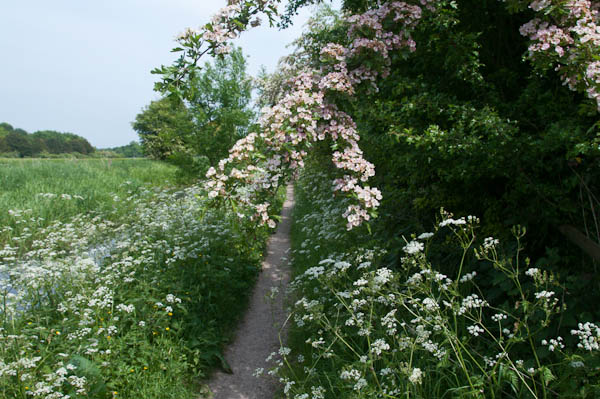
Last Monday was a Bank holiday, and rather than go an photograph London taking its Bank Holiday in different ways I went with my wife and two sons (both in their 30s) for a walk in the country. Fortunately I didn’t take the full kit, just the Nikon D300 with a couple of lenses, because it turned out to be about twice as far as I’d expected, around 18 miles.

Fortunately it was mainly along canals, and so pretty flat. And quite pretty and mainly very quiet – not quite my sort of thing at all! Probably there are far too many pictures taken along canals and as there was a canal festival going on there were lots of prettified canal boats (and for a short stretch some excruciating country music – the wrong country – over a noisy loudspeaker system.)

I was reminded of something I wrote a few years ago, about Eric de Maré, though largely because I’d then omitted to mention his great interest in canals. What I mainly wrote about was his Penguin “Photography” written in the 1950s on which a whole generation cut its photographic teeth, and a better introduction to the subject than many – here’s an edited version of what I wrote then:

A historical introduction, was followed by a chapter on photography as a creative medium, then one on composition and then five pages of quotations about photography. Only after that did it get down to a basic and readable coverage of the technical side of black and white photography.

A strong point was its use of many fine examples of the medium in its two picture sections, which included well-known works by great figures of the medium, including Werner Bischof, Bill Brandt, Julia Margaret Cameron, Henri Cartier-Bresson, Peter H Emerson, Bert Hardy, Hill & Adamson, Man Ray, Edward Weston, Clarence White and many more. The few nudes included (the only images of naked bodies allowed in our house apart from a few anthropological images in ancient back-copies of National Geographic) undoubtedly were a major part of the book’s attraction for me as a young teenager.

There is a nice short feature on de Maré on the English Heritage site, although the only canal image included is more an image of a structure than a typical canal picture.

Incidentally if you are thinking about buying his canal book, the 1987 paperback edition is readily available second-hand at under a fiver, despite some vendors describing it as “hard to find” and offering it at around 20 times the price. His “Photography” can be found for less than a quid, and most of his other books are also available cheaply, not because they are bad, but because they were popular. Some are illustrated by his generally excellent drawings rather than photographs.

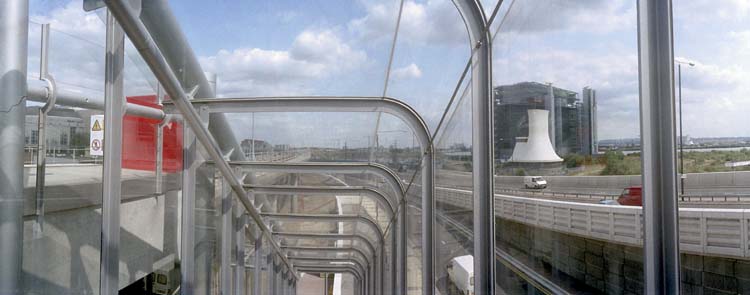
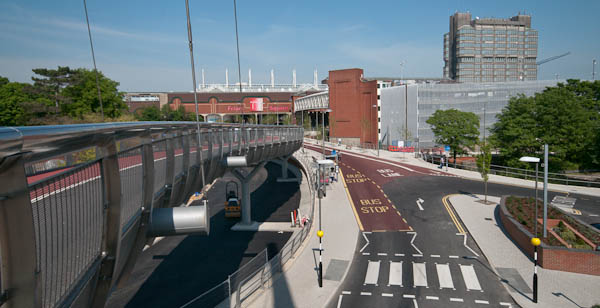
You can see some of my photographs from Monday’s route march on My London Diary. A couple appear in a roughly 2: 1 panoramic format, and were taken with this in mind using the Sigma 10-20mm (15-30mm equivalent on the D300.)  I find 10mm is often too extreme using the full image rectangle, but gives a decent panoramic.

© 2009 Peter Marshall.

The D700 (and D3) can record RAW images either for the full sensor or for the ‘FX’ cut down frame area – and with Nikon lenses at least you can get the camera to automatically switch between these as appropriate for the lens in use – or choose manually.

I actually rather like shooting with the FX format 18-200mm on this body, when you get a brightline frame in the centre of the viewfinder image, making taking pictures much more like using a rangefinder – so much better for cropping and also for action where being able to see what is just outside the image in the viewfinder is a real plus.  At around 6Mp, the cut down frames are a little short of pixels, but it’s still plenty for most purposes.

But for me it would be useful for Nikon to add a panoramic option too, that could be switched on to show in the viewfinder (and of course crop the RAW image too.)  Nikon’s 14-24mm and Sigma’s 12-24mm would be ideal candidates to use with this.  Of course there is some advantage to not cropping at the point of taking – but rather just thinking panoramic – in that the normal format image gives considerable scope for the equivalent of a rising or falling front when cropping to a panoramic format.

Hugh Van Es (1942-2009)

Dutch photojournalist Hugh Van Es, best known for his picture of South Vietnamese civilians clambering up a ladder into a US helicopter on the roof of a CIA building as Saigon fell to North Vietnamese troops died last Friday in Hong Kong where he had lived for over 35 years. When the North Vietnamese arrived he greeted them wearing a camouflage hat with “Dutch Press” written on it in Vietnamese.

Later he was one of very few photojournalists to get into Kabul when the Soviets invaded, making an escape from the airport where those who had tried to get into the country were being put on a flight out.

In 2005 he was among 60 people who returned for a 30th anniversary media reunion in Saigon.

As well as obituaries in leading newspapers (and here) there is a small gallery of his pictures on the BBC site.

Bill Jay (1940-2009)

I never got to know Bill Jay, though looking at his site I found one small thing that we had in common; both of us were first published in Practical Photography. I got seriously involved in photography a little after he had given up editing Creative Camera and just after the splendid but short-lived year of issues of his own magazine Album.  He had moved to America, at first to study with Van Deren Coke and Beaumont Newhall at the University of New Mexico, and then going on to Arizona State University where he founded the Photographic Studies program. I heard stories about him (few of which could be repeated in print) and later read many of his essays and several of his fine books on photography, and saw his portraits of photographers.

Bill Jay died peacefully in his sleep last Sunday, in Samara in Costa Rica where he had recently gone to live.  His web site show the great debt we owe him as well as his great generosity, offerening free downloads of his many articles about photography, as well as 11 of the of 12 issues of Album.  I’ve a few of the original issues, but I’ll certainly download the rest to complete my set (or rather almost complete it, as issue 9 is missing,) though they are around 15-20Mb each, so don’t try this on dial-up.

Jay had a great love for photography, and was a decent photographer, as his portraits of photographers and others show, but looking at the portraits of the perhaps 30 of so in his list that I’ve met, there are few that really seem to catch the person for me; his real strength was as a writer. Writing about photography well isn’t easy and many of his articles required a great deal of painstaking research as well as the actual writing. Thanks to him we know a great deal more about some of the less obvious aspects of our medium, but perhaps more importantly his writing has inspired others – photographers included – to think and appreciate the medium more deeply.