Paris on Sepia Town

Sepia Town is a great site that I’ve mentioned before that maps historical images, mainly photographs, from cities around the world on to Google maps so you can see from Street View what the places in the pictures look like now.  Hidden away in its view of London are a couple of my pictures, taken before 1980 which I think is Sepia Town’s  definition of a historical image.

The latest news on the Sepia Town blog is that they now have added some of Atget’s images of Paris to the site for us to enjoy.

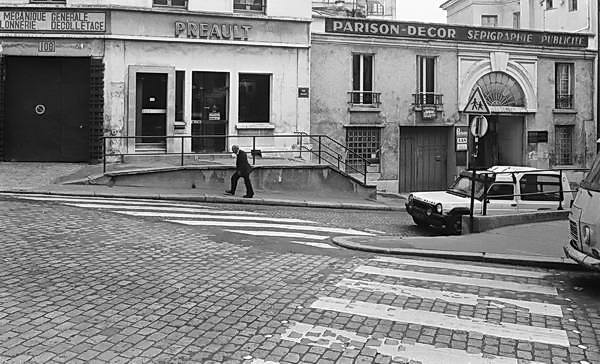
There are a few of my own pictures of that city which I might add, when I have the time, but you can already see a selection of the images that I made there in Paris 1973 ,

© 1973, Peter Marshall

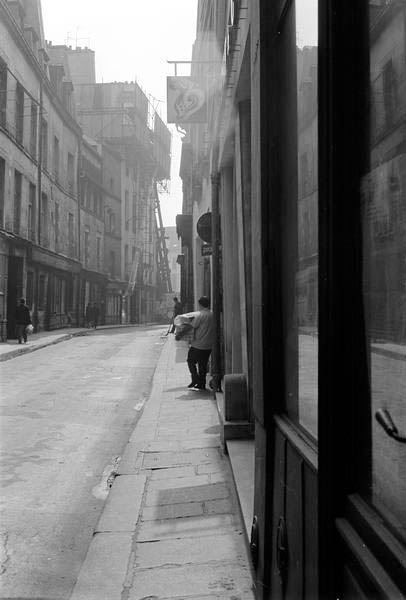
although the work that I took more consciously based on Atget came a few years later, in Paris Revisited, taken in 1984, which I put on line earlier this year.

© 1984, Peter Marshall
Quai de Jemappes / Rue Bichat, 10e, Paris, 1984

The other work from the 1970s that I intend to put on Sepia Town is from Hull  (sometimes known as Kingston upon Hull) where at the moment there are no pictures at all. A few of mine are on the Urban Landscapes web site.

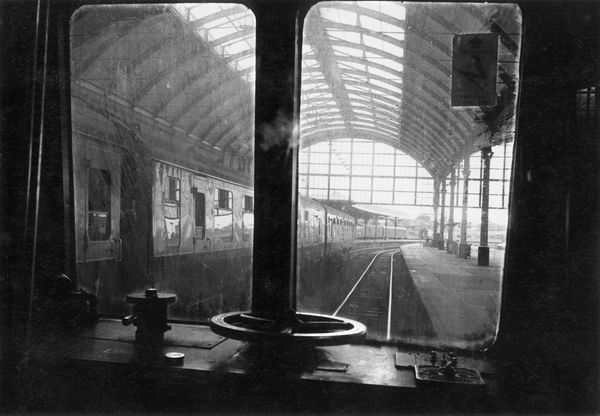
© 1975-83, Peter Marshall
Hull Paragon Station

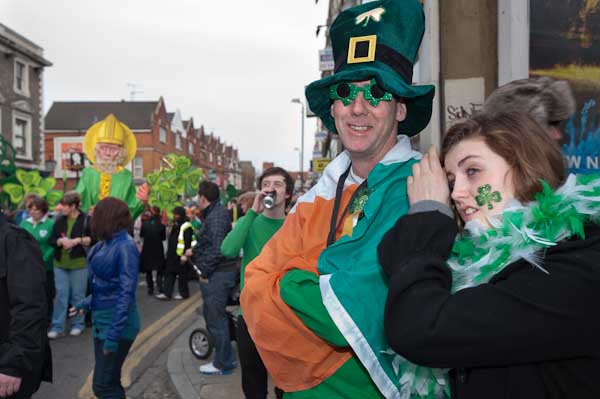
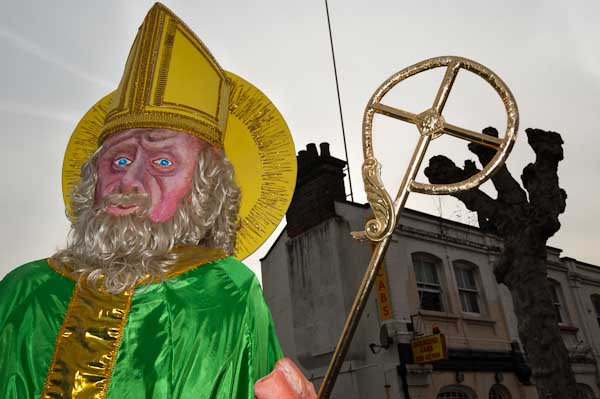
St Patrick’s Day

It’s taken me a week to get round to writing about St Patrick’s Day, mainly because I’ve been busy working taking other pictures and getting them on line since. If you want to keep up with what I’m doing then much of it appears on Demotix, and I post updates  on my work on Twitter and Facebook. Here I try to reflect on things a bit more rather than simply cover events, and that takes time and sometimes there isn’t a great deal to reflect on.

St Patrick’s Day was a little different for me this year because I went to it with a photographer who has made covering these parades one of his specialities, although mostly in the USA where they take these things rather more seriously. And who comes from an American-Irish family and grew up in the the Bronx. I first saw John Benton-Harris’s pictures in ‘Creative Camera‘ many years ago and he had a fine portfolio in one of their year books, but little of his work is currently available, which is a great loss. I can only find 3 images on the web, none well reproduced, one from Derby Day and two (click on the thumbnails to see them) from St Patrick’s parades.

Before the parade John and I went to a couple of exhibitions, one the ‘History of Photography‘ on fairly permanent display at the V&A which seemed very much not to be a history of photography but some rather random items from their large collection (and perhaps mainly chosen for their size.)   There are a few interesting images but it’s hard to see any particular justification for the particular selection. A couple seemed to be rather poor prints – the Robert Frank is damaged and the Don McCullin seemed rather too dark, and there were a few that the only justification for their presence was that they represented the fact that many photographs are bad. It did cheer me up a little to find that several of the better pictures were by photographers I know or have met. The one image that stood out for both John and I was probably the smallest in the show, Dorothea Lange’s ‘White Angel Bread Line.’

Also in the gallery is an exhibition about the first ever museum exhibition of photographs, held at the V&A in 1858.  Consisting of work from the Photographic Society of London and the Société française de photographie  there were the huge number of 1009 photographs on show, and you would have had to get down on your hands and knees to see some and stand on a chair to see others as they were hung 5 or 6 prints high from about six inches to what at a guess is around 7 foot. The photograph of some of them by the museum’s photographer is the earliest known photograph of a photographic exhibition.

We also dropped in to the Michael Hoppen gallery in Chelsea on our way to the V&A, but neither of us was impressed by the pictures of fashion photographer Fernand Fonssagrives (1910-2003), most of which were of his first wife, Lisa with her elegant torso covered with shadow patterns.  It was something that Man Ray had played with earlier (and I suspect others too) but I couldn’t see any great interest in the work though some of the other pictures were of more interest. Lisa Fonssagrives became rather more famous as a model and after their marriage ended in 1950 she married Irving Penn, while Fernand went to Spain and became a sculptor.

And yes, I did take some pictures in Kilburn. Perhaps the one I like best is this:

© 2010, Peter Marshall

though there are others, particularly some of the kids and the old ladies that have a charm (and sometimes an Irish charm.)

© 2010, Peter Marshall

And I quite like this one of the English saint whose day it is.  (The Irish of course came and kidnapped him from Somerset.)  More pictures on My London Diary.

Friedlander’s Diet

I’m not sure that the video of Lee Friedlander compiled by Mark Schwarz has a great deal to recommend it, though it could perhaps be seen as an ironically satirical comment on a US American lifestyle, but I’m afraid it really is straight-forward piece of genial Californian whimsy for Mr Lee’s 75th birthday on 14 July 2009.

But the site, AMERICAN SUBURB X,  does have a wealth of interesting material, including an illustrated article on Friedlander by Rod Slemmons, Director at The Museum of Contemporary Photography, and another by Carol Armstrong, professor of art and archaeology and Doris Stevens Professor of the Study of Women and Gender at Princeton University, written at the time of his 2005 MoMA show which may well enlarge your vocabulary, though I find her style akin to torture.  But academics certainly get brownie points for that.

Of course lots more about lots of other photographers including Aaron Siskind and William Klein – and quite a few alphabetically in between on its ‘ASX Channels.’  As well as some whose names I won’t mention without mouthwash to hand.

Among the various articles, there is one by Paul Graham, from his presentation at the first MoMA Photography Forum on 16th February 2010, The Unreasonable Apple in which he likens the art world’s approach to straight photography to “the parable of an isolated community who grew up eating potatoes all their life, and when presented with an apple, thought it unreasonable and useless, because it didn’t taste like a potato.”

Mark Power on Tony Ray-Jones

Regular readers of my posts will know that Tony Ray-Jones is one of my personal photographic heroes, although I never knowingly met the man but we possibly attended some of the same openings and other events in London before his tragic early death in 1972. I also own several of his pictures, and one of the relatively few prints that he made himself hangs on my wall, from his ICA show. The others are cheap inkjet prints from the Science & Society Picture Library which I think are better quality than most if not all of the silver gelatin prints that have been made direct from his negatives. Although these now cost £15 for an A4 print (more than a 50% increase since I bought mine), the last time I saw a gallery show of his work the asking price for the inferior prints on display was more than 100 times this.  Collecting good photography needn’t be expensive – just avoid the art dealers.  Some photographers, including myself, sell their work at reasonable prices directly from the web too.

One of the essential aspects of photography has always been its reproducibility, the ability to make a theoretically infinite number of copies from a negative. (Of course this was not true of the daguerreotype – and this is just one reason why this is no longer a popular process!)  The switch to digital, whether at the point of exposure or in scanning negatives, has made this process even easier. It has also revolutionised printing, enabling us to get more out of our negatives, particularly those where the exposure was not optimal – and apparently although Ray-Jones was a great photographer he was certainly  not a great technician.

Although a few have sought to deny it, Tony Ray-Jones had an undeniably enormous influence on British photography in the 1970s, not just through his own work, but also because he and a few others were largely responsible for getting a huge swathe of mainly American photography, hitherto only known to a few cognoscenti (including of course some established British photographers who were well connected through international agencies) out to a new generation of photographers, through magazines  and particularly ‘Creative Camera, where the then editor Bill Jay first published Ray-Jones’s personal work in the UK.  You can read about these on Weeping Ash, a great web site by Roy Hammans  which includes a great deal of writing on both Ray-Jones and Creative Camera, and of course quite a few photographs.

But what prompted this post was an article on the Little Brown Mushroom Blog, where Charlie B Ward has been asking photographers about the “first photo book that you can remember buying or seeing that really had a strong affect on you?” and Mark Power‘s answer was A Day Off – Tony Ray-Jones (Thames and Hudson 1974). But of course he had something more to say about it in a story that includes wading into ice-cold water to photograph a whale and unrequited love, and makes interesting reading. Boringly I think I just bought the book from the Creative Camera Book Room.

You can still pick up copies at least of the US edition of this work at a not unreasonable price, but the recent volume Tony Ray-Jones (ISBN:095428139X) published by Chris Boot in 2008 is considerably better printed, far more informative and a better bargain.

2010 Deutsche Börse Photography Prize

This evening I went to the opening of the showing fo the four photographers short-listed for this year’s Deutsche Börse Prize at the Photographer’s Gallery in London and was disappointed. Although in previous years I’ve usually disagreed with the decision of the judges in making the award, I think this year is the first in which I’ve found little or nothing among the work displayed really worth looking at.

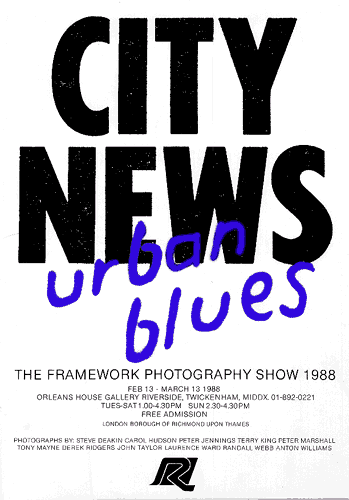
I’m particularly disappointed because one of those short-listed was a photographer who I knew years ago in the 1980s and whose work I then admired. Back then I was involved with a small group of photographers who called themselves Framework and met monthly to look at each other’s current work, and occasionally organised group shows. The core of the group apart from myself was Terry King, who did most of the organising, and others involved included Carol Hudson, Derek Ridgers and Jim Barron. (You can read more about this group in an old and outdated but never finished web site.) We had our first exhibition as Framework in 1986 and the last in 1992, and the full list of those who showed with us included some well-known names in UK photography, including Jo Spence.

© 1988 Peter Marshall

One of the photographers who brought her work to several of our meetings in Kew was Anna Fox, and I was greatly impressed by her pictures of office workers in London, later published as ‘Workstations‘ (1988). When she came to Framework she had I think just finished her degree studies at Farnham, where she is now Professor of Photography at University for the Creative Arts. I think she was also the only photographer we invited to show with Framework who declined to do so!

So I went to the gallery tonight rather rooting for Anna (though we’ve not kept in touch) but found myself rather disappointed by what I saw on the wall. You can see quite a lot of it on her web site. The series I found most interesting was her 1999 miniature bookwork ‘My Mother’s Cupboards‘, but it was simply too small and in a way too limited. The selection from ‘Back to the Village‘ was also rather disappointing, and in general I felt that what we were seeing in the gallery was too many little bits and nothing really substantial. And looking through her web site, I still find the work from her early projects – particularly ‘Workstations’ – rather more exciting than anything she has since produced. You can read about her work ( and the other three) in The Telegraph.

I can’t even bring myself to write anything about the actual work by Sophie Ristelhueber which is on the ground floor of the gallery. Other than that the prints are quite large. But on my last visit to Paris I saw shows by twenty or more French photographers who I find of more interest, and I find it hard to see why her work made it here. There is a gallery of her work from her Jeu de Paume show on The Guardian web site which I find rather better than looking at the gallery wall, but still fails to convince me the hype is really more than hype. And I’m not sure why the Photographers Gallery should be showing the work of someone who saysNowadays I am not even a photographer because I am a conceptual artist.’

Zoe Leonard is a photographer whose work I’ve known for a long time and probably first saw in the American photography magazines, perhaps Modern Photo. I’ve always thought of her as a pretty good photographer, but nothing really special, and the work on show confirms this.  Analogue 1998-2007, on show at the gallery, isn’t a bad piece of work, but I think there is very little to distinguish it above the work of the many other photographers who have also photographed “tacky shop windows, quaint signage and mundane commercial products“. I can’t really say anything against it. There are quite a few images I’d have been happy to take myself when I worked extensively with similar subject matter in London twenty years ago. But I didn’t take them on square format and print the film borders.

Duncan Wylie’s work on the Maze prison after closure I’ve always found rather boring, and this show did nothing to change my mind. The article in The Telegraph is considerably more interesting – and the smaller selection of images helps greatly in this.

But the prize winner in this show must surely be the original producer of the scrapbook which fills one wall, I think Wylie’s uncle, although it was published by Wylie and Timothy Prus. The selection of spreads on the Steidl page is misleading, because the major interest lies not in the photographs but in drawings and the text of the articles, from magazines and newspapers – and also a typed ‘recipe’ for the troubles.

It’s these articles and  (and that the wine ran out almost before the opening started) that stick in my memory and created the greatest impact –  not the photographs, and that seems to be a fairly damning indictment of what was meant to be a photography show.

Right Up My Street but

Unfortunately I’m more than unlikely to be in Milwaukee in the next couple of months (I’m not sure they’d let me in to the USA, and with the current fuss over “security” I think all those of us who need to travel with syringes are likely to have a hard time of it.)   But for those that are, the show Street Seen: The Psychological Gesture in AmericanPhotography, 1940–1959, which features the work of Lisette Model, Louis Faurer, Ted Croner, Saul Leiter, William Klein, and Robert Frank, continues at the Milwaukee Art Museum until April 25, 2010.

You can read a little more about the show (including that it also has work by Robert Capa, Henri Cartier-Bresson, Walker Evans, W. Eugene Smith, Helen Levitt and Weegee, among others) and that it claims to be the first major examination of street photography of the 1940s and ‘50s in nearly 20 years on Art Knowledge News.

While its hard to disagree with the statement that the six featured photographers “embraced photography as an ‘act of living‘”, it is perhaps harder to accept the opposition between this and telling a story, particularly with the work of photographers such as Cartier-Bresson and particularly Smith in mind who did pretty well at both.  But like many shows it sounds as if it would be good to view whatever caveats you might have about some of the curatorial texts.

There is a short review of the catalogue on the NY Times and a little more about the show here.

Where Three Dreams Cross

Where Three Dreams Cross, continuing at the Whitechapel Art Gallery in London (Aldgate East or Aldgate tube) until 11 April 2010 is an important show although it perhaps does not live up to its subtitle, 150 Years of Photography from India, Pakistan and Bangladesh. It is worth going to see mainly because of the broad cross-section of contemporary work it displays from the sub-continent, but perhaps fails to deal adequately with the earlier history of photography there.

I say perhaps, because I don’t know in detail what history exists, though I feel sure there must be considerably more than this exhibition reveals. One indication that this is so is the very poor showing given to the work of India’s first great indigenous photographer, Lala Deen Dayal (1844-1905), whose work I wrote about at some length a few years ago. There are eight pictures by him on display in the ‘Street‘ section of the show, four of them interiors. None really fits this section of the show, and only one is a good example of his work.

Although my piece on Lala Deen Dayal is no longer on line, you can find more about this remarkable photographer on the Lala Deen Dayal web site. He gained international recognition with his work being exhibited in the photographic shows in London and Chicago as well as India, gaining over 25 gold medals between 1875 and 1905. The problem perhaps for the organisers of this show is that Deen Dayal was very much a photographer of the Raj, and honoured by the Nizam of Hyderabad who appointed him Court Photographer and gave him the title of ‘Raja’. In November 2006, one of his images appeared in an edition of 0.4 million on an Indian 500 Rupee stamp.

Deen Dayal was certainly the leading Indian portrait photographer of the nineteenth century, but unless I missed them (and it is large show in a gallery where the layout is always misleading to simple guys like me) this work was missing from that section of the show.

The work in the first gallery of the show deals with the two themes of ‘The Portrait‘ and ‘The Performance‘ with the historical material in the second containing considerably too much routine cinema publicity work.

Raghu Rai is I think still the only Indian photographer (born in what is now Pakistan in 1942) to have made it to Magnum, and his work certainly stood out in this show. You can also read about him on Global Adjustments.

Most of the nineteenth century work on display in the portrait section appeared to be studio portraits by unknown photographers, and much of it was pretty ordinary stuff. It’s hard too to believe that the first half of the twentieth century has so little to offer from India, and although there was some exciting material from the second half, most of it came from names that will already be well-known to many, though it was still welcome to see it being given greater exposure here.

Perhaps the  most intriguing work in this gallery was that of Umrao Singh Sher-Gil (1870-1954.) I actually find his work rather more interesting in itself than in the more widely known works based on them by his daughter Amrita Sher-Gil. Umrao Singh began taking photos in 1889 and continued for over 60 years, during which time he married a Hungarian opera singer in 1912 and was a political exile in Hungary for the next 9 years. The family returned to Europe for five years in 1929 so Amrita and her sister could study at the the Ecole des Beaux Arts in Paris. His best-known work is probably an extensive series of self-portraits.  Another member of this artistic dynasty also has work in the show, Vivan Sundaram, the nephew of Amrita Sher-Gil, whose work in ‘The Family‘ section consisted of montages of Umrao Singh’s pictures. I’d  rather have seen the original photographs on which these works were based.

The Family gallery also contained perhaps the most traditionally Indian of the works on show, large hand coloured rather symmetric tableaux that could almost have been embroidery. Here photography was being forced into a very non-photographic mould and retaining little of its inherent magic, although the results do have a certain charm.

The final gallery of the show contains work on the two themes ‘The Body Politic’ and ‘The Street‘, and although there was a great deal of fine work it was dominated by the large colour photographs of Raghubir Singh, (1942-99) arguably the greatest Indian photographer and photographer of India of the twentieth century and one of the first to work seriously with colour in the early 1970s.

But there is plenty more fine work, particularly some pictures by Rashid Talukder (you can see more of his fine pictures on the Majority World site.) Talukder’s powerful images of the liberation struggle in Bangladesh were the outstanding work in the Bangladesh 1971 show at Autograph in Shoreditch, and the co-curator of that show, Shahidul Alam, also has an interesting set of pictures (and a letter) ‘A struggle for Democracy 1967-70′ on view here. As well as being a fine photographer, Alam is the founder chair of Majority World, and also founded the Drik picture library, the South Asian Institute of Photography and much more.

Sunil Janah, born in 1918, photographed much of the history of India from around 1940 on, including the Independence movement and partition. You see his work and learn more about him on his Historical Photographs of India (and they truly are) which also contains a virtual version of his 2000 San Francisco show,  Inside India, 1940-1975. The site are rather dated and the reproduction of images is often not up to current standards.  You can also watch him talking about some of his work on YouTube. It was disappointing not to see more of his work here.

Apart from the work that I’ve mentioned, the strength of this exhibition lies in the survey of contemporary work it shows. It does exhibit a wide range of work, some from well-known artists (Saatchi has bought Pushpamala N‘s work for example) and others from photographers unknown here. I found it hard to find anything much peculiarly Indian in the best of this work, but there is certainly much of interest. But I think the best is probably the least known here. There really is too much worth looking at for me to list. Go and see it and make up your own mind.

Postscripts

  • The show is free for under 18s & Sundays 11am–1pm, otherwise £8.50/£6.50 concessions.  It was well attended but not crowded when I visited on a Saturday afternoon.
  • I’m still often asked if inkjet prints can match the quality of conventional silver or dye coupler prints. Reading the labels here, almost all the modern prints are inkjet of one kind or another, though some make a great effort to hide it, with such descriptions as “archival pigment print.”

Lost London

One show just opened in London that I intend to see is Lost London, on show at Kenwood House in Hampstead  until 5 April 2010. Hampstead is an area of London I seldom visit, though it’s not a long journey, just that there are seldom things that happen there I want to go to.

The show, put on by English Heritage, is of phtoographs that came to them from the former London County Council, who got photographers to document the areas that were about to be demolished.

Years ago I used to make frequent visits to the Saville Row offices of the National Building record (long moved to Swindon) and often had some time to wait for my appointment which I spent in their picture library. There I used to take down the files of pictures from the various London boroughs and leaf through them. A very large proportion of the pictures were of churches, apparently because most of the work on record had been donated by keen amateur photographers in the late nineteenth and early twentieth century, and many of these were clergymen who, having preached their sermons on a Sunday were not frightfully busy the rest of the week.

But these pictures, which cover the years from 1870-1945, are rather different and with a hundred pictures illustrating the themes ‘Work, Poverty, Wealth and Change‘ it promises to be an interesting show.

You can see some more recent pictures of London on my site ‘The Buildings of London‘ and in particular the section of tha, a now antique web site, London Buildings.

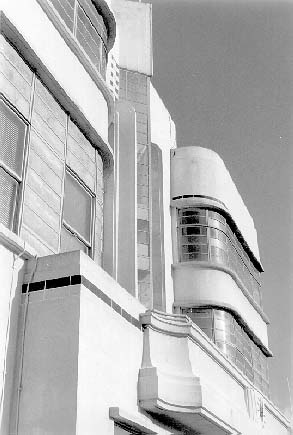
© Peter Marshall

This one – the Hoover Building in  Perivale – is preserved, but quite a few of those that I photographed in the 1970s and 1980s, here and on London’s Industrial Heritage have been demolished or radically refurbished.

Paris Revisited 1984 – Set 2

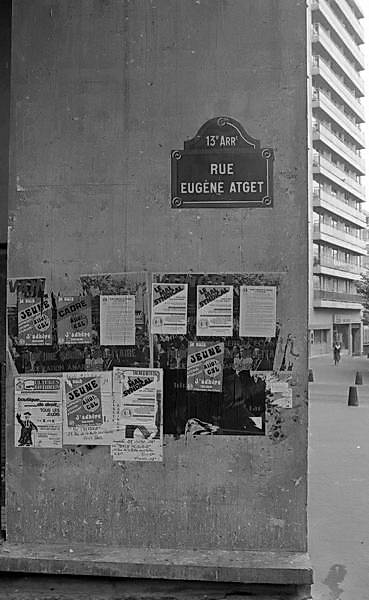
The  28 pictures that make up ‘Set 1’ of Paris Revisited included many of the favourite pictures that I took there in 1984, but there are also quite a few others that appeal to me, or that I found of particular interest for various reasons. It was good, for example, to find that Eugene Atget had a street named after him:

© 1984, Peter Marshall

though I’m fairly sure he would not have appreciated the architecture. Almost certainly the buildings that were demolished to make way for it were more to his taste – and probably among the many in the area that he photographed. This picture and the others in this post are in Paris Revisited – Set 2

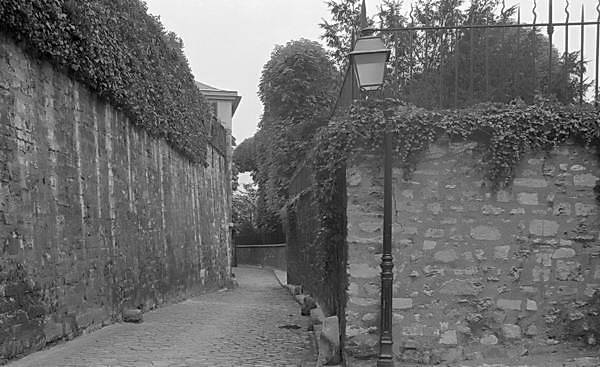
One scene that was virtually unchanged since he photographed it was in rue Berton in the  16th arrondissement, and it is one of the few pictures where I consciously copied one of his works.

© 1984, Peter Marshall

Of course there are differences. One is in the aspect ratio – his pictures are much more square than the 1.5:1 of 35mm cameras. Using the V750 scanner with the supplied film holder and Epson software which auto-detects the frame actually crops the 35mm neg to higher aspect ratio of around 1.63:1 making the difference more pronounced.

© 1984, Peter Marshall

Most of these images from Paris were taken using an Olympus OM4 camera which had come out in 1983, and using the Olympus 35mm shift lens. This gave some of the control over perspective that is available using the rising and falling front and left-right movement available in many large format cameras, but lacked the tilt and swing of some of them.  The greater depth of field on the smaller format largely made this unnecessary so far as getting sufficient depth of field was concerned if  your aim was to achieve overall sharpness in a image.

It was quite a bulky lens compared with  the non-shift 35mm lens, partly because of the mechanism allowing the lens to shift around 10mm left or right and 12mm up and down between the lens and the camera.  But it is also larger to give a wider image circle at the film plane. A normal 35mm lens has to produce a sharp image across the diagonal of the format – around 43 mm. To allow the lens to move 10mm to left or right, the PC lens needs to have an image circle of around 61mm, which also allowed a maximum rise of 12mm and fall of 13mm. You could also combine smaller amounts of sideways and up and down movement – and the lens design ensured that these kept within that image circle.

The larger image circle meant that if you didn’t use the shifts you were working in the central area of the lens, and gave the lens a really excellent performance – and it remained pretty good even a maximum shift.

As with the movements on large format cameras, perhaps the most common and certainly the most obvious use is in photographing buildings. To avoid converging verticals you need to keep the camera level and not to tilt it, but to do this from ground level without a rising front, you have to move back so that the  base of the building is at the middle of the frame. With a rising front or a shift lens you can move in closer and eliminate all or most of the foreground.

Of course now that images are digital (or scanned) you can tilt the camera and then straighten up the image in Photoshop but this does involve some extrapolation and thus loss of quality in the result and is best kept to a minimum.

But the shift lens really introduces a different dimension to photographic composition, meaning you can to some extent separate perspective from viewpoint. Although text-books draw diagrams and show example photographs I think it really is something you can only really appreciate by working with it day in and day out.

There were some downsides the the lens. Firstly it was rather expensive,  even like mine when bought second-hand. But because of the sliding mechanism it was a purely manual lens without the automatic stopping down of the iris we usually take for granted. So when using it the first thing was to stand in the place you wanted to take the picture from, then point the camera and push the lens across or up or down as required to adjust the perspective.  As usual you would do this with the lens wide open, and it would stay wide open whatever aperture you set on the aperture ring. For metering and taking the picture you then held down a small button on the lens which stopped it down to the value set by the aperture ring, and when you had set the shutter speed (or viewed that chosen by the camera on an auto setting) you kept holding that button down while making the exposure.

It soon became second nature, particularly since for some years I probably took around 90% of my pictures  with this lens. So much so that even now I sometimes find myself trying to slide the lens on my Nikon across or feeling for that button to hold down when I’m taking pictures. And I’m sometimes more than a little disappointed to find that these lenses just won’t shift!

[Nikon do make PC lenses, including the wide angle 24mm f/3.5D ED PC-E Nikkor as well as a 45mm and 85mm, none of which I’d really find suitable for general photography. Unlike the Olympus lens they only shift in one dimension – you can have  rise/fall or, by rotating the lens by 90 degrees left/right but not a combination of both. They do however have a tilt, making them more versatile for specialised use.]

Apology

Attentive readers of this blog may have noticed that my previous post, Parc de St Cloud 1984 was about the same set of pictures as an earlier post with the same title, Parc de St Cloud 1984 but at least I wrote something a little different about them second time!

Parc de St Cloud 1984

© 1984, Peter Marshall

One of the places on the edge of Paris that I visited in 1984 was the Parc de St Cloud. Since then I’ve had a print of the picture above on my wall and I still like it. The print is just a little darker and more luminous than the web image, which is from a scan made using the Epson V750 Pro flatbed scanner.

The scans aren’t quite as good as those I can get from my dedicated neg scanner (a Minolta Dimage Scan Multi Pro) which, with an added Scanhancer diffuser, a specially made negative holder and multi-scanning with Vuescan software rivals the best a drum scanner can produce, but they are not too far short. The V750 has a big advantage for things like making a web site as the scans are about ten times as fast.

Of course many other photographers have taken pictures of St Cloud, and I went there in particular because Eugene Atget had worked there. You can see several of his pictures from there in a set of 58 on-line from the large collection at MoMA.

Unlike a number of other photographers, I didn’t try to “re-photograph” the works of Atget, but I was interested in seeing the places where he had worked and making my own pictures there, and I spent a couple of weeks exploring “his” Paris and produced a set of work that I called ‘Paris Revisited‘ and subtitled ‘A Homage to Atget‘, and showed a set of around 40 pictures in 1985.

You can see more of my pictures from St Cloud on my Paris Photos site, where I’ve recently added a large selection of the pictures from ‘Paris Revisted‘ and I’ll write about some of the other sections in later posts. The images on the web site are almost all un-retouched scans, though I have made some minor adjustments to contrast on some.