Leon Levinstein at the Met

Like many with an interest in photography I’ve been reading the blogs and reviews from this year’s Arles Rencontres and from what I’ve seen I’m pleased I didn’t make the effort to go there. But one show I would like to see opened recently at the Met in New York, Hipsters, Hustlers, and Handball Players: Leon Levinstein’s New York Photographs, 1950-1980.

Levinstein was really the guy who wrote the book of what we now call ‘street photography’, so perhaps it’s rather unfair of Ken Johnson in the New York Times to denigrate the show as “a compendium of street photography clichés.” Much of it only became clichés because others followed his lead. But then I find it very hard to take with any seriousness the writing of someone who can describe Tina Modotti as “a master of the genre” along with Weegee and Robert Frank. This isn’t by the way a criticism of Modotti, though I’m not her greatest fan.

Gallerist James Danziger presents a markedly more sympathetic view, though I’d take exception at his suggestion that Levinstein is “more known and appreciated by dealers and curators than collectors or even photographers“, as I think more than almost anyone else I can think of he is a “photographer’s photographer”, (as indeed the Economist describes him in a short piece with a small set of images from the show) but although I’ve not seen the show I do know his work and Danziger is spot on when he says “he’s the real deal.”

Vince Aletti in The New Yorker gets to the nature of the work well when he talks of Levinstein as a loner “communing with New York at its grittiest, clearly relishing the experience” and producing work that is “brutal, brilliant, and uncompromising.”

In the Village Voice, Robert Shuster picks it as the only photographic show in his art recommendations and in a short piece compares him with Frank and finishes with the statement “Levinstein deserves wider recognition for recording the fleeting, quirky scenes of city life.”

The Met now has a decent short piece on him on their site, the real gem of which is a po0dacst with exceprts from a 1988 archival recording in which Leon Levinstein talks about his work.

The Howard Greenburg Gallery site isn’t my favourite – in my view a rather bad use of Flash, and if you have a recent Flash version installed you may well be told you haven’t got the correct one, but it will still actually work if you tell it you have. Under the ‘Artist’ tab if you scroll down you will find Levinstein and eventually a set of around 40 of his images.

Umbrella Parade

June 20 was World Refugee Day, and came at the end of a week where there had been various other events connected with refugees, although I’d not managed to photograph them though at the start of the month I had photographed a couple of events in the rather more radical European Week of Action to Stop the Deportation Machine. But the demonstration today was organised by the Refugee Week partnership, which  includes groups such as the UNHCR, Red Cross, Oxfam and Amnesty International.

Together they had ordered large numbers of white umbrellas,  rather more than the number of people who turned up for the protest, and others had brought their own decorated version, all to give the photographers something a little different to take pictures of. Unfortunately there weren’t many photographers, or at least not many pros, in evidence. Refugees aren’t news for our media unless they can manufacture some scandal or scare story about them flooding into the country in hordes, overburdening our social services, living a life of luxury thanks to our bountiful handouts. Unfortunately the truth – which is so very different – doesn’t get much of a hearing.

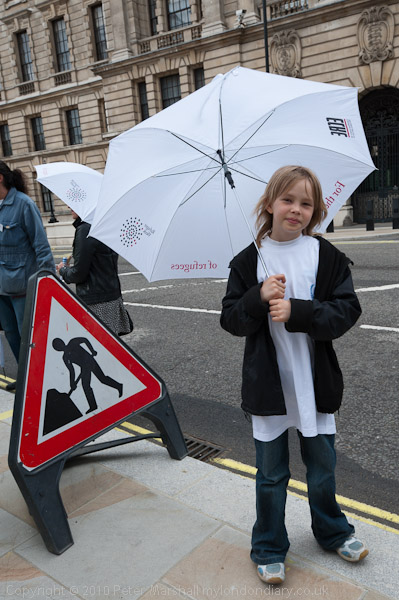
I don’t generally pose pictures, though I do often talk to people while I’m taking them and rather too often they pose for me when I do so, and I spend a lot of time asking people just to get on with what they were doing. This young girl really was just standing next to the road sign showing a man putting up an umbrella and I didn’t get her to pose :

© 2010, Peter Marshall

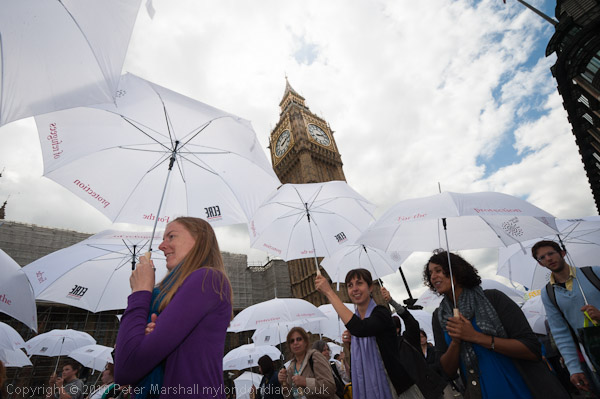
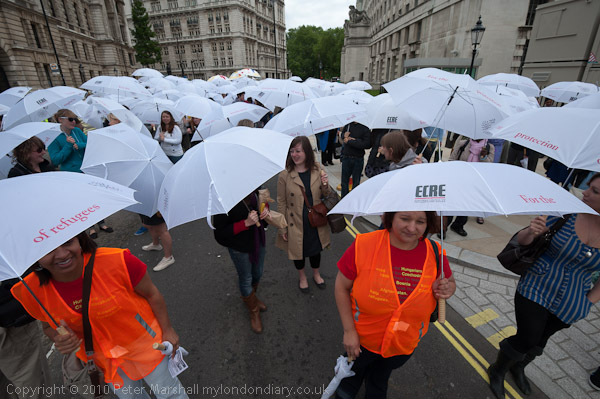
Probably the best opportunities for pictures came at the start of the parade and later when it was passing the Houses of Parliament, where Big Ben has the advantage both of representing the government and also meaning London to almost everyone around the world. At the start I was pleased to be able to take a view showing not just the street filled with people and umbrellas, but also to capture the full text around the umbrellas in the three most prominent”ECRE For the Protection of Refugees‘. It was just a little bit of luck, although had I been organising things I might have preferred it reading better left to right across the image. But this way the word ‘refugees’ gets more prominence.

© 2010, Peter Marshall

Incidentally, just after I’d taken the picture the woman on the left helpfully stepped out of my way, but by then I’d taken the picture. It was a ‘Hail Mary’ shot, holding the camera with the 16-35mm as high as I could reach, at 16mm, 1/500 f11.

© 2010, Peter Marshall

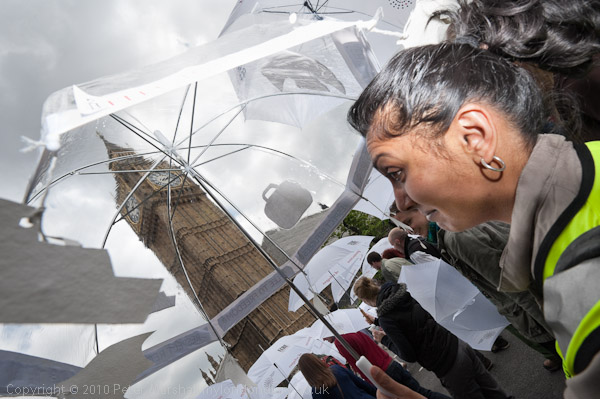
Some of the marchers had transparent umbrellas, so it seemed a good idea to shoot up through them at Big Ben.  Again nothing set up, I was walking along beside this woman, very close with the 16-35 at 17mm focal length, focus on the spokes of the umbrella and at f11 most of it is pretty sharp. As I noted in my previous post, I was having problems with flash, and only the top half of this frame received any flash exposure. Fortunately I needed it on the woman’s face and most of it was in that top half. I haven’t quite got the correction this image needs perfect (I did it in a rush to get the story on Demotix on the day) but I think it works well enough.

There are quite a few more examples of umbrella pictures in the set on My London Diary (which also tells you more about the event),  including some taken with the Nikon fisheye. Here’s just one more I liked with the 16-35mm, at 16mm:

© 2010, Peter Marshall

Joe Deal (1947-2010)

I’ve heard and read quite a few people responding to the news of the recent death of photographer Joe Deal by expressing their ignorance about him and his work. He was of course one of the photographers in the famed ‘New Topographics‘ show of 1975, which changed the direction of landscape photography and was recently revisted at George Eastman House (though their web site is rather uninformative – there is more at LACMA, and a feature on NPR.)

I first saw his work in reproduction that year, and a little later he was one of the photographers that Lewis Baltz discussed in some detail on his workshop I attended, showing work from his then current project on suburban housing along the San Andreas Fault Line in Southern California. Like many other photographers who worked in the urban landscape I found this show refreshing and it altered all of our work – and you can perhaps see this in at least some of my and other photographer’s projects on the Urban Landscapes web site – such as my Meridian, DLR and other panoramic series.

You can see a good selection Deal’s Fault Zone series and other work from the period on the Robert Mann Gallery site, where he had a show in 2004. There is an obituary by William Grimes in the New York Times with a slide show and you can also see a second show which begins with some of his more recent images at the Robert Mann gallery.

Editors and Photographers

The relationship between editors and photographers can sometimes be somewhat fraught – and the stories of the battles between Gene Smith and the guys at Life Magazine is one of the great enduring (and largely true) legends of photography. Of course it was a relationship that produced some of the classic photo essays, and although Smith was certainly not the greatest editor of his own work, without these battles I think we can be pretty sure his work would have been less well presented.

Balance wasn’t a concept Smith had a lot of time for, at least when it came to publishing his work, and he almost single-handedly brought Magnum to its knees during his relatively short time with them when he was photographing Pittsburgh, having started the job with one of the most illustrious of photo-editors, Stefan Lorant, who wanted 100 pictures to illustrate a book, while Smith had his own idea.

Although my essay on Smith is digitally “out of print” you can read a few comments about him and editing in a post here, Editing Your Work.  Smith spent at least two years trying to edit the 17,000 images he made in Pittsburgh, but eventually gave up and around 45 years later (and some twenty years after Smith’s death)  it took five years for Sam Stephenson of the Center for Documentary Studies at Duke University to produce the exhibition and book Dream Street, possibly the greatest testament to Smith’s photography and a book that should be on the bookshelf of anyone with an interest in documentary, but also a warning to photographers.

Like many photographers, I think I’m both the best and the worst editor of my own work. Best because I know it better than others and usually have some idea of what I was intending. Worst because I have a strong emotional involvement and am often distracted by things that are not actually in the picture but are more about the situation and process of making the image.

This train of thought was prompted by a piece on the Photoshelter Blog, written for photo-editors, Top 10 Ways To Make A Photographer Fall In Love With You. It’s the third in a series by Photoshelter co-founder  Grover Sanschagrin which started with Top 13 Ways to Piss Off a Photo Editor and continued with Top 10 Ways To Piss Off A Photographer. All three pieces were based on asking a selection of either working photographers or editors and contain a great deal of sometimes obvious common sense.

Black in White America

On NPR you can see a short piece with 11 images about the re-issue by the J. Paul Getty Museum of the book Black In White America,  by photojournalist Leonard Freed. He is one of nine photographers featured in their Los Angeles show from opening June 29 (until November 14, 2010) “Engaged Observers: Documentary Photography Since The Sixties” which also includes work by Lauren Greenfield, Philip Jones Griffiths, Mary Ellen Mark, Susan Meiselas, James Nachtwey, Sebastião Salgado, W. Eugene and Aileen M. Smith, and Larry Towell. As yet there is little about it on their site.

You can see more about Freed (1929-2006) on the Magnum site, where as well as his photographer pages there is also a Magnum in Motion tribute.  Looking through the 171 images from Black in White America there shows a really impressive body of work.

You can also of course see many of his other pictures, with some of the strongest coming from his book ‘Police Work’. There are altogether  16 of his features on the Magnum site, the earliest pictures from New York in the 1950s  and the latest on Liberian refugees in the Ivory Coast in 1995. A truly remarkable career.

It was three years later that I had the privilege of attending a photographic workshop with him at Duckspool.  You can hear him talking about his pictures in a couple of videos on You Tube, Part 1 and Part 2. Although I admired his work, he wasn’t a person I really warmed to, but he had some interesting stories to tell both with his camera and about his life. Though it was the work with the camera that was of real importance.

The review that I wrote about that workshop is still on line on the Duckspool site, although Peter Goldfield who ran the workshops is sadly no longer with us. This is one of the pictures from it that I took on the workshop (though now I might make a better scan!)

© 1998, Peter Marshall
Peter Marshall – taken on a Freed workshop

David Hurn

I came into photography in the 1970s, and completely missed the great input that David Hurn made into creative photography in the UK in the 1960s, meeting him for the first time in the early 1980s, when I had a short argument with him in the questions following a talk he gave on one of his shows.

The show wasn’t one of his better efforts, and his reply to my question appeared to me to be entirely based on commercial rather than artistic criteria, so I’ve perhaps never warmed to the man as I should, though I do have his Wales: Land of My Father (2000) on the main bookshelf in my living room (along with a volume by one of the many photographers whose career was intimately bound to his, Josef Koudelka.)

Had I started in photography ten years earlier I might have got to know him better, and if I had been ten years younger I would certainly have yearned to attend the course that he ran from 1973-90, the School of Documentary Photography at the Gwent College of Higher Education in Newport, Wales.

David Hurn is now 74, and his latest book, Writing The Picture with poet John Fuller was published by Seren on June 5th 2010. You can read more about his remarkable life in a feature by Graham Harrison on Photo Histories, where there is also a link to the book, as well as to the title sequence from Barbarella in which a space-suited Jane Fonda weightlessly disrobes.

Harrison attributes former student Dillon Bryden as stating that David’s course  engendered the work ethic and a very particular code of understanding, and although in many ways a strength, particularly in giving its students a way of making a living, it was perhaps also a weakness, pushing them down a particular route.  But it was certainly a great shame when this vocationally oriented course was lost in the scramble for university and degree status.

In his piece, Harrison writes “David Hurn says the art establishment in Britain remains staggeringly snobby about photography, and is particularly resistant to photojournalism and documentary photography.” Despite the work of Hurn and others this remains only too true.  Although he and other photographers did serve on the Arts Council in various ways, photography has never really got a serious look-in, though for a year or so in the 1970s it seemed it just might.

I’ve always felt it summed up the situation pretty well that, until 2001, the only money I had ever got from the Arts Council had been a couple of small payments from the Poetry budget. And in 2001 the money came from ‘The Year of the Artist‘ and again was not specifically for photography.

You can see some of David Hurn’s pictures on his Magnum page, and also worth reading is a piece on Hurn by the late Bill Jay, another vital figure in British photography in the late 1960s through Creative Camera and Album magazines.  This starts:

While still in my 20s, I showed David Hurn my photographs, the results of more than seven years of struggle to be a photographer. It took him about 30 seconds to look through the lot and deliver his judgment: boring. “Derivative”, he said. “You won’t make it.”

We have been friends ever since.

British photography might have had a rather different story had Jay not, as Harrison relates, been turned down for a post at the National Portrait Gallery.
Long Lange Interview

Although you can read the interview with Dorothea Lange made by Richard K. Doud in New York on May 22, 1964 at the Smithsonian Institution site, it was good both to have its existence pointed out and also to have suitable illustrations added, presumably all also from public domain sources on the ‘A Photo Student‘ blog by photographer James Pomerantz.

Although I’ve often criticised the USA approach to copyright it does have its good points, and one is the huge amount of publicly available public domain material. (Another is a proper concept of ‘fair use’ although this does not always work.)

If you haven’t already discovered the Library of Congress Online Catalogue (the web site was upgraded not long ago at a different address to make it easier to use) you are missing out.

This first illustration that Pomerantz uses is available there for free download both as scans from a copy neg of the print varying in size from 39Kb jpeg to 12Mb Tiff, from the original neg at sizes from 98kb jpeg to 20Mb Tiff as well as a scan of the print at 116kb or 41 Mb.

Since Lange made the image when working for the US Government, there are “No known restrictions on images” and you can download it and make a print for your wall with no guilty conscience. Personally I’d choose the scan from the negative and try and see if I could improve on the print.

You can actually build up an excellent collection of photographs in this way – including most of Walker Evans’s best images – for the cost of ink and paper alone.  There is also a very thorough explanation on the site about assessing the risk of using any of the photographs in the collection for various purposes. I think I’m pretty safe with this one, although unlike most bloggers I’m always very careful about copyright.

On the Street

I used to think of myself as a street photographer, but sometimes I think I’ve got over it, or at least a certain perception of it. Back in the seventies and eighties there was perhaps a sense of adventure in going out with a camera and an empty mind on to the streets and shooting, perhaps feeling one was following in the footsteps of guys like Cartier-Bresson, Frank and Winogrand (very different though they were.) But now it too often seems to me pointless and lacking in intention, chasing a rather empty if occasionally highly graphic kind of imagery that has little to say.

Of course there is good street photography around. I admire the work of a number of people from the last decade or so, including friends of mine such as Sam Tanner, Paul Baldesare and the late Jim Barron, little of which is available on the web. More recently I commented here on a roll of film by  Sang Tan, and there is more of his fine photography in this tradition on his web site. Another interesting photographer in this tradition is Brian David Stevens, and he regularly posts work on his Drifting Camera blog. And although I seldom feel inclined to wade through the mountains of mediocrity that make up Flickr, you can come across something that has a freshness and originality there too.

Years ago I remember a photographer (it could have been Leonard Freed) talking about the work of Henry Cartier-Bresson, and referring to a whole section of his output as ‘waiters‘. These were pictures where the photographer had clearly seen the visual potential of a particular view and had then stood there and waited for the right person to come into the view and put themselves in the right place. It was an insight that greatly clarified for me the dissatisfaction that I felt with some of the master’s work, images that I frankly found rather boring but had not dared say so. The images of his that I loved, that struck me deeply, were those that were ‘taken on the run’, moments stolen from the flux.

The current 10th anniversary show at Photofusion in Brixton by members of the street photography web site inPublic isn’t a bad show, and there is plenty of good work. It’s worth a trip to Brixton for the panel by French-born Christophe Agou who now lives in New York, work from his Life below (1998-2001) on the New York subway which owes a little to  Walker Evans’s ‘Many are Called‘ but takes it to a very different and more personal level.

There are pictures in the show that amuse me, that intrigue me and a few that I wish I had taken, but there are also rather too many that – like HCB’s ‘waiters’ rather bore me, and too many that I feel I’ve seen too many times before.

And it did seem to me that relatively little on the wall was really new or at the boundaries of the tradition and rather too much that was safe and harking back (and at times more ‘pictorial’ than ‘street’.) Where, where were the enfants terrible pushing at the limits, exploring the new possibilities of the medium? By the time I reached the end of the show I was longing for some really bad photography just to liven things up.

Street photography as we know it of course owes a great debt to New York, from some of the pioneers around the Photo League in the 40s and 50s and a show that I would like to see is coming on shortly at the Met there, ‘Hipsters, Hustlers, and Handball Players: Leon Levinstein’s New York Photographs, 1950–1980′, work that remains considerably more radical than anything on show in Brixton. You can see some examples of his work at the Stephen Daiter Gallery site. The first photographer whose colour street photography moved me to think about its possibilities was another New Yorker, Joel Meyerowitz, who often roamed the city’s streets with Garry Winogrand, and you can see a good selection of Meyerowitz’s work on  iN-PublicBruce Gilden from Brooklyn is another great street photographer, with plenty of work on his Magnum pages.

I’m not always a fan of curators (not least because so many have proved so bad) but this would have been a rather better show had the pictures been selected by a suitable despot, preferably one with a proven record as a street photographer as well as a curator.  Street photography needs more edge.

The Color Photographs of Irwin Klein

I’ve seen several references here and there to the work of Irwin Klein (1933-1974),  whose life ended tragically with a fall from his Brooklyn window. After his death, all of his negatives, cameras and other gear, and most of his prints were lost or stolen. All that remains are a small number of vintage black and white prints along with a few colour slides.

While most people seem to be interested in the black and white prints (and there are some pictures I really like, although perhaps others that don’t quite come off) it is his colour work that I find more interesting. Perhaps because in 1972-4 when he was taking it there was much less colour work visible around and to some extent he had to find his own way, while his black and white follows more or less similar lines to a number of other fine photographers working around the same time.

There are two shows of his work at the Domeischel Gallery web site and he has an exhibition at the Madison Avenue, NY, gallery which closes at the end of this month. His black and white work, along with much of the other photography I found on the gallery site,  is a demonstration of the immense influence of one of the great photographic ferments of the mid-twentieth century based around the New York Photo League.  Although this organisation, based as it was around a humanistic and basically left-leaning progressive view of society was brought to a disastrous end by the rise of the cold war and McCarthyism, it’s influence has continued to power much of photography since.

There was just so much happening in photography in New York at that time, so many photographers, and so many good photographers among them. Klein was one of them, and although it is good to see his black and white work, some of which can stand comparison with the best, it perhaps adds just a little to a vast body of great work by so many. When I first looked at the site around the start of the show in March I found one or two outstanding and familiar pictures – such as his Minnesota fire image which fronts his black and white work, but didn’t feel overall that there was anything new to mention. I stopped looking before I came to his colour.

Irwin Klein’s colour pictures all date from the last two years of his life, 1972-4, and it was a time when photographers were just beginning to discover (or re-discover) colour as a vehicle for their personal work.  If you wanted to be taken seriously as a photographer at that time it was black and white that mattered (a prejudice that still occasionally surfaces even in this digital age.)   There wasn’t the same vast and accessible tradition as with black and white and photographers who took colour (and many of us did) were very much finding our own ways of trying to avoid the clichés of commercial and advertising photography.

There is certainly nothing of the chocolate box about Klein’s colour, which in some images clearly draws on his black and white work, but I think sometimes has a greater intimacy and is more personal.  For me there is a feeling that these were pictures that he was making for himself rather than – as sometimes with the black and white – an audience with particular preconceived ideas. It is of course sad that what we see here is probably all or most that remains of his work, and I for one would have loved there to be more than these couple of dozen images.

Crow Country

The British Journal of Photography has a rather low opinion of it’s readers when it states “Few readers will have heard of – let along seen – Masahisha Fukase’s 1986 book, Karasu (Ravens), first printed by Sokyu-sha, a Japanese publisher based in Tokyo.”

Do I feel insulted or give myself a pat on the back as one of the chosen few?  No, but I do feel it rather more reflects the ignorance of the writers of the BJP about the wider aspects of photography which are too often demonstrated on its pages than anything about its readership, and for a publication hoping to establish itself as a monthly devoted to the medium is disappointing. Guys you need to up your game. In many respects the latest May issue is an improvement (and I’m pleased to see that it has lost the typographic fancies that made it literally hard for me to read.)

Although I don’t own ‘Karasu‘ I was among the thousands of us in London who flocked to the Serpentine Gallery in 1985-6 (and it was also shown in Oxford) for the show ‘Black Sun‘ which featured Fukase’s work along with that of three other great Japanese masters, Eokoh Hosoe, Shomei Tomatsu and Daido Moriyama and have the Aperture issue of the same name by Mark Holborn which served as a fine catalogue. It has 16 pages devoted to Fukase’s work, and in particular to the crows. Much more recently I remember seeing a whole wall of this work, I think at the V&A, and the former director there, Mark Haworth-Booth is among those listed in the acknoledgements to ‘Black Sun’.

More recently in 2008, Paris Photo had its thematic show on Japanese photography from 1848 to the present day and on this site I wrote “Of course there will be plenty of familiar work, including people such as Shoji Ueda, Ihei Kimura, Masahisa Fukase, Eikoh Hosoe, Shomei Tomastu, Hiroshi Sugimoto, Nobuyoshi Araki and Daido Moriyama” and there was.

Japanese photography, despite my particular interest in the work of people such as Eikoh Hosoe (who I was really delighted to meet in Poland in 2005) and Issei Suda, one of whose books I bought many years ago was an area I had only really just started to work seriously on in the ‘World Photography’ section of my ‘About Photography’ site when my contract was terminated.  A couple of years earlier I had published a piece ‘Early Photography in Japan’ which had dealt largely with the nineteenth century and was hoping to write more on the twentieth century, although I had written short notes about Fukase and the others.

© 2005 Peter Marshall
Eikoh Hosoe photograhs me with a pink phone in Alacatraz

The BJP calls Karasu an obscure masterpiece” and expresses surprise it was chosen as the best photobook of the past 25 years in their critic’s poll and you may like see the list of the other works that these “five experts” (themselves somewhat randomly chosen) have selected.  Perhaps surprisingly, the one Japanese among them, Yoko Sawada, who was responsible for many of the issues of the influential Japanese photographic magazine déjà-vu in the first half of the 1990s, does not mention the book, picking works by five other Japanese photographers starting with Nobuyoshi Araki to whom 4 of the magazine’s 20 issues (including its last produced by Akihito Yasumi) were entirely devoted.

There are rather few books on the list I would have chosen, although I’m familiar with many of them. Those I own are Nan Goldin’s ‘Ballad of Sexual Dependency‘, Chris Killip’s In Flagrante and What We Bought: The New World by Robert Adams, although I do have other works by several of the photographers named.

I don’t really subscribe to the idea of “the best photobook“. Books to me are working tools, things I use, and if you have a job that needs a screwdriver even the best spanner is likely to be pretty useless. I’ve never felt a need – nor do I expect to –  for quite a few of the volumes listed by this very small selection of critics.

What I have read recently is ‘Crow Country‘ by Mark Crocker, described in the Independent as “A thoughtful and brilliantly executed celebration of countryside and the importance of nature in human affairs.” It contains no photographs, but is superb evocation of one man’s obsession with the the corvid family of birds – crows, rooks, jackdaws, ravens and more – and his attempts to find what lies behind their migrations, roosting and massing. It’s a work that perhaps might well be read alongside Fukase’s work.