Shore: Photography and the Limits of Representation

I didn’t get to Stephen Shore’s talk in London on Tuesday, but I’ve just been listening to it and watching it on video on the AA School of Architecture web site. Shore has been the director of the Photography Program at Bard College in upstate New York since 1982, but most of us probably know him for his 1982 Aperture book Uncommon Places, which gave many of us a new impetus to explore colour photography.

He talks about the nature of photography and the four tools that a photographer has at his disposal, “focus, moment & duration, choice of frame and choice of vantage point.” He says “Photography is essentially an analytic medium  … a photographer starts with the whole world and every decision brings order to it … a photograph is solved more than it is composed.”

It’s a long video – 90 minutes – but it held my interest for most of that time, and is a very clear exposition of his views on photography and of course of his own work. As well as the actual talk the video also includes the whole of the question session with Shore after the talk.

New on Niépce

For many years since its re-discovery by Helmut Gernsheim, a view taken by Joseph Nicéphore Niépce from his upper-story workroom at his Saint-Loup-de-Varennes country house, Le Gras, has been regarded as the world’s first photograph, but the process, heliography,  has been dismissed as incapable of producing anything but the crudest results.

Niépce brought it, along with several other examples of his heliography to England to show the Royal Society in 1827, but circumstances prevented this, and he left the metal plates with his host in Kew. On his death they were sold, later sold again and in 1884 when they came up for auction again they were split into two lots. Three ‘heliographic reproductions’ of engravings and what was though to be an etching made using a heliograph on the plate as a guide were bought by the notable photographer H P Robinson, and on his death went to the collection of the Royal Photographic Society (and were lent to the Science Museum in London for display.)  The second lot, of one ‘heliograph’ and Niépce’s words on the process was bought by the Editor of the PHotographic News, H Baden Pritchard, and later disappeared from view.

Helmut Gernsheim attempted to enlist the help of the Times newspaper in 1948 to find the Pritchard family, but they refused to print his letter about the missing image – and did so for a second time in 1950. But a few months later, when he was contacted by the Observer newspaper about the photography of Lewis Carroll he had rediscovered, he got that paper to print his appeal for news.

Pritchard’s son immediately got in contact but only with the bad news that the family had no idea what had happened to it. But a year and a half later after the son’s death he got more news from the widow. The metal plate had been found in an old trunk – but unfortunately it had faded and there was no picture on it.

Gernheim knew this could not be true, as the process was extremely permanent, and was able to show her the faint image that could be seen if the plate was looked at carefully from the correct angle. He persuaded Mrs Pritchard that  rather than put the plate up for sale – when it would probably be sold at a very high price to a private collector and disappear again – she should make a gift of it to the Gernsheim collection – and later, when that collection was sold to the University of Texas, it was also as a gift.

You can read more about that familiar picture at the Harry Ransom Center site, and also on National Public Radio.

But now a new example has emerged among early photographs, and certainly it is a better image than the Le Gras window view. New tests on the image that was previously thought to be a hand-worked etching on a heliotype plate have shown it is actually a camera-produced image without any extra work, leading to a re-assessment of the process.

Since ‘Interior of an Abbey in Ruins’ is dated c. 1827, it seems likely that the Gernsheim image remains the first, but it does show how Niépce was able to develop his process further.

I read about the discovery in the BJP,  which has a reproduction of the image, but more details should be given today and tomorrow at the conference Niépce in England being held at the UK National Media Museum in Bradford. On the conference web page you can hear Dr Dusan Stulik of the Getty Conservation Institute waxing a little too lyrical about the import of the new discoveries from his investigation of this image.

But I don’t think many of us will be abandoning digital to become heliographers.

On Show in London

One of the things that I really miss with the revamped monthly British Journal of Photography is the ‘On Show’ listings. Although they were never comprehensive, they gave a pretty good selection of the photography shows in London and around the country, particularly those whose details were not covered by other listings.

There were some gaps, and in particular a number of commercial art galleries never bothered to tell BJP about their shows (and just occasionally some of the more important public galleries too.)  But often I’d rip out the page when I was catching the train up to London and thought I might have a little spare time to take in a show, and I’d spend a few minutes on my journey deciding which exhibitions to try and get to.

For a while you could also access ‘On Show’ on line, I think even for a month or two after the magazine went monthly, but it no longer appears either in the printed monthly or on the web site, and I’ve not yet found a decent alternative. The monthly BJP does have an exhibitions page, but it’s hopeless, listing just a few exhibitions that have already appeared in the Sunday papers, or are on elsewhere in Europe or the US.

Of course there are listings sites, but most of them seem defective so far as photography is concerned. Photography-now is an international site and its UK pages do include the major shows and quite a few of the commercial galleries, but not many of the other venues. Probably the best site that I’ve so far found is Spoonfed, where you can search for photography in London but the format makes it near to impossible to use sensibly – if you click on the link to see all of September’s shows you will find that a show that is open 20 days in the month gets 20 listings.

Despite the problems, I managed to find a couple of photographic shows to visit yesterday afternoon and both are certainly worth a few minutes of your time.

Chris Beetles, in Ryder St (a short walk from Green Park tube) is showing a good selection of Edward Weston pictures printed by his son Cole Weston, and you can see all 37 of them on the gallery web site.  The show is on until 25 Sept 2010.  Cole, who died in 2003, was the youngest of Weston’s four sons, and although he was a photographer himself was better known for printing his father’s work.

Prices for the prints on show range from £4000-10500, and personally I would rather spend a considerably smaller sum on one of the finely printed books of his work (and I actually have several.)  Cole’s prints were considerably cleaner than some of his father’s – those in this show seemed without blemish – but somehow they seem to lack a little of the intensity of those his father printed (and even of some of the fine reproductions in books.)

At the Michael Hoppen Gallery in Jubilee Place, off the Kings Road (the buses stop a few yards away at Markham St) are two shows that certainly offered a greater challenge, by two of Japan’s best-known post-war photographers, Daido Moriyama, (b1938) and Shomei Tomatsu (b1930.) The Tomatsu show is due to end 9 Oct 2010 and Moriyama 10 Oct 2010.

Moriyama is the more challenging of the two, a self-consciously avant-garde photographer impressed by the work of William Klein, Weegee and other American photographers and artists, who early in his photographic studies worked for three years as an assistant to Eikoh Hosoe.  On Japan Exposures you can see an interesting presentation of his early magazine work, looking at two Japanese books of his work from 1965-1970 and 1971-4.

© 2005 Peter Marshall.
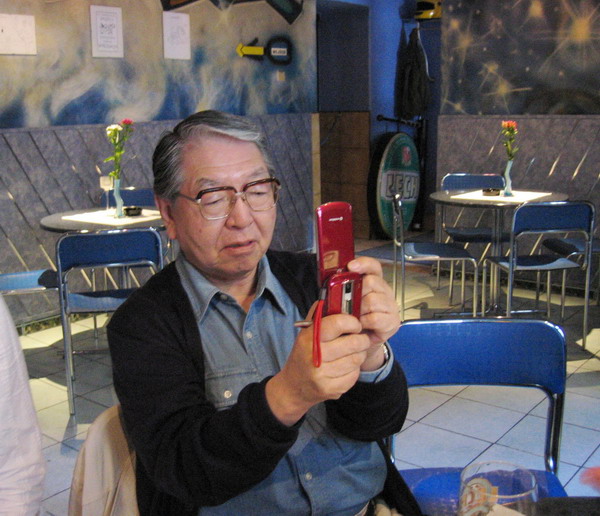
Eikoh Hosoe looks at his camera phone in a pizza place called Alcatraz
© 2005 Peter Marshall.
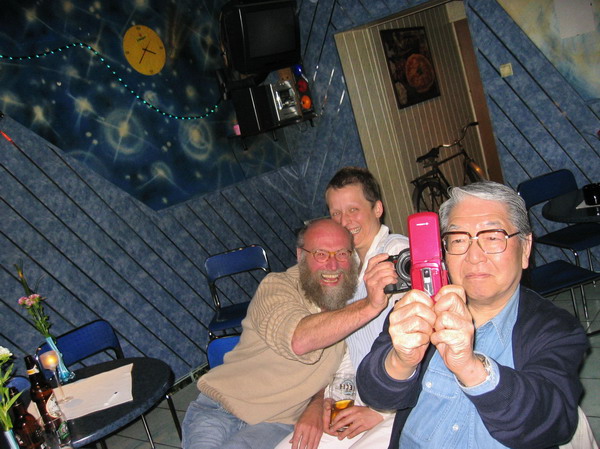
and takes a picture of me!

Moriyama worked on the city streets, often at night, with a 35mm camera, often taking pictures without the benefit of the viewfinder, and pushing Tri-X far beyond its design criteria. Printed high contrast and on a large scale his work is often reminiscent of Pop Art’s use of dot screens (and the Moriyama foundation’s web site presents them as coarse halftones.) His work epitomises the aesthetic behind the influential Japanese magazine Provoke, “are-bure-bokeh*” or “rough, blurred, out of focus.” Started in 1968 in Tokyo by photographer and writer Takuma Nakahira and others, the magazine, which published Moriyama’s work in it’s second issue, had a short publication history (three issues) but started a movement under it’s title including many young Japanese photographers of the era.

Although the Provoke photographers (including Yutaka Takanashi, Koji Taki and Takahiko Okada as well as Nakahira and Moriyama) very much saw themselves in revolt against the photography of the past – and that very much included  Shomei Tomatsu – looking at the older photographer’s work now the similarities are rather more marked than the differences, and he is now seen very much as a precursor of ‘Provoke’.

It’s a show that is very much worth going to see, particularly for the presentation of Moriyama’s work on a scale impossible in print. There does now seem to be a considerable publishing industry devoted to his work in Japan, though rather fewer seem to be available in this country.  A new monograph, Daido Moriyama: The World through My Eyes (ISBN-10: 8857200612)  is to be published by Skira on 12 Oct 2010, and Daido Moriyama: Shinjuku 19XX-20XX, (ISBN-10: 3775717293), pictures from a Tokyo district he became obsessed with, is still available at a reasonable price.

While in the gallery I also looked through the fine  book ‘The Skin of the Nation‘, produced for Tomatsu’s first retrospective outside of Japan which was shown in New York, Washington, San Francisco and Winterthur,Switzerland in 2004/6.  And no, I’m not surprised that it didn’t make the UK. It’s perhaps unfortunate that one image by Tomatsu – a beer bottle melted by the heat of the nuclear holocaust at Nagasaki – has been so successful that it has obscured his other work. Before I started to write about the show I went on line and ordered myself a second-hand copy.

*Bokeh here does not mean the excessive pre-occupation with the rendering of out of focus areas which bedevils some areas of the Internet, but simply that things are not rendered sharply because they are not in focus.

Peter Sekaer Overhyped

Peter Sekaer (1901-50) was a Dane who went to New York in 1918, setting up a business producing posters for shop window displays. In 1929 he joined the National Art Students League to study painting meeting Ben Shahn, who probably got him interested in photography and also introduced him to Walker Evans. In 1933 he studied photography with Berenice Abbott at the New School for Social Reasearch and assisted for Walker Evans who was photographing artworks at the Museum of Modern Art.

Sekaer also went with Evans on his Resettlement Administration/Farm Security Administration (FSA) trip to the South, taking some pictures of similar subjects as they travelled around together. From 1936 to 1942 he worked for various US government agencies including the Rural Electrification Administration (REA), the United States Housing Authority (USHA) and the Office of Indian Affairs, working briefly for the Office of War Information (OWI) in 1941.

In 1945 he gave up working for the government agencies (and the American Red Cross) to freelance, moving to New York in 1947 where he did magazine and commercial work. A heart attack killed him in 1950, aged only 49.

Solo shows of his work took place at the Witkin Gallery, New York in 1980, in Copenhagen in 1990 and at Howard Greenberg Gallery in 1999. Books were published alongside the latter two shows. Currently the High Museum of Art in Atlanta, USA, which recently acquired 70 vintage prints of his work has a show ‘Signs of Life, Photographs by Peter Seaker, which continues until Jan 9, 2011 and there is also an accompanying book.

Searching for pictures under Sekaer’s name at the Library of Congress produces surprising few results; a set of images of an FSA trailer camp at the Vultee Aircraft Plant in Nashville Tenesse, taken in May 1941 for the OWI, and two earlier images, only one of which is on line.  The trailer camp pictures are undistinguished, a fairly dreary record of the site. The other picture shown, of mothers and children at the doorway of a brick home in a former slum area for the USHA, is a little more interesting but also rather routine.

The Library of Congress does include many fine photographs from the less well-known government agencies for which Sekaer mainly worked, taken by other better-known photographers – for example Arthur Rothstein. There are also some very run of the mill unattributed images. But unless I’ve missed something Sekaer appears to have produced little or nothing of worth for these agencies.

You get a rather more positive impression of him as a photographer by searching at the Addison Gallery of American Art which produces 17 results, one of which shows a page from a scrapbook containing 725 small prints by him (27 or 28 on the page shown appear to be contact prints including several frames of some subjects.) Not all of the other 16 pictures are on-line.

There are some nice touches visible in some of those which are. A young woman is posed behind a restaurant window in Charleston which has a cup of tea and a fish painted on it; the collar of her dress appears as a heart. But looking at most of them I can’t help thinking of rather stronger images of similar scenes by Walker Evans, Helen Levitt and others.

Sekaer’s ‘artist’ pages at the Howard Greenberg Gallery which include 25 images concentrates even more on those that make him seem heavily under the spell of Walker Evans. But frankly they just are nothing like as good. He isn’t a bad photographer, but just rather ordinary when compared with Evans  – as most of us would be. But there are two or three images that perhaps show something rather more personal, all including people. Images 19 – Lousiville, 1938, with two women and a child with an upturned tricycle and 21 – Untitled, 1938, with and old woman wrapped in a shawl on her front step, for me stand out above the rest.

Sekaer was obviously a proficient photographer, and doubtless his work adds something to our knowledge of the era he photographed, and the book may well be of interest. It’s good to see publications and shows of some of the minor figures of photography – and there were very many of them – whose contribution to photography is more in their collective input than in individual work. There are hundreds if not thousands more like him, and it would be good to see more of them recognised for what they are. But don’t let’s make them out to be overlooked geniuses.

You can read more about Sekaer and the High Museum show in a feature in the New York Times. Apparerently 53 or the works in the museum were acquired from the Howard Greenberg Gallery, and the piece quotes Greenburg as saying that had he lived to promote his work  “he would have had a great reputation.” Earlier the writer  seems to suggest that Walker Evans is better known because he “lived into his 70s and promoted himself as an artist as well as a documentarian.”

I have news for Eve M. Kahn – and also Mr Greenburg (though I think he already knows it but also knows his business.) Walker Evans is better known because he was an incomparably better photographer.

Meatyard

If you’ve not yet come across the rather curious world of Ralph Eugene Meatyard, (1925-72), also known as ‘Eyeglasses of Kentucky’ you could do worse than start with the selection of his pictures on the ASX Facebook page.

Meatyard became a licenced optician after Navy service, and bought a camera to photograph his newly-born son in 1950. In 1954 he studied with Van Deren Coke, and later with Minor White and Henry Holmes Smith.

Although included in several prestigious shows, he remained an amateur photographer, opening his own business as an optician in Lexington, Kentucky in 1967. A monograph of his work was published in 1970, the same year he discovered he had terminal cancer.

Meatyard never just took a photograph. His work was always carefully planned and executed, with his children and friends acting some surreal charade for the camera. The pictures are full of menace and foreboding. People wear masks or blur their faces by moving their heads during exposure,  emerge out of bushes or other unexpected places. Even the bushes sometimes seem to move. Meatyard creates a world in his pictures, that sometimes touches on our everyday, but always has some surprise up its sleeve.

More of his pictures at George Eastman House and on Google images, and a more detailed biography on Wikipedia.

1848 Daguerreotypes

There is a fairly remarkable story on ‘Wired’ about the digital cleaning of the 1848 daugerreotypes by Charles Fontayne and William Porte, a set of eight whole plate (8.5 x6.5″) images taken from across the river at Cincinnati and together showing a couple of miles of the waterfront (with some small gaps.) By 1848 the daguerreotype process was more than 10 years old, although it was only announced to the world in 1839, and technically had been considerably improved, particularly in the USA.

We’ve long known the incredible detail of the best daguerreotypes, so the hype around this particular set of pictures is rather overdone, but it’s certainly good to see that the images can be restored to something like their original state by scanning and the use of digital techniques to remove spots, although I rather wish they had ignored the wishes of the art historians and also removed the polishing marks.

If anything the actual resolution of the images turns out to be rather less than I expected, with a 1mm wide clock face being only just legible after the cleaning process.  An 8.5 inch wide print is around 216mm wide, which would be around 20 pixels wide from a D700 file and that might also be just enough to make out the time.  But if I read correctly the Bite piece suggests that you would need a 170Mp back rather than the 12Mp of the D700 to match the dags, and that doesn’t quite seem right.  Perhaps digital pixels are worth more than dag pixels, just as we found we could outdo film with around a third of the pixel count?

Probably what limited the resolution of the dag were the optics, though at least they had a simpler job to do than today’s lenses, as the plates were only blue sensitive. And since the image made in the camera was the actual final piece, in normal viewing their was no enlargement.  It’s perhaps surprising that the “details — down to window curtains and wheel spokes — remained crisp even at 30X magnification” as this was rather more than required, but I get pretty crisp detail when I enlarge a 12Mp digital file from the D700 by the same amount too.

The daguerreotype is not the only highly detailed process, and perhaps the real trail-blazers were the giant(or even Mammoth) plates taken by some wet plate photographers, which I think would be difficult to equal with modern materials, even by the few people I’ve known who’ve used larger than 8×10 film cameras.

Byte describe it as “one of the most famous photographs in the history of the medium” though I doubt if many of us have heard of this set of pictures and one of the things that appeals to me greatly is how ordinary it is. But it gives us a small glimpse into everyday life in one US city 162 years ago, which is truly remarkable. Of course its great value comes from the rarity of such images at the time – taking them was both expensive and highly skilled. But I think it is likely to be true that those images that we take today which will become truly valuable in the future are not the arty or conceptual creations that currently clog many gallery spaces and dealers, but pictures of the ordinary and everyday.

Hiroshima 65 Years On

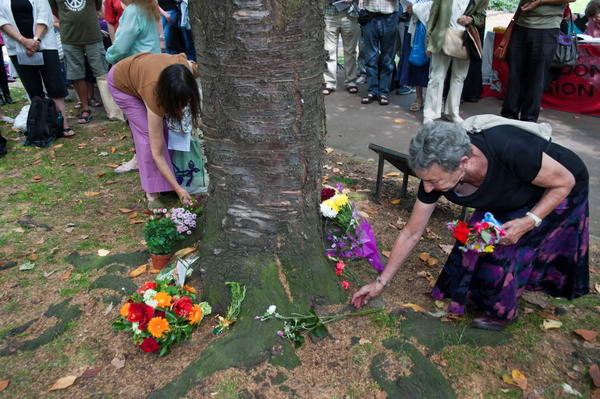
At 8.15 am Hiroshima time on 6 August 1945 the bomb called “Little Boy” was released from the B29 named “Enola Gay” after the pilot’s mother and around 45 seconds later its 60 kilograms  of uranium-235 detonated around 1900 ft above the city.

© 2009 Peter Marshall
Flowers are laid at the cherry tree commemorating Hiroshima in Tavistock Square, 6 Aug 2009

Several years recently I’ve attended the annual memorial event at Tavistock Square in central London, but this year I didn’t make it.  You can see a report on last year’s event on My London Diary.  I hope to get to the exhibition ‘After the Bomb Dropped: How Hiroshima and Nagasaki Suffered’ which is now showing at the Friends Meeting House on Euston Road until August 12.

I don’t know which photographs the show will contain. The only photographer known to have photographed in Hiroshima on the day the bomb dropped was Yoshito Matsushige (1913-2005) a 32 year-old photographer for the Chugoku Newspaper in 1945, and you can read his testimony in English online. He was eating breakfast without his shirt on at his home, 2.7 km away from the centre of the blast when them bomb exploded. He saw “the world around me turned bright white.” Then came the blast, which felt like hundreds of needles stabbing into his bare torso, blowing holes in the wall and ceiling, filling the room with dust.

Matsushige pulled his camera and clothes from a mound of dust and went out on the streets. War-time shortages meant he had only two rolls of 120 film for his camera. He soon came on victims, school kids with terrible burn blisters, but though he picked up his camera he couldn’t bear to press the shutter. It took him 20 minutes to get courage to take one shot, then he moved to take a second. He walked all around the central area where the damage was at its worst, finding many terrible scenes, including a bus full of 15-20 naked dead bodies, people whose clothes had been stripped away by the blast that killed them, but was unable to bring himself to take the picture. As a newspaper photographer he also knew that pictures showing corpses could not at that time be published.

In all he managed to force himself to take just a handful of images, seven in all, of which only five came out, so stunned was he by the horror of the scenes he saw. He found himself unable to photograph the screaming and suffering victims face on; he could only make himself photograph them from the back, and even then it was hard to know that he was unable to help them. He reports that there were other photographers in Hiroshima that day, both at his newspaper and army photographers, but none of them were able to take pictures. He is the only photographer known to have photographed Hiroshima that day.

Three days later on August 9 a second bomb was dropped on Nagasaki. Yosuke Yamahata was sent by the Japanese Army News and Information Bureau to photograph the city as soon as the news came through, but transport was so badly disrupted that he was unable to reach it until the following day. He published a book of his pictures, Nagasaki Journey, in 1996 (the review by David L. Jacobs looks more generally at pictures of the dead), and you can also see his pictures and read his testimony at the Exploratorium site.

Funeral For Photojournalism?

One of the earliest pieces I wrote for About.com soon after I became the photography guide in 1999 was entitled ‘The Death of Photojournalism‘ and included a potted history of the genre along with some thoughts about the future. My pessimism then was occasioned by attending a show of the work of Brian Harris, “one of the UK’s best and most prolific photojournalists” who had worked his way up from starting at 16 as a messenger boy in Fleet Street eventually becoming a staff photographer on The Times and then in 1986 became the first photographer for a new daily, The Independent, which promised “to reject the typical newspaper contrived pictures and photocalls and to publish honest and powerful photojournalism.

At the start of 1999, Harris had written about his concern for photography in UK newspapers, with an increasing trend to use agency pictures and freelances rather than employing photographers. Within two weeks of this being published in the British Journal of Photography, the Independent acknowledged it had abandoned its radical policy by removing Harris’s own staff job.  As you can see from his web site this hasn’t prevented him from continuing to produce some fine stories, and there are still some great photographers working for the newspapers. The web has at least provided an opportunity for the papers such as The Guardian to feature slide shows of their work, where previously only a single image might have made the paper.

Another piece of sad evidence in my 1999 piece was the demise of the print version of Reportage magazine, started by Colin Jacobson to showcase fine photojournalism, mostly publishing work that magazines and newspapers had failed to show much interest in.

Here again the story since is not entirely gloom, with an even more successful magazine and gallery taking up the baton in Foto8, with Jacobson himself making contributions on line in his far too occasional MOG’s (Miserable Old Git) blog .

Back in 1999 too, I was able to point out that recently Tom Picton had written in Red Pepper:

‘Twenty years ago Philip Jones Griffiths, a Magnum photographer, said: ‘There are no great issues which are treated seriously by picture journalism today… the whole idea is to trivialise everything to make it as colourful as possible in order to get the advertising. Now you say to an editor: “I’m going to Bangkok,” and all he says is &Could you bring me back some temple bells?”‘

I went on to say that the decisive shift now was to digital and that

“If photojournalists are going to survive they need to come to terms with the new technology and use it not only to make and deliver their work, but also to publicise it. At the moment few working professionals seem to have fully grasped this challenge – but more on this in a week or two.”

And indeed a week or two later, in August 1999 I published a further piece with the title ‘Photojournalism live and well?’ looking at the possibilities for photojournalism on the web. I started off again on a rather gloomy note and by the end of the first page was writing:

Because its on the web people expect it to be free. The editors don’t work for nothing. The printer wouldn’t print the paper for free, but somehow photographers are expected to live on zero. If photojournalism is to stay healthy it needs a sound financial base. At the moment the web is not too successful in providing this.

Too true, and it still isn’t. And although I went on from there to look at some successful examples of photographers showing work on the web and web magazines, I couldn’t really advance on that.

I was reminded of these articles by reading an post on the EPUK web site today by Neil Burgess, previously  head of Network Photographers, Magnum Photos in New York and Magnum London, and  twice Chairman of World Press Photo who now run his own picture agency, NB Pictures.

Burgess says that people have been talking about the death of photojournalism for 30 years, and despite his former optimism, he now thinks it time to take the corpse off from the life support system and declare it dead.

It’s hard in particular to argue when he says:

I believe we owe it to our children to tell them that the profession of ‘photojournalist’ no longer exists. There are thousands of the poor bastards, creating massive debt for themselves hoping to graduate and get a job which no-one is prepared to pay for anymore.

I’m perhaps not quite as despondent at Burgess. Even in the ‘Golden Age’ there was work of merit and interest produced without corporate backing – and Eugene Smith‘s Pittsburgh project (only really completed years after his death) and of course Philip Jones Griffiths’s incredibly powerful ‘Vietnam Inc‘. In more recent years too, there have been many significant bodies of work that have been produced largely or wholly unfunded, with photographers scraping a living by odd jobs, weddings, teaching and other non-photographic work, or by having partners who have believed in and supported them.

If you get too despondent (and I sometimes do, particularly when I look at my own falling receipts)  it’s worth looking at sites like Verve Photo, subtitled ‘The New Breed of Documentary Photographers‘, looking at some of the work and reading about the photographers and their projects.

Perhaps it’s harder to really kill photojournalism than even such an experienced figure as Burgess suggests. Few if any of us really do it for the money, though I’m sure we are right to resist being screwed by guys in comfy jobs. But perhaps photojournalism shouldn’t be called a profession but an obsession.

Lost Ansel Adams?

The claim by Richard Norsigian that the 60 glass negatives he bought at a garage sale nearly ten years ago from a man in Fresno are lost images by Ansel Adams is attracting a lot of attention in the press.  The negatives, which Norsigan bought for $45, having haggled with the seller who wanted $60 are said to be worth $2 million. Experts are said to have identified the handwriting on the negative envelopes as that of Ansel’s wife Virginia, and the evidence of a meteorological expert and others is said to confirm they are by Adams.

You can see some of these pictures for sale on the Lost Negatives web site, yours for $1500 for a 24×30″ digital print. Looking at them I’m not convinced that they show the same interest as the known work of Adams; if they are by him they were surely in the main his rejects, and it is hard to believe that he would not have destroyed at least some of them.

But truly the last thing we need is more Ansel Adams pictures. Not only did he take rather a large number – of which a small few are works of considerable power and majesty and most are frankly rather on the boring side, but thousands of other photographers have gone out and taken Ansel Adams pictures too. Sometimes I have this image of queues of photographers lining up with their 10×8 view cameras to try to faithfully replicate his once unique vision of the Californian landscape.

So I’d really like to see some kind of mechanism for losing much of Mr Adams’s work rather than anyone coming up with more. The true finds of his work that are interesting are those that show a different side of his photographic mind, such as the many pictures by him in the Los Angeles Public Library, pointed out by Gerard Van der Leun on American Digest in 2006 (and reposted in 2009) which you can find by putting the photographer’s name in either the photographer or keyword fields in the LAPL search page.

Back to those Norsigan images. The grandson of Ansel Adams believes the claim that they were by Adams to be false and has given some reasons. Although Norsigan may genuinely believe they are by Adams it seems to me that he may not be entitled to market them as such without the permission of the Ansel Adams estate, who may have some title to the use of the photographer’s name.  And if they are genuinely the work of Adams, surely the copyright would still lie with the Ansel Adams estate except in the case of images taken before 1923, although the Digital Millennium Copyright Act 0f 1998 is not entirely clear on the status of unpublished images.

Trent and Narelle

Thanks to Magnum for a tweet pointing out a “Wonderful 30 minute documentary about photographers Trent Parke and Narelle Autio“, Trent Parke – Dreamlives (2002) – Australian Story which you can watch on Vimeo.

According to my computer its actually 25 minutes 17 seconds long,  although perhaps it does seem longer as Magnum suggest.  Although it does have a lot of interesting moments and comments – it was good to see some of the locations of pictures in ‘Dreamlives’ and also some more about the making of their joint book ‘The Seventh Wave’ I did end up feeling it would have been a much better 10 minute film.

But if you want to relax for a while with a glass or two of wine or a couple of beers 10 minutes would be a little short. So perhaps its a film about a very photographically driven couple for an Australian audience who perhaps won’t notice the title and the strapline “Newcastle’s own Trent Parke” omits to mention the female half while the film itself stresses the importance of them working together. And in case anyone is confused, that’s Newcastle, New South Wales and I think Parke was Magnum’s first Australian photographer.

Considerably more interesting photographically is his Minutes to Midnight,  produced over a two-year period tavelling across Australia with his partner, and culminating with the birth of their first son in November 2004.

This  2006 Magnum in Motion essay is  clearly to date the definitive presentation of this work, (the book is a 32 page pamphlet with only 20 images) and I think is a now a real classic.  After completing it he stopped working in black and white and moved to colour.