Fay Godwin – Land Revisited

On Saturday The Guardian in its ‘Review’ section published an appreciation by Margaret Drabble of the work of landscape photographer Fay Godwin – and you can read it online too. It’s better online, as the single image which accompanies it, although smaller there, stands out much better on the screen than in the muted greys of newsprint, which also splits it unfortunately across the two pages of the spread.

It is of course a well-crafted piece, presenting much of the relevant information, but rather lacking so far as Fay’s relationship to the medium is concerned, and it contains at least one statement that I am fairly certain would have enraged her, when Drabble talks of her 1983 The Saxon Shoreway as an example of her “author-led publications“.  Indeed perhaps her only truly author-led work was her collaboration with Ted Hughes, Remains of Elmet (1979) which was one of her first and I think possibly her weakest works as a photographer. Drabble correctly describes this as a creative partnership between poet and photographer, but despite some fine images it is perhaps the only of her works in which she is arguably the junior partner.

The rules and attitudes of the publishing companies, which resulted in her early works – books which she had conceived,  and photographed, being listed under the names of the literary figures whose contribution other than their name was often rather minor (I can’t vouch for the actual words she used, and the phrase ‘I did everything but wipe his sodding arse’ that comes to my mind about one of them may well just be my own précis of her argument) with her simply as an illustrator remained a continual irritation to her, even after she gained the clout to get books such as Land (1985) under her own name.

I first met Fay at Paul Hill‘s cottage in Derbyshire, the Photographers Place in Bradbourne, where we had both gone to learn at the feet of Raymond Moore. She was then in her mid-forties and just becoming well-known in photographic circles as a landscape photographer. It was at the same place and probably the same time that I also met Roger Taylor who talks about her work  on the short video about the show, Land Revisited which continues at the National Media Museum in Bradford until 27 March 2011.

I never became a close friend, but we met occasionally at events and openings, and in many ways spoke the same language. Whenever we found ourselves together at a show we always took a tour around together, sharing our opinions (often unprintable) and enthusiasms about the work on the wall. We shared too some of the same influences – people like Moore and Bill Brandt who worked in this country, Paul Strand, and although we took it rather differently, the earlier US landscape tradition.

Brandt’s book ‘Literary Britain‘ was I think in many ways a fairly direct forerunner of much of her approach to landscape, and I think like me she would have preferred the perhaps rather gloomy 1951 original to the later more contrasty revision.

One of the texts on the National Media Museum site is by Fay, and in the previously unpublished ‘How Land Came About‘ her voice comes through very clearly, with a real sense of the frustrations she faced and felt in pursuing her work in an environment where photography was not valued by the UK publishing and media industries.  (Nothing has changed there!) There is also an interview with Fay from 2002 on the UK Landscape site.

Fay was fortunate in 1978 to receive a major award from the English Arts Council to photograph the British landscape during the brief period when they supported photographers rather than institutions. Work she produced from this provided the bulk of her show and book ‘Land’ (1985), perhaps the best of her books. The 2001 retrospective book Landmarks covers a wider range of her work as you can see her web site.

Fay died in May 2005, aged 74 (her website was updated to include some of the obituaries) and in 2008 “the entire contents of Godwin’s studio: negatives, contact sheets and exhibition prints (around 11,000 prints in total), as well as correspondence with some of her sitters including Ted Hughes, Philip Larkin and Doris Lessing” was accepted in lieu of Inheritance Tax by the government and is held by the British Library. You can see 128 of her images on their site.

I’ve written about her and her work on various occasions, most recently in a post here, Copying, Co-Incidence or Cliché? where both she and I made almost identical images of a sleepy stone lion at Chatsworth. Along the bottom strip of images on the page I link to containing her picture are thumbnails of a number of her finest images, and there are several others that are similar to pictures I’ve made and a couple that – at a glance – could be by Brandt. It doesn’t in any way detract from here as a photographer that this is so, but it does root her firmly in a tradition that she would have been happy to affirm, even if it seems not to have occurred to Margaret Drabble.

© 1980, Peter Marshall
This is not a photo by Fay Godwin! Sleepy Lion, Chatsworth  © Peter Marshall, 1980

Dancing on the Street

Thanks to Alan Griffiths of the Luminous Lint web site, which carries such a wealth of photographs for pointing out on Facebook a video interview with Joel Meyerowitz on featured on The New Yorker web site.

The clip is from a new 30 minute film by Cheryl Dunn,  on New York street photography, ‘Everybody Street‘, which was commissioned for the show the show ‘Alfred Steiglitz New York‘ just coming to an end at the  Seaport Museum  in NYC.

The Seaport Museum page on the film has links to the trailer and three clips which are on Vimeo. The trailer includes short comments from a number of the photographers, including Rebecca Lepkoff, now a remarkable 94 year old, who I wrote about some years ago as a part of a series on the New York Photo League, who has been documenting the city since the 1930s,  and as well as Meyerowitz there are also clips on Bruce Gilden and Mary Ellen Mark. Other photographers in the film include Tim Barber, Martha Cooper, Bruce Davidson, Jeff Mermelstein, Clayton Patterson, Ricky Powell and Jamel Shabazz.

Viewing Meyerowitz pretending to photograph on the streets of New York for Dunn’s camera made me very much wonder how that kind of behaviour would go down in – for example Peckham or Hackney, certainly without a film crew present.  But it – and his account of how watching Robert Frank at work – made him on the spot decide to throw up his job and become a photographer (he didn’t even own a camera at the time) also brought back some of my own thoughts and writing about photographing events on the street, and in particular this picture of mine from Notting Hill Carnival in the 1990s, about as a photographer becoming a part of the dance.

© 1991, Peter Marshall

London has also had its street photographers, and they too are to be celebrated later this year, although not so far as I am aware in a film. But ‘London Street Photography‘, opening at the Museum of London on 18 Feb 2011 (until 4 Sept) includes over 200 street images from 1860 to the present day, and includes  the work of 59 photographers – including around 47 still living, many of whom are still working. I’ll write more about this show – I have a colour  picture on the museum leaflet for it – and the accompanying book at a later date.

Vivian Maier

If you’ve yet to come across the story of Vivian Maier (1926-2009), a Chicago nanny whose photography was discovered more or less by chance around the time of her death, read the Vivian Maier blog, written by John Maloof, a young Chicago estate agent who bought a box of her negatives for $400 at an auction sale in 2007 after she had defaulted on payments to keep them in a storage locker. Another group of collectors of her work has set up a Vivian Maier web site as well as another blog.

It took Maloof a couple of years to find the name of the photographer who had taken the work, and when he did and Googled it, all that turned up was a death notice written a few days earlier. Maier had slipped on ice and hit her head, and spent some months in a nursing home before she died age 83.  Maloof has been working intensively on his collection of her work and he contacted the other buyers from the sale and bought their boxes of her work. He has also made contact with some of her former employers and charges, and has been given some of her former belongings, including cameras, her collection of photographic book, and some tape recordings she made.

I’ve occasionally written that what we know about the history of photography is perhaps only the tip of an iceberg, with many photographers from the past whose work has simply not become known (and there are some good examples from the past, such as Bellocq, Lartigue and Disfarmer whose work was only discovered long after they took it.) Its a question that Blake Andrews has written about at greater length on his blog in a post ‘The Flame of Recognition.’  I’ve not seen a great deal of Maier’s work but it does seem to be a substantial body of work with some fine pictures that bear comparison with many well-known photographers, and an intriguing example of how work can develop apparently completely outside the art/curatorial/academic establishment.

Perhaps the film and the book coming out shortly will answer some more questions about her – including the mystery of why she abandoned her work with some 20-30,000 pictures on undeveloped films dating from the 60s and 70s in a total of around 100,000 pictures, many of which have still to be looked at by anyone.  The film is seeking funding on Kickstarter and the video introducing it and appealing for funds is worth watching.

It’s been a relatively slow-moving story, developing over a couple of years, but growing to an impressive level. An article appeared in The Independent  in November 2009 and there has been a long and continuing discussion on Flickr. Recently Chicago Tonight broadcast a 9 minute TV programme about her and the discovery by Maloof, and the first US exhibition (some has been previously shown in Norway)  from Maloof’s collection opens in Chicago on Jan 7, 2011.

Making comparisons, as some have done, between Maier and great  photographers of the American mid-century such as Robert Frank is of course to miss the point. Although her pictures may at times remind us of his work (or that of Lisette Model, Leon Levenstein and others) Frank’s importance to photography was not so much in the pictures that he took – some good, some not so good – or even his attitude and approach, but in the influence that his work had on several generations of photographers from the 1950s on. Interesting though her work is, it does not appear to have been innovative, and has long lost any ability to alter the course of our medium. At best it can retrospectively broaden and enrich its history.

Photography is in a very real sense a communal activity, and sharing your work with others is a vital part of this. For reasons that are not yet clear to me, Maier chose not to do so.

Many who do try to do so find themselves ignored or rebuffed at an early stage by the photographic establishment, and at least in the past it is probably true that we have a history that has been dominated by the best-connected and the thickest skinned.

It is significant that Maier’s work has not so far been taken up by any of the major museums or galleries or academic institutions, but has largely been promoted by outsiders and through the Internet – and in particular on Flickr. Institutional photography has still very much to adapt itself to the ever increasing importance of the web as the vital centre of the photographic community, for sharing work and increasingly for exhibiting and publishing photography.

It was a future that I saw and began to grasp fifteen years ago when I set up my first web site (Family Pictures, still on-line in more or less its original state though at a different location), although it was perhaps this early acquaintance that led me not to fully appreciate the potential of sites such as Flickr, which seemed to me too primitive in the way that it presented work. But it’s importance – as its promotion and discussion of Maier shows – was in establishing a new channel for the photographic community. Perhaps had it been around 30 years earlier her work would have long been a part of our shared history.

Tio Fotgrafer

© 2010, Peter Marshall
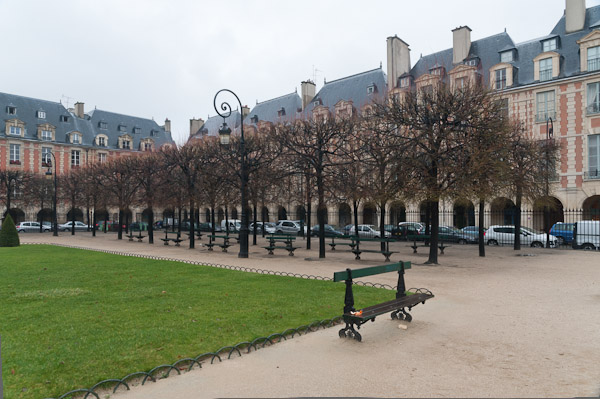
Orange Peel in the Place des Vosges

We met for lunch after our separate Sunday morning activities and lunched in the Place des Vosges before walking the short distance to the Institut suedois where there was a show of work by the Swedish collective Tio Fotgrafer (Ten Photographers), formed by a group of young photographers in 1958 after the model of Magnum as an independent alternative to the Swedish post-war photographic establishment. Later they enlarged the agency and became Nordic Photos.

At first we went in the small hall to the right in the courtyard of the Hotel de Marie. Here there were just a small number of very large prints on the wall along with another in a curious wooden trough on the floor, and the prints seemed rather crude, blown up far too much. If it hadn’t been rather cold and wet outside I might have seen this and given the rest of the show a miss.

© 2010, Peter Marshall
It was raining so we took an umbrella…

Fortunately I didn’t do so, as on the other side of the courtyard there was a show with proper photographs from the photographers in the group,

The group were very much influenced by finding the work of photographers such  as Kertész, Brassaï, Henri Cartier-Bresson and Edouard Boubat (1923-99), and perhaps it shows too much, as although the work of these masters was unknown in Sweden in the 1950s,they are now very familiar to us.

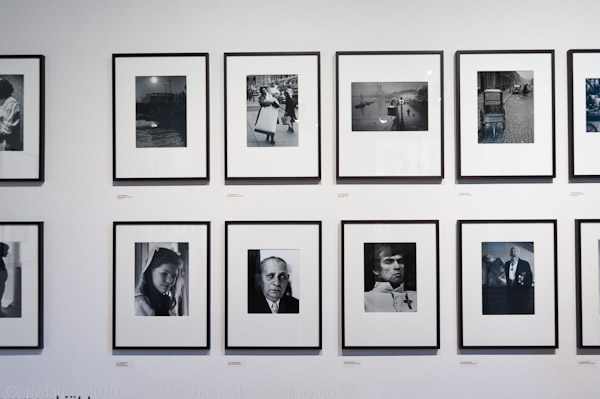
Several of them became friends of Boubat and a panel of his pictures, from the collection of the MEP in Paris, was included in the show.

© 2010, Peter Marshall
Four in the top row of these pictures by
Hammarskiöld are from London

Several of these Swedish photographers were known to me – three were in the Family of Man and work from others appeared in international shows and publications. I was particularly interested to find a number of pictures of London by Hans Hammarskiöld in the show which has been seen at a number of places around the world, including Moscow.

It was a pleasant show, but one that showed that these were very much photographers of their times, working in  a tradition that had already perhaps become rather comfortable over the previous 20 or so years before they founded their collective, and which younger photographers such as Robert Frank were already reacting to. As well as the links above you can find more of some of their work on either the Nordic Photos or Hasselblad sites.

UPDATE:

PARIS PHOTO SUPPLEMENT is now on MY LONDON DIARY

Sunday Worship at the MEP

Sunday morning when Linda went to the culte at the Temple de l’Oratoire du Louvre I took the Metro instead to St Paul to worship at the  Maison Européenne de la Photographie, although my service started half an hour after hers.

The MEP is a great place, and I’ve never visited it without finding at least something of great interest. But this time as I went in I noticed that it is about the only place I found in Paris where photography is forbidden, so there are none of my pictures in this post. Of course there are links to pictures elsewhere.

The MEP is also the driving force behind the Mois de la Photo and many other photographic events in Paris, and this year they were making good use of their fine collection of photographs. I think I heard that there were pictures from it currently on display in 50 (or was it only 15) other venues. Plenty still remained to fill most of its large exhibition space with its major show, ‘Autour de l’Extrême, perhaps indeed a few too many. Their collection includes over 15,000 photographs, including in depth sets of works by a number of great photographers and covering a wide range of photography. As well as many gifts from photographers, they also have benefited from several major sponsors, particularly in adding Japanese photography and the work of young photographers to the collection.

I think an important part of the success of the MEP is that it charges for admission, which encourages regular visitors to take out an annual subscription (at 28 Euros, the price of four visits.) Anyone unable to afford the entrance fee can come and see the shows free from 5pm Wednesday, and entry is free at all times to those with a press card etc.

Autour de l’Extrême
proposed to show images that in various ways approached the extreme, the kind of limits on expression, pictures that perhaps altered the limits of what is acceptable to show. The curators “see one of the recurrent themes of contemporary art” as the constant endeavour “to roll back its own social, political, aesthetic and scientific limits.”

Although there were pictures that clearly illustrated this – what claims to be the first male nude used in advertising, an image by Jean-François Bauret used in 1964 – there were relatively few such clear examples, and the inclusion of some images – including many I was delighted to view – seemed inexplicable. Quite what is extreme for example about Tony Ray Jones’s image (and they had an excellent print of it) of picnickers at Glyndebourne?  And of course, as they state, many things that were at the time controversial are now commonplace – such as male nudes in advertising.

But it was an exhibition I enjoyed, more as a kind of lucky dip into the MEP collection than anything else, with some find work on display, as well as a number of pictures I would be happy never to see again – including a whole incredibly tedious kind of landscape section which seemed a total waste of space.

Not all of the pictures were by well-known names, and there were a few interesting works I’d not seen before or at least did not remember as well as some old favourites. You can get some idea of the range from the list of photographers included:

25/34 Photographes, Ansel Adams, Claude Alexandre, Manuel Alvarez Bravo, Claudia Andujar, Diane Arbus, Neil Amstrong, Richard Avedon, Roger Ballen, Martine Barrat, Gabriele Basilico, Jean-François Bauret, Valérie Belin, Rosella Bellusci, Philip Blenkinsop, Rodrigo Braga, Bill Brandt, George Robert Caron, Henri Cartier-Bresson, Jean-Philippe Charbonnier, Martial Cherrier, Larry Clark, Raphaël Dallaporta, Bruce Davidson, Jean Depara, Raymond Depardon, Philip-Lorca diCorcia, Doctor T, George Dureau, Gilles Ehrmann, Fouad Elkoury, Touhami Ennadre, Elliott Erwitt, Bernard Faucon, Alberto Ferreira, Giorgia Fiorio, Robert Frank, Mario Giacomelli, Nan Goldin, Gotscho, Emmet Gowin, Seymour Jacobs, Claudia Jaguaribe, Michel Journiac, Jürgen Klauke, Les Krims, Oumar Ly, Robert Mapplethorpe, Don McCullin, Duane Michals, Pierre Molinier, Vik Muniz, Ikko Narahara, David Nebreda, Helmut Newton, Pierre Notte, ORLAN, Martin Parr, Irving Penn, Pierre & Gilles, Tony Ray-Jones, Rogerio Reis, Bettina Rheims, Marc Riboud, Miguel Rio Branco, Sebastiao Salgado, Andres Serrano, Cindy Sherman, Jeanloup Sieff, Christine Spengler, Shomei Tomatsu, Pierre Verger, Alain Volut, Weegee, Edward Weston, Joel-Peter Witkin and Bernard-Pierre Wolff.

It’s a list of more than 70 names that includes around 20 phtoographers unfamiliar to me (as well as one spaceman and at least one other who isn’t really a photographer.)

Some of the work was perhaps too obvious and work I’ve seen too often before – such as Helmut Newton‘s giant images of fashion models clothed and unclothed which occupied a vast area of wall space. Frankly a magazine spread of the two would have done as well and  made room for other work – it would have been nice to have more than the three pictures for Bruce Davidson‘s East 100th St or by Roger Ballen. I could also have done without an unfamiliar series of large portraits showing Michael Jackson.

I enjoyed seeing a couple of Les Krims‘s fantastic tableaux, packed with little things including bad taste jokes in both image and text – a bitter comment on the American Dream in his A Marxist View (1984) – and Mary’s Middle Class.

There were some rightly familiar icons – Elliot Erwitts’s washing facilities for Whites and Coloureds which speak strongly about apartheid, Marc Riboud’s Flower Child, Henri Cartier-Bresson’s Denunciation of a Gestapo informer, Robert Frank’s New Orleans Trolley among them, but also images I’d not seen before such as a Seymour Jacobs portrait from Brighton Beach, one of a small selection of pictures on show in the various shows currently at the MEP you can see on Picasa.

Elsewhere around the show were many images or small groups of images predictable but still of interest, such as Larry Clark’s pictures of  young addicts from Tulsa, Manuel Alvaro Bravo’s assasinated worker, the Hiroshima mushroom cloud taken from Enola Gay alongside the invevitable Shomei Tomatsu watch and Don McCullin’s shell-shocked marine.

One of the few small sections which for me showed some curatorial added value were a small series of images of a shattered Beirut, with three pictures each by Gabriele Basilico, Fouad Elkoury and, in rather muted colour, Raymond Depardon.

In the basement of the MEP was the rather curious ‘Trans-apparence‘ the work of Rodolpe von Gombergh, which aparently uses ultrasound, electomagnetic waves and X-rays to produce images displaying the interior as well as the exterior of artifacts. The display using “holograms, 3D screens and cold light diodes” I found odd but not particularly gripping. I was rather reminded of the kind of graphics sequences found at the start of some TV programmes, but here there was nothing to follow.

Miguel Angel Rios’s twin-screen film ‘Mécha‘ uses the bizarre Colombian sport of that name, in which metal disks are thrown at a mud-filled inclined surface containing triangular pink targets filled with gunpowder which explode when hit, as a metaphor about the urban guerilla warfare between drug traffickers in Mexico and Colombia. With lots of slow motion, rolling cable drums, close-ups of running feet and noises off he creates an atmosphere of tension, but left me feeling I would rather have seen a more straightforward documentary about either the sport or drug trafficking.

The MEP has a gallery ‘La Vitrine’ with windows that look out onto the neighbouring main street and in this the 16th Grand Prix Paris Match for photojournalism was on display. The winner was Olivier Laban-Mattei of AFP with a series of colour images from the earthquake in Haiti, which included a couple of great images, (one apparently but not credibly taken with a Leica M9 at f1.0)  – it appears on his Photoshelter site in black and white.

All the work from the 20 or so photographers on display had a very similar look, with rather bright and slightly ugly colour reproduction, which for me made the show less interesting.

All too soon it was time to meet Linda and have a quick lunch before visiting a few more shows.

UPDATE:

PARIS PHOTO SUPPLEMENT is now on MY LONDON DIARY

Parcours Saint-Germain-des-Prés

© 2010, Peter Marshall

I’ve rather gone off the Left Bank, which has changed almost beyond recognition since I first went there more than 40 years ago. Then it had the charm of seemingly hundreds of years of neglect. Now virtually every one of the old shops is a gallery or some other establishment catering largely for the tasteless over-moneyed. In between there are a few good galleries – including many of the more than 30 showing photographs that we looked into on our late afternoon walk around the area – most were staying open until 7pm. As well as the 31 in Photo Saint-Germain-Des-Prés there were also several with shows in the Mois de la Photo, though unfortunately several closed too early for us to do more than look through a window (and the hours given in the MdP booklet weren’t always accurate.)

© 2010, Peter Marshall
Depardon’s work on the Magnum stand at Paris Photo – the lower picture was my favourite from the show

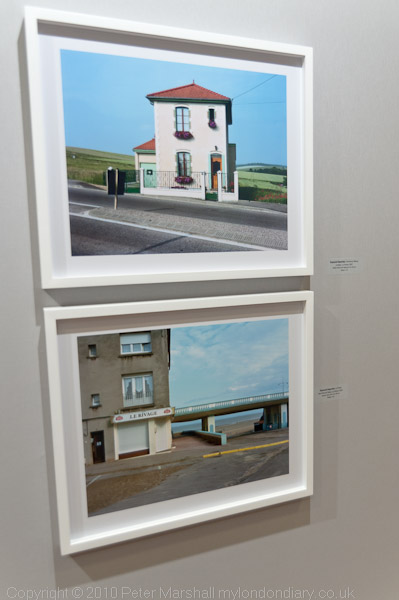
We started at Magnum’s gallery just behind the former Abbey, which was showing pictures from two bodies of work by Raymond Depardon, a photographer whose work I’ve long admired. As well as the colour prints from La France de Raymond Depardon, there were also some black and white pictures from his ‘Errance‘. I was unimpressed by these – if anything they look slightly better in the book preview – and you can see 77 pictures in the album. I think the concept is too vague, and too few of the images really work for me (and those on show in Paris were not I think the best.) What they do of course show is Depardon’s interest in the urban environment, and that continues in the considerably more impressive colour work.

The Magnum page on the main exhibition of ‘La France’ which continues at the Bibliothèque nationale de France until 9 Jan 2011, has some curious difficulties, perhaps largely from translation. Here is a sample:

The main features of Depardon’s full of empathy former works were the contrast effects of black and white photographs and the use of a dynamic depth of field. This time, he preferred frontality and the use of the photographic chamber, colour, and a soft, neutral and unique light. The photographer sometimes preferred landscapes to human beings; however, it is a way « to focus on human influence which modified landscapes throughout history. »”

The next paragraph starts by talking about the work on display as a “series of 36 very large silver prints.” Of course as anyone with any knowledge of photography can see from that link (which shows the 36 colour images) they are not silver prints at all. What I think they meant to say was that these are colour images taken on film using a large format camera.

I don’t know how they were printed, but I think it unlikely that Depardon actually  polished the scans as they suggest, although he may well have worked on them considerably at the computer, and possibly not entirely to their benefit. The colour in all those I have seen is, to my eye, over-saturated, almost garishly so in a few of the prints at Magnum, although others were more realistic. I did find myself thinking while I looked at them that it might well have been a better show had he worked with digital!

© 2010, Peter Marshall
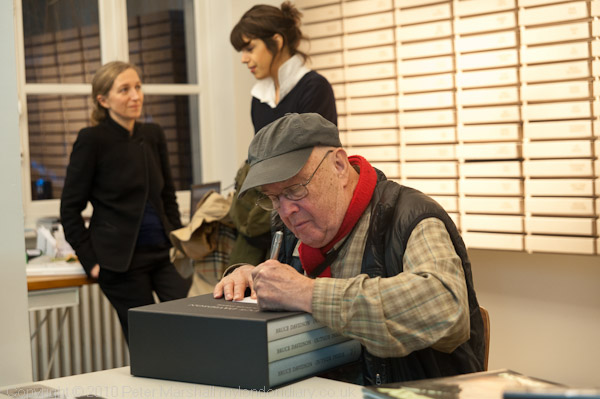
Bruce Davidson and a rather heavy three volume book at Magnum Gallery

His work is interesting, and very different to the view of France by Thibaut Cuisset I had seen a short while earlier, some of the pictures in which were also taken on the edges of urban areas. Depardon’s book too looked good, but far too heavy to carry, and the same was even more true of the volumes which Bruce Davidson was signing while we were there.

© 2010, Peter Marshall

Our next stop was a cafe – I needed a beer and Linda would have liked a nice cup of tea, but this was France, so I think she settled for a coffee – like everything else round here rather on the expensive side. But then we pressed on.

© 2005 Peter Marshall.

Closer to the river on rue Bonaparte were two shows by photographers I’ve actually met, Eikoh Hosoe, seen above photographing in Poland (more pictures here) at Galerie Photo4, and Ralph Gibson at Galerie Lucie Weill & Seligmann next door, who made some generous comments when I showed him my work in London many years ago (including some of the pictures I later showed and put on the web as ‘Ideal Cafe, Cool Blondes and Paradise‘.) For me there was nothing new there, but it was good to see some of the work again. Gibson is a photographer who has rather gone out of fashion in the UK (and I think USA), probably now more regarded for his Lustrum Press rather than the actual pictures in books such as ‘Days At Sea‘ but he has remained rather bigger in France.

Another of the MdP shows was by Mac Adams, in Galerie Serge Aboukrat in place Furstemberg. Born in Wales but a US citizen, he is an artist whose photographic work I’ve never really appreciated, even when I can see his idea, visually it seldom seems to me to offer enough. This show didn’t help, though you can download a well-illustrated pdf from his site which is rather better.

Many of the other thirty or more galleries we visited – including some not listed on the ‘Parcours’ map – merited nothing more than a quick visit, but there were things of interest, including vintage work on Paris in the windows of Agence Roger-Viollet (I particularly liked an image of Delbord  diving into the Seine with his bicycle as a part of the 1913 French diving championships on the Île des Cygnes  – there is a larger version on Getty) and the surrealist images at Galerie les Yeux Fertiles. But there were also galleries full of rather stylized portraits and other work which while often technically excellent I failed to see much interest in, along with just a little of the kind of anaemic soft-porn that sometimes passes as art in France.

But at the end of our long and complicated walk we came to the Galerie Arcturus, showing Marc Riboud‘s ‘Icônes et Inconnues‘ and it was a joy to look at some of his great work. One image I don’t remember seeing before was of a street that could only have been in the north of England, taken in Leeds in 1954, a bowler hatted man in a raincoat with a stick struggling forward head down in the foreground while two women in coats and hats, one holding her shopping back chat in the road on the street corner, terraced houses leading down through the murk towards the gas holder.

By now – and perhaps more suitably for Leeds than Paris, it was cold and wet and we were in need of sustenance. Fortunately we’d come to the end of the parcours and we rushed to the Metro to get to a cheaper and more down to earth area.

UPDATE:

PARIS PHOTO SUPPLEMENT is now on MY LONDON DIARY

Paris Photo – Lab East

© 2010, Peter Marshall

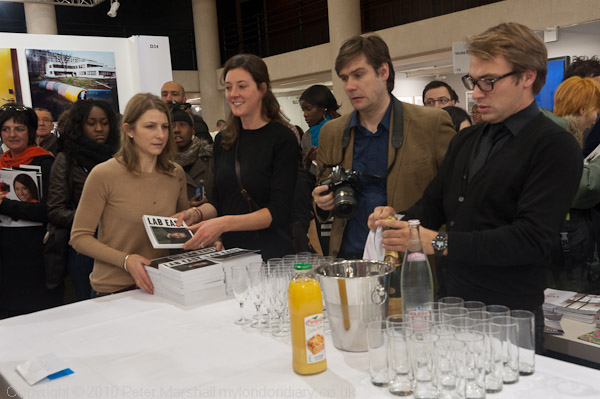
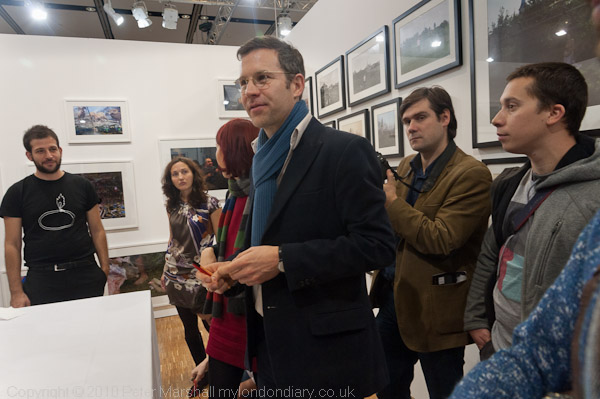
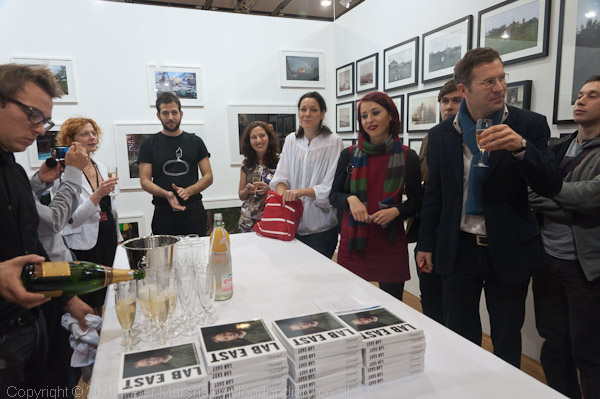
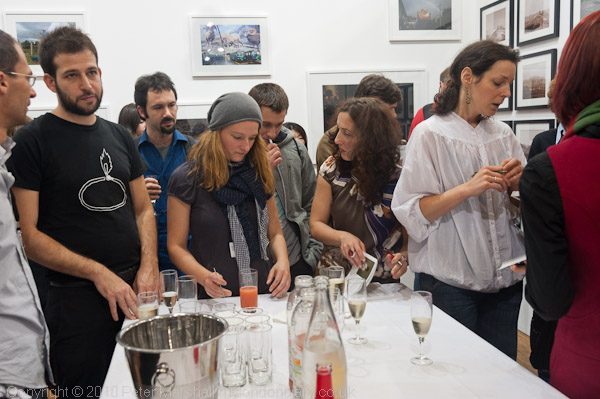
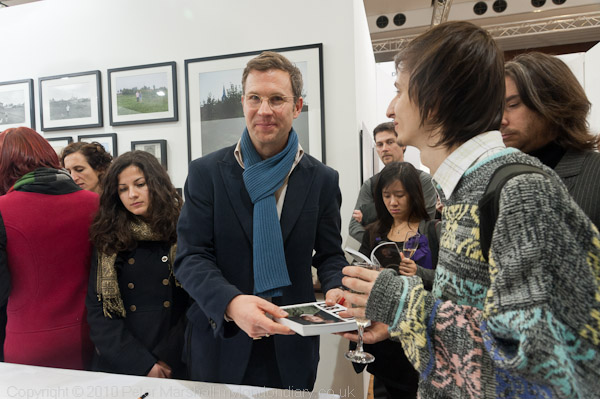
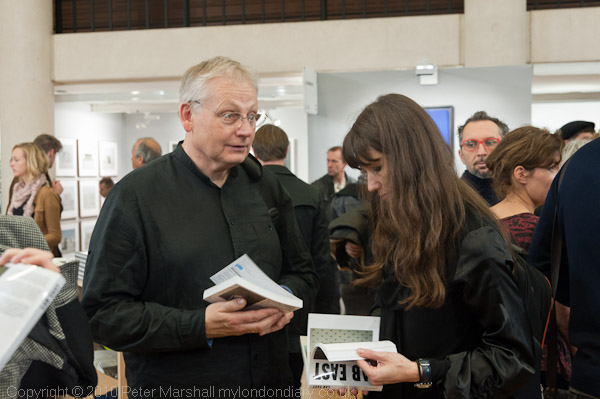
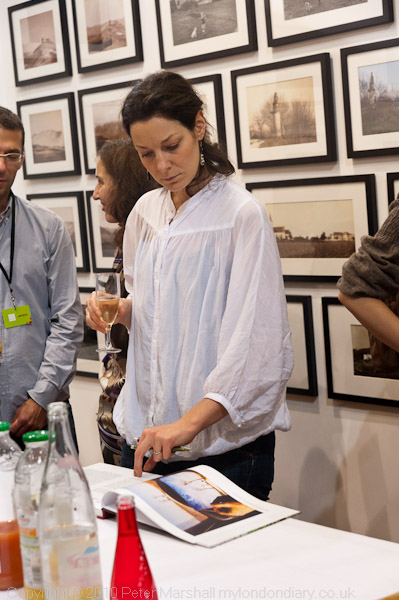
It was thanks to Teresa from Blurb that I was invited to the book launch of ‘Lab East‘ at the Lumen Gallery stand in Paris Photo. Lab East, a roughly seven inch square slab of 260 or so pages, “printed with the friendly support of blurb, the creative publishing platform” is I think an important work in several respects. Edited by Horst Kloever of photeur.net, it presents “30 photographic positions fron Central and Eastern Europe“, work by young photographers – all born in the 1970s and 80s – few of whom will be known outside their own countries, although there were one or two photographs I recognised, and a number of those included have worked or studied in the west.

© 2010, Peter Marshall

One of those included is Bevis Fusha from Albania, who I got to know when we both showed work at the first FotoArt Festival in Bielsko-Biala, Poland in 2005, and whose work I’ve written briefly about on several occasions, and it was good to see his black and white images exploring the antagonistic aspects of the ‘Supermodel of the World’ annual competition in Tirana. Although there were half a dozen of the photographers there for the book signing, unfortunately he wasn’t among them.

© 2010, Peter Marshall

I don’t entirely agree with the forward by Walter Keller, the organiser of the Labor Ost show in Zurich in May 2010 and was an important advisor for this book (the show included many of the same images.) Perhaps there are countries where “a dense net of art schools, supporting foundations, photo museums, commercial galleries and curators all merge into a promotional engine of high energy, making it almost impossible for a young photographer not to be discovered“, but I certainly don’t live in one. It seems to me that most photography of interest in the UK arises outside of any such system and probably only a small proportion is actually devoured by it. But the UK has a particular inbred cultural aversion to photography, or rather photography as art, and things are perhaps different in Switzerland.

© 2010, Peter Marshall

But what is obvious is that although most of these photographers were still in school or kindergarten when the Berlin Wall fell 31 years ago, photography still has to seriously address its own Iron Curtain. This book, like this year’s Paris Photo, is one small step in that direction.

However the very richness of the work on display in this book – and to be found elsewhere across the former Soviet empire – surely owes something to the importance placed on culture and cultural organisations during those years – and which in turn stimulated vital dissident work. These artists grew up in more fertile soil than that provided by McDonalds and MTV.

Reading through the short biographies traces of this still exist – for example I learn that Pawel Bownikreceived a scholarship from the polish Ministry of Culture and National Heritage in 2008.” Here our governments give money to people who can run, jump, swim, throw, row or sail instead.

Latvian photographer Arnis Balcus, who took his MA in photography in London after after studying communications in Riga, addresses the Soviet past, or rather the ‘Collective Amnesia’ around it in his pictures which, by fortuitous alphabetism, start the book. His image of a young man in military uniform sitting on a rough bench outside a dreary and run-down block of flats, another identical in the distance, grass overlong and pushing up through the cracks in the pavement seems to me truly an archetypal post-Soviet image.

© 2010, Peter Marshall

To go through all 30 of the photographers in this book would take me until Christmas, and I’ve other things to do. You can order it from Blurb and it will cost you £31.47 plus postage; not cheap, but perhaps someone will give it you for a Chrismas present? You can see 69 pages on the preview there, including some of the work I found most interesting, for example by Krisztina Erdei from Hungary, whose work was on display at the Lumen stand (she is a founder and curator of that gallery and foundation.)

© 2010, Peter Marshall

This is a book I intend to return to from time to time, and perhaps write a little about some of the others included in it. I can’t say that I like every work in it, but certainly a much higher proportion than on the walls of Paris Photo hold some interest for me.

© 2010, Peter Marshall

But this book is also important in that it is a part of the new photographic publishing, through Blurb (and perhaps also other print on demand services, though at the moment Blurb seems clearly to be in the lead.)  Although print on demand will still remain as a cheap way for anyone to produce personal books for themselves, friends and family, increasingly it is becoming the way that serious photographic books – such as this – will reach their audience. The Blurb London Pop-Up – in which I took part in, and it also had a ‘Magnum‘ day – and their ‘Photography Book Now‘ contest and even my own Blurb books are all a part of this (and might solve those Xmas present problems too:-))

UPDATE:

PARIS PHOTO SUPPLEMENT is now on MY LONDON DIARY
Geoffrey Crawley RIP

I read yesterday of the death, age 83, of Geoffrey Crawley, and wasn’t intending to write about it as I didn’t feel I had anything to add to what had already been published, particularly by the BJP and Amateur Photographer – he worked for both. The twenty years he spent as editor of the BJP, from around 1967 to 1987 were perhaps its best years within living memory, although not commercially.

I can’t remember ever having met him, but as a very occasional contributor and letter writer to the BJP, I did talk with him a few times on the phone and received several letters from him, including a very nice personal reply following a complaint I made about a rather insane review the magazine had printed by Ainslie Ellis (1920-1997.) 

Like many photographers I made use of the developer formulae which he contributed to the British Journal of Photography Annual, the whole ‘FX’ series of fine grain and acutance developers, some of which, such as Acutol and Acutol-S were commercially marketed.

As well as the magazine, he also edited the annual from 1967. In 1988, which I think was the last issue, it made the proud claim to being the oldest photographic annual in the world, first appearing as a wall calender in 1860, and then as a pocket book supplement to the magazine in 1861. You can read or download the 1898 issue (long out of copyright) made available by the University of Toronto.

It’s interesting to re-read the two page editorial in the 1988 issue by Crawley on advances in technology and how these will effect the future of photography – he notes that the “keynote of the next few years… could well turn out to be the increasing use of photography as a notebook in everyday life and particularly in leisure activities.” But writing in 1987, the article nowhere mentions the idea of digital imaging – how quickly things were to change in that respect.

The 1988 annual had another great figure from the last century of British photography as picture editor, Colin Osman, noted as a photo historian but also as the financial supporter for the crucial years of the magazine ‘Creative Camera.’ I was very pleased to have four of my pictures included in the picture section, along with work by many other photographers, including David Hoffman, Anna Fox, Tom Wood, Crispin Hughes, Mike Seabourne,  Barry Frydlender, John Blakemore and many others.

One of the strangest stories which Crawley was involved in was the 1917 Cottingley Faires hoax, and it was an article on PetaPixel about this that made me change my mind and write this post. As Michael Zhang notes, it’s interesting that so many people were taken in by these pictures (though they were not as he suggests “in the early days of photography” but when it was 78 years old.)

The hoax, carried out by two girls aged 10 and 16, was a very amateur affair. That people believed them was simply because they wanted to believe them, not that they were in any way believable – to any unprejudiced eye they were obviously fake. What Crawley did was to show in detail exactly how they had been made, and to gain the confidence of Elsie Wright and enable her to at last confess to the truth of the matter.

Rivington Place & Photomonth

Monday was an interesting day for me. After a few hours work on the computer I had a very nice lunch at a small restaurant in Tolworth with a couple of friends then went with one of them to London to spend an hour or so looking at some of the other shows in the East London Photomonth, (and one was in a pub) before going on the the Photographers Social in a bar in Soho. A minutes walk from a decent pub.

The following day I had a bit more time after a meeting with a friend at a London hospital and was able to see far more, including two of the major galleries taking part in the event, Flowers East and Rivington Place, before rushing to a union meeting where a distinguished and knowledgeable panel discussed the question whether street photography would still be around in five years time.

But some of the experiences finding shows were rather like those I had visiting the Brighton festival a couple of weeks ago. Galleries that according the the leaflet should have been open at the time we called but were not, one address that was a locked building with no indication that there was even a gallery there, as well as several places where a quick look through the window told us it was not worth entering. But I did find some work worth looking at, particularly on the Tuesday.

The oddest experience came when I went into a gallery on Rivington St, and asked one of a small group of people sitting around and talking there where the exhibition was. It seemed to be quite a large space, and all I could see were fairly empty walls with the occasional poster.

At first there was some laughter as I’d obviously picked exactly the wrong person to ask, but then one of the men asked to see the programme where the show was listed. He scratched his head and told me he knew the photographer, would have been happy to put on a show of his work, but that he knew nothing about it, and the show didn’t exist.

He then said that someone else had come in and asked about it a couple of weeks ago. This was a shock, apparently only two visitors in more than three weeks, and was also rather a surprise. My own show, Paris – New York – London, with Paul Baldesare and John Benton-Harris, only a couple of hundred yards away, tucked away in a side street and not the easiest place to find has been attracting quite a few viewers over the weeks as well as the normal visitors to the Juggler café it is part of. Surely it can’t just be because I’ve mentioned it here most days!

I was surprised again later, visiting one of the more interesting shows on at Rivington Place, a superb well-staffed gallery space – the first new-build public gallery in London for 40 years when it was opened in 2007 –  to find that I had both shows to myself (and in each case an attendant) while I spent some time looking at ‘Ever Young’, showing 60 years of photography by  James Barnor, born in 1929 in Ghana (he tells about his early career here on ‘Nowness‘) and now living in London.

Much of his studio photography from Ghana seemed a little ordinary, but there were a few images that stood out, and in the 1950s his ‘Ever Young Studio‘ was visited by many leading figures around the time that Ghana, in 1957. As well as the studio photography he was also working for a newspaper, The Daily Graphic, and later for Africa’s most popular magazine Drum.

In 1959 he came to England where he studied photography and joined the staff at the Medway College of Art in Rochester. In the 1960s he continued to photograph, including a number of pictures of cover girls that are included in the show, but also covering other stories of African interest including Mohammed Ali in London for a fight and BBC Africa Service reporter Mike Eghan.

In London he was trained in colour processing by Agfa-Gevaert and returned to Ghana in 1969 as their representative to establish colour processing in that country. In retirement he now lives in London, not far from Agfa’s UK HQ.

Barnor was certainly a very proficient photographer and there are several very nice images in the show, including two of people posing in Trafalgar Square and at Piccadilly Circus. But the great interest in his work is more in the different cultures and changing times it spans and to which he had access to photograph some of the leading figures particularly in Ghana, and in the relationship his work embodies between the new Africa and the old colonial power. It’s certainly a show worth seeing, and continues until 27 Nov 2010 (closed Sun & Mon.)

Also on show at Rivington Place is a fascinating set of portraits collected by the leading black intellectual and civil rights activist of the era, W E B Du Bois for the book ‘Types of American Negroes, Georgia, USA‘ and exhibited in at the 1900 Paris Exposition Universelle in the ‘American Negro Exhibit‘. Consisting of pictures from various sources and in a range of styles, these images challenged the racial stereotypes that were a part of the scientific thinking of that age.

Looking at them brought a number of thoughts to my mind. One was of a job I did for an Indian friend perhaps 20 years ago, taking some pictures of him and some of his friends. They were unhappy with the black and white prints I produced, but he was very reluctant to explain why. Eventually I realised that the problem was in the skin tones, which I had printed as I normally did, with an accurate tonal rendition. I made some further prints, dodging the faces to lighten them considerably to a more ‘European’ tone and they were happy. Looking at some of these images it is clear that in some of them a similar process had been taking place, using either lighting or printing to create very light (in some cases very white) skin tones. Of course the  ‘ordinary’ or ‘orthochromatic’ emulsions in this era had a certain lightening effect on all portraits, whatever the skin colour.

Library of Congress Image
Image from the Du Bois album in the Library of Congress LC-USZ62-124654

Another thought I had was that many of these pictures could actually have been from my own family album. Taken away from their context there are many that would not be recognised as black. The gallery notes suggest that this collection “can be read as the origins of a visual construction of a new African-American identity” but it seems more to me to suggest that this identify is not greatly dependent on the visual. But Du Bois’s intention to produce ‘an honest straightforward exhibit of a small nation of people, picturing their life and development without apology or gloss, and above all made by themselves‘ has certainly resulted in a fascinating collection.

At the Library of Congress you can see the complete collection of 482 African American Photographs compiled by Du Bois for the Paris show online, and can download them as jpegs or tiffs (large enough to make the prints in the show.) The portraits start on the second page of thumbnails. The image here comes from that collection and may or may not be in the Rivington Place show.

It is a thought-provoking show, and other people with other backgrounds will certainly have different thoughts from mine, a couple of which I’ve shared above. In many ways the decision to present them all in the same format in two large grids on the gallery wall makes sense, but I did find myself asking what the originals actually looked like, and in some respects the online presentation does that better.

The other shows not to be missed are at Flowers East (also closed Sun & Mon)  and I mentioned them briefly in a post after the packed opening there but I hope to write more about them and some other shows from Photomonth 2010 another day.

The Three Cities of Photography

[Text of my speech at the opening of ‘Paris – New York – London‘ at the Shoreditch Gallery, London on 20.10.2010. The show continues until 29.10.2010.]

Stars of tonight’s show are the most vital cities in the history of photography, Paris, New York and London. As we know the twin birth of our medium was announced within a few days in Paris and London in 1839; New York was to dominate much of the twentieth century.

The most notable British photographer of the last century illustrates their relationship well. Bill Brandt was a German who re-invented himself as a Londoner, learnt photography in Paris, and when he had the first major solo exhibition by a living photographer in any of our leading art institutions, his Hayward Gallery show came from the Museum of Modern Art in New York.

London dominated photography in the 19th century. One of our greatest photographers was Roger Fenton, honoured by a blue plaque on a fine house overlooking Parliament Hill Fields. But after a few years as our leading photographer he abandoned photography and went back to making some money instead – as a lawyer. Despite the strength of photography here, this country has never really accepted photography, never developed a culture, a community that supports it.

© Paul Baldesare
Sleeping vagrant, Davies St, Mayfair, London. Paul Baldesare

Paris’s great period was between the two World Wars; Atget was still working in the twenties, Henri CartierBresson was young and active in the next decade and others including Capa, Brassai, Kertesz and Man Ray flocked there. But photography was just one of the arts that flourished, and the inspiration for my own work on the wall here came more from Surrealist literature and in particular Aragon‘s ‘Paris Peasant.’

© 1988, Peter Marshall

One man almost single-handedly dragged the US to the forefront of photography around the start of the twentieth century, and Alfred Stieglitz in New York repeated his miracle when he published the work of Paul Strand in the final two editions of Camera Work in 1916-7. Later the city was the home for a hugely vital upsurge of photography in the form of the New York Photo League, closed down by McCarthyism at the start of the 1950s.

Alexey Brodovitch came from Paris to New York in the mid 1930s, becoming art director of Harper’s Bazaar and in the 1950s and 60s established a legendary laboratory for photographers. Two who went through that mill, John Benton-Harris and Tony Ray-Jones came to London in the late 1960s and helped to kick-start a decade of resurgence of photography here which lasted through most of the 1970s, particular through their influence on the magazine ‘Creative Camera‘, based in London, though its publisher, Coo Press was kept afloat by men in braces in the pigeon lofts of our northern cities who bought its other publications.

This was only a short-lived flutter, soon cut down to size and emasculated by a British establishment that refused to take photography seriously (and held its nose and kept it at arm’s length when it had to take it at all), and in particular the Arts Council and their ‘photographic flagship’ in London, the Photographers’ Gallery, or as I christened it a couple of years ago after its move to new premises, the zombies of Ramilees St. The gallery made only half-hearted attempts to encourage and nurture photography in this country, and these were abandoned completely  in the late 1980s.

I was one of the photographers influenced by that outburst of the 1970s, and Paul Baldesare‘s work developed particularly from that of Tony Ray-Jones and John Benton-Harris.

Although a photographic culture is still almost completely lacking here, there have been a few small glimmers of hope arising if sometimes rather dimly and uncertainly from a general pea-soup of indifference. Photofusion in Brixton, Host not too far from here, and, perhaps most notably, the East London Photomonth, now celebrating its tenth year. I’m pleased to have been able to be involved with it through shows here in the last three of these.

Peter Marshall 20.10.2010

[I ended with thanks to various people and also an advert for Photo Paris, which includes the pictures from Paris on show here, as well as mentioning that work from two of us was on sale. Pictures from the opening in a later post.]