Speculation on Photographs (Part 2)

This is a continuation of Speculation on Photographs which includes a discussion of Erroll Morris’s exhaustive examination of the two Roger Fenton images from ‘The Valley of the Shadow of Death’, one with cannonballs on the path and the other without.

Morris seems to me to be unduly concerned with reality and with establishing a connection between photograph and reality. To him it really was important whether those cannonballs were where they landed, while to me it seemed unlikely in view of both momentum and gravity. (I wroteYou might also ask why so many balls should have stopped rolling on the smoother road rather than going down into the gully by its side, especially if you’ve ever played bagatelle.”)

Fenton was of course working before there were any well-established conventions about what was ethical in news photography (which he was more or less inventing), let along in art, and there can be no doubt that he saw himself as an artist, and that he was someone who carefully composed his pictures.  I imagine that he took one picture as soon as he arrived, unsure about whether it would be safe to stay long enough to make a second exposure, then set about getting things arranged in a more artistic fashion.

Soth goes on to show an example from his series Broken Manual which is a kind of re-creation of Robert Frank’s image through a curtained window in Butte Montana, though in various respects a very different picture. Without the reference to Frank’s earlier image it would I feel have very little interest, and I would certainly wonder why the photographer took it. He does give some answers to that question in the link he provides to How to Revisit an Iconic Photograph which includes some other of his re-creations of well-known images. Soth says that he learnt a lot from re-visiting these pictures, which I’m sure is true, but I feel that I gain much from looking at the re-results of his learning experience.

Another image he has used as a starting point and is illustrated in the article is Dorothea Lange’s ‘Migrant Mother’, and he raises an interesting point when he mentions that her “are dramatically out of focus.” It’s worth downloading the digital file LC-DIG-fsa-8b29516 made from the original negative from the Library of Congress to examine this claim (the link to the larger 55Mb file fails for me) which is used for the image below, displayed here to a smaller size – right click and select ‘ View image’ to see it larger. Unlike some of the other images on the LoC site, including some versions of this image, it does not appear to have been ruined by excessive sharpening* of the digital file (which doubtless seemed a good idea given the different standards of the 1990s), and apart from a difference in tonality is a good match for the vintage print reproduced there.

LC-DIG-fsa-8b29516 Library of Congress, Prints & Photographs Division, FSA/OWI Collection
Library of Congress, Prints & Photographs Division, FSA/OWI Collection. Public Domain

The image above is an actual 821×1024 pixel file, and I’m looking at it on my screen at actual size as I write, where it displays at roughly 8 x 10 inches (a twice linear magnification from the original 4 x 5 negative, made by Lange on her Graflex RB Series D. Working with this format and probably with the camera hand-held, depth of field would have been pretty minimal as a fairly wide aperture such as f5.6 or f8 would have been used to avoid camera shake. Film was slow in modern terms, and generously exposed negatives were desired.

Critical sharpness occurs more or less on the ear and check shirt of Florence Owens Thompson, and I suspect as Lange peered down into the reflex viewfinder that the squares coming sharply into focus caught her attention. The eyes are certainly not as sharp, but sharp by the standards of the day which were much less rigorous than ours.

Way back in the 1970s I happened to be around when a very distinguished ex-President of the Royal Photographic Society was setting up a panel of his work for a workshop about gaining the awards of that body, and made the mistake of commenting that the pictures on it  – prints around 20 x 16″ were unsharp – as they clearly were. He overheard my comment and I got very firmly told that I didn’t know what I was talking about, his pictures were sharp enough. By his standards they were, but not by our more modern expectations – and things have got worse now we are used to zooming in to the actual pixels on screen.

Soth is of course correct to say that the eyes are “dramatically out of focus” in that their slight unsharpness actually increases the dramatic effect of the image, although for me it is perhaps the blurring of the wrinkles on her forehead that is more telling. There is a contrast between the biting sharpness of the hair of the child at the right of the image and the softness of the woman’s face as she stares into an unknown but apparently hopeless future.

For me the most successful of Soth’s re-creations is clearly based on Ruth Orkin’s ‘An American Girl in Italy’. As he clearly says, what gives his picture and the original their “energy is that a real event took place.” Though I still think Orkin’s image works so much better that I would hesitate in showing the new work if it were mine.


*With scans, standards of sharpness and tonality have also changed considerably but differently over a shorter period, as scanner technology has improved. The Library of Congress (and on a much smaller scale myself) suffers from having been one of the pioneers of putting photographic images onto the web. Many of those old scans now look more like caricatures rather than reproductions of the images the represent, with drastic white fringing and obvious jpeg artifacts.

Speculation on Photographs

Alec Soth starts an interesting discussion with his The art of speculation on his Little Brown Mushroom blog, where he begins by quoting a series of Tweets by Erroll Morris which attempt to give a simple account of the principles of his new book Believing Is Seeing.

Perhaps the most contentious of them is the first:

1. All photographs are posed

which on an obvious level is obviously not so.  Morris makes it true by a redefinition of the word ‘posed’, as becomes clear in his discussion of the two Roger Fenton pictures of ‘The Valley of the Shadow of Death’, one with cannonballs on the path and the other without, where he writes:

Couldn’t you argue that every photograph is posed because every photograph excludes something? In every photograph something is absent. Someone has made a decision about what time-slice to expose on the emulsion, what space-slice to expose on the emulsion.

You can only argue this if you are prepared to alter the accepted definition of ‘posed’ to mean something intrinsically different to its normally understood and accepted meaning, of something that has been set up or re-ordered or arranged within the view of the camera.  Framing isn’t posing, nor is the selection of the moment, or indeed the other decisions we all make that affect the picture we produce. His is not just a silly and circular argument, but one that erodes our critical vocabulary.

The quotation comes from the third and final of his three articles on these two pictures, where his quest to establish without doubt the order in which the two pictures were made takes him both to numerous experts in photo history and interpretation of images as well as on a field trip to the Crimea.

Public domain: US Library of Congress cph 3g09217
You can download a 50 Mb file from the Library of Congress and print your own Fenton

You can read his full three part series on line starting at Which Came First, the Chicken or the Egg? (Part One) which has links to parts 2 and 3.  It was certainly a painstaking exercise, but after I’d spent a couple of minutes reading a little of part 1, all I wanted to know was if he had established the answer – and whether it agreed with my own immediate photographic intuition on first viewing the image that the cannonballs on the path were perhaps rather too nicely scattered. I posted some thoughts on the matter here in Cannon Balls to Fenton when these articles by Morris were first published in 2007.

Morris’s argument – as I say above –  seems to me to be saying that if we redefine ‘posed’ to mean made using the kind of selection and abstraction that is always  involved in making a photograph (even those ones that, to quote Leon Neal, you only got “you only got … by accidentally dropping your camera as your ate your Big Mac, firing a frame of the subject … as they passed behind you“)  then all photographs are posed.  I object to this kind of abuse of language.  Let’s find the right word and use it rather than cheapen another that has a normally accepted different and useful meaning.

 Soth discusses Morris’s second point:

2. The intentions of the photographer are not recorded in a photographic image. (You can imagine what they are, but it’s pure speculation).

It seems a rather partial truth.  Soth makes the point that our speculations about the photographers intention are essential to our experience of the work, andI think it we can also say that the photographers intentions are also integral to the production of the work. Soth discusses a well-known image by Robert Frank, of the view from a hotel window in Butte Montana. Although Frank’s intentions may not be recorded in it, had they been different then he would have made a different picture. Or no picture at all.

Frank’s intentions of course made him take not just this picture, but a large number of others, and to edit and sequence them in a particular way.  And though his intentions may not be recorded precisely in the book or any individual image, both rule out many possible interpretations. What we imagine when we read the work is certainly not “pure speculation” but an impure speculation that runs with rather than against the evidence provided.

Of course each of us sees a different picture when we look at this (or any other image) constructing it from our own interpretation of what we see and what we know about it, our previous experiences and the environment in which we come across it.  We see a different picture every time we look at it, but we are likely to have both in our individual and our shared experience certain perceptions about it which are likely to be in common.  Photography isn’t just a medium, it is also a community.

Continued in Speculation on Photographs (part 2)


A Rare Opportunity

You can read my opinions on photography with some regularity on this site, although I’ve been rather busy in the last few days with a  couple of shows coming up, and producing a catalogue for one, and, when I get around to it a web site for the second. A more normal service will I hope be re-introduced here and on My London Diary (where August has yet to begin) shortly.

But tomorrow there is a fairly rare opportunity to actually hear me talking, in an event at the Museum of London, where with a few others I’m on a panel discussing the future of street photography and related issues.  On the panel with me are the curator of the museum’s attendance-breaking London Street Photography show, an old friend of mine, Mike Seaborne, and one of the other photographers with work in the show, Polly Braden, while photographer Stephen McClaren will try to keep some order. The discussion starts at 7pm and you can still book on-line.

Unless pressed I don’t intend to talk about my own picture in the show, not least because I don’t think it really is an example of street photography, although it was indeed taken on a London street, and was one of the images used on the poster for the show. But I have taken plenty of other pictures that are street photography but were not chosen. Of course the fact that it – and many other images in the show are not really street doesn’t mean they are not good pictures, but rather questions the criteria used in curating the show.

© 1991, Peter Marshall
Whitechapel 1991- a documentary image but is it ‘street photography’?
© 1987, Peter Marshall
But Portobello Road, Notting Hill, April 1987 certainly is

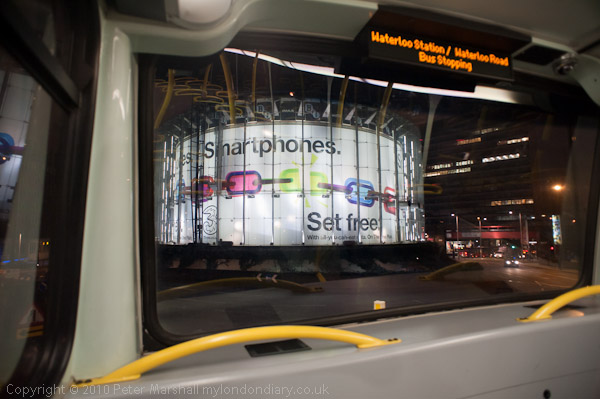
I wrote earlier this year about the opening of the show in London Street Photography, a piece that included one of my images that was a small attempt at a comment on the future of street photography.

© 2011, Peter Marshall
Smartphones  Set Free – perhaps the future of street photography?

The discussion lasts – including the time for questions – an hour, after which there is a further opportunity to see the show, which closes this Sunday, September 4. I’m not at all sure what the talking will be like, but I have been asked to supply five of my own pictures for a presentation as well as nominating two pictures from the book that I would like to say something about.

Although in some ways I found the show disappointing, as an event in promoting photography I think it has been a great success – and of course I was very pleased to be chosen to be in it and the book London Street Photography published by Dewi Lewis Publishing, ISBN 978-1-907893-09-4, together with it. But when asked to talk about two pictures from it, I found it hard to find pictures that I really wanted to talk about, as although there were some great photographers included, the pictures were seldom particularly good examples of their work. There were also some aspects of it I found hard to swallow, including the disregard for the moral rights shown in projecting some images taken on medium format cropped to 35mm format in the slide show. A museum should really not treat photography like this.

Despite such reservations (and I have others), this was a show that came at exactly the right moment, when street photography was high on the popular agenda, with shows in Derby and of course the first London Street Photography Festival which has just concluded, although there is still a chance to see a show of the much-hyped work of Vivian Meir at Photofusion in Brixton, where it continues until 16 September 2011.

Although the publicity for the show talks about “her unique style of candid street photography” unfortunately the images on show – including some that I liked very much – confirmed her as a fine but derivative photographer. I walked around the show last week with a photographer friend and we were saying things like “not a bad Lisette Model” or “sub-sub Arbus” in front of almost every image.  Most things she did do well, but I found it impossible to see any unique personal vision in the work. We all produce works that are based on those of others, but the aim needs to be to try and stand on their shoulders rather than march behind them. Of course there are many good photographers, people whose work adorns the history of photography, but very, very few who really advance it.

Brassai & Tony Ray Jones

Thanks to American Suburb X for posting an interview with Brassai by Tony Ray-Jones that I first read around 40 years ago in Creative Camera magazine where it was published in the April 1970 issue.

Although I’d long had an interest in photography, at least since the start of my teens, money in those days was more than tight and in my family every halfpenny had to be accounted for. A twelve exposure black and white film developed and contact printed cost around half a day of my family income and was made to stretch over two years of our annual weeks at a seaside boarding house or with relatives in the country.

Then came the sixties and I was busy with other things – being a revolting student, getting degrees, getting married – and there was still no money and even less time for photography. It was only in my final year as a student, taking a training course for teaching that I could begin to indulge my interests, managing to spend most of that year playing in the university’s TV studio, taking courses in media studies (from the guy who had more or less just invented it), photography and film alongside my required teaching studies.  AlsoI met a couple of real photographers, and, in the library, came across a rather strange magazine, Creative Camera.

The next year I was out in the world and earning money (if not huge amounts) as a teacher rather than scraping along on a student grant, and I bought a cheap USSR made camera and enlarger,  and set up a temporary darkroom in the kitchen of our flat. And took out a subscription to Creative Camera, ordering too all the back issues that were available. Although the Zenith B and suitcase enlarger are long gone, I still have those magazines on the shelves behind me, along with most of the other issues until its sad end around the end of the century.

In the main the interview concentrates on the history of Brassai’s career and his view of the history of photography, interesting because of his part in it.  I’m not sure how much of it was new information, but certainly most of it has been repeated by many others, including myself, in writing about Brassai.

Perhaps my favourite sections are those in which he talks about his attitudes to photography and to art, and in particular one section in which this remark appears:

I think that there are photographers who compose very well but who have no understanding of life or human things. There are others who have much human understanding but no feeling for form. I feel that it is important to have both because one must convey a living thing with strong composition.

Happy World Photography Day

I started off World Photography Day early for me, not only taking a picture but printing it out as a card a delivering it to the client (my wife) before 9am. Not a great picture of a rose but one that had more or less immediate use.

I only remembered it was World Photography Day a few minutes later when I read my e-mail from Shahidul News. Daguerre process had been announced by the French Academy of Sciences on 9 Jan 1839, but it was on 19 Aug 1839 that the French government made a gift of the process to the world.

Or at least to parts of it. Perhaps the reason we don’t make much of this celebration in the UK is that ‘the world’ for the French did not include us, and Daguerre patented the process here so those wishing to make Daguerreotypes in England had to pay for a licence.

This, along with our imperial need for Britain to have invented everything, doubtless contributed to this country always regarding W H F Talbot as the true inventor of our medium. Hearing about Daguerre’s announcement he rushed out some details of his ‘photogenic drawing’ and presented them within days, although it was not until a couple of years later that the calotype, almost certainly the first workable negative/positive process was introduced.

Now of course we have largely abandoned the whole family of processes that descended from that branch and perhaps even in the UK can acknowledge the priority of the French pioneers – Nièpce as well as Daguerre.

Shahidul News comes from photographer Shahidul Alam, the founder of Drik, and also on the blog is an interview between him and Shehab Uddin, which you can also read along with Uddin’s photographs of Dhaka’s pavement dwellers on the Magnum Foundation Emergency Fund site.

In it Alam desribes “Drik’s photography-philosophy–in telling rich and diverse stories without compromising the subject’s humanity–we just had to create a whole space for ourselves. And now we are telling our own stories.”  Drik really is an incredible and inspirational story and has led to a tremendous volume of great photography dealing with important issues across the majority world. You can follow some of the links in Alam’s blog to see some of it.

Photography may have started in France (and England) and perhaps came of age in the twentieth century in Europe and the USA. But now much of the more interesting work is happening elsewhere.

Anyway, I’m going out to celebrate the day by telling some more stories.

On John Szarkowski

I’d not read the obituary of John Szarkowski, the man who defined our medium for several decades in his tenure at MoMA in New York from 1962-1991 and whose work remains a strong influence, written for Artforum in 2007 by Maria Morris Hambourg, so it was interesting to see it republished on American Suburb X.

Although I’ve sometimes poked a little fun at some of his writing, his view of the medium was largely one that I subscribed too, based as it was – and as Hambourg makes clear – on the work of Walker Evans, whose ‘American Photographs’ remains one of the truly great photographic works. Among the aspects of Szarkowski’s work that particularly interested me were his promotion of the work of Lee Friedlander and Garry Winogrand, and also the re-evaluation that he made of the work of Eugene Atget, with his fine series of four books of his work, a project with which Hambourg was involved, and which came out around the time I was also investigating his work in my own ‘Paris Revisited‘, recently revised and republished as In Search of Atget.

Hambourg also mentions his ‘Looking at Photographs‘, still one of the better books which displays some of the joys to be appreciated in photography, although perhaps surprisingly she fails to mention his ‘The Photographer’s Eye‘, arguably the best introduction to how our medium works.

As she says, the “new directorial mode, constructed realities, appropriated pictorial worlds, and borrowed media identities interested him not at all”; like me he felt they had little to offer photography. Hambourg sees this as a weakness, but it came from the strength of his belief in the essential core of the medium and his appreciation of its subtleties and power.

Arbus: 40 Years Gone

James Pomerantz, who blogs as ‘A Photo Student‘ marked the 40th anniversary of the suicide of Diane Arbus a couple of days ago by publishing the obituary from the Village Voice at the time, written by A D Coleman, along with a link to 1972 Masters of Photography video in four parts with contributions from her daughter Doon Arbus, Lisette Model, Marvin Israel and John Szarkowski.

A D Coleman is of course still writing about photography, and always worth reading (though perhaps it helps that I usually agree with him.) Our medium hasn’t been blessed with too many who have actually written intelligently about it and he is one of the few who doesn’t seem to be too scared by images to actually look at them rather than hide behind obscuring theory.

I’ve several times mentioned his detailed postings on the still unfinished saga of the attempts to pass off some rather second-rate images of Yosemite as previously unknown work by Ansel Adams. His latest series of articles, I’ve Seen the Future, and It’s In 3D, is about how the image world is rapidly and inevitably moving “toward a 3D digital environment.”

For some years people – including museum curators – have been telling me the future was moving images. It’s a trend that I’ve deliberately resisted, still personally finding much greater satisfaction and a greater plasticity in still photography. With still photography you can work much more on the individual image, and then go on to putting images together in different ways, and it’s always seemed to me to give more scope for the individual artist. Making film (and the first cameras I seriously used when I was a student were TV, video and 8mm film cameras) was always a team effort.

Of course video has its uses, and often gives a clearer view of the story of what is happening at some of the events I cover, but it lacks the focus on significant instants that the still image gives.  The 3D digital environment clearly has its uses, but it takes imaging further away from the kind of personal response that for me is the power of the still image.

On the Buses Again

The pictures I saw last week in Seen/Unseen at the Collective gallery as a part of the London Street Photography Festival reminded me of my own very different work on the buses around 20 years ago.

© 1991, Peter Marshall

In the early 1990s I was a member of a group of photographers called ‘London Documentary Photographers‘, brought together by Mike Seaborne, which met at the Museum of London, and discussed our work documenting the city as well as working together on some joint projects. One of these was a project on Transport, shown as Transport in the City at the Museum in 1992. Having admired the work that Paul Baldesare had already been carrying out on London’s underground for several years I decided that I would photograph people on buses.

You can see some of Baldesare’s black and white work from that project – with scans that are fairly typical of the web around ten years ago – on the Fixing Shadows web site.  He later worked on the project again in colour.

A dozen pictures of my work on London buses – with similar antique scans rather than those here- also went on to Fixing Shadows, where I was the first of several photographers from London. Fixing Shadows was one of the first great photographic sites on the web, founded in May 1995 to champion ‘straight photography’ by J. David Sapir, then a Professor, now Emeritus Professor in the Department of Anthropology at the University of Virginia and for some years the editor of the Visual Anthropology Review.

© 1991, Peter Marshall

Here’s the introduction that I wrote to my work on that site and which was particularly pertinent to the work on the buses :

Some people feel that you should only photograph others after asking permission. However, our behaviour in public places is public behaviour and thus, I believe, proper subject matter for the photographer.

It is – I was taught as a child – wrong to stare, but these pictures are glances rather than stares. All were taken with a wide angle lens, typically within a few feet of the subjects. Most were unaware of the camera: others choose to ignore it. Asking permission would have destroyed both the events I was trying to picture and the spontaneity of my response to them.

Many people – myself included – would generally prefer not to be asked. Just get on with it and don’t make a fuss – preferably don’t let me know. Daily our images are recorded unasked on security cameras on almost every city building and interior. I find the odd guy with a camera far less threatening; at least as a photographer I acknowledge a responsibility towards those who I photograph. I hope none would consider themselves misrepresented.

Documenting the way we live is perhaps the most important role of photography.

In some ways it would be easier to carry out this project today, although people often say that it is getting harder to photograph on the streets.  The cameras I used then were certainly noisier and more obtrusive than some now, and many designed to be used away from the eye.  Some of these images were taken without using the viewfinder, and framing then was a problem, which today’s swivelling screens would have greatly simplified. Usually I managed to lift the camera quickly to my eye for a quick glance, but there were occasions when I knew I needed a lower viewpoint, and had to rely on experience and guesswork, shooting either with the camera held in my lap, or on my chest.

© 1992, Peter Marshall
A swivelling screen would have made pictures like this rather easier

The other main problem was contrast, with sometimes huge differences in lighting inside the bus and through the windows. Unfortunately some of the best pictures came in the worst weather for this, with bright sunlight outside. Using chromogenic film was a part of the solution, as I found it possible to recover detail from highly overexposed areas, but I learnt a great deal about printing techniques in the darkroom from coping with these negatives, including the use of coloured filters while burning in areas on multi-contrast paper. Again things are so much easier with digital printing, and using RAW on the Nikon cameras does appear in practice to cover a pretty wide dynamic range.

© 1991, Peter Marshall

I can only remember one occasion on which any of those I photographed objected to me taking pictures. It was an African man travelling wearing shorts and a large snake draped around his upper body, on his way to Covent Garden where he and his snake would, for a fee, pose with tourists. He was off-duty and I wasn’t offering him any money. Before I could really reply to him, two elderly ladies sitting to one side joined in on my side telling him in no uncertain terms that if he got on a bus dressed like that he should expect to have his picture taken.

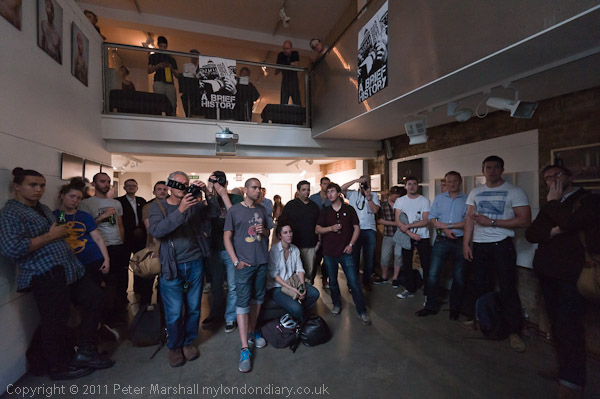
PhNAT History Launch

By the start of 2008, photographers who covered protests on the street were getting pretty fed up of being harassed by police photographers.  On one occasion I’d found myself covering an event in Parliament Square with a police photographer around 10 feet away photographing me time after time for around 5 minutes as I kept my camera to my face, waiting for me to lower it.  On an earlier occasion I’d been engaged in conversation by an officer only to look up after a minute or so to find myself staring into the  large lens of another member of the same FIT team around 5 feet away.

There were other little tensions too – the officers who would look at my press card and say flatly “That’s not a real press card” or others who would simply say “I don’t care if you’re the effing press” or words to that effect. The odd stop and search. Various threats of arrest unless I got off the road – or once if I continued to stand on a wide empty pavement, forcing me to stand in a road with fast-moving traffic.

In fact I got treated better than most, if only because I usually decided life was too short to argue and the best response was often just to walk a few yards away and get on with my job. And for the sake of balance there were plenty of occasions too when police helped me, gave me good advice and occasionally protected me from harm. One officer came up to talk to me at a demonstration and as we chatted told me that he had been given a firm telling off for talking to me at an earlier event. Others would come up and ask me questions that let me know that they were keeping an eye on me – and in some cases reading this blog.

Around Christmas 2007, a series of posters started to appear outside police stations aimed at getting people to report suspicious activities, and one of these included a camera. Then we got one all to ourselves, with the caption ‘Thousands of people take photos every day. What if one of them seems odd?’ and it was a kind of last straw.

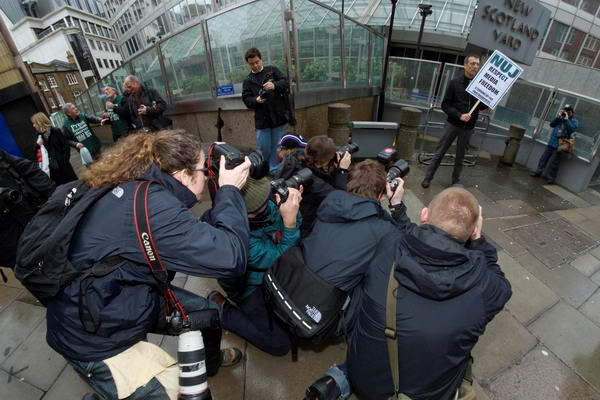
On March 28, 2008, along with 20 or so other photographers, mainly NUJ members, I was outside New Scotland Yard to photograph NUJ general secretary Jeremy Dear in a one-person protest for press freedom which centred around this campaign.

© 2011, Peter Marshall

You can read about that event and see more pictures in my post here, Photographers by the Yard. The protest was followed up by a letter from the NUJ to the Home Secretary calling on the government to “stamp out the routine and deliberate targeting of photographers and other journalists by the Forward Intelligence Team ” and at the TUC Congress in September 2008, the NUJ showed a short film by Jason N Parkinson with evidence of police targeting and obstruction.

I’d first met Jason a couple of years earlier outside Harmondsworth Detention centre, when I was standing on a grass bank photographing a group of demonstrators who had been surrounded by police – the term kettled had yet to enter our vocabulary. He was showing them his press card and they were refusing to recognise it as a real press card.

© 2006, Peter Marshall

Jason called up to the three of us who were standing on the bank and asked if we could come and show a press card to confirm his was the real thing. I’d walked past the police earlier carefully holding my thumb over the date on mine – it had run out 8 days earlier and I hadn’t noticed until too late to ask for a replacement, so I didn’t volunteer, but fortunately one of the other photographers did.

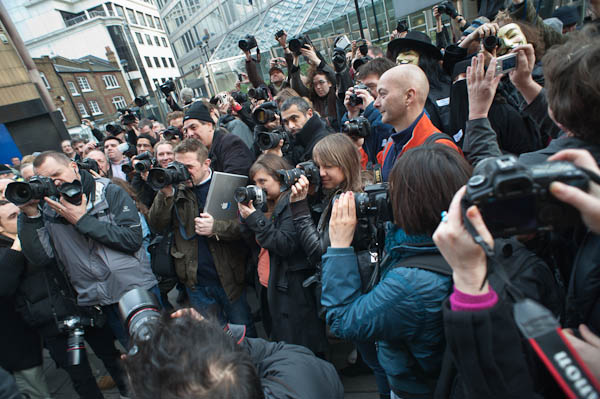
Other events followed, both through the union and through other organisations, and in February 2009 there was another protest, a flashmob called by the NUJ and backed by the BPPA and the BJP, and given publicity in Amateur Photographer and on Facebook and elsewhere on the web – including here. Around 400 photographers turned up to make their protest.

© 2009 Peter Marshall

You can read my report and see more pictures at Media Protest at Terror Law on My London Diary.

Our protests were beginning to have some effect, and by July 2009 police were certainly being more careful about photographing the press. Outside the French Embassy I confronted a FIT officer who had pointed his camera with a very long lens straight at me from around 20 metres and he squirmed and made excuses, saying he hadn’t been photographing me and wouldn’t dream of photographing the press. Though of course he had.

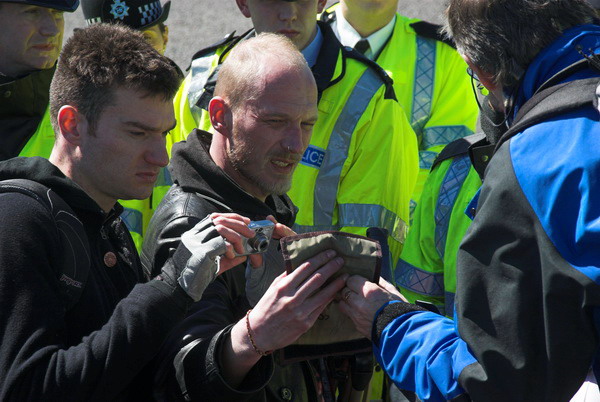
But there were still too many instances of harassment of photographers, and a group of them, mainly NUJ members, decided to set up the organisation ‘I’m a Photographer Not a Terrorist’ which had its launch party – one of the few events I didn’t get to as I was in Glasgow , but 300 others made it – at the late-lamented Foundry pub in Shoreditch

You can find more on the Phnat web site where you can download the pamphlet with a history of the campaign to date. It was actually launched earlier in Manchester, but we re-floated it on a plentiful supply of wine at the AoP gallery just a short walk from the former Foundry.

© 2011, Peter Marshall

More on the ‘launch’ and a few more pictures at Not A Terrorist History Launch on My London Diary.

In Search of Atget

I published In search of Atget, my fifth book on Blurb this morning.  The cover uses a slightly cropped version of the image above, and you can view the whole book on the Blurb site using the link above.

My introduction in the book is rather long to quote in full, but here are a few selected paragraphs that make my intentions at the time clear:

In the summer of 1984 I returned to Paris in search of Atget. It wasn’t one of the re-photographic exercises that were then in vogue. I had little interest in recreating the pictures that he had taken perhaps 60 years earlier; I was in search of his mind, wanting to know more about why he had photographed in the way he did, both on the broader level of his overall project and very much in the detailed way that he approached each image that he made.

My project was an attempt to discover more about Atget as a photographer and also a deliberate homage to him. The following year I put on a small show of these pictures at the college where I was teaching, ‘Paris Revisited – A Homage to Atget’, which attracted little attention.

I deliberately did not take books of his pictures with me to Paris and seek out the exact same views – I wanted more to think how I might photograph in the same sites (and others) rather than reproduce his images, although some turned out to be very similar.

This project was important personally not only for what I learnt about Atget but for the work it prompted me to carry out in the following 15 years on the streets of London. Without the inspiration of Atget which this project strengthened and focussed it would not have happened.

There are pictures in the book that turned out very similar to some of his, and those familiar with his work may recognise them, but I recognised that I was working from a very different cultural background. As it happens I don’t think I did photograph the Eiffel tower, but I did very definitely go to places and take pictures that had they existed he would have hated, such as this:

© 1984, Peter Marshall
La Défense – variant of image in book

But here’s one I think he might have appreciated more:

© 1984, Peter Marshall

The images in the book are nearly all from new scans of the negatives, with all the 55 or so larger images very carefully cleaned up – many of the negatives have suffered from tiny gelatin gobbling  insects lunching out on them over the years. The images on this page come from earlier scans made for my Paris Photos web site, which has most of the others in the book on display as well as others from my visit to Paris in 1984 in the section Paris Revisited.