So you want to be a wedding photographer?

One of the great influences on photography in the last century was the art director of Harper’s Bazaar, Alexey Brodovitch, (1898-1971), who spent 24 years at the magazine from 1934-58.  Brodovitch began his ‘Design Laboratory’ with courses for designers and photographers in 1933, with separate classes for designers and photographers, but it was perhaps after the war that they became more important.

Among the photographers who attended his courses were Diane Arbus, Eve Arnold, Richard Avedon, Irving Penn, Lisette Model, Garry Winogrand, Tony Ray Jones, Hiro and a personal friend of mine, John Benton-Harris.

In the American Institute of Graphic Arts biography of him, Andy Grundberg writes:

As a teacher, Brodovitch was inspiring, though sometimes harsh and unrelenting. A student’s worst offense was to present something Brodovitch found boring; at best, the hawk-faced Russian would pronounce a work “interesting.” Despite his unbending manner and lack of explicit critical standards—Brodovitch did not formulate a theory of design—many students under his tutelage discovered untapped creative reserves.

But perhaps his worst put-down when students brought work that did not meet his creative standards was “So you want to be a wedding photographer?”

It was a quotation that came to mind a couple of times today, first when I read an article For Photographers, Competition Gets Fierce in the New York Times, which talks about how many unemployed ‘digital debbies’ with little or no previous experience “are taking their fancy digital cameras and booking jobs shooting weddings”, seriously undercutting the pros at the game.

Back in the distant past, we had a professional photographer at my wedding, though I don’t really understand why. In those days photography was black and white, and he obviously had no idea how to use it, and the prints are flat and lifeless.  At a glance they seem over-exposed, taken with no feeling for composition and printed on the wrong paper grade – there’s professionalism for you!

My own father’s wedding was I think recorded in only one photograph, a highly detailed view of a large group with my parents at the centre. It seemed perfectly adequate, although it might have been better if my father had not been holding a baby when it was made (it wasn’t actually his, and I only came along, the fourth child, some fifteen years later in case anyone was having doubts about my legitimacy.)  I find it hard to understand why now people want large albums and even videos of the occasion.

Given that so many people attending weddings now take digital photographs, its hard to know why we also want professionals to take pictures, and harder still why they should employ those without some kind of track record at ‘under  $1000’, when what they are getting is unlikely to be much if any better than friends could provide for free. Although weddings have provided a useful income for many professionals for many years, I’m not sure this is necessarily a good thing; wedding photographs don’t seem to me to be particularly worthwhile and few of those who get a living income from them have used the support to do anything more worthwhile.

But should you really want to be a wedding photographer there is some very good advice on some things to avoid in 32 Tips For Taking The Perfect Wedding Photo which is subtitled ‘Avoid disaster and embarrassment by following these simple rules.’ Thanks to EPUK News for directing me to this page, which I’m sure would have had me laughing all the way down the aisle even if had drunk a few less glasses of a good Bordeaux before reading it. My apologies for any errors of typing, sense or grammar.

Bill Wood’s Fort Worth

Thanks to a Facebook link by Rina Sherman for reminding me of the work of Bill Wood Jr (1913-73), a commercial photographer in Fort Worth Texas from 1937 to 1970 when he retired because of ill health. Most of the pictures in the collection that was bought by actress Diane Keaton, who has a great passion for photography, date from the 1950s on, when Fort Worth was a rapidly expanding city, and Wood provided the images that represented the new citizens as they wanted to be seen.

I don’t know how representative the book and show at the ICP in 2008 was of his work as a whole; a search in the ICP collection on his name brings up 348 objects, most of which are photographs by Wood, and most of which have an image on line. Although not all have a great interest, they are almost all carefully composed, straightforward images, clearly made for a particular purpose by a skilled craftsman.  He wasn’t a photographer who took a huge number of pictures, and only made photographs for his clients, usually taking only a single or small number of exposures. The 10,000 negatives in the collection that Keaton bought are mainly from the 1950s and 1960s, and represent only an average of 500 pictures for a year – less than many photographers now take in a day. Even in the days of film, when Winogrand went to make a very different view of Fort Worth, he probably took more pictures in a few weeks than Wood in a lifetime.

There are pictures here that could well be mistaken – seen out of context – for the work of one of the photographers of the ‘New Topographic’ school, many of whom worked in similar environments on the outskirts of other US cities. And sometimes reminders of images by other well-known post-war photographers who worked in America, though Wood’s viewpoint is a very different one from any of these photographers.

You can hear Keaton and fellow curator Marvin Heiferman talking about the work on a Studio 360 public radio broadcast from 2008, and there are a number of reviews of the show and book online, including one by Ken Johnson in the New York Times and Melanie McWhorter in Fraction Magazine. There is also an article in North Texas’s Art&Seek, which includes the Pontiac/Kleenex image mentioned in the radio discussion.

London Photographs

Some years ago I registered the domain name londonphotographs.co.uk with the aim of setting up a web site called ‘London Photographs’ that would display my archive of images of Greater London taken since the 1970s, and it still provides a ‘front end’ to much of my work on the city, although I think all of it can also be reached through other domains that I also have.

Looking at the weather this last weekend I decided to use the time to work on another project for ‘London Photographs’, related to the book London Dérives that I completed a week or so ago.

The web site London Dérives isn’t the same as the book, although I think it includes all of the 73 images from the book (or near duplicates) but has almost 200 images. It includes the key text from the book related to the project.

© 2013, Peter Marshall
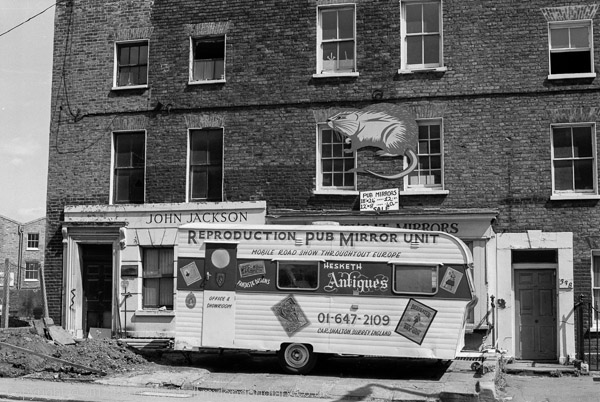
My caption says John Jackson & Pub Mirrors, London 1978, but where was it?

What took most time was going through the images again and adding captions. I’ve never been too good at keeping records of what I’ve photographed or where, but from around 1986 on I began to carefully annotate my contact sheets with things like Grid References, street names and other information while it was still fresh in my mind. But prior too that, it often involves a little detective work, looking at the series of frames for a particular walk, hunting for clues in the images, resorting to maps (on and off-line), Google searches, and sometimes even satellite images, StreetView or Bing’s rather nice Bird’s Eye views. But finding places can be pretty tricky as many buildings have been demolished and others built.

© 2013, Peter Marshall
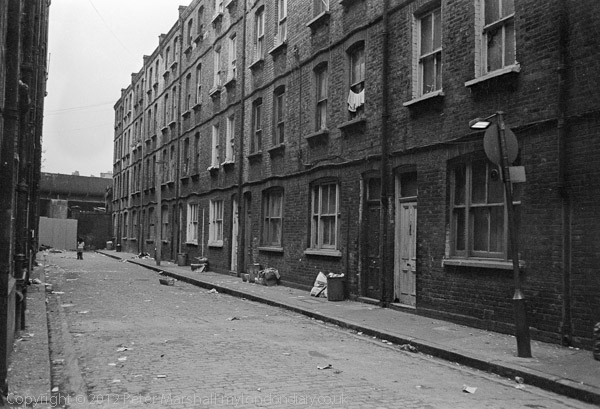
This was near Brick Lane, but exactly where?

Looking at some pictures, even from 35 years ago, I get a very clear impression of where I was and exactly what I was thinking when I took them, though these are not always entirely accurate. One image I was convinced was made close to the British Museum turned out – when I examined the evidence closely – to have been made around 6 miles to the north.

© 2013, Peter Marshall
And this wasn’t far away from Brick Lane either – but which street?

The site is now on the web, but I’m sure I’ll make some changes to it. But I’d be pleased to get any comments and suggestions on it and to get more accurate captions for some images. I haven’t put a comments form on the individual pages of the site, but I’d be happy to add suitable comments at the bottom of the pages.

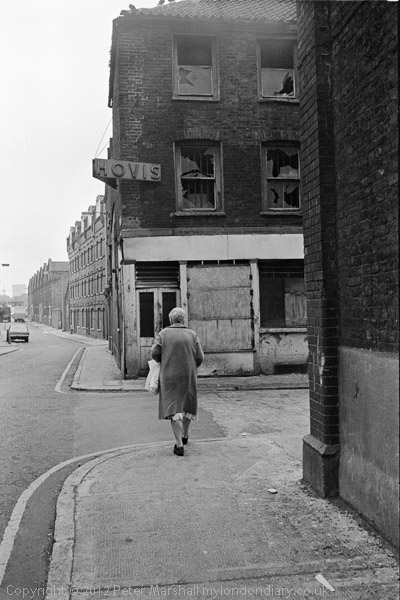
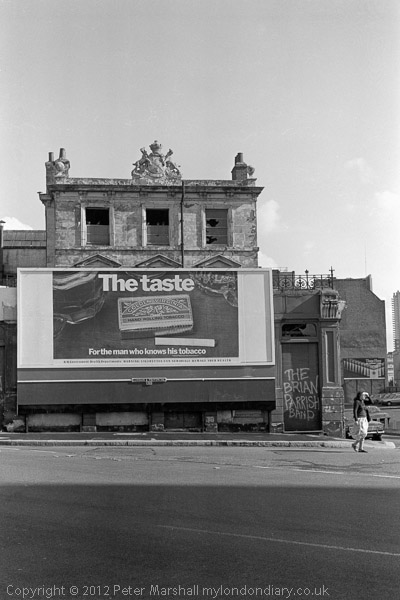
Here’s a final small mystery – a disused pub, possibly in Hoxton or Haggerston (an image taken a frame or two further on is from Haggerston and on later frames I was in Hackney.)

© 2013, Peter Marshall

On its top is a rather fine (if damaged) coat of arms with the motto ‘Sapere Aude’ – dare to be wise – which is apparently that of both the Wise and the Whittington families. Whittington seems more likely to be the connection. Obviously the building is in a poor state, but has a certain distinction, and might well have been renovated – or it might have been replaced by offices or flats. Looking at the image full-size doesn’t really yield any more clues other than making the motto just legible. Anyone?

Most of these pictures were taken either on a Leica M2 with a 35mm lens, and Olympus OM1 or one one of a series of Minox 35 cameras I owned. For some of them I was trying to get a feeling of glimpsing the sites on a walk and deliberately framing slightly oddly and sometimes with the camera not level. Some of these I’ve tidied up a little with cropping or rotation, and with a very few some correction of the verticals, but most I’ve left as I took them.

Continue reading London Photographs

Lens Culture Deserves Support

I first came across Lens Culture in the year that it started, 2004, when I was still writing for  About.com, and immediately appreciated that here was another site that really cared about photography and was doing something about it on-line.

Since then I’ve regularly written about and linked to content on the site, and also met and talked with Jim Casper, its founder and editor in Paris a few times.  We don’t always share the same views about particular photographers or aspects of photography but we do have a shared passion for the medium.

Since then I’ve moved from being someone who made a respectable amount by writing for a commercial site – that for most of my time with them gave me a free rein to promote photography around the world – to a fairly penniless photographer who runs a blog and various websites largely to share his own work and his views about photography with a wide audience – and with some success, with currently just over 40,000 visits a week to  my various sites including this blog.

Perhaps because of my previous incarnation, where at times my posts were difficult to read as adverts floated around over some of them or flashed annoyingly at the sides, I’ve deliberately kept all of my sites both advert-free (just one small commercial link in a single one of the over 97,000 pages) and also deliberately simple.  My aim was to produce a site that was very personal, although I’ve had a few contributions by others, and almost the only ‘cost’ is my labour. It takes considerable amount of time, perhaps twenty or thirty hours out of the sixty or seventy I work a week, but much of that involves thinking about my own photography and that of others which I enjoy, and at least some of it is time when I could otherwise be earning money. But I get by, though support by using my images in publications or by buying my prints or books or PDFs (direct from me or from Blurb) is ever welcome.

Jim with Lens Culture had far wider aims, although when he started it was simply “a magazine published 3 times a year in my spare time” it has grown into a much larger enterprise, and one that has set out to be and to look far more professional than >Re:PHOTO, My London Diary and the rest.  Back in 2004 there was very little serious writing on the web about photography (and it still isn’t plentiful) or exposure for good photography, and the magazine has since stepped firmly into that arena, as well as increasingly going in to other activities. All this has led to much greater expenses than I have and it even gets a few more visitors than my sites – around 50% more and a little over twice the visitors on this blog.

Here’s what Jim says about Lensculture’s activities:

Last year we organized screenings of great new contemporary photography on two continents, hosted our 3rd annual international portfolio reviews in Paris, awarded 9 prizes and 27 honorable mentions for the International Exposure Awards, and the UK Guardian called us “one of the most authoritative and wide-ranging sites” on contemporary photography.In the past 8 years we’ve published 35 issues of Lens Culture, including more than 40 original in-depth video and audio interviews with photographers, lots and lots of photobook reviews, and shared our discoveries of photographers from more than 50 countries worldwide. We’ve stayed up all night working on high-resolution slideshows, editing captions, revising translations, linking out to other sites that we find interesting. We’ve lost some friends and family, welcomed newborn babies, published 750,000+ photos (last count), written 2,500 photography-related tweets, and helped to launch dozens of new careers.

We love what we do, and apparently a lot of you do too. We appreciate your support, and we rely on your generous donations to continue our work. We’ve never cluttered our site with commercial advertising, and we think you appreciate that as much as we do.

So today we’re asking you to donate just $10 (or more if you can afford it) to keep us running.

It takes 200 hours per week to do everything we do. Many of us volunteer a lot of of our time, but we have real costs that include high-speed web servers, a dedicated part-time editorial staff, software, computer upgrades and video production.

If everyone who reads this donated $25, we could keep running for two more years.

You can read more on the Lensculture site, where there is a handy button for donations, although unfortunately it doesn’t take PayPal.

Sirkka-Liisa Konttinen

I last wrote about the work of Sirkka-Liisa Konttinen a couple of years ago, when the BBC had just broadcast a radio programme about her work. I bought her book ‘Byker‘ when it came out in 1983, and even the rather dull reproduction (standards really have improved greatly) couldn’t hide the power of her work on this area on the edge of Newcastle in a period when it was being completely redeveloped.

It was a subject that appealed to me as well as fine photography. The redevelopment of Byker in the 1970s showed how planners had learnt at least from some of the mistakes of the earlier decade that had taken me into political activism on the streets of Manchester before I became a photographer.

Born in Finland, Konttinen had come to London to study film at the Regent Street Polytechnic and there with like-minded fellow students had formed a collective to make documentary films. Amber Films had a commitment to documenting working-class life, and though they had started in London soon found that the capital was too expensive to live and work and moved to Newcastle, a city 300 miles to the north, where the older industries which it had depended on were in severe decline. She fell in love with Byker, moved in and lived there for 11 years, getting to know the people. Being a foreigner and being a young woman was almost certainly an advantage as she went round getting to know people and taking pictures, and as she writes “The first night I sat alone in the ‘Hare and Hounds’ I was taken under the collective wing.” And over the years she really did become a part of the community she was photographing and she goes on to write of her neighbour pointing “out proudly: ‘When she first came in our street, she couldn’t tell hello from tarra, and now she speaks Finnish with a Geordie accent.'”

I mention her again because her work  is featured on the New York Times Lens blog  Byker in Black and White and again today in Bringing Color to Newcastle The mention comes with a show in New York at the L. Parker Stephenson Gallery from 15 Feb until 18 May 2013 and a lecture by Konttinen at the International Center for Photography on Feb 13 which should be streamed live (and at some point make its way into their archive on the same page.)

Although the BBC programme linked on my page no longer has the audio available, the text does perhaps give a slightly different view (as too do my comments), and the other links on my page still seem to work, taking you among other places to Konttinen’s page on Amber Online, where as well as work from ‘Byker’ and ‘Byker Revisited‘ you can also see pictures from eight of her other projects.

On the Side Gallery page of the Amber website there is some more about her trip to New York, including a link to a short film on making her ‘spacehopper’ print.

London Dérives

Just published today, after much gnashing of my few remaining teeth, is a book of pictures taken on my rather aimless wanderings around London in the late 1970s and early 1980s. Well, not exactly aimless, but mainly walked with no particular destination in mind.

In those days, before the Travelcard, most of my walks were circular in nature, starting and finishing at the same station, and these starting points were also largely determined by those places to which it was possible to book a ticket from my closest station. When I did venture further it was a matter of buying two or three  or more separate tickets in the course of the journey.

London Dérives (or as Blurb will have it, being a US based company ‘London Derives’) ISBN 978-1-909363-08-3 contains 73 of my black and white pictures and the best way to buy it is to download the PDF version which is currently only £4.00, less than my usual price. You can of course see the preview and at the moment a full preview is on-line, though I may cut down the number  of pages visible in a few days. Viewed full-screen it is almost as good as the PDF, although I hope some readers will download this as it does make a donation to keeping this site running as well as to Blurb – and they take Paypal as well as plastic.

For most of the 1960s I was a student, and very much involved in the events of 1968, although things were a little quieter in Manchester than in Paris. But among our bedside reading at that time was ‘The Society of the Spectacle‘, a translation of Guy Debord’s 1967 La Société du spectacle.  When a few years later I had the time and money to start taking photographs, this was one of my text books for how to approach contemporary life with a camera. Twelve years earlier Debord had written ‘Introduction a une critique de la geographie urbaine‘ and in the main text of London Dérives I quote from this and his Theory of the Dérive.

One problem with Debord is that his thought was very French, and translations into English often lose the struggle, ending up with something that is in English but make little sense. London Dérives has a new translation of one often quoted key passage from his ‘urban geography’ that talks about his idea of the dérive (it’s sometimes useful being married to a linguist, though any mistakes are almost certainly mine.)  Like the published works of the Situationists, this short translation (but certainly not the rest of the book) is issued with an ‘anti-copyright’ message – it can be shared freely and without any need to attribute. Here it is:

The sudden change of mood in a street over only a few metres;
the obvious division of a city into clear-cut areas of mental
climate; the steepest slope – in no way connected to the
contours – down which aimless strolling will be led; the
captivating or repellent nature of certain places, all this seems
to be neglected. Or at any rate never considered as depending
on reasons that can be brought to light by a thorough analysis
and turned to advantage. People are aware that there are
gloomy districts and others that are pleasant. But they usually
convince themselves that the elegant streets give a sense of
satisfaction and that the poor ones depress, hardly any more
nuanced than that. In fact, the variety of possible combinations
of moods, just like the solution of chemical substances
into an infinite number of mixtures, leads to feelings as diverse
and as complex as those brought on by any other type of
spectacle. And even the most basic objective scrutiny shows
the impossibility of formulating a qualitative or quantitative
distinction between the influences of the diverse built
environments in a city based solely on the period or style of
architecture, much less on the living conditions.

Introduction à une critique de la géographie urbaine
Guy Debord, 1955

It took many hours of work to get the pictures ready, with some images needing around an hour and a half of detailed retouching, thanks to my negative files having been infested by tiny insects some years ago. Too small to see clearly with the naked eye, the remains of these insects and  the tracks they left chewing up the gelatin are only too obvious in enlargements. Fortunately after retouching they are generally not visible in the images in the book. It was also an opportunity to remove some of the other oddities we often got with film, and in most cases the images in the book are the best I have ever made from these negatives.

In the period covered by this book I made approximately 30,000 negatives, mainly in London. Some of these were on projects which are the subject of other books – such as ‘Before the Olympics’ on the Lea Valley and forthcoming volumes on Docklands, the River Thames, post-industrial London etc, and I have not included pictures from these areas in this work. As well as the 73 images that made it to the book, there are roughly twice as many that I scanned but were not selected. I’m thinking about making a set of the best of these these available to purchasers of the book (print or PDF) as a low cost supplement.

Continue reading London Dérives

Paris 1914

The Autochrome process was patented by the Lumière brothers in France in 1903 and sold from 1907. It was an ‘additive’ colour process, mixing light of the three primary colours like the image on a computer screen, rather than the later subtractive processes developed in the 1930s, including Kodachrome and Agfacolor. A tri-colour screen was incorporated onto the glass plate by squashing a single layer of a random mixture of dyed potato starch grains onto an adhesive coating, the gaps between the grains were blocked with lampblack and the screen varnished to preserve it, before being coated with a panchromatic black and white emulsion.

Public Domain image
Public domain image of a highly magnified autochrome screen – Wikimedia Commons

For practical reasons, probably due to the limitations of available dyes, the Lumières used orange-red, blue violet and green dyes rather than the conventional red, blue, green (RGB) set. As gaps between the starch grains were blocked by black lampblack, and the coloured starch grains also absorbed light, far less light reached the film than when making a black and white image. A strongly coloured orange filter was needed on the lens, partly to cut out all the UV, but also to correct for the higher sensitivity of the emulsion to the blue end of the spectrum – as panchromatic films of the era were still not very sensitive to red. They were also slow by modern standards, so exposures were length, made with the camera on a tripod – and avoiding subject movement.

The plate was developed in a normal developer to give a negative silver image. This was then chemically removed leaving the unexposed silver halide on the plate which could then be exposed overall to light and the plate developed a second time to give a positive image. These images were very dark but the colour could be extremely good. Particularly when enlarged, the results show a brightly ‘pointillist’ effect which can sometimes be annoying but often adds to their attraction.

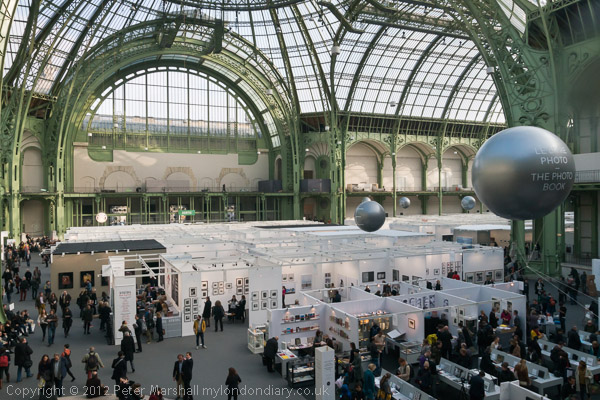
On the Paris1914 site there are a good selection of coloured images of Paris taken between the introduction of the process and 1939, including some taken by  Léon Gimpel (1878-1948),  a well-known amateur photographer of the era whose work was celebrated in a show at the Musée d’Orsay in 2008. One of his pictures is of an exhibition in the Grand Palais in 1909, which perhaps looks a little more interesting than Paris Photo at the same location 103 years later.

© 2012, Peter Marshall
The Grand Palais in 2012 – with smaller balloons

The quality of the results is quite variable – one of my favourite images, ‘Une famille, rue du Pot-de-Fer, Paris, 24 juin 1914′ by Stéphane Passet, could almost have been taken using modern materials, while some of the others are extremely crude.

You can see more about the Albert Kahn collection – which included these among around 70,000 autochromes – in a presentation about La Mongolie, entre deux ères, 1912-1913, about the current show (until 31 march 2013) at the musée Albert-Kahn in Boulogne-Billancourt on the edge of Paris.

You can also see a more varied selection of work on an official French government site, Autochromes Lumière, a superbly detailed site full of historical information and of course images. I really can’t imagine anything similar being produced here. There is also more about Gimpel and other photographers who used the process on this site.

Perhaps if the UK had a real Arts Council rather than a Opera Council with crumbs for the rest we might get sites like this dealing with aspects of photography?

Photography – the Art of Our Time

Jonathan Jones in a post on his On Art Guardian blog recently wrote “Photography is the art of our time. The old masters painted the drama of life and death. Today photography captures the human condition – better than any other artistic medium of our age” and went on to say “It has taken me a long time to see this, and you can laugh at me if you like.”

Well, I won’t laugh at him, not least because it is something I have been writing and saying and more importantly – at least for me – trying to do for many years, though I think when years ago I wrote that ‘photography is the defining medium of the twentieth century‘ I was including moving pictures in my definition. Of course I don’t claim any originality in my thought, inspired as it was by the thinking and writing of others, including Lazlo Moholy-Nagy and Walter Benjamin, well before I was born.

So Mr Jones is rather late in coming to the party, and though I welcome him, I’m not entirely convinced that the party is not more or less over. Certainly now in the twenty-first century we have photography being appropriated and emasculated by both academia and the art market, turning it into careerism and commodity. Though of course there is still much fine work being produced, and some younger photographers are showing themselves to be adept at sitting on several stools.

Art and academic pin-sitting/hair-splitting/bullshitting are perhaps the two major games photographers will have to play as a way to earn a living to support them as they continue their photography.

Shades of Grey

Although I’m a regular user of Surrey Libraries, I’ve yet to contribute to the statistics just announced that show Surrey borrowers to be the most avid readers of EL James’s Fifty Shades of Grey series – which apparently accounts for one in 5 loans – as a libray spokesman commented “they just can’t get enough.” Certainly I’ve noticed over recent months the ‘New Issues’ and ‘Quick choices’ troughs clustered around the front of the library are engorged, full to bursting with these titles and the many, many rip-offs, ‘Seventeen Shades of Purple‘ and the rest. It’s perhaps surprising that ’50 Shades’ was also reported to be the country’s least wanted Christmas present, so there are presumably many virgin copies lying around in homes through the country.

Although I’ve yet to open the covers of any of these titles which seem to be multiplying like rabbits – after all I’m not in any way the target audience – Shades of Grey has been on my own bookshelves – and regularly consulted – for over 20 years. And if anyone got that volume, long out of print, for Christmas they will have been entranced by Oscar Marzaroli‘s picture of Glasgow from 1956-87, published shortly before his death in 1988 (and reprinted twice the following year.) There is a very wide selection of his work on the Marzaroli Collection web site, but unfortunately the images are rather small and seem contrasty and over-sharpened (rather like some pictures I put on the web in the early days of the mid-1990s) and don’t show his work to advantage. The site does seem overdue for a re-vamp.

The book Shades of Grey, second-hand copies of which now seem to sell for £50 or more, wasn’t particularly well printed – bog-standard offset of the period, with poor separation of the darker tones and perhaps in homage to the title lacking a true black – but it does a much better job than the web site, and is a wonderful portrait of  a city and its people, complemented by a fine piece of writing ‘Where Greta Garbo Wouldn’t Have Been Alone‘ by William McIlvanney. I’d take issue with the flyleaf description which states that this, “with its subjective impressions perfectly complements the objective images from Marzaroli’s camera” only because his pictures are fortunately an equally subjective view of the city.

Harlem Views

Roy DeCarava has long been one of my favourite photographers, and his ‘The Sound I Saw‘, pictures of his from the 1960s was one of the more interesting publications of the early years of this century, and one that I often reach down from the shelf in my living room to leaf through. It helps of course that in the 60s, before became a photographer I was a great jazz fan (and the world’s worst tenor sax.)

The book is about jazz and Harlem, and is a kind of improvisation around his pictures and poetry of jazzmen and Harlem, something I can’t pick up and leaf through without the sound of Ellington’s ‘Harlem Airshaft‘ and other compositions including ‘Drop Me Off At Harlem’ springing into my head. I think too of Ben Webster (pictured here with Coltrane) who I once spent an afternoon with, trying to keep him sober for the evening’s concert with spectacular lack of success but who despite that reduced me to tears with a few breathy notes and continued to play a set that left me emotionally exhausted.

I was pleased a day or two ago to come across John Edwin Mason‘s blog and an article Roy DeCarava’s Harlem in which he rightly calls DeCarava “the greatest of all photographers of Harlem” and which includes video about him and links to a fine essay by A D Coleman. Elsewhere there is a nice review of the (re-issued) 1955 book The Sweet Flypaper of Life he produced with poet Langston Hughes by Alan Thomas and there is a fine set of pictures on the 2009 obituary programme on NPR. There is a DeCarava archive site, but authorisation is needed to access the images. There is another obit at BlackandWhiteCities, which links to the NYT Lens feature, as well as the JazzWax tribute with the Webster/Coltrane image and more – and you can read a long scholarly article by Rebecca Cobby, ‘Visions, dreams and a few nightmares’: Roy DeCarava’s Representations of African American Workers in Harlem‘ in the BAAS journal.

Mason’s post compares DeCarava’s view as an artist and an insider to that of photojournalist Gordon Parks, and the triumph and tragedy of his fine photo essay ‘A Harlem Family‘ which appeared on pages 48-62 of the edition of Life Magazine for March 8, 1968, the first of five features in a special section ‘The Cycle of Despair: The Negro and the City. As Mason points out in a second post ‘Gordon Parks: “A Harlem Family,” Life Magazine, 1968‘,this was published after “the end of the long hot summer of 1967, a summer of urban uprisings in black America.”

The feature is worth reading and thinking about, with some interesting reflections on the essay and the publication, and I think too on the role of photography and photojournalism which remain pertinent.  Mason ends with an account of the tragedy which followed – although unconnected – for the family Parks had photographed and Park’s own thoughts, as well as linking to an exhibition of the work marking the centenary last November of Park’s birth at the Studio Museum in Harlem, continuing until March 10, 2013, with an exhibition catalogue to accompany the five volume publication of Park’s work by Steidl.

Although a fine publication for libraries, at £148 it seems a little excessive both in terms of cost and shelf space for impoverished photographers, particularly those like me whose walls are already full of books. Perhaps a single print volume with an accompanying DVD with a larger selection of images would be more attractive to a wider audience.