As Drik as Possible

I’ve written on a number of occasions here and elsewhere about Shaidul Alam and Drik, most recently on the agency’s 25th anniversary. The idea of people in the majority world telling their own stories is one which has always seemed important to me, and I have a healthy distrust of some of the efforts of celebrity western journalists and photographers who  sometimes work with little real idea of the society and background to the events they are covering. It’s great to read a truly inspirational success story about Bangladesh, and how they have overcome so many problems. Optimism, a strong belief in what they are doing, the willingness to take serious risks and continuing hard work have been rewarded.

It goes a little deeper than that. Even when I look at how life in my own country and city gets represented though the media I’m often aware of a concentration on the froth and the failure to really understand or show the realities of life for the majority of our citizens. Of course there are some notable exceptions, but we really need a grass-roots photography movement too, as well as publishing on-line and in print that supports it.

The story of Drik, told in Alam’s blog post As Drik as Possible, is an introduction to the 2016 Drik Calendar, and tells a little of the storyand there is a little more about it on Flickr. You can also see a larger album of over 600 of Alam’s pictures of Bangladesh.

Vivian Maier still in hiding?

I’m not a true believer when it comes to Vivian Maier. Not that she was a bad photographer, far from it, but I’ve failed to share the kind of fawning hype that seems to have affected so many. Though I can enjoy looking at her work, to me its rather like the ‘Easy Listening’ section that they used to have in record stores. Obviously she had a great interest in photography and a good eye, and a great appreciation of the tradition, but to say, as curator Anne Morin does in her Lensculture interview with Jim CasperShe has a key place in the history of the medium—right next to Robert Frank and all the other great practitioners” seems just ridiculous nonsense.

As Morin makes clear, Maier was very aware of the history of the medium, and looking through the selection of 120 images on Lensculture it’s impossible not to realise some of the sources that inform her work. As you look at the images, its obvious that this one would not have been made had she not been aware of the work of Lisette Model, others completely predicated on her knowledge of Lee Friedlander or Robert Frank … though perhaps she never quite came to terms with Diane Arbus.

Maier didn’t make history, she depended on it, at least in the images we have seen, and Morin is misguided to think that her exhibition “helps place her work in the history of the field.” Perhaps the main point it and her story makes is that she was outside that history making, a mere – if sometimes enjoyable – footnote.

The fascination is very much in the back story, and it is one that has been carefully cultivated in article and film, with more yet to come to light. Morin mentions the link with the young French woman photographer Jeanne Bertrand with whom Vivian’s mother and the young Vivian were lodging in the Bronx at the 1930 census. Though Vivian was then only four, it seems likely that Bertrand was a friend of the family and they may have kept in touch in later years.

Claus Cyrny in his Artificial blog links to writer Jim Leonhirth who has posted the information he has gathered together about Maier’s family from various sources which often contradicts earlier statements and includes the information above about Bertrand, as well as reproducing a page from the Boston Globe in 1902 with a long article about her becoming well known as a photographer in the region at the age of 21.

Bertrand came from the same commune in rural France as Vivian Maier’s mother, where Vivian and her mother went to live from 1935-8 before returning to the USA, where the 1940 census shows them both living with Vivian’s brother and father (both called Charles) in 1940. Other family members, including an aunt and great-uncle also lived in New York, and it is thought that Vivian’s mother had reverted to her maiden name and died in New York in 1975.

Morin says that so far “somewhere between 120,000-150,000” Maier negatives have been found, including “6,000 rolls of film that Maier didn’t even develop” as well as voice recordings on cassette of her thoughts and ideas. She was only able to make her selection for her exhibition from a selection already made by John Maloof. Perhaps in the larger body of work we have yet to see there will somewhere be the real Vivian Maier?

Place de l’Europe

I’m not a great fan of appropriation, or as a friend once called it, “f**king with other people’s work“, but there are exceptions, and this is one:

via GIPHY

(It’s also worth visiting the original site on which this appears, where there is among other things, Episode #8 Printed Matter,  which tells you exactly how much Vice cares for photographers.)

I’m not sure that Henri Cartier Bresson had much of a sense of humour, though there is certainly and acute wit behind some of his pictures, which doesn’t really come across in the various films about him. I suspect too, that there are some at the Fondation in Paris who won’t approve.

The picture on which it is based is one of the first I wrote about at any length, and I remember making a rather disappointing pilgrimage to the Place de l’Europe – Gare Saint Lazare 40 years after he made this picture in 1932. I won’t today add to the the yards of mainly nonsense that have been written about the ‘Decisive Moment‘ for which this picture is always the prime exhibit since I’ve done so before, but for me it exemplifies a much more important rule, which also has vital implications outside of photography, the rule that ‘Rules are made to be broken‘.  Cartier-Bresson’s dictum that photographers should show their work without cropping as they conceived it in the viewfinder at the point of exposure has influenced generations of photographers, usually for the worse.

I’m not a great fan of cropping. I like to frame precisely (something the Leica that HCB used at least in his early years wasn’t really capable of doing) and I hope incisively. But it isn’t always possible. You may not be able or have time to get into the right position (sorry Mr White, but time only stands still for static photographs.)

This isn’t HCB’s only cropped photograph, though it is perhaps his most drastically cropped image, and certainly his most famous cropped image. Even for him, practicalities sometimes had to overcome theory.


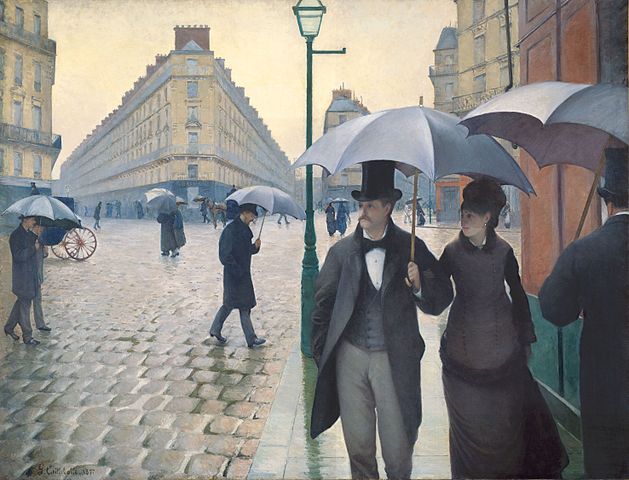
La Place de l’Europe, temps de pluie is also one of my favourite paintings by Gustave Caillebotte, though it isn’t based on the Place de L’Europe but a few yards to the north-east in the rue de Turin, looking towards the Place de Dublin, as Wikipedia details in Paris Street, Rainy Day. Caillebotte did paint La Place de l’Europe, and there are a couple of his pictures, as well as one by another artist on the French page for the Place.

Caillebotte’s image, as the Paris Street article makes very clear, very much based on photographic ways of seeing, perhaps why it appeals to me, with its central division by a lamp post something that many of us have played with over the past years – something I picked up on from both Walker Evans and Lee Friedlander, and that curious space produced by the buildings in the left half. And that cropping is so photographic.

Yunghi Kim

I’m rather surprised – and slightly ashamed – to find that I’ve never mentioned Yunghi Kim in my posts on this site. I’ve been aware of her work as a photographer for a long time, with some powerful images from Rwanda and Kosovo and in particular her remarkable 1996 project on ‘Comfort Women‘, Korean women then grandmothers in their 70s who had been tricked by the Japanese Army and forced to become sex slaves serving Japanese soldiers. Perhaps my only excuse is that these stories – which you can see on her web site – were made before I began seriously writing about photography for a living, but not long enough before to have become a part of photographic history.

Of course Kim has continued to produce great photography, working through Contact Press Images, and winning various awards. Her pictures on her site as ‘Protest in America 2011 & 2012‘ include some of the strongest images of the Occupy movement, and in a very different mood is her highly original and inventive series ‘Coney Island Winter’, also in black and white. It’s great work to see her work and feel how exciting black and white can be, when with so many other photographers now black and white seems more simply just a fashionable ‘look’.

I’ve also come across Kim through being a member of the Facebook group she began and runs, The Photojournalist’s Cooperative,  with its mission “to give freelance photographers a platform where they will exchange ideas and help each other maintain high standards as they navigate the dramatically changing business of photography in the areas of: image licensing, contracts and copyright protection.”  She set up the group after realising the huge extent of unauthorised use of her images on the web, wanting to find out more about how to protect her work and to share what she found with other photographers. Last month she took that sharing to a further stage, giving $10,000 from the fees she has recovered from unauthorized usage to create ten $1,000 grants for members of her Facebook group, who have until next Tuesday (Dec 20, 2015) to make submissions.

Many photographers I know are also members of the group, and it was a post from one of them, Ami Vitale, on my newsfeed today which prompted this short note. It read simply: “Yunghi Kim is a huge inspiration!” and linked to a profile of her on AI-AP (American Illustration-American Photograph) which gives all the information about her that I’ve left out here.  Ami, you are an inspiration too!

Morning Moods – Internet at Risk

I woke up in something of a black mood this morning, to radio coverage of the flooding in Cumbria, where we have friends who I think are fortunately safe. Although I was listening from the comfort of a warm bed, it brought back memories of our own local floods in February 2014, when dirty water was lapping around our street, above the level of our ground floor for anxious days, though we were fortunately saved from flooding by a ditch behind our house. Next time we probably won’t be so lucky, and the next time could come any time with the current climate instability, and I’m increasingly sceptical that the current climate talks in Paris will do much to help.

Other news only added to my unease, along with several concerns closer to home I won’t bother you with. So I was pleased when I sat down at my computer this morning to find Louis Stettner and the Glories of Penn Station, a beautiful set of black and white images from 1958, which really lifted my spirits.

It was also good to read A D Coleman coming out with what he calls an ‘Opening Salvo‘ against attacks on his Capa research by Magnum, who as he says has evolved from “the bohemian collective cum anarcho-syndicalist commune of its origins and first several decades” into “a substantial corporate entity with a multimillion-dollar annual revenue stream, a recognizable and decidedly upscale brand, an extensive and metastasizing product line, and a new executive director committed to aggressive and inventive marketing.”

Magnum has no facts or argument to answer the detailed research on Capa by Coleman and his colleagues but seem determined to try and discredit it to protect their image – now a highly commercial brand. Part of their response appears to be to a TV docudrama Magnum, made by Downton Abbey producer Carnival Films, which Coleman expects to reinforce the Capa myths about the ‘Falling Soldier’ and D Day rather than represent the truth – though he has contacted the company with details of the recent research.

Of course, though Capa was undoubtedly a great photographer, he was also a great raconteur, someone who would never have allowed the facts to get in the way of a good story, so Carnival Films could be said to be truly if cynically following in his tradition.

It’s also – as I’ve had occasion to say several time in the past few days, not least in the highly inaccurate recording of an apparently peaceful vigil in Walthamstow and almost every story about Jeremy Corbyn – very much in the tradition of at least parts of our press (though gutter and broadsheet have been vitriolically united over Corbyn, who I’ve known and photographed for many years and admire as a person even if I don’t always agree with his views.)

Another link in my feed reader this morning was from ‘Stand Up And Spit‘ and links to a BBC radio documentary from 1980 on a Sun newspaper shock horror probe on the Tilbury skinheads, Aggro Britain. It exposes how bad tabloid journalism can be, and how it was done, something that makes me ashamed of some fellow journalists (though the only real UK journalists union, the NUJ, is locked out of The Sun and other News International publications) and also reminds me how necessary it is to support the BBC, despite some of their often ridiculous news stories.

And a final bit of gloom from my e-mail, which could mean the end of the Internet as we know it. The EU Commission’s roadmap for copyright reform “could open the door to absurd new rules that would kill our ability to link freely – copyrighting hyperlinks and charging to link to freely accessible content online.” A ‘Link Tax‘ would make posts like this one impossible. If you click on one link today let it be to Save the Link to fill in your name on a message to Commissioner Oettinger “Link censorship has no place on the open Web. Please listen to users and guarantee our right to link freely.”

Derek Ridgers

It’s good to see one of my old friends – I first met Derek Ridgers almost 40 years ago – getting the exposure he deserves. I knew his work was good when I first saw it back then, and his work was included in a number of group shows we organised together – though none are listed in his Wikipedia entry.

Derek also designed posters for several of them, including a 1984 show at the Orleans House Gallery in 1984 by ‘Group Six‘, led by Terry King, which included the logo he designed for the group:

It was a rather better poster than those I cobbled together for some later of our group shows in which also took part,though the printer I took his artwork to complained bitterly about the large area of black which used too much ink.

Unfortunately we soon had to change the name after some fairly bitter moments that led to us leaving the photographic society we had been a rebellious part of and forming a totally separate group. Among our complaints was the society stealing an exhibition opportunity we had organised with a gallery on the basis of our group’s work to use for an exhibition by the whole society. Among theirs were the acerbic comments that Derek, myself and others made about  club photography.

So we became Framework:

which wasn’t really a logo at all (and apologies for the poor reproduction in a scan from one of the posters which I printed on dot-matrix for a later exhibition – which also included Derek. Among the various shows was

city news urban blues…

in 1988 at the Orleans House Gallery, Twickenham, which you can read more about here in an unfinished web site I began to write about the group some years ago.

Derek’s contribution was:

THE BOX PEOPLE

Photographs of a few of the hundreds of people who are permanently living in cardboard bases now throughout London.

1987 was designated as the International Year of Shelter for the Homeless. All proceeds from the sales of these pictures are to be donated to Shelter.

The New York Times a few days ago published a gallery of 17 pictures from Derek Ridgers’s latest book ‘The Others‘ along with an article Getting Hot and Heavy in the 1980s. You can read an interview with David Owen of IDEA who published it, and a brief review here.

Another book by Ridgers, The Dark Carnival is also published this month and is described as “a darkly fascinating celebration stretching across five decades of London Nightlife’s exuberance and self-expression.”

Yet More on Capa

Those few images that Robert Capa managed to take on Omaha Beach in the morning of D-Day continue to attract attention from researchers, with a second guest post in the series on Photocritic International by amateur military historian Charles Herrick (in two parts, Part 1 and Part 2.)

From careful examination of the ten images that we now know were all that Capa took, Herrick shows exactly where on the mile long beach he landed, and is able to pinpoint his position as “just a few yards east of the Roman ruins on Easy Red.” The posts also contain much detail about the military operations which I’m content to leave to military historians, but clearly seems researched in depth.

This was a critical area of the landing, at what Herrick describes as “a seam” in the German defences which enabled the US troops to make rapid advances at this very point. By the time Capa arrived with the second wave of landings they had made considerable progress and the area was only under “light” fire, enabling the engineers that Herrick earlier identified in Capa’s pictures to get on with the work of destroying the beach obstacles.

As Herrick, with the benefit of his 26 years in the US army followed by a career as a defence contractor comments, ‘“Light” is a relative term when describing fire, especially if you are on the receiving end.’ And he goes on to comment “Perhaps we can partially excuse Capa for his elaborations; Omaha was his first opposed assault landing” and states:

Omaha Beach must have come as a shock. In the grip of that shock, he undoubtedly registered false impressions, impressions that easily morphed into the further exaggerations of Slightly Out of Focus.”

Capa’s first reported account of his landing on D-Day morning was an interview three days later which was published in a book rushed out by September 1944 was quoted in an earlier post in the series by A D Coleman and he began it by stating ““It was very unpleasant there [on Omaha Beach] and, having nothing else to do, I start shooting pictures. I shoot for an hour and a half and then my film is all used up.

Herrick comments that by the time Capa brought out his own book , Slightly Out of Focus in 1947, the story had become “far, far bloodier“:

“Capa apparently lifted the carnage that occurred elsewhere on Omaha Beach and superimposed it on his own much less deadly experiences. One only has to take a fresh, unbiased look at his photos for proof.”

To look at them at least with the trained military eye of Herrick, and also in the light of what the research by Coleman and his colleagues in the Robert Capa D-Day Project has revealed.

Capa was a photographer and not a soldier, and clearly and as Herrick says, understandably, he panicked, reacting to his false impressions of what was happening, and he took the first opportunity to get out, even though he knew he had only taken a few pictures – ten frames. Herrick tells the story of the military surgeon who landed with Capa and had a similar reaction; he was shortly given orders by the regimental commander to follow him up the beach. But as a photographer, Capa was on his own on the shore, with no one to tell him what to do.

Herrick also mentions and links to the similar detective work of another military historian who by studying the pictures has come to similar but not identical conclusions about Capa on D-Day. Coleman also notes that Herrick’s account differs in details about the timings on the day from that advanced previously in the series by him and  J. Ross Baughman, but that all of them conclude that Capa only spent “15-30 minutes at most photographing on Omaha Beach; and made only the ten surviving 35mm negatives while there.”

Although there is still room for minor differences between accounts (and Herrick’s researches throw yet more doubt on the identification of “The Face in the Surf” as Private Huston Riley), the overall picture now appears very clear.

Though not apparently to some French commentators working for Le Monde and Télérama who are apparently still to firmly under the influence of the myth to believe the evidence. It’s perhaps a matter of national pride; although Capa was not French he was adopted by them, spending a great deal of his life in Paris, and Magnum very much is.

Harder to explain is the Wikipedia article on Capa, and the separate wildly inaccurate article on his D-Day images, The Magnificent Eleven, which after recounting the myth as gospel does mention that perhaps there were never more than eleven exposures, managing to give the credit for this suggestion to John Morris, the man who invented the whole now discredited fiction in the first place.

175th Birthday

In case you missed it, an interesting post by Larry J Schaaf, To the Calotype: Happy 175th Birthday! points out that it was “during this week in 1840 that Henry Talbot made the tremendous breakthrough that was to propel his negative/positive photography into the wider public arena.”

The discovery was that of the latent image, and the calotype process which utilised it was the first practical negative/positive process, the true forerunner of almost all photography that followed, at least up to the advent of digital. Schaaf’s discussion is an interesting one, pointing out that Talbot in that week realised the potential of the latent image, while both he and Herschel had previously seen the phenomenon as an annoying anomaly rather than something to be exploited, and that its significance in the daguerreotype – the mercury from the broken thermometer that revealed the image – had simply been accepted as a part of the process.  It is of course chemically very different, whereas the reaction of gallic acid – a substance that seemed to react in so magical a way that Talbot cut its name from his notebook to keep its secret – is essentially the same as that of metol, hydroquinone, phenidone and the other developers we came to rely on in later photography.

Schaaf also clarifies an issue that still foxes many who write about old photography, making clear that there are no calotype prints. The calotype was a process for making negatives, which where then printed as salt prints. There were good practical reasons for this. Some have to do with appearance, and calotype negatives seldom have the qualities of a good print, generally lacking something in contrast and maximum density as well as seldom having clean highlights, and often the colour is not attractive, but it was also a matter of practicality. Hand coated photographic materials lack the consistency of factory made products and required to be printed by inspection (with experience needed to judge the changes that processing would make.) You cannot inspect a latent image, and test strips are of limited use when one sheet may differ in speed from the next.

It wasn’t long before some factories began making materials in a more controlled fashion and when works were set up to produce prints in quantity the increase in speed made the use of the latent image and print development a great commercial advantage. By 1851, when Louis Désiré Blanquart-Evrard founded his Imprimerie Photographique in Lille, the albumen paper he made was consistent enough to allow development, enabling them to make several hundred prints in a day from a single negative rather than the handful – perhaps even only two or three – possible through printing out. But these developed prints were a rather cold grey and rather less attractive than those printed out which had finer silver grains which gave a warm brown, often slightly purplish tone. Gold toning improved their appearance somewhat.

It was only around thirty years later that print development came into more general use, with some of the new gelatin coated papers, and many photographers continued to use printing out papers, particularly for proof prints, well into the twentieth century.  They have of course more recently enjoyed something of a renaissance with the rise of interest in ‘alternative processes‘ in the 1970s and 80s, with which I dabbled for some years. But in the end I found photography far more interesting.

Hine and the Empire State

A short note in L’Oeil de la Photographie (The Eye of Photography), one of series by former LIFE picture editor and photographer John Loengard, based on his 1994 book and current touring show Celebrating the Negative, set me thinking about the life and work of Lewis Hine, and in particular his images of steelworkers made during the building in 1931 of New York’s Empire State Building.

At the bottom of the piece in L’Oeil there are links to several other posts in the series by Loengard, on negatives of celebrated images that he photographed by Henri Cartier-Bresson, Wynn Bullock, Edward Weston, Joe Rosenthal, Robert Capa, Man Ray and Richard Avedon.  (It should be noted that the short quote on Capa rather perpetuates the myth around his D-Day images that has been so effectively researched and demolished by A D Coleman and his collaborators in the Robert Capa D-Day Project, though of course their in-depth research does nothing to diminish the power of  Capa’s images.)

Loengard in his note on Hine states that that the new art director of Survey magazine which had used his work over the previous 20 years “found his pictures old-fashioned“, wanting more graphic images.

You can see more of Hine’s work on the Empire State in various collections, including that of George Eastman House. There appears to be more on their older web site than in their new image licensing website (search for Empire State.) There is another good collection online at the New York Public Library.

You can read more about Hine on various sites. I’ve written only fairly briefly about him in various places, including in a longer essay on the New York Photo League, which inherited some of his work as well as his being influenced by his work. This piece, written in 2001, is still available (though slow to load) from the web archive, and includes this paragraph:

Hine occupied a special place in this pantheon of the League. His campaigning work from around the turn of the century, fighting for protection for children in the workplace (and the enforcement of existing laws designed to protect them) was the epitome of the type of photography the League existed to promote.

It goes on to state that “When Hine died in 1940, his collection of pictures and negatives was presented to the League” and gives some further information. You can learn more about what happened to his work in an earlier article by Vicki Goldberg in the New York Times about a show at the Brooklyn Museum of Art. In it, Goldberg writes of Hine’s “daring and daringly designed images of men and steel and sky” which seems to match better what I see in the work than the opinion of the Survey art editor.

Goldberg goes on to write “Hine’s work sharply poses one of the crucial questions about photography: how much does esthetics count in documentary?” It remains a crucial question though my answer has been that aesthetics must be the means rather than the end. It was a conclusion that decisively altered my own work 35 years ago.

And Hine’s own end also perhaps has lessons. Goldberg writes that in his last years no one wanted his work; “he lost his house, stopped photographing and applied for welfare. He died as destitute as anyone who ever sat for his lens” and later in the piece, “Hine could scarcely sell a photograph at any price.”

Apparently at his death, “the Museum of Modern Art was offered his pictures but did not want them; George Eastman House in Rochester did.” Hine’s work wasn’t entirely lost from sight, and I first met him in the pages of the two early popular histories of photography, by the Gernsheims and by Beaumont Newhall, but the attitude of MoMA is still reflected in the art world today.

We saw it recently in the Arts Council England’s treatment of Side Gallery here in the UK, which lost its entire ACE funding in 2011, and Photofusion which lost funding in 2015. Side, like the Brooklyn Museum of Art which Goldberg states “put Hine squarely in the spotlight with a retrospective in 1977 after a nearly 40-year hiatus“, also exhibited his work in 1977.

Gibson’s Political Abstractions

A post in the L’Oeil de la Photographie sent me looking again at the work of Ralph Gibson,  who has a show which opened a few days ago at the Mary Boone Gallery in New York, Political Abstractions. The show, which continues until Oct 31, 2015 consists of diptychs, pairs of images sometimes in colour and sometimes black and white. I’ve read the text in L’Oeil and in the gallery press release without getting a great deal of enlightenment, but you may do better than me.

One of the things that inkjet printing makes easier it printing a black and white and a colour image on the same sheet of paper, and most of the images on-line pair colour and black and white, though some use two black and whites, and I think one – on Gibson’s own site – has two rather similar colour images. But mostly the pairs seem fairly unrelated, with a few showing a similar line or shape (or pattern or shadow, according to the press release, which also has nice summary of Gibson’s signature “everyday objects isolated, strongly shadowed, and cropped so that they become potent and mysterious.”)

I fail to understand why Gibson terms these works ‘Political’, though the release states: “The subject of the work
becomes not the individual images, or their juxtaposition, but the act of looking” which may be behind the use of the term.

Early in my time as a photographer I became something of a fan of Gibson, and certainly made a few images that (for me at least) recalled some of his in the early 1970s, and my copies of his Lustrum trilogy, The somnambulist (1970), Deja-Vu (1973) and Days at Sea (1974) are dog-eared and falling to pieces. Though I’ve also been impressed at more recent shows and publications it sometimes feels that there is little new in his work. There is perhaps only a short divide between a style and a rut and sometimes I’m unsure which side of that distinction the newer work lies. But there are still images that Gibson produces that have a powerful resonance. Whether or not that is increased by pairing them I leave – like Gibson – to the viewer.


Kensal Green, 1988. Peter Marshall, from Café Ideal, Cool Blondes & Paradise

Ralph Gibson certainly encouraged my photography through his publications (including the other books from Lustrum as well as his) and also in person on the one occasion I showed my work to him, I think in 1988 when he had a London exhibition at the Photographers’ Gallery. Not just to him but at a public criticism to a crowded space in the gallery where I took up my portfolio with some trepidation, after he had been fairly tough on the work of a previous photographer. I’d taken colour prints – from the body of work that produced (among other things) my ‘Café Ideal, Cool Blondes & Paradise‘ and he spent some time looking through the book as I stood there shaking.


Shoreditch, 1986. Peter Marshall, from Café Ideal, Cool Blondes & Paradise

His comments and questions were fortunately both perceptive and positive and it was a great encouragement to me to continue that work.

Poplar, 1988. Peter Marshall, from Café Ideal, Cool Blondes & Paradise

Continue reading Gibson’s Political Abstractions
