Inside in France

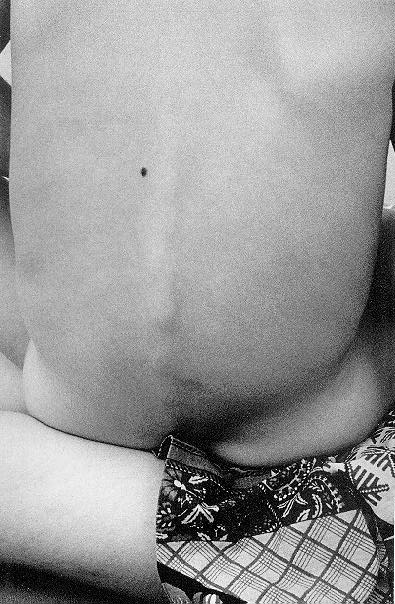
Like me you probably missed the show Prisons: 2011 – 2014 by Grégoire Korganow which was at the Maison Européenne de la Photographie (MEP) from Feb 4th-May 4th, 2015. I’ve been just too busy to go over to Paris for a while, much though I would like to.

In 2010, Korganow was working in French prisons on the making of a doucmentary film about the man in charge of them, Jean Marie Delarue, The Comptroller General of Places of Deprivation of Liberty (CGPL). At the end of the filming, Delarue asked him if he would photograph the French prison system, and Korganaw had the unique opportunity to work in twenty prisons, spending 5-10 days in each of them over the next three years.

Korganow was made an ‘inspector of prisons‘ and he writes on his web site “I’m able to photograph everything; the inside of the cells, the exercise yard, the visiting rooms, showers, the ‘cooler’ (solitary confinement unit)… Day and night. I have access to all areas.”

As Pete Brook writes: “Korganow has made the most of his phenomenal access producing an unrivaled and varied of body of work about the French prisons.” It really does seem to be a remarkable study. As well as the exhibition, there is also a book, Prisons-67065 (the number is the total of prisoners in French prisons on Jan 1st, 2014), with 432 pages (ISBN-13 979-10-92388-05-3) which I’ve not seen. It seems to be a relatively small format but rather fat book from the dimensions on the publishers page of 17 x 22.5 x 5.2 cm and its weight of three and a quarter pounds. I can’t see anywhere the number of photographs it contains.

I read about the show on Pete Brook’s Prison Photography site, and the same feature, with larger illustrations is also on Vantage, which seems a site well worth looking at.  On its ‘About’ page it reveals simply “We are fans of photography” but then goes on to list an impressive list of editors and writers including of course Pete Brook, but also a number of other names I recognise.

Vantage is a part of Medium, which is a kind of publishing network and looks very interesting – you can find out more about it in Ten reasons why I love writing on Medium. If I didn’t already have too many other things to do I might be thinking about using it.


Stanley Greene in Brixton

Stanley Greene is one of the best photojournalists around (see his work on Noor if you have any doubts), and someone I’ve written about before, particularly over his coverage of Chechnya. You can – though I don’t now for how long – see his coverage of the UK elections on Catch Up on Channel 4 News.  Asking him to cover the it was certainly a great idea,  and you can see the results in a video which combines  video footage with his black and white images at From Beirut to Brixton: war photographer on election trail. And there is an article about it.


One of my pictures from earlier in the day in Brixton

I was in Brixton earlier in the day at the event which he covered, but didn’t see him there.  Much of his coverage from Brixton (it starts at 7m30s) is of people that I know and that I also photographed, and its great to see how a real master does it (though I did get a few decent pictures too.)


One of my photographs of Lisa McKenzie in Brixton

The piece does a fine job of combining video clips with the still images and also is nicely edited, combining well-selected opinions from people on the street – including Class War’s election candidate standing in Chingford against Iain Duncan Smith, Lisa McKenzie – with Greene’s own intelligent and somewhat laconic insights.  As he concludes, there is plenty of politics happening on the streets, “but it seems to me, its the politicians who aren’t taking part.”

Camera buffs will no doubt find the equipment hung around Greene’s neck of interest. In Brixton at least there were two cameras, one of which has the word ‘Nikon’ on it, but I don’t recognise it. Certainly it isn’t a D3s which he mentions in a 2012 interview on ClueCult :

I’ve got it all figured it out. I’m shooting Leica for black and white, Nikon D3s for big jobs where you pull out the camera to say “I am the photographer”. I’m shooting the Leica M-9 when it’s a digital work with an artistic flavor and I can match it up. I’m using the Olympus to do daily life, it is my diary.

Embedded in that interview is a short video trailer for his book Black Passport, which is better viewed at higher resolution on Viewtube. There is also a video interview with him by the French magazine Polka which is also worth watching.

Often I find photographs produced now in black and white an annoying affectation, with photographers sometimes thinking that working that way makes their images more ‘documentary‘. But there is a big difference between a photographer who thinks in black and white – as Greene clearly does here, and those who work in colour and simply convert the images to monochrome.  In the Channel 4 video, choosing to work with black and white photographs clearly also has the function of separating them from the video clips.
Continue reading Stanley Greene in Brixton

Same Circus, Different Clowns

This isn’t a post about our general election, though I suspect the headline might do for the possible result, which might be a marginal improvement on the equally likely Same Circus, Same Clowns but isn’t I feel going to change things a great deal. Of course I shall still go out to vote, though only to register my opinion, which I think is important to do, however impotent politically.

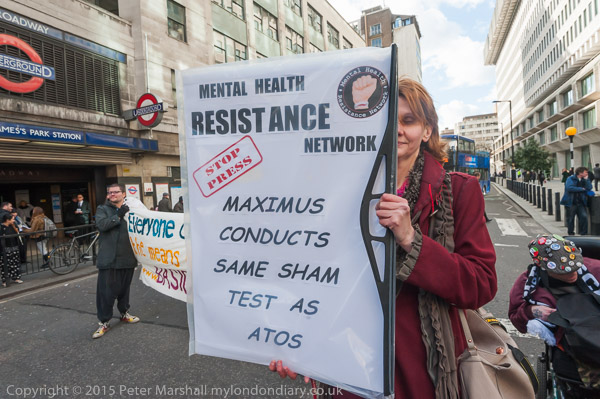
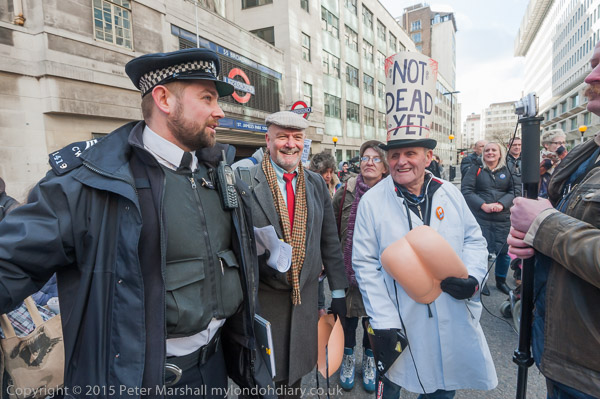
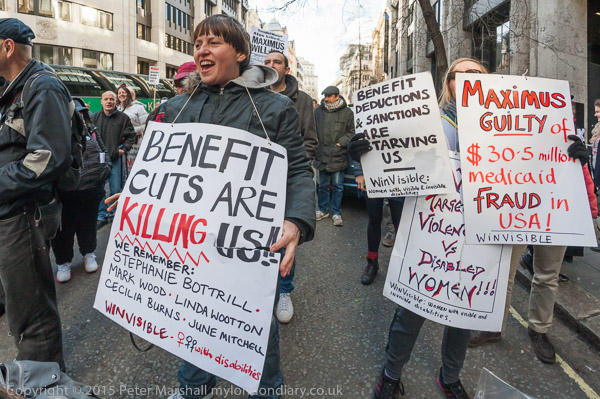
But as Maximus – Same Circus, Different Clowns makes clear, this was an event about a different company taking over the administration of Work Capability Assessments for sickness and disability benefits from Atos, who have been so hounded (and justifiably so) by protesters that they have thrown in the towel.

People didn’t protest because Atos were conducting the tests, but because the tests themselves, based on box-ticking computer questions are generally agreed to be woefully unfair and inadequate, and mainly because of the way that Atos pressured those largely unsuitably skilled people administrating them to do so in a way that was grossly unfair to claimants. It’s possible, though perhaps unlikely that Maximus will do the job better, though they will still presumably have the same financial incentive to fail as many people as possible. No fair system would pay more for failing more or set targets for the number to be failed.

Of course the tests should be scrapped, and replaced by assessments based on medical evidence provided by properly qualified people, and protests will continue until this happens, and this was just the first against the new administrators, Maximus, a US company with a UK office close to the Dept of Work and Pensions.

DPAC (Disabled People Against Cuts) and other disabled groups represent people who have been hardest hit by the coalition government’s welfare reforms, with Minister Iain Duncan Smith cynically seeing them as an easy target. Events have proved him wrong; their disabilities have made them one of the toughest groups of protesters in the country, both on the streets and in the courts, where they have inflicted a number of defeats on the government – though the response has been largely for the DWP to ignore the verdicts.

DPAC are determined because so much is at stake for them – and many know friends who have committed suicide because of losing essential benefits or the continual harassment of regular incorrect assessments and appeals which eventually overturn these.  Their protests also rightly attract a great deal of public sympathy, not least among the police, who also fear the bad image that reports and photographs of them treating the disabled as they sometimes do the general population would give.

There is also a great reserve of often unused and under-appreciated talent among people with disabilities, some of which leads to their protests being more inventive and more visual than most. It’s always a pleasure to photograph their protests, and you are never quite sure what will happen, though it is likely that something interesting will. And the public appreciation of the poor deal they have had from the government does result in greater interest in the media – and my pictures of events involving the disabled have been more widely used than those of other protests.

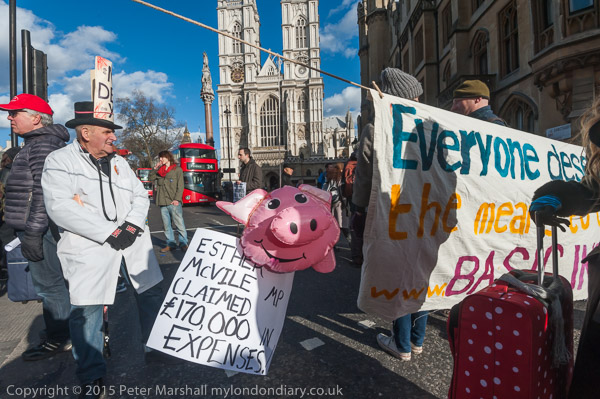
It’s not everyday you get the opportunity to take a rather different image of Westminster Abbey complete with a flying pink pig, and I’m not sure I really made the most of it, though I tried a few times. You can read the account of the event and see more pictures at Maximus – Same Circus, Different Clowns.  As usual I was working with the Nikon D700 with 16-35mm f4 and the D800E with 18-105mm DX, as well as just a few frames with the 16mm fisheye on the D700. The top image in this post was made with the D800E, others all with the D700.
Continue reading Same Circus, Different Clowns

Five Year Growth

Someone asked me yesterday if the only thing I photographed was protests. It was a genuine query, because she had seen me working at every protest she had attended in recent months, but my answer was “not quite”. But I went on to say that there were just so many protests at the moment that they had more or less forced everything else out of my diary – and out of My London Diary.  I used to cover a rather wider range of events.

It’s perhaps partly the election coming on, though I don’t really see a huge decrease in the activity of protesters after May 7, whichever party or parties form our new government. The policies that are behind what seems to be a growing resentment and militancy were many of them begun by Labour although the screw has certainly been tightened by the Conservative-LibDem coalition government. To mix a metaphor, Labour might release a little of the pressure, but it still looks to me as if growing inequality is stoking up a boiler on its way to bursting point.

Other photographers occasionally ask me how I find out about all the protests I cover, but really it isn’t a problem. My problem is more about choosing which of the many going on to decide to attend. Yesterday there were half a dozen things in various parts of London I knew about (and some I only heard about after the event) but I only got to one. And the pressure of work is such that I’ve been getting over-tired, not getting enough sleep and finding that I have to stop work after a few hours -at times I begin to feel my age.

It’s been a few days longer than usual since my last post here, mainly because I’ve been out working every day, and its likely to happen again. Today I’m able to sit here writing this because I didn’t manage to finish yesterday’s work at the computer, simply falling asleep as I tried to write, eventually dragging myself off to bed. So this morning I had work to finish and also still needed to rest. Otherwise there were a couple of protests in the centre of London and another following on from yesterday’s protests in Brixton I might be photographing. But I need a day off. Perhaps when I’ve finished writing this I’ll go for a quiet walk, taking as usual a camera with me, but probably not making and photographs.


X-Pro1, 10-24mm, 20mm

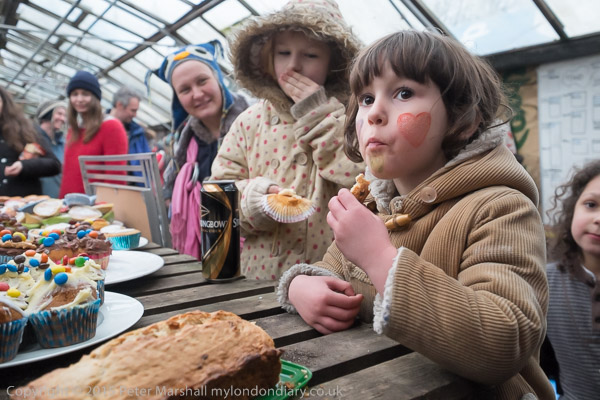
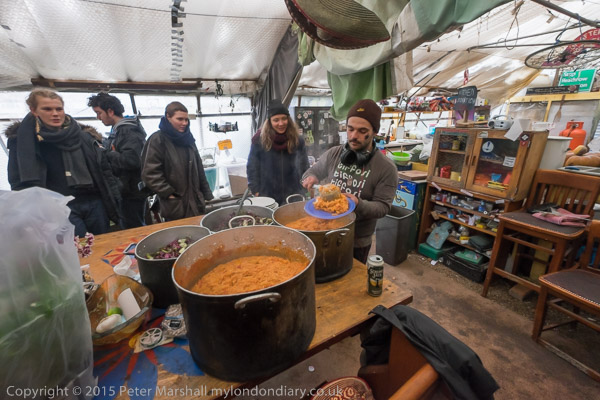
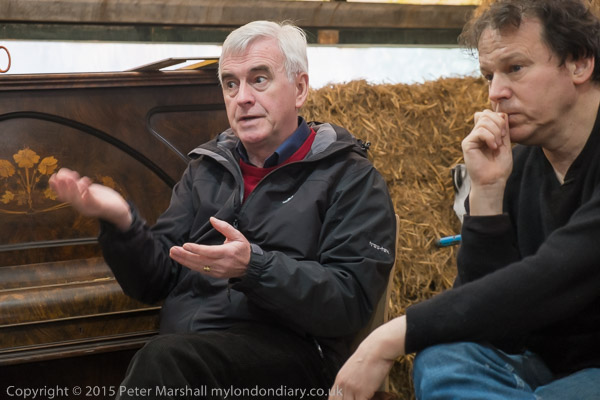
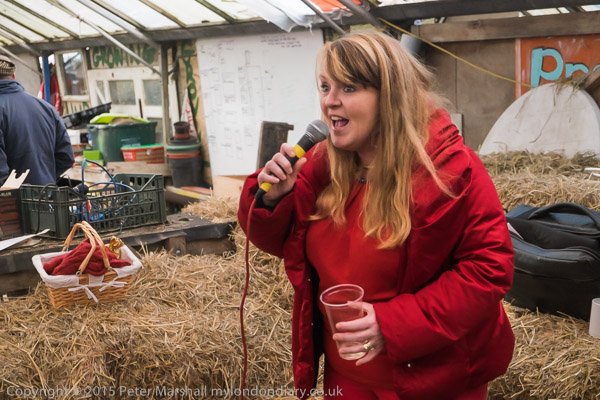
Sometimes I still do manage to photograph things that are really a day off from protests, and there was one such at the end of Febraury, when I went to a party to celebrate five years of Grow Heathrow. I’d first visited the site very briefly shortly after it had opened, just a short walk from an extremely small plot of land I had become a “beneficial owner” of at Heathrow Airplot in Sipson as a part of the campaign against a ‘third runway’ for Heathrow, and had returned for a couple more visits over the years.  Every time I went I thought it would be my last visit, with court cases and evictions always looming, and it was something of a surprise to find they were still there and active after 5 years.


X-T1, 10-20, 10mm

I’d thought a little about taking photographs, and decided it would be an ideal occasion to use the Fuji cameras, taking with me both the Fuji X-T1 and X-Pro1 bodies. I had four lenses, the 10-24mm and 18-55mm zooms, the 18mm f2 and the Samyang 8mm fisheye, though I didn’t use this. I’d taken the 18mm in case I had to work in low light, though it only has a one stop advantage over the 18-55 zoom at the same focal length. It’s also a nicely light and compact lens which is handy to have on a body hung around my neck when travelling, and my favourite focal length, but in the end I only made a few images with it. Eleven out of just over four hundred. Most used was the 18-55mm (266) with just over half as many (142) on the 10-24mm.


X-Pro1, 18-55mm, 55mm

I like the optical viewfinder of the X-Pro1, but ended up taking more pictures with it using the electronic viewfinder and the 10-24 zoom, and wishing that I had two X-T1 bodies. One thing I did miss was a longer lens than the 18-55mm, particularly when photographing the panellists at a discussion where I could not move in closer. I’ve rather got used to using the 18-105mm on the Nikon, and if I ever decide to use the Fujis seriously would certainly buy something longer, perhaps the 18-135mm.


X-T1, 18-55mm, 37.4mm

I had the usual battery problems – I got through four in the four hours I was there, and occasionally the focus was just a little slow, but otherwise things worked fine. I’m getting used to using the exposure compensation dials, though moving the focus point around is still a little tricky. The X-T1 viewfinder is really good in low light too.

There was a huge advantage in using the Fujis in quiet conditions close to other people in that I could take as many pictures as I liked without being a distraction. I often feel intrusive when photographing with the Nikons, although I know the shutter sound is louder to me than to other people, it is still loud enough to be annoying. Almost as annoying as a Canon :-)  though less so than a cannon. With the X-T1 you can use the electronic shutter and all there is to hear is a slight whir as the lens focusses. Usually I leave the shutter in mechanical mode, which is pretty quiet, but does give you some feedback that you have taken a picture. Sometimes I found myself having to review an image to be sure I had really pressed the button.


X-Pro1, 10-24mm, 17.4mm

It was a pleasant afternoon, and good to meet a few old friends as well. Of course you can read more about Grow Heathrow and see more pictures on My London Diary in Grow Heathrow’s 5th Birthday.

Continue reading Five Year Growth

In the Family Way

Most parents photograph their children. Or at least those of us fortunate enough to live at least reasonably comfortably and with our families do. Almost certainly now the great majority of those pictures will be taken on mobile phones, and many will be shared through social media. Some parents will share them privately, while others, either by accident or design will make them visible to the world. I’ve occasionally come across some which I would rather not have seen – usually on aesthetic grounds – on my Facebook feed, but usually I just hit the space bar to scroll down to the next post.

Occasionally I’ve told Facebook I don’t want to see any more posts like this (usually of cats or food) but it seems to have no real effect. A few people who only seem to post that kind of content I’ve blocked or unfriended, and some posts I’ve reported as spam.  If I saw anything that was clearly illegal I’d certainly report it to Facebook, but so far I haven’t had to do so.

Today on Facebook I read two different posts about people who have received an avalanche of negative comments after making photographic projects photographing their own children and publishing these images, prompting me to write this post, and I’ll mention both later.

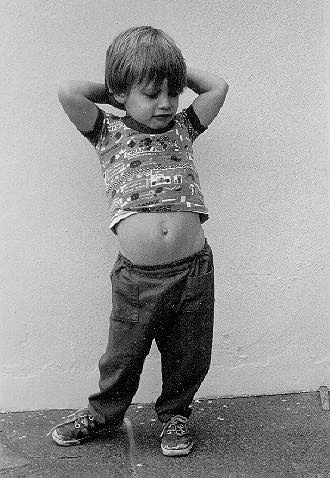
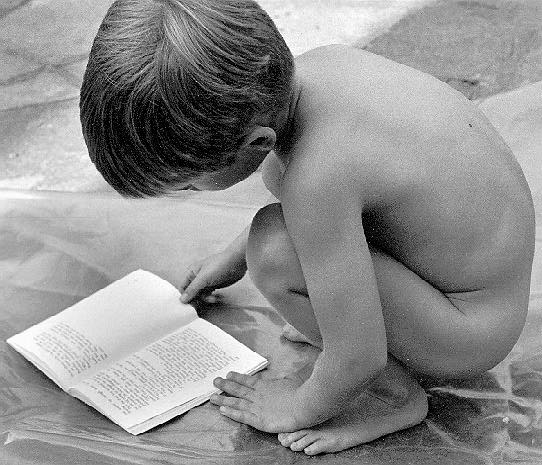
Firstly I was reminded that the first web site that used my own pictures was a small site with the title ‘Family Pictures‘, with images of my own two boys and some of their friends. I chose the images carefully as those which I felt would have an appeal outside my own family.  I was also careful to remove a few more revealing images of the children playing with friends in paddling pools and elsewhere on hot summer days that cause amusement in family circles but might have transgressed the ISP’s guidance on nudity.

By the time when these black and white images went live on the web in 1995, those two boys were in their late teens, and they helped me hand code the html for a rather basic web site and upload it to an ISP that was offering small amounts of free web space.

I updated the images a few months later to reduce image size, as some of the originals were around 100Kb and very slow to load on a dial-up connection, and got the whole site showing 16 jpeg images (and thumbnails of them) with 17 pages of html down to under 1Mb.

I transferred it to my own web space a few years later, and made a few changes to the code, removing the pre-loading of images we had thought up, which had appeared to speed up the site when going though the images in order. A full stop on each page of the site was actually the next image in the sequence resized down to a 1 or 2 pixel square. As modems got faster, such tricks became redundant, and just complicated matters. But visually the site is as it was almost 20 years ago – still the same scans, rather poor by modern standards and worsened by jpeg artifacts. You can still see all 16 images online.

Personally I find the pictures taken by photographer Wyatt Neumann during a trip with his 2-year-old daughter a charming record of childhood innocence and the relationship between father and daughter. What I find disturbing is the kind of comments that some have made about them – and also I dislike the way these images are introduced on the Upworthy site, alhtough the video is rather better than you might expect.  You can read the photographer’s own introduction to the work, which he has exhibited and published as I Feel Sorry For Your Children, on his own web site.  Those people who look at this work and see “sexual victimization and violence,” I feel sorry for their children too, and like Neumann would say “I choose life.”

Another photographer whose work has aroused similar controversy is Sally Mann, and in a long article in the New York Times, Sally Mann’s Exposure, she writes in great detail about the problems caused by such controversy, and the actions of some desperately sick people, one in particular that she goes into detail about. I’ve written before about my great admiration for Mann’s work, and a little about the misguided criticism of her for it, but had not realised the full extent of the persecution she and her family have had to suffer. It’s a moving article, and one that only strengthens my regard for her, and for the need to keep up the struggle for freedom of expression and the kind of positive family and societal values that underlie the work of these photographers and others.


Continue reading In the Family Way

March 2015 complete

I fell asleep around midnight last night trying to finish putting my work from March on to My London Diary, waking with a start to find a black screen in front of me, and when I moved the mouse to rouse the monitor from its dreams, found myself facing a blank page where I’d almost completed the coding. In my daze it seemed something of a calamity.

Fortunately hitting Ctrl+Z to undo my last action – presumbably hitting the space bar with the page selected as I collapsed on the keys – restored my work, although had I been thinking clearly I would have realised that only the few keystrokes I had made since the last saved version would in any case have been lost. But it was certainly time to give up and go to bed. And finish the work the following morning, which I now have. I think there are 40 stories from March, though not all have a great deal of content, and a couple are just pictures from my occasional days off.

But I’m also aware of the many events I’ve been aware of but been unable to cover, invitations I’ve had to refuse because I have to be at another place. We are indeed living in interesting times, and it is something of a curse.

Mar 2015

Another Country Walk
Cross Bones Open Day
Murdoch on Trial – Guilty as charged


Jon Bigger Class War South Croydon
RMT protest Ticket Office Closures


Sweets Way at Annington Homes


Quiet Night at Poor Doors
Occupy Rupert Murdoch
Around Tower Bridge
Arrest Warrant for Rupert Murdoch
John Lewis customers support Living Wage


Stand Up to Racism Rally
Britain First Protests anti-Racist March
Stand Up to Racism March
Great British Tax Robbery
Bermondsey Walk


Poor Doors blocks Rich Door
Unite protest against Benefit Sanctions
Dolce & Gabbana Boycott
Debt Resistance UK #Blockupy solidarity
Free Shaker Aamer vigils continue
Savage cuts to Adult Education budget
Stratford to Hackney Wick
Class War go to Aylesbury Estate
Class War celebrate Election Launch
Class War Chingford Election Launch
Free the Hares boys protest at G4S


Poverty pay at the Royal College of Art
Save Our Lions – ban Canned Hunting
Let Ife Stay in the UK!
Police seize Class War banner
Viking longship invades Tate steps
Climate Change Rally


Time to Act on Climate Change
Poor Doors Zero Police
Aylesbury Estate Occupiers Move
Homeless Persons Matter
Mexican President told Stop the Killing
Shut Down Yarls Wood


Maximus – Same Circus, Different Clowns

As always there are many more pictures from most of these events on My London Diary if you follow the links, and in some cases some fairly lengthy stories.

Continue reading March 2015 complete

Estates of Mind?

In 1951, a part of the Festival of Britain was the Live Architecture Exhibition, on what became knows as the Lansbury Estate in Poplar, and at its centre was Chrisp St Market, the work of architect Frederick Gibberd, the first purpose-built pedestrian shopping centre in the UK.

It wasn’t entirely succesful – and his iconic Clock Tower built as an observation tower soon had to be caged in against suicides, but it was an important statement of a new vision in housing, with huge programmes over the next thirty or so years to provide social housing for the mass of the population, replacing both the areas destroyed by bombing and the decaying streets of jerry-built Victorian slums. There was a national feeling, an urgency that something had to be done about the housing problem, and a consensus that a large part of the solution lay in providing social housing at resonable cost for the majority of the population at least in the major cities.

The problem was also addressed by the New Towns, such as Bracknell, where I myself lived in a Development Corporation flat for several years in the early 70s, but in London and other cities it was an era of large estates, often system-built and with much bare concrete surfaces.

The best of these were architectural gems and masterpieces of design, and while some may have looked they were often spacious and comfortable, offering many residents for the first time the kind of conveniences we now take for granted. But like all property they needed proper management, with regular repairs and maintenance, and in most cases local authorities failed to meet the challenges of ownership, allowing properties to run down. There were sometimes design faults, more often corners cut by the builders and, certainly in later years financial pressures on councils that made their job impossible.

Now the pressures on these estates come largely from the increase in land values and the greed of developers and councils. Many of these large estates are in highly desirable locations, and huge profits can be made by demolishing and rebuilding at a much higher density and to lower space standards for private sale. It’s a process part-fuelled by overseas investors buying properties not essentially to live in but for the capital gains from rapidly increasing house prices, particularly in London. Investment brochures for one block in Aldgate suggested that buyers would see a 35% rise in the value of their flats in around three years- and that prediction may well turn out to have been conservative. But can we afford to let London become simply a proiftable  safe deposit for foreign money rather than keeping it as a living city?

The name of this un-housing game for financiers is ‘regeneration’; a worthy aim announced in the early years of the last Labour government with probably the best intensions that has turned into a nightmare for Londoners on low or middle incomes. But while its first proponents may have been simply naive, it has turned London’s largely Labour councils into villains in league with property developers in boroughs including Labour strongholds such as Newham and Southwark as well as Tory boroughs including Brent and Wandsworth.

We’ve already lost much good, serviceable property, along with some of the best architecture of the era, such as the Heygate estate, where a long process of neglect, demonisation and PR enabled Southwark to sell off the now-demolished estate against the wishes of many of its residents, at a time when many of its buildings and landscape were just reaching maturity.

The Heygate too was one of the starting points for the now rapidly growing protests about housing across London – and which were certainly a part of the reason why Southwark has lost millions on that particular deal. Despite which, they are still going ahead with a similar scheme on the larger neighbouring Aylesbury Estate, currently the subject of occupations and battles between housing activists and security guards aided by police, and where some remaining residents now find themselves behind tall fences in what looks like some kind of prison, having to make lengthy detours and show documents to be let in or out – and to go to the security gates to meet any visitors.

Other protests too have made the news. Some appear to have met with some success – after Focus E15 mothers occupied an empty block on the Carpenters Estate, Newham has now moved a number of families back into properties they had left empty for ten years in their attempt to empty and demolish the estate. New Era tenants evaded eviction before Christmas (thanks to a little help from Russell Brand) with their block being sold to another housing association.

Other protests continue across London, including those over Sweets Way in Barnet, the West Hendon Estate, the West Ham football ground, Cressingham Gardens in Brixton, Fred Wigg and John Walsh Towers in Waltham Forest, the West Ken and Gibbs Green Estates in Hammersmith & Fulham, the Sutton Estate in Chelsea, Guiness Trust on the Loughborough Park Estate,  Northumberland Park and other estates in Haringey, and of course the ‘Poor Doors’ protests at One Commercial St, Aldgate.  Regular readers of this blog or visitors to My London Diary will be aware of some of these.

I began this post at Chrisp St, because I was there last night for the private view of  ‘Estates of Mind‘, a photographic show in which “Six photographers explore various social housing projects from the 1960s and 70s; an era of radical architectural determinism and social restructuring.” (Open between 12-6pm on 9-12 April and 15-19 April.)

The invitation continues with a question “What can we learn today, in a time of great uncertainty in social housing from their successes and failures.” Although there is some interesting photography on display, some of it taken on some of the key estates now under dispute, this is perhaps a question that the show largely fails to engage.

What I found most satisfying were the set of images by Mike Seaborne, who I’ve known and sometimes worked with for around 25 years (including on the Urban Landscapes web site), and in particular his combination of images that he took around the turn of the century with those from this year on the Isle of Dogs. It is perhaps the only part of the show which says something about what is happening through its use of these ‘then’ and ‘now’ views, as well as displaying a discerning choice of viewpoint and an admirable clarity of treatment.

Also of interest to me were pictures by Peter Kyte from Grahame Park in Colindale, North London, Barnet’s largest housing estate on the former Hendon Aerodrome developed in the 1970s and named for aviation pioneer Claude Grahame-White. The estate underwent some regeneration in the 1980s, removing some of the connecting walkways., but its major regenertion began with a demonstrtion phase in 2007, with the first major phase being completed in 2012 and is continuing. The original 18-year programme proposed the demolition of around 75% of the 1777 properties (including the long low-rise blocks of flats that give the estate its character) and their replacement by slightly over double that number of new properties, of which roughly 30% were to be social housing.

Unlike most other work in the show which is largely straightforwardly documentary, Kyte’s work is a very personal vision concentrating on the long dark passageways he saw there, emphasized by heavy printing and by the cropping to a tall narrow format in his 20×12″ prints. The work had a impressive coherency, though I think one that tells us more about the photographer than either that particular estate or the more general problems of housing in London.  I wondered particularly about how his view as a visitor might differ from that of someone for whom the estate was home.

There is also perhaps something of a contradiction in the location of the show, an empty shop made available for the show by the owner, Poplar HARCA (Poplar Housing and Regeneration Community Association) who a few years ago took over the regeneration of nearby Erno Goldfinger’s Balfron Tower (where this group held a show last year) from Tower Hamlets Council. As the Docklands and East London Advertiser reported earlier this month:

It appears that social landlord Poplar HARCA are preparing their tenants in Balfron Tower to leave the building so that the rich can purchase the newly refurbished flats. Another east end community is being destroyed for profit. A sad and insulting legacy to the values of its architect Erno Goldfinger, and that reminds us how little the voice of the powerless are heard, or acted on.

Rather earlier in 2010, Michael Newman had commented on an article in BDonline on the renovation of Balfron Tower:

This article is well written and informative but as a resident of Balfron Tower I want to point out that paragraph 3 is incorrect.

“Once refurbished, residents will have the choice of keeping their heads in the clouds or putting their feet back on the ground by moving into newly built homes elsewhere on the estate. “

At the moment HARCA has informed residents of its aim to refurbish and to empty the building to do so, but has failed to mention the choice of returning to their homes.

It appears that HARCA and those partners it is working with are forcing the present community in the Tower to leave their homes and never to return. So much for the values of social housing, for helping communities, and for a ‘Golden Future’ for the Tower and its inhabitants.

It looks like HARCA will refurbish the Tower, will sell off the flats and as usual the rich and so-called cultured will buy the right to ‘homes in the sky’.

I wonder what Goldfinger would think of HARCA’s guardianship of his building, and the council who historically were brave and fought for rights of its people.

Housing is a vital topic, particularly in London, and one which has, largely through the efforts of various protest groups, and marches such as January’s large ‘March For Homes‘ forced itself onto the news agenda. It’s good to see photographers and shows tackling it, but I would like to see ones that perhaps incorporated rather more thought and provoked it for those not already involved in the issues.
Firefighters on Strike


D700, 16-35mm, 16mm

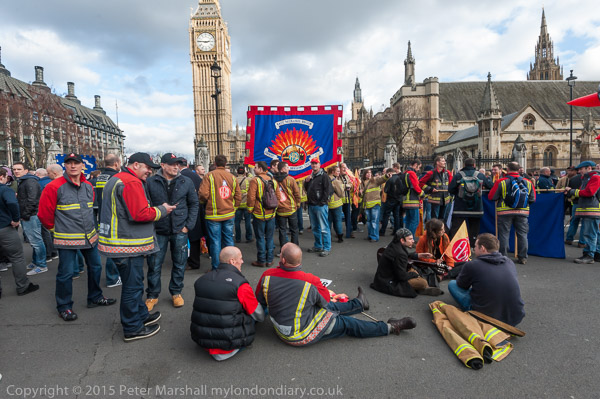
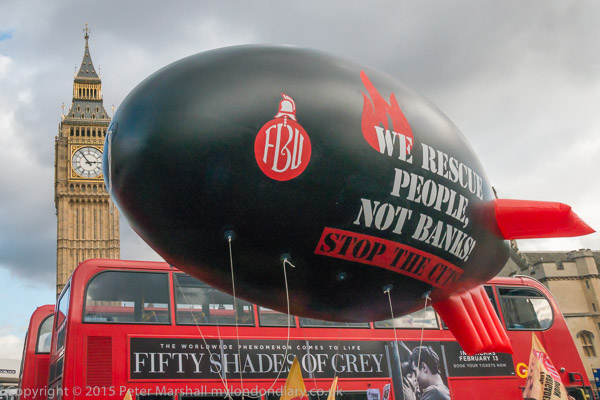
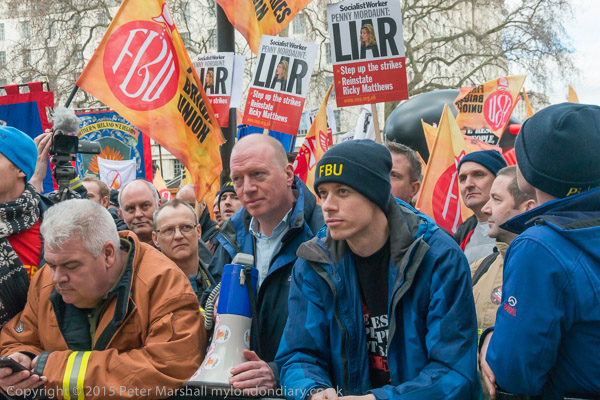
Although I’d known that the Fire Brigades Union were on strike and having a conference in Methodist Central Hall, just a couple of hundred yards from Parliament, I hadn’t come to Westminster to photograph them, but another protest taking place nearby. So it was something of a bonus to come across them sitting and standing in the roadway in front of Parliament. Apart from anything else it made it easier to cross the road!

I’ve long felt that Parliament Square should be improved, and one of the major improvements would be to take away the traffic, at least from the roads on two sides of the square, between it and Parliament and Westminster Abbey.  It just isn’t a good idea to have one of London’s major squares as a traffic island.

But the firefighters obviously have good reason to be upset, with promises clearly made to them having been broken, and I wasn’t surprised that they came to show their anger. Nor that police were treating their protest in an unusually relaxed fashion – they share a common bond with their fellow emergency workers and also many of them feel they too have been shafted by the government. And certainly it would be unwise to tangle with the firefighters, who are undoubtedly fitter and tougher than the average police officer.

It was too and almost perfect winter day for photography, with great light and good clouds, with a literal grey cloud over Parliament as well as a metaphorical one in front of it. I’ve always liked open shadows in my images in both black and white and now in colour, and the combination of Nikon sensors  and lenses with Lightroom 5 perhaps sometimes tempts me to take this to extremes.  The 16-35mm, here used at 16mm, f10 with a shutter speed of 1/400 at ISO 640 is a very sharp lens. Every slate on the roof at right is clearly defined and at 100% on screen the 4256 x 2832 pixel original processed with my standard noise removal and sharpening defaults seems noise free.
I’d arrived at a point where the protesters were uncertain about their next move, had missed the excitement of the marching on to the road and occupying the space. The grey of the roadway is a great background on which the individuals sit or stand, setting off their colours, which are perhaps just a little more saturated than real, the yellows, browns and reds of the jackets, warm colours that cluminate in the flames of the banner, set against a blue background and the blues of the working jeans.


D800E, 18-105mm DX, 24mm (36mm eq)

I took more pictures – you can see some of them in Striking Firefighters block traffic – and then photographed them as they made their way up Parliament St to Whitehall, stopping outside Downing St.

Things were rather crowded and chaotic there, and it was difficult to make pictures as both firefighters and other photographers filled any empty space.


D700, 16-35mm, 16mm

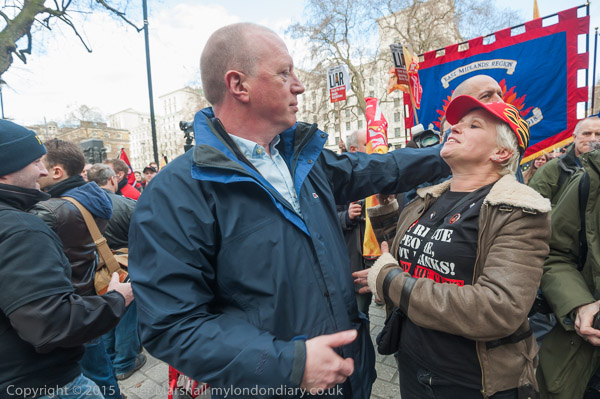
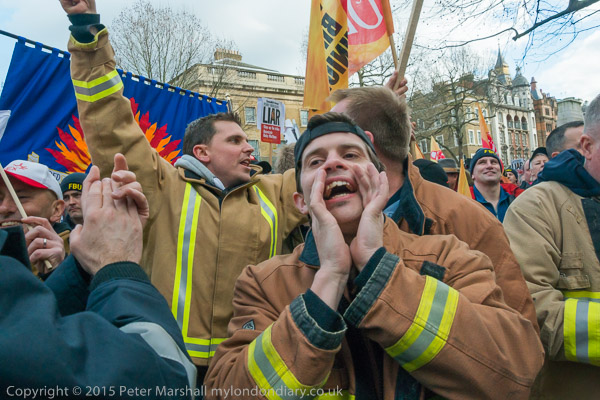
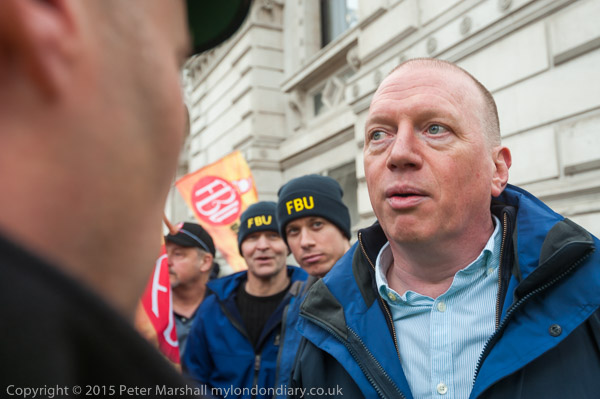
At Downing St I kept my eye on FBU leader Matt Wrack when he came to the gates, wondering what he would do next. As he moved around I tried to keep in a position where I could see his face, while also taking pictures of the firefighters who were crowding around him and shouting towards Downing St.


D800, 18mm (27mm eq)

When a police officer pushed his way through the crowd to speak with Wrack, I was at his side. Perhaps ideally I would have been a little further back, but I was wedged firmly in place, hardly able to move an inch in any direction, though just managing to have enough space in front of me to work with the 16-35mm.


D700, 35mm

I took what I thought was a rather nice series of photographs of the encounter, although all seen from that single viewpoint. It was as Wrack commented a surprisingly polite encounter with the officer asking what the firefighters wanted to do, taking down Wrack’s mobile number and then going away to see if he could arrange for someone from Downing St to come out and meet with the firefighters as requested.

By this time I was worried about missing the event I had actually come to Westminster to cover, and though I was in an interesting position I decided to leave. It wasn’t easy to make my way out through the dense crowd, but they were good-natured enough to squeeze out of my way.


D800E, 32mm (48mm equiv)

When I got as far as the gate leading into Downing St, a few yards down the road, I decided to go through it. I didn’t want to actually go inside as nothing seemed likely to happen there, and it involves and airport-style security check (those without a Press card have to apply days in advance and bring a passport) and I avoid it unless I really have to, but going just a little way down it did allow me to photograph the crowd from ‘inside’.

Had I stayed there any length of time, I think the police would have ordered me out, but I was able to take a few pictures and then move away without problems.

Striking Firefighters block traffic

Continue reading Firefighters on Strike

Truce Over – It’s War!

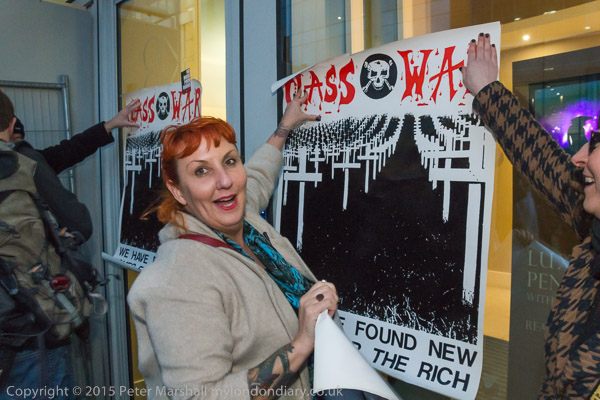
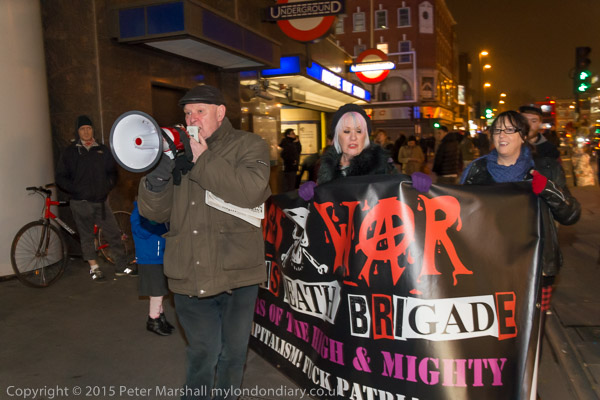
Last year I photographed around 20 protests by Class War outside a prestige block just to the east of the City of London, called One Commercial St. The recently built block contains a supermarket, a betting shop, a hotel, an entrance to Aldgate East Underground station and more, including car parking and both expensive private flats and some managed as social housing by a housing association.

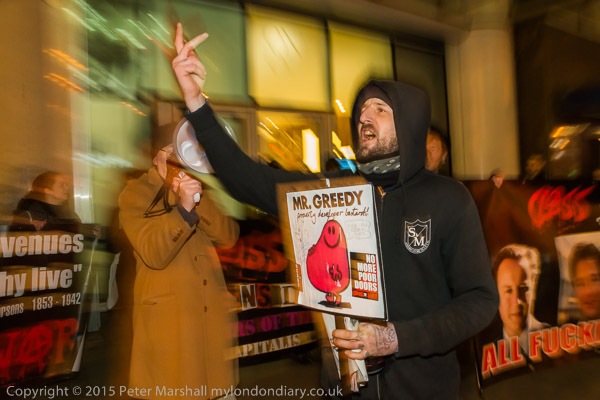
Class War started their protests at the end of last July, and kept them up weekly – with the occasional extra special event until almost the end of November. Like many others they were appalled by finding out that while the residents in the privately owned flats had a posh entrance on the main street – Whitechapel High Street – into a comfortable lounge area with a 24 hour staffed reception desk, those in the social housing had to go down a dirty and dimly lit alley at one side of the block to a door with a card entry system into a long blank corridor with just a block of mail boxes. When I first went down it, the alley was strewn with rubbish and smelt strongly of urine. Because the entry system was broken, the door to the block was not locked and anyone could walk in off the street. Apparently too, there had been problems with getting repairs to the lift, and the flats are up on the 10th floor and above.

Increasingly this kind of social segregation is being built into new blocks where the developers are forced to include some element of social housing, and the protests by Class War are just one of several that have served to bring this to public attention and fairly wholesale public condemnation. It reeks of the separate entrances for servants and workmen that have now largely disappeared from houses and workplaces. Most feel there is no place for separate doors for rich and poor in our country today.

Its also a part of a larger movement over housing, particularly in London, where former working-class estates and areas are increasingly are subject to a so-called ‘regeneration’, which involves evicting the working class tenants and lease-holders, and either demolishing and rebuilding or refurbishing the properties for sale or letting at ‘market rents’. Many of those buying these properties are overseas investors who may not even live in them, instead seeing a good return on their investment as London house prices continue to rise – particularly in places such as One Commercial St, close to the Crossrail development. Investors are told they can expect a 35% price increase by the time Crossrail opens in around three years.

Local residents – both those whose families have lived in the area for generations and more recent migrants to the area – cannot afford either the market rents or the so-called ‘affordable rents’ which are often around 80% of the market rate.

The process of regeneration was started, perhaps with good intentions, by the Labour government in the 1990s, but was poorly thought out – and the developers have managed to run rings around even the best intentioned councils. But most London councils have colluded with the developers – and often led the process of getting rid of their less well-off residents.

In November, the flats were sold by developers Redrow to Taylor McWilliams, and the new owner contacted Class War and offered talks to try an solve the problem. It seemed to me that relatively minor interior building works could have allowed all tenants to use the front entrance. I’d walked inside the block between the two sides myself, between separate lifts on the ground floor of the building when I was given a tour by one of the owners of a flat on the rich side. Class War were hopeful of a satisfactory settlement.

The meeting, when it came, was a shock. McWilliams told Class War he wasn’t prepared to make a single entrance so that everyone could enter from the front street. Complete intransigence. Class War told him what they thought and announced the protests would re-commence. They started with a short detour from the March for Homes at the end of January as it was going past the building, but the protests began again properly on 12th February, and are continuing every Thursday evening, from 6-7pm.

Like Class War, I was very disappointed by the response, and also as a photographer,  covering a regular protest like this presents problems. How do you keep going back to the same place  – and largely the same people – and making pictures that remain fresh?

There have been some minor changes. As you can see when the protesters returned there was building work taking place in the alley, and it is now rather more pleasant, and what was stygian is now well lit.

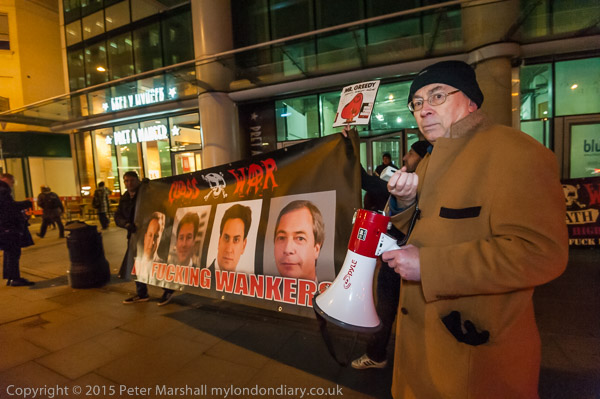
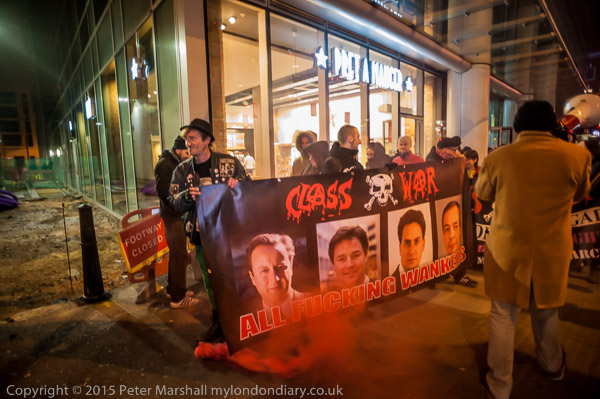
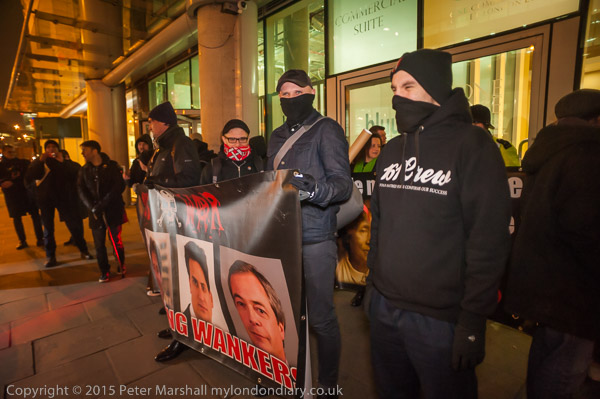
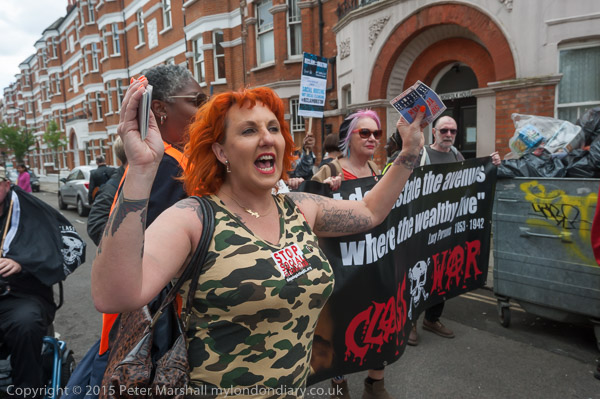
There are also some new protesters – with various groups including the 161 crew of Polish anti-fascists shown here holding what I euphemistically call Class War’s ‘Political Leaders‘ banner.  More about this banner in a later post, but while it is certainly in bad taste, most people seem to have a very positive reaction to it, often pointing and laughing. It’s certainly meant be and is provocative.

Class War does inject a certain amount of fun into politics, dealing with serious issues, but doing so in a theatrical way. But although I quite enjoy going to their protests, trying to cover them every week is sometimes difficult. I don’t really like working in the dark either, having to use flash or other artificial lighting much of the time. Even on a reasonably well-lit street parts of the pavement are pretty dark.  I’ve started using a LED light with the D700 (not least because it is now totally unpredictable with flash, suffering from old age) but that certainly has its limitations, and even at ISO3200 many images are blurred by subject movement. Again this is something I’m still not quite sure what I think about, but I will try and write more about later. Sometimes I seem to get some good results.

This is a project I’ve committed a great deal of time to and I hope to see it out.

More at Poor Doors Truce Over – It’s War! and of course in the following weeks.

Continue reading Truce Over – It’s War!

Definitely Not Cricket

To my surprise I find this is not the first post I’ve written about cricket.  I’ve never really been a cricketer, and when we had the choice at school in the summer term I always opted for athletics, though we did get a little compulsory  cricket training.  I learnt the forward defensive and backward defensive strokes, but for attacking was left using the playground wallop. I don’t think I ever really got into the swing of overarm bowling either, somehow my shoulder didn’t quite let my arm follow the necessary trajectory, and my deliveries ended as slow and guileless, occasionally getting a wicket when the batsman lost patience waiting for the ball to arrive and swung too early.

Of course being English I had to play the odd game, getting roped in for various school and college sides, and even for Air India when they were desperately short of players. They were a class side, but so much class that anyone below five in the batting order (and I was well below five) seldom got a knock, and it took only a fairly short wander around by the boundary untroubled by the proximity of that nasty hard ball watching the other side coming out and going back to the pavillion before we were all back in and at the bar too.

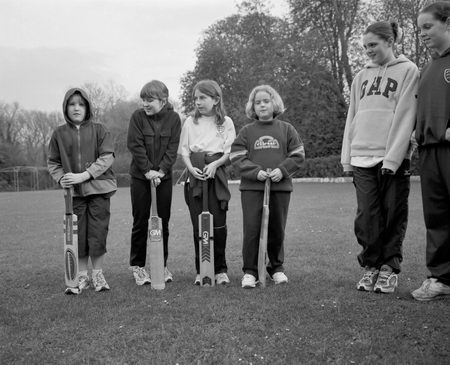
I find I’ve even written before about my cricket photography. Back in 2001 I got a commision from the local council under an Arts Council scheme to photograph Shepperton Ladies Cricket Club, and particularly the work they were doing with young girls.  It was an interesting assignment, and one I enjoyed doing, spending far more time on it than was sensible for the money.

I wasn’t really a sports photographer, and certainly didn’t then have the kind of equipment that proper cricket photographers would have, being seriously underpowered in the telephoto area.  The longest lens I owned was a 200mm, which hardly gets you into the league, as the boundary is a serious distance from the wicket at most grounds.  I had a 2x converter, but adding that made the 200mm f5 into a 400mm f10, which even on sunny days was a lttile slow for action especially as ISO 400 film was the fastest I could sensibly use. Even in bright sun I needed to work wide open to get a suitably fast shutter speed of 1/500th, and wide open with a 2x converter was never too sharp.

Without the converter, things were rather better, but few of the pictures I made were absolutely sharp, and even fewer managed to be from the right position at the right time. This didn’t worry me, because this wasn’t really what I was trying to do, and the real work I was making was in black and white, with a 65mm wideangle on 6×7, both of the ladies team but more importantly of the work they were doing with girls from a very young age.

Cricket wasn’t seen by those training the girls as just a game. It was about developing the character, encouraging independence and self-reliance.

I’ve written a little more about this project in a 2012 piece about my rather limited sports photography, Sports and Me, so I won’t repeat myself even more. I also wrote another post five years ago, Not Cricket.


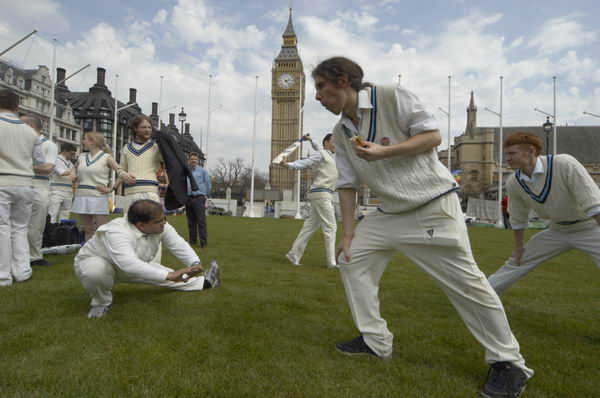
Space Hijackers -an international band of anarchitects who battle to save our streets…

What got me thinking and writing about this again was a message from Suzy Gillett, who I met when she was making the short film Epiphany (and also, rather embarrasingly another post titled Epiphany, which should have been Epiphany 2.) She is now the producer for another film in the making, This is Not Cricket, on which director Jacopo de Bertoldi has been working on since meeting the Piazza Vittorio Cricket team in 2012. This is anarchist cricket of a very different stamp to that I photographed back in 2005. They hope to complete the 90 minute feature-length documentary by the end of 2015 and urgently need cash, and are seeking it from crowdfunding.

Here are the first two paragraphs of the Synopsis:

Immigrants in Italy are under siege from increasingly violent xenophobic demonstrations and punishing laws. European austerity measures hit society, fanning the fire of intolerance.

Two adolescents in Rome, Shince from India and Fernando from Italy set out to rebuild their cricket team with a singular political vision to combat fascism, to integrate young people, and to play cricket. Their team was the strongest under 18s club in Italy, until it was forced to disband by the same problems they are determined to overcome: religious and social discrimination.

The trailer, on the same page is also worth viewing. I’ve just made a small gesture of support at the ‘Daisy Cutter’ level which seemed appropriate for my level of cricketing prowess; so far the appeal for $15,000 for the next stage of the product has had just over a third pledged, and you can also follow the project on Facebook. Some of the ‘rewards’ offered for higher levels of contribution appeal rather less. What would I do with a cricket bat!