Kalpana’s Warriors

Partition of India back in 1947 was a bloody business, and one that continues to have many bloody repercussions, not least in the Bangladesh Liberation War in 1971, which was the subject of an earlier show curated by Shahidul Alam (with Mark Sealey) ‘Bangladesh 1971‘ at Autograph ABP in Shoreditch, London, in 2008.

Although the great majority of the population of Bangladesh are Bengali, some areas of the country have considerable numbers of indigenous peoples, notably in the Chittagong Hill Tracts (CHT) in the south-east, bordering Myanmar and India, where they form roughly half of the population. Collectively known as the Jumma, the largest ethnic group is the Chakma (also known as Pehari) people. Unlike the Bengali majority who are largely Muslim, the indigenous people are mainly Buddhists.

Lord Mountbatten, sent as Viceroy to India to oversee independence and partition, was so concerned over the Boundary commission’s decision to include the CHT in East Pakistan that he delayed announcing the commission’s decisions until the day after Independence Day as he feared it would provoke a powerful reaction, with boycotts of the celebrations.

After independence the Bangladeshi government have attempted to solve the problem by settling the area with Bengali people, and the hill tribes set up a resistance movement with a guerilla force (encouraged covertly by India) which launched an insurgency in 1977 and the area became highly militarised, with government forces and paramilitary groups carrying out atrocities including mass rapes, genocide and ethnic cleansing.

Although a peace treaty was signed in 1997, Wikipedia reports “According to Amnesty International as of June 2013 the Bangladeshi government had still not honored the terms of the peace accord nor addressed the Jumma peoples concerns over the return of their land. Amnesty estimate that there are currently 90,000 internally displaced Jumma families.”

Kalpana Chakma “was a vocal and charismatic leader who campaigned for the rights of the indigenous people” of which she was one, and had become leader of the Hill Women’s Federation, speaking out against the military occupation and handing out their land to Bengali settlers. She was only 23 on 12 June 1996 when, a few hours before voting began in a national election in which she had been campaigning for an independent candidate, Lieutenant Ferdous and other members of the Bangladesh Army raided her family home and abducted her and her two brothers.

Attempts to report her abduction and get information from the army and police were refused, and continuing attempts to get at the truth about what happened to Kalpana Chakma have been met with deliberate lies and obfuscation.

Shahidul’s work in ‘Kalpana’s Warriors‘, curated by him together with Rahnuma Ahmed, Saydia Gulrukh, Dadia Marium and ASM Rezaur Rahman is an attempt to ‘break the silence surrounding her disappearance‘ but is also a powerful celebration of her continuing influence on political activists, the ‘warriors’ who have fought to demand the truth about her abduction and to obtain justice, as well as a candlelit vigil in her memory.
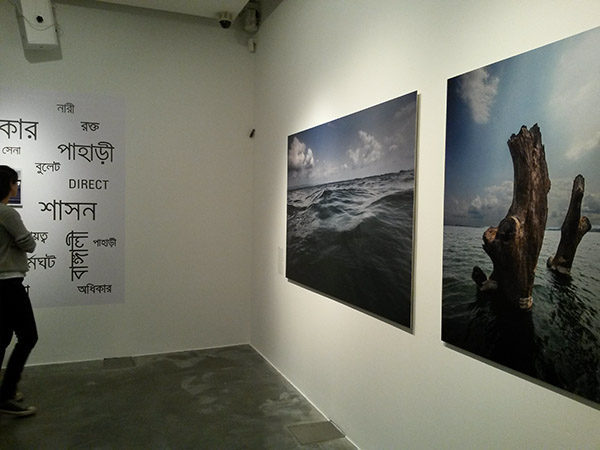
It’s probably best to visit part two of the exhibition first, which contextualises the work with images which show something of the area and the movement of which Kalpana was a part. A film made by Alam shows a number of people talking about Kalpana and her influence, with English subtitles, and at 35 minutes it seems a little slow-moving.But this is a general problem with subtitled interviews in that you can read in a second what perhaps takes 15 seconds to say, and then have to wait impatiently for the next sentence.

The installation in the ground floor main gallery is impressive, with large images, heads and shoulders at much greater than life-size etched on straw mats, each illuminated by a single hanging candle. It was getting dark outside when I walked around it, and it might be just lose a little during daylight hours with more light leaking in from outside.
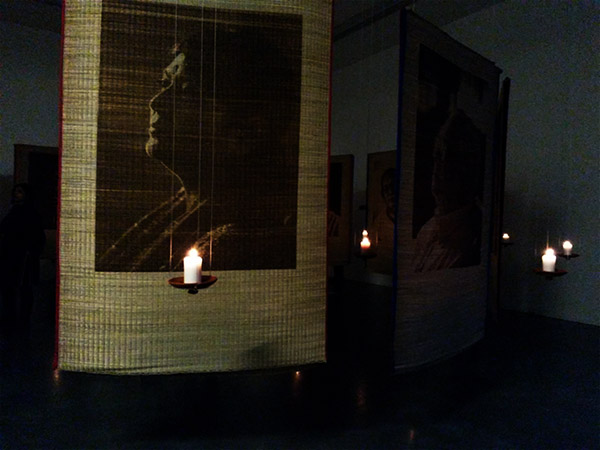
The straw mats are like those found in the village homes in CHT, and on one of which which Kalpana would have been sleeping when the soldiers came to take her, and the technique used to print on them also reflects the realities of life for her and her people. Before her abduction she had been leading protests against the burning of Pahari villages, and the images are burnt onto the mats using a laser beam. There are smaller 4×3″ more conventional prints in small piles against the wall around the installation which you can pick up and take away, with short texts on the reverse naming and describing the ‘warriors’.

The installation with its hanging mats in a circle which you can walk around both outside and inside is an experience with a highly religious feel to it, like entering a temple. Even on the opening night when it was relatively crowded – with numbers strictly limited to 30 inside the installation for health and safety reasons and many were using their phones to take photographs – it had a powerful atmosphere, and I think this would be more so on a normal day when it was quiet and empty.

It’s a show I recommend highly, and Kalpana’s Warriors continues at Autograph until 18 June.

Media and copyright lawyer Rupert Grey wrote a very detailed review of Shahidul Alam’s fine book ‘My Journey as a Witness‘ which includes a great deal about him as well as some pictures. You can also see videos on Vimeo and others on YouTube. You can see more work at Alam’s web site and he posts regularly on the ShahidulNews blog.
Yarl’s Wood in the mud

I’ve often written about my love for the fisheye lenses, the type that give a 180 degree view across the image diagonal, filling the whole frame with the image, first the Nikon 10.5mm for DX format and latterly the 16mm FX; both light and reasonably fast at f2.8. I use them when I want or need to work really close to the people I’m photographing, particularly in crowds and also for panoramic landscapes, usually with little in the close foreground. Where they seldom if ever work is at moderate subject distances.

Both lenses need a little help from software, and Lightroom (or Bridge or Photoshop) do a great job of removing the colour fringing which is otherwise rather pronounced on large prints. When I first started using the 10.5mm it was sometimes a problem, and reducing its effect in old versions of Photoshop something of a trial, involving careful selection by colour and desaturation. Now it’s automatic and does a much better job.

Also the curvature due to the spherical fisheye perspective is usually a distraction, and software that converts to a cylindrical perspective which gives straight vertical lines is often essential. Photoshop offers to correct it to rectilinear, but that only works if you are willing to accept a narrower horizontal angle of view and a definite softness at the image corners. Rectilinear images are really limited to a horizontal angle of view of around 90 degrees, while the fisheye covers around 147 degrees.

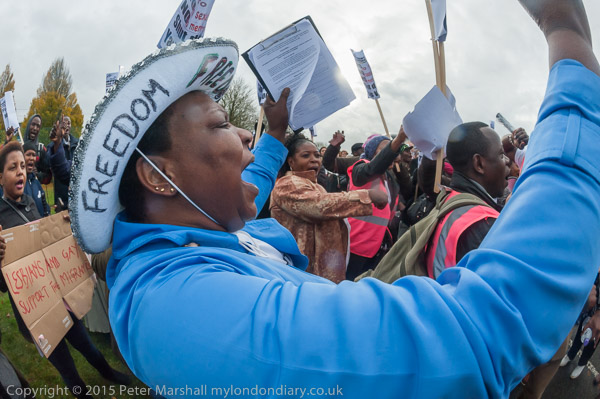
Just occasionally I take an image that – at least for me – works well without that conversion. If you are a photographer you probably noticed that the image above was taken with a fisheye; but to the ordinary viewer it just seems a ‘normal’ image.  And I want people to look at the pictures and not have problems with them seeming unnatural – I try hard to avoid a ‘lensy’ look, whether from ultrawide or extreme telephotos.

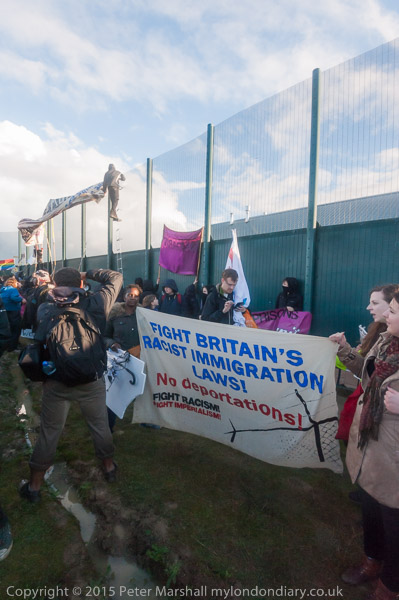
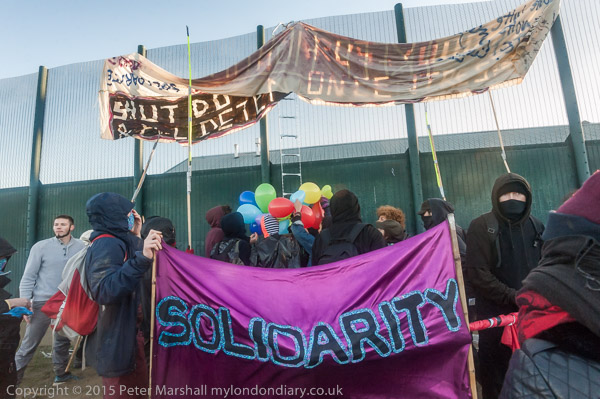
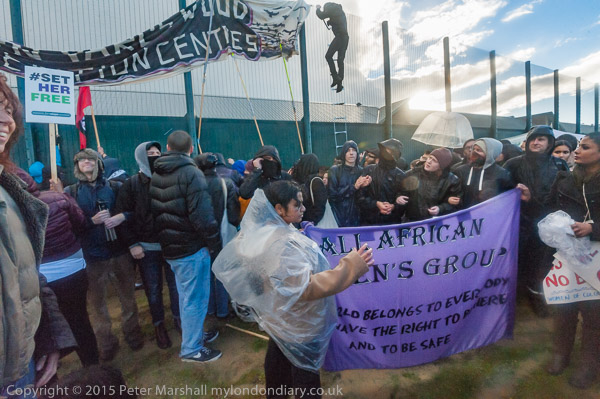
The picture was taken as protesters held a rally on the road close to Yarl’s Wood, one of the UK’s detention centres where we hold people seeking asylum indefinitely, sometimes for 18 months or more, treating them as criminals rather than as refugees. Yarl’s Wood is miles from nowhere, 5 or so miles north of Bedford on the edge of an isolated business park on a former WW2 airfield. The protesters come mainly in coaches and form up by the side of the road to march the three-quarets of a mile or so along a footpath to a field adjoining the prison.

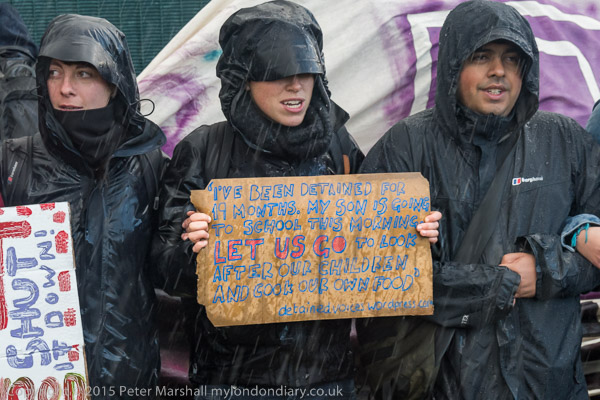
Once we were outside the prison, it rained, or rather poured, as you can see in some of the pictures. I got out my umbrella, which kept the worst of the rain off my cameras but they still got wet. I got wet too, and the ground got wetter still.

Down by the fence, against which much of the action was taking place, the mud got muddier, with water filling furrows running through it. It got hard to move around at any speed, walking on the filthy greasy surface, struggling to keep balance.  Fortunately the rain was a brief shower, or rather a series of brief showers, with the sun coming out between. But I was getting covered with mud just trying to move around, though fortunately kept my balance, though I saw a few others falling over and getting plastered with mud.

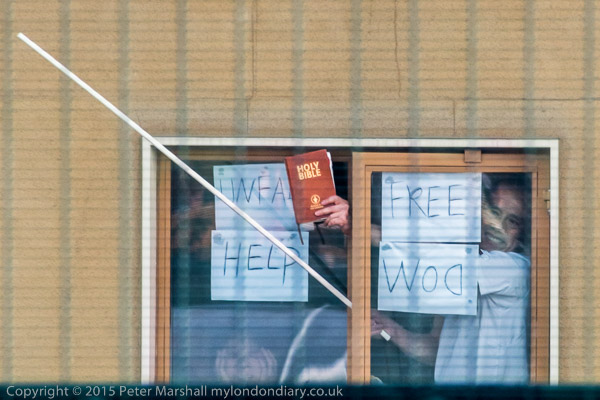
There is a slope in the field going down to the fence, and also a ditch which is just wide and deep enough to be difficult to cross, but not impossible. Hard to jump with camera gear and a muddy landing on the other side, though at one point the protesters  had put down a pallet to act as a bridge.  From higher up in the field we could see and wave to the prisoners inside, many of whom were holding up notices to the windows, clearly delighted to see there were people who knew what was happening to them and cared about it.

Even the sun caused problems for photographers, making it difficult to photograph the people putting banners up on the fence from some angles – except when the clouds came over again.

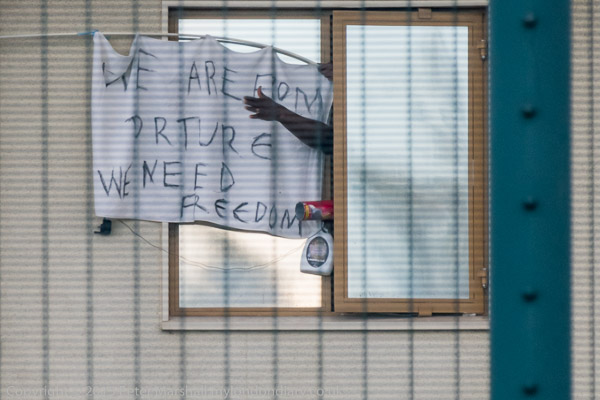
From higher up the hill, we could see some of the women holding things at and outside the windows, which will only open a couple of inches. One banner read banners ‘We came to seek refuge not to be locked up‘ and another ‘We are from torture we need freedom‘. Others wrote their phone numbers on sheets of paper so that the protesters could contact them and relay their messages over the public address system they had brought.

I didn’t have a very good day there. I was very unsteady on the mud, and had forgotten to bring my 70-300mm lens which would have been rather more useful for photographing people at the windows than the 28-200mm. Photographing through the wire fence is a pain too, with autofocus struggling to get the window frames rather than the wire fence sharp – and modern lenses are not good for using manual focus. And as I walked away I realised that I’d lost my umbrella.

I stayed for a couple of hours and was then pleased to walk away, and find somewhere to scrape the worst of the mud off my boots, which weighed several times as much as usual.  It was several days later that I finally got rid of all the mud. But the feeling of shame that my country could treat people seeking asylum like those locked up at Yarl’s Wood can’t be washed or scraped away.

More pictures at MFJ Meet Outside Yarl’s Wood and MfJ ‘Set Her Free’ protest at Yarl’s Wood.

I’ve been back with the protesters to Yarl’s Wood since Novemeber, and another protest is planned there and at other detention centres around the country on May 7th, 2016. More details of this and other protests from Movement for Justice.
Continue reading Yarl’s Wood in the mud

Language & Education

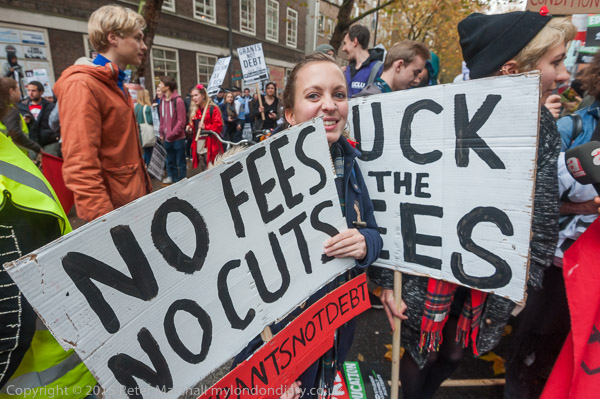
I have a slight problem with language. Or rather I don’t really have a problem with it, but some other people do, and they get offended by seeing some of the slogans on posters and placards. I don’t like to offend people gratuitously, and I was pleased to be able to find a viewpoint when making this photograph which obscured a vital letter ‘F’.

And though it doesn’t worry me, I normally use asterisks in captions and articles to avoid offending others with words such as f**k. Though myself I feel more offended by issues such as poverty and homelessness than in language that is a part of normal speech for many. At heart I think it’s a class issue, and I’m much more upset by class prejudice than by swearing.
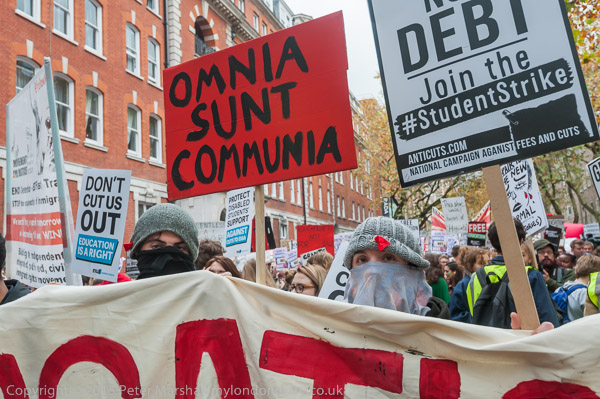
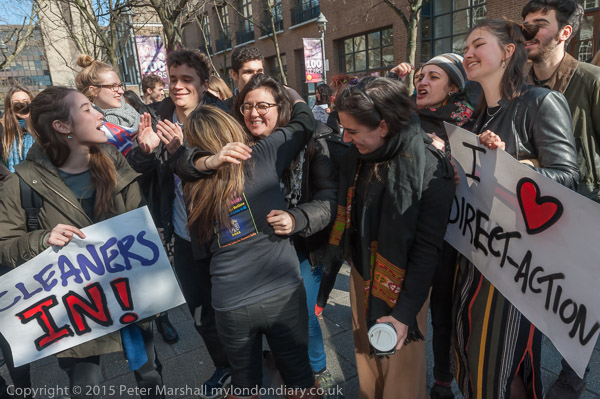
The protest for free education with its slogan ‘No Barriers, No Borders, No Business‘ was certainly a good one for placards, with a wide variety, including at least one in Latin. I was fortunate to have benefited from free education, which did for me include an O Level in that language, but probably even those without that advantage could understand the gist of this one, ‘Omnia Sunt Communia‘.  But I did have to turn to Google to find that it was a phrase pinned by his torturers on reformation theologian Thomas Muntzer who led the German peasants revolt of 1525.
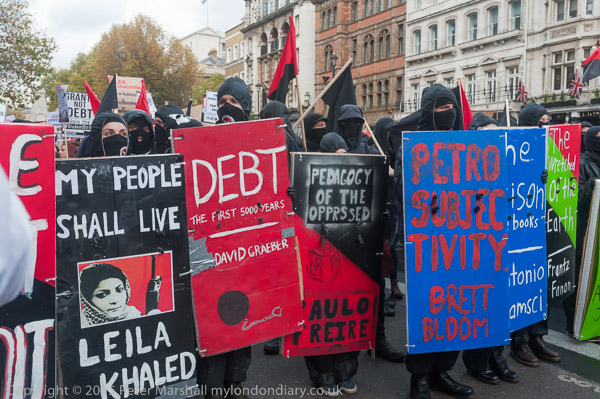
Fittingly for an education protest there was a ‘book bloc’, including here I couple I’ve read and including here two other authors I’ve photographed, though perhaps a shame that one of the volume titles includes a spelling error.

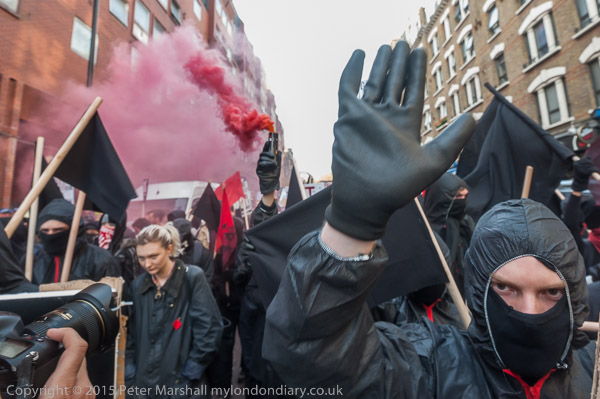
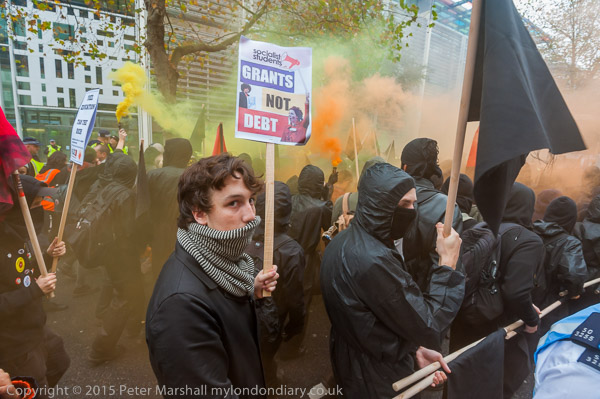
There were a few flares set off during the march, and something of a scramble by photographers to photograph them. I didn’t get any particularly good pictures, though one was enlivened by a masked protester holding up his hand to try and block my lens – which made me widen the view of my zoom to include him. But mostly people were friendly and happy to be photographed.

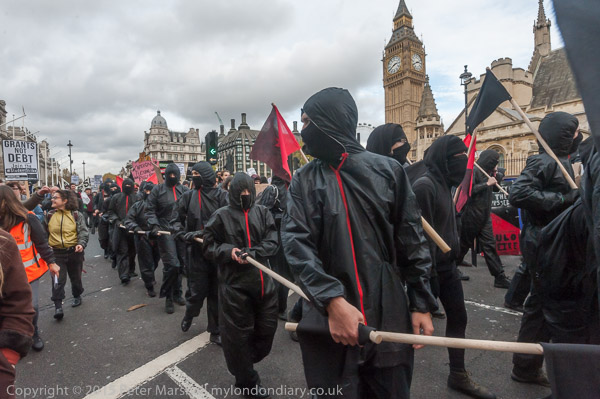
The ‘black bloc’ took on a more uniform appearance for the protest, most wearing identical jackets and trousers to make themselves rather less identifiable. But even so some were unhappy about photography. They were carrying black flags on sturdy poles and at times used them to restrict access to the bloc – as in the picture above.

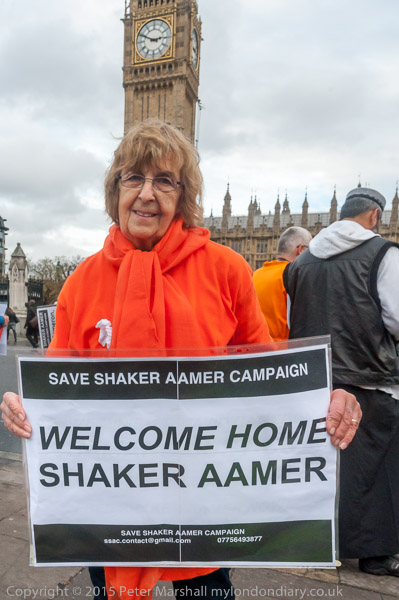
I left the march as it went down Millbank to speak to and photograph a protest that was also taking place along the edge of Parliament Square, where campaigners from the Save Shaker Aamer Campaign who have mounted a weekly vigil for his release opposite Parliament every Wednesday when Parliament was sitting were celebrating to welcome him home. There celebration was a little muted, as although he was the last British resident there, over a hundred men still remained captive.

I shared their rejoicing over his release, and also as I photographer flet glad I would not have to continue photographing – at least occasionally their weekly vigils. With similar protests on a regular basis it does become hard to say anything new, both in the text and the images. Protests against Guantanamo will of course continue, and I’ll still go to photograph them when I can, including the regular monthly event at the US Embassy.

I caught up with the students again outside the Home Office, but arrived a little too late to cover the protest there fully. From there they went to the Dept of Business, Innovation & Skills – which, as I commented ‘is now responsible for the universities which are no longer seen by government as a part of education.’

Here they made a fairly half-heated attempt to push through a police line, but were repulsed. Then a large group of police arrived and mounted a charge against the students, including many of those who had simply been standing and watching. I saw several photographers also being assaulted by police and got pretty roughly pushed to one side myself.

The police regrouped and stood watching the students. More police arrived and formed a tight line across the street, kettling the protest. I decided I’d had enough, but had some difficulty as officers refused to allow me through the line despite showing my press card. I walked along the line and eventually found an officer who let me through, and walked away. I’d gone about a hundred yards down a side street when I heard a lot of noise, and turned around to see a crowd of students running, having broken through the police line.  But I was tired, having been on my feet too long, and couldn’t face running after them – and continued on my way home.

Hidden Faces from Chile

One of the main reasons I began writing a series of articles about World Photography around 15 years ago was the strength and vitality of photography that I had seen coming from Central and Latin America, and I decided that as well as writing about various other countries around the world I would begin to tackle the countries of that continent in alphabetical order. It was a task I never completed, and I think the last country before I was sacked (at least in part because of a determinedly international approach which made it harder for my employers to sell space to US advertisers) was probably Mexico – which actually got several articles.

Other countries were much harder to find out much about, and one of the hardest was Chile, where I was able to find relatively little information then on the web, or in the libraries I had easy access to. It was the web that was vital, as I was writing for the web and needed to link readers to web sites they could visit to see photography.

Probably an important part of the reason for the lack of information was the human rights situation, particularly in the 1970s and 80s which my article mentioned. The show currently at the Maison de l’amérique latine in Paris until the end of April, Faces cachées: Photographie chilienne 1980-2015, is called ‘Hidden Faces’, and none of my research on the web led to any of the photographers represented in it. The article on the site is in French, but Google translate may help if you have problems with that. There is more information about the photographers and more images in the press release.

Lensculture has an illustrated feature on the show Hidden Faces: Chilean Photography, 1980-2015 with 9 pictures and text by Elizabeth Temkin, and also links to a documentary “La Ciudad de los Fotógrafos,” but once I found out how to turn on auto-generated subtitles made a little more sense, though at times they add an element of the surreal and some of the 1hr 20 minutes was lost on me.

March 2016

Rather to my surprise I actually finished uploading My London Diary for last month before the end of the month, thanks to taking the last two days of March off, and something of a less active period around Easter – less active that is apart from some fairly lengthy walks with my family.

I was so surprised that’s its been a few days before I finally got around to posting my normal monthly round-up here on >Re:PHOTO, but here at last it is.

There was one huge disappointment – although the cleaners at SOAS appeared to be about to win their case to be taken in-house, the management decided against it, though it is very unclear for what reason. One struggle they and I hoped had been won still continues – and staff, students and cleaners will be more determined than ever.

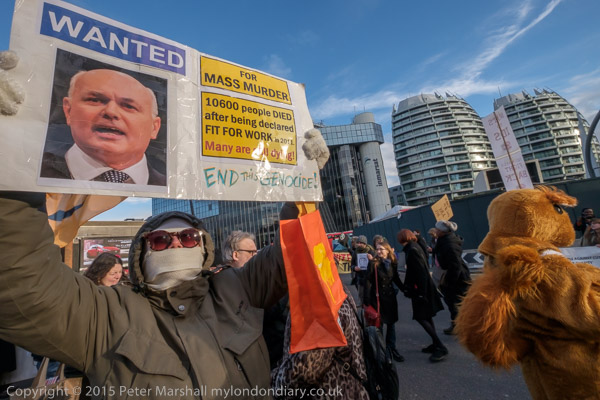
There was also one victory, or at least a partial one, with Iain Duncan Smith’s resignation. Although stated to be because of he was unwilling to accept further welfare cuts, this is hard to believe. IDS  was personally responsible for most or all of the cuts that have severely hit the disabled and for the vile sanctions regime that have left so many destitute and reliant on food banks, as well as to suicides like that of David Clapson – and many others. But his successor may even be worse.

My London Diary: Mar 2016

Act Up invade NHS to demand PrEP
Basingstoke Canal Walk
Staines & Ashford Walk
Syon, Isleworth & Mogden
Riverside Brentford Panoramas
Riverside Brentford
Belgian flags for Brussels


Hands Off Our Schools
DPAC’s ‘IDS Resignation Party’
Australians protest on UN Anti-Racism day


Marcia Rigg
Refugees Welcome Rally
Stand Up to Racism – Refugees Welcome march
Halt mass deportation flights to Nigeria
SOAS Cleaners Sense Victory
Houses of Parliament Budget Day
Kill the Housing & Planning Bill


Shut Down Yarl’s Wood
David Clapson – Sanctioned to Death


Unite against Benefit Sanctions
Ugandans protest rigged Presidential Election
UCH rally for Junior Doctors Strike
Set Her Free – International Women’s Day
IWGB Women’s Day protest over sacked cleaner


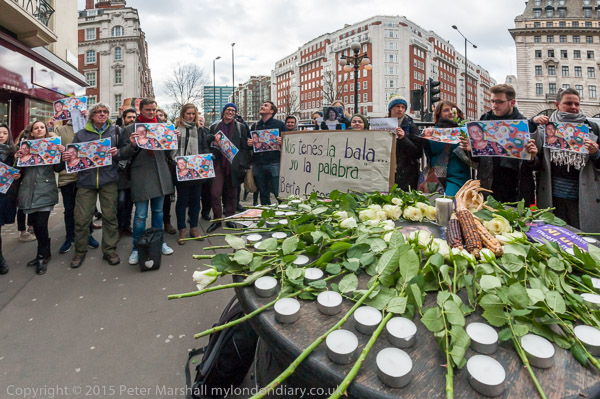
Vigil for murdered Berta Cáceres
Bunhill Fields Under Threat


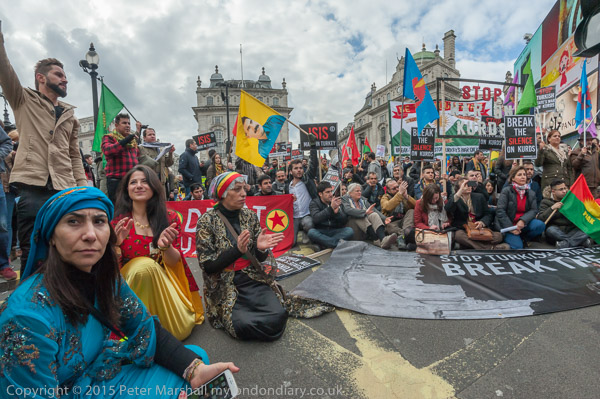
Break the Silence! Turkey’s War on Kurds
Class War’s Notting Hill Pub Stroll
London is on Fire – IT is back


No Job Coaches in GP Surgeries
Shut Guantanamo, End Indefinite Detention


London Images


March Stats
>Re:PHOTO 188,061 visits; 353,150 page impressions
My London Diary 56,603 visits; 296,647 page impressions

Neither site carries advertising or gets support from any outside body. My only income from this work comes from sales of images for reproduction in newspapers, magazines & books etc. which are small and ever-diminishing. Small donations – see below – from individuals to support my work are welcome.

Continue reading March 2016

Ripper Selfies

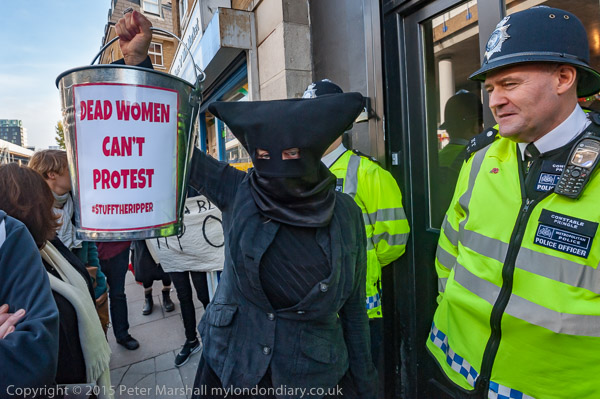
I find it hard to understand why anyone should want to visit the Ripper tourist attraction in East London, and it would seem that not many do. You have to have a particularly perverted lack of humanity to want to “have a selfie” with someone dressed in a Jack the Ripper costume “in his sitting room where he planned his horrific murders” or even worse “a picture with Jack in Mitre Square together with the body of Catherine Eddowes“. But such was the publicity for a Halloween event at this so-called museum.


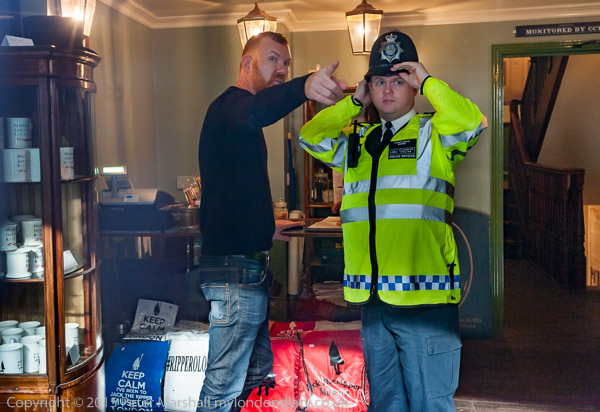
“Museum” proprietor Mark Palmer-Edgecumbe complains to the police about Class War

Of course we can’t know what his sitting room looked like, or even if he had one, as his identity has never been fully established, with a whole ‘Ripperology’ industry which sometimes seems more designed to obscure than solve the mystery. The most convincing case is made out for Montague John Druitt, an exceptional sportsman from Winchester College and the son of a doctor, thought to have been suffering from an inherited mental illness and he appears to be the man the police (and possibly Druitt’s family) were convinced was the murderer, though they had no proof. But they did stop special vigilance patrols and give up on their investigations after his body was found in the Thames.


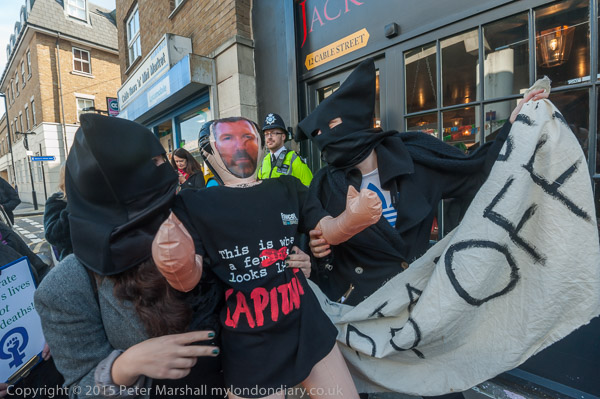
And that same face on the doll being savaged by the Sisters

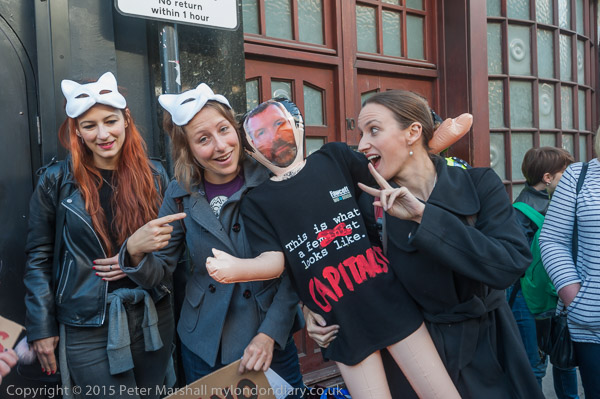
Unsurprisingly the “museum’s” publicity tweet inflamed those who have been protesting against this sordid venue, and they – including organisers 4th Wave London Feminist Activists, the Sisters of Perpetual Resistance, Class War and others – came to protest, bringing with them a life-size inflatable doll wearing a feminist t-shirt and a face-mask of the “museum” proprietor Mark Palmer-Edgecumbe.


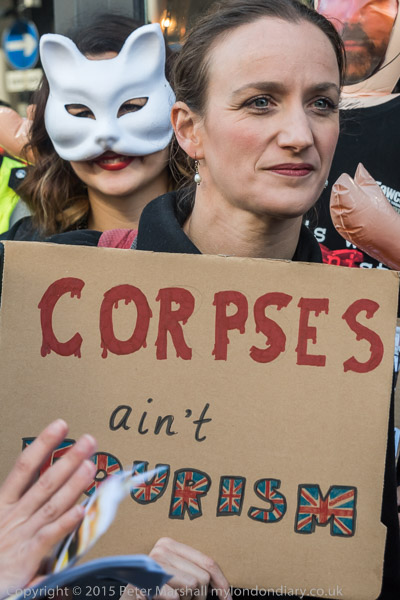
Kate Smurthwaite “Corpses ain’t Tourism

People, including comedian Kate Smurthwaite, posed for “selfies” with the doll, and it was stamped on by the Sisters of Perpetual Resistance and others. But I had to leave before the end of the protest.

It was a slightly difficult event to cover, as the protest mainly took place on the rather narrow pavement outside the “museum”, though later as it spilled out onto the road (and stopped the traffic) things became easier. Much of the time I was using the 16-35mm lens at its widest because it wasn’t possible to get any distance between myself and those I was photographing.
Continue reading Ripper Selfies

Flares

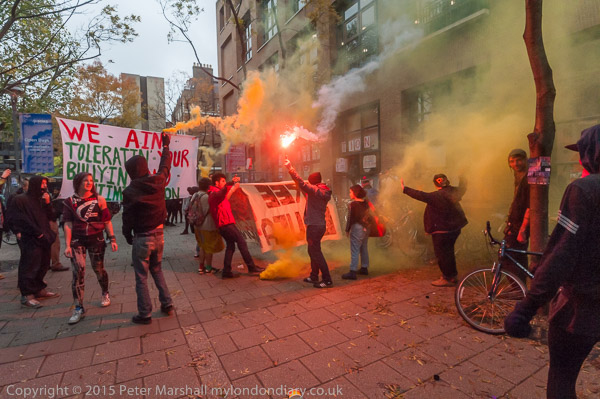
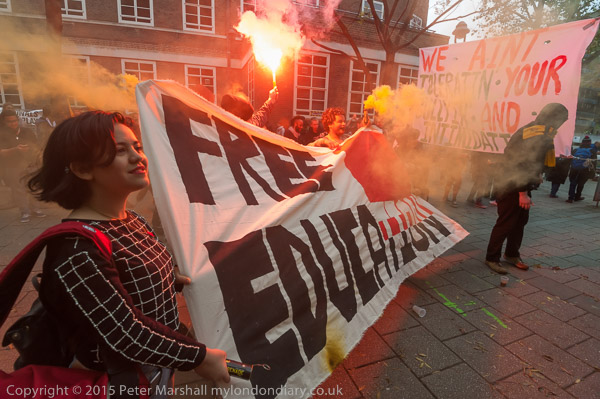
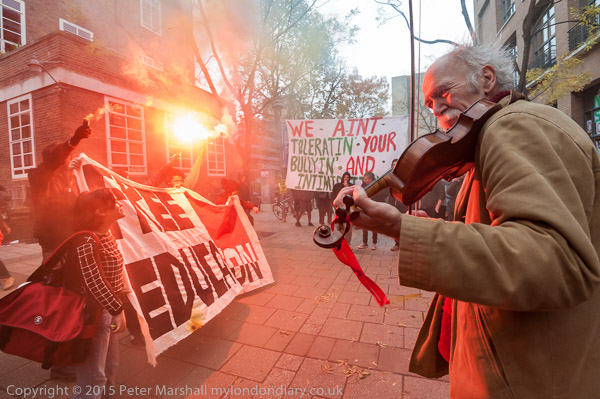
Flares are coming back into fashion. Not the flares I used to wear back in the late 60’s, natty though those were. I had to get rid of mine long ago, as although the legs were still wide enough, it has been some time since I had a 32″ waist.  But flares at protests.

As a photographer I have mixed feelings about them, or indeed flames of any sort. They certainly add a little colour and excitement, but they do create problems with exposure that are sometimes insoluble, and often very easy to get completely wrong. Good though Nikon’s matrix metering is, it usually fails in these situations.

The smoke too restricts visibility, and once you are inside the cloud it can get very difficult to see and photograph. I also worry about the effect of the smoke on my lungs, and it certainly can be very unpleasant.

Lightroom does often need to come to the rescue, and the De-Haze slider introduced not long back can often help. Even better is the more recently addition of De-Haze to the local adjustments brush.

Protests outside SOAS are often visually interesting, and the flares certainly added something. I was also pleased to be able to support Unison Branch Secretary Sandy Nicholl who I’ve photographed at many different protests over the years, and who had been suspended by management for his trade union activities, in particular related to the then current student occupation of part of the university gallery building. You can see and read more at SOAS Shut Down after Sandy suspended. A few days later he was re-instated. Probably the protest helped management see sense.

Dancing has also often been a part of protests here, and on this occasion it was the ‘Strikey-Strikey‘, a version of the hokey-cokey with a mad rush into the centre of the circle at the end of each verse. As someone who photographically likes to be in the middle of things, I was rather in danger of being overrun, particularly as most of the time I was viewing the scene through a 16mm lens (and sometimes, even worse, the 16mm fisheye), which makes anything more than a few feet away seem quite distant.

I almost missed the flares – and I think the few other photographers who had been at the protest mainly did, leaving before the end when they were set off. It’s always hard to know when it is safe to leave an event, and its often a case of what is next in your diary for the day. Fortunately I had a little time spare before an early evening meeting and was in no hurry to leave.

We are also in an age where getting images on-line fast is more important in terms of earning than getting good images. Agencies want them if possible before things happen, and at many events photographers are sitting down and tapping away on their notebooks less than ten minutes after they have started. Apart from missing the development of stories, they are also having to work with jpegs, sending them off with little or no adjustment. While that’s fine for some images – particularly those in relatively flat lighting – it would have been pretty hopeless with the images I took of those flares.
Continue reading Flares

I don’t appear in Court

October 21st started off uncomfortably for me, though nothing like as stressful as it must have been for Lisa McKenzie, in whose trial at Stratford Magistrates Court I was due to appear as a witness for the defence.

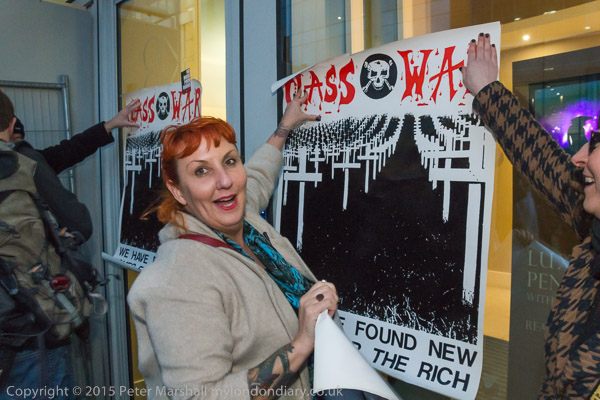
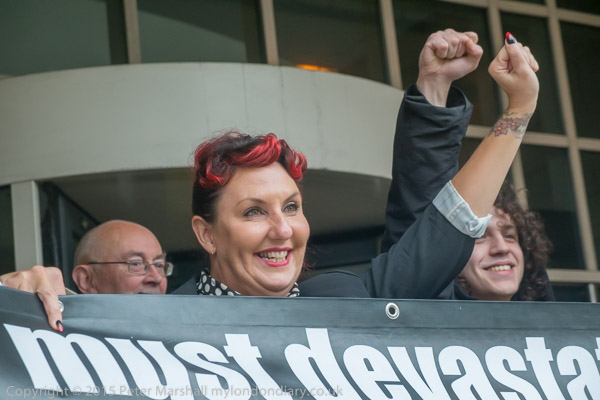
I’d been photographing the Class War ‘Poor Doors’ protest on April 2nd at One Commercial St when she was arrested and charged with criminal damage for having put a sticker on the window during a protest two weeks earlier, and I’d also covered that previous event, paying particular attention to her, not just because she is one of the livelier of the Class War circle, but because she was of particular news interest for standing as the Class War candidate against DWP minister Iain Duncan Smith in May’s general election.

So I had taken a great many photographs of her on the evening in question, and would certainly have photographed her putting up a sticker had she done so – rather than just holding up posters.  I hadn’t kept every picture I’d taken that night, but there were enough to show that she never had the two hands free that putting up a sticker needs to peel off the backing paper.

Initially there was also a second charge, a public order offence of causing alarm by holding up the poster showing cemetery crosses with the message ‘We have found new homes for the rich’ but it was hard to take that seriously, not least because the police had not taken action against so many doing exactly the same thing.

But a few days before the trial, the police and CPS seriously upped the ante, charging her also with ‘Joint Enterprise with Persons Unknown‘ of causing criminal damage. Joint Enterprise is an ancient principle of law which was revived to deal with duels 300 years ago and used in recent years to convict gang members of murder in trials where there is no evidence against them personally, leading to considerable injustice.

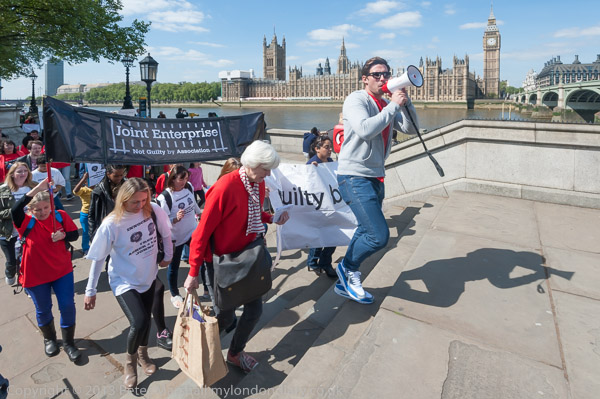
A little over a month ago the UK Supreme court ruled it to have been wrongly applied in many of these cases, thanks in part to a long campaign by JENGbA, short for Joint Enterprise – NOT Guilty By Association, who I’d photographed on a couple of protests. Never before had been used against anyone taking part in a political protest – and if successful would severely threaten the right to protest, with Lisa possibly having her freedom of speech and movement limited by a  Criminal Behaviour Order for up to 5 years.

I wasn’t looking forward to having to appear in court – I’ve never been a witness before, and hadn’t slept well, and having to get up early to travel across London didn’t help. At the court I had to hand in my cameras at the reception desk, and then just to sit around while the trial proceeded for several hours.

That the police really had no case became obvious when I was told that they had added another charge against her, relating to a protest on March 12th. I had my phone with me, and was able to look up my pictures on My London Diary, which confirmed that Lisa was not even present on that day. But the police withdrew that charge before the case started.

The first session of the court looked at some video produced by police at the last minute (and not shown to the defence) and threw out the Joint Enterprise and the public order offence, allowing only the charge of criminal damage to proceed – with the police alleging the cost of removing a small sticker to be £50.

The court heard the prosecution evidence from police and the concierge at One Commercial St, after which the defence barrister was told that nothing he could say or evidence he could present would change the verdict. I didn’t have to take to the witness box and Lisa was pronounced ‘not guilty’

I felt both elated and a little disappointed, having being keying myself up for so long to give evidence, but as soon as I heard the verdict rushed to the reception desk to reclaim my cameras and photograph Lisa and ‘persons unknown’ as the left the court.

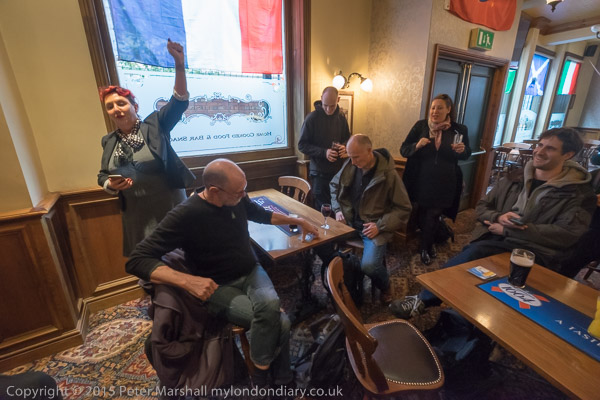
But I soon felt better, as we celebrated her victory in the pub. It was the second case in which police have brought charges against people taking a prominent role in the Poor Doors protests which the courts have thrown out, and since then a third case has had a similar outcome. It is had to entertain any conclusion other than that these arrests and charges have been politically motivated.


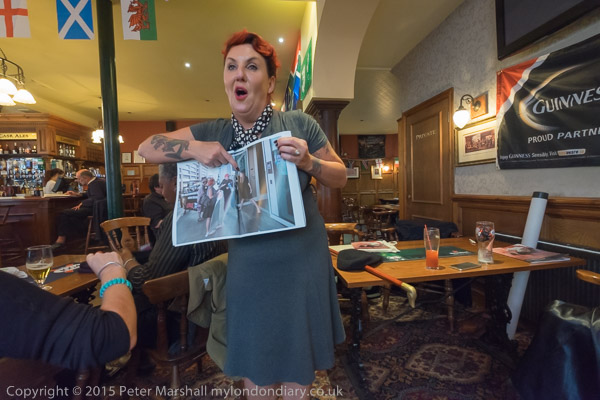
Lisa shows a spread of my ‘Poor Doors’ magazine’ in the pub after her acquittal

More at Lisa McKenzie Not Guilty!
Continue reading I don’t appear in Court

Free Speech in the Barbican

I’ve always found London’s Barbican Centre a rather confusing place, in fact the whole Barbican estate, a brutalist conception where painted yellow lines on the pathways were found necessary to guide people from the various Underground stations to performances at the centre.


Nikon D700 16-35 mm: 1/25s, f/4, ISO 3,200, -0.3Ev

It’s the different levels that really make it difficult, with the main walkways being well above ground, linking with a grand post-war scheme that saw a future City of London where pedestrians and road traffic would move at different levels. Away from the Barbican itself, only traces of this concept remain, with parts across and along London Wall having been demolished relatively recently, but most was simply never built, impossible without major demolition (which the Luftwaffe had previously carried out on the Barbican) and incredible expense.

But inside the Barbican too is confusing, with different levels and no really clear definition of spaces. Regular visitors and those who work there doubtless soon become used to it, but as an infrequent user I still have problems.


D700, 16mm fisheye: 1/40s, f/3.2, ISO 3,200, -0.3Ev

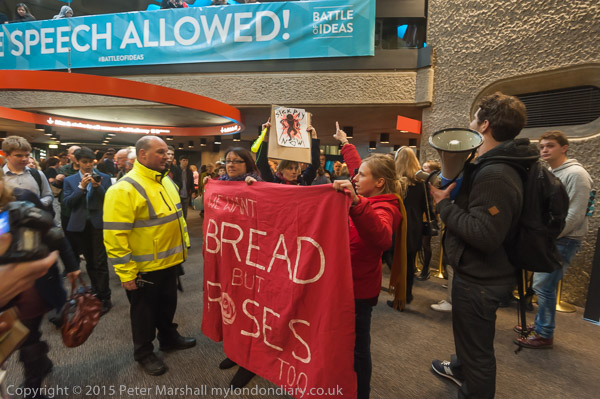
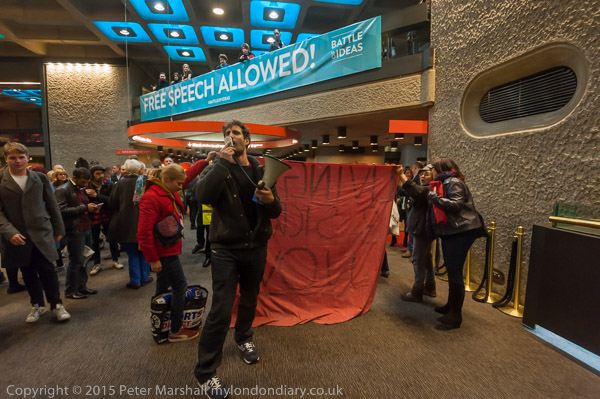
But on this occasion I didn’t have to worry. The protest by the United Voices of the World, the union representing the cleaners at the centre began at the entrance to the centre on a proper London street shown on the A-Z, and when a small group of cleaners led by UVW General Secretary Petros Elia ran inside, evading the security staff, all I had to do was follow them into those confusing depths.


D810, 28-200mm in DX mode, 28mm (42mm), 1/60s, f/3.5, ISO 3,200, -0.3Ev

Outside it was dark, with relatively little light from street lamps and in some areas where the protesters were standing rather more coming through the glass doors and windows of the Barbican entrance. With the Nikon D810 I was working with the 28-200 mm f/3.5-5.6 in DX mode (42-300mm equiv) at full aperture and ISO 3200, in shutter priority mode at around 1/60th second, augmenting the available light with a little flash from a SB800. The flash wasn’t doing a great deal (though you can see its effect in some images) as I was using the 16mm fisheye on the D700 at similar apertures and ISO, without flash at shutter speeds from 1/15-1/50th.

When we rushed inside, the light levels were not all that different,but I had changed from the 16mm fisheye to the 16-35mm f4. I generally prefer not to use flash when photographing such incursions, as it makes it much more likely that security will take notice and ask you to stop taking photographs or to leave. I did take a few images with the D810 and flash, but generally needed a wider angle of view, and almost all of the better images were made with the 16-35mm.


D700 16-35 mm: 16mm, 1/30s, f/4, ISO 3,200, -0.3Ev

The spot which the UVW chose for its protest inside was in a foyer area of the centre, and overlooking it was a balcony from a higher level, draped over which was a banner for an event taking place on that weekend, ‘Battle of Ideas’ with its message in large capitals ‘FREE SPEECH ALLOWED’. This protest wasn’t what they had in mind, but the banner certainly fitted. Although the security weren’t too happy about the protesters being there and speaking out.


D700 16-35 mm: 16mm, 1/60s, f/4, ISO 3,200, -0.3Ev

It was at first difficult as the protesters were largely facing the banner, but eventually I was able to get the picture I wanted.


D700 16-35 mm: 16mm, 1/50s, f/4, ISO 3,200, -0.3Ev

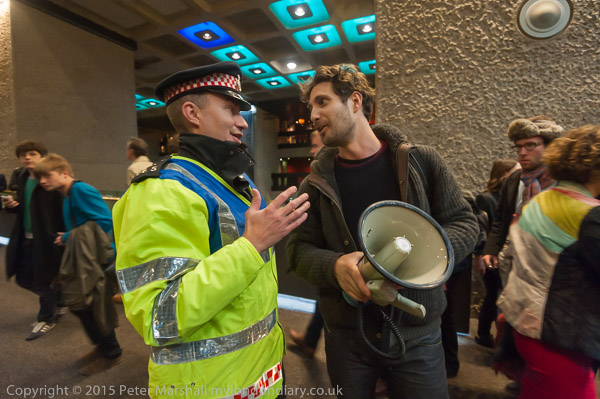
The Barbican’s reaction was one of moderation, and when the protesters carried on after being asked to stop and leave, they called in the police, and a very polite conversation ensued, with the protesters agreeing to leave peacefully and continue their protest outside.

More pictures and text about the cleaners demands for a proper living wage and decent conditions of service at Cleaners protest in Barbican.

Continue reading Free Speech in the Barbican

How to Fake a Giant Rat

Good to see a short photography lesson from The Guardian, How to fake a giant rat.  It’s perhaps a pity that they spoil it a little by continuing the title “(and why you shouldn’t trust pictures on the internet)”, as it isn’t really a story about the Internet, but something that illustrates a very basic fact of photography, and one which of course used to feature in photography courses long ago.

he article quotes news agency SWNS as correctly saying “clearly perspective plays a part in it”, and it goes on to comment that the image  was used by everyone “from Sky News to the Daily Mirror to the Evening Standard” without comment or bothering to check whether the rat was really four foot long.  These guys may be publishing on the Internet, but they are major media outlets and employ journalists. They even still employ a few photographers who could have advised them.  Had they asked, but it was a better story without the facts.

It isn’t really a story about the Internet. Or really about photography. But about journalistic standards and competency.