The Capa Controversy

Regular readers will have seen (and perhaps got rather tired of seeing) my frequent posts about the persistent detective work by A D Coleman and his co-workers, Pulitzer Prize-winning photojournalist J Ross Baughman, photo historian Rob McElroy and military historian Charles Herrick. Together they have succeeded in putting together a minutely detailed and evidenced examination of Robert Capa‘s exploits on D-Day and the subsequent processing and publication of the ten or eleven frames he took before leaving Omaha beach along with the stories fabricated around this begun by Life‘s then assistant picture editor John Morris within hours or days of the events and shortly after by Capa himself but with later embroidery by others.

It was of course obvious to any photographer who looked at the published images and thought about the story that was being told that it was absolute bunkum – film just doesn’t melt like that – but that didn’t stop it being repeated in book after book after film and web site, even those of some of the most prestigious organisations in photography (or perhaps especially them.)

I return to it because of a post by Coleman in iMediaEthics, Conflict of Interest, Cubed: Robert Capa’s D-Day Photos, John Morris, and the NPPA in which he looks at the article in the US NPPA’S (National Press Photographers Association) publication, News Photographer, The Fog of War – D Day and Robert Capa by Bruce Young. You might like to read both before continuing with my comments, though if you have been following the story I think you may well agree with me.

Young got considerable cooperation from Coleman and Baughmann who hoped he was going to acknowledge their work and put the record straight, but he does the opposite, muddying the water, adding some half-baked and unsubstantiated suggestions and parading a great deal of ignorance while somehow pretending to make some kind of objective overview that would put the matter to rest. NPPA members surely deserve better – we all do.

When Young gets down to business, he quotes at length from Capa’s own published account, written in Capa’s best story-telling mode, a fictionalised Hollywood version of his life story, followed by John Morris’s totally unbelievable account of the darkroom mishap. Young’s next paragraph is interesting, beginning by stating that this was the established story and legend for 70 years (which isn’t quite true – many of us challenged parts of the story long ago) and goes on to say “but if the devil is in the details, this story carries enough demons to populate all nine rings of Dante’s Hell“, going on to list a series of questions.

If he had bothered to read all of the published research by Coleman and others and had understood it, he would have found we now have answers to all or virtually all those questions, supported by evidence from various sources, but instead he goes on to suggest that Coleman, one of the best known and highly regarded critical writers about our medium over very many years, is not really qualified to comment because he has never been a professional photographer. While I sometimes think it helps, being a pro is neither necessary nor sufficient, why mention it when the research was the result of a team including one player with a Pulitzer for photjournalism?

There are many other curiosities in Young’s piece. Speaking about Morris’s reactions to Coleman’s research he suggests “But what if John Morris, now 98, sticks to the story because … well, it’s true? There are problems with some exacting details, but…” But it isn’t exacting details there are problems with but a fairly tremendous weight of evidence, and Morris himself has since accepted at least some of the facts, whilst spinning new fictions.

Young then goes into rather a lengthy digression on memory, which is to some degree irrelevant, as the fictions were written down close to the event, but rather fails to see that what he says about memory makes a nonsense of relying on Morris’s memory – having based his life and career around the story for the past 70 years he doubtless came to believe in his story. That’s how memory works!

I started writing not meaning to criticise Young, meaning to leave it to readers to make their own judgements. But it is really so bad I couldn’t resist, but I’ll spare you the rest of my thoughts. Of course Coleman has a lot more to say about it and about many details, and its hard not to feel his criticisms are at least largely justified.

But does it all matter about Capa? Well, obviously it does, from the angry responses that publishing the series of articles has generated from much of the photographic establishment. I think it matters because of the wider issues. Personally I’ve never been a great advocate of academic research that is too concerned with the details and minutiae, I’ve always been more concerned with the fate of the forests rather than the leaves on the tree. Integrity is the bedrock of photojournalism and documentary practice, and I think this research calls into question not so much the integrity of Capa – who didn’t make up the story about this or about the Falling soldier (about which Young also seems uninformed about the most recent research) but of the whole system that promulgates news to the public – immediately through Life Magazine in this case, but in the 70 years since then various other organisations including Magnum and the ICP.

Of course I didn’t know Capa, who was killed when I was still in short trousers, but I get a strong impression of him from his writing and photography and the stories about him I’ve heard over the years. I can imagine him opening the magazine and seeing the caption under the ‘Falling Soldier’ or the D-Day pictures, shrugging his shoulders and saying ‘Oh well, it’s a better story’ and thinking it was in any case too late to stick to the truth.

And of course the picture is still the same, still a powerful, truly iconic image of war. For me it isn’t diminished by knowing the truth, and it in no way diminishes my respect for Capa as a photographer to realise that he was only human, cold, wet, scared and shaking as he lay on the beach, only able to make ten or eleven exposures in the 20 minutes or so he was there. One was really enough.

You can read Coleman’s post about this at iMediaEthics and the NPPA, though I wrote this post before doing so. It contains a link to Young’s change of mind over the ‘Falling Soldier’ that I was unaware of, and also to another of Coleman’s own articles, Ethics in Photojournalism Then and Now: The Case of Robert Capa which I’m now reading with considerable interest.

Heathrow at 70

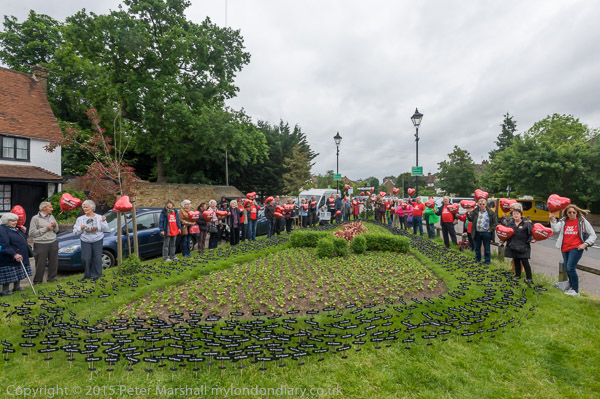
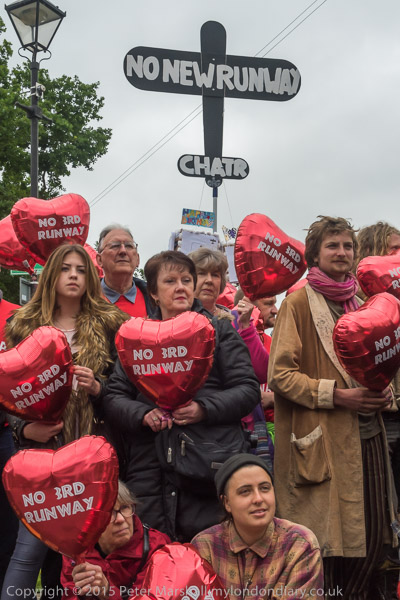
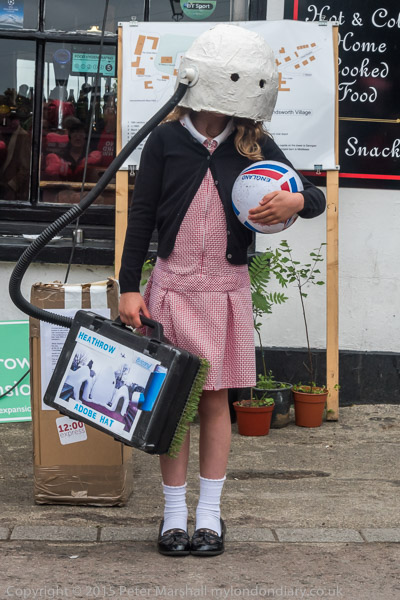
It often isn’t easy to photograph some of the ideas that people have – and this occasion was one, with the Harmondsworth village green planted with over 750 small black airplanes and people holding 70 heart-shaped balloons with the message ‘No 3rd Runway’. There aren’t quite that many balloons in the picture, partly because a few had escaped into the sky, but also because quite a few of the protesters were standing behind me or to one side, some taking pictures themselves and others feeling shy. And a few people (and balloons) had escaped into the Five Bells behind me, where there were a number of balloons on the rafters.

But the real problem was one of scale – which is of course the main problem with Heathrow too. It started as a relatively small (and allegedly military) airport, though the military aspect was always a deception by the aviation lobby to enable a civil airport to be built here – which would probably never have got off the ground otherwise. By the 1980s it was clear that it should be replaced, but the government of the day chickened out – and so we never got the airport London needed, but had to suffer a huge and unsuitably placed expansion at Heathrow, with terminal 4 (promised as the last expansion the airport would ever ask for) and terminal 5 (ditto.)

As a local resident, I celebrated when plans for a ‘third runway’ (Heathrow began with six, but larger, heavier and noisier planes have made all but two unusable) were dropped, with a firm promise from then PM David Cameron and his party that this expansion would not take place, but the aviation lobby would not take his ‘No’ as an answer.

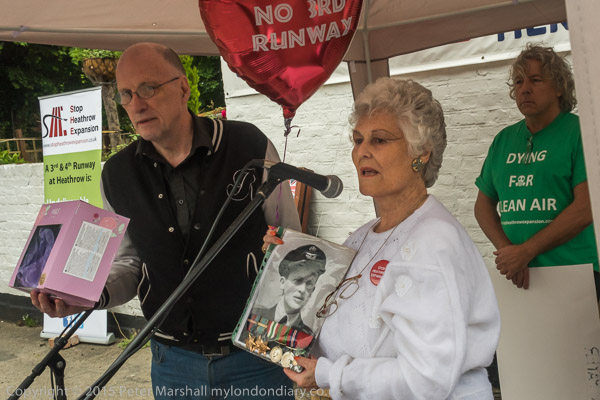
But there were other opportunities for pictures: Armelle Thomas, a Harmondsworth resident holding a photograph and the medals of her late husband Tommy who had flown as a rear gunner in Lysanders and later worked at Heathrow for BEA had brought the piece of the cake from last year’s protests which she had tried to present to Heathrow bosses but they had refused to see her;

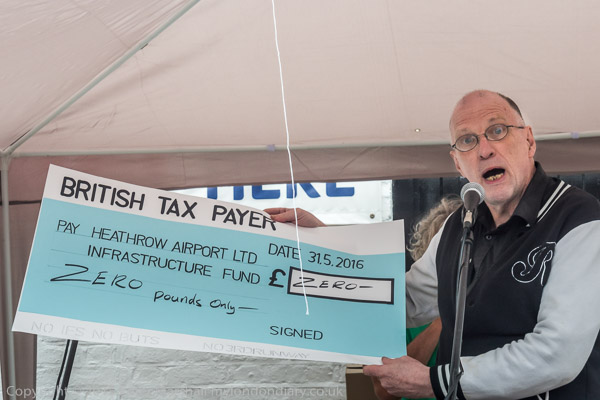
John Stewart holding a giant cheque for ZERO pounds – the amount Heathrow want to pay towards the huge infrastructure costs that will be needed if the third runway ever goes ahead – and will be borne completely by the taxpayer;

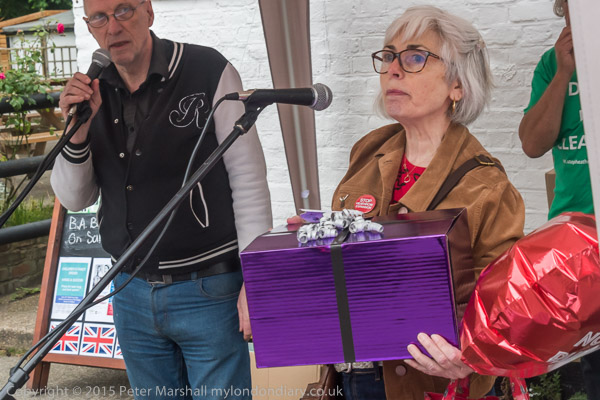
several campaigners with boxes of empty promises – made by Heathrow over the years;

and what is still the only attempt at a practical solution to the huge problems of noise and pollution the extra traffic – in the air and on the ground – the extra runway would produce, the Heathrow Adobe Hat, complete with portable air purifier in a environmentally bio-diverse suitcase.

Apologies for all the typos that are in the captions to the photographs of the event at No 3rd Runway Heathrow 70th Birthday, which I will try and find time later to correct.

Continue reading Heathrow at 70

Housing & Mental Health

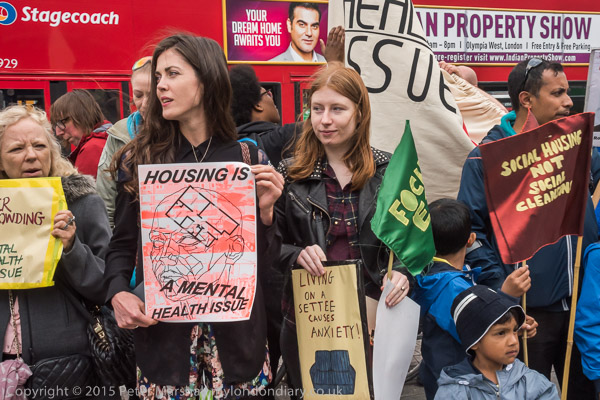
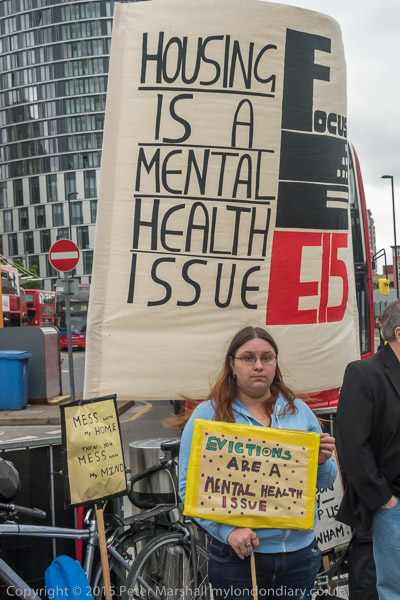
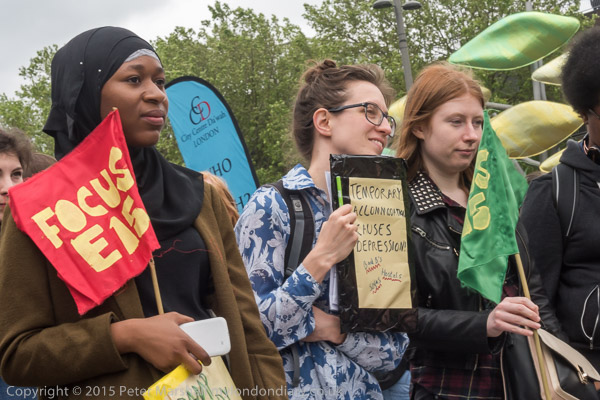
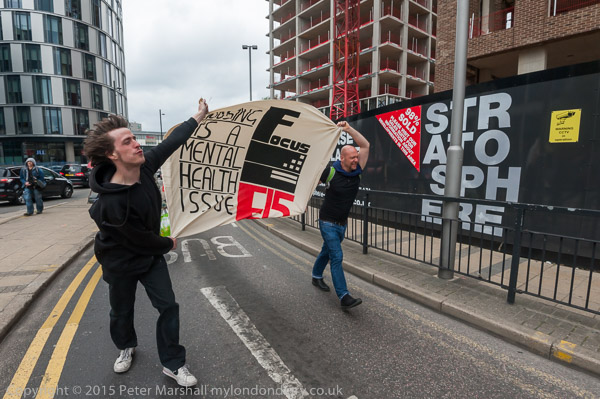
Sometimes luck smiles on you a little, though often only if you are awake and keeping your wits about you.  I’d seen the adverts on the side of a bus for the London Property Show and was ready when it drove slowly behind the protesters, but it was a fleeting opportunity and there were no second chances. But while for the rich ‘Your Dream Home Awaits You’, for most Londoners, housing is a nightmare, and for too many becomes, as the poster below says, ‘A Mental Health Issue.’

London property prices are now simply beyond the reach of most Londoners, partly because property here has become an investment opportunity for the wealthy around the world, particularly in the Far East.  Developers advertise properties in Singapore and elsewhere, suggesting that prices will increase at rates much higher than bank interest rates or most investment bonds, and their predictions have proved correct over the years.

Market rents for even relatively small flats in less popular areas of the city are now too expensive for most,  and while they used to be advertised with their monthly rates (pcm), increasingly in the agent’s windows the figures are weekly, with little below £400 a week. A worker doing 40 hours a week on the legal minimum wage that the government now refers to as the living wage of £7.20 per hour (starvation wage would be a more accurate term) would make £288 per week before deductions, and even those fortunate enough to get the real London Living Wage of £9.75 per hour would find it entirely swallowed up.

There is still some lower cost social housing, though the current government policies seem aimed at getting rid of it, either by bringing up rent levels to the market rent, or at least to 80% of that,  which is ridiculously called an “affordable” rent – still usually well above the weekly earnings on that so-called ‘living wage’. There is of course housing benefit – though generally that is capped well below market rents in London, and its main effect has been to push up rents and put money into the pockets of the landlords.

London urgently needs more social housing – and that should really be council housing, which Margaret Thatcher put a stop to councils providing – while forcing them to sell off existing stock at knock-down prices to the sitting tenants. Just one of many policies that have earned her the eternal hate of a large section of the community. Relatively few came out to dance when she died, but many, many more celebrated in the privacy of their homes, pubs and clubs. And as they say to those who want to set up some monument to her, she already has one in the thousands of food banks around the country.

The protest by Focus E15 housing campaigners and mental health activists was in Stratford, the centre of the London Borough of Newham, which has one of the largest housing problems in the country, one of the longest waiting lists for council housing, the great majority of whom will never get it, and is currently in the middle of a huge building site, with tall blocks of apartments going up. But few if any of these huge schemes will offer accommodation at prices locals can afford – over a third earn below the London Living Wage.

Newham puts many into temporary accommodation, often of a very poor standard, dangerous and infested with vermin, provided by companies that fail to repair or maintain them properly and a long way from friends and jobs. They try to force those with urgent housing needs that they have a statutory obligation to rehouse to move to towns and cities in distant parts of the country, breaking the links they have to family, services and schooling. And scandalously they have been trying to empty and sell off one of their best loved council estates close to the centre of Stratford, the Carpenters Estate, where people have been moved out of hundreds of good quality homes, some now vacant for well over ten years.


A 1 bed flat to be completed here in Spring 2017 was recently on offer at a bargain £420,000 – the market price was £470,000

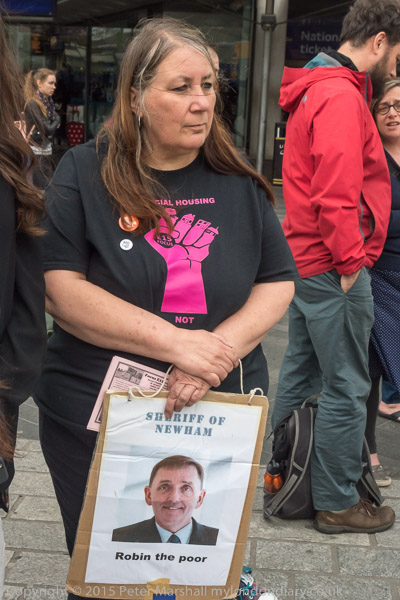
Newham is a one-party state, with 60 Labour councilors and an elected Labour Mayor, Sir Robin Wales (who campaigners refer to as ‘Robin the Poor‘, though financially he has done pretty well out of the job he has held since 2002. Recently Private Eye revealed the ballot rigging in Newham that made him the only Labour candidate for the 2018 elections. Party members voted 424 members to 351 in favour of other members being allowed to stand, but then affiliated groups were allowed to vote and their votes overturned the local party decision.

Its long past time that Labour Party members in Newham began to take a good look at how their borough is being run, and to get back to asserting the values that the party traditionally stood for. But the chances of any real change in policy seem low at the moment. It’s boroughs like this that are far more in need of investigation than the neighbouring Tower Hamlets, where the Mayor Lutfur Rahman was deposed. Had he, like Robin Wales have been Scottish rather than Bangladeshi he would still be Mayour – and still doing a rather better job for his residents.

Continue reading Housing & Mental Health

Capita accused of racism

I’d got a message from the Cleaners and Allied Independent Workers Union that they were going to stage a protest in the city against an employer who they said has sacked two African workers because they were African, and was given a time and place where they were meeting.

They hadn’t advertised the protest in advance, hoping to keep it secret, and I knew that they hoped to be able to rush into the entrance hall of some offices and protest inside, leaving after a short time to continue the protest outside.

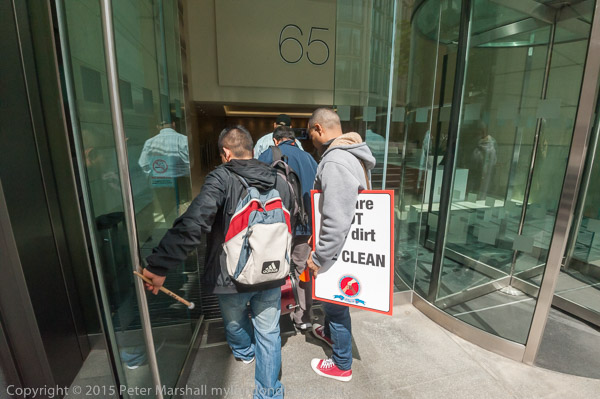
The group of around a dozen cleaners gathered close to an underground station and when everyone had arrived walked together, stopping just a few yards before the offices to get out posters and other materials for the protest. I still didn’t know exactly where the offices were we were headed to, and was slightly taken by suprise when some of them rushed down a few steps and into a door, but managed to take a picture before following them inside.

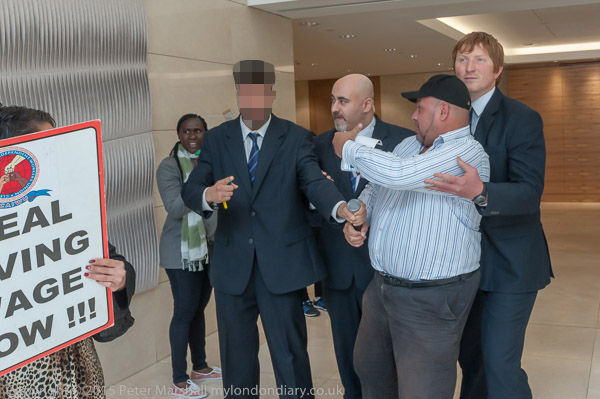
The sacked cleaners had cleaned offices for Capita, who had offices on one or two floors of the building, but were employed by the contractor Mitie; there were three African workers at the site and Mitie had sacked two of them, and reduced the hours of the third. They were among the group of workers in the CAIWU who had put in a demand to be paid the London Living Wage.

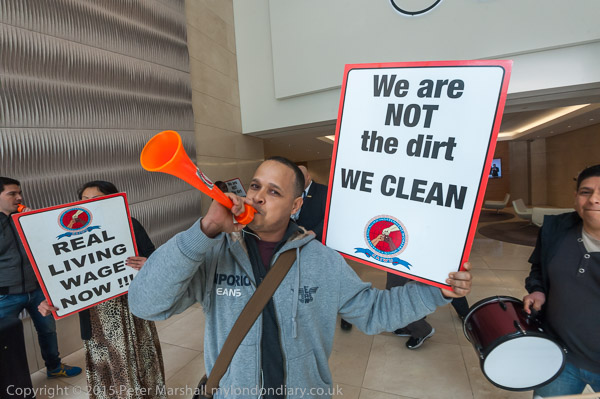
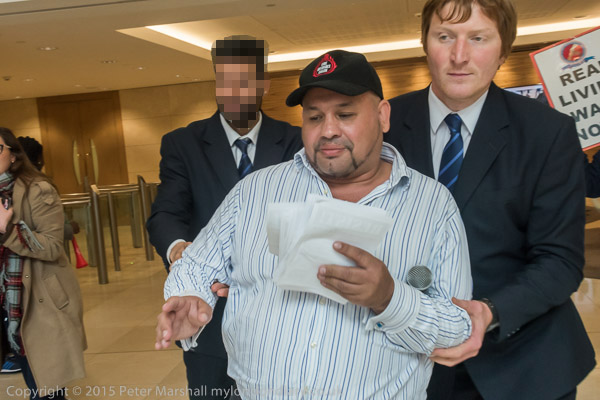
Some of the cleaners, including those who worked in the building, stayed to protest on the pavement outside, but the group who went inside protested noisily, while people who worked inside came in and out for lunch. Betwwen bouts of noise, union organiser Alberto used a microphone and a sound system in a trolley to explain the reason for the protest, demanding the re-instatement of the sacked workers and the London Living Wage.

Several security men approached him, and one made an attempt to snatch the microphone away, but he shrugges them off and continued to speak. Eventually after a few minutes of protest, two of them managed to push him out through the door and the other protesters followed.

At a later date one of the security men came and asked me not to publish his photograph, as he was worried about the safety of his family in another country, and I have pixelated his face in these images. It isn’t something I normally do, but there were special circumstances in his case.

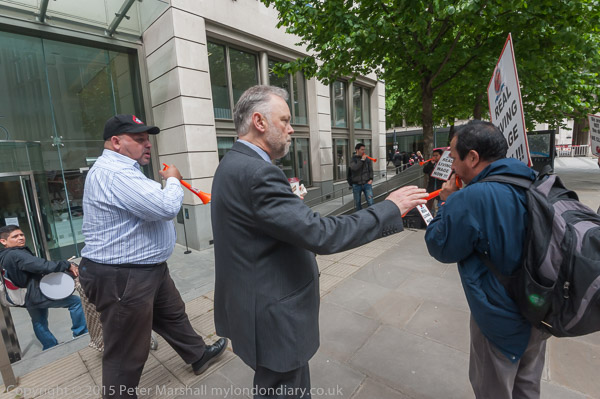
The protesters then made their way around to the rear entrance to the block which was now being used by more of the workers to go to lunch and continued to protest noisily and hand out fliers explaining the protest. After a few minutes they were joined by a police officer, who talked briefly with them and then stayed to wtach and ensure the protesters kept on the pavement but did not block it.

The officer came in useful a few minutes later, by which time the protesters had moved back to the front of the building. A man in a suit walking by suddenly got angry and tried to grab Alberto’s microphone, told me I should not be taking pictures and then grabbed one of the protesters by the shoulder.

If there is one way to make sure I take your picture, it is to tell me I can’t when I know have a perfect right and an interest in doing so, and of course I took his picture, and the police officer came over, asked the protesters what had happened and then took the man to one side and told him to leave the area – and warned him about his actions.

At the end of the lunchhour the protesters packed up and I went home. More pictures at Cleaners protest at Capita.

Continue reading Capita accused of racism

Photojournalism 2017

Here’s a piece you shouldn’t miss if you have an interest in photojournalism and its future – if it has one, though this is really more about its past. In its way it doesn’t say a lot, but I think even that says something. Donald R Winslow has been in the business for 40 years, at all levels. James Estrin, a staff photographer and regular writer for the New York Times, has also been around a while – he started with the NYT in 1987 and founded their Lens blog.

Also recently by Estrin are his comments on the 2017 World Press Photo. In The Guardian you can read the thoughts of the jury chairman, Magnum photographer Stuart Franklin, in This image of terror should not be photo of the year – I voted against it.

CETA & TTIP

CETA is the CETA Canada EU secret trade deal which has been negotiated for some years behind our backs, a companion to the slightly better-known TTIP deal between the US and the EU. While TTIP appears to have been stopped, thanks to several million signatures on a European petition (and now a President who thinks that any deals he hasn’t made are an attack on the USA), CETA looks increasingly likely to be finalised.


London Green MEP Jean Lambert

For once, Trump is at least in part right. TTIP and CETA are not made in the US’s interests, but neigther are they made to advantage the EU. THe interests they primarily serve are not those of any state but of the huge corporations, although the US’s position is more aligned with these compared to the EU.

These and similar treaties are aimed at marginalising state interests in favour of corporate intesters, and ending the ability of states to act in a way that disadvantages corporate profit. Democracy goes out of the window when treaties provide a mechanism for corporates to challenge government policies on the grounds that these may limit their right ot profit.

Free trade isn’t necessarily a good thing, and rather more important as the basis for gree trade is that trade should be fair, and in particular fair to those who actually produce the goods or services that are to be traded. Unfortunately this isn’t what trade agreements are about.

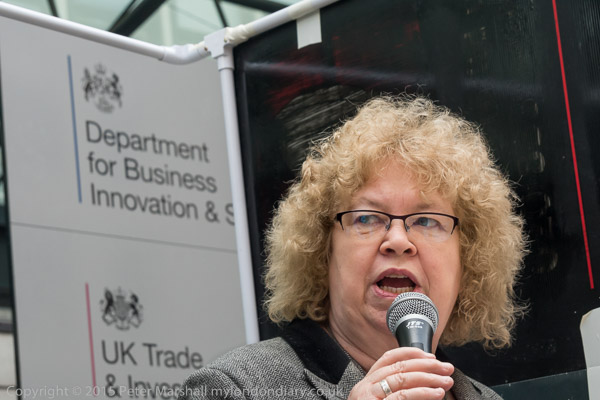
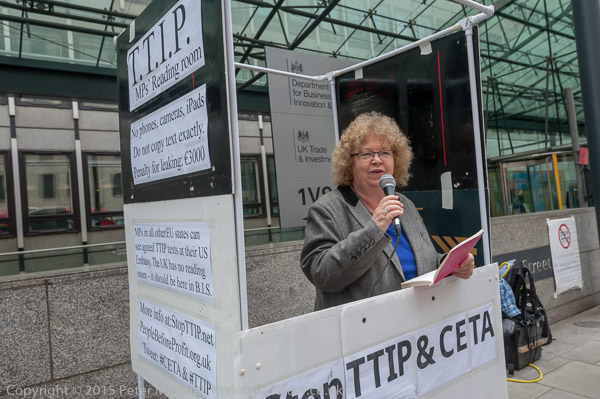
We started the day outside the Dept of Business, Innovation & Skills in Victora St, a few hundred yards from Parliament, where protesters had erected a mock reading room. In the other EU countries MPs can read the secret agreements at the US Embassy, though they are not allowed to take in phones, cameras or iPads or to make any exact copies of the texts. But in the UK there is no such reading room, the government having agreed to set one up but it has failed to do so. Our government – and the others involved – want to keep these deals secret, and to approve them without subjecting them to any public scrutiny.

If we were allowed to see the details it is almost certain these deals would be rejected. SO the idea is to push them thorugh in secret, only revealing the details when they are signed and approved and it is too late – and one of the details is that it will then be imposible to withdraw. If they are completed while we are still in Europe, one of the details is that we will still be bound by them when we leave.

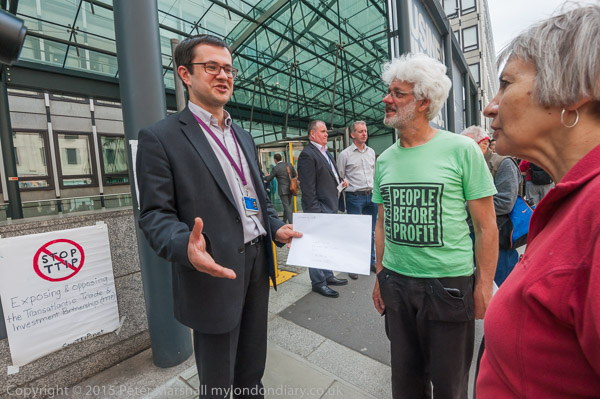
There were a few minor moments of friction when security at the BIS objected to the parotesters fixing anything to their building and refused to let them enter the building to deliver a letter to the minister – though a civil servant did come out, talk civilly with the protesters and accept it. But is was perhaps a little dissappointingly low key and rather small, though one of our MEPs, London Green MEP Jean Lambert, who I think had been able to view the agreed documents in Brussels (but not to copy them) did come along to speak.

After the protest at the BIS came a banner drop, one of my least favourite froms of protest. While it can be of interest when made from a particularly interesting or apt location, usually these are simply rather boring and offering few chances of an interesting picture.

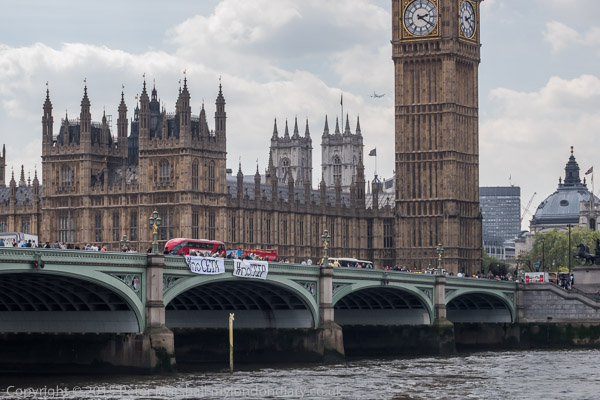
This one was from Westminster Bridge and the idea was to photogaph it with the Houses of Parliament in the background to highlit the fact that ours is the only EU Parliament that will not be allowed to vote on either CETA or TTIP, as our government can apparently make treaties without needing the approval of Parliament.

I’ve written before about Banner Drops, and in particular about the problems of doing them on Westminster Bridge. This again demonstrated the problems – and showed that a merely big banner isn’t enough, you would need one that was truly huge for it to work well.

Since the day was mainly aimed at CETA, which is much closer to being approved, largly because very few people have heard of it, the logical place to end the day of protest was outside the Canadian High Commission at the west edge of Trafalgar Square.

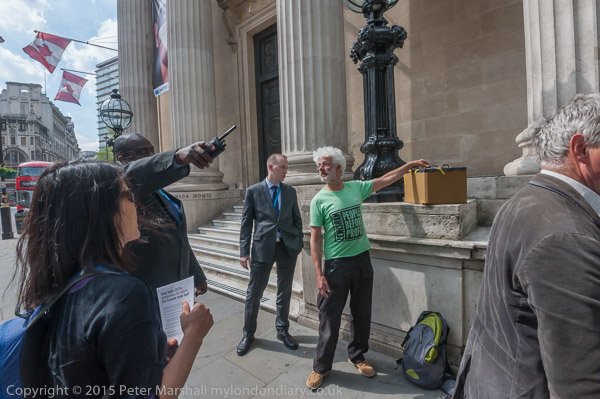
Sewcurity there didn’t share that view and tried to get the protesters to move away, and made them remove any of the banners and posters from the walls or railings. But the pavement outside is the public highwy, and the protesters knew that their rights meant they could protest there, and they did so. Among those speaking was Maude Barlow, Chair of the Council of Canadians, and MEP Jean Lambert came to speak again.

The day was to continue with an evening meeting (where these two were among the speakers as well) but by now I’d had enough. And though meetings are vital in campaigns, they seldom have much to offer for photography.

BIS protest against CETA & TTIP
Banner Drop against CETA & TTIP
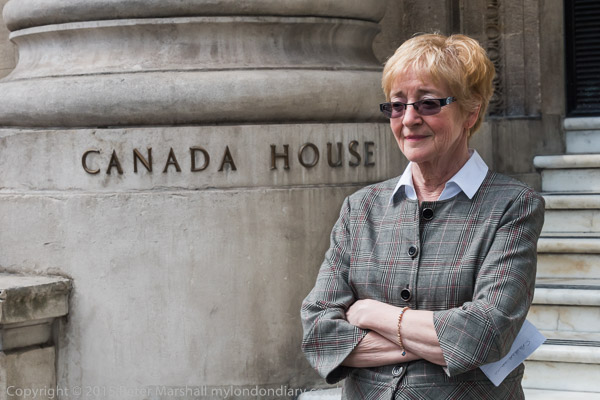
Canada House vigil condemns CETA

Continue reading CETA & TTIP

Upsizing & AI

Back in January 2016, when the Chinese bought up Corbis and Demotix where I was placing many of my pictures and handed their entrails to Getty, I began to put many of the pictures I was taking into Facebook albums as well as sending them to agencies.

I hadn’t been happy with Demotix for some years – particularly since they sold out to Corbis, but they had the advantage for me of presenting my work as coherent stories with text and captions that were easy to link to – so I could post links to these stories for my friends on Facebook and also others, particularly those who had taken part in the events I had photographed.

I’ve lost count of how many albums I put on Facebook in 2016, though at a rough guess they would contain around 5000 pictures. So when I read an advert on Facebook offering to make an album of my year I was intrigued to see what they would make of them, and clicked the links, though I had at the time no intention of buying the book from ‘Re-Snap‘.

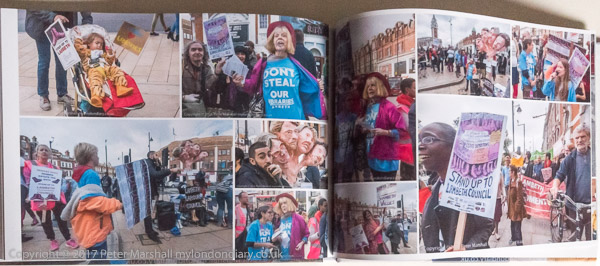
It took several minutes before the book appeared as a 100 page A4 hardback and I was able to page through it’s roughly 100 pages, each with 5 images in a variety of layouts, mostly more or less uncropped. The selection they made wasn’t entirely random – they state:

“The images are selected by analyzing all the images step by step. For instance, we filter out photos by looking at several quality aspects (like blurriness). Our system also automatically looks at the amount of faces and the micro expressions of the faces. Of course we filter out similar photos by looking at the pixels. After this part our deep learning network will look at correlations the pictures in your uploaded photo set. In this way we analyse what kind of picture you would like to have in your photo book.”
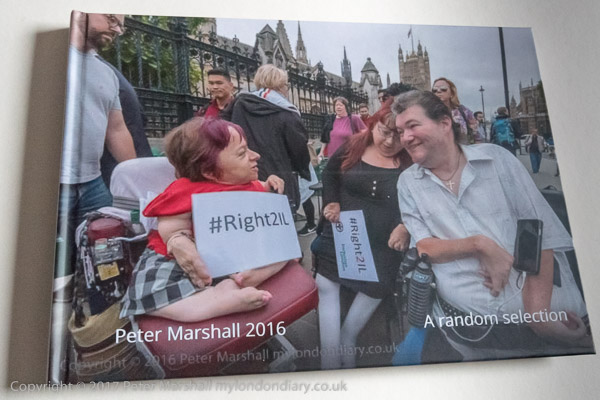
All of my images on-line at Facebook are uploaded at 600×400 pixels and with my watermark – exactly the same images as I post on My London Diary (though sometimes these are a little tidied up as I generally post them there rather later.) Printing at the normal standard of 300dpi would result in images only 2 inches wide, and while the smallest images in the book are not much larger than this (I think around 3.5 inches) others are significantly larger – around 8 inches) and on the covers and a few inner images cropped to an 8.5 inch square they are even further stretched – to 12×8.5 inches on the cover (which also requires a slight crop. A little simple maths gives a figure of around 47 dpi.
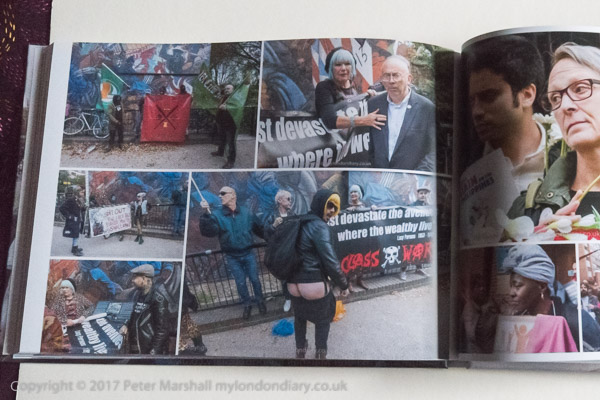
The book actually looked pretty good on screen, and I couldn’t resist going ahead with the order. Of course I could have done a better job myself, more selective and with better quality originals, and the selection algorithm hadn’t included a number of my favourite pictures from the year.  There were just too many pictures from some events that were just a little too similar for me to have included them. But as a fairly random selection of typical images from the year it seemed useful, the kind of thing I could possibly had to people who ask me ‘So what do you photograph?’ as a view of my current work.
Possibly one day I’ll make a better book of 2016, but it would probably take me a week or so to put together, and still cost almost as much as the roughly £50 for this volume (allegedly on special offer), so I clicked and went ahead. It’s possible to edit the book, take out pictures and choose replacement images, but I decided to make only a single change, removing an awards certificate for this blog. Essentially I wanted to retain the automatic selection which was reflected in the title I added to the cover, ‘Peter Marshall 2016 – A random selection‘. I missed one picture that I should have removed, by my friend Townly Cooke who died last year – though I was happy with it appearing once, I should have removed a second, smaller version of the same image, but I must have turned over the page too quickly to notice it.

Obviously the quality of the highly upsized images is noticeably poorer, but the pictures still work, and however Re-Snap upsizes them, it does a pretty good job. Obviously the larger images don’t stand up to detailed scrutiny, but if you saw them in – for example – the pages of a newspaper, they would be acceptable. My main complaint is that the printing inside the book lacks vibrancy, almost as if it had been printed with watered-down inks, rather than any lack of detail or sharpness. It’s acceptable but lacks the punch of the original sRGB files, though the colour balance seems more or less spot on.

Seeing the result, I’m rather pleased that I now watermark all the new images I put on Facebook – and the watermarks are present throughout this book. It doesn’t stop people using my images without permission, sometimes complete with watermark, but more often cropping it or even removing it in Photoshop, both of which seem a clear admission of guilt. If only I could find a few abusers worth suing in the UK courts. I wrote a post here some while ago about an images that I had found used without permission on over 80 web sites, none of which on investigation I felt were worth pursing.

And recently, Google have published a paper on https://arxiv.org/pdf/1702.00783.pdf Pixel Recursive Super Resolution which doesn’t make for easy reading, but essentially shows how a believable image (rather than the actual original) can be created using neural networks from even a very small 8×8 pixel pixillated image. Unsurprisingly it works better on reasonably predictable subject matter, such as faces (which after all generally have the same number of eyes, a nose and a mouth) than other subjects.

And the most predictable images of all must be the photographs of ‘celebrities’ that so obsess our popular media. There can’t really be any need for yet another photograph of any of them, yet outside the Albert Hall yesterday was a pen crammed full of photographers with hardly room to swing a lens, when inputting a little blur and typing in a name – for example ‘Ken Loach‘ – could surely have generated an equally newsworthy image.

It was of course not his image, but his film, I Daniel Blake, and his speech that were newsworthy, telling to the nation the truth about the terrible treatment of benefit claimants by the DWP, something that all those who visit our job centres or talk to those who do already know, but which the complacent well off like to assure us doesn’t happen. And while some news outlets reported it, the BBC did their best to play it down, ignoring it in their early bulletins, though rather grudgingly reporting it later.
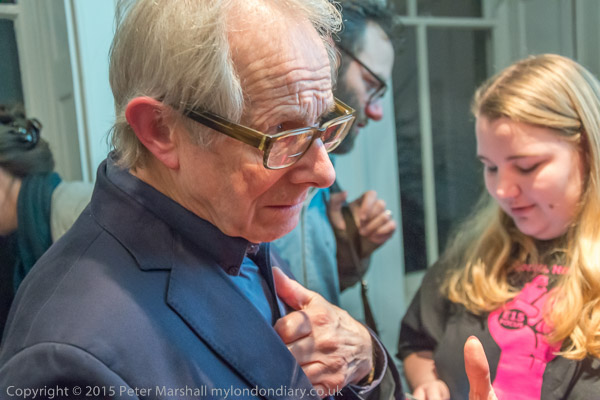
I mention him mainly because I’ve photographed him on a number of occasions in the past, but there was no way I’d ever cover an event like that. I was having much more fun a few miles to the west at the Willesden Green Wassail.
Continue reading Upsizing & AI
Tish Murtha

I’m not a fan of the Metro, the free newspaper that litters our trains in the mornings. It’s useful if you have to wait for a train, to put underneath your bottom to sit on those cold metal benches, but otherwise I never bother to pick up a copy myself, and when occasionally I pick up a copy someone else has left on the train, a quick flick through confirms my belief that it isn’t worth reading. Which is what you expect given it comes from the same stable as the Daily Mail, a sorry excuse of a right wing newspaper.

But for once the Metro web site has published something worth reading – and my thanks to friends on Facebook for point out Ellen Scott‘s article Powerful photo series captures unemployed youths of Thatcher’s Britain, about the work of Trish Murtha (1956 – 2013), a photographer who lived the life she photographed in Newcastle’s west end.

Murtha first used a camera to frighten away men who would proposition her on the streets where she lived, taking it out and threatening to take their pictures – even if there was often no film in the camera, but soon got hooked on photography and aged 20 went to study at Newport’s School of Documentary Photography in 1976, returning to photograph in the community where she lived. Later she spent some time in London.

The Guardian published a piece written by her younger brother Glenn Murtha, in their That’s me in the picture‘ series in 2015, and you can find out more about her on Wikipedia, which also links to a number of sites with her work on them. She died suddenly of a brain aneurysm just a day before what would have been her 57th birthday in 2013.

Her daughter Ella Murtha wants to make sure that her mother and her pictures are not forgotten, and manages an official Facebook page dedicated to her. She is planning to create a Kickstarter page shortly to fund the publication of a book of this series of pictures and her essay, Youth Unemployment. I’ll add details here when they become available.

My opinion about the Metro was confirmed by the two stories listed under the heading ‘MORE’ at the bottom of the piece which includes eighteen of Tish Murtha’s pictures.

MORE: Photo series celebrates hard-working cats on the job
MORE: Photographer captures the weird and wonderful things people have flushed down the toilet

Holloway

I wasn’t sure about going to take pictures at Reclaim Holloway; I had several other things to cover later in the day and this was expected to be a relatively small event. Holloway is up in the north of London, and although its not a hugely long journey it would make my day a rather long one.

But in the end I decided it would be worth the effort, and part of the reason was that it was in the Islington North constituency of Labour Leader Jeremy Corbyn, and knowing that he is a good constituency MP there was a decent chance he might turn up.

I’ve photographed Corbyn many times over the years, supporting protests on a wide range of issued – often in the past few years along with John McDonnell, now his shadow chancellor. But since he won his remarkable victory  to become party leader by a substantial majority, he has become a hate figure for the British media and often is at the centre of an intense media scrum at events, and seldom has time for many of the smaller protests he used to come to.

It was also an event that interested me, as housing has long been a special interest – since I was a student activist back in the 1960s. The protesters want Holloway Prison, which is closing down, to be kept in the public domain and used for social housing and community services, rather than to be sold to developers for yet more expensive housing that few Londoners can afford.

And Corbyn did turn up, and there were only a couple of photographers present, though many people taking pictures of him with their phones, but it was all pretty civilised. He spoke briefly, giving his support to the campaign, posed behind the banner (after I had asked him, more for the campaign organisers than myself – it wasn’t my sort fof picture) and then cycled off to do what he needed to do as party leader, while the rest of us marched off to HM Prison for another rally.

Reclaim Holloway

Continue reading Holloway

Walking Backwards

One of the skills that every photographer who covers protests has to master is walking backwards, or rather more importantly, taking photographs while walking backwards.

Back when I learnt photography – and when I taught it – there was a considerable emphasis on avoiding camera shake when taking pictures.

We learnt and taught to stand  still, feet a foot or eighteen inches apart to make a solid platform (of course if you could lean against a post or wall, kneel or lie prone it was even better.) The camera should be held firmly in both hands, the left cradled under the lens, the right holding the body firmly with the first finger resting gently on the shutter release. Elbows should press in against the side of your chest, and it was vital to hold your breath and squeeze rather than jab at the button.

Of course, even this was only second-best, and ideally photographs should be made with the camera on a truly solid and weighty tripod. Of course in part this was a hangover from the days of large cameras and slow emulsions. Back in the 1890s when people started to make pictures without a tripod, exposures were often well under the 1/30th which makes hand-holding relatively easy with standard lenses.

I still sometimes see photographers trying to work this way – and some even at protests, but I’ve come to hate tripods (except for those few very special projects for which they are essential) and many, if not the majority of my pictures are taken while I’m walking, and often when I’m walking backwards, though sometimes I walk in the same direction as the people I”m photographing and twist around to work at an angle over my shoulder. It works for me better over the left than the right shoulder.

Walking backwards when taking pictures does need a little practice, but if you match your speed precisely and keep in step with those you are photographing you can get surprisingly sharp results at shutter speeds slow enough to give an attractive blurring to the background.

Though more normally I play safe by using ISOs that were unthinkable in the past. With both the D810 and D750 I’m now using there seems to be very little advantage in working below around ISO800, and results at much higher ISOs are still usable. In general I set the D750 with the wide-angle lens to ISO640, and the D810 with the 28-200mm at ISO800 and ISO auto allowing it to rise to ISO6400.

Nearly all the wide-angle pictures are sharp, and those with the longer lens usually suffer from focus problems rather than those caused by camera or subject movement.

One slightly limiting human design specification is the lack of eyes in the back of the head, and when walking backwards it is essential to take the occaisonal glimpse behing to check for curbs, lamposts and other obstacles. Falling over backwards is something of an occupational hazard, and could be dangerous, though the worst I’ve suffered has been the odd bruise.

But the march I covered on the 8th May was a break from all this, as the marchers were marching backwards from Trafalgar Square down Whitehall, though in easy stages with several  stops for speeches on the way.   And they really weren’t very good at it, proceeding very slowly and cautiously.

This march in reverse gear was to highlight the governments back-tracking over clean energy, with insulation grants being dropped and clean energy programmes being crippled while they back technololgies such as fracking and burning biomass which contribute to climate change as well as proposing massively polluting and unnecessary road and runway projects.

The event had started with some speeches including one from a woman whose house had been flooded. It brought back memories for me of watching the water come up to my own house a year or so earlier – though fortunately in our case it had stopped an inch or so short.

One of the others who spoke was Kye Gbangbola, whose son Zane had died in those same floods in February 2014 and had been left part paralysed. Despite a lengthy inquest since then it still seems not entirely proven that this was the effect of carbon monoxide rather than deadly hydrogen cyanide released by flooding from landfill.

Later there were speeches from others as the march halted first at the Old War Office, where speakers included Dame Vivienne Westwood, and opposite Downing St, where Sheila Menon of Plane Stupid talked about the lack of any real need or public good of airport expansion and the catastrophic effect it would have on climate change, as well as the increased deaths through air pollution, and called for the huge subsidies that aviation enjoys to be removed.

Finally outside the Dept of Health there were speechs and street theatre, which again looked at the huge subsidies the governemnt gives to the oil industry while at the same time it is cutting green initiatives. The protest had been intended to end in Parliament Square, but time had run out, probably because non-photographers are so slow at walking backwards.

More pictures at Going Backwards on Climate Change
Continue reading Walking Backwards