Class War and the Shard

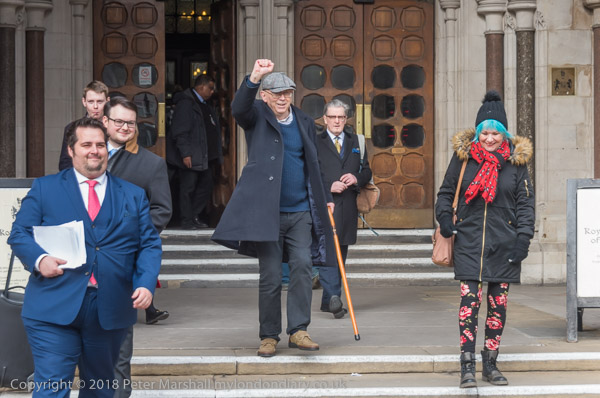
Class War continued their successful court record, with Ian Bone raising his fist in a victory gesture for the photographers (I think there were two of us) as he makes his way out of the High Court in the Strand, where lawyers acting for the Qatari royal family had tried to get an injunction to prevent a Class War protest against the ten empty £50 million pound apartments in The Shard, and to claim over £500 in legal costs from the 70 year-old south London pensioner. Smiling at the left is his brief, barrister Ian Brownhill who on hearing of the attempt to stifle legitimate protest had offered to conduct Bone’s defence pro bono, and at right, Bone’s partner, Jane Nicholl.


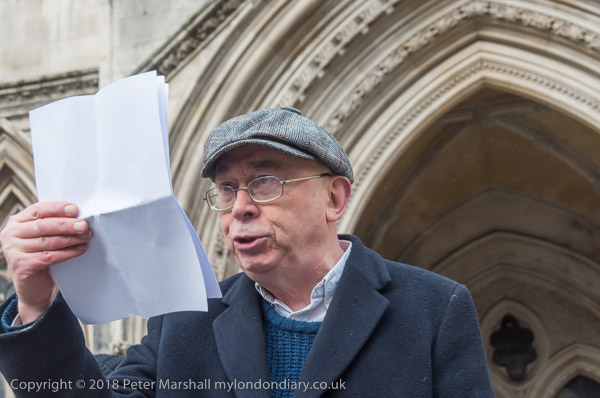
Ian Bone proudly reads the description of Class War presented to the court by lawyers for the Qatari Royal Family

Class War are a much misunderstood bunch, bringing out an existential fear in the hearts of the bourgeoisie, and in particular of the press and police force. At some of their protests they have been outnumbered five or ten to one by uniformed officers, with a number who look suspiciously undercover hanging around. The idea of anarchism still arouses a class memory of bombs, sieges and the mob running in the streets, but Class War is more an anarchy of ideas, with actions as spectacle rather than armed struggle.

Despite their small size – or perhaps in part because of it – they have been remarkably effective in many campaigns, particularly those around housing and low pay. Some of their own campaigns – such as the series of around 30 ‘Poor Doors’ protests I photographed – have shown a remarkable tenacity and have done much to bring the issues to wider attention. Led by a small core, hard for undercovers to infiltrate, they have at times attracted the support of hundreds of others. It’s not a group with membership or rules but a truly anarchist lack of organisation, a group of friends who share common ways of thinking about politics and life and are prepared to act – and anyone who thinks and acts in the same way can be Class War too.

“Want to get involved? We have no leaders, no bureaucracy, no fees and you don’t have to sell a paper! Just come along to an action and get involved.

Join in * Reject cynicism * Life’s more fun with Class War!”

Though it does require a good sense of humour, they are deadly serious about politics and the need for change, for a society that works for the ordinary people rather than being arranged for the one percent, and they and others in groups close to them often bring out some of the more glaring inequalities that those at the top would prefer to keep hidden. We all know that there is a housing problem in London, and that much of the building that is going on over London is not aimed at reducing this, but at allowing largely foreign investors to profit from rising property prices, buying luxury flats which will often never be used, just sold a few years later when their value has risen – with developers publishing investment proposals suggesting huge rises and quick profits.

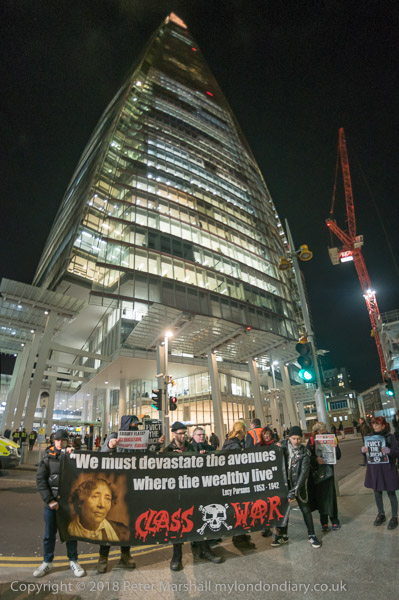
At their protest outside the Shard, Class War pointed out that the ten £50 million pound apartments in it have remained empty since the building was completed, and that developers currently plan to build a further 26,000 flats costing more than a million pounds each, many replacing current social housing, when London has a huge housing crisis with thousands sleeping on the street, and over 100 families from Grenfell are still in temporary accommodation. Official figures show that despite the huge and increasing need, London is losing several thousand properties at council rents each year.

Although the court decision had made it clear that the protest was permitted outside the Shard, so long as the protesters did not enter the property, police still insisted that Class War move further away, across the road.

Their attempt to justify this seemed even more pathetic than usual, suggesting that Class War, who were standing to one side of the normal pedestrian routes, were causing an obstruction; there was a clear obstruction, but this was caused by the line of police officers. But Class War did take their banner across the road, though some members continued to protest as the court had allowed on the clearly marked edge of the property.

The Shard presents something of a challenge to photograph from a close distance, and even from across the road it was hard to show the building as a whole as well as the protesters. Even my 16mm fisheye couldn’t do the job sensibly in landscape format, and I had to turn it 90 degrees to get it all in.

While the software I use to convert perspective does a good job with landscape format images, it doesn’t cope well in portrait format. Playing a little in Photoshop with its Adaptive Wide Angle and a little more fiddling, including a change in aspect ratio and a little image rotation can produce a straighter result for the tower, which may be more acceptable.

More pictures on My London Diary:

Class War protest at Shard
Class War victory against Qatari Royals

There are no adverts on this site and it receives no sponsorship, and I like to keep it that way. But it does take a considerable amount of my time and thought, and if you enjoy reading it, a small donation – perhaps the cost of a beer – would be appreciated.

My London Diary : London Photos : Hull : River Lea/Lee Valley : London’s Industrial Heritage

All photographs on this and my other sites, unless otherwise stated, are taken by and copyright of Peter Marshall, and are available for reproduction or can be bought as prints.

To order prints or reproduce images

________________________________________________________
The Corners

I first got to know Chris Dorley-Brown when I was curating a photography show for a now defunct organisation, London Arts Café in 2000. Cities of Walls, Cities of People included work by eight photographers, some of whom I had known for some time and worked with before and two I found when planning the show, including Chris. He was suggested to me by Mike Seaborne, also in the show and at the time Curator of the Historic Photographs Collection at the Museum of London. Dorley-Brown’s work in the show was a number of paired images of council estate tower blocks from a group of images ‘Revisits 1987-2001’ showing how these blocks had altered in that time period. The web page for the show has one of these pairs and my brief text on him and the work.

I was pleased to read a post on BJP Online by Diane Smyth, Chris Dorley-Brown’s singular vision of East End London, which looks at some of his more recent work which is being published by Hoxton Mini Press as The Corners.

As it says on the web site:

These hyperreal photographs of East London street corners are a unique documentation of an ever-changing landscape. Using multiple exposures, Chris Dorley-Brown plays out different narratives simultaneously, creating dream-like scenes that lie somewhere between fiction and reality.

Although I’m impressed by these images – and there are many more on the web (this link goes direct to his galleries rather than the front page of his site which my browser seems to have a problem with) not just from the East End but elsewhere, I find them rather disturbing.  Firstly there is something about the tonality that makes them seem to me more like paintings than photographs – truly as the blurb says they are hyperreal.

But it is the figures caught on the multiple exposures that worry me most,  and the whole idea behind these pictures. As he says in the BJP, “I don’t have a journalistic bone in my body” and it seems to me that this way of working subverts the whole idea of photographic truth which lies behind the realism that has always been central to my own work. Of course photography can be used in many different ways, and such methods are unquestionable in, for example advertising photography, but in the BJP article it states that his work is filed under ‘documentary’ which I find worrying.

Brixton Portraits and GDPR

Rather fewer photographers now have shops with windows to display examples of their work, and of course it was only those who made a living from social photography – weddings, portraits etc – who sold their services to the general public for whom it made sense. Now, most people take their own portraits, apart from those usually hideous examples produced by school photographers which parents are blackmailed into accepting so that schools can have a photographic record of their pupils (or rather ‘students’ now that you graduate even from nursery schools.)

Of course there are parents who like them, but when I was a teacher I was opposed to them on principle; not just because they generally had the same degree of originality as a photobooth, but because I knew that they put parents on low incomes into the position of having to either pay for them and go without necessary food or clothing or disappoint their child and force them to take the pictures back to hand in at school.

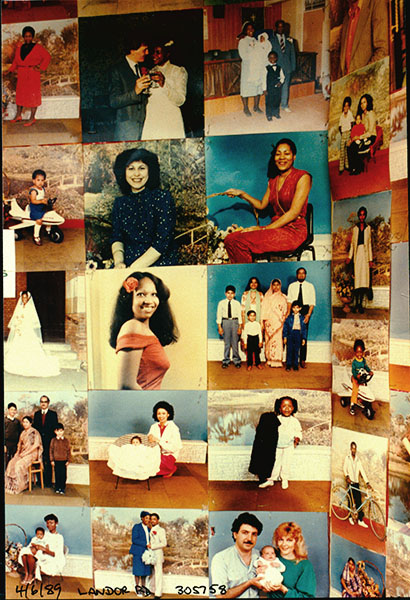
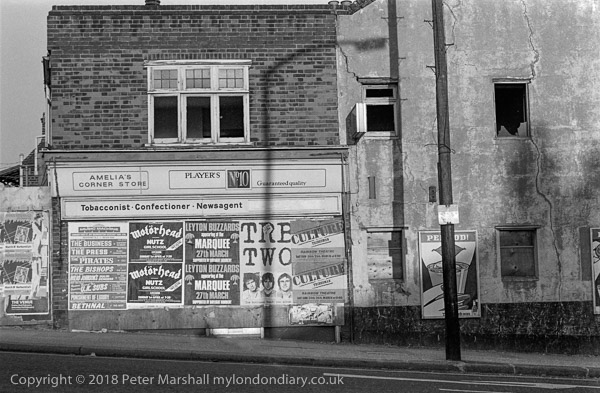
But good social portraiture is a rare skill, and during the late 1980s and early 1980s I carried out a project that involved photographing in and through many shop windows across London, and this included many photographer’s windows. I photographed a detail on one in Landor Rd in 1989 which I think must have been Harry Jacobs studio window; the caption states 4/6/89 Landor Rd 305758, where the 6 figure number is a Grid reference, though these were not always correct to the last figure. The image is a scan from a commercial enprint, which I could locate quickly as these are filed by the 1km grid square in which they were taken.

I’m sorry that I don’t appear to have taken a wider view of the shop front, but this picture is unusual for me and I think means that I realised the value of his work. As with many of the pictures in this series it was taken on a Sunday morning, when most shops were closed as this usually enabled me to work undisturbed. I do remember thinking that it would be worth going back and finding out more about what appeared to be a remarkable social record, but I never got around to doing so. And perhaps a little over ten years later I noticed the shop no was no longer there.

Soemone from the Photographers’ Gallery had clearly also noticed the work, and three years after Jacobs retired in 1999, with an archive of almost 60,000 photographs they put on a show based around his work in 2002, discussed in The Guardian. His son wrote a short piece, My Father the photographer which was published in The Evening Standard.

The Photographers’ Gallery apparently decided at the time that for photographs taken before the 1988 Copyright Act they had to get permission from the subjects to exhibit them. I’m not sure that was true, but although we have had no such problems from then until now, it is possible that things may be different again under the EU General Data Protection Regulation (GDPR). But you can rest assured that the GDPR allows processing for the purposes of journalism, and I think for art. The problem with the work by Jacobs was that it had been taken as a commercial agreement between the sitter and photographer and the sitter’s permission was probably required for it to be shown as art or documentary. My photograph above is clearly a work of art!

The Freelance Branch of the NUJ (a union to which all journalists in the UK should belong) has published an excellent guide to the GDPR for Freelances, which is generally reassuring, though it does point out we should all have registered as data controllers under the Data Protection Act 1998 and should continue to pay the £40 per year this involves.

You are also required to take proper steps to protect your data, which would include using strong passwords or physical locks on devices including computers, backup disks and memory sticks etc. The article makes clear that as journalists you can use the exemptions for free expression to avoid giving any information in response to ‘subject access requests‘ and that journalism is explicitly exempted from the ‘right to be forgotten‘. Something which may upset some is that the advice suggests that there may be problems under GDPR in using cloud storage.

Back to Harry Jacobs. My reason for mentioning him is that Lambeth Council are for once doing something I approve of, with a show of his work in the Town Hall. A Snapshot of Brixton: Harry Jacobs and the Empire Windrush opened on Friday 25th May and runs until Friday 6th July. Open M – F, 09.00 – 20.00

Back to the Elephant

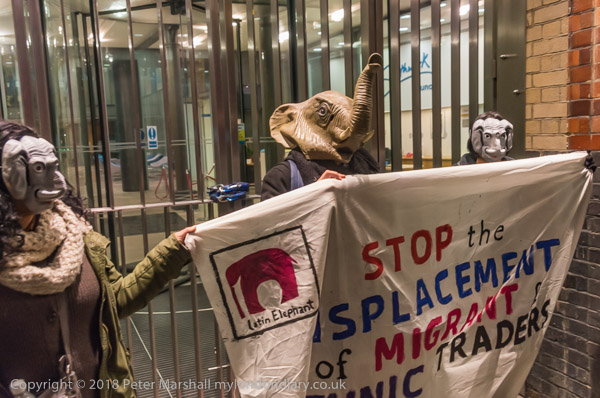
Though not actually to the Elephant, but to the dark street outside Southwark Council Offices near London Bridge for a protest outside where a Southwark Council meeting which due to vote on plans by developer Delancey and the council which would destroy the Elephant & Castle centre and the community around it. At an earlier meeting the decision had been deferred to allow Delancey to come up with new proposals to meet the community objections.

Although they had made some changes, the proposals were still nowhere near acceptable, but the protest ended in something of an anti-climax. While the protesters had been hopeful that the plans would be turned down, instead the council voted to put off the decision until a further meeting to give Delancey time to submit a revised proposal.

There seems to be little hope that the revised plans will be very much better, but whether they will then be approved is hard to predict. It looks as if the council cabinet that backs the private developer has enough power to keep the redevelopment on the table until the opposition in the council gets worn down enough to pass it.

So it remained likely that the redevelopment would at some point go ahead, and that most of the protesters worse fears about social cleansing etc. will be shown to have been justified, while the developers and a few in the council offices do very nicely for themselves, with some moving to lucrative private sector jobs.

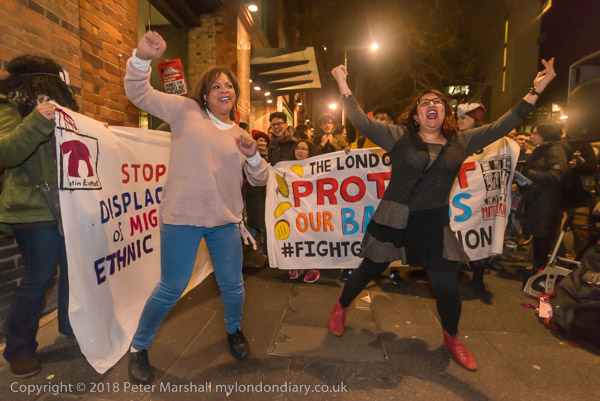
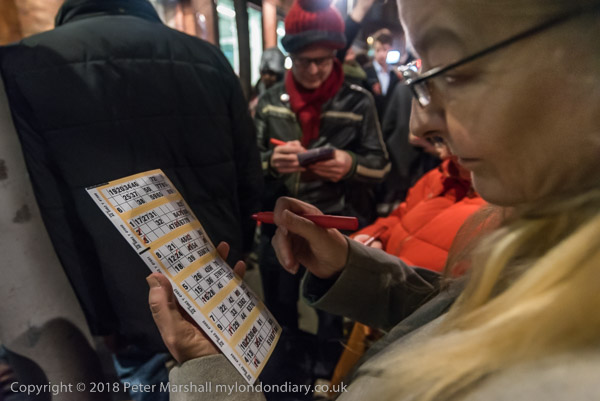
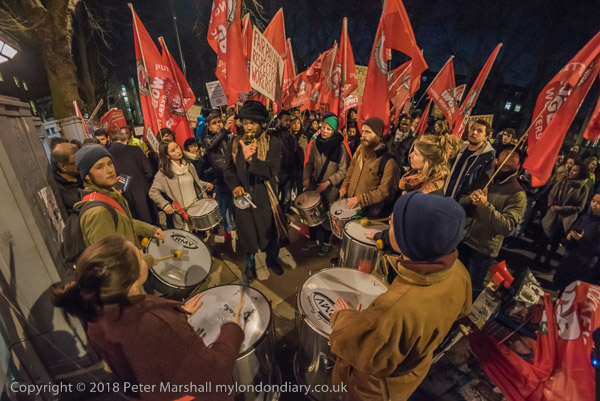
The protest was unusual, featuring Latin dancing and bingo, representing just two of the groups who will lose out. And of course elephants.

The struggle here is of course part of a wider struggle in the Labour movement, with Southwark COuncil dominated by right-wing Blairites, members of ‘Progress’, a group in the party opposed to many of its present policies and including many dedicated to the downfall of Jeremy Corbyn.

So far the Labour right have managed to maintain control of important aspects of the party machinery, which has allowed this group to continue as a Thatcherite fifth column inside the party, but with increasing support  both in the party and in the nation for the new policies this may change. It has long been clear that the party’s only hope of re-election is to unite behind a leader – like Corbyn – who rejects the old and failed Blairite approach.

Estate regeneration, as first proposed under Blair, was one of the party’s better policies, but failed in essentials like taking the needs of the estate residents and others on council waiting lists into account and accounting for the clever tricks of developers.  With proper consultation which actually took the residents views seriously and relatively small sums of money to renovate and refurbish, along with sensitive infill to provide new council-owned properties, most of the estates now being demolished could have a useful long-term future – as the schemes put forward by ASH (Architects for Social Housing) and others have demonstrated.

Many of the estates targeted so far are not those most in need of regeneration, but often some of the more viable estates, chosen because their position and scale means huge profits for private developers.  Many of the estates from the 1960s, though possibly in out of fashion styles, are better built and to higher standards in many respects to their new replacements, and with refurbishment and maintenance would have long outlasted current builds.

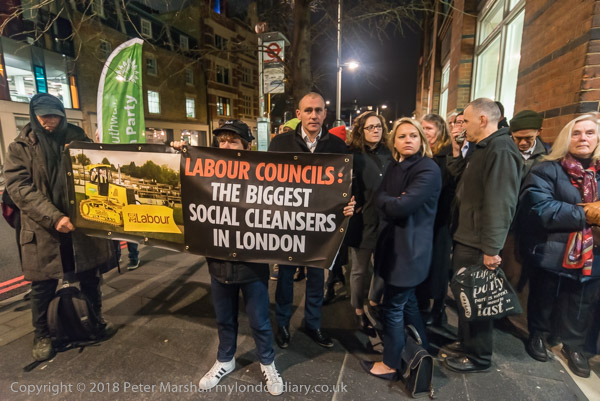
Class War’s poster ‘Labour Councils: The Biggest Social Cleansers in London‘ is of course correct, because Labour controls most of London’s councils. And while Tory councils might well see social cleansing as one of their aims (as Dame Shirley Porter did as Leader in Westminsterwe expect Labour councils to work for all their residents, including those in social housing, and their failure to do so is shameful.

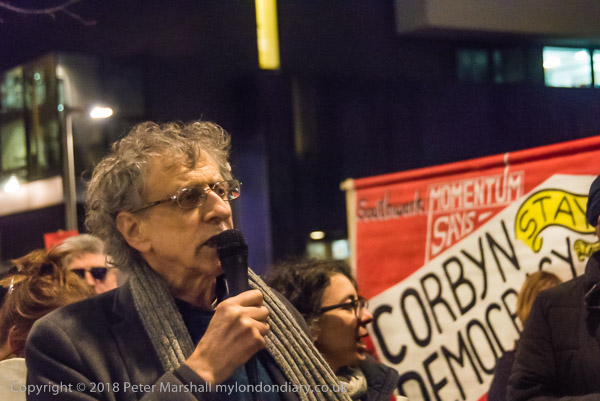
One of those who spoke at the protest was Piers Corbyn, who told us he had talked to his younger brother who was determined to see a change.  I worked hard to get the name Corbyn visible behind him as he spoke, with people keeping getting in the way, but I finally managed it. Southwark Momentum just didn’t have their banner up high enough at the protest, and a few months later failed to get enough of those they supported nominated for the council.

Bingo and Dancing for Elephant & Castle

______________________________________________________

There are no adverts on this site and it receives no sponsorship, and I like to keep it that way. But it does take a considerable amount of my time and thought, and if you enjoy reading it, a small donation – perhaps the cost of a beer – would be appreciated.

My London Diary : London Photos : Hull : River Lea/Lee Valley : London’s Industrial Heritage

All photographs on this and my other sites, unless otherwise stated, are taken by and copyright of Peter Marshall, and are available for reproduction or can be bought as prints.

To order prints or reproduce images

________________________________________________________
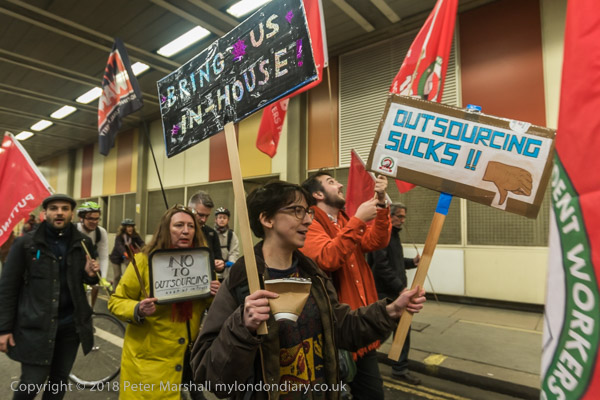
IWGB Protest Outsourcing in Academia

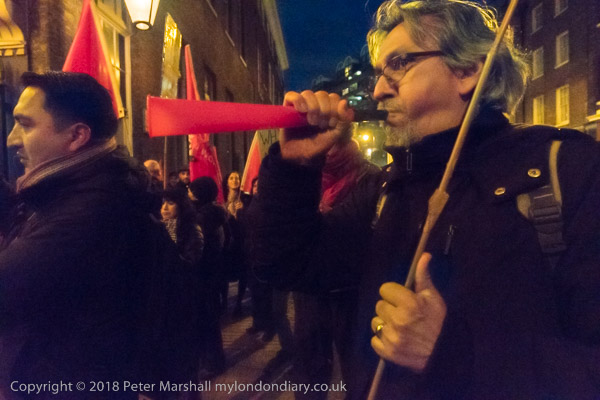
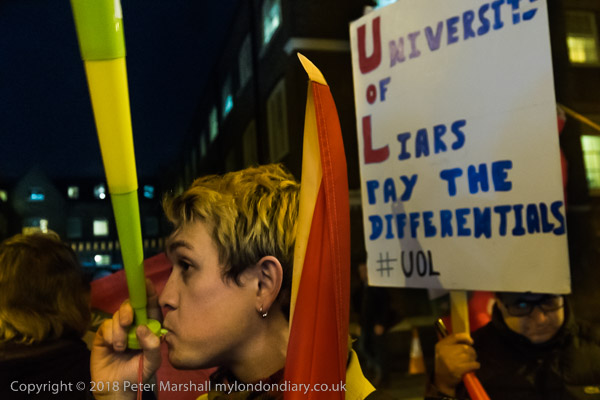
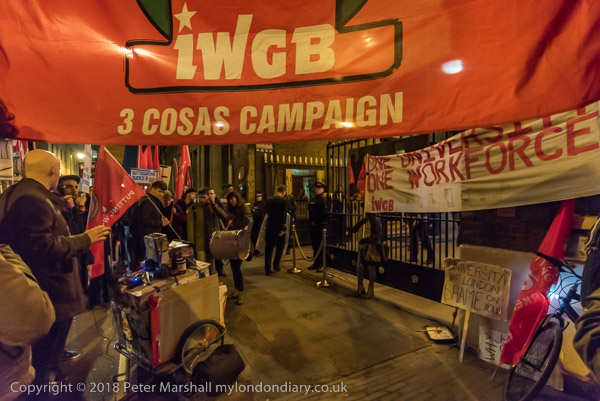
I like to photograph the protests organised by the IWGB (Independent Workers Union of Great Britain) both because they are noisy, lively and generally photogenic, but also because I think it scandalous the way low paid workers are treated.

I’ve written often enough about out-sourcing and how it is used by companies to try and evade their duty as responsible employers, hiding behind the convenient fiction that they have no responsibility towards these people whose work is essential to the running of their organisations because they pay another company to employ them. It simply doesn’t wash.

As well as low wages and the legal minimum conditions of service – holidays, sick pay, pensions – outsourced workers also generally suffer from poor and sometimes despotic management, with overwork and bullying rife. Many too are on zero hours contracts, a legal fiction which is effectively a non-contract which works only in the interests of the employer and lays employees open to various unfair practices.

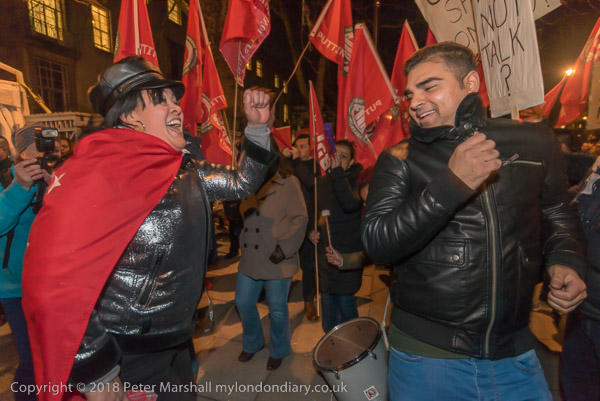
I’d gone to photograph the protest by cleaners, receptionists, security officers, porters and post room staff at the central administration of the University of London who had been on strike and picketing since the early morning. The picket over (severely restricted by Thatcherian anti-union laws) they were joined by other workers and supporters and myself for a loud rally in the early evening.

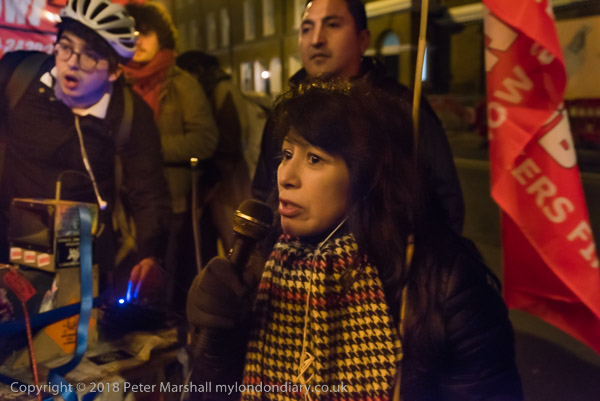
There was music on a PA system, much waving of flags and shouting of demands, and a great samba band all reminding the University that its workers are demanding to be directly employed. And at the end a number of speeches by the workers and their trade union leader, as well as other trade unionists in support.

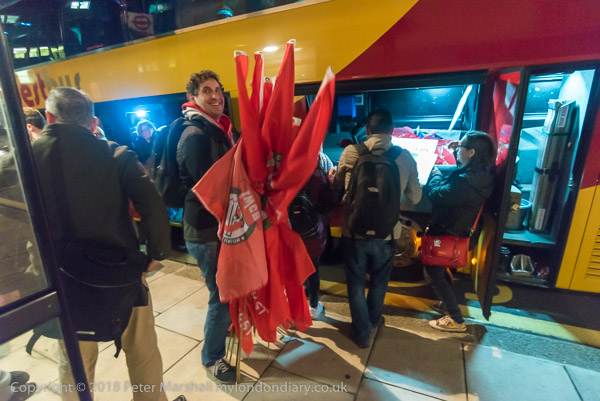
And there was then a surprise. Well, by then it was not a surprise to me as one of the trade union leaders had whispered in my ear (though given the noise level I think he had to shout) earlier what would happen, and a double-decker bus arrived and we were invited to go on a mystery tour to another location where the IWGB are in dispute.

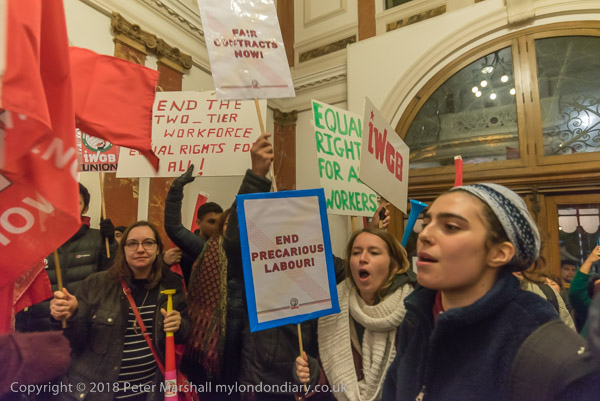
The location was not announced (though I had been told) so that the police and others listening could not warn those at our destination, where the IWGB hoped to be able to walk in and protest in the foyer. I wasn’t entirely pleased with the idea, as I was getting rather hungry and wanted to get home where dinner was waiting, but it was an opportunity not to be missed. The journey through London in the evening rush hour was hideously slow but eventually we were dropped off just around the corner from our destination, and got ready, walking quietly towards the doors. Two people went ahead and held them open as we arrived and walked in with two security guards helpless to stop us.

We were at the Royal College of Music, another academic institution that outsources its cleaners to evade its responsibilities, and where Tenon FM who recently took over the cleaning contract decided to unilaterally cut hours in half and change shift times, telling the cleaners they must work at times most already have other cleaning jobs. The cleaners now threatened with dismissal for refusing to accept the new hours.

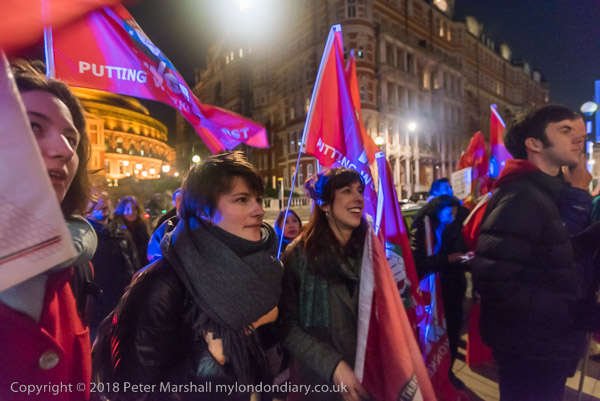
After 12 minutes, the police arrived and ordered the protesters outside, where the protest continued on the pavement. One of the police officers was clearly incensed at the way the protesters were behaving and seemed likely to arrest some of them, but his colleagues restrained him. The protest appeared to be lawful and the police should not be taking sides as he so obviously was.

Flashing blue lights from police cars make photography a little unpredictable, and produce some strange effects, which are seldom too appealing. The high-output blue LEDs have a very limited spectral range, turning everything directly illuminated by them an intense blue. But the protest appeared to have settled down and I felt nothing much else was going to happen, so I left for home and food.

More on the two protests at:

Cleaners rush into Royal College of Music
End Outsourcing at University of London

There are no adverts on this site and it receives no sponsorship, and I like to keep it that way. But it does take a considerable amount of my time and thought, and if you enjoy reading it, a small donation – perhaps the cost of a beer – would be appreciated.

My London Diary : London Photos : Hull : River Lea/Lee Valley : London’s Industrial Heritage

All photographs on this and my other sites, unless otherwise stated, are taken by and copyright of Peter Marshall, and are available for reproduction or can be bought as prints.

To order prints or reproduce images

________________________________________________________
Homeopathic Advertising

I was attracted by a post by Shaun Curry Co-founder of Pixelrights on their blog, We laughed then decided it wasn’t funny at all largely because of the phrase ‘Homeopathic Advertising’ he invents in it.

It tells the story of how the UK Government Trade & Investment office (UKTi) approached him to use one of his pictures “in their new ‘GREAT Britain campaign’ “the biggest ever integrated Government international marketing campaign” with funding of £30 million” and which they say would be seen in “120 countries!!” Which sounds like good news except all that they were offering the photographer from that £30million was ‘exposure’.

After he contacted them suggesting they should pay for its use, they did offer him £100. Now for us people who sell stuff for use in newspapers and magazines that would not be an unusually low fee for single use – but this was a major campaign and they wanted to secure the “images for 2 years, with above and below the line advertising rights.”

Basically this means using the image in all sorts of media, both mass media – print, web, TV – and in more personalised advertising such as direct mail, email… If like me you are an advertising virgin (I did come close to selling an image to some clothing company a few years ago, I think it had some name like Gap, for a few thou, but they changed their mind at the last minute) you might want to read more about Above and Below the Line, but basically it means big bucks.

Quite how big – and how much to ask should UKTi get in touch with you and want free use you can work out from the Association of Photographers online usage calculator. You need to start by inputting your BUR or Base Usage Rate, which they advise should never be less than your normal day rate, and would include a single use of the image.

The calculator then allows you to multiply this for the various rights the client wants, including the type or usage and the countries in which the image would be used. If you try it out for the UKTi’s claim you are almost certain to end up somewhere well north of £10,000 – for which they were offering a byline.

Even on Alamy, putting in some details of just one of the uses can come up with four figure sums though I suspect many customers opt for vague things like ‘Marketing package’ at around $50 rather than paying for their actual usage. If I was at Alamy I’d take a close look at what UKTi have done with any images they have bought.

Curry found out he wasn’t the only photographer they had tried it on. They approached someone else with a similar image who also wasn’t going to play ball. I have a nasty suspicion they will have gone on trying other photographers until they found one who fell for it, probably someone who is a near-starving photojournalist who thought that getting a hundred (or even two if they had to raise their offer) wasn’t a bad deal, perhaps someone like me who found his best sale so far on Alamy this month was $20.

£30 million is a big budget, and photography is a vital part of the campaign. UKTi should be prepared to pay a reasonable price for it – and heads should roll there if people are prepared to compromise the project with derisory offers like this.

Wembley 1979

Facebook friends will know already that most days at the moment I am posting a picture or sometimes a couple of them that I took in London in years past, currently from 1979, which are on my growing London Photographs site, along with my comments, sometimes about the pictures but also about other things that come into my mind.  I don’t intend to publish all of them here – as I tried to with the pictures of Hull throughout 2017 – but will try an put some of those that include more general comments about photography on here as well.

Back in March 1979 I took a trip to Wembley, and walked around a bit, stopping off on my way home in Harlesden around Willesden Junction. Part of the reason was to look at the buildings on the British Empire Exhibition site, close to the stadium, some of which were threatened with demolition.  And here are a couple of posts about them:

________________________________________________________


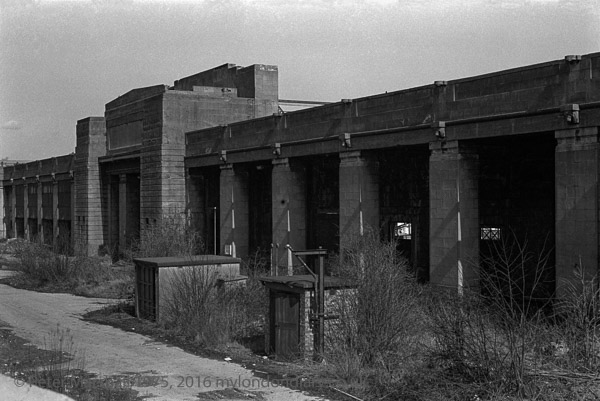
Palaces of Industry, British Empire Exhibition site, Wembley, Brent, 1979
19g-52: building, concrete, reinforced, derelict

I had come to Wembley to photograph these derelict buildings which were built in 1922 and 1923 for the British Empire Exhibition of 1924 -25, probably because some of them were about to be demolished shortly I’m not quite sure exactly which buildings I photographed, and although some were demolished in 1980, the last only went in 2013.

Although they had been built for the temporary exhibition, their reinforced concrete made them difficult to demolish, and they had only remained there so long because it would have been expensive to get rid of them. I think this is one of the buildings that was still standing and being renovated when I returned three years later and took some more pictures on Engineers Way.

The Empire exhibition was important in accelerating the development of the surrounding areas of north-west London, much of which soon became covered with suburban housing in the years up to the second war.

The area is I think totally unrecognisable now, with about the only remaining building being the 1934 Empire Pool (now Wembley Arena), which I think I photographed a few years later.


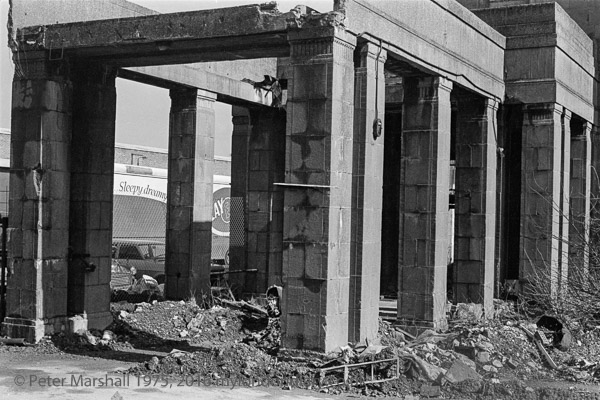
Palaces of Industry, British Empire Exhibition site, Wembley, Brent, 1979
19g-64: building, concrete, reinforced, derelict,

A second picture of the derelict concrete buildings, apparently left standing after the exhibition as it was too expensive to demolish them.

I think I probably took rather more than the handful of pictures in the area during this visit than have survived, and suspect that one of the films that I took may have been ruined by a camera or cassette fault or in processing. Although it is possible to lose digital images though card or hard disk problems – and to delete them by human error, digital is in many ways more reliable than film, not least because you can see some or your mistakes on the back of the camera.

In the 70s and 80s I was always short of cash, and loaded almost all the film I used into cassettes from bulk 100 ft lengths. I used a ‘daylight loader’ which mean that a short length at the end of each film was exposed in attaching it to the cassette spool, though later I learnt to do this part of the procedure in total darkness to avoid this. Re-using cassettes led to occasional problems with light leaks. Sometimes I used plastic bodied cassettes made for reloading – and these had caps which were quite easy to twist off – sometimes too easy. The metal bodies used by Ilford and most other films had ends which popped off when you squeezed the cassettes and could be re-used but could get too easy to remove with repeated use. (Kodak’s were crimped on and needed a can opener to remove and were not re-usable.)

All normal cassettes used felt light-traps on the opening where film emerged and films might be ruined by scratches if grit was caught in these from loading the camera in a dusty place, and we had to try hard to keep them clean when reloading them. Those fabric light traps were not intended for repeated use and this sometimes led to leaks. Leica used to have their own metal re-usable cassette which worked without a light trap, the with a slot opening up inside the camera, but it was hardly practical.

Processing too had its traps. Developers not stored in air-tight containers could react with oxygen in the air and become less active or even entirely useless (though normally they went brown to show this.) Some were meant to be re-used, and careful counting of the number of films developed was necessary to avoid them becoming too weak. As mentioned in a previous post I had to abandon some developers as simply too unpredictable.

One of my late friends, a professional photographer who did a number of jobs for a leading oil company magazine, was flown out by helicopter by them to photograph their North Sea Oil rigs. It was an extremely long and tiring day, and on reaching home she loaded the films into a multiple tank to develop them. After she poured the first chemical into the tank she realised she had poured in the fixer rather than developer. (Fixer is the chemical used to dissolve the undeveloped silver halides from films after development as most photographers will know.) The films were ruined, and she had to go in the next day and confess to her client. Fortunately for her, she had worked for them on many previous assignments and they appreciated her work, and they arranged another helicopter to take her out and make the pictures again. That time she made sure she got the processing right.

________________________________________________________

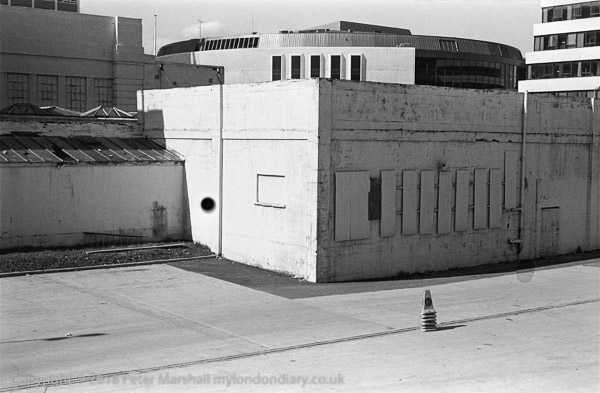
Another picture from that walk around Wembley (though I’m again not sure exactly where it was taken) has I think two clear processing faults, visible even in this small reproduction. I could of course have removed them digitally. Fortunately I think this was the only frame on that roll affected.

You can see thumbnails of my selected images from 1979 here.

______________________________________________________

There are no adverts on this site and it receives no sponsorship, and I like to keep it that way. But it does take a considerable amount of my time and thought, and if you enjoy reading it, a small donation – perhaps the cost of a beer – would be appreciated.

My London Diary : London Photos : Hull : River Lea/Lee Valley : London’s Industrial Heritage

All photographs on this and my other sites, unless otherwise stated, are taken by and copyright of Peter Marshall, and are available for reproduction or can be bought as prints.

To order prints or reproduce images

________________________________________________________
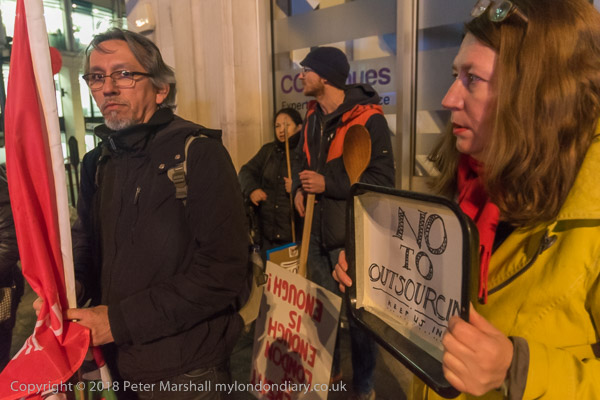
Success from City Office protest

Most of the protests by cleaners and other low-paid workers I’ve photographed have eventually led to success, though sometimes it has been a long and difficult struggle. One is now coming to an end after I first photographed them around 8 years ago, and I think it was then in its second year. Fortunately most are resolved rather faster.

Cleaners, like those at the City offices of Lee Hecht Harrison are almost always not employed by the people whose offices they clean or by the owners of the building, but by cleaning contractors who put in bids for the work. And since the lowest bid wins the contract, the company that pays its cleaners least, overworks them most and awards them the worst conditions of service – and sometimes on zero hours contracts – will be the winner. The cleaners of course lose.

I arrived late at the protest outside Lee Hecht Harrison as I’d been photographing another protest, part of the long-drawn out campaign by workers at Picturehouse cinemas to get the London Living Wage. That campaign by the union BECTU which is now a part of the larger union Prospect. Although the Picturehouse strikers have held a number of protests at half a dozen cinemas around London, the support they get from their union seems rather low key – and at Hackney there was a union official who appeared to be dampening down the protest, worried about the trade union laws (and I think confusing a protest with a picket, on which there are strict limitations.) But the UVW (who have supported various Picturehouse protests) are considerably less constrained, which makes their protests rather more effective.

There was a very different atmosphere on the crowded pavement on Gracechurch St, and it was far easier to take good pictures of the protest by the United Voices of the World which the cleaners belong to. The main problem was the crowding, not helped by their being a bus stop and shelter where the protest was taking place, as well as a constant stream of workers on their way home making their way through the protesters.

There was quite a lot of light in parts of the area, but mainly coming from the windows of the building in front of which the protest was taking place, with the faces of the protesters often in deep shadow. So while I didn’t use flash, I did quite often need to use the LED light to fill in these shadows.

I left the protest as it was coming to an end after an hour when the four cleaners went in to start their shift. As usual they are not employed by Lee Hecht Harrison but by a cleaning contractor, who had refused to talk with the UVW about the claim for a living wage, and had threatened the cleaners with the sack if they took strike action.

The noisy and very public protest obviously made LHH think about the problem, and I suspect they put considerable pressure on the cleaning contractor to come to a settlement with the UVW. The next protest planned outside the offices was cancelled at short notice when a satisfactory settlement was reached.

Companies like LHH – and Picturehouse – are making huge profits. Paying workers a living wage would hardly be noticeable on their balance sheets, and it is hard to know why they don’t do so without having to be pressured into it by union action. Plenty of companies have realised that it is only fair that those who work there get a living wage and some have done so without any prompting. The London Living Wage has been backed by all three London Mayors, though it would be good to see the current mayor, Labour’s Sadiq Khan, being considerably more proactive in the matter.

City cleaners strike at LHH for Living Wage
Star Wars Strike Picket Picturehouse

Lambeth Shame


Jeremy Corbyn on the banner really looks three-dimensional in this picture

Last Thursday’s local election results in Lambeth make rather sorry reading for democracy. It seems you can fool most of the people most of the time, and a 55% vote for Labour means that they now have 57 of the 63 councillors. There is a little good news in that 5 of the remaining 6 are Greens, including Green Party co-leader Jonathan Bartley, and it’s heartening that the Conservatives lost 2 of their three seats, though sad that both went to Labour.

One of the new Green councillors, Pete Elliott, elected for Gipsy Hill was pictured at the count in a ‘Save Cressingham Gardens’ t-shirt, and I think Gypsy Hill is the ward which includes another loved and under threat estate, Central Hill. One result that particularly saddened me was for Coldharbour ward – the heart of Brixton – where Rachel Heywood, the only Labour councillor who stood up for the future of the Brixton Arches (and for other things) was kicked out by Labour and stood as an Independent, failed to get elected. It would have been good also to see the Green candidates for this ward who were also active in trying to save these and other community assets elected, but Labour had a convincing victory, apparently helped by a rather doubtful endorsement alleged to have been extracted under threat from a black community leader.

There really is no good argument against electing local councils by a proportional representation which would give councils that far more truly represented the views of the population. Labour would still control Lambeth, but there would be a far more significant opposition on the council, which has for some time effectively been a one-party state.


An anarchist approach to playing the ukulele as Andrew Cooper speaks

Lambeth hasn’t really been a Labour council, but a Progress council, run by members of the right-wing Labour group. Its policies are not those which were in the Labour Party manifesto at the last election, but closer to those of Tony Blair and Margaret Thatcher. Members of Progress have actively campaigned against the current Labour Leader and are the source of most of the smears against him which have dominated the news since he became leader. Unfortunately the Labour right-wing still hold key positions in the party machinery which have meant that complaints over the behaviour of Progress members have no been investigated, while similar actions sabotaging the party from the left would have led to speedy expulsions.

The protest in December pointed out the huge cuts the Labour party have made in services for the disabled, mentally ill, youth and community and social services generally, as well as the closing down of traders in the railway arches at the centre of Brixton and the process of social cleansing in demolishing council estates and rebuilding them with developers largely as private housing at market prices and rents, forcing former tenants and lease-holders out of the area.


Lambeth work with Savills to turn council estates into private property

The event was also a vigil in memory of Ann Plant, one of the leading campaigners to save Cressingham Gardens, Ann Plant who died of cancer in December 2016, spending her final months still fighting to prevent the demolition of her home and her community by the council.

Photographically I had no problems in recording the event, with some fine banners and placards by Class War, Andrew Cooper and others livening up the images. But this must be one of the coldest street corners in London and there was a truly biting wind. Even with an extra layer of thermal underwear covering me from ankle to neck and a windproof hood over my Thermolactyl beanie I was shivering, and the two layers of gloves – silk underneath and wool on top – were not enough to keep my hands warm. Silk gloves are thin and great for operating cameras, but soon tear but are still useful if it isn’t too cold, and the wool add a little insulation while still allowing normal operation of mechanical camera controls. Thicker gloves would keep my hands warm, and I wear them for some things, but those I have don’t allow me to properly control a camera.

More pictures at Stand Up to Lambeth protest and vigil
______________________________________________________

There are no adverts on this site and it receives no sponsorship, and I like to keep it that way. But it does take a considerable amount of my time and thought, and if you enjoy reading it, a small donation – perhaps the cost of a beer – would be appreciated.

My London Diary : London Photos : Hull : River Lea/Lee Valley : London’s Industrial Heritage

All photographs on this and my other sites, unless otherwise stated, are taken by and copyright of Peter Marshall, and are available for reproduction or can be bought as prints.

To order prints or reproduce images

________________________________________________________
Against Slavery

We are of course all against slavery, but the protest following the posting of videos of slave auctions of African migrants in Libya was predominantly by Black British citizens, and although others shared their outrage it was understandably closer to them.  Many are here because slavery took their ancestors out of Africa to work on plantations in the Caribbean and elsewhere.

It was the wealth of slave plantations owned by white Britons, mainly those who owned large areas of their own country too, that enabled the building of squares like Belgrave Square where the protest met. Along of course with the mines they also owned in Africa and elsewhere, and are still exploiting, long after the end of the British Empire. Most of the leading mining companies are still London listed companies.

While we often celebrate – and rightly – the efforts of British people to bring an end to the slave trade its important to remember it was British slave traders and slave plantation owners that they were fighting against to get English law changed. And while the British navy was important in stopping slave traders, it did so to protect the commercial interests of those British-owned plantations which would otherwise have been undercut by foreigners still using slaves.

And while slavery went on the sugar plantations and elsewhere in the British Empire, this was by no means an an end to exploitation.  Nor of course to the continuing preaching of racist attitudes throughout the British population, with an often unstated but pervasive and unquestioned assumption of the superiority of the white race, and above all the English.  It was certainly an attitude that underlay the education I received and still obtains in much of our society with the ideas that we took civilisation to the ‘backward nations’ of Africa, India and even China.  Though my having one year with a Marxist history teacher helped a bit.

In reality, although they were some things we gave these countries, it was often at the expense of destroying civilisations and always of forcing them into subservience to the enrichment of Britain – and the other colonial nations.  And even though many of us in the mass of ‘ordinary people’ were oppressed by the same masters through evicitions from our common lands and the harsh conditions of factory employment that created – again with the aid of slave monies – the industrial revolution and an underclass working class, we too benefited from the exploitation of the empire and our colonies.

It was a large protest and ended in a small space outside the Libyan embassy, and it was difficult to get into a place with a clear view of what was happening during the ceremony in memory of the many Africans who have fought for their people against enslavement and colonialism.  But I’m pleased that I was able to record it – even if there were moments that I missed, limited through working in something of a crowd in a very small space.

Although I’m used to working in crowds, it was an event I found quite stressful, and had to leave not just because I wanted to go to another event, but because I began to feel a danger of fainting. I needed to get out and do something to raise my blood sugar levels, sit down and have something suitable to eat. Although people were friendly it was still something of a struggle to make my way through the densely packed crowd and find somewhere I could sit and rest a little.

Pictures and more about the event: National Anti-Slavery March

______________________________________________________
There are no adverts on this site and it receives no sponsorship, and I like to keep it that way. But it does take a considerable amount of my time and thought, and if you enjoy reading it, a small donation – perhaps the cost of a beer – would be appreciated.

My London Diary : London Photos : Hull : River Lea/Lee Valley : London’s Industrial Heritage

All photographs on this and my other sites, unless otherwise stated, are taken by and copyright of Peter Marshall, and are available for reproduction or can be bought as prints.

To order prints or reproduce images

________________________________________________________