Bethnal Green Blues

We had a fine day for our book-related walk around Bethnal Green and a good audience. Our meeting point was, for various reasons, the Museum of Childhood, which features in two of my pictures in Cathy’s book (‘The Romance of Bethnal Green‘ (ISBN 9781901992748), Cathy Ross, 2007). One shows the sculpture which was in the space at the front of the museum for many years, and I was surprised to find it now inside, at the rear of the cafe area, and given a white coating (perhaps so the ice-cream won’t show), and the other features some of the panels on the outside of the building about agriculture.


Bethnal Green, (C) Peter Marshall, 1986

So I chose to talk here instead about perhaps one of the most significant changes to the geography of London in the past 50 years, the small card rectangle of the Travelcard. My father lived in the London area for the first 70 or so years of his life, but probably never visited Bethnal Green, and the convoluted journey I’d made that morning on the way to the Museum would, before its introduction have involved me queuing to buy two train tickets and paying separate fares to 4 bus conductors. The Travelcard (and slightly later the Capitalcard), introduced by the Greater London Council led by Ken Livingstone in 1981, was a revolution in travelling across London.

It made a significant change in my photography. Previously I’d photographed Hull, a much more compact city, walking almost everywhere with just the occasional bus journey back to base from the city centre (a fairly massive project from which a gross of pictures were shown as ‘Still Occupied, A View of Hull‘ at the Ferens Art Gallery in 1983.)

Before the Travelcard, my work in London – with a few exceptions – had been limited to very specific areas, largely within walking distance of Waterloo or London Bridge, as well as pictures taken on visits to tourist attractions and other specific trips. The Travelcard opened up the whole of London in a new way – and among the areas I visited in a fairly systematic coverage of the capital was Bethnal Green.


Roman Road (C) 1988, Peter Marshall


Bethnal Green (C) Peter Marshall, 1993


Arnold Circus, Bethnal Green (C) Peter Marshall, 1986

Arnold Circus, shown above, was one of the places our walk took us, though it has come up in the world considerably since 1986. The first major slum clearance scheme from the London County Council, it was built due to the urging of the local vicar, Rev Osborne Jay, in 1890. Charles Booth’s great survey had marked ‘Friar’s Mount’, better known as the ‘Old Nichol’, as London’s worst slum. Jay also brought the writer Arthur Morrison to the area, and his ‘A Child of the Jago‘, published as the demolitions were taking place gives a horrifyingly real picture of the old area, and its people. Those who lived in the Old Nichol of course got no benefit from its clearance, simply being evicted and having to fend for themselves, decanted into the slums of surrounding areas, the new flats being let by the council to the ‘industrious poor.’

Around the corner at the new Rich Mix Cultural Centre lay the great disappointment of my day. Earlier, standing opposite the former site of ‘Camerawork’ I’d talked about the great days of the ‘Half Moon Photography Workshop’ based in Aldgate, and the magazine, ‘Camerawork’, the early issues of which – before it sank into theory-laden senescence – helped vitalise British photography, and of two very different important photographers associated with it I had known, Jo Spence and Paul Trevor. And I’d promised that people would be able to see why I think of Paul as one of the most important British photographers of the 1970s when we arrived at Rich Mix, although I had yet to visit the show myself.

Unfortunately we couldn’t. This is what we found:


Installation view: Paul Trevor’s work on display at Rich Mix (see note)

Images projected at a slight angle onto a wall mostly in fairly bright light from the large window area at the front of the building, pale and washed out. Of course they would look better at night, although the air vent will still hide the upper left part of the image . But more , but even then they all suffered from a curious squashing effect, presumably due to some digital reprocessing to make the images fit the format of the projector, but resulting in figures that looked like caricatures.

It’s hard to imagine that anyone could do something this badly. This is a show that has been well advertised and is in many respects the major event of the East London Photomonth. But it seemed to have been presented with less care than most people would take over showing their holiday snaps. (See note below)
Peter Marshall

PS

What we saw at Rich Mix was not the real show, which we should have seen when we went and sat down on the sofa downstairs. We sat down and had a little rest there (it had been a long walk) but there was nothing to see. I’d actually walked down the stairs expecting to see more, and was surprised to find nothing there.  It just hadn’t occurred to me that a gallery would switch an exhibition off during opening hours.

Urban Mutations

Listening to Sam Appleby talking about his series of night images of Crawley, one of the post-war war new towns, brought many resonances.

The presentation was the initial meeting of ‘Urban Mutations‘, a group initiated by Appleby and 3 others who have just completed an urban studies course. It took place in the Angel pub in Rotherhithe, a stone’s throw from the genesis of another gang of four (in Limehouse), but perhaps significantly south of the river. The first floor room, close to Cherry Gardens pier, looks out over the Thames, with views of Tower Bridge, the City and, in the other direction, the towers of Canary Wharf.

One image I couldn’t resist on my way to the Angel (its roof is visible at centre right.) Cherry Gardens pier, Rotherhithe and Canary Wharf; the figure caught in the centre appears caged in the centre of the gate.

My urban studies were of a more guerilla nature, starting on the streets of Manchester, walking through the cramped Victorian terraces of Hulme, learning to drive around their flattened acres of rubble, interviewing in the instant system-built slums (now in turn demolished.) Neighbourhood politics in Moss Side, including what I think was the first real exercise in public participation in the UK, “planning for real” with people modelling their own future (years later when the council knocked down what they went ahead with at the time, the next generation replacement bore an uncanny resemblance.)

From their I went to Leicester, sitting at the feet (literally, as there were usually more students than chairs) of Jim Halloran, one of the pioneers of Media Studies, as well as learning photography, and filming and editing hour after hour of live closed circuit TV.

My first job after Leicester was in a new town, Bracknell. The Development Corporation provided a large new flat at a decent rent – including enough space to set up my first darkroom, as well as an empty shop in the local shopping centre a few yards away dedicated to community purposes, where a few of us met regularly as a community photography group. I started to take photographs for the theatre group based in the local arts centre, and help in the hire darkrooms there, as well as setting up a photography course in the local comprehensive where I was teaching.

In many ways, Bracknell wasn’t a bad place to live, and much of the criticism of new towns in general is unfair and ill-informed – and is usually made from the perspective of Hampstead rather than Dagenham or the St Helier Estate or North Peckham.

Although Bracknell seldom inspired me, since then I’ve taken many urban landscape images, with shows on Hull, London and Paris. Some of these – together with work by a number of other photographers – appear on the urban landscape web site I run with Mike Seaborne.

Appleby’s view of Crawley was shown in print form at the Photographers’ Gallery in 1990 (it had started life as a tape-slide presentation.) At the time I found it an interesting set of pictures accompanied by the kind of theoretical baggage that fortunately seemed to bear little relation to what the photographer was actually doing.

It came at a time when theory had become all in many photographic courses, and it was de rigeur for gallery respectability to have a jargon-infested statement and presentation. As many shows were almost entirely composed of this, often with minimal, tedious, bland or even incomptent photographic content, Appleby’s work stood out.

There is a long history of night photography, stemming from the early days of the dry plate, with photographers such as Paul Martin in London and Jessie Tarbox Beals and Alfred Stieglitz in America, and continuing – for example in London in the 1930s – with books such as John Morrison & Howard Burdekin’s ‘London Night‘ (1934) and Francis Sandwith’s ‘London By Night‘ (ca 1935). One of the more influential books of the 1980s was ‘Summer Nights‘ by Robert Adams (1985) – this year at Rhubarb Rhubarb in Birmingham at least 3 of the roughly 30 portfolios I reviewed were clearly influenced by it.

Of course these photographers had worked in black and white, but in the 1970s we had started to see colour becoming respectable – even trendy – in fine art photography. Guys like Shore, Eggleston, Meyerowitz and the rest were shooting day and night and (among other concerns) exploring the peculiar colour response of films under different lighting conditions. Often the kind of peculiar effects of mixed lighting, of neon, tungsten and dusk skyglow.

Appleby’s images from Crawley very much explore the kind of alienating effect of typcial colour-deficient street lighting, notably the almost monochromatic sodium yellow (shifted more towards red in some images, either by dye characteristics or differential reciprocity of particular emulsions) and also the ghastly green peak of mercury vapour.

The images broke the photographic taboos of the amateur hobby press in this respect, as well as in their deliberate use of the tilted frame, a sometimes over-mannered bow in the direction of Rodchenko’s soviet modernism. Winogrand was of course at the time upsetting some by his tilted viewpoint, but in his images the framing follows a certain compositional logic based on the subject. In Appleby’s pictures it sometimes works in a similar way, but in others seems a deliberately upsetting device which didn’t always seem to suceed.

I was sorry to have to leave in the middle of the evening, and miss the further discussion by the group about urban issues. I look forward to further events.

Exciting Times for Black and White

It must be well over 18 months since I last went into the darkroom to make a black and white print. Until recently it wasn’t something I’d ruled out, just that I hadn’t had a need to do so.

I’ve now printed several shows in black and white using ink jet, including some quite important events – such as my exhibition for the 2005 FotoArtFestival in Beilsko-Biala, Poland, where I was chosen as the photographer to represent the United Kingdom. It can’t have been too disastrous, as I’m back there again in around ten days time, although this time giving a presentation rather than as an exhibitor (Mitri Tabrizian is batting for us this time.)

The work that I showed in Poland was from my London’s Industrial Heritage web site, taken in the late 1970’s and early 1980s, a kind of post-industrial landscape of London, largely based around the River Thames (but later extended to cover a wider area.)

Then I was printing using one of Jon Cone’s great Piezotone inksets, perhaps the first to really give great prints on fine-art matte papers, such as Hahnemuhle’s Photorag and German Etching. Few photographers really mastered printing on matte silver papers – George Krause is one of the few whose work has impressed me, although rather more have made fine matte prints using platinum – including the great masters of the medium, Frederick Evans and Dr Peter H Emerson. But using the Cone Piezography inksets (including the more recent K7 inks) makes it easy to acheive similar results.

A few years back, I had a platinum printer of some note come round to investigate making digital negatives for use in platinum printing. While he was here, I scanned one of his 4×5 negatives and made a Piezo print as well as the enlarged negative he wanted. It gave our meeting an uncomfortable end, as the print seemed to me considerably superior to the platinum he had previously made from an enlarge film negative.

Until around 18 months ago it was still clear that if you wanted really high quality glossy prints, the only way to produce them was in the darkroom. Then came the first generation of improved ‘fibre-base’ glossy inkjet materials, including Crane Museo Silver Rag, Innova F-Type FibaPrint and Hahnemuhle Fine Art Pearl, (and also their re-packaged equivalents, DaVinci Fibre Gloss Classic and Permajet Classic Fine Art Fibre Base Gloss.) These gave colour prints that more than matched those on the plastic RA4 colour papers, and black and whites that were hard to distinguish at least from run of the mill silver prints, although still perhaps a little lacking when compared to the best the current darkroom has to offer – and certainly inferior to the Holy Grail of the old formula Cadmium ridden and highly environmentally friendly Agfa Record Rapid of blessed memory.

Now we have a second generation of fibre-base inkjet papers, so far including Harmon’s Gloss FB Al, Hahnemuhle’s Fine Art Baryt and, perhaps most interesting, the first such paper from an inkjet printer manufacturer, Epson’s Exhibition Fiber, available from next month. So far all I’ve been able to do is read the reviews, such as this on Luminous Light.

I’m already thinking what I can do with my darkroom. At the moment the most likely use is storage for all those Terabyte disk arrays I’m going to need for the incredible amount of digital files I’m currently shooting on the D200 for ‘My London Diary.’

Nan Goldin – Police swoop

A set of 100 photographs by Nan Goldin, owned by Elton John, were due to go on show at the Baltic Centre for Contemporary Art in Gateshead from 21 Sept until 6 January 2008. But presumably there are only 99 on the wall, as one image was taken into custody last Thursday and is being examined by the police and the Crown Prosecution Service, who are considering prosecution under the 1978 Protection of Children Act.

It is hard to see any sensible purpose that can be served by this action. Goldin is a highly admired photographer whose work has been shown in galleries around the world. She herself had a tough childhood, suffering abuse and running away from home at 11 after the suicide of her sister. Her work has always reflected her lifestyle – a mirror on her life.

Some years ago I wrote: “I find it difficult to imagine the position she was in, with these immense emotional pressures coming at an age when I was still in short trousers and being taught that sex was a Latin numeric prefix. Life was not without its traumas, but mine were less dramatic. Goldin was confronted in those sudden and tragic events with forces that most of us become aware of slowly over a period and evolve mechanisms to deal with or repress, and it is hardly surprising that the issues behind them have dominated her work. I don’t share her lifestyle or some of her attitudes, but I admire the honesty and clarity of her approach.”

What the police have seized is a photograph, which, according to The Telegraph,  shows “two young girls, one sitting down with her legs wide apart”. I don’t know anything more about it and the circumstances in which it was made, although I have seen a great deal of Goldin’s work. Much of it has been published – and this may well be an image that is widely available in bookshops here and elsewhere.

The Telegraph states that she “is well known for her shots of young, semic-clothed girls” which is both incorrect and entirely misleading. Young semi-clothed girls may appear in her work, but so far as I’m aware, have not been a major pre-occupation; what appears in her work has usually been what appears in her life. Most of the people she has photographed has been her friends and she has rather more often been a victim than an abuser.

Child abuse is a serious problem and minors need protection, but I would be very surprised if the children involved in this image were being seriously abused or were in need of the protection of the Northhumbria police. What I am sure of is that police time could be better employed investigating the real abuse of children (and other crimes) that will be occurring in Gateshead while they waste their time on this case.

The law has a long history of making itself an ass over art, and this looks very much like another episode in that ongoing saga. The publicity of course will not be doing the Baltic Centre for Contemporary Art any harm, (and here I am adding to it,) which could well be why one of the assistant directors there called them in.

You can read a lengthy feature on Nan Goldin on here this blog

Peter Marshall

CS2 going cheap

One of life’s truisms is that if something sounds too good to be true it probably is. So when I heard from Tony Sleep that genuine shrink-wrapped copies of Photoshop CS2 (not the latest edition, which is CS3) were going cheap, I was suspicious. But I did take a look, and they looked absolutely kosher, and some were from sellers with excellent feedback.

The story was that they were old stock that was being sold off cheap for clearance. Tony had bought a copy, and everything about it looked genuine. Later he notices that although he had installed it and found it worked fine, the activation process hadn’t set him up an account with Adobe. Another buyer then informed him that having had the same problem, he had contacted Adobe, who had told him the serial number he had was not genuine. Tony also contacted them and was told the same.

Being Tony, he didn’t leave things there, but took it up with Adobe, and also started doing a little research. The printed material is of such high quality he feels sure it was produced from genuine Adobe files, and Adobe appear to have known about the forgeries for several months, since May or June of this year. Ebay has a procedure called VeRO, (Verified RightsOwner Program) which enables companies such as Adobe to put a stop to such things more or less immediately, but have failed to take action. I checked again today and found over 20 copies still on offer, all presumably counterfeit.

You can read more about the scam and Adobe’s failure to act on Tony‘s blog. Photoshop must be one of the most widely pirated programs around, and whenever I mention in a group of photographers that I’m still using Photoshop 7, I get offers of CDs containing pirated versions of CS2 or CS3. Most of these were either downloaded free from ‘warez’ sites or bought for a few pounds – sometimes from eBay – while the current ‘genuine’ fakes seem to go at auction for around £120.

I didn’t upgrade from PS7 mainly because it seems to do all I want, and also because Adobe had added an ‘activation’ routine to the software which not only meant you had to contact them to keep the software running (which is acceptable if extremely annoying when your computer has a hard disk failure or the operating system needs re-installing) but also wrote to areas of the hard disk it had no business to access.

Like many photographers I hope that someone is going to come up with a viable alternative to Photoshop for various reasons (and it would be nice if it ran on Linux as well.) One project that looks promising is Pixel, from Pavel Kanzelberger in Slovakia, though there are still some vital aspects missing.

Many of us need software that understands colour management and that can also convert to and work in CMYK when we really have to, as well as working with 16 bit files and running useful Photoshop plugins offering noise reduction, smart sharpening, lens distortion correction and so much more. In many ways Photoshop is just a framework for other software, and there are huge areas of it I never use directly. I certainly don’t need the whole ‘Creative Suite’ that Adobe is trying to push at us.

Peter Marshall

A Leading Photographer?

Like many photographers around the world, I’ve been following the story of the late Joe O’Donnell with some interest. If you’ve been on Mars or Venus, O’Donnell died at the age of 85 on Aug 9, and on Aug 14 the ‘New York Times’ published an obit under the heading “Joe O’Donnell, 85, Dies; Long a Leading Photographer.” Unfortunately, the two pictures included were taken by other photographers and much of the information within the article was incorrect. Similar obits appeared elsewhere, many relying on the NYT as their source.

I have to declare a particular schadenfreude at these events. As attentive readers will know, I wrote the ‘About Photography‘ site for almost exactly eight years until May 2007, establishing it as a major on-line resource on photography and for photographers, in particular dealing with the history of photography, with hundreds of short features and a considerable number of longer essays on leading photographers among the content.

After ‘About.com‘ was bought by the New York Times for a ridiculous number of millions (not that I saw a penny of it), new management came in, photography as we know it was out of fashion, and eventually I was out of a job. The suits decided there was more money in catering solely for beginners, and the presence of more advanced material (I also had plenty of good advice for new photographers) was deemed an off-putting ‘user experience.’

Not of course that the NYT would have dreamed of asking me for advice even when I was on the payroll, although in this case a single e-mail to me or indeed to almost anyone else in the photographic world could have prevented their gaffe.

The real scandal of this event is that the NYT obviously has no-one on their staff who knows that much about photography – or cares about it. Or even worse, since apparently from their ‘explanation’ published on September 16, both the writer and the night photo editor had certain doubts about aspects of the feature, that the NYT is happy to publish material it knows is questionable.

Even had it all been correct, the headline would have been more hype than reality – if he were a leading photographer we would all have known his name.

Stories and confusion 

We know many photographers (if not all) like to tell a good story, and seldom let the exact facts get in the way, though often there may be a kernel of truth. One of the greatest of all story-tellers was of course Robert Capa (who even invented himself and was a great photographer), but at least Capa knew which pictures he had taken.

O’Donnell in many cases probably didn’t, even at the time, and certainly not in the 1990s. He worked for 20 years for the United States Information Agency, and in those days photographers were largely anonymous. At some of the events he photographed there would be a whole crowd of photographers standing more or less in the same place and often taking more or less the same pictures. Films from a number of photographers were often developed together and it wasn’t that unusual for there to be disputes about who took which picture.

From around 1994, O’Donnell had suffered increasingly from dementia, and it seems likely that he actually believed the images were taken by him – and he copyrighted and tried to sell them. From some of the interviews he gave he obviously suffered from delusions. The fullest, most carefully researched – and most sympathetic account of the whole case I’ve so far seen is on the NPPA website.

John-John’s Salute 

One of the pictures falsely attributed to him was a Stan Stearns image of the young John-John Kennedy making a salute at his father’s funeral. There were 70 photographers present, all crammed into a small pen at some distance from the family. Although it has sometimes been said than Stearns was the only photographer to catch this moment, this was not the case – and it was of course also seen on TV. At least 4 of the other photographers took very similar pictures; what made his famous – as the NPPA feature makes clear – was an astute picture editor, Ted Majeski of UPI, who took a very small section – less than a twentieth of the frame – and put that on the wire as a separate image of the boy’s salute.

For the remaining 65 or so in the pen, this would have been an obvious opportunity not to be missed, although some may have had their view blocked by a marine. As yet it hasn’t been established whether O’Donnell was even present, but if so, he may well have take a similar image. What is certain is that neither he nor the USIA realised the potential of a cropped version at the time.

Hiroshima & Nagasaki 

O’Donnell did apparently take some rather remarkable images as a young man in Japan, visiting Hiroshima and Nagasaki while he was in the Marines as a photographer. He took two cameras with him, shooting on one for official use and keeping the pictures from the other for himself. He smuggled the films back to the US hidden in a photographic paper box and the family still have negatives and contact sheets.

Many years later O’Donnell became an anti-nuclear activist, and brought out his old pictures to show the horrors of nuclear warfare. The Smithsonian Institute planned to show some in 1994, but gave way to pressure from veterans groups who claimed they were too sympathetic to the Japanese – they were later published as ‘Japan 1945: A US Marine’s Photographs from Ground Zero (2005). Even among this work there was one image he claimed that was taken by someone else.

Japanese photographer Shigeo Hayashi had shot a panorama from a rooftop in October 1945. The print was confiscated by the US Authorities at the time, and probably ended up in the US National Archives. O’Donnell visited there in the early 1990s and is suspected of having stolen a number of unaccredited prints that he believed he had taken – probably also including those by other photographers which were shown as his work.

Moral Rights 

The whole story I think stresses the importance of photographers moral rights, almost entirely unheard of in the 1940s and 50s, and still often denied. Look at any British newspaper and you will almost certainly find most of the photographs are uncredited; even more annoyingly, images where the photographer is certainly known are often simply credited to an agency. Attribution should be made legally enforcable, with publications that print images where the photographer is not credited being required to publish a correction where it can be established who took them.

Copyright 

There are also issues of copyright in this case. O’Donnell claimed copyright on the images that he thought he had taken, presumably through registration at the US Copyright Office (what a shame that it still exists, despite Berne.)

Even if the pictures were actually his, images taken by employees in the course of their work for the government are not eligible for US Copyright. This appears to have escaped the notice of O’Donnell and the Copyright Office, just as it also seems often to do so for some of the mega-agencies, (and they also claim copyright on many images where it has long expired.)

Unlike O’Donnell, they cannot claim the excuse of dementia, and unlike them, there is little evidence that O’Donnell every made much if any money from his copyright fraud.

Peter Marshall
Not A1 at Lloyds

When the idea of Open House days first came up I thought it was a great one, and in the first couple of years I went into quite a few places otherwise inaccessible to the public, and even took a few pictures, although photography wasn’t always allowed. Now it has perhaps become too popular, and except for those locations where you need to book in advance (and where places tend to fill very rapidly) there are often extremely large queues.

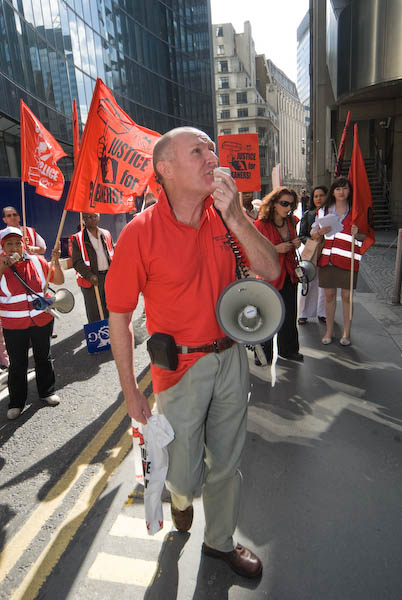
One of the longest queues this year was at the Lloyd’s building, and the London Citizen Workers took advantage of the event to hold a demonstration. Cleaners at Lloyd’s – whose members are among the wealthiest people in the country – are some of the lowest paid in the capital, and the contract firm that employs them apparently provides no sickness pay or other benefits. They have so far resisted the campaign by the LCWA for a ‘London living wage’ for cleaners, which demands £7.20 an hour, along with entitlement to sick pay, holidays and access to a recognized trade union.

It was a small but vociferous demonstration, and some of those queuing expressed surprise at the poor treatment of the people who keep the Lloyd’s building clean. The Living Wage campaign reveals the poor treatment of essential workers, who are trapped in a ‘working poverty gap.’

Technically it was an interesting but difficult job. More film and megabytes have been used on the Lloyd’s building than any other modern building in London, and its shining silver surfaces have a definite appeal to photographers. The red banners and tabards of the demonstrators added some exciting colour, and the strong sunlight coming down the street some powerful lighting effects. But although visually stimulating, it was murder to photograph, with contrast hitting the extremes.

Picket at Lloyd's London

At least with digital you get a clear view of the problems you are facing, although in this case they were not entirely soluble. Although flash fill can bring up the foreground, it could not deal with the lower floors of the building which were in deep shade while the upper levels were in bright sun. A few years back I would have shot this kind of thing on black and white without fill (as a colleague was still doing with his Leica and doubtless getting great pictures) and probably cursed on location my inability to take wider images, and back in the darkroom cursed the empty shadows and dense highlights.

More pictures on ‘My London Diary‘.

Peter Marshall

Not Another Drop

Saturday I photographed a demonstration at which the police could not have been more helpful. Perhaps hardly surprising, since they were a part of the ‘Not Another Drop‘ campaign started in 2001 by the Community Safety Partnership uniting the Met and Brent Council. The annual Peace March – this was the fourth – was founded by Patsy Hopwood, whose student son, Kavian Francis-Hopwood was shot dead on the Stonebridge Estate in 2003 – still an unsolved crime.

Supporting the march were several local church groups (including a Brazilian congregation from the area) and families of several of the many young people who have met similar violent deaths in Brent in recent years, many of whom were shown on posters carried in the march. Although obviously the aims of the march can only be applauded, it was perhaps disappointing not to see greater support from the various communities in the area, with only around 250 gathering for the start of the march at Stonebridge, although more were expected for the rally at the end of the event in South Kilburn.

One of the trickier parts of the event for the half-dozen or so photographers present was the release of white doves shortly before the march started. I’m still not quite sure whether to rely on my reflexes or the 5 fps mode of the D200 to try to catch the peak moment. What I actually did was to try to catch the moment and then hold my finger down to get the next few frames at 5 fps. In fact the second exposure turned out to be the best, but I was left wishing I had one slightly earlier – and perhaps slightly later. It’s one of the few situations where I’d really like to have the 9fps that Nikon promise us for the D3 due later this year.

More pictures from the event on My London Diary.

Bad Press?

Yesterday I was out covering protests against the arms fair taking place in East London as a freelance photographer. I wasn’t commissioned but I hope to sell some of the pictures through the libraries I place work with as well as possibly direct from my own ‘My London Diary’ web site where they will be posted shortly. I’ve also already contributed a couple of short reports to ‘Indymedia‘ on both the march by the ‘Campaign Against the Arms Trade‘, here passing down the Barking Road,

CAAT March on Barking Road

and the Space Hijackers, who hired a tank (or at least some similar military vehicle) to take

CAAT March on Barking Road
themselves to the event after the police had stopped their own real tank. In the picture it has just arrived and stopped outside the main vehicle gate of the arms fair.

Like most news photographers, I have a press card. On the back of mine it says “The Association of Chief Police Officers of England, Wales and Northern Ireland and the Association of Chief Police Officers in Scotland recognise the holder of this card as a bona-fide newsgatherer.

A few months ago a joint working party of police and journalists came to an agreement over guidelines for relations between the press and police, recognising the need to allow proper access to events and cooperation between police and those carrying the card.

Unfortunately although the Chief Police Officers may recognise the card – and have read the guidelines, too many officers lower down haven’t. Yesterday, when asked at one point to show my card, I was even told it wasn’t a real press card and the officer concerned wouldn’t recognise that I was press. Last year I took a picture of a fellow photographer and union member having a similar confrontation:

In his case, the police held him inside a cordon for 20 minutes although several colleagues showed their own cards to make it clear his was genuine. I was lucky in that I was just threatened with arrest if I didn’t stop arguing and get back on the other side of a police line. So I did as I was told despite being rather worked up. Unfortunately although I told him I was taking his number I was so agitated that I forgot it before I could write it down, so I can’t make a formal complaint. I thought I had it on a picture, but it isn’t visible.

I’ve lost count of how many times I’ve been threatened with arrest for just trying to do my job. I don’t think I’m getting any special treatment, and other photographers who photograph similar events suffer in the same way. Mostly I get on well with police, and they are sometimes very helpful, and of course I recognise that they often have a difficult job.

In handling demonstrations such as this by the Space Hijackers, they do seem to me to make the job more difficult for themselves by deliberately provoking the demonstrators, often moving them – as they did me – for no good reason and imposing arbitrary restrictions. The continued and over-aggressive photographing of people also raises the temperature and can be of little real use – they must by now have several thousand images of me on record.

Police photograph partying demonstrators
Demonstrator and police photographer

I go to events aiming to record what happens, to tell the story – as I see it – using my camera. I like to think of my camera (and flash) spreading a little light on what is happening, and making it known to a wider audience.

Some police – not all, but too many – seem to want to keep things private. They would prefer the press didn’t come along to demonstrations, or at least stayed in a nice neat area somewhere under police control. They think of those of us who cover such events and interact with the protesters as ‘bad’ press.

More pictures from both events on ‘My London Diary’ shortly.

Peter Marshall 

Around Heathrow

This morning I rode to Southall on my push bike, the 1957 vintage Cinelli that was my best birthday present ever when I was 13. It was a real racer, and had spent the previous season being pounded over the cobbles of Europe by a guy who got himself a new road machine every year.

Now, like me, its a lot older and in a pretty sorry state. Wheels almost twice as thick and tyres several times fatter when I got fed up with mending punctures in thin racing tubulars and indignities such as a carrier and pannier, not to mention rust, scratches, some rather careless paint jobs and a ton of greasy hardened on dirt.

It still rides fairly well and gets me places, but is the kind of bike you can leave on the street almost anywhere and expect to find it there when you come back. I do usually lock it, but more for my own peace of mind rather than thinking that anyone might otherwise take it away.

Cycling through light rain along the edge of the airport at Hatton Cross I saw two police standing in the refuge at the cross-roads. I think they only bothered to stop me because they were bored – there were really very few people around at half past ten on a wet Sunday morning.

Are you going to join the climate camp I was asked, and I replied no, I was on my way to Southall to photograph a religious procession. And since I carry a UK Press Card, supposedly recognised by “The Association of Chief Police Officers of England, Wales and Nothern Ireland etc” I got it out to show them. I thought that should have been enough, but they decided to go through the whole business of taking my details and searching my bags etc.

The two officers were at all times polite – and we had a reasonable and pleasant enough conversation, and it relieved their boredom a little, while only holding me up for around five minutes. But I don’t like the process and it seems like something from the kind of police state I don’t really relish living in. It also seems to make a mockery of the Press Card, which should serve to identify me and gain the cooperation of the police.

Police Search form

After I’d been to Southall, I had to cycle back past the airport again, and this time went along the A4 which runs along the north side of Heathrow. Parts of it were swarming with police, and I did photograph a few of the demonstrators (and a proud mother.) I was pleased to see them too – it really is time that we got rid of Heathrow, built by deception in the wrong place 60 or so years ago.

Demonstrators and Mother

A little further on a stand-off was developing around some BA offices, but things didn’t look promising for the demonstrators. The place was buzzing with photographers and film crews and I decided I wasn’t going to get anything different to the crowd, so I moved off down the road to see if anything else was happening. I met a few more small groups of demonstrators coming along the road:

Demonstrators and Police

each group accompanied by a police van. The police were for some reason making a big fuss of photographing the clown army. They still haven’t learnt that the best tactic with clowns is to ignore them – unless they actually commit a crime.

Clown Army

I’d seen enough to be fairly sure that nothing much was likely to happen along the A4, and I checked out BA’s Waterside HQ. There they had police horses and a lot of guys in their black fighting gear wandering around the grounds with absolutely nothing to do. I didn’t stop to give them another chance to harass a photographer.

I couldn’t be bothered to try the other side of the airport, where more might be happening (it was, as I later heard on the news), and came home.
There will be a few more pictures from Heathrow on My London Diary shortly. And some rather more interesting images from Southall.