Magnum Magnum

Three posts on the Magnum blog let you take a look at three sample chapters from the incredibly weighty recently published “Magnum Magnum” in which Magnum members write about other Magnum members and half a dozen of their photographs. The book weighs in at 6.5 kilograms, almost a stone for those who still think in old money.

The samples on line are Chien-Chi Chang by Bruce Davidson, Eve Arnold by Elliott Erwitt and, to me the most interesting, Antoine d’Agata by Patrick Zachmann.

Chien-Chi Chang’s work is great, but perhaps I find it a little too pretty – but I also respond that way to some of Henri Cartier-Bresson’s work.

I have to admit to a blind spot so far as Eve Arnold is concerned. Of course her work is very professional photojournalism, but it seldom makes me sit up and take notice. Her portrait of Francis Bacon – one of the six – is fine, very recognisable, tightly framed, nice colour, but really pales beside Bill Brandt‘s photo or the artists’s own self-portraits or those head shots by John Deakin and Dmitri Kasterine or… And I wonder what Brian Griffin would have made of him (I was pleased to be at Space in Hackney yesterday on the last day of his show there to hear him talk about his career, and about making many of the portraits.) Don’t get me wrong, I would certainly have been pleased to have taken a picture like hers, but it just seems to lack the spark of the others. The only picture among her six that strikes me as a little special is the Mormon Tabernacle Choir, which could so easily have been extremely boring.

What I like about d’Agata‘s work is the element of surprise or even shock. Zachman writes about this very well, and I won’t attempt to repeat or better him. Where I don’t think he really does the photographer justice is in his choice of six images, with a couple that are surely not among his best images. Take a look at his Magnum portfolio and you will find it hard to avoid the same conclusion.

You can currently see d’Agata‘s work at the Photographers’ Gallery in London until 27 Jan, 2008. It is worth a visit, although I think the display is rather poor compared to seeing his work on screen. As well as large images from the series Insomnia (2003), the gallery has a montage of several hundred small images from other projects including Vortex (2003) and Stigma (2004), which for me are far too dominated by the way they have been put in frames and fixed to the wall. Many are also virtually impossible to see.

Magnum Magnum seems to me to be a volume making a great case for the death of the book and its replacement by some more convenient viewing method. Or else trying to be both book and trouser-press or exercise equipment. Surely it can’t be long before we can have a lightweight device with a large, paper-quality viewing screen, given that small and slightly primitive versions such as Amazon’s Kindle have appeared.

Cannon Balls to Fenton

I have to admit that when I first read Errol Morris‘s lengthy blog post on which of two Roger Fenton images of the ‘Valley of the Shadow of Death‘ where the Light Brigade charged to its death in 1855, my first thought was “who cares?” Or, as Simon Grant put it last year in his piece for the Tate, “Does it matter?”

In fact I still somewhat feel that way, but there is no doubt that the controversy that his article and the follow-ups to it have aroused are of interest. You can read part 2 and part 3 here – the link on his blog is now incorrect. (though perhaps he will put it right if he reads this.)

Fenton made two pictures of the valley. One with no cannon balls on the road, but plenty on the rougher and apparently lower ground at its edge and the second with quite a few on the smoother road.


Library of Congress: http://hdl.loc.gov/loc.pnp/cph.3a06028

Ask yourself as a photographer, going to photograph this scene, whether it is likely that you would decide to clear off the road to make another photograph? Can you imagine Fenton saying, “Marcus my man, just tidy up that roadway there’s a good chap, those cannon balls just look too untidy.” and Sparling saying “Yes Sir, right away” getting down to it? (You might also ask why so many balls should have stopped rolling on the smoother road rather than going down into the gully by its side, especially if you’ve ever played bagatelle.)

Then read many thousands of words and consultations with experts of all kinds by which Morris finally proves (in part 3) – at least to his satisfaction – what I think any successful working photographer would have known all the time.

But I’m being unfair, because a) other people have suggested the opposite, and b) much of the discussion the issue invoked is fascinating. Point a) perhaps just goes to show that many people – even people with big reputations – who write about photography are basically word guys who’ve never really worked with the medium. But read it – along with Morris’s earlier pieces, Liar, Liar, Pants on Fire and Will the Real Hooded Man Please Stand Up for some fascinating argument that often relates to the peculiarly American obsession about not posing or in any way interfering with news photographs. (His latest piece,
Primae Objectiones Et Responsio Auctoris Ad Primas Objectiones (Part One),
is a reply to some of the over a thousand comments made about his previous Fenton pieces, and is also worth reading, although I feel at times far too long-winded and suggesting he has run out of anything fresh to say. Given the number of words he has now expended on the issue, I’m only surprised he hasn’t yet found the 7th Lord Lucan, descendent of the unfortunate 3rd who got Raglan’s order to charge in 1854, carrying it out to the letter despite knowing it was mad. Almost as mysterious is the change of the Lucan Arms, down the road from me towards Laleham, once a decent local, now morphed into the abysmal and anonymous Anglers Retreat.)

I’m a photographer who doesn’t like to pose things, and have spent an awful lot of time cursing (if usually only inwardly) the guys from the big print (what we once called ‘Fleet Street’ – about all that’s left is the Cheshire Cheese) as they get in and interfere with the people I’m photographing. But even though I don’t like to pose people, I’m very aware that I can’t photograph without a point of view.

Property Licences – who needs them?

I’ve written several times over the years about property licences.

Basically saying that in general there seems to be no justification for them, either in this country or in the US, although that doesn’t stop some agencies and libraries asking for them, and certainly some clients won’t use your work without one.

I’m not a lawyer, but in the past I’ve read all the legal advice I could find in books and on-line about the issue, and been unable to find anyone suggesting there was a legal basis for the requirement.

One site that I trust more than most is PhotoAttorney, written by Carolyn E. Wright, of Decatur, Georgia and a real expert in US Law as it applies to photography, and this week she has again repeated her position, which goes a little further than mine – and certainly carrys rather more authority – that it is probably “detrimental for photographers to obtain property releases.

Her comment applies to all kinds of property, although where I most often come up against it is photographing buildings. Fortunately I don’t work in the USA, where photographers have to do a little research as architectural historians, since – as it says on the US copyright site, “Copyright protection extends to any architectural work created on or after December 1, 1990.”

In the UK, copyright law specifically exempts buildings, and we can probably photograph almost any building from a public place without worrying about copyright – and generally make use of the images without copyright releases.

There is even apparently no problem when photographing sculptures that can be seen ordinarily from a public place in the UK, although you do need to respect the artist’s moral rights – in terms of attribution and not treating the work in a derogatory fashion, at least if the work is included in more than an incidental fashion.

There are also a few well-recorded pitfalls. If you want to photograph the Eiffel Tower, don’t do it at night, because although the structure can be photographed freely, its lighting is apparently copyright (and copyright is also claimed on some other buildings – including the Louvre and its pyramid.)

However even in France it is likely to be OK to publish pictures so long as your picture is a wider view including other buildings, and copyright laws in some other countries do not recognise the French claim. Well-known properties in London which are claimed to be copyright apparently include the London Eye and the Gherkin . You can read lists including these and other claims on some stock photography sites, such as iStockphoto.

Buildings, particularly in the US, can also be trademarked, which can also put their use off-limits for commercial photography without permission – and examples of these are also given in these lists. At this year’s NUJ Photographers Conference barrister Henry Ward, who specialises in copyright, gave the opinion that this “doesn’t hold water” in the UK (but also gave apparently contradictory advice on the copyright of buildings such as the Gherkin, at least according to the London Freelance feature.)

One problem familiar to UK photographers is the London Transport logo. If this is the point of your picture you may have problems (although probably unless you were actually using the image to promote something transport-related there would be little actual legal case) but it would clearly be unreasonable for any objection to be made if it is incidentally included in your picture taken on a London street.

Back to the PhotoAttorney blog, Wright’s recent posting on property releases is of particular interest, because it recounts a case where the need for these is currently being put to test. The College of Charleston Foundation has taken photographer Benjamin Ham to court over a picture he is offering for sale of some of their trees, accusing him of trespass, invasion of privacy and ‘conversion’ – which appears to mean profiting from the use of college property in his picture.

As Wright points out, some of the claims seem odd, and at least one unsupported by any reference to a specific law, but it does seem as if this may be an important test case for photographers – assuming that it is taken to a conclusion.

However a complication in the case is that the College alleges that the photographer “passed through locked gates” (how?) and ignored signs prohibiting trespass in order to take the picture.

It will be interesting to see whether the case is actually determined by a court, and if so what the decision will be – and I look forward to reading Wright’s comments. However the parties may well come to an agreement out of court.

Bilal Hussein and Press Freedom

If you are a photographer and work in Iraq, you run the risk of being imprisoned by the US military. The Committee to Protect Journalists claim that “dozens of journalists – mostly Iraqis – have been detained by US troops over the last three years.”

They get arrested for photographing or filming things that the US army would prefer not to be recorded. Those we know about were mainly working for major foreign agencies such as Reuters and Agence France-Presse, although I wonder if in fact we only know about these people because they were employed by the agencies. Are there many more we don’t know of?

Most get released without charge after a few days or weeks, but the site lists eight cases of more prolonged detention of up to a year. The details of each case ends with the statement: “Charges Substantiated: None

Of course the best known case is that of Associated Press photographer Bilal Hussein, who has been held for almost 20 months. I’ve previously written about him here (and elsewhere,) and linked to the campaign to free him, urging others to join in the petition to free him.

His case at last came to the Central Criminal Court of Iraq yesterday, 9 Dec 2007, but the magistrate issued an order that everything should be kept secret, so the AP report can only report the bare facts. Although Hussein and his lawyer were allowed to see some of the material presented to the court, they were not allowed to take copies to use to prepare his defence, and no actual charges were made.

Hussein and his lawyer have also not been allowed to talk privately in order to plan a defence; their meetings have been held with a US soldier and military interpreter present.

It is now up to the Iraqi magistrate to decide whether there is any case to answer – and if so, it will be dealt with by a panel of three judges. It isn’t clear how long this will take, and certainly at the moment there are grave doubts about whether if the case does come to trial Hussein and his lawyers will be given the opportunity to prepare a proper defence so that he can get a fair trial.

Here in the UK of course we do things differently, although perhaps not so differently if you read the time-line of the SOCPA antics by police and courts as published on Indymedia. It is news and I think important news that has hardly been covered by the mainstream press.

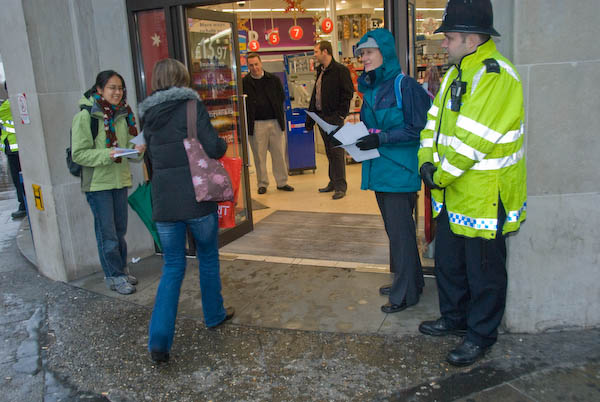
One thing that gives photographers (and videographers) covering events such as these on our streets a little – if limited – protection is the UK Press Card. It isn’t perfect, but it does at least sometimes mean that photographers will get treated as reporters rather than as protesters. This Saturday, photographing a picket at Tesco Metro in Lower Regent Street, I would quite likely have been arrested for refusing to go into a pen when told to do so by a police officer if I hadn’t been able to show my card.


Picket against Tesco support for bio-fuels, London, Dec 8, 2007

Strangely enough, most of the times when I’ve really needed a press card have been at small events – like that picket – where the mainstream press aren’t interested and none of the photographers working for them cover.

I photograph them – as do others – because we think it important in terms of freedom of the individual, freedom of expression and a genuinely free press that such things should be recorded and published – even if only non-commercial media – such as Indymedia – are prepared to do so. Most of us also make some money out of such pictures through their use in small publications and as stock. Not a great deal, but with luck enough to make ends meet, at least along with the occasional more lucrative jobs.

Some news photographers are scheming to severely limit the issue of press cards, basically to guys like them working more or less full-time for the big newspapers. It is a change the police would welcome as making their job considerably easier, but which would severely curtail the wider freedom of the press.

Peter Marshall 

Make a fortune from copying

If I were Jim Krantz I’d be talking to a lawyer.

In 2005, of his pictures sold for $1.2 million and he didn’t get a cent. Not even a name check. Trousering the big money is Richard Prince, an acclaimed artist, whose contribution was to copy and enlarge Krantz’s image, taken as a Marlborough ad – and apparently – if the reproductions on Art Knowledge News and the New York Times are reliable (Randy Kennedy’s article appears in both), add a colour cast.

Of course the whole thing is an incredible admission of a total aridity in the art world, and of course the total lack of appreciation of photography – Prince is quoted as once sending an e-mail saying “I never associated advertisements with having an author.” What phenomenal ignorance and arrogance.

Krantz of course is such a successful commercial photographer that he doesn’t need the money, and what he is really concerned about is “attribution and recognition.” But I’d certainly like to see him take Prince to the cleaners.

And I’d like to see all the art critics and increasingly photography critics who for some odd reason feel that Prince’s work is worth writing about to acknowledge that what they are really writing about is work by other people – just blown up large.

I’ve written previously about the importance of moral rights. This is a good example that makes the case.

You can also see Jim Krantz’s ‘art work‘ on line. Not entirely my kind of thing, but more interesting than Prince.

Photo Histories

Some months ago, Graham Harrison contacted me about a new on-line photography site he was setting up, looking at photography in an intelligent way, and invited me to have a look at the preview site. I was impressed, and offered to write something, though as yet I’ve not got around to it. Perhaps later…

Photo Histories is now up for all to read, and the content so far is impressive, with a great interview with Philip Jones Griffiths, who talks about “why the ideals of the thinking photojournalist forged in the 20th century should not be sacrificed for the dumbed down culture of the 21st.” His ‘Vietnam Inc’ (1971) was one of the most important books of the era, and one that moved me and others powerfully when it came out – and is still a fine example of why photojournalism is important. I also have a great deal of sympathy for his views on the current state of Magnum which you can read in the interview. While others – including myself – have written about his work and its significance, this interview does add some insights into the work and the man who produced it – and has a nice picture of him by Harrison.

Another photographer I’ve also written about previously is Homer Sykes, whose self-published books Hunting with Hounds and On the Road Again I reviewed at some length. (You can download a pdf file of the Autumn 2002 issue of the LIP Journal where my review of On the Road Again appeared in print – and both – along with features on photographers Berenice Abbot and Brassai mentioned below – are probably available on the ‘Wayback Machine‘ or its mirror from About Photography.)

In Photo Histories there is another detailed interview with Sykes, as well as a interesting set of pictures ‘Unknown Homer Sykes : The English 1968 – 78‘.

I met Homer again earlier this year, when he was back photographing Swan Upping on the Thames for the first time for many years. You can see some of my pictures from the event at My London Diary, but surprisingly I don’t seem to have mentioned him. The two of us were the only photographers who ran along the river bank to record the Dyers and Vintners men raising their oars to salute the Royal uppers at the end of the day. I hope he got the exposure better than I did in the wickedly contrasting light. I left the D200 to sort it out and it didn’t.

Other features on Photo Histories include some on key books from the history of photography, including Berenice Abbott‘s ‘Changing New York‘ and ‘Paris de Nuit‘ with pictures by Brassai. Perhaps these were a little disappointing in not really dealing with the images, more with biography and background matters, but still useful introductions. Perhaps it might be a useful addition to have features about key images or sets of images from them as well.

Graham Harrison has of course worked for some of the big names in British publishing, and at the centre of Photo Histories is a section called by that same title, which includes an article (originally published on EPUK) about the first Press Photographer’s Year Expo held this summer. At the end is a footnote:

After the success of the Press Photographer’s Year Expo it was sobering to see Stoddart’s stills used with effect throughout the C4 TV documentary The Rise and Fall of Tony Blair credited to Getty Images only.

Moral rights – including that of attribution – are something that photographers still have to fight for. The Photo Histories section also has a very nice insider story by Brian Harris about working with the late Don McPhee during the 1988 US Presidential campaign.

As well as his main site, you can also see more of Graham Harrison’s work in ‘The Oxford Year,’ though in the two years this has been going he seems so far to have missed those swan uppers!

Paris Nudes

I’ve written in the past about the history of nude photography, and Paris was certainly one of the major centres of production of ‘academies‘, those early nude figure studies, ostensibly made for the education of artists, but in fact gratifying a rather wider section of the middle-class male population.

The exhibition ‘Books of Nudes: an anthology‘ at the MEP until 6 Jan, 2008, shows work from the astonishing collection of Alessandro Bertolotti of published nudes gathered over 30 years (and those unable to visit the show may be interested in the catalogue or the book, Books of Nudes, published by Harry Abrams, which is the English version – and rather cheaper.)

It is a splendid collection, and a book that might well go on Christmas lists for photographers – and those with an interest in the subject. But although it is a great source of material – particularly work by lesser-known photographers – I found the organisation and exhibition text less than satisfying.

The work is organised on a chronological basis, and this allows for a reasonably sensible grouping and analysis of work in the early years, but begins to fall apart early in the twentieth century. When it came to the section covering work in the period immediately after 1945, it is clear that it breaks down completely, lumping together work such as Bill Brandt‘s with work that I would dismiss as ‘glamour’ rather than nude. And things can only get worse.

I’ve always refused to write about or feature ‘glamour’ photography. To me it is just a dishonest sibling of pornography. Of course porn covers a very wide range of material, some of which truly disgusts me – and I think it is more than a matter of taste. So-called ‘glamour’ merely saddens me to think that there are some who find it glamorous. It is the artificiality I object to, not any nudity.

We each have our boundaries, and our interests. I’d be quite happy never to see another picture of a ‘celebrity’, with or without clothing. Although there was nothing in the show I’d want to see banned there was certainly some material which I think the show would have been better without.

But there is plenty there of interest, including fine work I’d not seen before, for example by Germaine Krull, as well as much by photographers I’m familiar with and have written about, including Man Ray, (select ‘Nude‘ in the Themes drop-down), Willy Ronis, Jan Saudek, (but not Sara) and many more.

Peter Marshall

Copycat Images?

Copying of images has been making the headlines again in recent weeks. The estate of Bob Carlos Clarke perhaps appears to be claiming rights on any close-up of lips and a tongue, and preparing to take Pepsi to court – you can judge for yourself the validity of their claim on the Amateur Photography web site.

For me, such originality as exists in Carlos Clarke’s image is in the biting down of the teeth on the lips, the particular upthrust of the curled tongue, the slight dynamic tilt and the grainy black and white tonalites, all absent from the Pepsi offering, which – as one might expect from the US giant – is bland, pink and ugly.

It is after all, subject matter we all have to hand (or at least mouth) and probably many of us are wondering if in turn we can sue the estate if Mr Carlos Clarke given that we’ve been photographing people with mouths since the 1960s (or whenever.)

Another case over a similar issue has been decided in the Paris courts, and you can read about it on EPUK (Editorial Photographers UK.) The court ruled that a picture used by the “French National Tourist Office Federation (FNOTSI) was a deliberate copy of a Getty Images stock photograph” by Ian Sanderson.

Here there seems to me little doubt about the visual similarity of the two images – and you can compare them in the EPUK feature, which lists the similarities. As Getty argued in court, you cannot copyright the idea of a couple kissing on a roundabout, but this was an obvious attempt to recreate the image, including the appearance of the models, clothing, pose, background and viewpoint.

Sanderson’s image is widely known, and the only surprising thing about the case appears to me that the agency concerned didn’t just put up their hands, say its a fair cop guv, apologise and then negotiate over the fee. I suspect they may well have tried to do so, but found that Getty were intransigent. The court settlement, including costs, is said to be well below the five times the normal fee that Getty demanded, and given that it took 4 years to reach a settlement one suspects the real costs involved, including all the time of the people concerned, may actually leave Getty out of pocket, though the photographer should be in the money.

FNOTSI have of course lost out – and deserve to on various counts. They had to scrap the campaign and replace it – at an estimated cost of 60,000 euros, as well as paying the fine and damages. And apart from the deliberate breach of copyright involved, they only paid the photographer concerned a miserly 1750 euros for the work, expenses and licencing – when getting the original legally from Getty would have cost around five times as much.

This pair of images is just one of those featured earlier in an earlier feature on Visual Plagiarism on EPUK, now updated, which I’ve written about previously elsewhere.

One vital point to make is that it isn’t sufficient for two images to be visually very similar to cry plagiarism. Your original has to really be original in the first place; there can be plagiarism in copying a cliché. And by my reckoning there are several images featured in the EPUK feature that would be disqualified by that test.

Another problem is that of coincidence. I wouldn’t for a single moment accuse Fay Godwin of either plagiarism or producing clichés, but when I opened one of her books some years ago, I recognised one of my pictures, taken at Chatsworth. One that had actually been hanging on my wall for several years at the time. I made my image in 1984, while hers, in the book ‘Landmarks‘ is dated 1988. (The two pictures are not quite identical, and hers is taken or cropped to a square format.) And although I knew Fay and on various occasions we enjoyed going around exhibitions together and sharing our often similar prejudices, I’m sure neither of us had seen the other’s image when we made our own.

There is a big difference between this case and that of the couple on the roundabout. Neither Fay nor myself arranged anything for the photograph, it was simply a matter of being in the same place within a few inches and using a lens with a similar angle of view (mine was I think a 35mm on an OM body) pointing in more or less the same direction in similar lighting.


I think this was my second picture of the sleepy lion and it was made in May 1984. I’ve put the two pieces of sculpture a little closer together, but the resemblance is fairly striking. (C) Peter Marshall, 1984

Strangely enough, looking through my contact sheets later, I found that I had actually made a very similar photograph on two occasions myself, although I’m fairly sure I didn’t remember the first when I was making the second image. Although I’ve generally got a pretty good memory for images, it is something that has happened to me on a number of occasions.

Milton Rogovin

For images by Rogovin, open a new window on the Rogovin website while reading this essay.

New York Origins

Milton Rogovin‘s parents, Jacob and Dora, were Lithuanian Jewish immigrants; Jacob had arrived in New York in 1904 and Dora came the following year with their year old baby Sam, and they set up a shop selling household goods on Park Avenue in New York’s Harlem. Their second son was born in 1907, followed in 1909 by Milton. His first language and that of his family was Yiddish.

Business started to get tough after the First World War ended in 1918, and in 1920 the family and shop moved to Bay Ridge in Brooklyn, but Milton travelled in to Manhattan to attend Stuyvesant High School. From there he went on to Columbia University where he qualified as an optometrist in 1931.

By then the depression had hit, the family store had gone bust, and his father died of a heart attack four months before he graduated. Work as an optometrist in New York was hard to find and sporadic. In 1938 he moved to Buffalo to take a job there where there was more opportunity.

Politicisation

The depression and his own experiences, particularly the failure of the shop and his father’s death made him become politically active, and he helped to set up the Optical Workers Union in New York City. He continued his union activities after moving to Buffalo, losing his job there in 1939 when he picketed two of his boss’s offices.

He had met Anne Snetsky (later Setters) at a wedding in Buffalo in 1938, where they argued about the Spanish Civil War – he was highly concerned while she was then indifferent to the cause – and fell in love. They were to remain life-long lovers and comrades until her death in 2003.

With Anne’s encouragement and the support of the union, he decided to set up in practice as an optometrist on his own, on the edge of Buffalo’s deprived working-class Italian Lower West Side.

War Years

Anne and he got married in 1942, which was also the year Rogovin bought his first camera. Later in the year he volunteered to serve in the US armed forces, training as an X-ray technician before being assigned to serve as an optometrist. During his training he entered and won a photo contest at the training school with a picture of a waterfall taken on his new camera.

In 1944 he was posted to a hospital in Cirencester in the west of England, until the end of the war in Europe.

Back In Buffalo

After war service, he returned to Buffalo, where his brother (also an optometrist) had been keeping the practice running, and they worked as partners. He continued his political activities, becoming the librarian for the local communist party, as well as being active in the union, taking part in encouraging black voters to register and other political campaigns.

Mexico
Rogovin and Anne made their first visit to Mexico in 1953, where they met a number of left-wing Mexican artists and then and in subsequent visits over the next four years he made a number of photographs there.

He was by this time developing a greater interest in photography, showing pictures in the annual Western New York Exhibition at the Albright-Knox Art Gallery in Buffalo in 1954 and 1958.

Red Scare: “The Top Red in Buffalo”

Cold-war hysteria in America was growing, and in 1957 Rogovin was summoned to appear before Senator Joseph McCarthy’s House Un-American Activities Committee. Rogovin invoked his constitutional right to refuse to testify rather than cooperate in any way, but became the subject of various newspaper headlines which labelled him as ‘Buffalo’s Top Red.’

In the following months his business fell off dramatically; some who thought of themselves as loyal Americans wanted nothing to do with ‘Commies’, while others felt that they too might suffer from similar smears if they continued to associate with him.

Many photographers and other artists also suffered from McCarthyism. The New York Photo League, the most important and vital photographic organisation of the era – one that changed the history of photography and had many leading photographers as members (and to their credit others joined to try and protect it after it had been named) – was forced to close. Paul Strand chose to leave America and live in France to avoid the persecution. Any American who dreamed there could be a better and more equal future was open to attack.

Store Front Churches

Rogovin was left with time on his hands as the business collapsed. William Tallmadge, a friend and professor of music at Buffalo State University, was recording music at one of Buffalo’s Afro-American Holiness Churches and invited him to come along and photograph.

The experience decided him to dedicate his life to photography. Progressive political activities had become virtually impossible in Buffalo and he felt his “voice was essentially silenced, so I decided to speak out through photographs.”

After working with Tallmadge for three months, he continued to photograph in Afro-American churches in Buffalo for the next three years, learning the skills that he needed. He went on a two week workshop with Minor White, who showed him how to use the bare-bulb flash technique that he continued to work with for the rest of his career, and worked out how to photograph black faces in a way that achieved proper gradation with their darker skin tones.

White also gave him advice on shutter speeds, suggesting that rather than use 1/125th which had the effect of freezing the movement of his subjects, he should use a slower speed, perhaps 1/25th, which would give a slightly more dynamic quality where there was some movement.

His approach when photographing people was simple and straightforward. He would ask permission to take their picture, set up his camera on its tripod and let them decide how to pose. The only thing he would ask them was to look at the camera – he liked to see their eyes – as was perhaps natural for an optometrist. The camera meets the gaze of the subjects, giving his work a powerful directness.

Minor White was a great supporter of his work, and published pictures from the project in his magazine, Aperture, getting W E B Du Bois, one of the founders of the NAACP (National Association of the Advancement of Colored People) to write an introduction.

Family of Miners

Rogovin was not making money from his pictures at this time. Fortunately Anne was still able to carry on with her teaching in special education and support the family and his work, as well as helping him in developing his projects.

In 1962, they read about the problems in the coal industry and in particular for Appalachian miners, with declining production as the car industry leading to lower demand for coal. As well as increasing unemployment there were also the health problems faced from working under appalling, dusty conditions underground, with most or all eventually succumbing to silicosis.

A letter to the mineworkers union president got them an introduction to the union office in West Virginia, and during Anne’s summer break they travelled there to see and photograph the workers. They were to return for the next eight summers to continue the work.

In 1981 he began a larger project which he called ‘Family of Miners’, starting again in the Appalachians. The following year there was a show of his work on the store front churches and working people in Paris, and he came and photographed miners in the north of France, then in 1983, support from the Scottish miners union enabled him to photograph miners in Scotland.

In 1983, he received the W Eugene Smith Award for Humanistic Photography and was able to extend his work on miners to other countries, eventually including China, Cuba, Germany, Mexico, Spain and Zimbabwe

Neruda and Chile

On 1967, Rogovin sent a letter to the great Chilean poet, Pablo Neruda, requesting his help in producing a series of photographs of the people and the country with Neruda’s writing. Some of the pictures were published in the Czech Revue Fotografie in 1976 later the project was published as ‘Windows that Open Inward‘ including poems by Neruda.

Lower West Side

By 1970, Rogovin was deliberately cutting down his remaining work as an optimetrist to spend more time on photography. However it was not until many years later, around 1978, that he was able – with family support and his wife’s income – to give this up to be full time as a photographer.

His next major project began in 1972, when he decided to document the Lower West Side. The Italian population there when he moved to Buffalo had moved out to wealthier areas, and had been replaced by Puerto Rican and African-Americans. It was now an area with high levels of crime, drugs, alcoholism, prostitution and high unemployment.

At first people there were very suspicious of a white guy with a camera, regarding him as a spy sent by the police or other authorities. With the help of Anne, he slowly get to know people and gain their trust, enabling him to photograph them in their homes as well as in public.

When he took his Hasselblad and set it up on a tripod, he noticed that people came up to him and asked him how much it had cost. He took the hint and decided it would be more sensible to use his old Rolleiflex instead – and it was his preferred camera from then on, used for most of his best pictures.

The Rolleiflex – like the Hasselblad – has a focussing screen on the top of the camera, requiring the photographer to bow his head to look down at it. This reverent attitude towards the sitter contrasts with the more aggresive direct view, aiming at the person with an eye-level viewfinder. It reflected his attitude to those he photographed.

Three years of work in the Lower West side led to his first major exhibition, at the Albright-Knox Art Gallery in Buffalo. He organised a smaller show in the Lower West Side itself with buses to the gallery so that those he had photographed and their friends would see the work.

He returned to photograph there in 1984-6, at Anne’s suggestion producing ‘Lower West Side Revisted‘ which pairs these pictures with the work a dozen or so years earlier in diptychs. He managed to locate over a hundred people he had photographed previously – and found many had the pictures he had made hanging proudly on their walls.

Following his recovery from surgery for a heart problem and prostate cancer, again prompted by his wife he returned again in 1992-4, again photographing the same people thus producing some outstanding triptychs taken over a 20 year period, showing them at radically different stages in their lives. These produced the book ‘Triptychs: Buffalo’s Lower West Side Revisited‘ (1994.)

By 1997, cataracts in both eyes and fading sight forced Rogovin to sell his camera and shut up his darkroom. But being unable to photograph was too frustrating and he had surgery in 1999, which restored his vision, and he bought back his camera.

In 2000, with Anne and broadcaster Dave Isay, he returned to photograph in the Lower West Side for a fourth time. They managed to find 18 of his original subjects and photograph them to produce a series of ‘Quartets’. Isay had worked with photographer Harvey Wang, who produced the award-winning documentary short film ‘Milton Rogovin, The Forgotten Ones‘ (2003.)

Workers

In 1976, inspired by a Bertolt Brecht poem, ‘A Worker Reads History‘ he began to photograph workers at the steel mills and car factories around Buffalo.

A picture of a steel worker and child feeding ducks outside their home published in the Illinois Historical Society journal led him to extend his work. When he had photographed someone at work, he would go back with a print and a request to photograph them at home with their families. His workers are not just workers, not just a small cog in the machine of production, but people, individuals with their own lives outside of work.

In 1987, he returned to photograph these people again, now out of work, as steel production had ended in the area.

In 1993, his book ‘Portraits in Steel‘ was published, with interviews of the subjects by Michael Frisch.

Working Methods

Working with 120 roll film, Rogovin could make 12 images on a roll, and to keep costs down he usually fitted three or four people or groups onto each roll, taking only 3 or 4 frames for each of them.

He did all his own darkroom work, developing the film and them contact printing it to choose which of the frames to enlarge. The Rolleiflex (and Hasselblad) produce 6×6 cm negatives (actually around 56mmx56mm) making the contacts easy to assess. Normally he would chose at least one image of each person and print it carefully, dodging and burning as required to bring out the most from the negative, to make sure that he had a good picture to give to the subject.

The bare bulb technique is a good method of getting fairly even light in small rooms. As its name suggests, it uses a bulb holder with a bulb but no reflector, so that light is given out in all directions more or less evenly. Shooting as he usually did in small rooms, this produced in a lot of light bouncing from walls and ceilings as well as some direct illumination.

Special flash guns or slaves can be bought for bare bulb use, or you can get bare bulb effects from an ordinary flashgun by using an attachment – a large translucent bulb on the front of the flash. You do however need a fairly powerful flash as the light, being spread out is considerably less intense than with a normal directional flash.

Rogovin worked almost entirely in black and white. He decided that colour was a distraction that took people’s attention away from the subject and into thinking about the colour of the clothes or surrounding objects.

Colour would of course have added considerably to his costs and to the complexity of the processing and printing. Black and white is very much more straightforward to process and print yourself, while colour is generally best handled by machine rather than hand processing.

Influences on his Work

Although Rogovin was aware of documentary photography and was a friend of Paul Strand, as well as having respect for the work of photographers such as Lewis Hine, Walker Evans and Margaret Bourke-White, he has said that his major influences came not from photography but painting, and in particular the work of Goya and Kâthe Kollwitz.

It is perhaps hard to understand this, looking at the very photographic quality of his work. Of course the paintings may interest him more and inspire him to get out an make images, but the forms that these take are rather more clearly based on the photographic sources.

One particular film by Luis Bunuel, ‘Los Olvidados‘ (1950) did have an important impact, and is reflected not just in the title of his book ‘The Forgotten Ones’ (he liked it so much that he actually used the title for two books, the first in 1985, and then in 2003), but in a devotion throughout his working life as a photographer to photograph ordinary people rather than the rich and famous. In its concern for ordinary people and their often forgotten lives his work obviously resembles Bunuel’s film, but it lacks the surreal symbolism which is central to Bunuel’s vision.

Peter Marshall, 2007

Other web links on Milton Rogovin, some of which provided information for this feature:

Milton Rogovin web site
Library of Congress: Milton Rogovin
Luminous Lint – Milton Rogovin
N Y Times A Sympathetic Lens on Ordinary People
NPR: Milton Rogovin
Afterimage: Robert Hirsch Interview with Milton Rogovin
The Forgotten Ones (book – with pictures on line

David Plowden – Vanishing Point?

I’ve written before – elsewhere – about David Plowden. His ‘Small Town America‘, published in 1994 by Harry Abrams in NY (ISBN 0810938421) remains one of my favourite records of America – just one among around 20 of his books, and he was among the list of around 250 ‘Notable Photographers‘ I first put on-line around 2000.

He is also one of the photographers whose work is included on David Sapir’s Fixing Shadows, one of the earliest web sites to feature fine collections of ‘straight photography‘ (and on which I was proud to be included as the first UK photographer on the site.)

So it was a little surprising to read on The Online Photographer a review of his retrospective publication ‘Vanishing Point‘ starting “David Plowden may be the best photographer you never heard of.” Surely there can be few with a serious interest in photography who didn’t visit the old ‘About Photography‘ or ‘Fixing Shadows‘ – I ask tongue in cheek, although back in 2000, there really were not too many other serious games on the block.

But of course there are people with a serious interest in photography – even some photographers – who were hardly out of nappies in those primitive days of the web, and now we are overwhelmed with material. Then I had problems finding sites worth writing about because there was so little available; now I have problems finding sites worth writing about because there is so much.

Back to David Plowden, a fine and unassuming gentleman who I met a few years back, and a great photographer. Reviewer Geoffrey Wittig puts it well: “Walker Evans without the condescension.” His work is clear, precise statements, beautifully seen and presented. As the review also says, it is perhaps low on irony, but it is full of a kind of love and reverence for the subject.

Plowden’s lack of visibility in some circles largely resulted from a difference of opinion between him and curator John Szarkowski, and he never made it to the Czar’s pantheon. There seems to me to be a certain irony here, in that some of Szarkowski’s own photography has a very similar character; perhaps their failure to connect was some kind of turf war on the curator’s part.

Plowden of course kept on at the photography for some 50 years, and at 75 has a show – as Arthur Gross points out in a comment to the review (do read it) – at the Catherine Edelmann Gallery in Chicago (until Dec 29, 2007.) You can also find his work at the Lawrence Miller Gallery, but the definitive site is his own David Plowden website.

Vanishing Point (ISBN-10: 0393062546) is an expensively produced book and one that needs a strong table to rest it on, with some 350 pages. Fortunately it is heavily discounted from suppliers such as Amazon and would be a very acceptable Christmas present for many photographers, including myself!