Ford Lawyers Goof

The latest silly story on the ‘intellectual property’ scene comes from the Ford Motor Company, whose lawyers have blocked the production of the 2008 BMC calendar. BMC stands for the Black Mustang Club, a misguided organisation that has some kind of perverted interest in spewing out carbon dioxide using hardware that Ford produces.

A law firm representing Ford has blocked not only blocked production of the calendar on the basis that it infringes on Ford’s trademarks by the use of images of Ford cars, but it has also claimed it owns the rights of all the various images, logos and designs made for the BMC, as well as any pictures anyone may have made of a Ford car.

Of course, this claim will have great consequence for photography. Take a look t that great Walker Evans classic, American Photographs, and you will find a number of images in which cars, probably largely Fords, play a key role. One is parked outside a barber shop:


and in the next plate another is central outside the Cherokee Parts Store,

then comes the main street of Alabama’s county seat lined by autos,

and the little set of 4 images finishes with a neatly parked line along the wet main street of Saratoga Springs.

Evans of course is past worrying about it, but if you wanted to bring out a new vision of America, you would now have to contend with Ford’s lawyers.

I read about this story first on PDNPulse, which had picked it up from The Consumerist, but you can read more about it from the source, the Black Mustang Club forum where you can also see some previews of the calendar. The BMC had sent to to Cafepress to produce and sell. They have a long list of prohibited content on their site, which includes “NO pictures or photographs of products (such as toys). Even if you own a product, trademark laws may still prohibit you from selling merchandise that features pictures of it.” The page also has a convenient link to additional information on intellectual property on Nolo, where you can get the advice that trademark protection applies to the use for competing goods or services that could cause the consumer to be confused.

As BMC’s members are now aware, the whole paraphernalia that has been allowed to grow up around intellectual property is a ridiculous nonsense which has surely been allowed to go considerably too far. Of course we need laws that protect original creative works, and also laws that stop people other than Ford making cars and using Ford logos on them. But here we have a case that clearly involves no conflict of interests and is equally not derogatory in any way to Ford, but rather serves them as valuable free marketing. Far from preventing such use, Ford’s interests would be better served by encouraging and even sponsoring such usage.

The thread has generated 53 pages of comments on the BMC Forum, and they have had to start a new thread to take some of the load – the issue has generated over 8 million hits on the site. I suspect that shortly someone in Ford will come to their senses and give the calendar the go-ahead, because the issue is digging a huge pit of negative responses from American customers. I can’t resist quoting a part of one comment on the site: “many staunch Ford supporters are now saying (paraphrasing), “If this is true and continues, I”m going to dump my (Mustang, F150 SuperCrew, 6.0 PSD, insert model name here) and buying a (Challenger, ’09 Camaro, Ram Quad-Cab, Tundra Crew-Cab, Cummins Turbo-Diesel, DuraMax Silverado HD, insert competing model name here) because they’re being @-holes!

Walker Evans images above are from the Library of Congress, Prints & Photographs Division, FSA-OWI Collection. If you would like your own Walker Evans print, go to the Library of Congress site and look at the catalogue of Walker Evans images there – it includes most of this best-known works. Some but not all are available as high quality digital files that you can print – better than Evans did if you have a suitable printer – for yourself. For example there is a 20Mb TIFF version of the Cherokee Parts Store image, although you will find it needs quite a lot of retouching, presumably because of processing faults from the original negative.

Postscript

The day after I made this post, Ford had the sense to settle the problem with the BMC and allow production of the calendar to go ahead. However the statement from someone at Ford, “Ford has no problem with Mustang or other car owners taking pictures of their vehicles for use in club materials like calendars. What we do have an issue with are individuals using Ford’s logo and other trademarks for products they intend to sell” is perhaps deliberately lacking in clarity as the BMC is of course selling a product which does include the logo.

Trademark law was essentially aimed at preventing other people passing off their goods as those made by the trademark holder.  Not to stop people taking photographs or even publishing them.

Garden Suburbs and Garden Cities*

From almost the start of photography, photographers have been recording the urban landscape. Thomas Annan, was commissioned by Glasgow City Improvement Trust to photograph the slums they were about to demolish. Roughly 40 of his pictures were published as carbon prints in a book in 1878, and with a few extra plates by his son, James Craig Annan, printed again as photogravures in 1900.

Similarly in Paris, Charles Marville worked for the city and other official bodies. As well as recording the buildings and areas that were to be demolished, he also made pictures of the new streets that replaced them. (You can also see a little of his work online at the Getty and MoMA as well as occasional prints at commercial galleries. (Unfortunately I can’t find a good French source of his images. There are 54 good thumbnails online at Scholarsresource but will need an account and payment to see larger images.)

In the early years of the 20th century, the great Eugène Atget was to cover similar territory, impelled by his own desire to record a French civilisation he saw disappearing, preserving this in his images which he sold to museums, artists and fans of ‘Old Paris.’

Although his work could always be seen in museums and collections in Paris (where I first came across it, at the Musee Carnavalet), it was for many years largely forgotten by photographers. In America, Berenice Abbott, who had bought the residue of his personal collection after his death, continued to publish and promote his work, but it was only in 1964 when she published the book “The World of Atget” that he began to be a significant influence on photographers in America and around the world – including myself. As well as the selection on Luminous Lint (link above,) there is a superb collection of almost 500 of his images on line at George Eastman House.

John Thomson, another fine Scottish photographer, is now best known for his book ‘Street Life in London‘, made with writer and socialist reformer Adolphe Smith, one of the earliest classics of photographic documentary, and published in 1877-8. The photographs were printed using the Woodburytype process, one of the first methods for the volume production of photographs – which were essentially carbon prints. Although his work was not urban landscape, the work – both pictures and text by both Thomson and Smith – was important in a campaign to get improved flood protection for the poorer areas of London.

Renovation in Bedford Park, 1987 (C) Peter Marshall

The Bedford Park estate, in the borough where I was born in West London, was started around the same time in 1875 and was the world’s first ‘Garden suburb’. Much of the property was in a sorry state of decay by the time I first knew it, in the 1950s, but it has since gone up considerably in the world. Most of the buildings were designed by architect Richard Norman Shaw, and it set a pattern for suburbs around much of the world, including many on a rather less grand scale.


Monk’s Orchard, a 1930s development, LB Croydon, London, 1995.
(C) Peter Marshall

The ideals of the Garden City movement were clearly stated at the turn of the century by Ebenezer Howard, who aimed to produce communities that were self-contained, carefully balancing housing, agriculture and industry, and combining the best of town and country living while avoiding their worse problems.


Cité Jardin in Stains, near Paris. (C) Peter Marshall, 2005.

England’s first environmental charity, The Town and Country Planning Association, was founded by Howard as the Garden Cities Association in 1899 (you can download a largish well-illustrated pdf of its centenary publication.) It still has the original aims of promoting well-designed homes in an environment on a human scale, and sustainable development. It also tries to empower people to influence the planning decisions that will alter their lives.


Brentham Garden Suburb, developed from 1901, Ealing, London, celebrates its 100th May Queen festival. (C) Peter Marshall, 2006

Howard’s was a utopian vision, deriving much from earlier utopias, probably including ‘News from Nowhere‘ written in 1890 by the great English socialist thinker and designer, William Morris, in which the idea of the garden plays a key role. In it Morris wakes up in a future England which is his dream of a better society, set at a date not far from the present day, and makes a journey into the centre of a rather different London, finding out on his way about the incredible changes that have occurred since his times.

In one of many answers to his questions about the new England, Morris is told that by the mid-twentieth century England had become “a country of huge and foul workshops and fouler gambling-dens, surrounded by an ill-kept, poverty-stricken farm, pillaged by the masters of the workshops.” Not quite the language I would use, but not entirely an inaccurate description.


Manor Gardens Allotments, demolished in 2007 for the forthcoming London 2012 Olympics. (C) Peter Marshall, 2007

The answer continues “It is now a garden, where nothing is wasted and nothing is spoilt, with the necessary dwellings, sheds, and workshops scattered up and down the country, all trim and neat and pretty. for, indeed, we should be too much ashamed of ourselves if we allowed the making of goods, even on a large scale, to carry with it the appearance, even, of desolation and misery.”

Morris was writing in 1890, significantly it was before the age of the car and plane, but his is a vision that does perhaps have some relevance to our current problems, although for various reasons – not least that we failed to have the socialist revolution of which he dreamed in Britain – it has yet to become true.

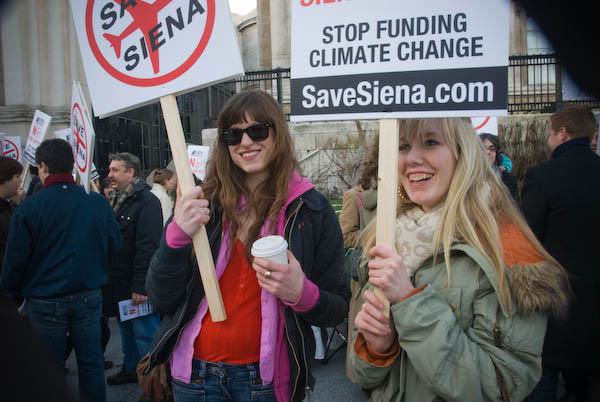
An effective response to our environmental challenge will require a radical shake-up of our political and economic systems, one that looks at sustainable lifestyles and the elimination of both wasteful production and wasteful consumption. Like Morris, I think it will require a far more local and people-centred approach. I think we also share the view that essentially it is shared ideas – culture – rather than the economic base that determine the evolution of our civilisation, although the twentieth century has provided a greater awareness of the finite limits within which these have to operate. As some of the placards I photographed recently put it, “There is no Planet B

Unfortunately, what came next after Morris was a twentieth century obsessed by ideas of growth and progress, increasing Gross National Product (whatever was being produced) and the motor car, which drove us all in this very different direction. Instead of carefully planned environments, we got roads and ribbon development along them, and urban sprawl, both entirely dependent on the car. Along with this came vehicle emissions, road deaths, decreased personal interactions, increased transport costs and more.

Continued in Under the Car

*NOTE

This post is one of a series based on the talk “Photography and the Urban environment” given by me at Foto Arte 2007 in Brasilia in December 2007. Previous posts in the series include ‘Under the Car‘ and ‘Architecture and Urban Landscape photography.’

Peter Marshall
Architecture and Urban Landscape photography*

Five years ago, with Mike Seaborne, a friend who works as the curator of photography at the Museum of London and who I’d worked with on various projects, I set up a website for Urban Landscape photography. We started with our own work, but there are now a dozen photographers from around the world with work on the site or waiting to be included – and we welcome more submissions.

Probably 95% of the work sent us is unsuitable, mainly because although taken in cities it doesn’t fit our definition of urban landscape, which comes from the web site.

urban landscape photography

  • in some way describes a town or city
  • represents an attempt to understand our experience of the city
  • shows a dedication to the subject, expressed through a body of work rather than isolated images
  • concentrates on structures or processes rather than on people
  • may deal in either details or a broader view

From almost the start of photography, photographers have been recording the urban landscape for various reasons, but often concerned with city environment, city planning and city problems, including issues of housing, transport, pollution and other environmental issues, sanitation, clean water, city growth…

Urban Landscape of course overlaps with architectural photography – architecture is a vital part of the urban landscape, but the intentions of the two are different.

My pair of pictures of London’s Canary Wharf tower – made on the same day in 1992 – I hope illustrate this:


Canary Wharf from Rich Street, Limehouse, 1992 (C) Peter Marshall

Canary Wharf from Rich St puts it more clearly into an environmental and social context, and has a deliberate irony that is absent from the more formal architectural image, DLR and Canary Wharf from South Dock, below. Clearly too, it is an image of a city in transition, whereas the architectural image shows it as a monument. Of course things have changed, and a photograph from either location today would look very different.


DLR and Canary Wharf from South Quay, Isle of Dogs, 1992 (C) Peter Marshall

NOTES

*This post is one of a series based on the talk “Photography and the Urban environment” given by me at Foto Arte 2007 in Brasilia in December 2007. Previous posts in the series include ‘Under the Car.’ For copyright reasons some of the images used in the talk cannot be used on >Re:PHOTO.

In Brasilia as well as some of my own work from the Urban Landscape site, I showed pictures of London by Mike Seaborne and John Davies which you can find on the Urban Landscape site, along with work by Lorena Endara, Bee Flowers, Nicola Hulett, Paul Raphaelson, Luca Tommasi and Neal Oshima.

Creative Commons? Photographers – just say no.

Two blogs I read fairly regularly are Dan Heller‘s Photo Business blog and PDNPulse from Photo District News (PDN), and there are related recent posts on the two of them.

When last I looked there were three features on Dan Heller’s site dealing with the problems of Creative Commons Licences for photographs, but by the time you read this, there may well be more! The first in the series was posted on Jan 3, 2008, and you’ll find the others on the left sidebar.

If you are someone who puts images on the web – especially on photo-sharing sites such as Flickr, I suggest you take a careful read.

Creative Commons Licence come in 6 varieties on the UK Creative Commons site, with a slightly different presentation on the US site – which covers over 40 countries – including England and Scotland and various languages.

As Heller points out, because of the vast number of images contributed to sites such as Flickr, Creative Commons (CC) licences actually are the dominant form of photographic licencing, at least numerically. Flickr does give you the choice of ‘None’ as well as the six CC licences – and it is the one I choose for all of my pictures there – but I think most Flickr users go for one of the CC licences.

Heller certainly makes a lot of interesting points and should give all photographers something to think about. Some of the arguments he makes depends on US copyright law – rather different to the UK and other countries that followed the Berne convention as it retains a copyright registration system (although unregistered images are still copyright.) Registration enables the copyright holder to claim punitive damages rather than more normal usage fees. The US also has a rather different and generally looser interpretation of ‘fair use.’

As Heller also points out, many people see the CC licences as an alternative to copyright, but in fact they are not, but are simply licences for the use of work that do not actually affect your copyright.

I decided a year or so back that CC licences didn’t make sense for me, although I have an fairly liberal policy of granting no-cost use of my work to funds-free non-commercial organisations – with a few exceptions. For me copyright is first an issue of control over the use of my work, and secondly a strong sense of not wanting to get ripped off by guys who can afford to pay. And yes, it would be nice to make a living!

Heller comes to the conclusion that CC licences have no part in the world of photography, by which I understand he means the commercial use of photography. They simply don’t give the end-user of the picture the protection. He sees this as good news for professional photographers, as it increases the need for commercial users of photographs to get images from agencies and photographers who can be trusted to provide less risky licences for their images.

PDNPulse today links to a Washington Post article (it may require you to fill in a free subscription form) which gives some interesting examples of images used without permission, as well as some of the rather feeble excuses that companies give for their actions.

Hanging in Brasilia

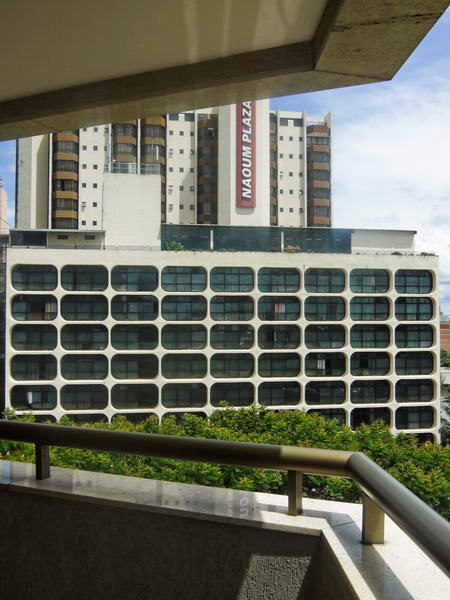
I certainly wasn’t the right kind of person for my hotel in Brasilia last month. I never even got to see the sauna, gym and swimming pool, there just wasn’t time, and I really made very little use of the two balconies my suite was provided with – one on the bedroom and the other on the living room, nor did I get time to even sit in all the chairs or watch the two TVs.


From the living room balcony


From the bedroom balcony

Other than the bed and bathroom (or rather shower room) about the only other facility I got to use was breakfast. Included in the room price, if bought separately it would have cost about what I normally think of paying for a hotel room. It was a buffet and I made the most of it, eating fully if not particularly well, although the scrambled eggs were good.

After a leisurely breakfast I walked back to my room and got a phone call to be in the foyer in ten minutes where I’d be picked up to go and help hang the show. Two guys arrived in a car and we left for the Espaco Cultural Renato Russo.

Brasilia is both simple and confusing. The afternoon I’d arrived I had been taken to see where my show was to be hung, but had no idea of where it was in the city. The normal rule seems to be that to get anywhere you start by driving in exactly the opposite direction. But by now I was beginning to the hang of things, and was not at all surprised when we drove past the Espaco and some way on before turning back and through the superquadra (neighbourhood block) to park at the back of it. Neither of my companions spoke or understood more than the odd word of English, but I watched as they brought out a large brown-paper parcel and started to unwrap it.

These were my prints, made at the best lab in Brazil, in Sao Paulo, and they were superb. A perfect match for the files I had viewed on my screen over 5,000 miles away (just slightly larger than my widescreen monitor) before e-mailing them for printing.

Which shows that colour management can really work. A monitor with a good profile and an Adobe RGB file should translate through a properly profiled printer to a close to perfect result, but it so seldom seems to. It isn’t long since I phoned one well-known lab to ask about profiles and how to send my files to be told “we don’t take much notice of that sort of thing.” My work went elsewhere.

I had six panels in a rough hexagon on which to organise the 24 prints. The panels did have two sides, but because of their position not all could sensibly be used on both. My show was in two parts; six prints on the Manor Gardens allotments, and the rest. There was also a panel of text.

I decided it would work well with most of the work inside the hexagon, but it needed a couple of prints on the outside in the main passageway as well as the text to draw people’s attention to the show. That left me with an almost perfect fit. Two panels with 3 prints each for the Manor Gardens work, which was a nicely loose spacing, then the remaining 16 prints on the other 4 inside panels in a fairly tight single row or 4 to a panel. These were in chronological order, with the two most recent works saved for the outside panel.


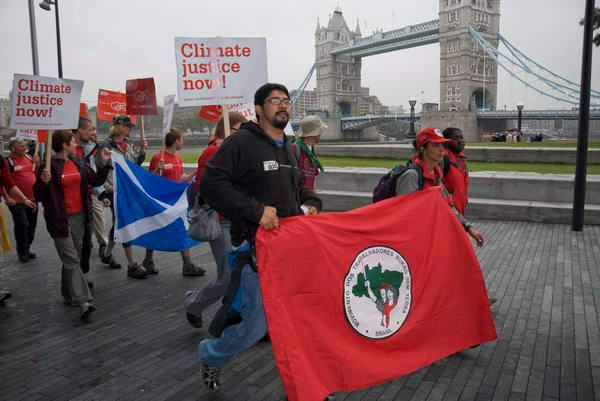
Brazilians lead on the last mile of a 1000 mile ‘Cut the Carbon’ march in the UK

I’d actually chosen these works specially to illustrate the international nature of the work. Although both were taken in London, one showed Brazilians leading a Christian Aid ‘Cut the Carbon’ march, and the other was from a protest against logging in the Tasmanian forest.

Having explained (with much gesture) how I wanted the work hung I got out of the way, looking at the other shows on in the centre – including some interesting black and white student work, as well as the show by Susana Dobal, and colourful pictures from India by Gisa Müller, before sitting down on the steps leading to the main street to make some last minute corrections to my lecture for the evening.

Before I had finished the show was hung and we were in the car heading back to ECCO, where I was to meet festival director Karla Osorio and lunch with her and the British ambassador.

More of my pictures from Brasilia.

Susana Dobal: Minding Language

One of the things I like to say is that if your work isn’t personal it isn’t worth doing. However my navel – and probably yours – is not of a great deal of interest to the rest of the world (I don’t even have any diamonds in mine, and generally prefer to keep it out of sight.) Our work also has to have something to say to other people, in some way reflecting our ideas, the issues that concern us. It has to be about something.

In photography we share a more or less common visual language across cultures. I can look at and respond (and have written about) work from China or Mexico or Mali or Albania, and although I may perhaps miss some of the more local cultural references, feel that I can appreciate (and criticise) the work.

But once we enter the Tower of Babel and bring written (or spoken) language into our work things can become more difficult. I probably am not the right person to review the work of Susan Dobal, whose Alem-Mar (Beyond the Sea) was showing at the Espaco Cultural Renato Russo in Brasilia last month, though I spent some time looking at it and thinking about it while my own work was being hung in the adjoining space. Dobal teaches photography at the University of Brasilia and has a PhD in the history of art from the City University of New York (2003) ws as as a masters in phtoography from New York University. She is one of four members of the Brazilian photo group ‘Ladrões of Alma‘ (The soul-stealers) along with Rinaldo Morelli, Usha Velasco and Marcelo Feijó.
For Dobal’s images of Portugal have added text in Portuguese. A woman totally in black, including a black hood, perhaps a religious or a widow in mourning, stands with her back to us on a stone floor in front of the massive warm orange pillars and arched doorway of a cathedral or something similar. She is small, seen from a middle distance, just right of the centre of the image.


From ‘
Alem-Mar’, (C) Susana Dobal (image Foto Arte2007)

It was an interesting image with some nice use of colour and a contrast between the light and warmth and power of the strong erect verticals and the deep sinister blackness of the crow-like figure.

But there was more to it. As if projected onto the floor was a short text in Portuguese, intended to contrast and illuminate the work. I think it says

sob sol escaldante
passeia a dor secular e ambulante”

which appears to mean

under the burning sun
strolls a pain secular and walking

Either I am missing something in my translation, or the text seems to add little or nothing to my reading of the image.

This was disappointing, as her earlier work on Zone Zero uses text in a far more interesting manner. In World, the images are largely of trees in urban settings shot in the ‘Superquadras‘ of Brasilia, but are combined with captions giving snippets of world news. These contrast with the seeming calm and isolation of these residential building blocks of the city, in which, if present, people are shown as isolated individuals.


From ‘Alem-Mar’, (C) Susana Dobal
(My apologies for the shadow at the top due to gallery lighting – and for generally poor reproduction.)

There were two pictures that attracted me very much as images in ‘Alem Mar’, Solar de Mateus I and II – presumably taken in the grounds of the famous Portuguese ‘stately home’ or manor house which is open to the public. One was of a many-trunked tree in a garden with some purple flowers, words added on its trunks and branches, in a very organic fashion. Again I’m not sure what they add to a picture that again shows Dobal as an excellent colorist.

A final image that caught my imagination is also on the Foto Arte site:

and here it was the flow of the text and the flow or the girl’s hair. Barroco means weird or freaky (or baroque) but my dictionary doesn’t include ‘alumbramento‘, although it sounds like some musical term and is certainly the title of a song.

2008 To Do List

I’m not a great believer in New Year resolutions, which tend to get broken in the first week or two anyway. But it’s often useful to make lists so here’s a quick one, some of which I hope will be of some interest to others. I’ll start with the one that has always been by aim.

1. Make better pictures
Pictures that matter more to me, that say what I think is worth saying. Thirty years ago I decided to take the pictures I wanted to take rather than try and make a living from photography. It led to years of hard graft teaching and doing photography in the gaps, low earnings, and not a great deal of recognition. Of course I don’t regret it. And it’s great to find other people who understand and care too, whether they write to me about my work on the web or see my work in the occasional show – such as that at Foto Arte 2007 in Brasilia, on until Jan 20.

2. get out more and take more pictures.
I got off to a good start on this one, at the New Year Parade in Westminster (which is why this blog appears on Jan 2.) More pictures from this on My London Diary. Events force you to get off your backside or you miss them. What is harder to keep doing are the longer-term projects, where its always too easy to look out of the window and decide the weather isn’t quite right, or find other reasons not to work on them today. Experience of course tells me that the best pictures often come in bad weather and the time is never perfect.

3. check my camera settings more often when taking pictures
So yesterday I decide one picture needs -1.33 stop, and find half an hour later that I’ve shot another hundred or so that didn’t want it at the same setting… Or that the whole set of pictures I shot in one very dark street all show unwanted motion blur because I didn’t increase the ISO… It’s so easy to get absorbed in the visual side of image-making and forget the technical (though many more photographs are failures for the opposite reason – technically perfect nothings.)

4. always check for dirt on the lens
Check and keep checking. Become paranoid about it. One of the best set of pictures I almost took in 2007 was ruined by a little bit of greasy dirt. It had been a huge rush and I hadn’t had time for my normal careful checks as I packed my camera bag.

5. edit my work more stringently
I’m writing this as Lightroom churns out 244 jpegs from the 800 or so pictures I took yesterday. I need to work that down into a much more sensible number for the web and libraries etc.

6. sort out a proper back-up system
After I lost a couple of days work when I first started using digital I’ve been careful to always make sure the first thing I do is to make TWO copies of every file I shoot as soon as I get back to base. But in the longer term that doesn’t really address the needs, as the volume of data is too large, and the media used have limited lifetimes.

For the longer term I need to sort out a carefully edited core of work for extended storage in some form or other. Or rather at least two forms, one preferably off-site.

7. make proper to-do lists
My preferred format for these at the moment is backs of envelopes. That may be ok for developing Government policies, but this is far more serious! I could do it on computer, (and I’ve tried it in the past) but I think it will work best as a large list on the wall of my work room.

8. really sort out my old ‘street photography’
‘Street’ is more a way of thinking and working, and I think most of what I do is street, though there are some purists who have some very funny ideas about it. But it would be nice to put some of my old work, scattered through perhaps 25 years of negatives, together.

9. publish, at least on the Internet, my Docklands work from the 1980s
Pictures of the empty and abandoned docks before the redevelopment really got going that I’ve hardly shown or printed for 20 years. This is stuff that people thought I was mad to bother with then, but I think will be of interest now.

10. get back to scanning my old work which is on deteriorating film negatives
Much of my older work can now only be printed by scanning, restoration work on the scans and then digital output. Film that has been processed and stored under ideal conditions has a decent life-time, but in the real world things are different for many of us.

11. rewrite as many as possible of my features and put them back on line
Few of the several thousand articles I wrote from 1999-2007 are still available on line. For legal and financial reasons I can’t simply republish them, but I would like to write about some of the same photographers and themes again. The problem is finding some way to generate an income that would make devoting the time to this possible.

12. make more money by selling photographs
I wish I knew how!

So my best wishes for a happy and successful 2008 for us all,

Peter

Nick Ut – Now and Then

If you haven’t yet read it, take a look at Nick Ut: Double Negative, an interesting article in a paper I seldom read, the Daily Telegraph. Nick Ut is the guy who took the iconic Vietnam image of a nine-year-old girl running along the road towards him, screaming, naked because she had torn off her napalm covered burning clothes, strips of burnt skin hanging from her shoulders. It was a picture that changed the attitudes of many towards the war, and won Ut a Pulitzer prize.

As John Preston says, he took the shot, but then saved Kim Phuc’s life, cleaning off the napalm, wrapping her in a jacket and driving her to hospital. The two are still in contact, still friends – almost family – 35 years later.

Last year, he took another picture that made the news worldwide, catching Paris Hilton crying in a car after she had been told she would serve her jail sentence. Ut was one of a pack of several hundred photographers outside her house, and with his camera on high speed, just happened to get one ‘lucky’ shot in which her face is clear – and clearly crying.

It isn’t a good picture. It’s about an event of infinitesimal significance to anyone except the one spoilt woman in the car, but it made front pages and TV news around the world. It makes me sick that so many photographers are wasting so much time on such trivia – and that it is more or less all that pays. Ut says he doesn’t mind, was “grateful to have the work.” To me it is just a total waste of time and talent.

Heroes: Luiz Garrido

Strictly in the interests of research, I spent some minutes this morning on coming out of the shower posing naked, establishing that by crossing my thighs it was indeed possible to tuck my tackle away out of sight, leaving just a triangle of hair visible at the meeting of legs and stomach. Fortunately I was the only photographer present and I certainly wasn’t using a camera.


Brasilia – Congress buildings (C) Peter Marshall, 2007

The show Heróis (Heroes) by Luiz Garrido opened in the Black Hall of the Chamber of Deputies of the Brazilian Government at the centre of Brasilia in November with considerable controversy.

What caused the fuss was an image of the famous Brazilian transsexual actress, Rogéria, in a pose similar to my bathroom experiment (though let’s be clear, I omitted the blonde wig, lipstick, nail varnish, loose shirt, tie, trainers and white socks.)

Rogéria,
(C) Luiz Garrido

Apparently this image was not among those that had been shown when the exhibition was arranged, and the director of Public Relations at the parliament building took exception to it, arguing it was not appropriate to be shown in a space visited by so many children. The same argument was also put forward by my very courteous guide on my visit to the chamber when I asked him about it.


Brasilia – The view from the Black Hall of Congress (C) Peter Marshall, 2007

So for the opening night, the image was on show behind a screen, while negotiations went on about how it might be presented, involving the Festival Organiser and photographer and the management of the chamber. A notice that was put up, announcing (in Portuguese) that “By a decision of the Chamber of Deputies, this cubicle contains a photograph of Rogéria whose open exhibition to the public was not permitted” and this apparently so upset the chamber that they took down the whole show overnight without further discussion.

I find it hard to image how anyone could seriously think that this image would in any way offend against the Brazilian law relating to children and adolescents, which apparently protects them from displays that are inhuman, violent, terrifying, vexing or embarrassing. Young children would walk by unconcerned, while it is hard to see it causing more than a shrug with teenagers exposed to everything the Brazilian media deem fit to publish. This was certainly not – as one bloggers suggests – an erotic image.

You can read more details on the story – and the responses to it by various bloggers – on ‘Global Voices‘ which also has more pictures from the show.

Luiz Garrido‘s show was at ECCO when I was in Brasilia, and looking at the whole show as an outsider, this picture actually struck me as the least interesting of his images on display. The kind of image that gets chosen not because of the photograph but simply because of the discordant views about LGBT rights that it embodies. I’m very much against censorship, but would personally as a curator not have chosen to show this picture.

But there is no doubt that Garrido is an interesting portraitist. I visited his show at ECCO after hours, following a very satisfying rump steak at ‘Oliver’, the contemporary restaurant that is a part of the gallery complex, together with my companions for the evening, Robson and Chris, and I think we were all impressed by his portrait of President Lula, swathed in cigar smoke (and more than a hint of the revolutionary Cubans.)


Lula, (C) Luiz Garrido

Next to him was another fine portrait, of Lucio Costa (1902-98), whose master plan created Brasilia, and next to that, the architect who designed its famous buildings,
Oscar Niemeyer, 100 on Dec 15, and still working. Costa, taken in a study after my own heart, the shelves behind him separated by bricks, slumps to one side, one eye bright and alert, the other side of his face resigned, reflective.


Lucio Costa, (C) Luiz Garrido


Oscar Niemeyer, (C) Luiz Garrido

Niemeyer is placed centrally in the frame, but cropped along the line of his upper lip, taken in front of a white board with some lines and writing, dominated by the two words “mundo injusto” (unjust world.) It is a powerful image, and one that concentrates on the eyes and intellect of the sitter, his balding dome against the world, as well as reflecting the architect’s own use of geometry and curved shapes – as for example in the National Museum at Brasilia.


Brasilia – National Musuem, (C) Peter Marshall, 2007

Greek Automobiles – Foto Arte 2007

United Photojournalists Agency. Automobiles 1944-1964.

Given that I had gone to Brasilia to give a talk that – among other subjects – reflected on the disastrous environmental impact of the car in the twentieth century (and continuing) the show Automobiles at the Gallery Bulcão Athos (part of the National Theatre Claudio Santoro) might not have been the most appropriate for me.


Image from the Foto Arte 2007 web site.

However one of the pictures on-line at the Foto Arte site – and one of the more striking in a show, did show a car “wheels-up”, sitting on its roof like a stranded whale on some beach, with an an out of focus figure in a dark skirt and white socks looking on from the left background, which was perhaps more suitable.

The show was by four Greek photographers, Euripidis Martoglou, Dimitris Triantafillou, Dimitris Floros and Dimitris Foteinopoulos, who from 1944-1964 worked as the “United Photojournalists Agency.” The sixty pictures, from the collection of Nikos E. Tolis, were first shown at the Thessaloniki Chamber of Commerce and Industry in April-May 2007 as a part of the 19th International Photography Meeting organised by the Thessaloniki Museum of Photography, the only photography musuem in Greece. You may be more succesful than me in finding out more about this ‘Photobieenale’ (which has until now been an annual event) on its ‘cleverly designed’ web site (perhaps it has problems with Firefox.) There are times when I think that if most photography festival’s web site budget was cut by around 90% we would all be better served. On the web, simpler (and thus cheaper) design is nearly always better.

To see all the pictures from the show that are on the Foto Arte site, I think you also need to look at the artists pages for Dimitris Floros, Dimitris Foteinopoulous and Dimitris Triantafillou, as well as that for Euripidis Martoglou given previously, although most pictures appear on several of the pages. Disappointingly it doesn’t appear possible to identify which photographer took each picture – which come from an earlier, more primitive age of disrespect for the moral rights of photographers who are not attributed as the authors of their work. Of course this is a fight that photographers have yet to win, with newspapers and magazines in the UK seldom bothering to properly identify the source of their images. The show could also have benefited from rather tighter editing.

The show itself was actually a fascinating reflection on what now seems a distant age (and as the theme of the Greek festival in which it was first shown was ‘Time’, fittingly so, though it is harder to see how it fits Foto Arte’s ‘Nature, the Environment and Sustainability,) a real period piece, with the views of cars and the people around them – including a ‘Miss Greece‘ – providing a window onto the the immediate post-war years – liberation, the Marshall plan (which brought US autos), civil war, austerity, wide open streets and more. As well as the cars, the clothing also is very much a time machine.

You can see a few more pictures, although none of them among the more interesting in the show, at the Greek Ministry of Culture.

The show as a whole was a fine demonstration of how time alters how we view images. Many of those on show at the time would have seemed such obvious, ordinary statements as not to deserve the attention of the camera. (I used to tell my students, when showing them Stieglitz’s ‘The Terminal‘ that they should go down and take pictures like him at the local bus garage – but then they closed the garage, knocked it down and built some dreary offices on the site.) Some pictures, though certainly not all, acquire very different meanings over time.

My own view on the car is rather different, and I’ll write more on that – based on a part of the talk I gave in Brasilia – here on this site shortly.