PGDB Shortlist: Fazal Sheikh

Fazal Sheikh’s work is far better for me in the book (and on the web) than on the gallery wall. On his web site he describes himself as “an artist-activist who uses photography to create a sustained portrait of different communities around the world, addressing their beliefs and traditions, as well as their political and economic problems. By establishing a context of respect and understanding, his photographs demand we learn more about the people in them and about the circumstances in which they live.”

Reading the exhibition labels, and even more so the book, I found the texts considerably more interesting than the photographs. You can read the complete book, Ladli – ‘Beloved Daughter’ in either English or French on his web site (or of course you can buy it in print.) The text on the web (actually present as images) is just a little small for my comfort on the web, but the images are well reproduced.

Part of the problem on the gallery wall is the scale of the images. In his work, Sheikh makes use of a narrow plane of focus, usually rendering the eyes and face sharp, while the side of the head and ears are out of focus. It’s a technique that for me only really works at a particular size of print, as the print size alters the apparent degree of ‘fuzziness’, giving a different effect at different scales. The web images, at around 13.5 cms high are a little too small, and just look slightly annoyingly unsharp, for example the ears in the portrait of Kajal. It looks more like a slight mistake than deliberate decision, while in the large gallery prints they seemed too fuzzy. There is an uneasy line between when a ‘signature’ becomes merely a ‘formula’ and seeing all these works gathered together on the gallery wall rather than embedded in the lengthy text of the book did start to make me find the approach relentless.

Sheik’s prints are inkjet prints, and according to the catalogue are maked on “handmade Photo Rag paper.” They are actually pretty good prints, but the paper looked to me rather like a machine made Hahnemuhle paper that many of us use for our exhibition prints. But perhaps this is just another manifestation of the extreme problem that galleries have in spitting out (or gicleeing) the “i” word.

I think his are fine books, and that they deal with important issues. However I think that other photographers have produced essays around these topics that are more powerful photographically, less mannered and more direct.

The Final Four: Deutsche Börse

This evening I went to the opening of the Photographers’ Gallery Deutsche Börse Photographic prize, where work from the 4 shortlisted photographers is on display until April 4, with the winner to be announced on March 5, 2008.

The drinks for the event were kindly supplied by Asahi (beer) and Errazuriz (wine) but as usual were not to my taste. So perhaps my thoughts I’m now writing will be more lucid than might otherwise be the case. I’ve been a supporter and member of the gallery for over 25 years, because I think photographers ought to give their support to the major London gallery supposedly devoted to the medium. However I sometimes despair of the gallery’s taste in photography as well as wine and beer!

In previous years, when I was writing for the largest commercial site yet to deal seriously with photography (alas no longer) I’ve given a prediction of the winner of this prize (formerly sponsored by another bank.) I’ve always found it necessary to think who should win the prize because of their photography, but then to look at the jury and where they are coming from and try and predict the winner on political grounds. This is a process that usually gives me two chances out of four of being right, although my experience is that choosing the photographer “who has made the greatest contribution to photography over the previous year” (the stated purpose of the award) seldom finds the winner.

This year the contest is between John Davies (b1949, Britain), Jacob Holdt (b1947, Denmark), Esko Männikkö (b1959, Finland) and Fazal Sheikh (b1947, USA). Although I personally think one of them stands heads and shoulders above the rest, it is perhaps possible this year, unlike in some previous years, to see reasons why any of the four might walk away with the £30,000 first prize. There is a reasonably illustrated catalogue available from the Photographers Gallery at £16.99, though I didn’t feel moved to buy a copy, for reasons that will probably be clear when you have read my four pieces on the people in the show.

In my previous post on the Deutsche Börse Shortlist I gave some basic information about the four people selected, along with links to their work online. What I will write now are some fairly short pieces based on the work as now displayed at the gallery and my reactions to it.

John Davies
Jacob Holdt
Esko Männikkö
Fazal Sheikh

You can read some of the basic information about these photographers (and a little more) on other sites – one of the better examples is the Daily Telegraph, (not a paper I would normally bother to read, though many years ago my step-mother used to take it simply on the grounds that it had a crossword she could cope with.) This has features on Davies, Holdt, Männikkö and Sheikh, each accompanied by a set of pictures from those at the gallery.

A Busy Friday

Demonstrations are sometimes rather like buses, with none for ages and then three come along together. On the afternoon of Friday 25 Jan it was four rather than three, and I think there were a couple more I didn’t manage to get to.
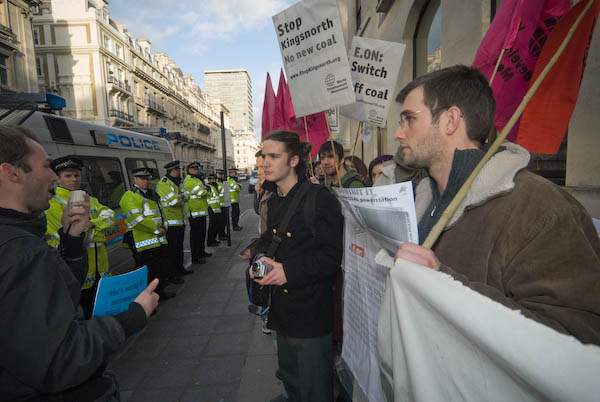

Stop Kingsnorth – No new coal fired power stations

The first I photographed was outside the Pall Mall offices of energy company E.ON who have recently got planning permission from Medway Council to build a coal-fired power station at Kingsnorth on the Thames Estuary. It’s now up to the government to decide whether to give it the go-ahead – another test of whether they take environmental issues seriously.

Of course it’s time we were moving away from large power stations and the high energy losses that come with transferring electricity long distances on the grid, moving to a decentralised low energy use society.

I like the picture above because of the way it lines up demonstrators and police facing each other and shows the whole situation with a speaker addressing the demonstration at the left of picture.

In fact I largely had to work from the side as the officer in charge told me I was obstructing the pavement when I stopped in front of the demonstrators to take photographs. We had a small argument and I reminded him that the police had reached an agreement with the press that recognised we had a job to do and should be allowed to do it, but it didn’t help. I pointed out that if I stood in the large gaps between the officers on the kerb I would not be either obstructing the pavement or impeding the police in any way, but was simply refused permission to do so, without any attempt to justify the decision – but with the clear suggestion I would be arrested if I disobeyed the instruction. So much for police cooperation. As you can see from the other pictures I took, I didn’t entirely do as I was told, but it did make my work difficult.

From Pall Mall I walked along to Trafalgar Square, stopping briefly outside the Uganda High Commission where a group of Kenyans was beginning to gather to demonstrate against the Ugandan president who has given support to the fraudulent Kenyan President. I didn’t stop long as I wanted to go to a larger gathering in Whitehall.

President Musharraf was visiting England, and expected to arrive in Horseguards Avenue by car. A group of around 50 Pakistanis was waiting their to protest against him. I took some pictures of them (and as with the other demonstrations you can see them on ‘My London Diary’.)

Finally I went to Borough in Southwark, where ‘Feminist Fightback‘ were demonstrating outside the offices of the Christian Medical Fellowship.
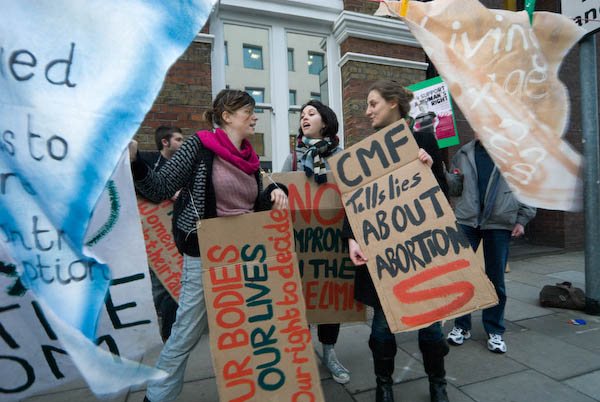
The CMF gave misleading evidence to the Parliamentary Committee which was considering possible reforms of the abortion act last year, and a number of its members with little direct scientific knowledge also gave evidence as if they were expert witnesses. They also support (and hosts) the minority report, which is in part based on their unreliable evidence.

Here there were no police and I was able to work without hindrance. Several people came out of the CMF office to talk to the demonstrators and they also had a table with soft drinks and biscuits although I don’t think anyone took any.

Although it was only a small demo, it was more interesting than many to photograph, and presented a few interesting problems, particularly because of a stiff breeze that kept blowing the items of ‘washing’ on the line that the demonstrators strung between a couple of roadside posts, making it hard or impossible to read the slogans on them. But I also liked the contrast between the CMF people and the demonstrators (with whom I felt considerably more at home despite a religious background.) Abortion is a subject that arouses strong and not always rational feelings, often with a failure to understand or appreciate what others are saying.

More about all these events – and of course more pictures – on My London Diary:
Stop Kingsnorth – No New Coal
Kenyans protest against Ugandan President
Protest against Musharraf
Feminist Fightback

Leica Full Frame?

Leica’s announcement last week of a “perpetual update program” involving hardware upgrades to the Leica M8 to keep the camera always up to date with the “latest refinements and developments in technology” is certainly an interesting development. Given that Leica has such a commitment to the body size and shape of its cameras, and the really solid build quality – unlike other modern cameras, it certainly makes great sense.

The cost of the upgrade is now said to be 1200 euros (£900.) This seems fairly reasonable compared to the replacement cost of a quality digital camera – and particularly given Leica prices. After the upgrade the M8 will essentially be a new camera with a new guarantee period. I’m not sure if the update policy will keep my M8 useful for as long as my Leica M2 has been but it is certainly a revolutionary policy for a digital model.

The Nikon D200 which I’ve now been using intensively for over 2 years, will cost me rather more to replace and I probably will do so fairly soon (and in any case I will soon have to take it in for fairly expensive repair.) So

One of the more interesting statements from Leica is “We are presently investigating
the possibility of further upgrade steps including the camera’s complete digital section, even including the sensor itself
.” What has become clear is that at some future date Leica hope that this will include the replacement of the current 1.3x sensor with a full-frame one, assuming that they can find a technical solution to the problem of using such a sensor with Leica wide-angle lenses. Those people who’ve said to me that they are “waiting for the M9” need wait no longer.

I downloaded and installed the new firmware (1.201) and it seems to have improved the colour balance noticeably; I haven’t yet found any problems. You can download it and the information about the upgrades from the M8 download page.

Reality Crossings

I’ve just today got my copy of the Winter 2007/8 issue of ‘European Photography‘ magazine (no. 82 – the web site is out of date and still shows 81, another worthwhile issue, but on ‘Photography in Berlin’ as the current issue), which is devoted to the project ‘Reality Crossings’ shown at the 2nd Fotofestival Mannheim_Ludwigshaven_Heidelberg (FMLH for short) in Sept-Oct 2007. Unfortunately I wasn’t invited to be there, but from this magazine issue I think that ‘Reality Crossings‘ may well turn out to have been one of those significant defining moments in photography – like such shows as Szarkowski’s “New Documents” in 1967 or William Jenkins’ “New Topographics: Photographs of a Man-Altered Landscape” at George Eastman House in 1975. And although I didn’t see either of those shows, they changed photography and they changed my photography.

Reality Crossings was a much more diverse show than either of those I’ve mentioned, and the issue contains a photograph (or in some cases, several) and a short statement (mainly by the curator) about the work of around 66 photographers as well as introducing almost 20 videographers. You can see some of the work on the festival web site, (the link is to the English version). I’d recommend anyone with an interest in contemporary photography to both buy the magazine and to look at the work on the web.

Of course many of the photographers in the show will be familiar. They include several I’ve written about elsewhere, including Michelle Sank, Michael Ackerman, Christian Schad and Michel Tichy (as you can see, not all the work is contemporary) as well as a number already on my ‘to-watch’ list.

Of course a publication – or even an exhibition – with such a large number of voices has to be unsatisfactory in that it can only give the merest glimpse of what activates the various authors. It’s even rather an introduction than a manifesto, but, as the introduction by curator Christoph Tannert states, it is “based on realism as an outlook on life” and demonstrates “that courage is indispensable in the pursuit of truth.

He goes on to say “The documentary must be confronted with the psychedelic extravagance of the photographic eye, which also involves conjugating structures, reflecting on form itself.” This is a thought which resonates with me (and I think will do so with all fellow ‘post-street‘ photographers) and which reflects some of the spirit which has inhabited my own work, both in the post-industrial landscapes of ‘London’s Industrial Heritage‘ and in the web-centred profligacy of ‘My London Diary.’

Copyright – more from Dan Heller

Dan Heller has made another post on image rights this week, with his Proposal for Privatizing the Copyright Registration Process which in some respects make sense, but perhaps only if you are American and in business in America. There, rather than accepting the international agreed approach, they set up a two-tier copyright system.

Like almost every other country on the planet, if you produce a creative work in America, it is automatically copyright.  But in the USA, that kind of copyright the rest of us over the world use isn’t taken too seriously, because you can only make a reasonable claim for lost revenue and expenses if someone violates your copyright.

By bribing the US Gov’t with $45, they will let you sue for totally unreasonable ‘statutory damages’ through the US court system.  However although many professionals and businesses will bother to cough up the $45 and follow the relatively simple process, it isn’t something that Joe Public will bother with.

It is fairly simple to do, and your $45 can cover a large collection of images – such as a year’s work, so long as you can fit viewable image files onto a single disk. The only slightly tricky thing for those of us outside the USA is finding a method of payment that the office will accept, and so far I’ve given up at this point.

Heller argues that by making private companies able to act as agents for the US Copyright Office,  it could become cheaper and simpler to register copyright – for example sites such as Flickr and YouTube could offer it as a part of the upload process.

It isn’t actually a bad idea, but I think I’ve a better one, simpler and that could fairly easily be applied.  Simply to abolish the US Copyright Office, which actually serves little useful function, and to come in line with the rest of the world, but to change the law and procedure to make it possible to claim sensible copyright damages .

Such a law could be enacted in any country. I’d suggest setting a minimum level of damages – perhaps of £100  ($200) with a general presumption that the damages awarded should be perhaps 3 times the normal fee for normal infringements up to perhaps 10 times for wilful infringements, together with the award of reasonable costs.

In the UK, damages could be sought through our ‘small claims’ procedure – as they can currently be pursued, although this is a system in need of some radical overhaul.  Most cases of copyright infringement are clear-cut and largely administrative rather than requiring expensive legal argument and decision, and should be dealt with by some kind of simplified process. There is no little for high legal costs – or for the kind of swingeing damages sometimes awarded in the US courts.

However, as in some other – and rather more important areas – we can probably rely on the American government to continue going on its own way.

Peter Marshall

Photographers and Politicians

Nowadays it seems to be de riguer for celebs feeling a tad low on publicity oxygen to slap a pap, and the police always seem to have better things to do than investigate cases of assaults on photographers (perhaps because the officers are too busy assaulting those photographers who cover demonstrations – more on the event where this took place on My London Diary.) So it was good to hear (thanks to PDNPulse) that it isn’t open season for politicians to give us a kicking too – or at least not in the USA.

Douglas Bruce, a new qand already controversial Republican in the house from Colorado Springs, interrupted his public prayer at the start of the session in the Capitol, diverting his thoughts from the holy to the lowly photographer crouching rather too close to his feet for the photographers safety. Bible in hand, Bruce booted photographer Javier Manzano one in the knee, upset that he was being photographed during his prayers.

According to the report in The Denver Post, Bruce thinks its ok because he just “tapped him with the bottom of my shoe” and his assault didn’t leave the photographer squirming in agony – there was “no sound, no shriek, no anything” – clearly we need to make sure to squeal well, though that could be tricky should you happen to be knocked unconscious. Manzano actually didn’t seem to be badly hurt – you can see a video of the incident on CBS4Denver although it doesn’t show the actual impact – you see Bruce moving to take a fairly firm swing and hear a thump. And before you get to the action you do have to put up with some more thumping in an ad for medical heart testing.

Bruce is still refusing to apologise, adamant that it is the photographer who should apologise – presumably for doing his job of taking pictures and getting kicked. He continues to refuse despite a 5-1 ruling from a Capitol panel that the Speaker should request a formal apology from him for disrupting the dignity of the chamber. The panel also unanimously recommended that the House should censure him.

The Denver Post already has, with a columinst giving him the tag of ‘Girlyman’, because he “kicks like a little girl” and suggesting that in any other business his conduct would have led to suspension or dismissal.

The Denver Post prints a picture taken just before the kick by their own photographer, and it clearly gives Bruce a dignity that his subsequent action shows is unfounded. Manzano was working for the Rocky Mountain News, where his rather more straightforward picture appears with their feature on the incident.

As this article states “House rules allow the media full access to the floor where the incident occurred. No restrictions are placed on photographers during prayers or any other activities.” Of course, things are rather different in this country and it may perhaps be wise to give Gordon Brown a little more room.

Thinking of politics and the press, things are also different in Brazil.
Congress Brasilia
This picture shows is the area immediately next to the lower house in their Congress building, open to the public, where representatives stroll out from the chamber and are interviewed by the press. As for security, I did write my name and country in the visitor book, though I think this was probably optional.

Andrew Hetherington and Chris Floyd

A week or two ago I was looking at Andrew Hetherington‘s web site and wondering whether to write a blog post about this Dublin- born photographer who is currently extremely well-thought of in New York and whose work I first became aware of when he was selected for PDN’s 30 photographers to watch in 2003. (The site will still work if you allow pop-ups for it.)

I didn’t get round to writing about him then, largely because his site is so slow to load on my fairly basic 1Mb broadband connection that I got fed up. But just click on one of the portfolios and go and read e-mail for a minute or two or make a coffee, because they are really worth waiting for. Once loaded the site works reasonably slickly (almost as well as if it had been well-written in html) and the images are great – and good quality.

(You can also download each of the three portfolios as a PDF. Mix and Match 1 has I think 32 pictures and is around 3.2Mb. But I don’t recommend this, as someone has made rather a mess of this file – I didn’t bother to try the others. The image quality on screen is nothing like as good as you would expect from 100Kb jpegs, and very poor compared to the flash. They are also curiously distorted on my screen. The flash presentation shows images on my screen as sharp 98mm squares. At full size in the PDF they are extremly nastily artifacted and 198mm wide, 230 mm tall. The quality become almost acceptable when viewed at 33% but the distortion remains.)

One of Hetherington’s favourite photographers is obviously Martin Parr, but I say that not in any way to detract from his work but to locate it in a broad area of work. It’s easy to see why people are talking about him, and work that I think is successful in both artistic and commercial terms.

I came back to look at Hetherington’s web site thanks to a link from the EPUK newsletter about a feature on his blog, what’s the jackanory? where in a post called ‘London Calling‘ he picks up on a post by photographer Chris Floyd (have that mouse at the ready at the bottom left of this page to douse the music when that site loads) made as a comment on another blog, Rob Haggart’s A Photo Editor (is anyone in this business still taking pictures rather than typing into blogs?) with an interview in which he discusses with Chris Floyd the current state of photography in Britain.

Those of us in Britain will indeed recognise many of the things that Floyd says – and backs up from his own experience. The piece perhaps won’t endear itself to my friends in Birmingham, nor photographers in Manchester, Belfast, Edinburgh, Glasgow etc with the comment “Britain is not like America. The UK media market is London, London, London. Trailing a distant fourth place is London” though it may be hard to argue differently.

But its a long, interesting and fairly wide-ranging conversation about the current state of the industry, with some comments on Martin Parr and Ryan McGinley among others, as well as on being an artist. Of course it comes from a particular viewpoint, and is between two photographers whose ways of thinking come very much from their successful commercial practice and shared experience in New York.

And while you are on Chris Floyd’s site (see link and note above), don’t miss The Nineties, in the Archive Section. Some fine pictures I can appreciate even though I’ve no interest in (and don’t recognise) most of the celebrated subjects.

Rights of Publicity etc

Perhaps the clearest thing you can say about Rights of Publicity is that they are a mess. And it’s a mess to which the recent decision in California concerning images of Marilyn Monroe, which you can read about on the ‘State of the Art‘ blog only adds. Monroe was of course photographed by many photographers, notably Dennis Stock, Milton Greene, Sam Shaw, and Tom Kelley. I suspect this is a story which will continue in various courts.

If you want to read more about the confusion of legislation world-wide, the best introduction I’ve found comes from the Australian consultancy Caslon Analytics.

My own advice for photographers is simple. Don’t photograph celebs. It may mean passing up a bit of income now, but it will avoid the possibility of a lot of hassle in the future for us and our heirs.


Outside the National Gallery, Jan 2008 (C) Peter Marshall

A better reason for not photographing them is simply that in general I find them – and the pictures of them that clog the press – extremely boring. There are just so many other more interesting things to photograph.

But it wasn’t a surprise when out of the sixteen stories I’ve so far posted this month, the only one to attract any attention from the mainstream press was a small protest outside the National Gallery in London against the expansion of an airport in Siena. Although it’s a cause I’m in favour of, here’s part of what I wrote about it:

The protest group is apparently led by the young grandson of a Lord, and includes models and young people from some of the richest families around (the kind of people who own Guinness rather than drink it.)

If you had a nice big villa there you probably wouldn’t want all sorts of riff-raff coming in on cheap flights either, and would have been there outside the National Gallery too.

I do think it’s time to take urgent action about airport expansion, particularly because of the effect of increasing flights on climate change. Far more pressing than Siena is Heathrow, and the No Third Runway campaign.


Global Climate Change March, London, Dec 2007 (C) Peter Marshall

To be fair, those protesting against Siena that I talked to also told me that they would think about doing more to protest against the expansion of Heathrow.

This week’s crash-landing at Heathrow again raises the question of safety, and the danger of having a major airport in such a heavily built-up area. I grew up under the main flightpath in Hounslow, a major centre of population only a couple of miles from touchdown, and live in another highly populated area where where planes on approach to one of the alternative runways (fortunately now seldom used) come in low enough to rattle the windows. So while applauding the brave performance of the senior first officer John Coward, I’m also shocked at the fool-hardiness of the authorities in allowing Heathrow to remain, let alone to expand.

Flash

I’ve always had a rather edgy relationship with flash. Of course like most photographers of my era I grew up with the conviction that it was a mortal sin, thanks to guys like Henri Cartier-Bresson and Robert Frank. Available light was everything, and as much as striking a match would somehow destroy the vital integrity of the moment.

It’s still a way I like working, at least at times, but there are other occasions on which really my Leica, even with film pushed to ISO 1600 and the great old 35mm f1.4 won’t deliver. The M8 doesn’t help a lot, turning that 35mm a standard lens, and its performance above ISO 640 isn’t too great.

Digital has led to a distinct rise in what people expect – at least technically – from work in poor light. My library would almost certainly now reject those great grainy images I still rather like, and the best modern digital cameras can now deliver results at high ISO that a few years back we would have thought impossible (and still are impossible with film.)

But that still leaves me with a problem. First I haven’t got a Nikon D3, and the D200, while a fine camera, is best used below ISO 1000. Then there is the matter of lenses. Because of the smaller sensor, what I’d really like for that camera in low light is something like a 20mm f1.4 lens. What I tend to be using is a zoom lens with a maximum aperture around f4. Sigma do actually make a 20mm f1.8, so perhaps I should try one.

Back to my sins, (and there are even yet photographers fighting some kind of rearguard action against digital that seems to me more religious than practical,) digital cameras and modern flash technology have actually greatly simplified matters, making fill flash, once a tedious necessity that I struggled with roughly twice a year, part of my normal daily routine. Probably a majority of the pictures that end up on My London Diary use it, though not always too obviously.


Freedom to Protest – last Saturday at Downing St (C) Peter Marshall, 2008

Flash at night – and it was getting dark when I too the picture above – still presents a few problems, and thanks to my poor luck and inability to keep hold of a working SB-800 with it’s all-singing i-TTL flash system, one which I’ve recently been getting to grips with using an older SB-80DX unit. I’ve actually come to quite like the simple and slightly Luddite approach this requires, and when I once more have a system that actually talks to my camera may just try and stick with it.