June 2018 – At last


Huddersfield Royal Infirmary campaigners at the BBC – NHS at 70 – Free, for all, forever

I have at last finished updating My London Diary for June 2018. It’s been hard work for various reasons. Thirty three stories and around 1800 pictures represents quite a lot of time, travelling to and from events as well as being there to take the pictures. And on average it probably takes me another couple of hours to process and caption the images to upload to one of my agencies. Some stories require quite a bit of extra research, as well as more general research to keep up with events.

After I’ve sent off the pictures there are other things to do. Most I make available on Facebook for my friends and the public, particularly for those who took part in any events. Usually having created a Facebook album I then post links to the pictures on the event pages or other relevant places, as well as putting them on Twitter.

For the posts on My London Diary I then go through the pictures again, picking out more pictures that fill gaps in the story, showing different aspects or different people taking part and ‘develop’ those to add to the set I’s selected to go to an agency. Typically I’ll put a little over twice as many on my web site as I file, and these often include a number of the more interesting pictures which I’ve decided for various reasons aren’t suitable for the agency.

The text that was filed with the pictures is a starting point for My London Diary, but often needs extra information. And since it is my own web site and meant to be a personal one, often it gives rather more of my opinions. Finally, although I designed the web site to be easy to update, adding the information also takes time, most of it in adding captions which as well as telling readers what the pictures are about are also vital in making them accessible through on-line searches.

June 2018

NHS at 70 – Free, for all, forever
Torture protest at US Embassy
Vauxhall & Nine Elms
Peckham & Deptford
Many Thousands March for a People’s Vote


Vote No to Disastrous Heathrow Expansion

White Pendragon letters refused
No Heathrow block Parliament Square
Stop Arming Saudi to bomb Yemen
Protesters Stand Up For The Elephant
Assange in Embassy for Six Years
Staines Walk
Justice for Grenfell Solidarity March
Massive Silent Walk for Grenfell Anniversary


‘SOAS 9’ deported cleaners remembered

TGI Fridays demand Fair Tips & Fair Pay
Stop Brexit ‘Pies Not Lies’


Al Quds (Jerusalem) Day

Zionists protest against AlQuds Day
100 years of Votes for Women
End government killings in Nicaragua
Anti-fascists oppose Free Tommy protest


Free Tommy Robinson

Close all Slaughterhouses
Flypast for Queen’s Official Birthday
Colombian Carnival for Water, Life & Land
Die-in against Greenwich cycle deaths
University of London staff in-House now
Zionists defend Israel shooting protesters


Free Palestine, Stop Arming Israel

Abortion Rights in Northern Ireland Now


Sikhs remember the 1984 genocide

Anti-Knife UK protest

At the bottom of the page is a link to the pictures I occasionally take travelling around London, mainly from bus or train windows, and a few when I’m walking. I like to travel on the top deck of buses which gives a different angle from Google’s Streetview, and trains often provide a quite different view of the city.

London Images

As usual, comments are welcome here on any of these pictures and stories.

______________________________________________________

There are no adverts on this site and it receives no sponsorship, and I like to keep it that way. But it does take a considerable amount of my time and thought, and if you enjoy reading it, a small donation – perhaps the cost of a beer – would be appreciated.

My London Diary : London Photos : Hull : River Lea/Lee Valley : London’s Industrial Heritage

All photographs on this and my other sites, unless otherwise stated, are taken by and copyright of Peter Marshall, and are available for reproduction or can be bought as prints.

To order prints or reproduce images

________________________________________________________
Stop the Killing

I spend a lot of time at events wondering what I should photograph. Of course there are people and situations that are visually attractive and it would generally not be sensible to miss these opportunities, but that isn’t enough. It can often even be quite misleading and unrepresentative of the event, though it’s often such images that get published, and what I think many photographers aim for to sell to newspapers.

Another type of image that seems often to get published are group photos, with large numbers of people holding a banner, taken frontally in the manner of team photographs – I often joke about putting someone in the middle holding the ball, though few find them funny. I suppose for small events these at least let you see how many were taking part, and local newspapers used to feel that showing more faces boosted sales, but when there is often a large group of photographers crowding to get around the centre spot I usually avoid it.

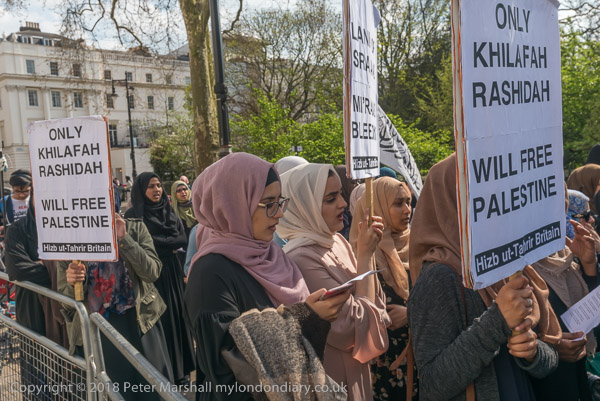
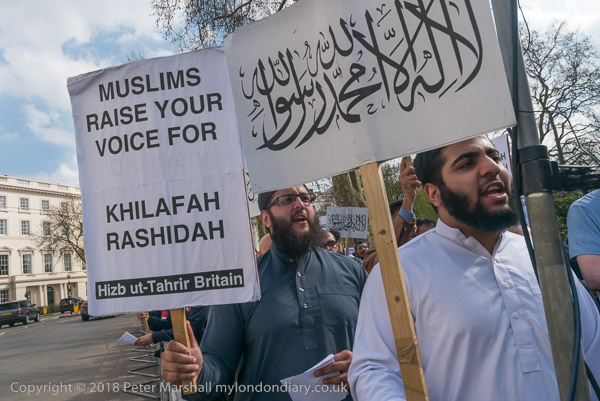
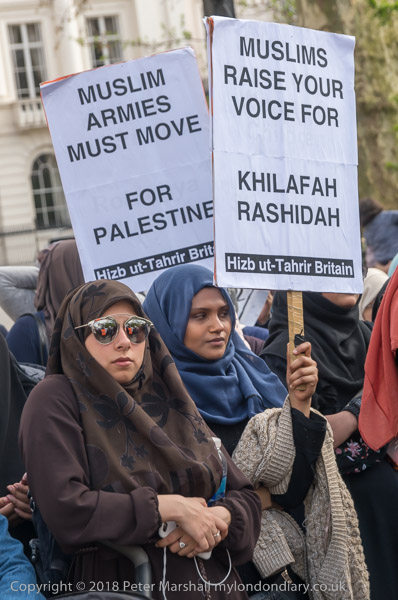
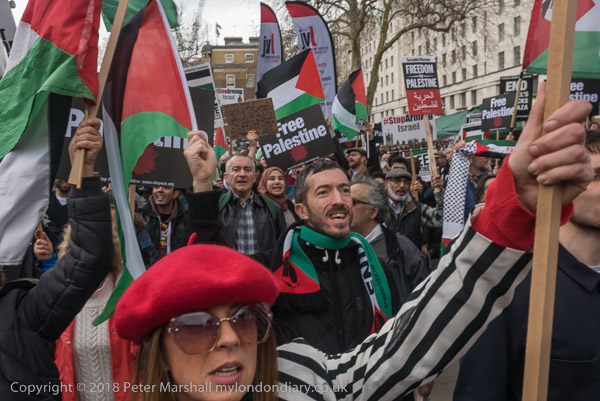
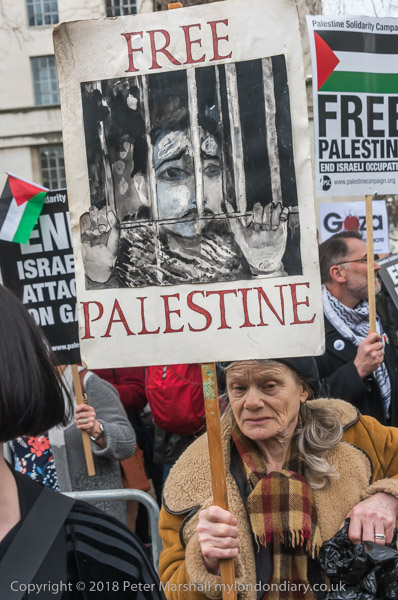
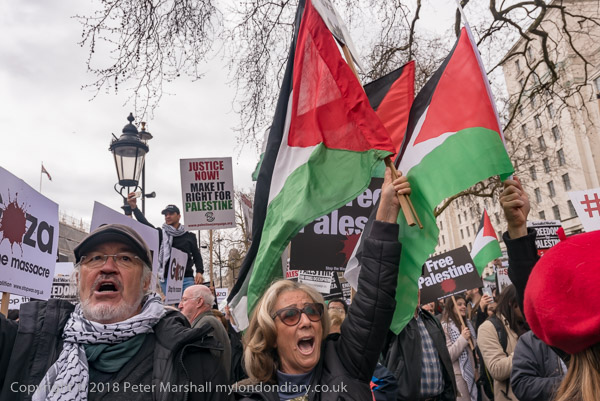
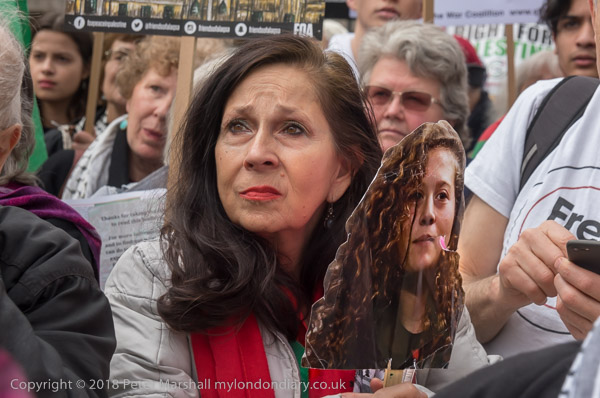
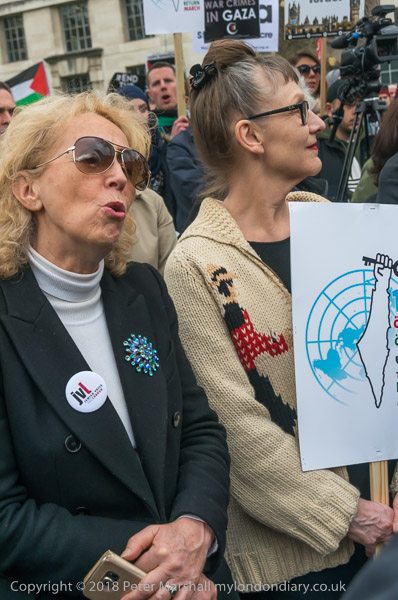
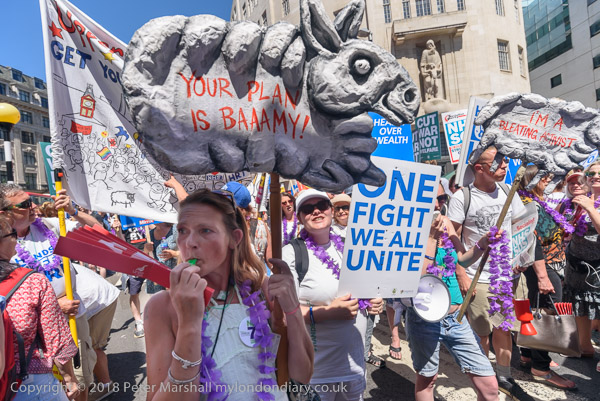
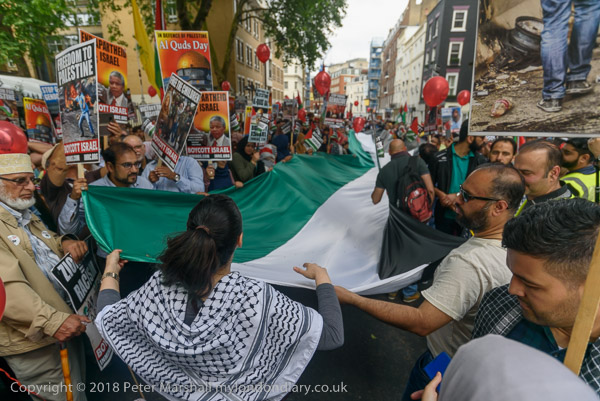
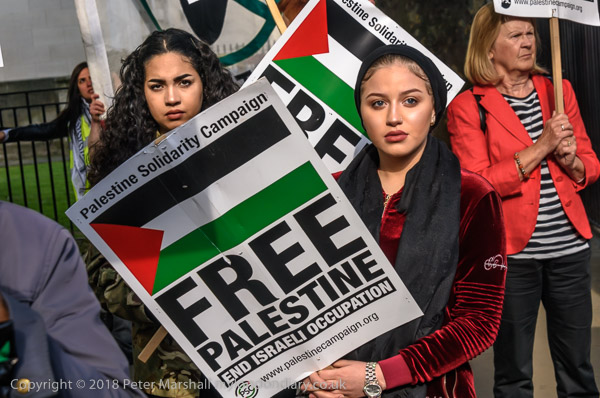
My motivation for photographing events is to tell the story. And for me that very seldom can be done in a single image but requires a series of images. Placards and banners are often very important in this, as to are gestures and expressions. At this protest, I tried to show something of the anger that people felt at the cold-blooded shooting of Palestinian protesters by Israeli snipers.

Things that are worth photographing aren’t always particularly photogenic, and it is often something of a challenge to make pictures that are visually attractive, clear and precise. I took a great many pictures, probably over a thousand, though at times there were very many of the same subject as I tried hard to ensure I had something close to what I wanted.

Photographing an event like this involves a huge number of decisions about where to be when and what to photograph – and on more technical matters such as focus, focal length and framing. I try to concentrate on these and take advantage of the automatic features of the camera to deal with as much as it can; though usually I like to chose where the focus is, I’m happy to let the camera actually auto-focus there, and to let auto-exposure get the exposure more or less correct.

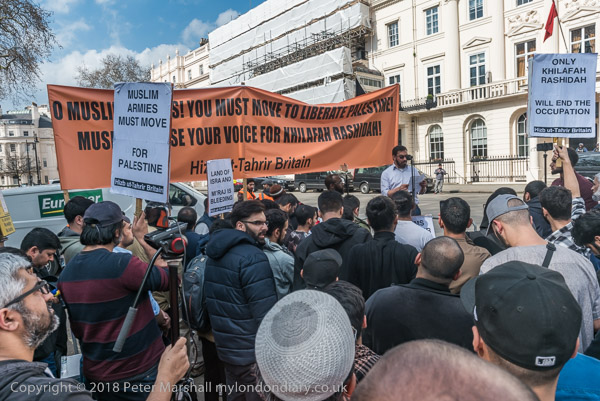
This was a large protest, with several thousand packing mainly in to a fairly small space, making movement through the crowd a little difficult. There was a small press area in front of the stage, but I chose not to use it for photographing the speakers as it was too close to them looking up from below. But the crowd perhaps meant I stood in that one place rather longer than I would have liked.

I wondered briefly whether or not to photograph the counter-protest by half a dozen Zionists a few yards away, and decided to do so – and you can see a few at the link below. There were many, many more Jews in the protest ashamed of the actions of the Israeli snipers following their orders to kill and maim unarmed protesters at a distance, shooting many in the back as they ran away, using bullets designed to expand and inflict maximum damage to those they did not kill.

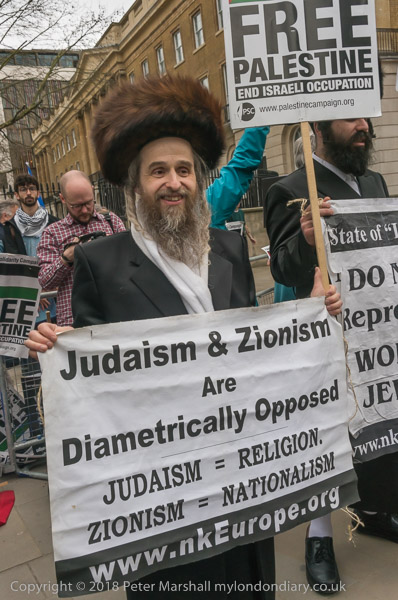
And as usual at such protests there were the anti-Zionist Jews with their message “Judaism Demands FREEDOM for GAZA and ALL PALESTINE & forbids any Jewish State” .

Here I’ve only posted a small and fairly random selection of the images that I took – and written very little about the actual protest. You can read more and see an unusually large number – around a hundred – of the pictures I made (edited down from perhaps a thousand) on My London Diary at Great March of Return – Stop the Killing

______________________________________________________

There are no adverts on this site and it receives no sponsorship, and I like to keep it that way. But it does take a considerable amount of my time and thought, and if you enjoy reading it, a small donation – perhaps the cost of a beer – would be appreciated.

My London Diary : London Photos : Hull : River Lea/Lee Valley : London’s Industrial Heritage

All photographs on this and my other sites, unless otherwise stated, are taken by and copyright of Peter Marshall, and are available for reproduction or can be bought as prints.

To order prints or reproduce images

________________________________________________________
Pennies for the guy…

Pennies for the guy who took the picture is the offer to photographers from  National Geographic Fine Art Galleries (NGFA) revealed in the article  Is National Geographic Fine Art a Ripoff for Photographers?  published on PetaPixel. In it Ken Bower writes of how his initial reaction to having one of his landscape images selected to be sold by the NGFA turned sour when he found out more about how the NGFA sales programme works.

The NGFA explained it to him, and you can read their explanation in the Petapixel post. If NGFA sell the print for $1800, 10% of that amount goes to the National Geographic Creative agency – so in this case a miserly $180. That agency then gives half of their cut to the photographer, who ends up with $90 – just 5% of the price the buyer has paid.

Simple maths shows us that the NGFA itself takes 90% of the purchase price – in this case $1620. That’s 18 times as much as the photographer. And although NGFA increases the price of the prints as the edition – of 200 prints – sells, that ratio remains the same. If they sell the whole edition of 200, those pennies for the photographer would however add up to a substantial amount – if nothing like as substantial as that made by the NGFA.

Now I appreciate galleries have costs. In this case they are making the prints, running a web site, conducting the sales etc. I’ve sold a few prints through galleries, and their commissions have ranged from 20% to 35%, and a 50:50 split is not unusual. Some I’m told even take a little more – but even the worst deals I’ve heard of leave the photographer with 40%, eight times what NGFA are offering.

As Bower points out, the NGFA seems to be “targeting photographers who have placed well in Nat Geo photo competitions or who are popular on the Your Shot community” for their sales, rather than the extremely professional and talented professionals whose work is published by National Geographic – who would have a much better idea of the worth of their images.

I’m not a great fan of commercial photo galleries, as regular readers will have noticed. With few exceptions I don’t feel they have the best interests of photographers or photography at the base of their activities. I still think and have often argued that the concept of limited editions is inimical to our medium and am unhappy at the fetishisation of the photographic print and in particular of the ‘original print’ that they foster. Overall I think they are parasitical on photographers and photography, though there are a few I respect for how they have genuinely contributed to our knowledge and understanding of the medium’s history.

But while buying prints from a commercial gallery, or better, from a photographer may at least sometimes be a sound investment as well as a pleasure to be enjoyed, it seems to me that the NGFA is essentially selling high price decor. I’m not dismissing Bower and those who have signed up with them as photographers – his is certainly a decent landscape image – but those with cash to spare will buy it or images like it because it goes with their colour scheme – and the next time they have new interior decorators in, that picture will go out with the trash – or if they try to sell it they will almost certainly find its resale value is far less than they paid, possibly little if any more than the worth of the frame.

As Bower hints, essentially what is being sold are high-price posters. Not printed by the photographer, the printing not overseen by the photographer, decisions about paper etc. not made by the photographer. An edition of 200 might almost as well be labelled unlimited, and the prints are not signed by the photograph but machine-signed with a ‘digital signature’.

There is a poll at the bottom of the Petapixel page asking for readers to rate the deal. When I looked at it, to my astonishment there were 15 people out of a little over a thousand who thought NGFA were offering a great or good deal. It made me wonder if they worked for the company, though on any poll you can get a few random drunken clicks. At the other end of the scale almost 96% thought it a bad or horrible deal. I think you can guess how I voted.

Yarl’s Wood 13

This was I think my 12th visit to Yarl’s Wood, but the 13th major protest there organised by the small left-wing political group Movement For Justice.

The protests they have organised here and elsewhere have done much to bring our terrible racist immigration detention system to public attention, and have given many detainees the courage to fight against the system, knowing they are not forgotten and that others outside know what is happening and support them.  MfJ bring a powerful public address system to their protests, and those who speak are mainly former detainees – and they also give people inside a voice over mobile phone link-ups.

So though the story told by a former active member of how she had been treated appalled me (though I realised I was only hearing it from one side) my overwhelming thought was that it was important that, whatever else, the campaign to close down these shameful prisons should go on.  The story didn’t actually surprise me – and some of what were presented as revelations were common knowledge, though some of the more personal aspects seem disgraceful. But much of it was exactly what might be expected of small left wing groups.

I’m not a member and would not consider joining such a group, or larger groups such as the SWP (which have also had their share of not dissimilar controversies.) I’ve always thought of myself as part of a much broader left movement, willing to support various campaigns I sympathise with, while still maintaining a professional distance and adhering to documentary and journalistic standards of integrity.

Perhaps some good has come out of the controversy, in that other groups have now also taken up the organising of protests against Yarl’s Wood, which before had been largely left to the MfJ. So far they seem to be on a much smaller scale but hopefully a larger movement will eventually grow. At the March protest they worked separately but alongside the MfJ, but since there has been at least one separate event. MfJ’s next protest there is on July 21st.

The most important of the other organisations is I think ‘Detained Voices‘ which publishes the messages of the women inside the prison. After the March 24 protest one of them began her comment with “We want to thank all the protesters who were here today, and I hope we made our presence felt even though we are oppressed.”

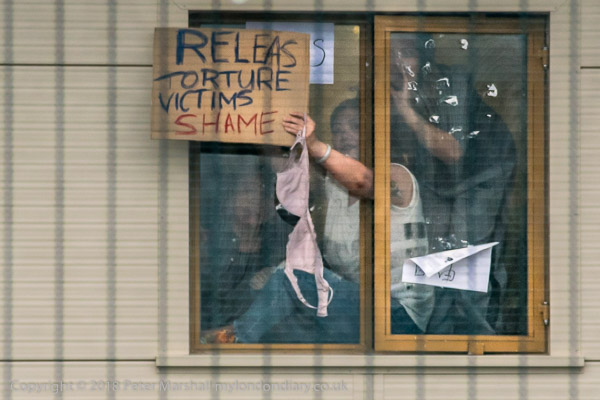
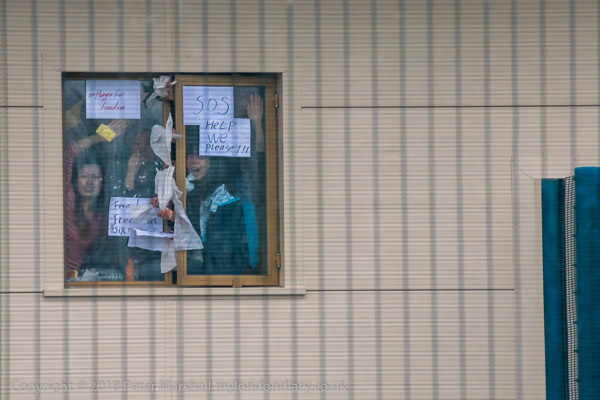
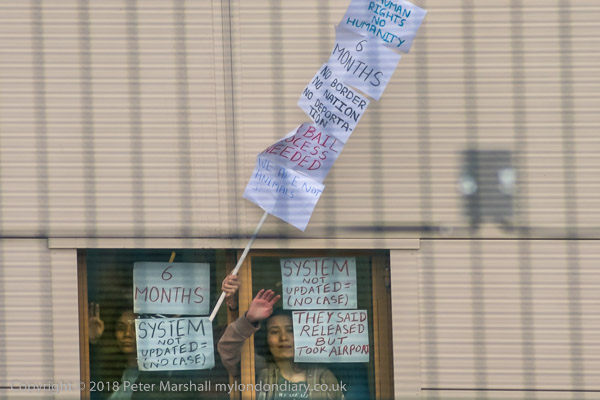
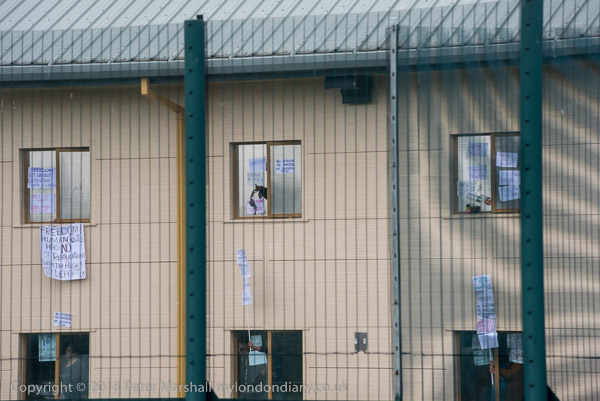
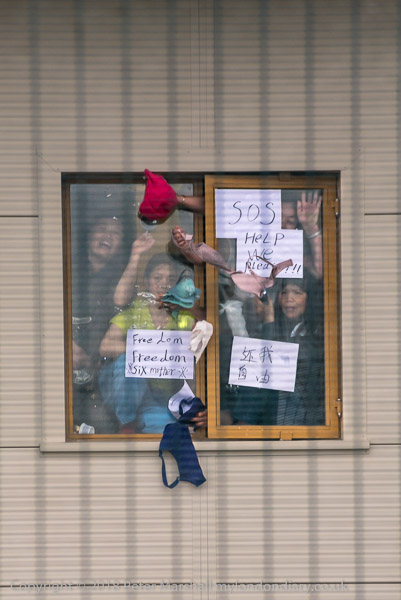
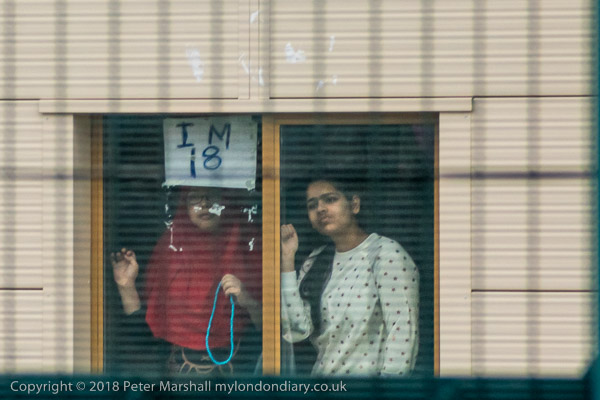
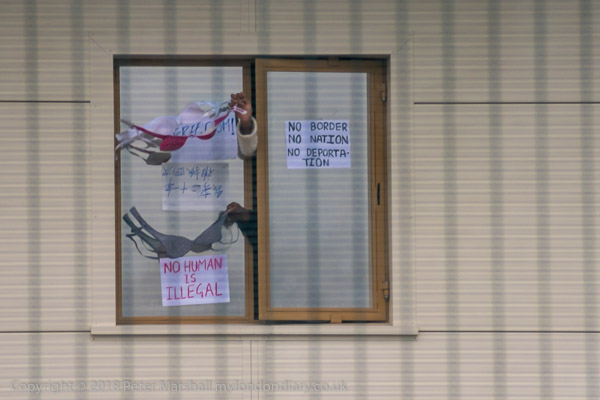
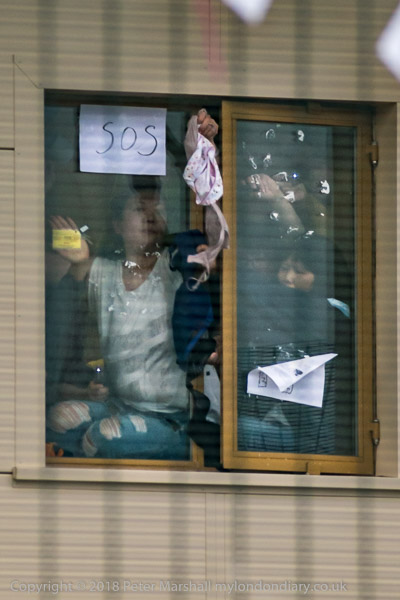
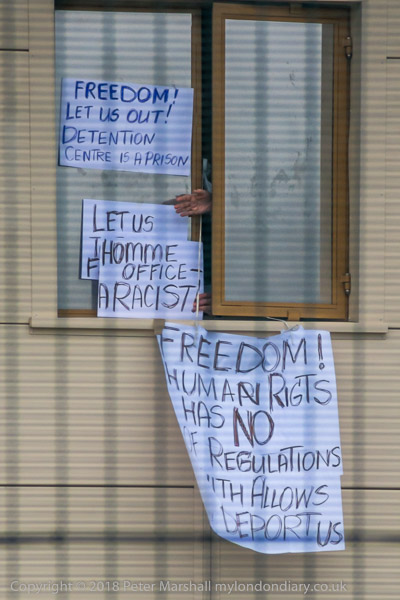
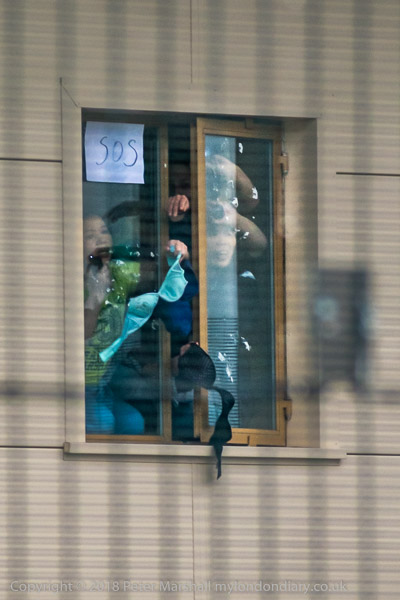
I tried hard to take pictures of the women inside Yarl’s Wood (and there are a few men too in the family units. Only a small proportion of them are able to reach the windows visible from the field where the protests take place, though others in the prison will hear the protests.  Outside we can hear them shouting through the narrow gaps the windows open and see them waving and holding up signs.

Photographing the women at the windows presents several problems. Obviously you need a long lens, and something a little longer than I have would help. Most of these were taken with a Nikon 70.0-300.0 mm f/4.0-5.6, but working in DX mode which effectively makes it a 105-450mm, and most are at the 300mm end. Even then the windows only occupy about a third of the width of the frame, and some images are fairly severely cropped.  Obviously you need a fast shutter speed to avoid shake, and typically these were taken at 1/500s or faster. The aperture also matters, although there is little depth in the subject, but stopping down a stop from maximum aperture to f8 certainly helps to tighten the lens performance. To get those kind of exposure values I needed to work at around ISO 1000, not a problem with the NIkon D750, where this is hard to tell from base ISO.

A faster lens would help here, as you have to take almost all pictures through a mesh fence, and a wider aperture would put this more out of focus and so less noticeable. But a significantly faster 300mm would be large, heavy and expensive. The fence is also a rather better target for autofocus than the windows, and almost all these pictures were taken using manual focus.

The protesters pose another problem. They have come to shout and wave banners and placards at the women inside the prison, and in doing so often make it difficult to get a clear view of the women at the windows. It’s also difficult to get good images that show both the protesters on the rise and the women at the windows because you see the protesters from the back when trying to do so.

And of course I also want to photograph the protesters as well as the prisoners. You can see some of the results on My London Diary at Shut Down Yarl’s Wood.  And a couple of days earlier I had photographed a protest in solidarity with their hunger strike by people outside the Home Office: Support for Yarls Wood strikers.

______________________________________________________

There are no adverts on this site and it receives no sponsorship, and I like to keep it that way. But it does take a considerable amount of my time and thought, and if you enjoy reading it, a small donation – perhaps the cost of a beer – would be appreciated.

My London Diary : London Photos : Hull : River Lea/Lee Valley : London’s Industrial Heritage

All photographs on this and my other sites, unless otherwise stated, are taken by and copyright of Peter Marshall, and are available for reproduction or can be bought as prints.

To order prints or reproduce images

________________________________________________________
Opera Performance

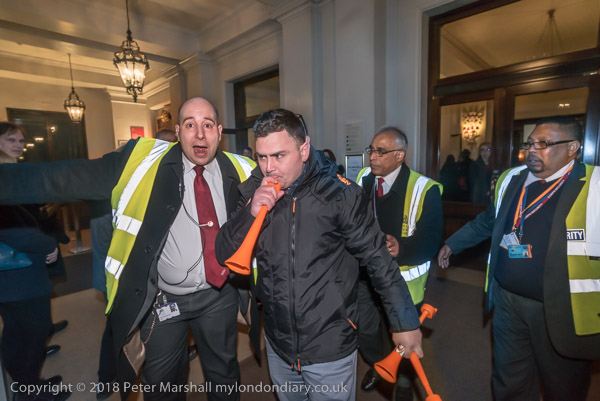
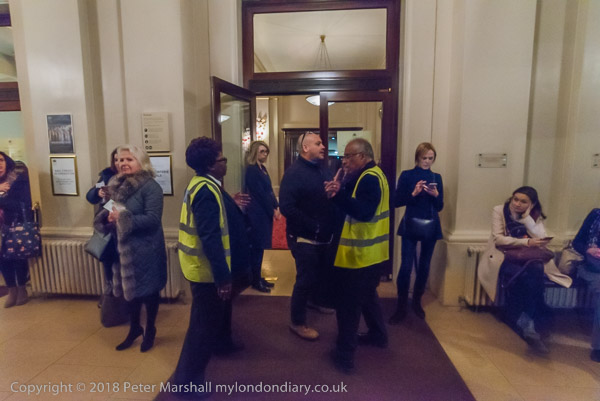
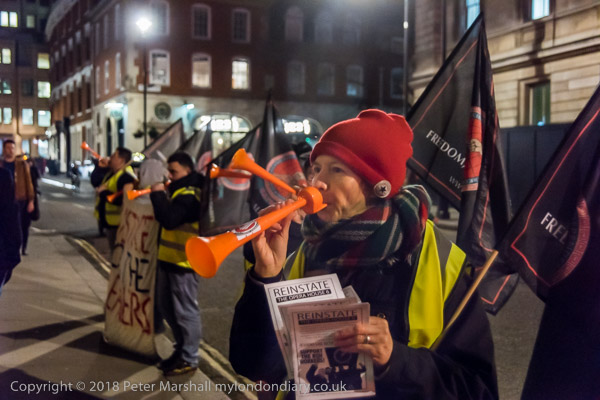
I wasn’t expecting to go in side the Royal Opera House when I met a small group of members of the cleaner’s union CAIWU a short distance away on Bow Street, but when a few of them walked in I followed. And although I didn’t get to sing I did manage to take quite a few pictures before security led the few protesters outside, as they were too busy dealing with the noisy protesters to take much notice of me.

The foyer of the Royal Opera is a place of dim lighting, and even at ISO 12800 it really wasn’t enough. I don’t like to use flash in these situations as it draws attention to me and makes it more likely I will get thrown out. Flash is also a problem when people – like the security guys here – are wearing reflective clothing which results in large amounts of light coming back from the reflective strips. There was quite a lot of movement so I wanted a shutter speed of at least 1/125th second.

Faster lenses might help a little – my 18-35mm f3.5-f4.5 is a little pathetic in this department, but in situations like this you also need a reasonable depth of field, which generally makes larger apertures unsuitable even at the wider end.

I had expected a rather more leisurely start to the protest, which was around the sixth on successive nights at the Opera House in a concentrated campaign against the victimisation of six CAIWU members for their trade union activities. I’d assumed that security would have expected the protest and locked the doors as we arrived and that the protest would be on the pavement outside.

I had my D750 on a strap around my neck, but the D810 was still inside my camera bag with a longer zoom in place. Once inside I decided the situation and low light made there little point in stopping to take it out, though had their been time in advance to think I might have taken it out and changed to the 16mm f2.8 fisheye, often a useful lens at close quarters and with remarkable depth of field.

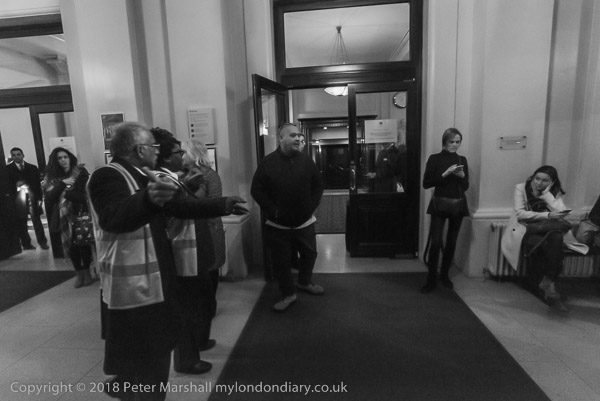
As I viewed the pictures later on my computer I was pretty despondent. The colour quality of most of those taken in the foyer was abysmal, with darker areas exhibiting a nasty purple cast and a blotchiness. I’d taken just a few with flash that were usable, and managed to get a couple looking not too bad. The rest I converted to black and white.

It’s the colour that goes first with excessive under-exposure, and by converting to black and white you can work at least a couple of stops faster. But I don’t like converting images taken thinking in colour to black and white – either my own or those by other photographers. But here it was necessary.

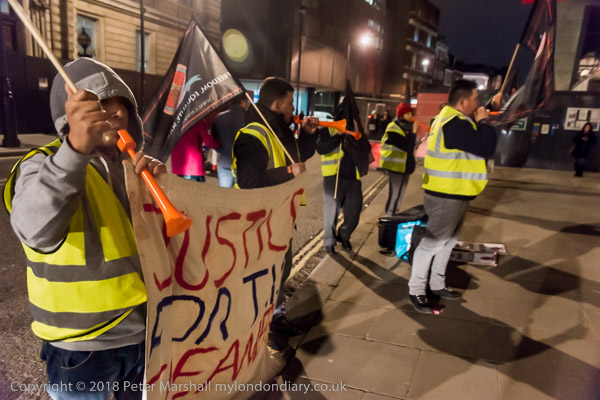
Outside on the pavement, alhough it was getting dark, things were much better.

More pictures: Cleaners protest at Royal Opera House.
______________________________________________________

There are no adverts on this site and it receives no sponsorship, and I like to keep it that way. But it does take a considerable amount of my time and thought, and if you enjoy reading it, a small donation – perhaps the cost of a beer – would be appreciated.

My London Diary : London Photos : Hull : River Lea/Lee Valley : London’s Industrial Heritage

All photographs on this and my other sites, unless otherwise stated, are taken by and copyright of Peter Marshall, and are available for reproduction or can be bought as prints.

To order prints or reproduce images

________________________________________________________
Against Racism

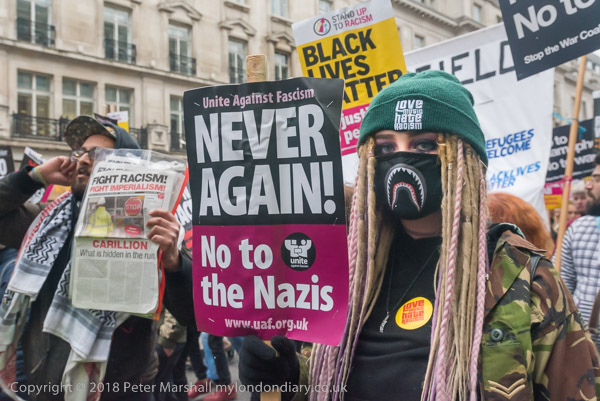
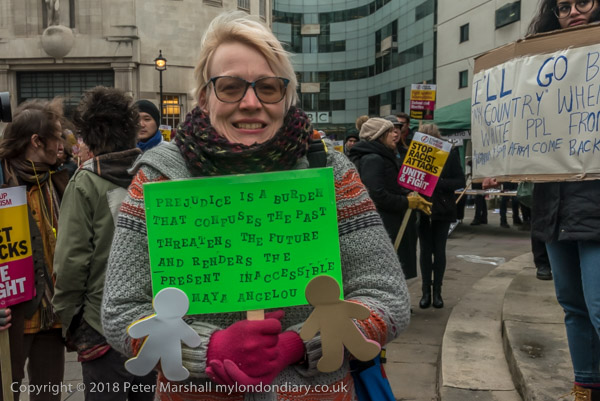
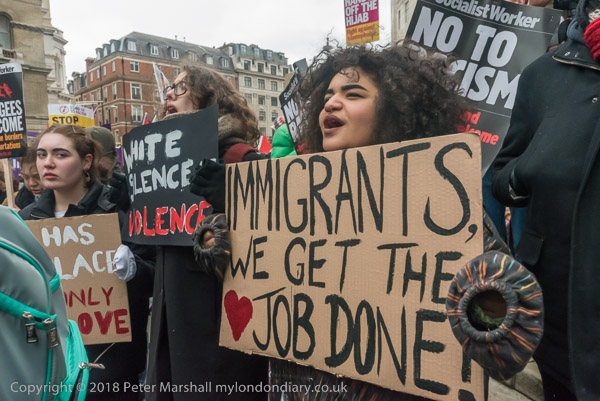
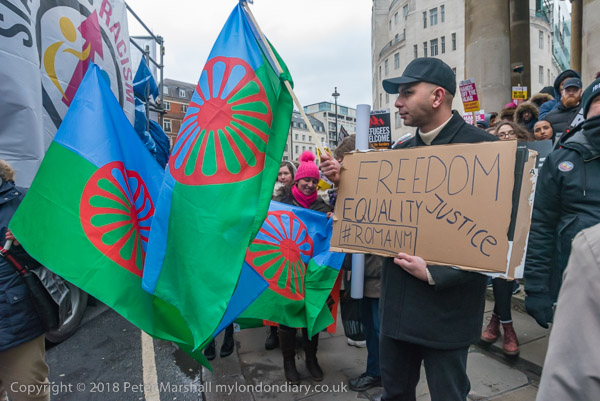
Writing today with the temperature around 30 degrees in the shade, my shirt sticking to my body and wondering if it is worth leaving the keyboard for a while and get another glass of ice-cold water it’s had to remember just how cold it was back in March. The several thousand who turned up to march on UN Anti Racism Day ignored apocalyptic weather forecasts, an amber weather warning, a temperature around zero with the occasional snowflake and a chilling east wind. And we froze.

Portland Place, outside Broadcasting House has become a popular starting point for many protests. Partly to point out what seems to many campaigners to be a peculiar reluctance on the part of the BBC to report protests in the UK, particularly those that might embarrass the government. And a protest against racism should embarrass the current government, with its ‘hostile environment’ towards refugees and other migrants and clearly discriminatory policies in other areas, Though to be fair it doesn’t only discriminate on grounds of race, but is has an equal opportunities discrimination policy that also extends to class, disability, women, etc.

Britain has changed enormously in my lifetime, and the arrival of many workers from the Commonwealth in particular has greatly enriched us, both by doing many of the vital low paid jobs we all depend on  but also because of the cultural enrichment provided by their differing traditions. Many when they came in the past were citizens with the right to settle here, but increasingly racist immigration acts have changed that, reaching the state where the Home Office under Theresa May has been caught carrying out illegal deportations and destroying records that give some the right to remain.

The Windrush generation – and there children – are only the tip of an ugly iceberg, with many thousands being affected. But government racism has also extended to more traditional groups who have lived in this country far longer, travellers and Roma. Much of their harassment comes from local government, often failing to meet the limited responsibilities they have to provide sites, and employing licensed thugs to turn travellers off land – including at times land the travellers actually own.

Some areas of discrimination have changed for the better. Catholics and non-conformists are now seldom subject to discrimination on the grounds of their religion at least in mainland UK. And Jews too now escape official disbarment, though some Tories and extreme right neo-Nazi inspired groups still keep up the anti-semitic hate, though many have now transferred they evil bile towards Muslims. And while caste discrimination is illegal in India (although it flourishes under the current right-wing Hindu regime), here in the UK wealthy Tory-supporting Hindus have so far blocked attempts to make it illegal here.

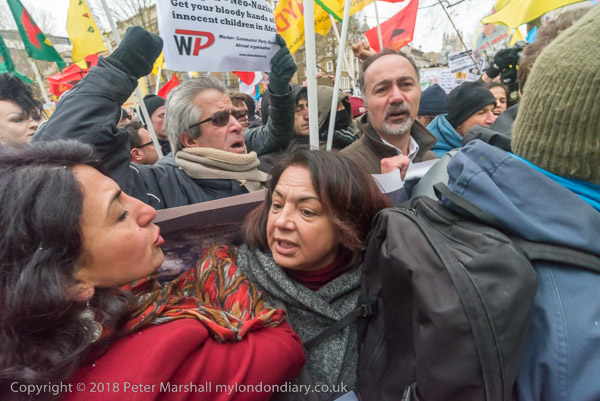
Many wars around the world remain racial wars, including that between Turkey and the Kurds, with Turkey doing its best at least throughout the last century to eliminate the Kurdish people and culture. On the protest Kurds were calling for an end to the attacks by Turkey and Islamic militants fighting on their behalf to take control of Afrin, with the aim of removing the majority Kurdish population.

Militarily the Turkish army is far superior, thanks largely to its NATO friends including the UK who have helped make it the strongest force in the area, and with the aid of its former ISIS and Al Qaeda allies victory in the area seemed inevitable, though it may only be the start of a prolonged guerilla struggle.

As the Kurds arrived opposite Downing St, a misguided police office removed the cones and tape across the middle of Whitehall that had guided the marchers away from Downing St, and it was taken as a signal for them to make a rush towards its gates. These were of course well-protected, with barriers and police offices – and behind them several armed police, but the situation certainly became chaotic.

Eventually police and march stewards brought them under some sort of control, with some moving on to the stage on which a rally had already begun, but others simply standing around in the middle of Whitehall. It was still biting cold, and the majority of marchers quickly drifted away to make their journeys home. I held out for the first four or five speakers, but then joined them. It was far too cold to stand around.

March Against Racism

______________________________________________________

There are no adverts on this site and it receives no sponsorship, and I like to keep it that way. But it does take a considerable amount of my time and thought, and if you enjoy reading it, a small donation – perhaps the cost of a beer – would be appreciated.

My London Diary : London Photos : Hull : River Lea/Lee Valley : London’s Industrial Heritage

All photographs on this and my other sites, unless otherwise stated, are taken by and copyright of Peter Marshall, and are available for reproduction or can be bought as prints.

To order prints or reproduce images

________________________________________________________
Fukushima 7th Anniversary

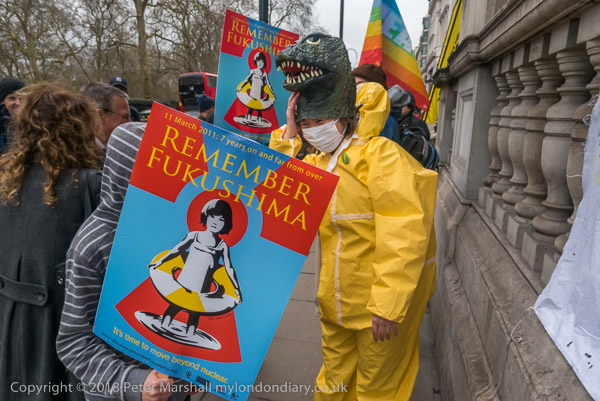
Remember Fukushima.  The disaster began seven years ago, but it is still happening, and will go on for many years . Radioactive materials are still escaping from the  melted down cores of the three reactors damaged by the March 2011 earthquake and tsunami damaged reactors, with the water needed to keep the No 1 plant core cool still releasing around 2 billion becquerels a day – although the bequerel is a very small unit, still a substantial amount. Recent research by the University of Manchester has also shown the surrounding area up to several kilometres from the plant to be contaminated with micro-particles containing radioactive uranium. Different isotopes have widely differing decay rates, but the clean up will certainly take hundreds if not thousands of years.

In a sane world, we would have delayed any introduction of power generation from nuclear fission until the problems of nuclear disaster and nuclear waste had been properly investigated, but in the real world people saw the promise without letting the unsolved problems deter them, though TEPCO’s choice to build their nuclear power station in an earthquake zone was surely a gamble too far. And clearly no sane person would ever suggest we make or use nuclear weapons – and only one rogue country has so far used them. Japan had plenty of evidence from Hiroshima and Nagasaki to the the dangers of nuclear catastrophe

When photographing protests I look for pictures that as well as concentrating on the people taking part also show clearly the 5 W’s (and the H) as promulgated long ago by Aristotle – Wikipedia gives a quotation from St Thomas Aquinas:

“For in acts we must take note of who did it, by what aids or instruments he did it (with), what he did, where he did it, why he did it, how and when he did it.”

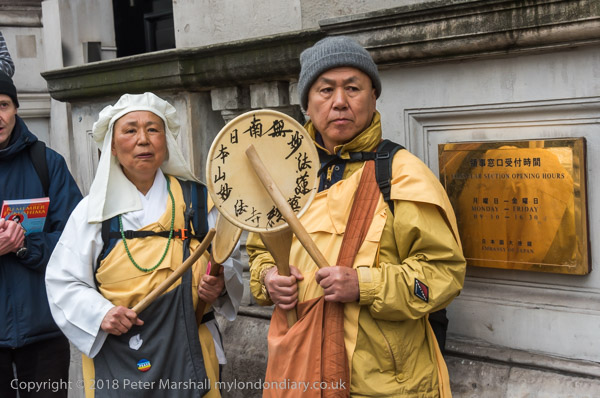
The photograph at the top of this post uses the fine poster for the event which has a precis of the what  of the occasion and why those taking part are doing so. In the second image I’ve included the brass plate of the Japanese embassy along with the two Japanese Buddhist monks taking part in the event.

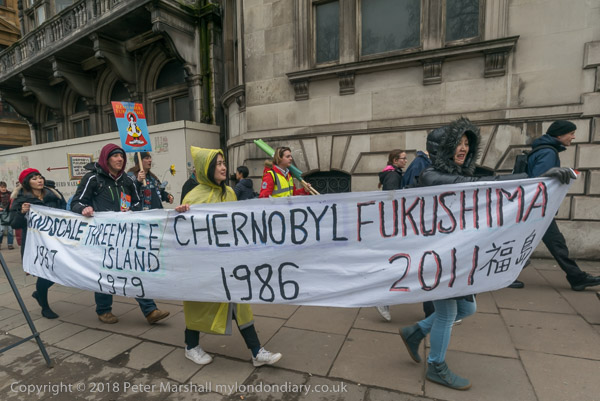
Other pictures show the long banner listing some of the major nuclear catastrophes – Windscale 1957, Three Mile Island 1979, Chernobyl 1986 and Fukushima 2011  (two further major incidents at a nuclear weapons plant on the Techa River in Russia, including the 1957 Kyshtym disaster were hushed up by Russia.) 

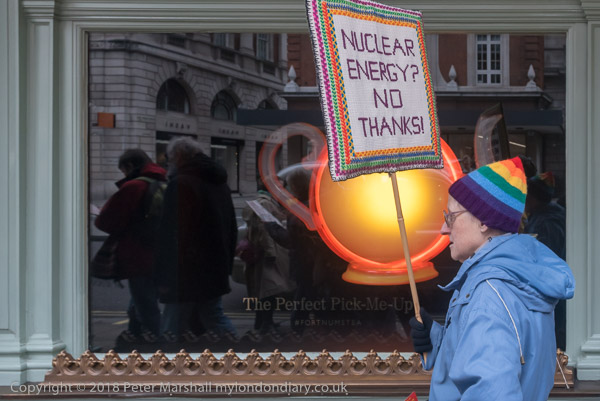
Passing Fortnum & Mason on Piccadilly I was intrigued by the window displays featuring various teapots, one of which I thought perhaps looking a little like the overheated core of a reactor, and I photographed it with one protester who comes to protests with her own hand-embroidered placards which often attract photographers walking past.  She is a woman who used many years ago to work with my wife and I often go and have a few words with her when I see her at protests, but I kept to my normal practice of not posing people when I’m photographing events. I’m there to record events not create them and simply stood in the right place to take the picture as she walked past.

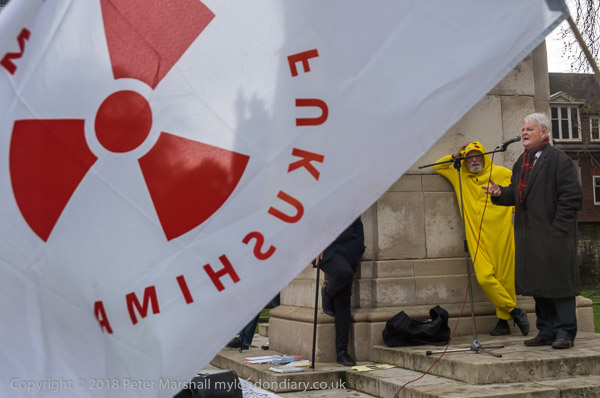
But of course you have to create pictures, by making use of what the event has to offer. I’ve photographed Bruce Kent on many occasions (not always as he would have liked, but never unkindly) and on My London Diary you can see some closer views as he spoke. But in the tightly-cropped head and shoulders view he could be speaking anywhere about anything.

While in the picture above only those familiar with Westminster will recognise the plinth on which he is standing in Old Palace Yard, the radioactivity symbol makes fairly clear the nature of the event, and assuming you can read back to front that it is about Fukushima. The figure in the yellow suit beside him perhaps helps, and certainly draws the eye to the speaker (though perhaps the yellow arm and leg on the point of a toe do give an impression of boredom).

Of course I didn’t set this up – or I might have found some way to get the flag the right way around. There was quite a breeze, and the flag was fluttering fairly wildly and while it might have been easier to get someone to hold it still in the correct position with a hand out of frame I didn’t do so. Nor did I ask the person holding at right out of frame to keep the bamboo pole still and at the same angle, though it would have made life easier.

Partly I didn’t do either of these things as it would go against my idea and training of not manipulating the news, but also because I remain convinced of the value of chance and accident which often make my images rather more exciting than any limited ideas I might have about making pictures.

Rather a lot more to see on My London Diary at Remember Fukushima, 7th Anniversary.

______________________________________________________

There are no adverts on this site and it receives no sponsorship, and I like to keep it that way. But it does take a considerable amount of my time and thought, and if you enjoy reading it, a small donation – perhaps the cost of a beer – would be appreciated.

My London Diary : London Photos : Hull : River Lea/Lee Valley : London’s Industrial Heritage

All photographs on this and my other sites, unless otherwise stated, are taken by and copyright of Peter Marshall, and are available for reproduction or can be bought as prints.

To order prints or reproduce images

________________________________________________________
Dark Practices

Outsourcing of staff is a dark practice used by many organisations to retain their own shining images while screwing their workers, who get the kind of management, employment rights and wages you would expect from least scrupulous of companies whose only concern is making profits while reducing their bids for the contracts to the lowest possible levels.

So it was perhaps appropriate that this protest by the IWGB which represents cleaners, security officers, receptionists, porters, gardeners and others who work at the University of London keeping its central services running outside Vice Chancellor Sir Adrian Smith’s graduation dinner should be one of the darkest that I’ve ever tried to photograph.

The protesters were in their usual good spirits, making a great deal of noise and calling for the university to employ them directly, for an end to zero hours contracts and to implement promised pay rises.

In the days of film, the only possibility would have been to use flash (or pay a fortune to light this as a film set.) But digital has shifted the possibilities, and I decided to work with what little available light there was, and just occasionally to supplement this with my handheld LED light source. This event soon showed the limitations of this, a Neewer CN-216, at least when running from rechargeable AA batteries, when the power drops off considerably after only a few minutes of use, though it continues to give some light for several hours. Most pictures were made without its help. The light will also run from a number of Sony and Panasonic batteries and Neewer also make high-capacity ones to fit which might improve the performance.

Almost all the pictures were made with the camera set at ISO 12,800 and with an exposure bias of -0.3 or -0.7 stops, and were still mainly underexposed, at shutter speeds mainly around 1/30 – 1/50s. Neither of the two lenses I was using was a fast lens, the 18.0-35.0 mm f/3.5-4.5 and the 28.0-200.0 mm f/3.5-5.6, and I often had to stop down a little for depth of field. I don’t own any very fast lenses, but hadn’t expected these Stygian conditions or might have replaced the 28-200 in my bag with the heavier Sigma 24-70mm and added the petite Nikon 20mm f2.8 for luck. Neither is particularly fast but a stop or two does make a noticeable difference.

But apart from being heavier, and running out at only 70mm when I often want something longer, somehow I just don’t trust the Sigma. It wasn’t a cheap lens, but I think isn’t quite sharp enough wide open to be worth carrying the extra weight. I bought it for use on DX where it perhaps does better.

The IWGB met outside Barbican station and marched to protest outside the dinner through the tunnel under the Barbican. There the lighting was much brighter and I was able to work at a lower ISO even using shutter speeds around 1/100s.

More pictures: IWGB protest at Graduation Dinner

______________________________________________________

There are no adverts on this site and it receives no sponsorship, and I like to keep it that way. But it does take a considerable amount of my time and thought, and if you enjoy reading it, a small donation – perhaps the cost of a beer – would be appreciated.

My London Diary : London Photos : Hull : River Lea/Lee Valley : London’s Industrial Heritage

All photographs on this and my other sites, unless otherwise stated, are taken by and copyright of Peter Marshall, and are available for reproduction or can be bought as prints.

To order prints or reproduce images

________________________________________________________
Snowy HE protest

London felt more like Moscow, or rather how I imagine Moscow as I’ve never been there, as I made my way from the bus stop to Malet St. There was a wind that made it hard to walk and drove the snow into my face, and I’d slipped and almost fallen, just “catching myself and my camera bag before either hit the couple of inches of snow on the ground in Byng Place”. By the time I was in Torrington Place it was hard to see the crowd standing there with a large banner, having to wipe my glasses and my camera lens and trying to take pictures. It slackened off slightly and between squalls I managed to get one picture that wasn’t ruined. I always hope that I’ll get a nice arty result from rain and snow on the lens, but somehow it never seems to happen, and in any case I don’t think Alamy would like it.

One book on ‘Bad Weather‘ is probably enough for the whole of photographic history, and it remains in my opinion one of Martin Parr’s better titles. I even paid money for it, though my first edition seems to have gone missing. Being unsigned might make it something of a rarity!

Once I was in the crowd they afforded some shelter from the weather and things were a little easier and I could make the occasional picture without snow on the lens. And even some in which people’s eyes weren’t covered by snowflakes. Fortunately the snow didn’t keep on for too long, though there were some short and heavy showers as the march made its way towards Westminster.

This was a protest by the UCU, lecturers in higher education, with support from their students, and some of the placards reflected this. They wanted proper talks with their employers about pensions and pay, particularly as the universities had announced their intention to steal much of their pension funds. And they were joined by some FE staff from the London area who were on the first day of a two-day strike over their pay and conditions.

If you’ve ever tried walking backwards on snow or ice, you may appreciate the problem I faced on photographing the marchers, where most of the time you are walking backwards at the same speed as they walk while taking pictures. Usually the main hazards of this are lamp posts and kerbs, but snow does add a dimension. Fortunately once we got out of Russell Square and were onto busier roads (they would have been busier but for the marches) most of the snow there was now slush and rather less slippery.

It wasn’t a particularly long march, I think about two and a half miles, and I walked the whole way, though there were some long sections where I took no pictures when the snow came on again. I’d dressed well for the weather – with long-sleeved thermal vest and longjohns over my normal underwear, a cashmere scarf, thick socks and a woolly hat, as well as my usual wind and waterproof winter jacket, but I still got cold. Better gloves would have helped – but photographers need to be able to use their fingers. I had a pair of thin silk gloves under a thicker wool pair, which still allow be to operate the camera controls, but I think I need to research for a better solution.

I don’t usually cover indoor rallies, but went into Methodist Central Hall with the first of the marchers largely to sit in the warm. I spent around an hour or so in there, and took pictures of the speakers, who included some well-known trade unionists and Labour politicians, so the time wasn’t wasted, though the light wasn’t too good and I could have got a little closer. But I got nice and warm by the time I had to leave to cover another protest outside a short distance away.

HE and FE march for pensions and jobs
HE & FE rally for pensions and jobs
______________________________________________________

There are no adverts on this site and it receives no sponsorship, and I like to keep it that way. But it does take a considerable amount of my time and thought, and if you enjoy reading it, a small donation – perhaps the cost of a beer – would be appreciated.

My London Diary : London Photos : Hull : River Lea/Lee Valley : London’s Industrial Heritage

All photographs on this and my other sites, unless otherwise stated, are taken by and copyright of Peter Marshall, and are available for reproduction or can be bought as prints.

To order prints or reproduce images

________________________________________________________
D Day and more

Perhaps because the media have been so preoccupied with the anniversaries of the First World War there was little publicity this year about the anniversary of D-Day, June 6th 1944. Which perhaps explains why I’m only writing about it a day late, having seen some posts about it on Facebook late last night.

Although we now know much more about the iconic images taken by Robert Capa – and the myths that have grown up around them and are still being stated as fact, even by some who are perfectly aware of the investigation by A D Coleman and his team, a three year study concluded around a year ago, when I last wrote about it. I suppose they are following Capa’s example; his most famous dictum was ‘If you’re pictures aren’t good enough, you’re not close enough‘ but perhaps the attitude that most shaped his life was to never let the facts get in the way of a good story, though to be fair the story that he wrote was intended more as a Hollywood treatment than real autobiography.

I don’t mean by this in any way to belittle Capa as a photographer. The investigation is one that I think paints others in a worse light than him, though he certainly went along with the deception. Nor do I in any way minimise the shock of landing on that Normandy beach; for the military who went as a team to do a job they had trained to do it will have been far less horrific than for a lone individual, and I doubt if many of us would have handled the situation there any better. If anything I admire him more for his courage in realising that he had to return as soon as he could and get on with doing the job.

I’ve fortunately never been under fire from an enemy army. The nearest I’ve come is having milk bottles thrown at me from six floors up on a council estate, beer cans and bricks thrown from far right groups and a firework rocket aimed horizontally at me early one Sunday morning by kids in Bermondsey that missed by inches. And a paintball which splatted on my chest from the black bloc, probably like other missiles aimed at nearby police. I’ve been spat at, threatened, cursed, pushed and punched by the right, assaulted by police… But generally I’ve chosen to avoid violent situations, and I know I would never be a good war photographer. So Capa and the others who have chosen that course deserve and get my respect.

I hadn’t meant to do more than briefly mention D-Day and Capa, but as so often I got a little carried away. On being reminded of the anniversary I took another look (as I do fairly often) at Photocritic International. A D Coleman’s latest post there has the rather uninformative title Spring Fever: Ends and Odds 2018 and is, as always, worth reading, with a typically acute analysis of the case of Naruto, a crested macaque who picked up David Slater’s camera and took a few pictures with it. Coleman explains and comments on the decision by the Federal Appeal Court that copyright law covers the actions and creations of humans, and only humans, as well as on the concept of animals having names.

The post also contains Coleman’s incisive comments on two other matters, one of which is also – like the names of animals – related to ideas of ‘identity’ and brings in Alfred Korzybski’s argument that we should beware of all variants of the verb to be, which is perhaps rather relevant to some current debates, and a second more specific to photography, and in particular the devaluation of photojournalism, something some previous guest posts on Photocritic International have explored. It’s perhaps ironic that while some photographs now sell for undreamed of amounts in the art market, the rates for photojournalism are actual cash terms are lower than they were 30 or 40 years ago, despite huge inflation. Or if not ironic at least pretty desperate for those trying to make a living.