Fairey or Not?

I don’t know I have a great deal to contribute to the controversy of the use of a photograph by Shepard Fairey as a basis for his Obama posters, other than to be rather clear that this is definitively not a case of plagiarism. It may well however be a matter of copyright abuse.

Frankly I think it shows a certain stupidity or at least a lack of forethought on Fairey’s part (although seeing what some other artists have got away with – Sherrie Levine and Richard Prince being prime examples – in my book appropriation is clearly an offence rather than valid art – perhaps he felt no need to bother about the legality of what he was doing.)

You can read a thorough examination of the US legal issues as would be expected by Carolyn E. Wright on her Photo Attorney blog, where she makes clear that although it is a case for the court to decide,  she would be happy to take on for the copyright owner.

As well as a very useful Checklist for Fair Use, she also links to a blog post by John Harrington on Photo Business News that looks at the question of whether the photographer, Mannie Garcia or the AP owns the copyright.  Garcia reproduces both the photograph and two posters by Fairey on his web site (and I wonder if he has Fairey’s permission to show his work and if  otherwise this constitutes fair use.)

Funnily enough, at the top of the post where you might expect the Photo Business News blog to have run either the poster or Garcia’s photograph – either could I think have been justified in the US as fair use – we instead have an ugly rectangle with the two letters ‘AP’. (Fair use is mch more restricted here in the UK, although my policy not to use images without permission is because I’d like people to ask me before using my work rather than for any legal reasons; you will need to click on links elsewhere – such as that to Garcia’s site above –  to see the photograph and poster in this case.)

In the past my own work has been used as a basis for work by various artists which has been sold or published. In at least one case I’ve received a standard licence fee for supplying a print or file for this use, but in most cases I’ve simply granted permission, knowing that the work produced will both be very different from my original both in appearance and usage.

But although it seems clear to me that a licence should have been sought in this case, Fairey’s real offence seems to me to be laziness. There are many thousands of images of Obama that have been published in print and on the web, several of which were actually identified in the press as sources for the poster before Mannie Garcia’s image was located. It’s a good photograph, but not outstanding, the kind of head shot that any of us would take and be happy to have taken at an event where a well-known figure was speaking. What for me makes it a little more than most is actually the way the flag behind frames his head, at a similar angle to the tilt of Obama’s head, something Fairey has not copied. But I actually thing there are some considerably better pictures (of other people) on Garcia’s site.

Had Fairey not chosen to have simply traced from this particular image, including its basic lines and some of its tonal structure (though in a much simplified form) but followed good practice in using a number of similar images as source material for his poster there would I think have been no claim to answer.

But he should be accused of laziness or sloppy practice and cetainly not plagiarism. The poster is quite obviously a powerful work that although based on a photographic image has created something new and quite different (and frankly considerably more iconic), not any attempt to pass off Garcia’s photograph as his own.

My final thought:
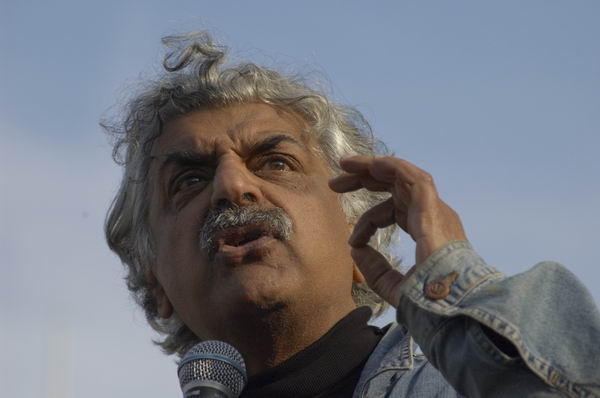
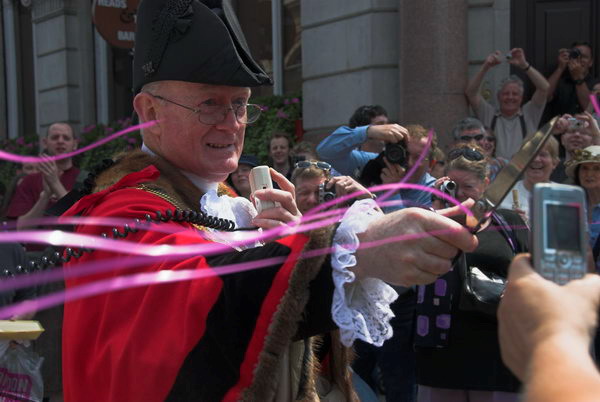
© 2005 Peter MarshallThis might make a good poster in the unlikely event that Tariq Ali were ever to become our Prime Minister!

Photography Crunch

Photographers have perhaps always complained about hard times – and they have often been harder for the best photographers, as for example a reading of Edward Weston‘s Daybooks will show. But the widely published news about rates at The Sun which I read on the Press Gazette site last week led to complaints that these were below 1993 prices. The rates for photos in The Times are even lower, with a minimum rate of £54 and a postcard size image (11-25 square inches) earning £90.

Of course back in the 90s I can remember complaining that the fee one magazine was offering for a story and pictures was actually less than they had paid me for a similar feature fifteen years earlier. And those ‘Fleet Street’ rates above are of course considerably higher than anyone can expect from the regional and local press, where conversations often end with the mention of any payment at all, and fees are generally minimal.

In one of the comments to the Press Gazette feature, Roger Maynard takes things back further still, suggesting that lineage rates, also cut, are “not much higher than the sort of lineage paid back in the sixties...”

It makes me wonder what future there is if any for the press as we know it – on wood pulp or on line. There just don’t seem to be enough peanuts going round at the moment to sustain anything really worth publishing.

Personally I’m happier to publish my work in different ways, even ones that don’t produce any direct income but which do allow me to write what I want to say and publish the pictures I want to publish – if for various reasons not always exactly how I would like. So I’ll write stories for Indymedia or NowPublic and of course here on >Re:PHOTO and My London Diary.  The audiences may be smaller, but they are certainly, dear reader, much more select, intelligent and interested.

Of course you reading this are one of a growing number who know that various blogs and web sites – including but certainly not exclusively those from the commercial media – are increasingly how we keep in touch with what is happening.  While too much of the press is at least metaphorically down in the gutter looking up the skirts of celebs – thanks to the BJP I learnt a new word for this type of photographer this week, “crotchdog.” Much to my surprise, despite the snow paralysis of the UK this week’s issue arrived on my doormat at the usual time so congratulations to them on this.


Suburban snow in Staines

But almost all other areas of photography are also feeling the pinch – even advertising and fashion. Commercial galleries around the world are hitting hard times – and according to Bloomberg, prices of some of Hiroshi Sugimoto’s seacapes currently on show the the Gagosian gallery have been reduced from $450,000 to $360,000!

According to a news item this week’s BJP (like the link above this may need a subscriber login, but in this case you can read the original press release at CIPA), one area still looking healthy is sales of digital SLRs. The  Camera and Imaging Products Association forecast a 6% increase in worldwide DSLR sales over 2008, to more than 10 million. Not only a staggering number of cameras, but even more mind-boggling the number of pictures these will produce – and what will happen to them?

What will happen in the UK at least to the prices for DSLRs is that they will rise. I’ve left thinking about buying a Nikon D700 rather too long. A few weeks ago I could have bought one for just over £1400. This week the cheapest I could find was £1625, an increase of £200. This week’s price is likely to look cheap in a few months time.

However, anything dealing in any way with financial advice coming from me should carry a prominent health warning. I ignored the professional advice a few years ago to take my savings out of unit trusts, signed up for a fixed price deal on gas when prices went sky-high last summer and more.

Chinese New Year

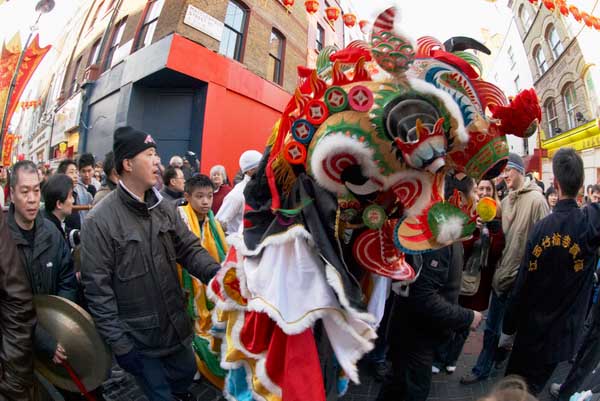
London today celebrates the Chinese New Year, the Year of the Ox, but I don’t feel any great need to go and take pictures, or indeed to go and join in the celebrations.

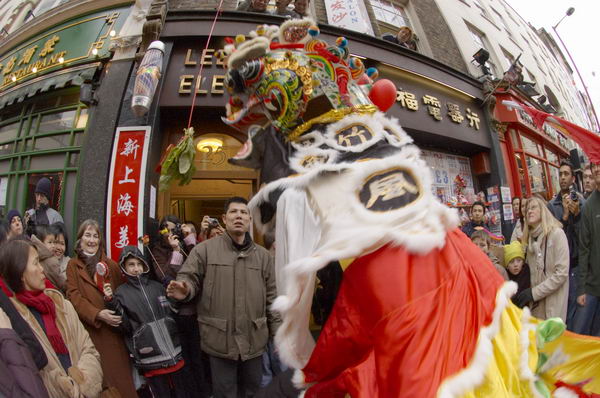
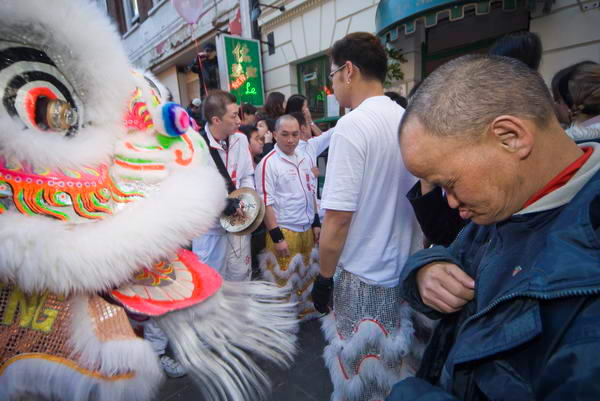
I’ve nothing against the Chinese, and I’ve been to the celebrations in London most years. The roads will be crowded for the parade and later in the day the streets of Soho’s Chinatown will be packed to the gunnels (or gunwales) with crowds trying to watch as the lion dancers and their teams of drummers visit the many shops and leap at the hanging greens above their doorways, or queue to eat in the many restaurants.

© 2008 Peter Marshall
Chinese New Year, Soho, London 2008

It’s certainly a spectacle worth seeing, but I’ve seen it before and photographed it many times and don’t feel a need to repeat the experience. Looking at the pictures from last year or earlier years

© 2006 Peter Marshall
Chinese New Year, Soho, London 2006

© 2005 Peter Marshall
Chinese New Year, Soho, London 2005

I feel I’m simply repeating myself (though of course I did take other pictures:)

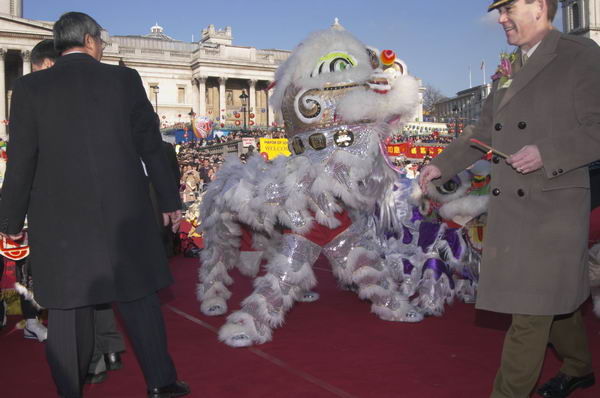
© 2004 Peter Marshall
Chinese New Year, Trafalgar Square, London 2004

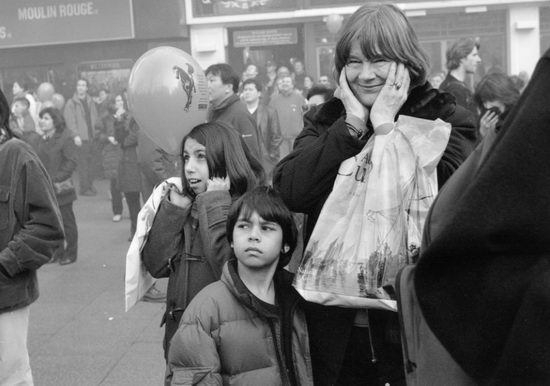
but perhaps the best are from earlier years where I shot mainly in black and white and concentrated on the people

© 2002 Peter Marshall
Firecrackers, Chinese New Year, Soho, London 2002

Of course it’s an event that brings out the Flickrati in droves (again I’ve nothing against them but don’t feel moved to join them, though I do have a free account with 97 pictures there) and where everyman and her dog has a camera and is pushing to get pictures – so, unlike some of the other events I photograph I don’t think my pictures will be missed.

And it’s actually much harder to work with amateurs than with a whole pack of pros.

Pros tend to be aware of other photographers and to “do as they would wish to be done by“, at least to some extent working together as a team and not deliberately impeding others; a certain unwritten etiquette applies (though TV crews sometimes think they are God and treat still photographers as dirt.)

© 2006 Peter Marshall
At the last second a hand appeared blocking my view

But holding a camera phone at arms length and concentrating on its small screen makes some people (mainly young and male and self-assured) completely oblivious to the presence of others as they happily walk right in front of me as I’m photographing or hold their phone right in front of my lens.

Obama

Certainly the new president seems to be good news for those still in Guantanamo – and perhaps it won’t be long before London can welcome back two former residents, but so far I haven’t been too impressed by the photographs I’ve seen of the event.

You can read the story of how Chuck Kennedy got his widely published low angle shot from a remote Canon 5D Mark II fitted in a Pelican case to muffle the shutter noise on  Poynter Online (thanks to PDN Pulse for the link) but despite showing some great ingenuity I think it makes the president look rather odd and doesn’t really convey a great deal in the way of atmosphere. But of course I’m not from the USA.

Of course at a huge events like this, only one camera got that front row space and all credit to Kennedy for coming up with the idea and getting permission. But another picture, which doesn’t include the president, seemed to me to to say far more about the occasion and to show you don’t need special facilities to photograph major events. Published on the Heading East blog, it’s an image by New York freelance Rachel Feierman (her work is distributed by Sipa Press) and you can see more of her impressive work on Politics 08 and other projects on her web site.

Observers and Events

Photographing last Saturday’s demonstration about Gaza in Trafalgar Square on Saturday I was very aware how the presence of photographers and the way that they react to events can actually very much influence what is happening.

© 2009 Peter Marshall.

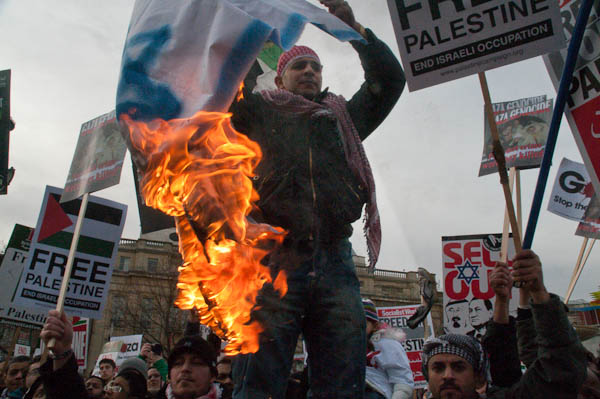
At times speakers had to stop and wait because of the noise, which was prompted by the activities of a smallish group of men at one side of front of the crowd facing the speakers. As well as chanting noisily they also burnt Israeli flags and posters, and of course when they did so a crowd of photographers formed in front of them.

Obviously they felt deeply about what was happening in Gaza and wanted to show it, but this and other similar displays at the demonstrations are very much designed to catch the attention of the press, and very much encouraged by the press reaction.

As photographers we need visual symbols, and the more powerful these are the easier our job becomes. So of course, with all the others I went and photographed what was happening.

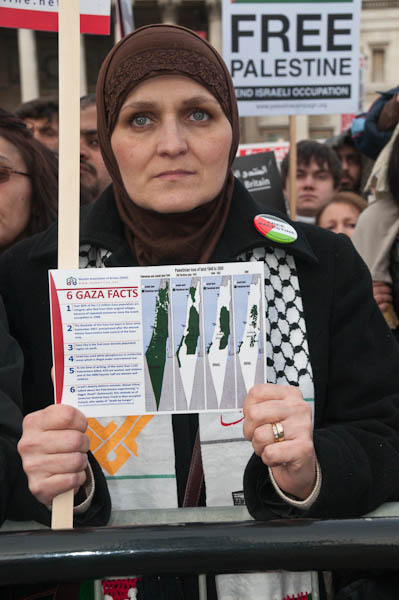
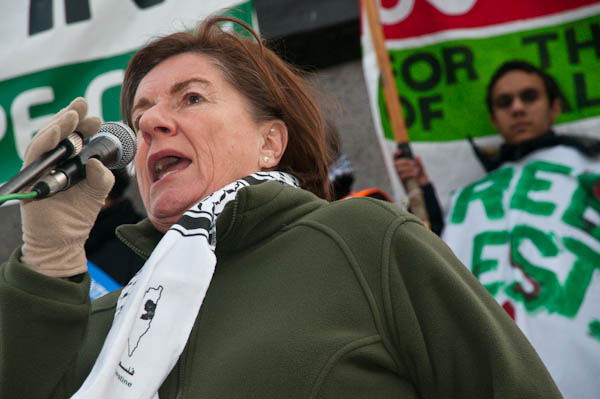
But once I’d got some pictures of a burning flag and images that I thought showed their anger I walked away and photographed other things, leaving them alone. Not that it made any difference as there were plenty of other photographers encouraging them. But I wanted to hear the speeches and photograph the speakers and the audience, and this was an event that was very much about women and children, so I tried to concentrate on them.

© 2009 Peter Marshall.

The police often accuse photographers of provoking demonstrators to violence, but in general I don’t think we do, at least not to any measurable extent. Demonstrators are far more often provoked by the police – and being pushed around or hit by a baton is considerably more effective effective provocation than a camera. Even the way the police use cameras is often considerably more provocative than the way that journalists usually work.

Most of the time we are doing our best to record what is happening rather than to be a part of it, but there are times when our presence as observers can very much change the events we observe, and we need to be aware of it.

You can see my photographs from the rally in Trafalgar Square and the women and children’s march along Whitehall on My London Diary as usual.

Hoppé Mad

I have a great deal of interest in the photography of E O Hoppé – and indeed included him in my list of two hundred or so ‘Notable Photographers‘ that I put on line in 2000.  I have a particular interest in him as I share his fascination with London, and like him have spent many years photographing it.

But today I got an email quoting an article from Luminous Lint  which suggests he is a recently rediscovered early Photo Modernist and goes on to quote photography curator Phillip Prodger of the Peabody Essex Museum as comparing his pictures to those of Steichen, Stieglitz, and Weston. Frankly this is utter nonsense, not least because it’s hard to rediscover someone who was never lost – as my listing on a major photography site visited by millions demonstrated.

According to  The Recession or: How I learned to Stop Worrying and Love Photographs! Bruce Silverstein, one of my favourite photo dealers,  whose New York gallery represents Hoppé, (and a show of his work including ‘Early London Photographs’ opens at the 24th Street Silverstein Gallery in February 2009) is quoted as saying “it is becoming increasingly clear that E.O. Hoppé played a major role in the evolution of Modernist photography both in Europe, having influenced the industrial images of Albert Renger-Patsch and Werner Mantz, and as well in the United States, where his images predate equivalent but better known works by Charles Sheeler, Walker Evans and Berenice Abbott.” I’m sorry Bruce, but I can’t take this seriously.

Quite a Hoppé industry is certainly developing, with a number of books forthcoming. Hoppé too was very industrious in his lifetime, and I have at various of his books scattered around the house, mainly for their topographic interest, including his ‘The Image of London‘ published by Chatto and Windus in their ‘Life and Art in Photograph‘ series in 1935,  which was probably the closest he came to producing an ‘art’ book.  Does it show a ground-breaking photographer?  In no way, though the negative image on the dust jacket is interesting, considerably more so than the same image printed conventionally as Plate 1 of the book.  Everything else about it’s 100 photographs is competent but rather ordinary, even pedestrian and at times hopelssly corny.

Hoppé, born in Munich in 1878, studied photography but became a banker and this brought him to London in 1900. Here he became a leading pictorial photographer, one of the founders of the London Salon – and the work which he was taking in the 1920s was still very much in that tradition – as can be seen in a number of the works from around 1926 on the Silverstein Gallery site, for example Middletown in the Snow. It could indeed be compared with pictures by Stieglitz  – but those he took in the 1890s, and can hardly be seen as innovative. And somehow Stieglitz clearly has the edge – you feel the weather and the cold and the atmosphere rather than just a pretty picture.

Like many others, Hoppé was influenced by changes that were taking place particularly on the continent of Europe after the First World War, and in particular at the Bauhaus in Weimar from 1919-25, as well as the work of many other photographers who were beginning to exploit the possibilities of smaller and more flexible cameras. I don’t know what evidence there is to say that his work influenced people such as Renger-Patsch, but so far as I am aware – and on the evidence of the work I’ve seen – he was a follower of wider trends rather than in any sense an initiator. But his widely published work – in books such as ‘The Image of London‘ certainly did help to set norms, though I think others did it rather better.

It is interesting that both Hoppé and Sheeler photographed the Ford plant in 1926/7, and you can compare the their images –  Hoppé and Sheeler. Then go back  and look at  a similar subject photographed four years earlier by Edward Weston, Armco Steel, 1922.
If you can’t see the difference, then you certainly shouldn’t be writing about photography.

Of course the article isn’t really about photography but about the market and market values. Hoppé’s work – or at least his more interesting images, such as those on show at Silverstein –  may well be a very good investment, and like most non-USAmerican photographers is undervalued, but don’t let’s get the real value of his work out of proportion.

Paranoia or Politics?

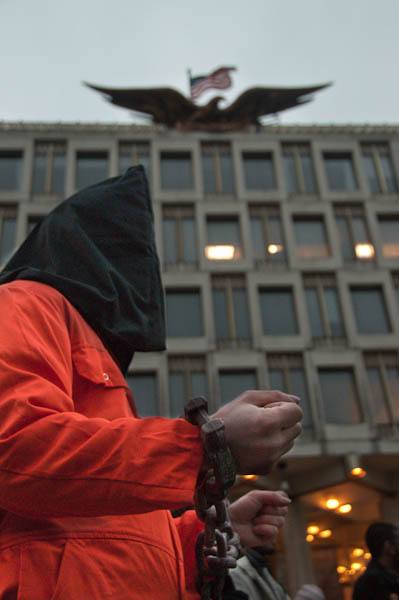
I was outside the US Embassy at dusk on Sunday, photographing a protest on the 7th anniversary of the first prisoners being held at Guantanamo – and remembering those who are still there and still being mistreated, including two Londoners.

To remind us, there were two figures in orange jumpsuits standing manacled while the speeches were being made, so of course I went to photograph them, framing them under the watchful eye of the eagle and the stars and stripes on the embassy roof.

Not of course an original idea, and something I’ve done myself before on numerous occasions, so I was rather suprised when a police officer came up to me and told me not to take pictures that included the US embassy, but to restrict my photographs to point my camera away from the building.

I asked why, and the answer of course was “security“. Which is of course total nonsense, but  rather a common answer these days. Although it is an impressively ugly building, it has been photographed many times and pictures of it are widely available, and it is hard to see how any picture of it could represent a security risk. Rather easier to see why the US government might not wish it to be associated with such.

But I suppose these days I should think myself lucky not to be searched or arrested for taking photographs – like some others. And things could be much worse. While I was being given a polite warning I was listening to a Muslim man from Walthamstow talking about his experience of spending 18 months in prison for having a rather more impressive beard than mine and liking to go paint-balling. The police called it “military training” but fortunately for him the jury were less paranoid.

More pictures

Blessing the Thames

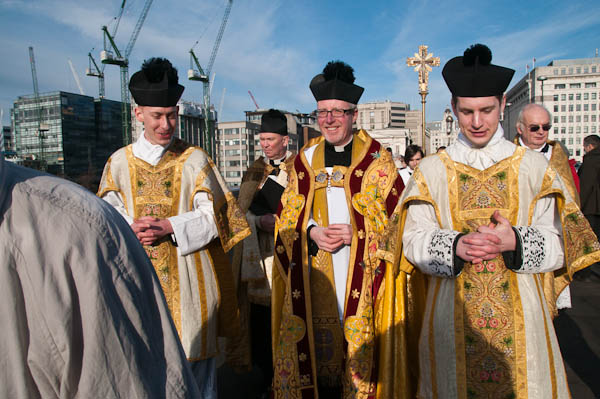
The annual ceremony of blessing the Thames was only started 5 years ago, although it has a very traditional look, thanks to the more ancient forms of dress of those taking part.

I always try to respect religious events when photographing them, trying to interfere as little as possible with the worship of those taking part. But two other photographers from the two churches concerned seemed to have rather less inhibitions than me. I’m not sure if it is simply a matter of insiders having a clearer idea of what is and is not appropriate or just different sensitivities.

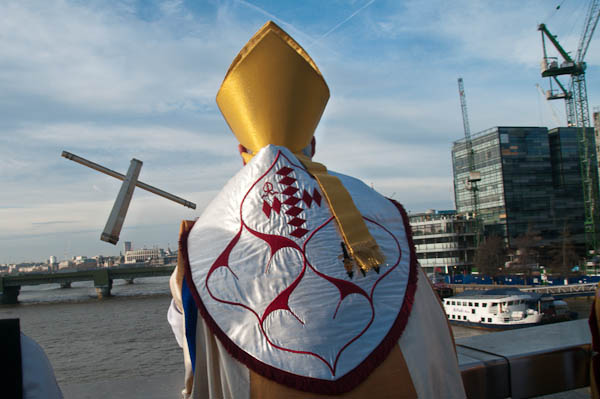
It isn’t easy to work out how to photograph the cross being thrown into the river; perhaps the ideal position for a photographer would be quite impossibly suspended in mid-air over the edge. It was quite a crowded event and it wasn’t possible for me to be exactly the best of possible positions, but I was quite pleased to capture a couple of frames with the cross in mid-air, and, by a happy chance to include a second less obvious cross just to the right of the Bishop’s mitre, made by the con trails in the sky.

More pictures

Suit for Prince

It’s interesting to read, thanks to Cityfile that French photographer Patrick Cariou has filed a suit against Richard Prince and his gallery for using his photographs published in the 2000 book Yes Rasta in a series of paintings that were recently on show at Gagosian New York. Not least because the precendents suggest that Cariou is probably unlikely to win, despite a certain obvious justice in his case. Prince’s work clearly could not exist without his creative input, and to suggest otherwise seems to me to deny the creative input of Cariou’s work.

I rather suspect that if Prince’s work had been shown in Paris, the result of a case in the French courts would be rather different. I don’t have any time for the appropriation of photographs – but then I’m a photographer. I’d be happy if people wanted to use my work, so long as they were prepared both to acknowledge their indebtedness explicitly in both words and cash.

Police Continue Clamp Down on UK Photographers

At least two more stories about police targeting photographers in the London area have hit the papers in the last couple of days.

Artist Reuben Powell (story in the Independent, 6 Jan) was photographing the former HMSO print works in Amelia Street SE17, just south of the Elephant, off the Walworth Road, empty since 2000 and being converted into flats as part of a new Printworks development of over 160 flats. A police car screeched to a halt next to him and an officer jumped out, ran over and asked him what he was doing. When Powell told him he was taking photographs the officer said he was going to search him under Section 44 of the Terrorism Act 2000.

It is hard if not impossible to see how this search complies with the law, which makes it clear that officers may not carry out such a search unless they suspect criminal or terrorist intent. There do have to be reasonable grounds for suspicion, and they seem totally absent in this case.

In the search, police found a knife that Powell uses to sharpen his drawing pencils, and he was handcuffed, had a DNA sample taken and spent five hours in police custody, only finally being released after the local MP intervened on his behalf.

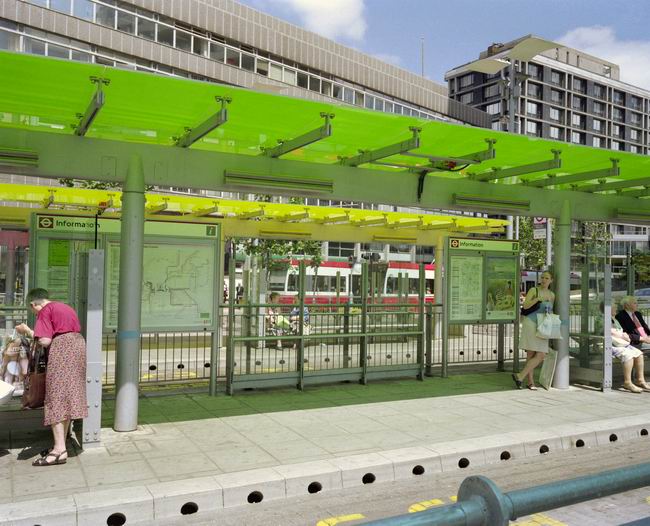
The Mail Online has the story of another MP Andrew Pelling, Tory member for Central Croydon, who was stopped and searched while taking pictures of a neglected cycle path in his constituency. Police give as the excuse for this search that he “was taking pictures in the vicinity of a major transport hub.”

By this they don’t mean the cycle path, but the nearby East Croydon Station, together with its tram stops. In the current climate I expect police to knock on my front door in the middle of the night for naming it (and I note the Mail don’t!)


A major transport hub in East Croydon.
More pictures of the vital strategic Croydon Tramway Line 1 taken by me (without being arrested) in 2001.

I’m all for the police being vigilant against possible terrorist attacks, but this is no excuse for paranoia, and we need to see evidence that senior officers are giving sensible advice (and the occasional warning) to the loonier members of the police force. Unfortunately the opposite appears to be true, with such behaviour being encouraged by the kind of anti-photographer campaigns the police have organised.

What should be required reading for all police is the article written last June by security expert Bruce Schneier, The War on Photography. As he makes clear, the fear of photography isn’t related to real terrorism, but is the stuff of movies, a Movie Plot Threat.

And the real danger is this. If a huge proportion of police time and public money is taken up with dealing with movie-plot threats, although it may make the police feel good (and even keep some of the public happy) the chances are much higher that the real thing will go ahead unnoticed.