Advice to Met Officers

On Monday, a statement by Assistant Commissioner John Yates was issued by the Metropolitan Police Press Bureau which details the advice sent by him to all MPS officers and staff. It clearly repeats the tone of the advice contained in the Home Office circular in September, and I’ll repeat it in full at the end of this piece.

Photographers may even feel it is worth carrying a copy with them, but I think should you do so that you should make use of it tactfully if you are approached by the police or even police community support officers while taking pictures.  If you adopt a confrontational or evasive attitude when you are questioned it will only serve to escalate the situation – and can be a trigger for some very inappropriate behaviour by PCSOs and police, as I think two reports from the Guardian clearly demonstrate.

One was a deliberate attempt by Guardian reporter Paul Lewis to get himself harassed while taking what were misleadingly described as “Casual shots of London’s Gherkin“and the second was the considerably more serious and inexcusable harassment of Italian art student Simona Bonomo at Paddington, described in a story and video “Italian student tells of arrest while filming for fun” a month ago which they published last Tuesday.

Had Lewis, when approached by security staff told them – or the off-duty police officer who came along – he was a Guardian journalist working on a story about the harassment of photographers while photographing buildings and shown them his press card there would of course have been no story. But it seems pretty clear to me from his own video that he was behaving at best rather curiously and in a way that was clearly intended to arouse suspicion.  If you poke the animal with a stick you should really be hardly surprised that it bites.

Of course the response of the police was stupid and in some respects over the top, but hardly unexpected. The least defensible part of their response seems to have been the stop and search carried out on the photographer who was recording the event from a distance with a telephoto lens, for which there appears to be no remotely believable justification.

I have considerably more sympathy for Simona Bonomo, particularly as she was both assaulted with obviously unreasonable and entirely unnecessary force by police officers and was then stitched up with a fixed penalty fine of £80 for a public order offence of which she is obviously innocent.

But again I think it was an incident that need not have happened, and that the Guardian’s report of it is again in some respects misleading though they deserve credit for bringing it to public attention.  Their headline that says she was arrested “while filming for fun” is incorrect. Although her first rather offhand response to the PCSO was to say that she was filming “just for fun” it is clear that this was not true, both from the actual video footage which starts with her filming security cameras (which probably alerted the PCSOs) on the buildings and what she says later on in her exchange with the PCSO. She is an art student at a London university and was working on a project on surveillance (and rather painfully this incident produced some only too real material for it,)  Had she made that clear when she was first approached the situation would almost certainly not have escalated as it did – the PCSO himself says so on the video.

Of course the police – and the PCSO – got it seriously wrong. But while photographers should stand up for their rights,  we should also generally be open and clear about what we are doing. If anyone asks me why I’m taking pictures – by a member of the public or the police force – I try to explain briefly and politely (usually but not always entirely truthfully), and when appropriate show my press card or offer my business card.

Of course sometimes you need to explain to people about your rights – and for some years my camera bag contained a personal letter from the Met which clearly explained that like all other photographers I had a right to take photographs on the public highway which sometimes came in  handy (and arose from a rather unpleasant run-in I had with two officers in the ’90s.)  But it’s generally more effective to do so in a polite and reasonable rather than a confrontational way. Experience tells me that arguing the law with the police at street level is unlikely to be productive – if they don’t know it they certainly won’t admit it.

Back when I taught photography – mainly to rather younger students than Simona Bonomo –  we advised students how to work in public, and in particular that telling people who asked that you were “working on a project for your photography course” was often a good way to get their cooperation.  I know a number of working photographers who still sometimes use this excuse – just as the great ‘Eisie’ – Alfred Eisenstaedt – would sometimes assure the people he was photographing that he was “just an amateur.”

Some of my students did occasionally decide to work on projects that might be contentious in some way and it was then my job to discuss the possible risks with them,  and at times suggest other ways of approaching the subject. For a project like this I would have provided a student with an official letter signed by the head of department “to whom it may concern” giving brief details of the student and the project with a request for their cooperation and of course a phone number they could ring if they had any concerns, and have asked the student to ensure they had this with them when working outside college on the project.
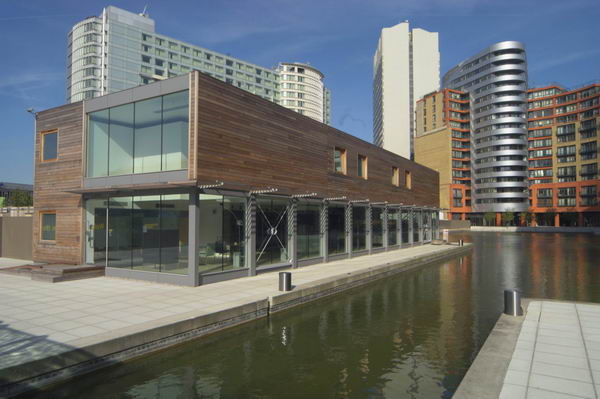
© 2004 Peter Marshall
Paddington Basin, 2004. Peter Marshall

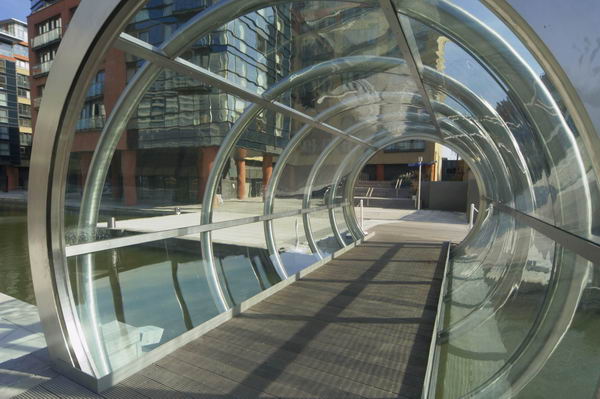
I’ve photographed around new developments in Paddington and the surrounding area on several occasions over the years without permissions or problems, though I was approached by a security man on one occasion. I told him what I found interesting in the particular view I was taking and he went away thinking I was mad but harmless.  I suspect that much of the land here is actually private – like so many new developments, but I wasn’t asked to stop taking pictures.
© 2004 Peter Marshall

Anyway, here’s the statement from the Met in full:

Statement by Assistant Commissioner John Yates

John Yates, Assistant Commissioner Specialist Operations, has today reminded all MPS officers and staff that people taking photographs in public should not be stopped and searched unless there is a valid reason.

The message, which has been circulated to all Borough Commanders and published on the MPS intranet, reinforces guidance previously issued around powers relating to stop and search under the Terrorism Act 2000.

Guidance on the issue will continue to be included in briefings to all operational officers and staff.

Mr Yates said: “People have complained that they are being stopped when taking photographs in public places. These stops are being recorded under Stop and Account and under Section 44 of TACT. The complaints have included allegations that people have been told that they cannot photograph certain public buildings, that they cannot photograph police officers or PCSOs and that taking photographs is, in itself, suspicious.

Whilst we must remain vigilant at all times in dealing with suspicious behaviour, staff must also be clear that:

  • there is no restriction on people taking photographs in public places or of any building other than in very exceptional circumstances
  •  there is no prohibition on photographing front-line uniform staff
  • the act of taking a photograph in itself is not usually sufficient to carry out a stop.

Unless there is a very good reason, people taking photographs should not be stopped.

An enormous amount of concern has been generated about these matters. You will find below what I hope is clear and unequivocal guidance on what you can and cannot do in respect of these sections. This complements and reinforces previous guidance that has been issued. You are reminded that in any instance where you do have reasonable suspicion then you should use your powers under Section 43 TACT 2000 and account for it in the normal way.

These are important yet intrusive powers. They form a vital part of our overall tactics in deterring and detecting terrorist attacks. We must use these powers wisely. Public confidence in our ability to do so rightly depends upon your common sense. We risk losing public support when they are used in circumstances that most reasonable people would consider inappropriate.”

++++

The guidance:

Section 43 Terrorism Act 2000

Section 43 is a stop and search power which can be used if a police officer has reasonable suspicion that a person may be a terrorist.

Any police officer can:

– Stop and search a person who they reasonably suspect to be a terrorist to discover whether they have in their possession anything which may constitute evidence that they are a terrorist.

– View digital images contained in mobile telephones or cameras carried by the person searched to discover whether the images constitute evidence they are involved in terrorism.

– Seize and retain any article found during the search which the officer reasonably suspects may constitute evidence that the person is a terrorist, including any mobile telephone or camera containing such evidence.

The power, in itself, does not permit a vehicle to be stopped and searched.

Section 44 Terrorism Act 2000

Section 44 is a stop and search power which can be used by virtue of a person being in a designated area.

Where an authority is in place, police officers in uniform, or PCSOs IF ACCOMPANIED by a police officer can:

– Stop and search any person; reasonable grounds to suspect an individual is a terrorist are not required. (PCSOs cannot search the person themselves, only their property.)

– View digital images contained in mobile telephones or cameras carried by a person searched, provided that the viewing is to determine whether the images contained in the camera or mobile telephone are connected with terrorism.

– Seize and retain any article found during the search which the officer reasonably suspects is intended to be used in connection with terrorism.

General points

Officers do not have the power to delete digital images, destroy film or to prevent photography in a public place under either power. Equally, officers are also reminded that under these powers they must not access text messages, voicemails or emails.

Where it is clear that the person being searched under Sections 43 or 44 is a journalist, officers should exercise caution before viewing images as images acquired or created for the purposes of journalism may constitute journalistic material and should not be viewed without a Court Order.

If an officer’s rationale for effecting a stop is that the person is taking photographs as a means of hostile reconnaissance, then it should be borne in mind that this should be under the Section 43 power. Officers should not default to the Section 44 power in such instances simply because the person is within one of the designated areas

So the Met at least have clear advice on the law – though it remains to be seen how well this will permeate down to street level. I hope someone has given a copy to the guys in the City of London force too, and elsewhere around the country.
Anti-Mosque Demo Flops in Harrow

A photographer friend had suggested I cover the demonstration outside the Hendon Hall Hotel on Sunday morning before going on to the event in Harrow, which we – and the police – had expected to be much bigger and possibly rather more exciting. “Both in North London” he’d said, and they are, but still around 6 miles apart by the shortest route – London is a fairly spread out place. If I was making a lot of money from photography the obvious answer would have been to take a taxi, but things being as they are I’d worked out how to travel between the two with a five minute walk, half an hour on a bus and a short tube journey.  Using my folding bike would have been a better solution, but I don’t like leaving it locked in the open anywhere as Bromptons are such tempting targets for bike thieves.

It wasn’t a bad journey in the end, though the bus was running around five minutes late, and we made it in plenty of time because there wasn’t a lot happening when we arrived at Harrow. The counter-demonstration  had been called for two hours before the right-wing demo was due to begin and there was little to do except stand around and talk – mainly to the many other photographers who were also covering the event.

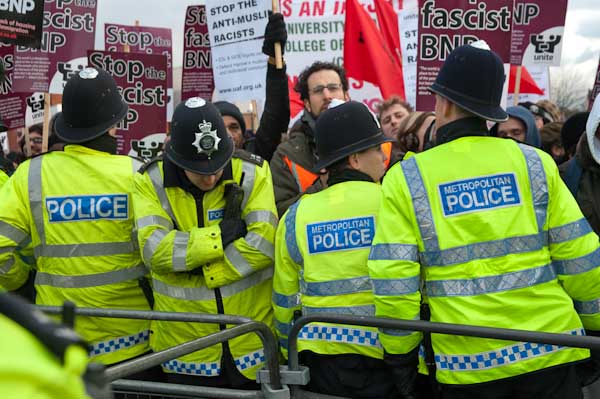
One thing that was a little disconcerting was the police, who were obviously putting on a charm offensive towards the press. One greeted me with a smile and a handshake as I walked out of the station and asked me what I thought was going to happen.  There really were police everywhere – according to one local paper, 800 of them, because last time the English Defence League had visited Harrow in the Summer there was a certain amount of trouble and fighting by them with both police and young Muslims who forced them to retreat.

This time the police had erected a pretty effective dividing line between where the two sides were meeting, with a two rows of barriers linked  and large bags of sand to hold them in place, though it did occur to me that these would allow determined and reasonably athletic protesters to easily leap over.

© 2009 Peter Marshall

We chose to start opposite the mosque, as the car park where the EDL and the SIOE (Stop Islamisation of Europe) were to have their rally at 2pm was empty. There wasn’t actually a lot to photograph with the counter-demonstrators, organised by Brent and Harrow Unite Against Fascism, but at least there were a couple of hundred people milling around and after a while a few speeches.

A little before 2pm photographers wandered over to look at the car park it was still virtually empty, with a group of six forlorn-looking youths and men.  Police told us we could walk round along the main road to get to the other side of the barrier but there seemed to be little point, although there were several TV crews there. Much more was happening on the side where we were, particularly as the several hundred UAF supporters moved closer and started to chant.

Eventually they charged right up to the double barrier, which was defended by a line of police as well as half a dozen rather menacing looking dogs straining on their leashes. But now we were obviously on the wrong side to take pictures. Much to my surprise, the police allowed those of us who could show a valid press card to climb over the barrier at a point away from the demonstrators. It was a degree of cooperation that I’ve seldom experienced. I’m just sorry I was in so much of a rush to get to the other side that I didn’t photograph us climbing over.

© 2009 Peter Marshall

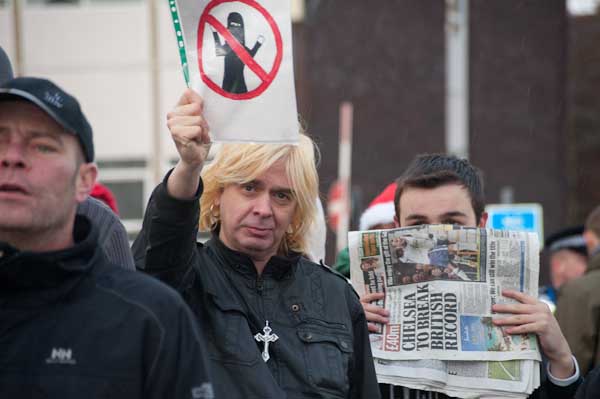
We were now able both to photograph the noisy demonstration across the barriers and also to wander a few yards and photograph the EDL/SIOE handful – now almost up to double figures. Some of them were clearly trying to hide from photographers, but others were posing and showing an England flag and a poorly drawn anti-burkha sign.

You can read about what happened after this on My London Diary (or Demotix) where the two stories are more or less the same. But on Demotix there is an edited selection of just under 20 pictures, while on My London Diary there are considerably more – and they are not watermarked.

I’m often asked why I put so many images on that site (or rather told that I put too many on it).  In part it’s because I want to use pictures to tell a story, rather than, as in newspapers and magazines to spice up the text with an illustration or two. And although I do edit quite considerably – and typically only about 1 in 8 or 1 in 10 of the pictures I take makes it to the site – it has always been my intention to make My London Diary a site for the people without whom I could not have taken the pictures. When people I photograph ask me “Can I have a copy?” I give them my card with the web site address on it, and tell them I’ll put it on there – and the pictures are also there for those who haven’t asked me. It’s a site that I see as very much being for the people I photograph as well as my own diary of events.

Throughout the afternoon until I left just before 3.30pm, people seemed to keep arriving to defend the mosque. My rough estimate, made shortly before I left, was that there were more than 500 present, and I think 23 in the right-wing demonstration.  One account in a local paper gives rather lower numbers for both, perhaps suggesting they counted rather earlier than I did.

© 2009 Peter Marshall.

Sometimes of course it’s been hard to get away from demonstrations where there is a large police presence, but today as I walked past a number of lines and groups of police it was all smiles. One asked me if I had got any good pictures – a judgement I really leave to others. Well, I think a few aren’t bad, but perhaps the image above is my favourite.

Hendon No-Show

The demonstrators outside the Hendon Hall Hotel on Sunday morning didn’t know that the person they had come to demonstrate against was over 2000 miles away in Israel.

Tzipi Livni was Foreign Minister of Israel when they launched their attack on Gaza a year ago, but is no longer in office. This means she has lost her immunity against prosecution under international law, and lawyers supporting the Palestinian cause had apparently obtained a warrant for her arrest on international war crimes charges in a London court.  Acting on advice from the Israeli authorities that it would be possible for her to be arrested should she visit Britain (or Spain, Belgium or Norway)  she had decided not to travel here and delivered a speech to a largely elderly Jewish audience at the Jewish National Fund conference by video link some time on Sunday afternooon.

Photographically the demonstration with a little less than a hundred people inside a pen outside the hotel complex was not particularly of interest. There were some few banners and flags and a certain amount of animation whenever a car pulled up to enter the gateway next to the pen after being checked by the security guards, but really not a lot was happening.

So it was a little of a challenge to produce interesting pictures – but of course I wasn’t going to set anything up – it goes against my principles. I did what I think you always have to do, watched the people taking part carefully and picked out scenes that struck me as visually more interesting, framing carefully. There were only one or two other actual photographers present which made it a little easier, not having to bother much about getting in the way of other people.

© 2009 Peter Marshall.

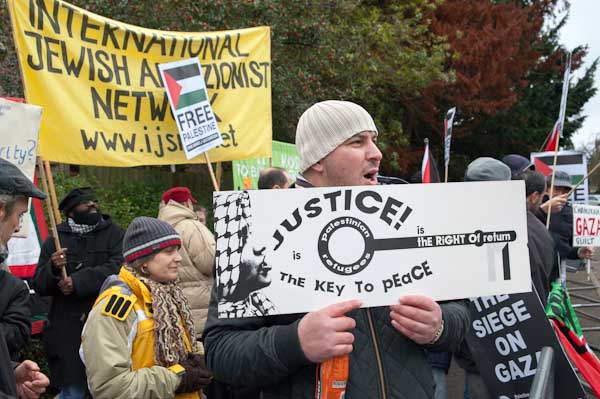
This man attracted me because I saw him as a man holding not a placard but a gun, its barrel the the stem of the key with its text “thE RIGHT Of return”, his right forefinger on the trigger and the orange scarf a part of the stock. I took a series of pictures, but couldn’t quite get the expression I wanted.

The there were images like this, where the placard stands out and tells a story:

© 2009 Peter Marshall

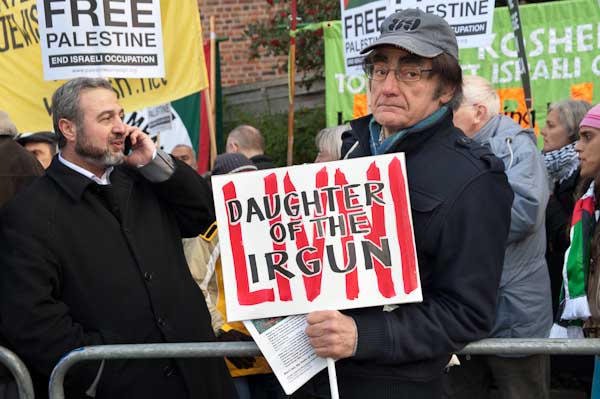
and of course I wrote about the story for Demotix and also on My London Diary.  Normally I might have framed more tightly, perhaps as a vertical eliminating the man on the phone at the left, although I liked having the ‘Free Palestine’ placard above his head. But there were other reasons to frame it like this (or rather to use the frame like this), partly that I wanted to use a closer image of this demonstrator with the other side of his placard (which there is also a story about that in the piece on My London Diary/Demotix.)

Altogether I spent over an hour taking pictures, and used around a dozen of them with the story on Demotix.  As usual you can see a looser edit  – around 20 pictures from the roughly 200 exposures I made – on My London Diary, along with a similar but slightly updated version of the story.

Little Brown Mushroom

Little Brown Mushroom Books were the publishers of Alec Soth‘s “The Last Days of W”, a self-published 48 page newsprint publication that came out at the time of the 2008 Paris Photo. Although I very much liked the pictures on the wall there, I couldn’t bring myself to pay even the lowish price asked for this because it just didn’t seem to me to do justice to his work – and it was better to leave it to my memory and what I felt were rather better reproductions on the web.  The 10,000 copies soon sold out, and many have written in praise of the publication. Probably one day it will become a high priced collector’s item, although doubtless by then fading and falling to pieces.

Alec Soth used to have one of the more interesting blogs written by a working photographer – in my blogroll still, and most of us wondered how he ever found the time to do it. By October 1, 2007 he had obviously got to wondering too, and made his last post, though his archived blog is still on line and still makes some good reading.

But the good news – which I read in a new post there – is that he is now a contributor to a new Little Brown Mushroom blog, like the book company based at his studio address in St Paul, Minnesota, USA, where he is one of a team of six on the blog.  (Check out Carrie Elizabeth Thompson‘s rather minimal web site too.) Little Brown Mushroom Books has also just published  Lost Boy Mountain its first zine by another of the team, Lester B. Morrison – his first publication. You can of course find out more about it there, although again I don’t think I’ll be buying.

As the first post on the blog on Dec 12 said, “This is a place to talk about good books (our own and others)” and Soth has given his own response to The Future of the Photobook – currently under discussion elsewhere – in the blog.  But following  the death last week of Larry Sultan,  Soth has contributed a generous and thoughtful post, Larry Sultan, Pictures From Home.

Bells Not Bombs

I made life a little harder for myself on Thursday by forgetting to check my camera settings before taking pictures. No excuse, I just forgot.

Normally I have a roughly 35 minute train journey to London and often either a bus or an underground ride to the location when I’m photographing demonstrations, although quite are few that take place in Central London are in easy walking distance from the mainline station I arrive at.

When I get on the train I usually sit down and take out my camera and check everything is ok. If I’m not taking the train I do this at home before setting out.  All the basic stuff like spare batteries for camera and flash, spare CF cards, cleaning cloth, lens cleaning kit live in my bag along with my camera and my normal set of lenses, so when as usual I find I’m in a rush and have to pick up my bag and run for the train I can be fairly sure I’ll have what I need.

On the train I usually check the lens surfaces and clean if necessary,  get the camera to clean the sensor, format the CF card in the camera and restore the camera settings to my defaults. The Nikon lets you store sets of custom settings – and I almost always use the same set.

Then I’ll think about where I’m going and what I’ll be taking (so far as I know),  the weather and anything else and decide what would be suitable initial settings for the job. I decide on the appropriate ISO and whether or not to use auto-ISO and if so, on the highest setting, and make  appropriate settings for the aperture and shutter speed for aperture priority,m shutter priority and manual modes so that should I switch to them from P (either accidentally or on purpose) I don’t have too much fiddling to do or get exposure horribly wrong.  I make sure I haven’t left the metering on spot – which I use at times, but if you use it when you think you are in centr-weighted mode can be embarrasing.  And a few other little things like that, so that when I arrive somewhere if things are already happening I can just pick up the camera and start taking pictures.

Because I know if things are happening, that’s what I will do, and if the camera isn’t set up sensibly it may well be some time before I notice. I’m not very good at noticing the information in the viewfinder, rather single-minded about looking at the picture and solving the visual problems. I do occasionally glance at the image on the back of the camera, but ‘chimping’ disturbs the flow, and in any case quite a few problems don’t show up obviously there.

I’ve also got the problem that I can’t actually see the display on the camera back at all clearly (or the top plate display) when I’m working. I need glasses to read, but have never used to wearing them when using a camera. My Nikons have just enough eyesight correction available so I can see the viewfinder image clearly (though its rather blurred for most other people if I ask them to take a picture with it.) One day I’ll have to have an expensive talk with my optician and start working with glasses on, but I don’t look forward to it.

On Thursday I was distracted and forgot my usual routine, missing one very important point when I took out the camera. I’d left the ISO at 3200 from when I’d been taking pictures in a very dimly lit pub a couple of days earlier.

Of course I should have noticed the ISO and rather unusual settings for me such as 1/500 fll displayed very clearly below the image in the viewfinder,  but I actually managed to shoot several hundred images without doing so!

Fortunately, the D700 does a pretty marvellous job at ISO3200 (if it didn’t I would have noticed earlier as I do occasionally zoom right into images on the screen and put my glasses on to check, particularly that eyes are sharp in portraits.)  So back in Lightroom, with just a touch more noise reduction and sharpening than normal I had more or less perfect results.

3200 is just a little extreme, and viewed at actual size on screen I could see just a little more noise and a little less detail than normal, but an actual size image would be 31 inches (79cm) wide if my screen was that wide.

© 2009 Peter Marshall

But looking on the positive side, I think this image wouldn’t have worked so well at the ISO 400 I would probably have been working at had I got my act together.

And perhaps the extra depth of field does help in a picture like this:

© 2009 Peter Marshall

so perhaps I ought to work at ISO 3200 more often. Although it might make sense to edit the EXIF data before trying to smuggle it past Alamy quality control.

The event was a demonstration by Trident Ploughshares at the UK HQ of the leading company involved in making nuclear bombs in Britain, at the AWE at Aldermaston. Of course Lockheed Martin is a US company, and there are allegations that it is also producing warheads for US use at their Aldermaston bomb factory, probably in breach of international war.

Given the Cold War ended 20 years ago and we are supposed to support an international treaty aimed at stopping the proliferation of nuclear weapons, we might ask why we are paying a US company billions of pounds to make more. Any government that is serious about making savings and repaying our huge national debt should be ditching our nuclear programme rather than expanding it.More pictures and more about it on My London Diary.

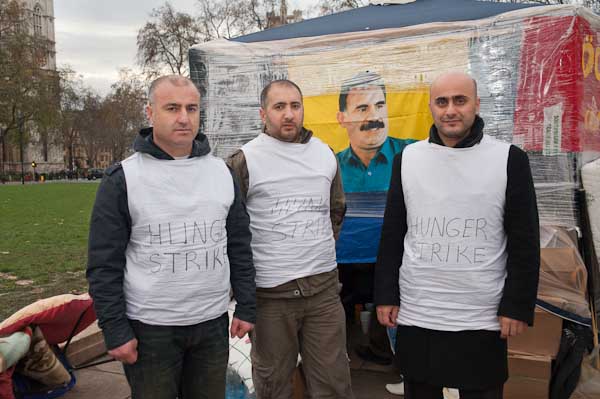
Kurds on Hunger Strike

© 2009 Peter Marshall

Really there was just one obvious picture to take, so I took it.  The hunger strike is over the treatment of their imprisoned national leader Abdullah Ocalan, now confined in a small, poorly ventilated ‘death-pit’, and here he is in the middle of three men on hunger strike, just slightly larger than life.

Of course I did take a few more – though not many – but I don’t think they add a lot to the story, which you can read on My London Diary.

The March And The Wave

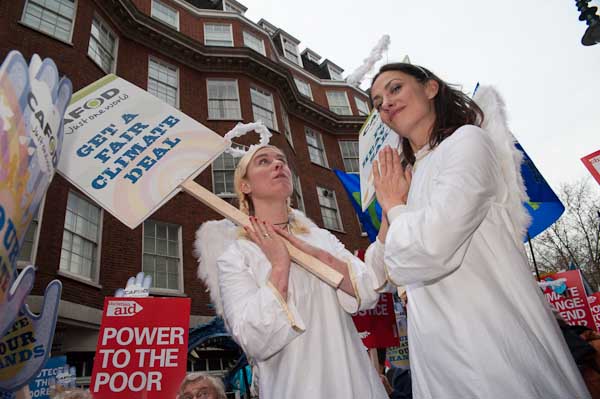
Saturday’s main event was organised by the Stop Climate Chaos Coalition, made up of over a hundred organisations whose only common feature is their concern over climate change and which have a combined membership of around 11 million – about 1 in 6 of the UK population.

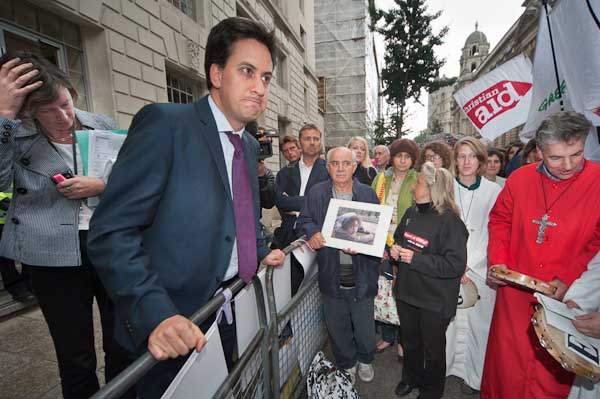
I first came across them a few months back when they organised a demonstration outside the Department of Energy and Climate Change and minister Ed Miliband came out in person to speak to them.

© 2009 Peter Marshall.
A real Minister (with a worried aide) and a false cardinal
with other demonstrators outside the DECC in September.

Although they didn’t succeed in getting all 11 million to come to ‘The Wave’ there were roughly 50,000 marching though London (so many that some were still at Trafalgar Square or in Whitehall at 3pm and missed the actual wave when Parliament was surrounded) making this the largest demonstration on climate change in the UK to date.

© 2009 Peter Marshall

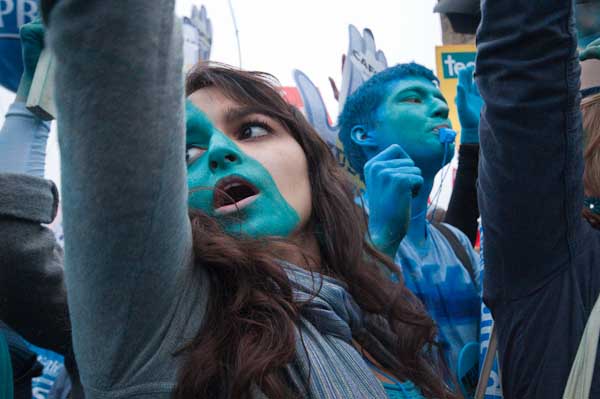
If the main event lacked the political bite of the Campaign Against Climate Change (who were taking part as one member of the coalition) there was certainly plenty of enthusiasm, fancy dress and blue face paint to make for some visually striking images.  The ‘Wave’ itself was perhaps something of an anti-climax, and the crush of photographers close to Big Ben at the head of the demonstration made photography difficult.

© 2009 Peter Marshall

Especially those photographers who hold their large DSLRs out at arms length in front of other photographers.  Photographic etiquette generally stops other still photographers from actually walking in front of you as you are taking pictures (nothing stops some guys taking video), but somehow a growing number seem to think its OK if you just hold your camera in front of others.

More pictures from the march and the final wave on My London Diary.

Police Dig Deeper Hole?

Police seem determined to spurn the usual sage advice about stopping digging in their relationship with photographers.  Read today’s news piece by Chris Cheesman on the Amateur Photographer, Police crackdown on City photographers, which recounts how Graham White was stopped by a security guared while photogarphing a building in Silk St. A police spokeswoman is reported as having said that the police advise photographers to inform a security official of their intentions, prior to taking pictures.

Yesterday AP reported yet another case of photographer harassment, in which a man taking pictures in Hounslow High Street was arrested, handcuffed and taken to Hounslow Police Station where he was held for three hours for a for a ‘Section 5’ Public Order Offence before being issued with an £80 fine and released. He intends to take the case to court rather than pay the fine.

Also today, in The Register, John Ozimek titles his piecePolice snapper silliness reaches new heights: City of London employ new ironic policing tactics‘ and recounts how London Tonight reporter Marcus Powell with an ITN crew filming a story about an earlier incident in which seven police officers in three cars and a riot van were called to deal with architectural photographer Grant Smith who was photographing one of the city’s Wren churches were questioned by police.

These incidents appear to be getting more common, despite various campaigns and demonstrations by photographers, a Home Office Circular, statements by the Home Secretary and ACPO, a debate in the House of Commons, comments in the Lords, features and leading articles in newspapers… But it seems that there is nothing and nobody that can bring the police under control.

You can of course read some more about the situation on the ‘I’m a photographer not a Terrorist‘ web site, which also gives details of a Mass Photo Gathering in defence of street photography to take place in Trafalgar Square at 12 noon on Saturday 23rd January 2010.  Something to put in your new Diary. See you there!

In the meantime, I suggest we all take our cameras with us whenever we go into town (any town)  and take pictures, even if we are only going shopping or to the pub and intend to delete the pictures (unless the police tell us to.)  That way we might wear the bastards down.

If you’ve got a camera, use it. Otherwise soon you won’t be able to.

Trust Me, I’m a Banker

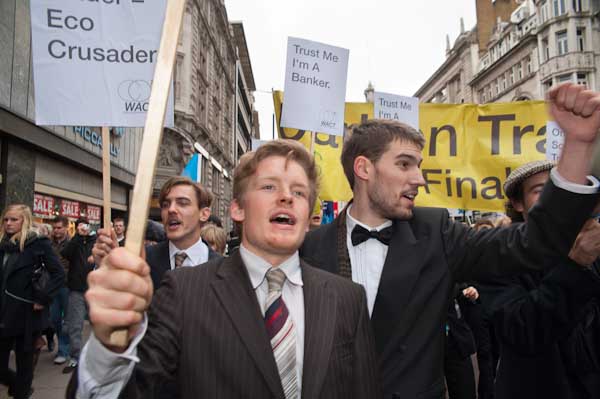
You may well not have heard of WACT, the ‘World Association of Carbon Traders‘ and some of the slogans on the placards they carried in Saturday’s Climate march may have surprised a few, though it would have been hard to miss the irony in ‘Trust Me, I’m a Banker‘ or others such as ‘Greed is Green‘. They also stood out from the others taking part in not following the recommended dress code of blue and preferring pin-stripe suits and ties.

© 2009 Peter Marshall.
‘Carbon Trader = Eco Crusader’ and WACT’s logo is CO2$

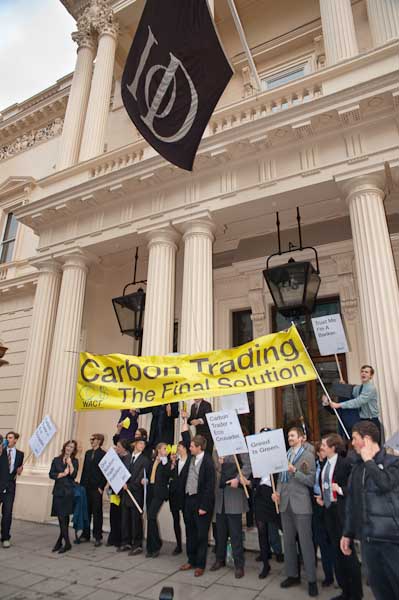
I don’t believe that photographers should pose people or tell them what to do when taking photographs – though I might occasionally ask someone to turn their placard so I can read the message, in general I’m at pains not to intervene in the situation I’m photographing. But as I photographed this group of ‘city gents’ (and ladies) coming down the road I couldn’t resist pointing out they were approaching the Institute of Directors, with the hope that they might in some way react. And they did, running across the road to pose for a group photograph in its doorway.

© 2009 Peter Marshall

Of course it is only too obvious at the moment that many people are profiting from climate change and that carbon trading is one way that the rich can make money and keep in charge – markets are always controlled by those with money.

More about the WACT and more pictures on My London Diary.